
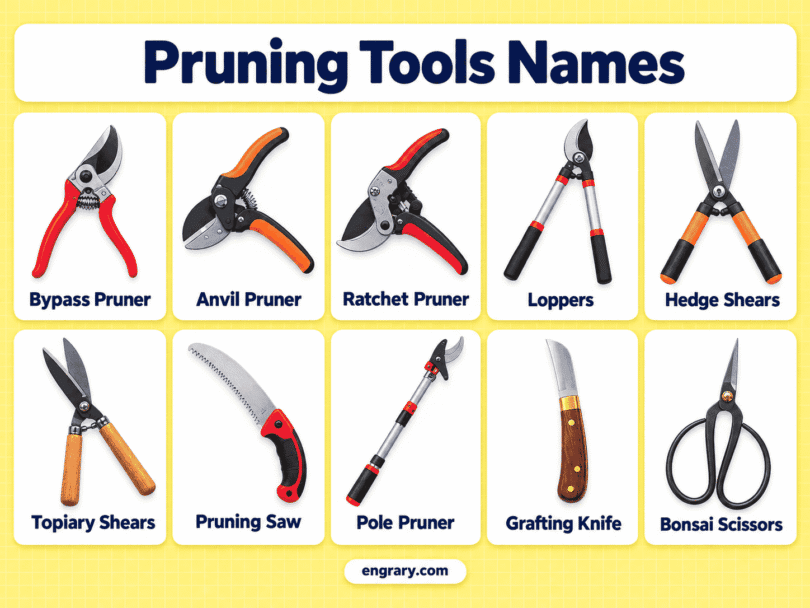
Pruning tools come in different shapes for trimming stems, cutting branches, shaping hedges, and managing woody plant growth. Learning pruning tools names with pictures and uses makes it easier to recognize the difference between pruners, loppers, saws, shears, and long-reach tools.
This guide covers 35 pruning tools names with short descriptions and simple identification clues. The list includes hand pruners, loppers, pruning saws, hedge tools, precision cutters, and long-reach pruning equipment.
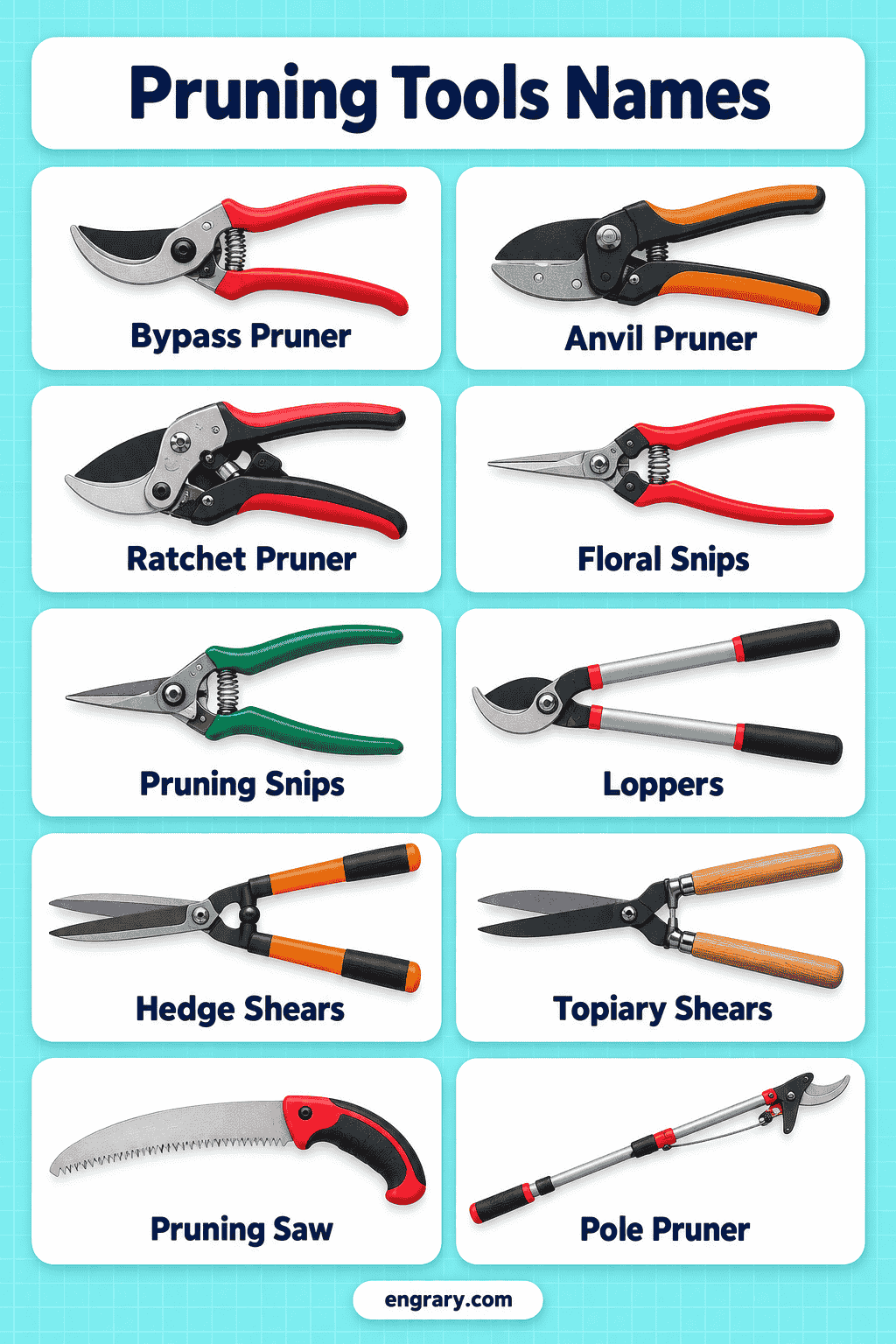
Pruning Tools Used for Different Types of Plant Cutting
Different pruning jobs require different blade shapes, handle lengths, and cutting mechanisms. Some tools suit fine stems and flowers, while others handle thicker branches, hedges, or woody growth.
1. Pruning Shears
Pruning shears are compact handheld cutters with two handles and a small cutting head. They are also commonly called hand pruners or secateurs.
2. Bypass Pruner
A bypass pruner has two curved blades that pass each other in a scissor-like motion. Its overlapping blades make it easy to recognize.
3. Anvil Pruner
An anvil pruner has one cutting blade that closes against a flat supporting surface called an anvil.
4. Ratchet Pruner
A ratchet pruner has a mechanism that closes the cutting blade in stages. It usually looks similar to ordinary hand pruners but includes a ratcheting joint.
5. Needle-Nose Pruner
A needle-nose pruner has long, narrow cutting blades that reach into confined plant growth.
6. Pruning Snips
Pruning snips are small precision cutters with short, narrow blades. They suit delicate stems and detailed trimming.
7. Flower Snips
Flower snips have fine blades designed for cutting blooms, flower stems, and other soft plant growth.
8. Garden Snips
Garden snips are lightweight cutters used for detailed trimming and small plant material.
9. Bypass Lopper
A bypass lopper has two curved cutting blades combined with long handles. The blades pass each other in the same way as bypass pruners.
10. Anvil Lopper
An anvil lopper uses one cutting blade that closes against a flat base. Its long handles distinguish it from an anvil hand pruner.
11. Ratchet Lopper
A ratchet lopper combines long handles with a staged cutting mechanism that closes progressively.
12. Geared Lopper
A geared lopper has visible gears near the cutting head that increase mechanical leverage.
13. Telescopic Lopper
A telescopic lopper has extendable handles that increase reach while retaining a lopper-style cutting head.
14. Compound-Action Lopper
A compound-action lopper uses multiple pivot points or linked parts around the cutting head to increase leverage.
15. Pruning Saw
A pruning saw has a toothed blade designed specifically for woody plant material and branches.
16. Folding Pruning Saw
A folding pruning saw has a toothed blade that folds into its handle for compact storage.
17. Curved Pruning Saw
A curved pruning saw has a noticeably arched blade that follows the shape of larger branches.
18. Straight Pruning Saw
A straight pruning saw uses a relatively straight toothed blade rather than a curved one.
19. Fixed Pruning Saw
A fixed pruning saw has a rigid blade that remains permanently extended from its handle.
20. Bow Saw
A bow saw has a thin blade stretched across a large curved metal frame, giving it a distinctive bow-like appearance.
21. Hedge Shears
Hedge shears have two long blades attached to two handles. They are designed mainly for trimming and shaping hedge growth.
22. Topiary Shears
Topiary shears are compact shaping tools designed for detailed trimming of ornamental plants and topiary forms.
23. Shrub Shears
Shrub shears have long paired blades suited to trimming broad areas of soft shrub growth.
24. Pole Pruner
A pole pruner places a pruning head at the end of a long shaft, allowing the cutting head to reach higher plant growth.
25. Pole Saw
A pole saw has a saw blade attached to a long pole. Its cutting head clearly differs from the scissor-like mechanism of a pole pruner.

Types of Hand Pruners and Secateurs
Hand pruners are designed for close, controlled plant cutting. Their biggest differences come from the way the blades meet and the shape of the cutting head.
26. Rotating-Handle Pruner
A rotating-handle pruner has a movable lower handle that turns slightly as the tool closes. Its handle design distinguishes it from standard pruners.
27. Left-Handed Pruner
A left-handed pruner uses a blade and handle arrangement designed for comfortable use in the left hand.
Types of Loppers for Thicker Branches
Loppers are easy to recognize because they combine a pruning-style cutting head with much longer handles. Different mechanisms change how the cutting head operates.
28. Fixed-Handle Lopper
A fixed-handle lopper has rigid handles that do not extend. Its simple construction makes it visually different from telescopic models.
29. Lever-Action Lopper
A lever-action lopper uses an additional linkage near the cutting head to increase mechanical advantage.
Pruning Saws for Woody Growth
Pruning saws vary by blade shape and whether the blade folds, stays fixed, or attaches to a longer shaft. Their toothed blades make them easy to distinguish from shears and loppers.
30. Folding Curved Pruning Saw
A folding curved pruning saw combines a curved toothed blade with a folding handle design.
31. Fine-Tooth Pruning Saw
A fine-tooth pruning saw has smaller, more closely spaced teeth than many standard pruning saws.
Tools for Hedge Trimming and Plant Shaping
Hedge and shaping tools are designed to trim broader areas of soft plant growth rather than individual woody branches.
32. Long-Blade Garden Shears
Long-blade garden shears have extended paired blades that allow broader trimming across hedge and shrub surfaces.
33. Precision Topiary Scissors
Precision topiary scissors have shorter fine blades designed for detailed shaping around small ornamental plants.
Long-Reach Pruning Tools
Long-reach tools place the cutting head farther from the handles so gardeners can identify and manage higher plant growth without using ordinary short-handled pruners.
34. Telescopic Pole Pruner
A telescopic pole pruner has an extendable shaft with a pruning head mounted at the upper end.
35. Long-Reach Pruner
A long-reach pruner has an extended shaft and compact cutting head designed for branches positioned beyond normal hand reach.
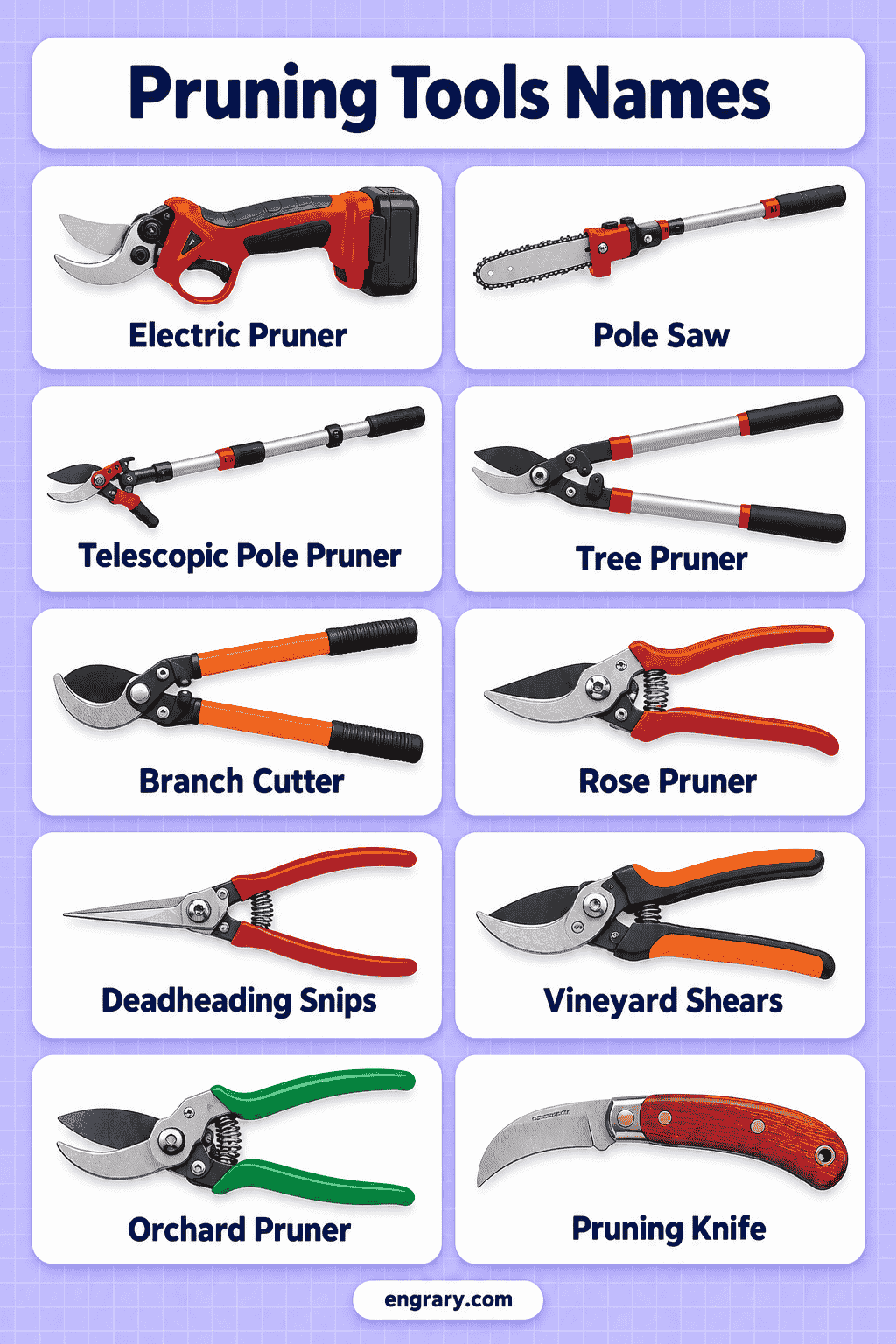
Precision Tools for Fine Pruning Work
Fine pruning focuses on smaller stems, flowers, and detailed shaping. Tools in this group usually have narrow blades and compact cutting heads.
Pruning snips, flower snips, garden snips, needle-nose pruners, topiary scissors, and similar precision cutters are easier to control around delicate growth than large loppers or pruning saws.
Pruning Tools That Are Easy to Confuse
Several pruning tools look similar because they perform related cutting tasks. Blade design, handle length, and cutting mechanism provide the easiest clues for distinguishing them.
| Tools | Main Difference |
|---|---|
| Bypass Pruner vs Anvil Pruner | A bypass pruner has two blades that pass each other, while an anvil pruner uses one blade that closes against a flat base. |
| Pruning Shears vs Loppers | Pruning shears are compact handheld cutters, while loppers have much longer handles and larger cutting heads. |
| Pruning Shears vs Garden Scissors | Pruning shears have a stronger pruning head, while garden scissors use slimmer scissor-like blades for lighter trimming. |
| Bypass Lopper vs Anvil Lopper | A bypass lopper uses two passing blades, while an anvil lopper uses one blade and a flat supporting surface. |
| Loppers vs Pruning Saw | Loppers cut with paired jaws or blades, while a pruning saw uses a toothed blade. |
| Folding Pruning Saw vs Fixed Pruning Saw | A folding saw closes into its handle, while a fixed saw keeps its blade permanently extended. |
| Pruning Saw vs Bow Saw | A pruning saw normally has one narrow toothed blade, while a bow saw stretches a blade across a curved frame. |
| Pole Pruner vs Pole Saw | A pole pruner uses a pruning head, while a pole saw uses a toothed saw blade. |
| Hedge Shears vs Pruning Shears | Hedge shears have long blades for shaping broader growth, while pruning shears make individual stem cuts. |
| Pruning Snips vs Pruning Shears | Pruning snips have smaller, finer blades for delicate work, while pruning shears have a stronger cutting head. |
Alternate Names for Pruning Tools
Pruning terminology varies by region and manufacturer. Therefore, learning alternate names can make tool identification easier.
| Main Name | Alternate Name |
|---|---|
| Pruning Shears | Hand Pruners, Secateurs |
| Pruning Snips | Garden Snips, Pruning Scissors |
| Hedge Shears | Hedge Clippers |
| Pole Pruner | Long-Reach Pruner in some contexts |
| Pruning Saw | Hand Pruning Saw |
| Bypass Pruner | Bypass Secateurs |
| Anvil Pruner | Anvil Secateurs |
| Loppers | Lopping Shears |
Alternate terms should not be counted as separate tools when they refer to the same or closely related design.
Frequently Asked Questions
Common pruning tools include pruning shears, bypass pruners, anvil pruners, loppers, pruning saws, hedge shears, pruning snips, pole pruners, and pole saws.
A bypass pruner uses two blades that pass each other, while an anvil pruner uses one blade that closes against a flat supporting surface.
Pruning shears are compact handheld tools for smaller plant growth. Loppers use much longer handles and larger cutting heads.
A pruning saw belongs to a different cutting family and uses a toothed blade for woody growth that does not suit ordinary scissor-style pruning tools.
A pole pruner has a pruning-style cutting head attached to a long shaft, while a pole saw has a toothed saw blade mounted on a pole.
You May Also Like



Leave a Comment