

A metalworking shop can contain slim marking tools, heavy vises, cutting tools, grinders, forming equipment, and large machines. At first, many of these items may look unfamiliar. However, their shape, working position, and basic purpose usually provide strong clues to their names.
Learning metalworking tools names by function makes them easier to recognize and remember. Therefore, this guide groups common tools into measuring, holding, shaping, cutting, drilling, threading, finishing, forming, and machining categories. Each entry also includes a simple identification detail and basic use without turning the article into a technical operating manual.
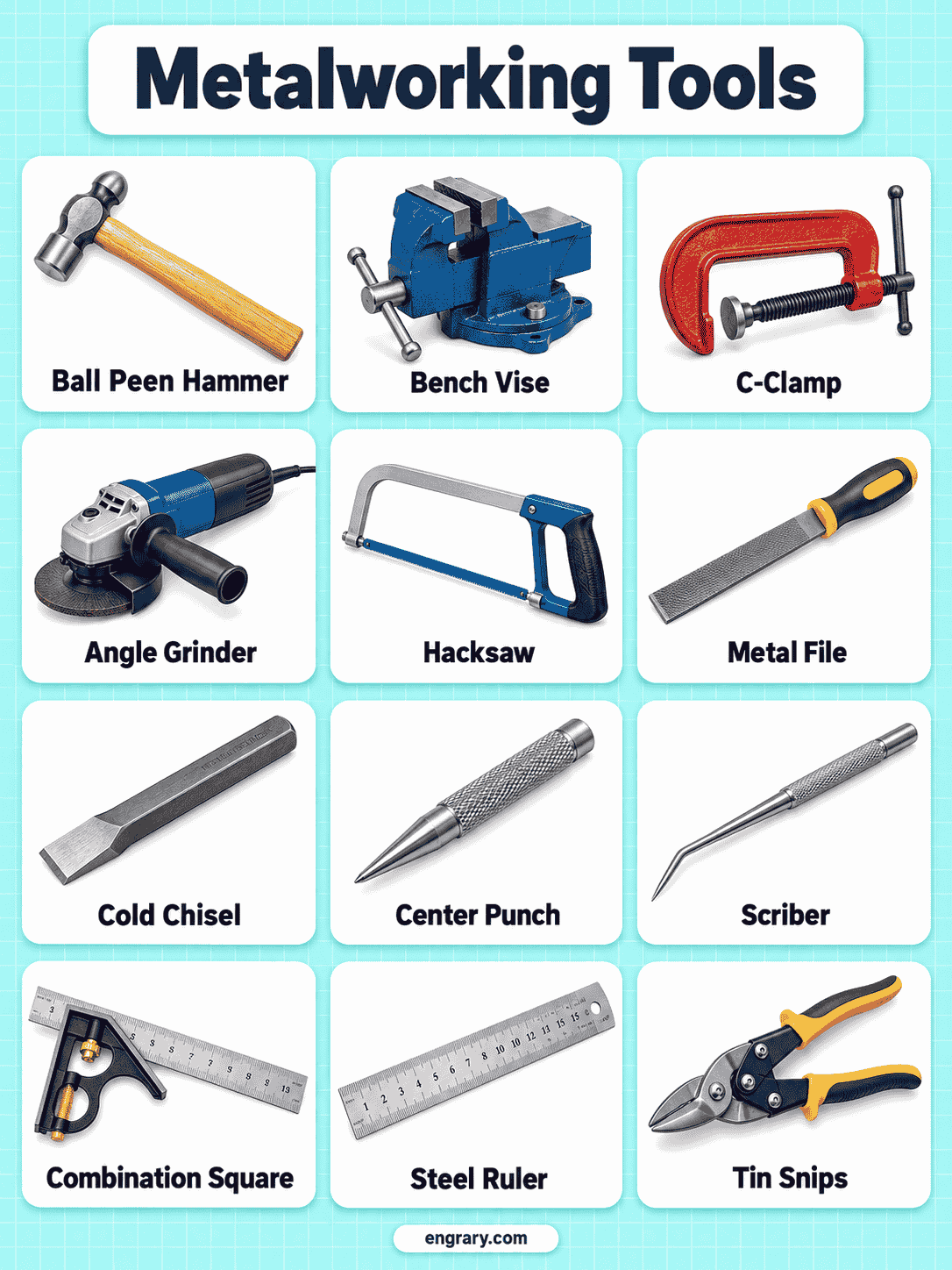
Common Metalworking Measuring and Marking Tools Names
Metalworkers use measuring and marking tools to establish accurate dimensions, angles, reference points, and layout lines before cutting, drilling, shaping, or joining metal. The following 20 tools cover the most common measuring and marking tasks.
Steel Rule
A steel rule provides short, straight measurements and a rigid edge for basic layout work.
Combination Square
A combination square checks right angles, measures short distances, and marks straight reference lines.
Vernier Caliper
A vernier caliper measures external, internal, and depth dimensions with greater precision than a ruler.
Digital Caliper
A digital caliper uses sliding jaws and an electronic display to show precise measurements quickly.
Micrometer
A micrometer measures small thicknesses or diameters with very fine accuracy.
Feeler Gauge
A feeler gauge uses thin metal blades of known thickness to check narrow gaps and clearances.
Scriber
A scriber scratches fine reference lines directly onto metal surfaces.
Center Punch
A center punch creates a small indentation that marks the center of a planned drilling point.
Prick Punch
A prick punch makes lighter, finer layout marks than a standard center punch.
Dividers
Dividers transfer measurements and mark circles, arcs, or equal spacing on metal.
Surface Gauge
A surface gauge marks lines at a consistent height from a flat reference surface.
Engineer’s Square
An engineer’s square checks and marks accurate 90-degree angles on metal workpieces.
Try Square
A try square helps check straight edges and mark right-angle lines during layout work.
Protractor
A protractor measures and marks angles in degrees.
Bevel Gauge
A bevel gauge transfers or compares angles between surfaces without directly measuring them in degrees.
Height Gauge
A height gauge measures vertical dimensions and can also mark precise lines from a surface plate.
Depth Gauge
A depth gauge measures the depth of holes, slots, recesses, and other openings.
Radius Gauge
A radius gauge checks the curved radius of inside or outside edges.
Thread Pitch Gauge
A thread pitch gauge identifies the spacing and pitch of screw threads.
Marking Blue
Marking blue creates a colored surface that makes scratched layout lines easier to see on metal.
Metalworking Holding and Clamping Tools Names
Metalworkers often need to keep a workpiece stable while measuring, fitting, filing, drilling, or machining it. Consequently, vises and clamps form an important tool family. Their jaws, frames, bars, and adjustment screws usually reveal how they hold the work.
Bench Vise
A bench vise mounts to a workbench and uses two opposing jaws to grip a workpiece. Usually, one jaw remains fixed while the other moves through a screw mechanism. Its heavy base makes it one of the most recognizable holding tools.
Machine Vise
A machine vise holds work on machine tools such as milling or drilling equipment. Compared with a general bench vise, it often has a flatter, more compact base designed for mounting to a machine table.
C-Clamp
A C-clamp has a rigid C-shaped frame and an adjustable screw. Consequently, its outline immediately explains its name.
F-Clamp
An F-clamp uses a long straight bar with one fixed jaw and one sliding jaw. Although it performs a similar holding role to a C-clamp, its longer reach gives it a very different appearance.
Locking Pliers
Locking pliers use adjustable jaws that lock around a suitable workpiece. In addition, many designs have an adjustment screw at the end of one handle.
Toolmaker’s Clamp
A toolmaker’s clamp is a compact precision clamp with parallel jaws and threaded screws. Unlike large C-clamps, it has a small rectangular form suited to lighter work.
Angle Clamp
An angle clamp holds pieces at a defined angle, often around a right-angle arrangement. Therefore, its jaw position makes it easy to distinguish from straight clamps.
Metalworking Hammers and Shaping Tools Names
Metalworking hammers and shaping tools move, support, straighten, or form metal. However, their head shapes differ because each tool suits a different kind of striking or forming work.
Ball-Peen Hammer
A ball-peen hammer has a flat striking face on one side and a rounded peen on the other. The spherical end makes it easy to distinguish from an ordinary claw hammer.
Cross-Peen Hammer
A cross-peen hammer has a flat face and a narrow wedge-shaped peen positioned across the handle. Therefore, the wedge orientation provides its clearest identification clue.
Straight-Peen Hammer
A straight-peen hammer also has a wedge-shaped peen, but it runs parallel to the handle. By contrast, the cross-peen version runs across it.
Soft-Faced Mallet
A soft-faced mallet has striking faces made from softer material than a steel hammer. As a result, its head often looks larger and less metallic than conventional metalworking hammers.
Planishing Hammer
A planishing hammer has smooth faces intended for controlled finishing and shaping of sheet metal. Its polished faces help distinguish it from heavier general-purpose hammers.
Anvil
An anvil is a heavy metal support with a broad flat face and, on traditional designs, a projecting horn. Its substantial body makes it one of the easiest shaping tools to recognize.
Swage Block
A swage block is a heavy block containing shaped holes, grooves, and recesses. These features provide several supporting surfaces for shaping metal.
Sheet Metal Stake
A sheet metal stake is a shaped metal support used during forming work. Different stake heads provide different working surfaces, so the category includes several distinctive forms.
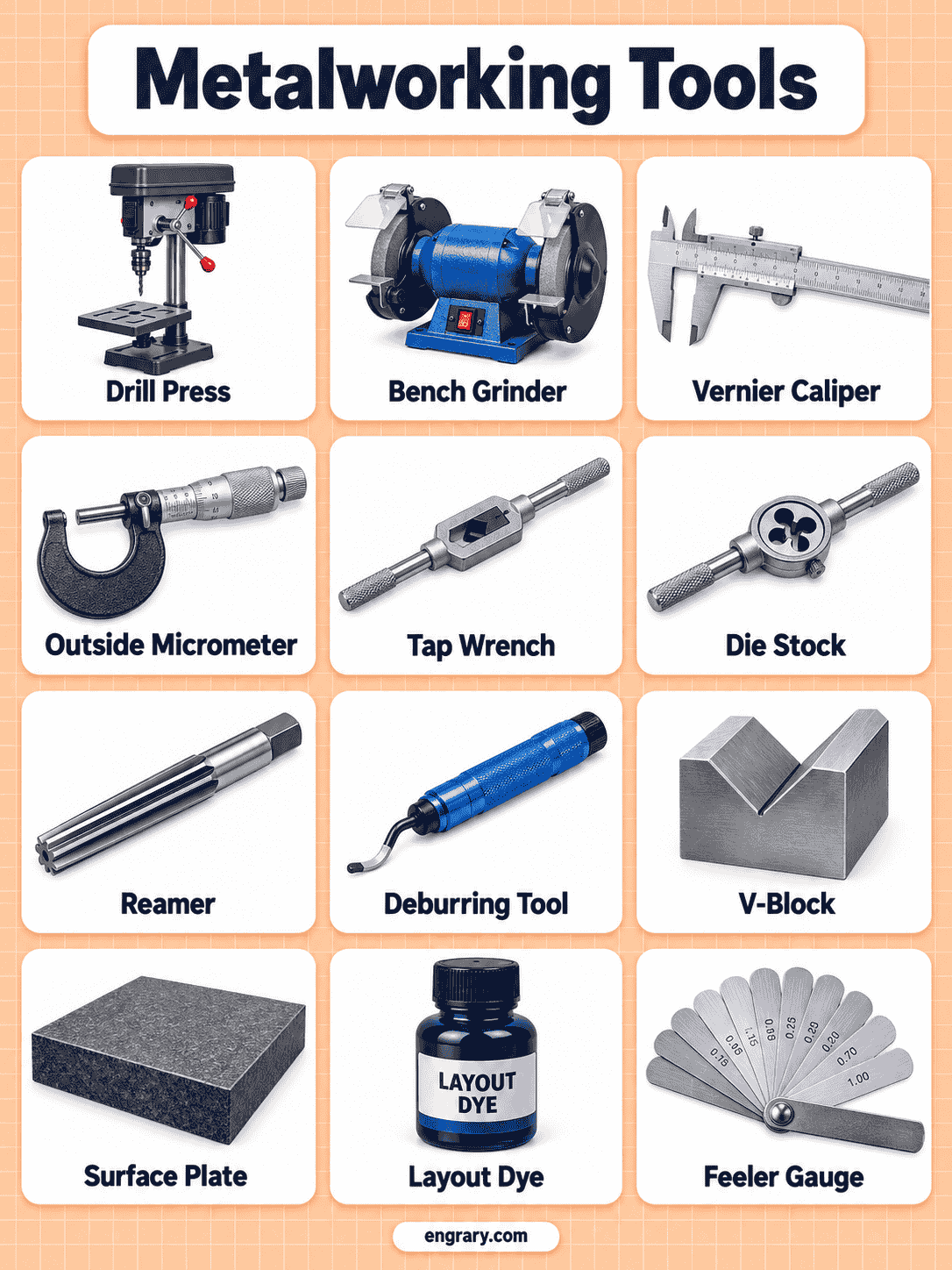
Metal Cutting Tools Names
Metal cutting tools range from simple hand tools to powered saws and shearing equipment. Because each tool removes material differently, the blade shape or cutting mechanism usually gives readers the fastest identification clue.
Hacksaw
A hacksaw has a thin replaceable blade stretched across a rigid frame. Its narrow blade and bow-shaped frame distinguish it from most woodworking saws.
Cold Chisel
A cold chisel is a solid metal hand tool with a beveled cutting edge. Unlike a woodworking chisel, it normally has an all-metal body designed for metalwork.
Tin Snips
Tin snips resemble heavy-duty scissors and cut thin sheet metal. Traditional versions usually have long handles and relatively short blades.
Aviation Snips
Aviation snips also cut sheet metal; however, they use a compound-leverage mechanism and typically have shorter jaws with spring-loaded handles. Left-, right-, and straight-cut versions are common.
Hand Nibbler
A hand nibbler removes small sections from sheet metal as its jaws move through the material. It resembles specialized pliers more than traditional scissors.
Metal Shear
A metal shear cuts sheet material by moving blades past one another. Depending on the design, it may be handheld, bench-mounted, or powered.
Metal Bandsaw
A metal bandsaw uses a continuous loop blade running around wheels. Horizontal machines commonly cut bar, tube, or other stock, whereas vertical versions support the work on a table.
Cold Saw
A cold saw uses a circular toothed blade in a rigid machine arrangement. Its visible metal-cutting teeth distinguish it from abrasive cut-off equipment.
Metal Drilling and Hole-Making Tools Names
Creating a hole in metal may involve more than one tool. A drill starts the opening, while another tool may enlarge, finish, or shape it. Therefore, this category includes both powered equipment and smaller hole-finishing tools.
Electric Drill
An electric drill is a handheld power tool with a chuck at the front. Although people use drills across many trades, suitable drill tooling makes them important in metalworking.
Drill Press
A drill press holds a rotating spindle above an adjustable worktable. Unlike a handheld drill, it uses a vertical column and fixed base.
Twist Drill
A twist drill is the familiar spiral-fluted cutting tool fitted into drilling equipment. Its two helical grooves provide the clearest recognition feature.
Step Drill
A step drill has a cone-shaped body formed by several progressively larger cutting steps. Therefore, one tool presents several visible diameter levels.
Hole Saw
A hole saw has a hollow cylindrical body with cutting teeth around its rim. Its cup-like shape separates it from a solid twist drill.
Reamer
A reamer finishes or sizes an existing hole. It may resemble a drill at first; however, it typically has more cutting edges and a different flute shape.
Countersink
A countersink has a conical cutting form that creates a tapered opening at the top of an existing hole. Consequently, its short cone-shaped head makes it easy to recognize.
Metal Threading Tools Names
Threading tools create or repair screw threads. The most useful distinction is whether the tool works inside a hole or around the outside of a round part. Therefore, taps and dies should be learned together.
Tap
A tap forms or repairs internal threads inside a suitable hole. It has a fluted cutting section and often a square drive at the end for a tap wrench.
Tap Wrench
A tap wrench holds and turns a hand tap. Many versions use two handles extending from a central gripping body.
Die
A die forms or repairs external threads around a round workpiece. Round dies commonly look like thick metal discs with a threaded opening in the center.
Die Stock
A die stock holds a threading die. Typically, it has two handles extending from a round central body.
Tap-and-Die Set
A tap-and-die set combines several taps, dies, and holders in one organized kit. Because the pieces usually sit in labeled positions, the entire set is easy to identify.
Thread File
A thread file has cutting teeth shaped to match different thread pitches. Compared with a standard flat file, it often shows several clearly defined toothed sections.
Metal Filing, Grinding, and Finishing Tools Names
Cut edges and machined surfaces often need smoothing, deburring, or finishing. Therefore, files and abrasive tools form another major metalworking group. Their shape, abrasive surface, or tool body helps separate one item from another.
Flat File
A flat file has broad flat faces covered with cutting teeth. It is one of the most familiar hand-finishing tools used around metalwork.
Round File
A round file has a circular cross-section and often tapers toward the end. Consequently, its rod-like form is easy to distinguish from a flat file.
Half-Round File
A half-round file combines one flat face with one curved face. This mixed profile makes the tool useful for both flat and curved surfaces.
Square File
A square file has four flat faces and a square cross-section. Therefore, its shape distinguishes it immediately from round and half-round files.
Angle Grinder
An angle grinder is a portable power tool with a rotating abrasive or cutting accessory mounted at roughly a right angle to the motor body. Its side-mounted disc creates a distinctive profile.
Bench Grinder
A bench grinder remains fixed to a bench or stand while abrasive wheels rotate on either side of its central motor housing. By contrast, an angle grinder moves with the worker.
Die Grinder
A die grinder is a smaller rotary power tool with a narrow body and compact attachments. Compared with an angle grinder, it usually looks slimmer and lighter.
Belt Grinder
A belt grinder uses a continuous abrasive belt moving around rollers. Its exposed belt surface distinguishes it from wheel-based grinders.
Deburring Tool
A deburring tool removes small raised burrs from suitable edges. Hand versions often have slim handles with a small hooked or swiveling blade.
Flap Disc
A flap disc consists of overlapping abrasive flaps arranged around a circular backing. As a result, its layered surface looks clearly different from a solid grinding wheel.
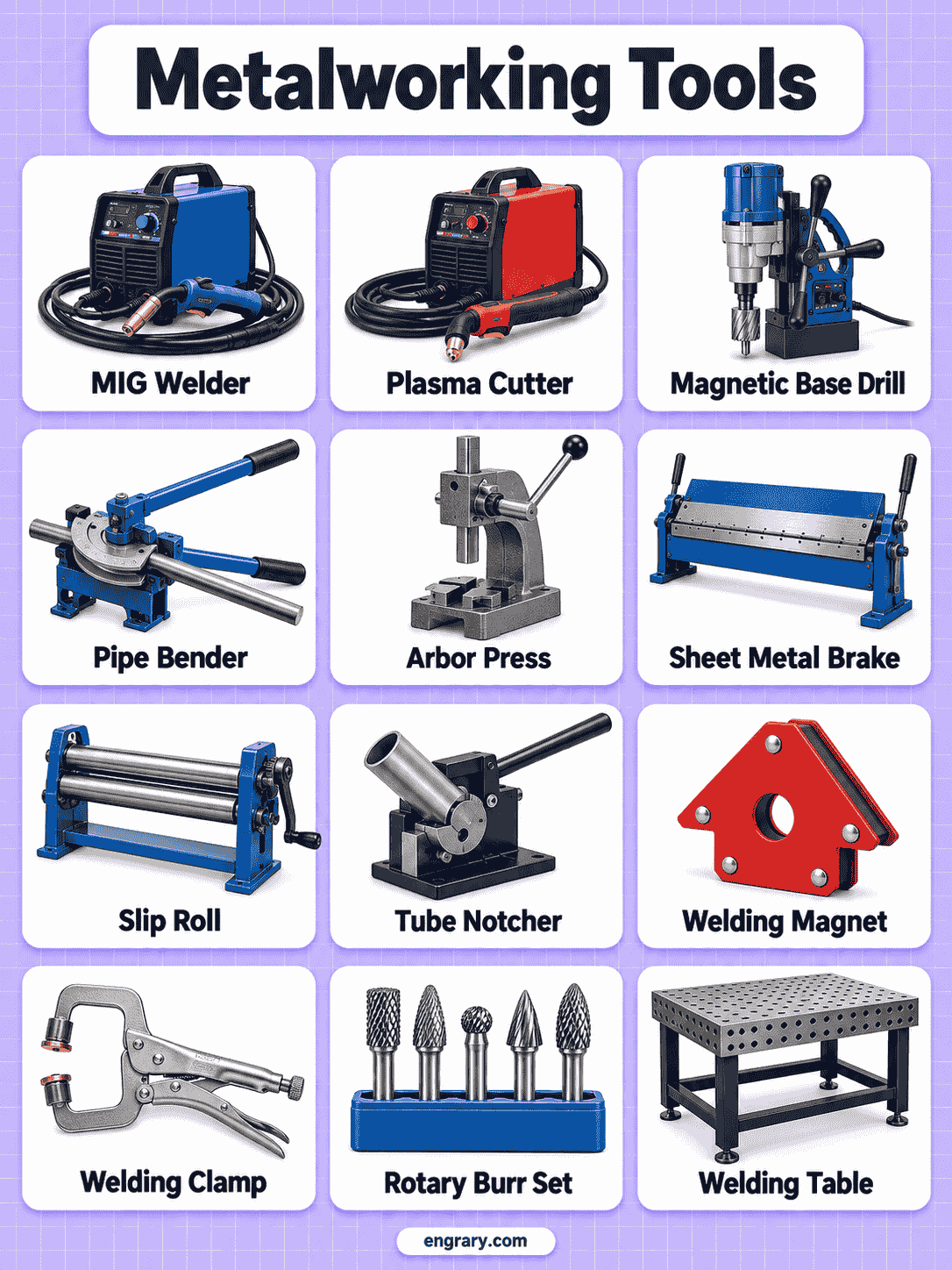
Sheet Metal Bending and Forming Tools Names
Sheet metal often needs controlled bending, curving, stretching, or shaping rather than simple cutting. Consequently, metalworking shops use several machines and hand-supported tools designed specifically for forming flat material.
Sheet Metal Brake
A sheet metal brake bends sheet metal along a straight line. It usually has a long clamping edge and hinged bending leaf, giving the machine a wide horizontal appearance.
Box-and-Pan Brake
A box-and-pan brake resembles a sheet metal brake but uses removable or segmented upper fingers. Therefore, those individual finger sections provide its easiest recognition feature.
Slip Roller
A slip roller uses several long parallel rollers to curve sheet metal. The stacked cylindrical rollers make the machine easy to identify.
Tube Bender
A tube bender shapes tubing around a die or former. Depending on the design, it may be a compact handheld tool or a larger shop machine.
English Wheel
An English wheel has a tall C-shaped frame with two wheels positioned opposite each other. Its large open frame makes it one of the most visually distinctive sheet-metal tools.
Shrinker-Stretcher
A shrinker-stretcher changes the edge shape of sheet metal by shrinking or stretching it. Compact versions usually have a small jaw area and a lever or pedal mechanism.
Metalworking Machine Tools Names
Machine tools perform controlled cutting or shaping while supporting the workpiece, cutting tool, or both. Unlike handheld equipment, these machines use rigid frames, dedicated workholding areas, and controlled movement.
Metal Lathe
A metal lathe rotates a workpiece while a cutting tool moves relative to it. Traditional machines have a long bed with a headstock at one end and a carriage that travels along the work.
Milling Machine
A milling machine uses a rotating cutting tool while the workpiece sits on a movable table. Vertical mills commonly have a spindle positioned above the worktable.
Surface Grinder
A surface grinder uses a grinding wheel with a precision table beneath it. Its rigid frame and flat moving work area distinguish it from a portable or bench grinder.
Metal Shaper
A metal shaper uses a reciprocating cutting motion above a work-supporting table. Its ram-and-table arrangement gives the machine a distinctive profile.
Power Press
A power press applies controlled force through a moving ram or slide. Although presses vary greatly in size, most have a strong frame with a defined working area between the ram and bed.
Horizontal Bandsaw
A horizontal bandsaw supports long stock while its saw head moves through the material. Compared with a vertical bandsaw, the cutting frame sits in a more horizontal orientation.
Common Metalworking Tool Names That Are Easy to Confuse
Several metalworking tools belong to similar tasks, so beginners may confuse their names. A concise comparison shows the main distinction without creating several repetitive sections.
| Tools | Main Difference |
|---|---|
| Caliper vs Micrometer | A caliper handles several types of dimensional measurements, whereas a micrometer usually focuses on a narrower range with finer measurement resolution. |
| Tap vs Die | A tap forms or repairs internal threads, while a die works on external threads. |
| Tin Snips vs Aviation Snips | Tin snips use a simpler shear-like design, whereas aviation snips use compound leverage and commonly come in directional versions. |
| Angle Grinder vs Bench Grinder | An angle grinder is portable, while a bench grinder stays fixed as the workpiece moves toward the wheel. |
| Lathe vs Milling Machine | A lathe primarily rotates the workpiece, whereas a milling machine primarily rotates the cutting tool. |
FAQs
Common examples include steel rules, calipers, micrometers, scribers, center punches, bench vises, clamps, ball-peen hammers, hacksaws, files, drills, taps, dies, grinders, sheet-metal brakes, lathes, and milling machines.
Common metal-cutting tools include hacksaws, cold chisels, tin snips, aviation snips, nibblers, shears, bandsaws, and cold saws. However, the best category depends on the type and shape of material being identified.
Steel rules, combination squares, calipers, micrometers, and feeler gauges measure or check dimensions. By contrast, scribers, punches, dividers, and surface gauges help create or transfer layout references.
Metalworkers use hammers, mallets, anvils, stakes, swage blocks, sheet-metal brakes, rollers, tube benders, English wheels, and other forming equipment depending on the work.
Common machine-tool names include metal lathes, milling machines, drill presses, surface grinders, metal shapers, presses, and bandsaws. Each machine performs a different type of controlled metalworking operation.
You May Also Like



Leave a Comment