
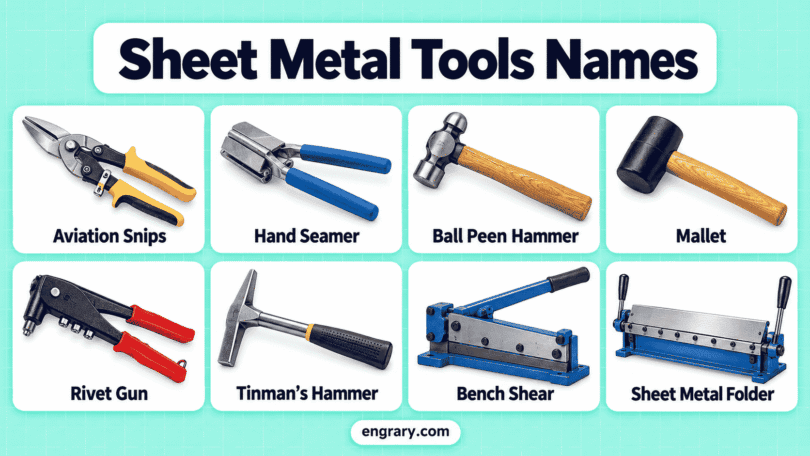
Sheet metal work uses a distinctive mix of measuring tools, snips, shears, seamers, hammers, stakes, punches, and forming machines. Some tools make straight cuts, while others create folds, curves, seams, holes, or reinforced shapes. Their jaws, working faces, rollers, handles, and frames often provide the easiest clues to their names.
Learning sheet metal tools names by purpose makes unfamiliar equipment easier to recognize. Therefore, this guide covers common tools used for measuring, marking, cutting, bending, seaming, forming, supporting, punching, riveting, holding, and finishing sheet metal, with simple visual clues and basic uses.

Common Sheet Metal Tools Used in Fabrication
Sheet metal fabricators regularly move between layout, cutting, bending, forming, and joining tasks. The following familiar names provide a quick introduction before the later sections explain the tool families in more detail.
Steel Rule
Measures short distances and provides a straight edge for basic sheet layout.
Tinman’s Square
Checks right angles and helps mark straight perpendicular lines on sheet metal.
Scriber
Scratches fine layout lines onto the metal surface before cutting or forming.
Dividers
Transfer measurements and mark circles or arcs on sheet material.
Sheet and Wire Gauge
Checks sheet thickness or wire diameter through numbered slots around a metal plate.
Tin Snips
Cut thin sheet metal with long, scissor-like blades and handles.
Aviation Snips
Use compound-action handles and short jaws for controlled straight or curved cutting.
Hand Nibbler
Cuts sheet by removing a series of small pieces along the cutting path.
Bench Shear
Uses a bench-mounted blade mechanism for straighter, heavier sheet cutting.
Hand Seamer
Uses broad flat jaws to grip, bend, or fold small areas of sheet metal.
Folding Bar
Helps create controlled folds along a straight sheet-metal edge.
Sheet Metal Brake
Makes long, straight bends by clamping the sheet along a bending line.
Hand Groover
Forms or closes grooves used in sheet-metal seams.
Crimper
Creates repeated crimps or shaped edge patterns in thin sheet.
Planishing Hammer
Uses smooth faces for controlled finishing and smoothing of formed sheet.
Rubber Mallet
Shapes sheet with a softer striking surface that reduces marking.
Beak Iron Stake
Provides a tapered horn-shaped support for forming and shaping sheet metal.
Blowhorn Stake
Offers a long curved supporting surface for rounded forming work.
English Wheel
Uses two opposing wheels in a deep frame to gradually shape curved panels.
Bead Roller
Forms beads, ribs, or channels into sheet metal.
Slip Roller
Uses long parallel rollers to curve flat sheet into broad rounded forms.
Hand Punch
Creates holes in thin sheet without relying on a conventional drill.
Hand Riveter
Installs compatible blind rivets for joining sheets.
Cleco Fastener
Temporarily holds aligned sheets together before permanent joining.
Cleco Pliers
Compress and operate compatible spring-loaded Cleco fasteners.
Flat File
Smooths cut sheet-metal edges and removes small irregularities.
Deburring Tool
Removes burrs left along drilled, punched, or cut edges.
These names cover several of the most recognizable tools associated with sheet-metal fabrication. Educational sheet-metal references similarly group tools around marking, measuring, cutting, forming, seaming, grooving, and supporting operations.
Measuring and Marking Tools for Sheet Metal Work
Accurate sheet-metal work usually begins with clear dimensions and layout lines. Consequently, these tools help establish lengths, angles, circles, thicknesses, and reference points before material is cut or bent. Training references specifically identify tinman’s squares, trammels, gauges, and compass-type tools as common sheet-metal layout equipment.
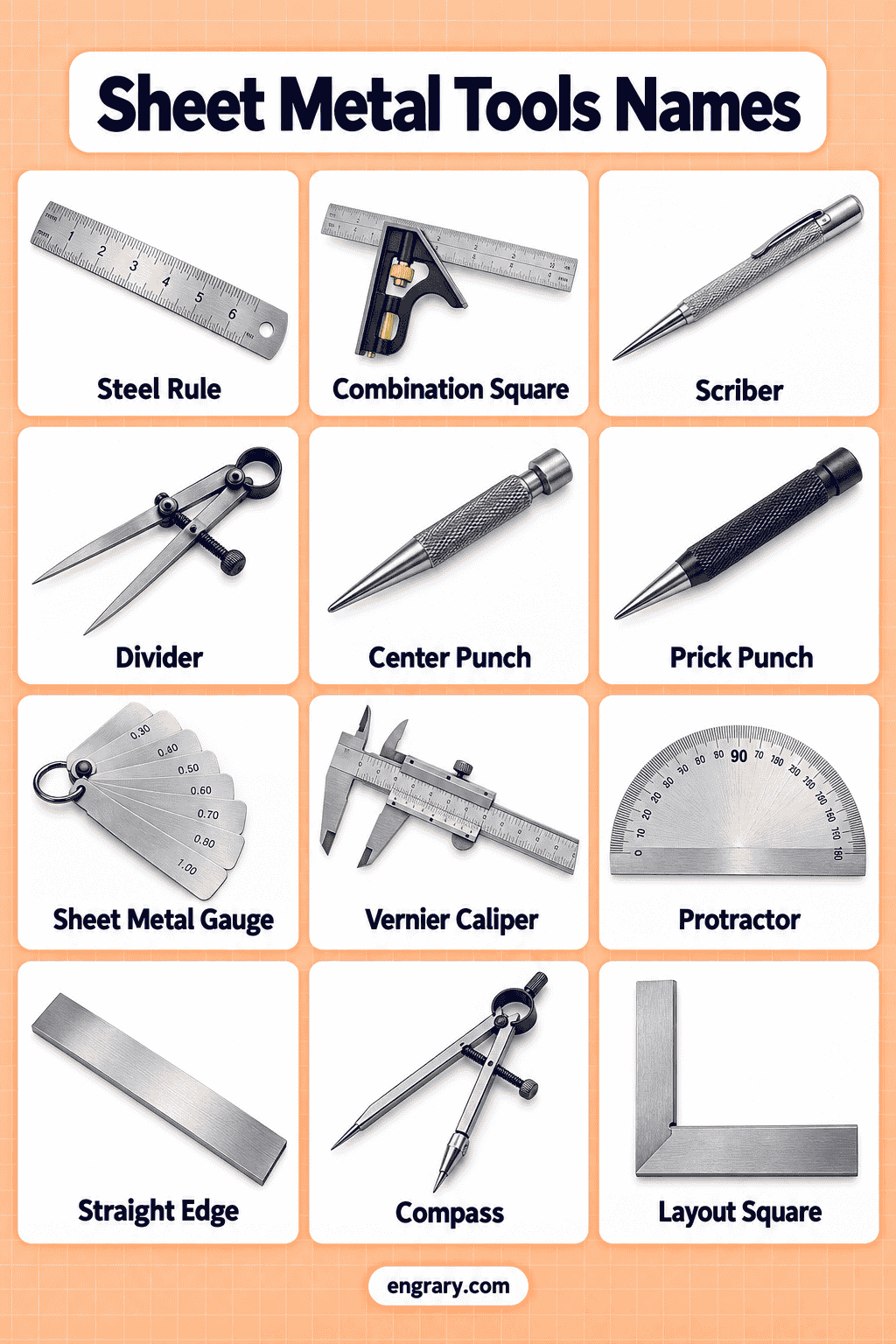
Steel Rule
A steel rule is a rigid graduated strip used for short measurements and straight layout work. Its thin rectangular body distinguishes it from flexible measuring tapes.
Tinman’s Square
A tinman’s square, also called a tinman’s try square in some contexts, has two arms fixed at a right angle. It helps check 90-degree corners and mark perpendicular lines on sheet.
Combination Square
A combination square has an adjustable head that slides along a graduated rule. Therefore, it can support both measurement and angular layout work.
Scriber
A scriber has a hardened pointed tip that scratches a fine line into the sheet surface. It often resembles a slim metal pen.
Dividers
Dividers have two pointed legs connected at a pivot. They can transfer distances or mark circles and arcs.
Wing Compass
A wing compass resembles dividers but includes an adjustment screw that helps hold a selected radius. This makes it useful for controlled circular layout work.
Trammel
A trammel uses two adjustable heads mounted on a longer bar. Unlike ordinary dividers, it can mark much larger circles and arcs on sheet metal.
Protractor
A protractor measures or transfers angles. Metalworking versions usually have a graduated semicircular or circular body with an adjustable blade.
Sheet and Wire Gauge
A sheet and wire gauge is typically a circular metal plate with numbered slots around its edge. Each slot corresponds to a particular sheet thickness or wire diameter, making the tool especially easy to recognize.
Prick Punch
A prick punch makes a small, precise reference mark on a layout point. Its tip is generally finer than the point of a center punch.
Center Punch
A center punch produces a deeper indentation for locating a point more clearly. Therefore, it commonly follows finer layout marking rather than replacing it.
Sheet Metal Cutting Tools Names
Cutting tools are among the most important sheet-metal tools because flat stock must often be trimmed before bending or forming. Hand snips suit many smaller cuts, while nibblers and shears use different mechanisms for heavier or more specialized work. Eastwood likewise distinguishes hand shears or aviation snips from powered shears and tighter-radius nibbler-style cutting tools.
Tin Snips
Tin snips are traditional hand cutters with long handles and relatively long scissor-like blades. They work well for straightforward cuts in suitable thin sheet.
Straight Snips
Straight snips have blade geometry intended mainly for straight cutting. Their conventional scissor-like appearance makes them easy to recognize.
Aviation Snips
Aviation snips use a compound linkage between the handles and jaws. Consequently, they usually have shorter jaws and more complex handles than traditional tin snips.
Left-Cut Aviation Snips
Left-cut aviation snips are shaped to make controlled curves toward the left as well as suitable straight cuts.
Right-Cut Aviation Snips
Right-cut aviation snips favor curves toward the right. Although handle colors often help identify directional models, color conventions should not replace the actual tool label or blade design.
Hand Nibbler
A hand nibbler removes small pieces of sheet progressively rather than making one continuous scissor-like cut. Its plier-style body helps distinguish it from ordinary snips.
Power Nibbler
A power nibbler uses powered repeated cutting action to follow straight or curved paths. Unlike a shear, it removes a narrow strip or series of small pieces as it advances.
Bench Shear
A bench shear mounts to a bench and uses a long lever with cutting blades. Its fixed base and extended handle distinguish it from handheld cutters.
Throatless Shear
A throatless shear has an open cutting arrangement that allows sheet to move around the blades with less obstruction. Therefore, it can suit curved and irregular cutting better than some enclosed shears.
Lever Shear
A lever shear uses a long manual handle to provide mechanical advantage for cutting sheet or light stock.
Squaring Shear
A squaring shear, often called a guillotine shear, cuts along a straight blade across a wider sheet. Its broad bed and long cutting edge make it visually distinct from smaller bench shears.
Power Shear
A power shear uses electric or pneumatic power to move its cutting blades. Current fabrication guidance describes these tools as powered metal-cutting shears suited to faster sheet cutting.
Sheet Metal Bending and Folding Tools Names
Bending tools create angles, flanges, hems, and folds without necessarily stretching the entire panel. Some operate by hand on small sections, whereas larger brakes control long straight bends across a wider piece.
Hand Seamer
A hand seamer resembles pliers with unusually wide, flat jaws. Those broad jaws grip a larger section of sheet for localized bending or folding.
Folding Bar
A folding bar is a straight tool used to support and create sheet-metal folds. Its long flat form helps keep bends consistent along an edge.
Bending Pliers
Bending pliers use shaped jaws to grip and bend narrower areas of sheet. They are more localized than a full brake.
Duckbill Pliers
Duckbill pliers have wide, flattened jaws that resemble a duck’s bill. They help grip, bend, or straighten sheet edges with broader contact than ordinary pliers.
Sheet Metal Brake
A sheet metal brake clamps sheet along a straight line while a hinged leaf creates the bend. Fabrication references describe brakes as common machines for producing clean, controlled sheet-metal bends.
Box-and-Pan Brake
A box-and-pan brake uses segmented upper fingers instead of one continuous clamping bar. Therefore, its removable or adjustable fingers allow bends around box-like shapes and flanges.
Press Brake
A press brake bends sheet between a punch and die. It is generally larger and more machine-like than a hand-operated folding brake.
Sheet Metal Seaming and Grooving Tools
Sheet-metal seams join or reinforce folded edges, so this category uses tools that close, shape, or tighten those folds. Educational material treats seaming tools, grooving tools, and folding bars as distinct parts of traditional sheet-metal practice.
Hand Groover
A hand groover, also called a hand groove in some training material, has a shaped working end that fits over a folded seam. It helps form or close the groove in the joint.
Grooving Tool
A grooving tool is a broader name for a tool designed to form or tighten a groove in sheet-metal seams. Its working edge usually reflects the seam profile it is intended to shape.
Seaming Pliers
Seaming pliers use broad jaws to grip and close folded sheet edges. They look similar to wide-jaw forming pliers rather than ordinary combination pliers.
Seam Closing Tool
A seam closing tool helps compress or finish a prepared seam. Depending on the design, it may have jaws, rollers, or a shaped working face.
Sheet Metal Crimper
A sheet metal crimper creates repeated small folds or crimps along an edge. Hand versions often resemble special pliers with several shaped jaw sections.
Folding Tool
A folding tool helps turn narrow sheet edges or hems along a straight line. Many hand versions have slots of different depths along the tool body.
Sheet Metal Hammers and Mallets Names
Hammers and mallets shape sheet by applying controlled blows. However, their face shapes and materials differ because some operations need concentrated force, while others benefit from a softer surface that reduces marking.
Planishing Hammer
A planishing hammer has smooth, polished faces for controlled finishing and smoothing of already-formed sheet. Its clean rounded faces provide the main visual clue.
Raising Hammer
A raising hammer uses specially shaped faces to help form sheet into deeper curved forms over suitable support.
Bumping Hammer
A bumping hammer is commonly associated with panel shaping and correction. Its head often has broad faces designed for controlled sheet movement.
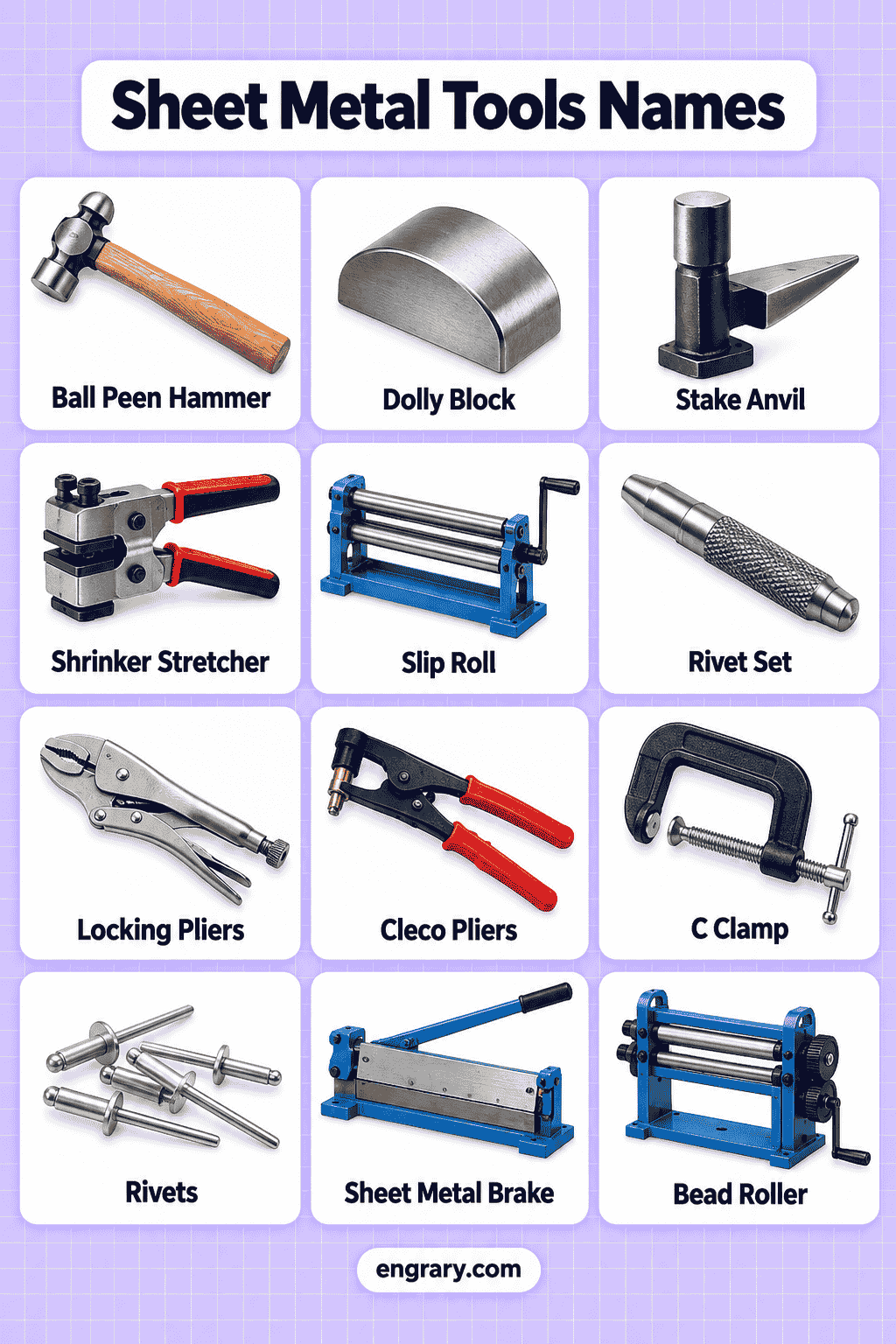
Ball-Peen Hammer
A ball-peen hammer has one flat face and one rounded ball-shaped peen. Sheet-metal training material includes it among traditional tinman’s hammers for shaping and riveting.
Rubber Mallet
A rubber mallet has a soft rubber head that spreads impact over a wider area. Therefore, it can shape suitable sheet while leaving fewer hard hammer marks.
Rawhide Mallet
A rawhide mallet has a softer non-steel head, often cylindrical. It is another forming option when a hard metal face would mark the work too aggressively.
Wooden Mallet
A wooden mallet has a broad wooden head used for bending and forming sheet over supports or forms. Training references also identify wooden, rubber, and plastic mallets as sheet-metal shaping tools.
Sheet Metal Stakes and Supporting Tools Names
Stakes are one of the most distinctive traditional sheet-metal tool families. They act as small anvils that support the metal while the worker bends, seams, or shapes it. Recent training material describes stakes as bench-mounted supporting and shaping tools and identifies several specialized forms.
Beak Iron Stake
A beak iron stake has a long tapered horn extending from its body. The horn provides curved working surfaces for forming rounded or tapered sheet-metal features.
Blowhorn Stake
A blowhorn stake has a long curved horn-like working section. Its sweeping shape supports cylindrical and curved forming operations.
Hatchet Stake
A hatchet stake has a thin, narrow working edge that resembles a hatchet blade. This edge supports sharper bends and narrow forming work.
Hollow Mandrel Stake
A hollow mandrel stake provides rounded mandrel-like working surfaces for shaping curved or hollow sheet-metal forms. It appears among standard stake types in workshop training illustrations.
Double-Seaming Stake
A double-seaming stake has shaped working surfaces designed to support seam-forming operations. Some versions have several usable heads or profiles.
Square Stake
A square stake provides flatter and squarer supporting surfaces for bending or forming work.
Round Stake
A round stake offers a rounded working surface that supports curved sheet shapes.
Half-Moon Stake
A half-moon stake has a curved working profile resembling part of a circle. Sheet-metal training resources list it among specialized stake types.
Small Anvil
A small anvil provides flat and curved support surfaces for general sheet shaping. Unlike specialized stakes, it offers a broader range of general-purpose working faces.
How Stakes and Hammers Work Together
A stake supports the sheet from underneath, while a hammer or mallet shapes the material against that surface. Therefore, the stake determines much of the supporting contour, while the striking tool provides the force needed to move the metal. This relationship explains why sheet-metal shops use several stake shapes rather than one universal support.
Sheet Metal Forming and Shaping Machines
Some sheet-metal shapes are easier to create with rollers or wheeled machines than with hand hammers. These machines form curves, beads, flanges, and panel contours while keeping their function distinct from simple straight-line bending.
English Wheel
An English wheel has a large C-shaped frame with an upper wheel and smaller lower anvil wheel. Sheet passes between the two wheels while the operator gradually forms smooth compound curves.
Shrinker-Stretcher
A shrinker-stretcher changes the length of a sheet edge by compressing or stretching small sections. Compact versions typically have a jaw mechanism operated by a handle or pedal.
Bead Roller
A bead roller has opposing forming rolls mounted in a frame. As sheet passes between them, matched rolls can create beads, ribs, channels, or other profiles.
Slip Roller
A slip roller uses several long parallel cylindrical rollers to curve flat sheet. Unlike a bead roller, its primary visual feature is the set of long rollers spanning the width of the machine.
Sheet Metal Punching and Hole-Making Tools
Sheet metal can receive holes through punching as well as drilling. Punching tools are particularly relevant because they can create clean openings in thin material without relying on a conventional twist-drill operation.
Hand Punch
A hand punch resembles heavy pliers with a punch and die at the jaws. Squeezing the handles drives the punch through suitable thin sheet.
Hollow Punch
A hollow punch has a sharpened circular cutting edge at one end. The hollow cylindrical end distinguishes it from a pointed center punch.
Lever Punch
A lever punch uses a long handle to provide greater mechanical advantage than small hand punches. Its frame holds the punch and die in alignment.
Sheet Metal Punch
A sheet metal punch is a general name for punch-and-die tools designed to create holes or shaped openings in sheet.
Step Drill
A step drill has a cone-shaped body divided into progressively larger cutting steps. Therefore, one cutter can create several hole diameters in suitable thin material.
Hole Saw
A hole saw has a hollow cylindrical body with cutting teeth around its rim. Its cup-like form makes it easy to distinguish from a solid drill bit.
Sheet Metal Riveting and Temporary Fastening Tools
Sheet-metal assemblies often need either permanent mechanical fasteners or temporary alignment before final joining. Riveters form permanent riveted joints, while Clecos temporarily hold drilled sheets in position. Cleco references specifically describe these reusable fasteners as sheet-holding devices used before permanent riveting, welding, or bonding.
Hand Riveter
A hand riveter has long plier-style handles and a nosepiece at the front. It installs compatible blind rivets by pulling their mandrels.
Pop Rivet Gun
A pop rivet gun is another common name for a blind-rivet installation tool. Manual versions resemble hand riveters, while powered versions may use pneumatic or electric mechanisms.
Rivet Set
A rivet set is a shaped tool that supports or forms a rivet head. Its working end matches the head style it is designed to shape.
Riveting Hammer
A riveting hammer is a small hammer associated with forming or setting suitable rivets. Its relatively compact head supports controlled striking.
Cleco Fastener
A Cleco fastener, also called a skin pin in some industries, is a temporary reusable sheet-holding fastener. Common plier-operated versions are spring loaded and pass through aligned holes to hold multiple sheets together.
Cleco Pliers
Cleco pliers operate compatible spring-loaded Cleco fasteners. Their narrow jaws compress the fastener mechanism so it can enter or leave the aligned holes.
Cleco Fastener and Cleco Pliers Relationship
The Cleco fastener does the temporary holding, whereas Cleco pliers operate the fastener during installation or removal. Keeping those names separate prevents a common vocabulary mistake.
Sheet Metal Forming and Holding Pliers
Special pliers give workers close control over narrow edges, flanges, and localized forms. Unlike ordinary gripping pliers, these tools often use broader, longer, or specially shaped jaws that spread pressure across the sheet.
Sheet Metal Pliers
Sheet metal pliers use broad jaws for gripping, turning, or adjusting thin sheet. Their wider contact area distinguishes them from ordinary combination pliers.
Duckbill Pliers
Duckbill pliers have long flattened jaws that widen toward the working end. They are useful for controlled edge bending and straightening.
Locking Sheet Metal Pliers
Locking sheet metal pliers combine wide sheet-gripping jaws with a locking handle mechanism. As a result, they can maintain a grip without continuous hand pressure.
Forming Pliers
Forming pliers use shaped jaws to create or correct small bends and curves in sheet.
Sheet Metal Tongs
Sheet metal tongs have extended gripping jaws and handles for holding or manipulating sheet during bench work.
Cleco Side-Grip Clamp
A Cleco side-grip clamp temporarily grips sheets from an edge rather than through a drilled hole. Cleco suppliers identify these side-grip clamps alongside conventional plier-operated temporary fasteners.
Sheet Metal Finishing and Edge-Cleaning Tools
Cutting, punching, and forming can leave rough edges or small burrs. Therefore, a few simple finishing tools remain useful even though they are not unique to sheet-metal work.
Flat File
A flat file has broad toothed faces used to smooth straight edges and remove small amounts of metal.
Half-Round File
A half-round file combines one flat face with one curved face. Consequently, it can work on both straight and rounded sheet-metal edges.
Deburring Tool
A deburring tool usually has a small hooked or swiveling blade mounted in a handle. It removes burrs from cut or punched edges.
Abrasive Block
An abrasive block provides a compact abrasive surface for light edge smoothing and surface cleanup.
Hand Scraper
A hand scraper has a hardened shaped edge for controlled removal of small raised areas or burrs.
Common Sheet Metal Tool Names That Are Easy to Confuse
Several sheet-metal tools perform related jobs but use different mechanisms. Therefore, learning the distinction between these names is more useful than treating them as interchangeable.
| Tools | Main Difference |
|---|---|
| Tin Snips vs Aviation Snips | Tin snips use a simpler scissor-like design, while aviation snips use compound linkage and shorter jaws for increased leverage. |
| Snips vs Shears | Snips are mainly handheld scissor-like cutters, whereas shears include heavier manual and powered blade-cutting equipment. |
| Shear vs Nibbler | A shear separates sheet with moving blades, while a nibbler removes a narrow path through repeated small cutting actions. |
| Hand Seamer vs Sheet Metal Brake | A hand seamer creates localized bends by hand, while a brake produces longer controlled bends across a wider sheet. |
| Bead Roller vs Slip Roller | A bead roller forms ribs and profiles with shaped rolls, whereas a slip roller creates broad curves with long cylindrical rollers. |
Frequently Asked Questions
Common names include steel rules, scribers, sheet gauges, tin snips, aviation snips, nibblers, seamers, brakes, groovers, hammers, mallets, stakes, bead rollers, slip rollers, punches, riveters, Clecos, files, and deburring tools.
A sheet and wire gauge is a traditional tool used to identify sheet thickness or gauge number. It usually has numbered slots around a circular metal plate.
Common cutting tools include tin snips, aviation snips, hand nibblers, power nibblers, bench shears, throatless shears, lever shears, squaring shears, and power shears. The appropriate type depends on the material, thickness, and shape of the required cut.
Hand seamers, folding bars, bending pliers, brakes, hammers, mallets, stakes, English wheels, shrinker-stretchers, bead rollers, and slip rollers all support different types of bending or forming work.
Sheet-metal stakes provide shaped support surfaces while metal is bent, seamed, or formed. Different profiles suit different contours, which is why workshops use specialized forms such as beak iron, blowhorn, hatchet, round, and half-moon stakes.
You May Also Like



Leave a Comment