

Woodworking tools help people measure, cut, shape, join, smooth, and finish wood for furniture, cabinets, shelves, boxes, decorative pieces, and other projects. Learning common woodworking tools names in English makes it easier to recognize the equipment used in workshops, understand woodworking instructions, and build practical vocabulary.
This article covers 70 woodworking tools with simple explanations of what they do. It also explains how different tools fit into the woodworking process, which tools suit common projects and joints, how similar tools differ, and how woodworking tools compare with carpenter tools.

Common Woodworking Tools Names
Some woodworking tools appear more often than others because they handle everyday measuring, cutting, shaping, drilling, holding, and finishing jobs. The following names give a quick overview before the complete list.
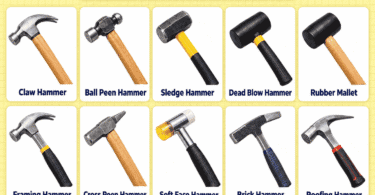
Claw Hammer
A claw hammer drives nails into wood and removes them with its curved claw.
Hand Saw
A hand saw cuts boards, timber, and other wooden pieces by hand.
Circular Saw
A circular saw uses a spinning blade to make fast, straight cuts through wood.
Jigsaw
A jigsaw uses a narrow moving blade to cut curves, openings, and irregular shapes.
Miter Saw
A miter saw makes accurate straight and angled cuts for trim, molding, frames, and other wooden parts.
Table Saw
A table saw uses a circular blade mounted through a flat table to cut boards and sheet wood accurately.
Bench Chisel
A bench chisel cuts, trims, and removes small sections of wood during joinery and fitting.
Smoothing Plane
A smoothing plane removes fine shavings to produce a clean wooden surface.
Router
A router shapes edges, cuts grooves, and creates joints or decorative profiles in wood.
Cordless Drill
A cordless drill makes holes and drives screws during woodworking and assembly.
Tape Measure
A tape measure checks length, width, height, and spacing before cutting or assembling wood.
Combination Square
A combination square marks straight lines, checks angles, and measures short distances or depths.
Marking Gauge
A marking gauge scores a line parallel to the edge of a wooden board.
Wooden Mallet
A wooden mallet strikes chisels and adjusts wooden joints without the hard impact of a steel hammer.
F-Clamp
An F-clamp holds pieces of wood firmly during gluing, drilling, fitting, or assembly.
Bench Vise
A bench vise grips wooden workpieces securely while they are cut, shaped, drilled, or filed.
Random Orbital Sander
A random orbital sander smooths broad wooden surfaces while reducing obvious sanding marks.
Band Saw
A band saw cuts curves, irregular shapes, and thicker pieces of wood with a continuous blade.
Wood Lathe
A wood lathe rotates wood so it can be shaped into rounded or symmetrical forms.
Cabinet Scraper
A cabinet scraper removes very thin shavings to refine a wooden surface.
Essential Woodworking Tools for Every Workshop
The following 70 tools cover the main stages of woodworking, from measuring and marking to cutting, shaping, joining, clamping, sanding, and finishing.
Measuring and Marking Tools
Accurate woodworking begins with reliable measurements and clear layout lines.
Tape Measure
Checks board lengths, panel dimensions, spacing, and overall project size.
Steel Rule
Measures short distances and provides a rigid straight edge for precise marking.
Combination Square
Checks 90-degree and 45-degree angles, marks straight lines, and measures short depths.
Try Square
Checks and marks accurate right angles on boards and smaller workpieces.
Sliding Bevel
Copies and transfers angles between wooden parts.
Marking Knife
Scores fine layout lines for accurate cutting and joinery.
Marking Gauge
Marks a line parallel to the edge of a board.
Mortise Gauge
Marks paired parallel lines for mortise-and-tenon joints.
Compass
Draws circles and arcs and transfers short measurements between workpieces.
Saws for Woodworking
Woodworking saws vary according to grain direction, cut depth, shape, and the level of accuracy required.
Rip Saw
Cuts mainly along the wood grain when reducing the width of solid timber.
Crosscut Saw
Cuts across the grain to shorten boards and wooden components.
Backsaw
Makes controlled, accurate cuts with a stiffened blade.
Dovetail Saw
Produces fine, shallow cuts for dovetails and other detailed joints.
Tenon Saw
Handles deeper joinery cuts such as tenon cheeks and shoulders.
Coping Saw
Creates curves, internal shapes, and detailed manual cuts.
Japanese Pull Saw
Cuts on the pull stroke with a thin blade that produces narrow, controlled cuts.
Planes for Shaping and Smoothing Wood
Planes remove thin shavings to flatten boards, refine joints, trim edges, and improve surface quality.
Smoothing Plane
Takes fine shavings to produce a clean final surface.
Jack Plane
Handles general flattening and removes uneven material from rough boards.
Jointer Plane
Straightens long board edges and flattens larger wooden surfaces.
Block Plane
Trims end grain, edges, and small areas with a compact body.
Shoulder Plane
Refines joint shoulders, rebates, and narrow surfaces close to corners.
Router Plane
Levels the bottoms of grooves, dados, and recesses to a consistent depth.
Spokeshave
Shapes curved wooden parts such as handles, legs, rails, and rounded edges.
Cabinet Scraper
Removes fine shavings to improve surface quality and eliminate minor imperfections.
Rasp
Shapes wood quickly with coarse raised teeth, especially on curves and irregular forms.
Hand File
Refines edges and smooths smaller areas where a rasp would remove too much material.

Chisels and Joinery Tools
Chisels and related joinery tools remove waste, refine joints, shape recesses, and fit wooden components accurately.
Bench Chisel
Handles general chopping, trimming, fitting, and joint cleanup.
Mortise Chisel
Cuts deep rectangular mortises with a thick, strong blade.
Paring Chisel
Removes thin layers of wood with controlled hand pressure.
Firmer Chisel
Handles heavier chopping and general shaping work.
Corner Chisel
Squares the corners of routed or drilled recesses.
Wooden Mallet
Strikes chisels and adjusts wooden joints without the concentrated impact of a metal hammer.
Dovetail Marker
Marks consistent dovetail angles before sawing and chiseling.
Drilling and Boring Tools
These tools create pilot holes, larger bores, countersinks, and accurate openings in wood.
Cordless Drill
Drills holes and drives screws with portable rechargeable power.
Hand Drill
Turns smaller drill bits manually through a geared crank.
Brace
Rotates larger boring bits by hand with controlled leverage.
Bradawl
Starts small holes before screws or nails enter the wood.
Gimlet
Bores narrow holes through a screw-like point and hand-twisting action.
Drill Press
Keeps drilling vertical and controlled with a fixed spindle and adjustable worktable.
Countersink Tool
Creates a tapered recess so a screw head can sit flush or slightly below the wood surface.
Clamps and Vises
Clamps and vises keep wooden parts stable while cutting, drilling, gluing, fitting, and assembling them.
Bench Vise
Secures workpieces between jaws attached to a workbench.
Woodworking Vise
Uses broad jaws to hold wood firmly with less risk of surface damage.
F-Clamp
Applies adjustable pressure across medium or large workpieces.
Bar Clamp
Secures wide panels, frames, and assemblies across a long clamping span.
Pipe Clamp
Uses a length of pipe to provide adjustable capacity for larger glue-ups.
Hand Screw Clamp
Controls pressure through independently adjustable wooden jaws.
Quick-Grip Clamp
Provides fast one-handed clamping for light assembly and temporary holding.
Holdfast
Pins a workpiece against a bench through downward pressure from a hooked metal arm.
Power Tools for Cutting and Shaping Wood
Power tools make repeated cutting, shaping, routing, and joinery work faster and more consistent.
Circular Saw
Makes fast portable straight cuts through boards and sheet materials.
Jigsaw
Cuts curves, openings, and irregular shapes with a narrow reciprocating blade.
Miter Saw
Produces accurate crosscuts, miters, and bevels in boards, trim, and molding.
Table Saw
Makes repeatable ripping and crosscutting operations with a fixed circular blade.
Band Saw
Cuts curves, irregular shapes, and thicker stock with a continuous looped blade.
Scroll Saw
Creates intricate curves and decorative patterns in thin wood.
Router
Cuts grooves, rebates, profiles, joints, and decorative edges with rotating bits.
Biscuit Joiner
Cuts matching slots for wooden biscuits that help align and join boards.
Sanding and Finishing Tools
Sanding and finishing tools refine wooden surfaces and prepare them for paint, stain, oil, wax, or another finish.
Random Orbital Sander
Smooths broad surfaces while reducing obvious sanding patterns.
Palm Sander
Handles lighter finishing work with a compact vibrating sanding pad.
Belt Sander
Removes material quickly with a continuous abrasive belt.
Detail Sander
Reaches corners, edges, and confined areas with a pointed sanding pad.
Sanding Block
Supports sandpaper for controlled manual smoothing.
Card Scraper
Shaves fine material from wood and produces a clean surface.
Burnisher
Forms and refreshes the cutting hook on a card scraper.
Stationary Woodworking Machines
Larger woodworking machines usually remain in one workshop position and handle repeated preparation, shaping, sanding, or turning jobs.
Thickness Planer
Reduces boards to a consistent thickness and smooths the upper surface.
Jointer
Flattens one face and straightens one edge before further stock preparation.
Wood Lathe
Rotates wood so turning tools can shape rounded and symmetrical forms.
Spindle Sander
Smooths curves and inside edges with a vertically moving sanding drum.
Disc Sander
Sands edges and ends against a rotating abrasive disc.
Drum Sander
Smooths broad flat wooden surfaces with an abrasive rotating drum.
Mortiser
Cuts square or rectangular mortises for traditional joinery.

Woodworking Tools from Rough Wood to Finished Work
Woodworking usually moves through several stages, and different tools become useful as rough lumber develops into a finished component or project.
| Stage | Common Tools |
|---|---|
| Measuring | Tape Measure, Combination Square |
| Marking | Marking Knife, Marking Gauge |
| Rough Cutting | Rip Saw, Circular Saw, Table Saw |
| Crosscutting | Crosscut Saw, Miter Saw |
| Flattening | Jack Plane, Jointer Plane |
| Smoothing | Smoothing Plane, Cabinet Scraper |
| Joinery | Dovetail Saw, Bench Chisel, Mortise Gauge |
| Assembly | F-Clamp, Bar Clamp, Wooden Mallet |
| Sanding | Random Orbital Sander, Sanding Block |
| Surface Preparation | Card Scraper, Burnisher |
The exact order varies from project to project, but accurate layout, controlled cutting, careful fitting, and good surface preparation remain important throughout the process.
Tools for Different Woodworking Projects
Different woodworking projects depend on different combinations of hand tools, power tools, and machines.
| Project | Useful Tools |
|---|---|
| Furniture Making | Planes, Chisels, Table Saw, Router, Clamps |
| Cabinetmaking | Combination Square, Table Saw, Router, F-Clamps |
| Fine Joinery | Dovetail Saw, Mortise Chisel, Marking Gauge, Wooden Mallet |
| Small Crafts | Coping Saw, Bench Chisel, Rasp, Sanding Block |
| Woodturning | Wood Lathe, Measuring Tools, Sanding Tools |
| Box Making | Dovetail Saw, Chisels, Try Square, Clamps |
| Shelves and Panels | Circular Saw, Table Saw, Router, Bar Clamps |
Large machines are not necessary for every woodworking job. Hand tools often provide better control during fitting, trimming, and detailed adjustments.
Tools Used for Common Wood Joints
Joinery is one of the clearest areas where specialized woodworking tools become useful.
Dovetail Joint
A Dovetail Saw cuts the joint lines, a Marking Gauge establishes reference lines, and Bench Chisels remove and refine waste.
Mortise and Tenon Joint
A Mortise Gauge marks the joint, a Mortise Chisel cuts the mortise, and a Tenon Saw shapes the tenon.
Rabbet and Groove Joint
A Router cuts the recess efficiently, while a Router Plane refines its bottom to a consistent depth.
Dowel Joint
A Cordless Drill creates the holes, while clamps keep the parts aligned during assembly.
Biscuit Joint
A Biscuit Joiner cuts matching slots, and clamps hold the boards together while the adhesive sets.
Careful measuring, marking, and fitting matter just as much as the tools selected for each joint.
Hand Tools vs Woodworking Machines
Hand tools and machines can perform related jobs, but they offer different levels of control, speed, and repeatability.
| Hand Woodworking Tools | Powered or Stationary Tools |
|---|---|
| Hand Saw | Table Saw |
| Hand Plane | Thickness Planer |
| Brace | Drill Press |
| Bench Chisel | Router |
| Sanding Block | Random Orbital Sander |
Similar Woodworking Tools and How They Differ
Some woodworking tools look similar or perform related jobs, but each one suits a different type of cut, surface, or stage of work.
| Tools | Main Difference |
|---|---|
| Rip Saw vs Crosscut Saw | A rip saw cuts mainly along the grain, while a crosscut saw cuts across it. |
| Jack Plane vs Smoothing Plane | A jack plane removes more material and handles general flattening, while a smoothing plane takes finer shavings for the final surface. |
| Block Plane vs Shoulder Plane | A block plane handles trimming and end grain, while a shoulder plane refines shoulders, rebates, and joints. |
| Rasp vs Hand File | A rasp removes wood more aggressively with coarse teeth, while a hand file refines material more gradually. |
| Marking Gauge vs Mortise Gauge | A marking gauge scores one parallel line, while a mortise gauge marks paired lines for mortise-and-tenon work. |
| Dovetail Saw vs Tenon Saw | A dovetail saw suits fine, shallow joinery cuts, while a tenon saw handles deeper and larger joints. |
| Table Saw vs Band Saw | A table saw excels at straight ripping and repeatable cuts, while a band saw also handles curves and thicker irregular stock. |
| Random Orbital Sander vs Belt Sander | A random orbital sander handles controlled smoothing, while a belt sander removes material much faster. |
The main difference usually comes down to grain direction, cutting depth, material removal, or the level of precision required.
Beginner Woodworking Tools vs Full Workshop Setup
A beginner can complete many useful projects with a relatively small tool collection. A larger workshop adds greater speed, precision, and specialized capability.
| Beginner Woodworking Tools | Full Workshop Setup |
|---|---|
| Tape Measure | Vernier Caliper |
| Combination Square | Mortise Gauge |
| Hand Saw | Table Saw |
| Bench Chisel | Mortiser |
| Block Plane | Jointer Plane |
| Cordless Drill | Drill Press |
| F-Clamp | Pipe Clamp |
| Sanding Block | Random Orbital Sander |
Good measuring, marking, sawing, and fitting skills remain important even as the workshop becomes more advanced.
Woodworking Tools vs Carpenter Tools
Woodworking and carpentry overlap, but they usually emphasize different kinds of work.
| Woodworking Tools | Carpenter Tools |
|---|---|
| Often focus on furniture, cabinetry, joinery, bench work, shaping, and finishing | Often focus on framing, trim, installation, and jobsite construction |
| Smoothing Plane | Speed Square |
| Mortise Gauge | Chalk Line |
| Dovetail Saw | Framing Hammer |
| Cabinet Scraper | Nail Gun |
| Woodworking Vise | Pry Bar |
A carpenter may use planes, chisels, and woodworking saws, while a woodworker may also use drills, circular saws, and other common carpenter tools. The difference lies mainly in the type of work rather than a strict boundary between the two tool groups.
FAQs
Common woodworking tools include measuring squares, marking gauges, hand saws, chisels, planes, drills, clamps, routers, sanders, table saws, and other shaping tools.
A practical beginner set includes a tape measure, combination square, hand saw, bench chisels, block plane, cordless drill, clamps, and sanding block.
Common joinery tools include marking gauges, mortise gauges, dovetail saws, tenon saws, bench chisels, mortise chisels, wooden mallets, router planes, and clamps.
Planes, rasps, hand files, spokeshaves, cabinet scrapers, sanders, and card scrapers help shape or smooth wooden surfaces.
Woodworking tools often focus on furniture, cabinetry, joinery, shaping, and bench work, while carpenter tools more often support framing, trim, installation, and jobsite construction.
You May Also Like



Leave a Comment