
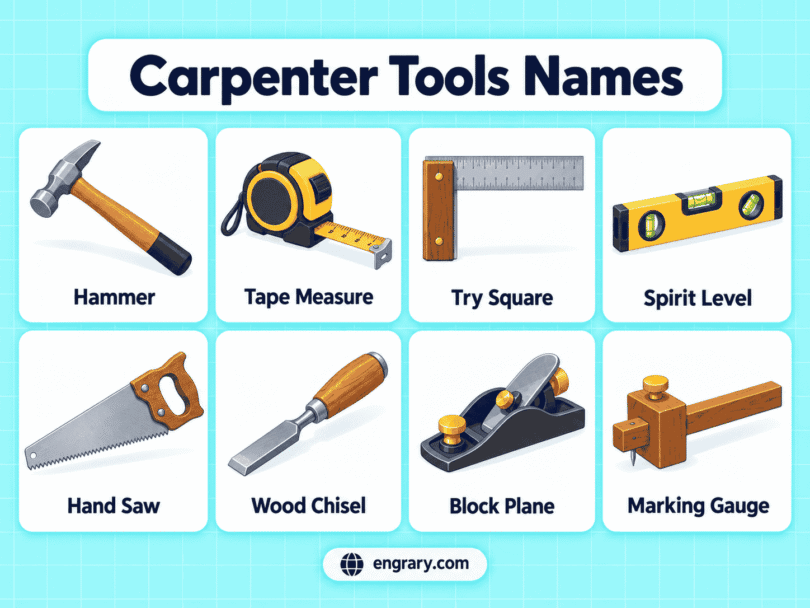
Carpenters rely on accurate measuring, clean cutting, secure fastening, careful fitting, and precise finishing to turn wood and sheet materials into useful structures and features. Learning common carpenter tools names in English makes it easier to recognize the tools used for framing, doors, trim, cabinets, decking, stairs, and other carpentry work.
This article introduces 60 carpenter tools with their practical uses, following the natural flow of carpentry from measuring and marking to cutting, shaping, fastening, and assembly. You will also see how tools differ across framing and finish carpentry, which tools carpenters carry on the job, and which larger tools usually stay in the workshop.
Tools Carpenters Use Every Day
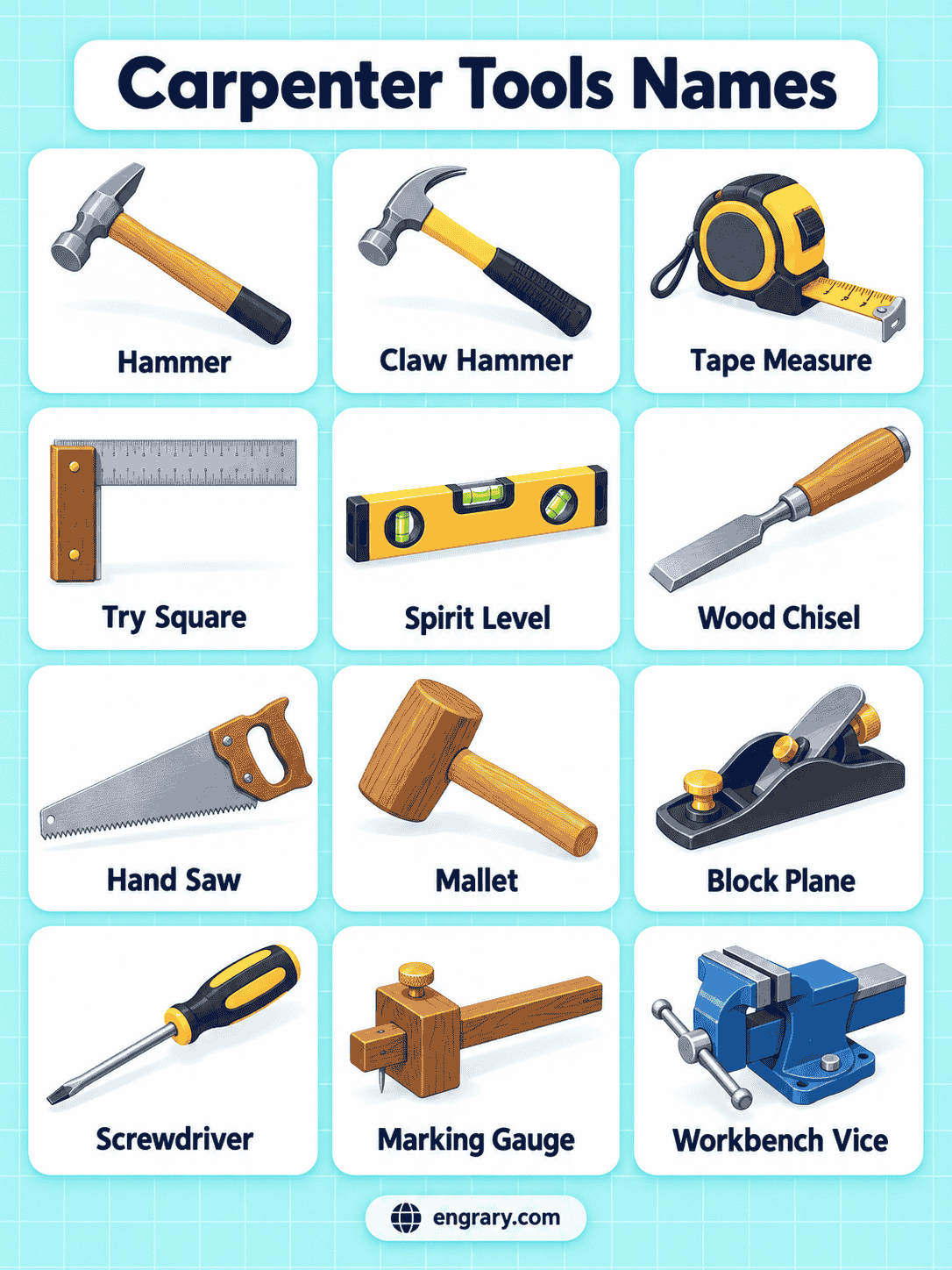
Carpenters use measuring, cutting, shaping, fastening, and finishing tools to work with wood and build or repair structures. Learning these tool names helps beginners and English learners recognize common carpentry equipment more easily.
Claw Hammer
A claw hammer drives nails into wood and removes them with its curved claw.
Tape Measure
A tape measure checks length, width, height, and spacing before cutting or assembling wood.
Carpenter’s Pencil
A carpenter’s pencil marks measurements and cutting lines clearly on wood and other rough surfaces.
Combination Square
A combination square helps mark straight lines, check right angles, and measure short distances.
Spirit Level
A spirit level checks whether shelves, frames, walls, and other surfaces sit horizontally or vertically.
Hand Saw
A hand saw cuts boards, timber, and other wooden pieces by hand.
Circular Saw
A circular saw uses a spinning blade to make fast, straight cuts through wood and sheet materials.
Jigsaw
A jigsaw uses a narrow moving blade to cut curves, shapes, and detailed patterns in wood.
Miter Saw
A miter saw makes accurate straight and angled cuts for trim, molding, frames, and similar work.
Chisel
A chisel cuts, shapes, and removes small sections of wood during joinery and finishing work.
Wood Plane
A wood plane shaves thin layers from wooden surfaces to smooth, level, or shape them.
Utility Knife
A utility knife cuts thin materials, trims edges, and scores surfaces during carpentry tasks.
Screwdriver
A screwdriver tightens or loosens screws used in furniture, fittings, and wooden structures.
Cordless Drill
A cordless drill makes holes and drives screws quickly during assembly and installation work.
Nail Gun
A nail gun drives nails into wood much faster than manual hammering.
Clamp
A clamp holds wooden pieces firmly together while someone cuts, drills, glues, or assembles them.
Workbench
A workbench provides a stable surface for measuring, cutting, shaping, and assembling wood.
Sandpaper
Sandpaper smooths rough wooden surfaces and prepares them for paint, stain, or finishing.
Orbital Sander
An orbital sander smooths larger wooden surfaces quickly with a powered sanding pad.
Router
A router shapes edges, cuts grooves, and creates decorative details in wood.
These tools support the main stages of carpentry: measuring, layout, cutting, shaping, fastening, fitting, and finishing.
Carpenter Tools from Measuring to Finishing
Measuring and Layout Tools
Accurate carpentry begins with reliable measurements and clear layout marks.
Tape Measure
Checks lengths, widths, heights, spacing, and material dimensions before cutting or installation.
Carpenter Pencil
Marks wood clearly with a thick, durable lead that resists breaking during jobsite work.
Speed Square
Marks 90-degree and 45-degree lines and helps guide quick crosscuts, roof layouts, and angle work.
Framing Square
Handles larger framing layouts, stair calculations, rafter work, and right-angle checks.
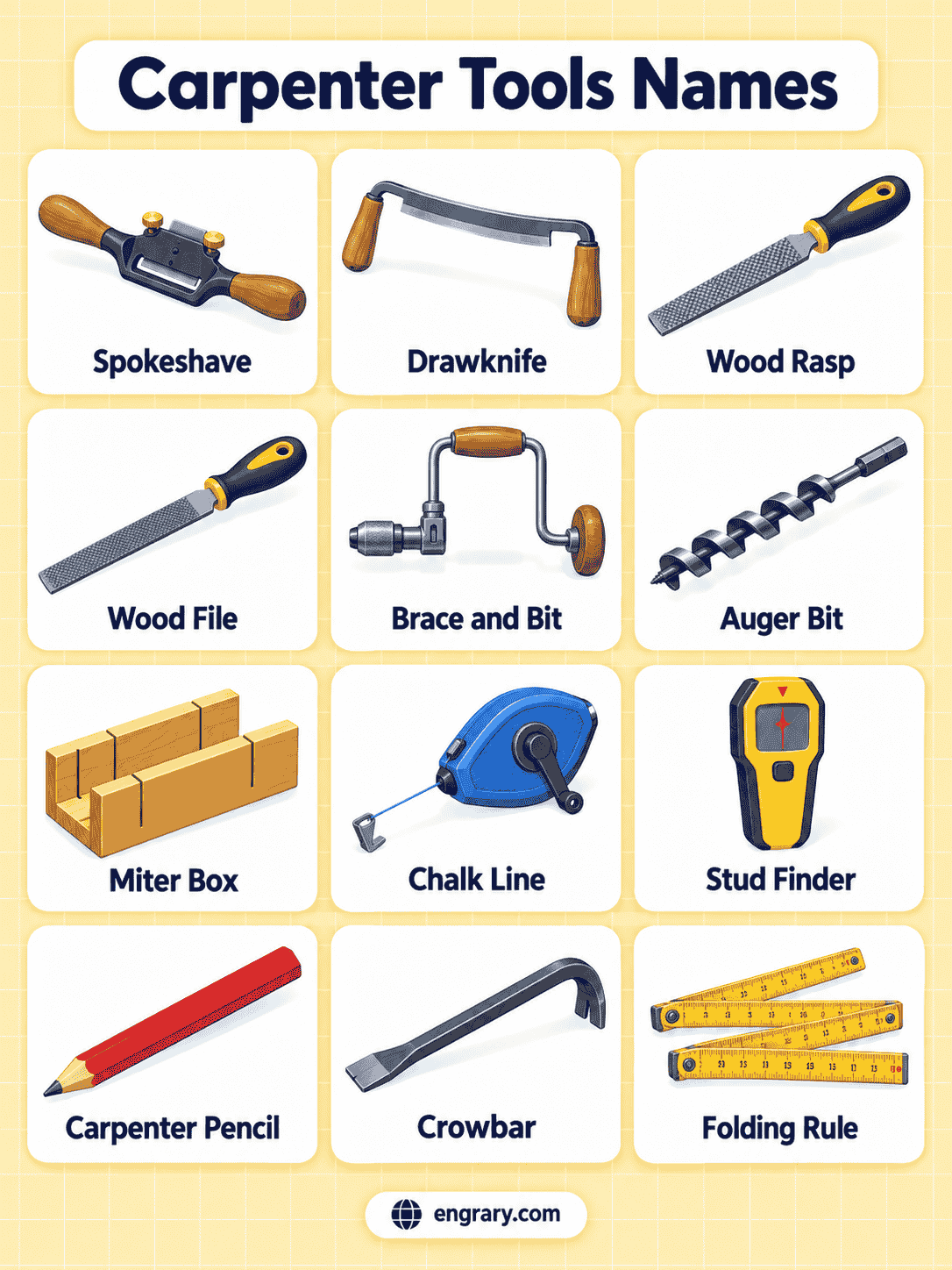
Combination Square
Checks square corners, marks 45-degree lines, and measures short depths or offsets.
Try Square
Checks and marks precise 90-degree angles on timber and smaller workpieces.
Sliding Bevel
Copies and transfers angles from one piece of work to another.
Spirit Level
Checks whether framing, doors, cabinets, shelves, and trim sit level or plumb.
Chalk Line
Snaps long straight reference lines across floors, walls, framing, and sheet materials.
Marking Gauge
Scores a line parallel to the edge of a board for joinery and accurate woodworking layout.
Plumb Bob
Checks true vertical alignment with a weighted point suspended from a string.
Cutting Tools for Timber and Sheet Material
Carpenters use different saws and cutting tools according to the direction, accuracy, and shape of the cut.
Hand Saw
Cuts timber manually for general carpentry and jobsite work.
Crosscut Saw
Cuts across the wood grain to shorten boards and timber.
Rip Saw
Cuts along the grain when reducing the width of solid wood.
Backsaw
Makes controlled, accurate cuts with a stiffened blade suited to joinery and trim work.
Coping Saw
Creates curved and detailed cuts in trim, molding, and thin wooden pieces.
Circular Saw
Makes fast portable cuts through boards, framing timber, plywood, and other sheet materials.
Jigsaw
Cuts curves, openings, and irregular shapes with a narrow powered blade.
Miter Saw
Produces accurate crosscuts, bevels, and angled cuts for trim, framing, and molding.
Table Saw
Cuts boards and sheet material accurately by feeding the workpiece across a stationary blade.
Utility Knife
Scores sheet materials and cuts packaging, veneer, thin coverings, and other lightweight materials.
Track Saw
Guides a circular blade along a rail for long, clean, straight cuts in panels and sheet goods.
Shaping and Fitting Tools
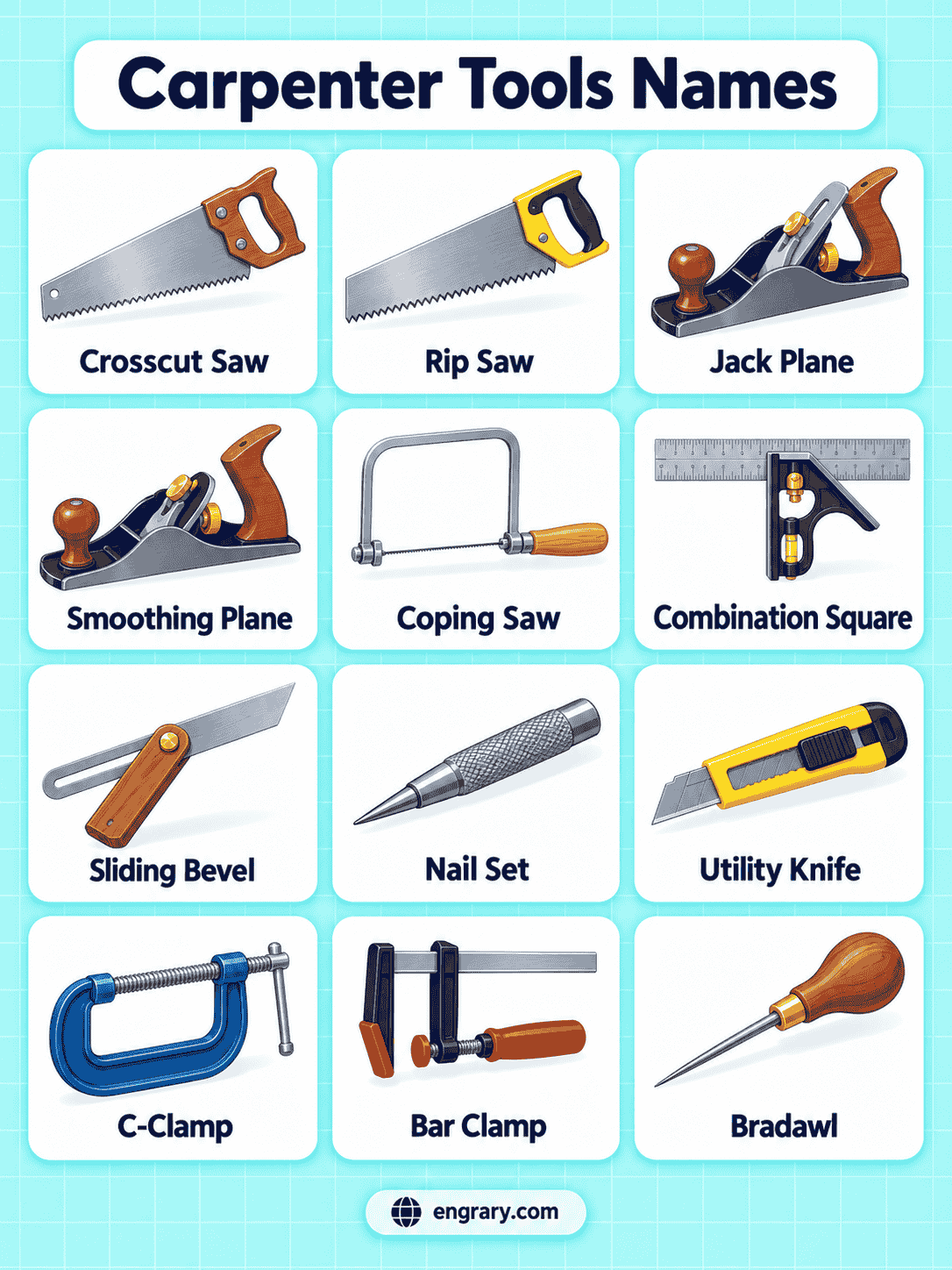
After cutting, carpenters often need to trim, shave, smooth, or refine wood so pieces fit correctly.
Wood Chisel
Cuts recesses, trims joints, removes waste, and refines wooden parts.
Block Plane
Trims edges, adjusts doors, and smooths end grain or small surfaces.
Jack Plane
Flattens broader surfaces and removes uneven material from rough or oversized boards.
Spokeshave
Shapes curved wooden parts such as handles, rails, and rounded edges.
Rasp
Removes wood quickly with coarse teeth when shaping irregular or curved areas.
Hand File
Smooths rough edges and refines wood, plastic, or metal fittings during carpentry work.
Cabinet Scraper
Shaves very thin layers from wood to refine surfaces and remove minor imperfections.
Surform Tool
Shapes and trims wood quickly with a perforated cutting surface.
Shoulder Plane
Trims shoulders, rebates, and joints where a standard plane cannot reach accurately.
Hammers, Nail Tools, and Fastening
Carpentry often requires driving fasteners, pulling nails, securing trim, and joining structural pieces.
Claw Hammer
Drives nails and removes them with its curved claw during general carpentry work.
Framing Hammer
Delivers heavier blows for structural framing, joists, studs, and larger nails.
Finish Hammer
Handles lighter nailing where the carpenter needs more control and less surface damage.
Nail Set
Pushes nail heads slightly below the wood surface so filler can hide them cleanly.
Cat’s Paw
Pulls deeply embedded nails from timber with a compact hooked claw.
Pry Bar
Lifts trim, separates fitted parts, adjusts framing, and removes boards or fasteners.
Nail Gun
Drives nails rapidly during framing, sheathing, flooring, and other repetitive fastening jobs.
Brad Nailer
Fires thin brads into delicate trim, molding, and lightweight wooden pieces.
Finish Nailer
Drives stronger finishing nails into baseboards, casings, cabinets, and larger trim.
Staple Gun
Fastens thin materials, backing, fabric, insulation, and some sheet products with staples.
Drilling and Screwdriving Tools
These tools create holes, install hardware, and drive screws into timber and other carpentry materials.
Cordless Drill
Drills holes and drives screws with rechargeable battery power.
Corded Drill
Provides continuous drilling power for longer jobs near an electrical supply.
Impact Driver
Drives long screws, structural fasteners, and stubborn fixings with high rotational force.
Right-Angle Drill
Reaches between studs, joists, cabinets, and other confined areas with a compact angled head.
Flathead Screwdriver
Turns slotted screws during hardware installation and adjustment.
Phillips Screwdriver
Fits cross-shaped screws commonly found in hinges, brackets, cabinets, and fixtures.
Ratcheting Screwdriver
Speeds up repeated screwdriving without requiring constant handle repositioning.
Countersink Tool
Creates a tapered recess so screw heads can sit flush or below the wood surface.
Brace
Bores larger holes manually with controlled turning force, especially in timber.
Hand Drill
Rotates smaller drill bits manually through a geared crank mechanism.
Holding and Assembly Tools
Clamps and vises keep carpentry work stable while pieces are glued, drilled, fitted, or fastened.
C-Clamp
Applies firm pressure to small or medium workpieces during repair and assembly.
F-Clamp
Holds wider pieces through a sliding jaw mounted on a long bar.
Bar Clamp
Secures broad panels, frames, and larger assemblies across a long clamping span.
Quick-Grip Clamp
Provides fast one-handed clamping for temporary holding and light assembly work.
Corner Clamp
Holds two pieces at a right angle while the carpenter joins or fastens them.
Bench Vise
Secures workpieces between fixed jaws for sawing, drilling, filing, or fitting.
Pipe Clamp
Uses a length of pipe to provide adjustable clamping capacity for wide assemblies.
Hand Screw Clamp
Controls pressure through independently adjustable wooden jaws, especially during woodworking.
Strap Clamp
Wraps around frames, boxes, and irregular assemblies to pull several sides together evenly.
Carpentry Work from Layout to Installation
Carpentry normally moves through several stages, and each stage calls for a different set of tools.
| Carpentry Stage | Common Tools |
|---|---|
| Measuring | Tape Measure, Spirit Level, Combination Square |
| Marking | Carpenter Pencil, Chalk Line, Speed Square |
| Cutting | Circular Saw, Hand Saw, Miter Saw |
| Shaping | Wood Chisel, Block Plane, Rasp |
| Holding | C-Clamp, F-Clamp, Bar Clamp |
| Fastening | Claw Hammer, Nail Gun, Impact Driver |
| Fitting | Pry Bar, Block Plane, Wood Chisel |
| Finishing | Nail Set, Brad Nailer, Finish Hammer |
A carpenter may move through several of these stages repeatedly during a single project.
Tools Used in Different Types of Carpentry
The exact tool set changes according to the kind of carpentry being completed.
| Carpentry Work | Common Tools |
|---|---|
| Framing | Framing Hammer, Speed Square, Circular Saw, Chalk Line, Nail Gun |
| Finish Carpentry | Miter Saw, Coping Saw, Nail Set, Brad Nailer, Block Plane |
| Door and Trim Work | Wood Chisel, Block Plane, Pry Bar, Spirit Level, Finish Nailer |
| Cabinet Installation | Cordless Drill, Impact Driver, Spirit Level, Clamps |
| Decking | Circular Saw, Framing Square, Cordless Drill, Impact Driver |
| Stair Work | Framing Square, Sliding Bevel, Miter Saw, Spirit Level |
| Panel and Sheet Work | Track Saw, Circular Saw, Combination Square, Clamps |
This division helps explain why two carpenters may carry different tools even though they work in the same trade.
Carpenter Tools for Framing vs Finish Work
Framing and finish carpentry both work with wood, but they prioritize different types of accuracy, speed, and appearance.
| Carpenter Work | Typical Tools |
|---|---|
| Framing Carpentry | Framing Hammer, Speed Square, Circular Saw, Chalk Line, Nail Gun |
| Finish Carpentry | Miter Saw, Coping Saw, Block Plane, Nail Set, Brad Nailer |
Framing tools support structural layout and fast assembly, while finish tools focus more on precise cuts, close fitting, and a clean final appearance.
Similar Carpenter Tools and How They Differ
Several carpentry tools perform related jobs, but their designs suit different situations.
| Tools | Main Difference |
|---|---|
| Speed Square vs Framing Square | A speed square is compact and quick for common angles and saw guides, while a framing square handles larger framing, rafter, and stair layouts. |
| Try Square vs Combination Square | A try square mainly checks 90-degree angles, while a combination square also measures depth and 45-degree angles. |
| Circular Saw vs Miter Saw | A circular saw moves across the material for portable cuts, while a miter saw stays fixed and excels at accurate crosscuts and angles. |
| Coping Saw vs Jigsaw | A coping saw makes manual detailed cuts, while a jigsaw cuts powered curves and shaped openings more quickly. |
| Claw Hammer vs Framing Hammer | A claw hammer handles general carpentry, while a framing hammer is heavier and better suited to structural nailing. |
| Block Plane vs Jack Plane | A block plane handles small trimming and end grain, while a jack plane works across broader surfaces and rougher stock. |
| Brad Nailer vs Finish Nailer | A brad nailer drives thinner fasteners for delicate trim, while a finish nailer drives larger nails for stronger finish work. |
The main difference usually comes down to the scale of the job, the accuracy required, or whether the tool suits structural or finish work.
Tools Carpenters Carry on the Job
Carpenters cannot carry every tool at once, so a belt, pouch, or small toolbox usually holds the compact tools needed most often.
Common jobsite choices include:
- Carpenter Pencil
- Tape Measure
- Speed Square
- Utility Knife
- Claw Hammer
- Nail Set
- Screwdriver
- Small Pry Bar
A carpenter may change this set according to the task. Framing work may call for a heavier hammer and speed square, while trim work may require a nail set, utility knife, and smaller measuring tools.
Carpentry Tools That Stay in the Workshop
Larger or more stable tools usually remain in a workshop because they need dedicated space, a bench, or a fixed setup.
Common examples include:
Table Saw
Handles repeated ripping and accurate sheet-material cuts from a fixed position.
Miter Saw
Stays on a bench or stand when repeated crosscuts and angle cuts are required.
Bench Vise
Mounts to a workbench and secures materials during fitting, sawing, or adjustment.
Large Bar Clamps
Remain in the workshop because their length makes them awkward to carry on routine jobsites.
Pipe Clamps
Suit large glued assemblies and panel work where wide clamping capacity matters.
Portable tools such as a cordless drill, circular saw, tape measure, and speed square are much easier to carry between jobs.
Carpenter Tools vs Woodworking Tools
Carpentry and woodworking overlap, but their typical work environments and priorities often differ.
| Carpenter Tools | Woodworking Tools |
|---|---|
| Often support framing, fitting, trim, installation, and jobsite work | Often support furniture, fine joinery, shaping, and bench work |
| Speed Square | Marking Gauge |
| Framing Hammer | Wooden Mallet |
| Circular Saw | Cabinet Scraper |
| Nail Gun | Fine Chisels |
| Chalk Line | Mortise Gauge |
A carpenter may still use woodworking tools, and a woodworker may use common carpenter tools. The difference lies mainly in the type of work rather than a strict boundary between the two tool groups.
FAQs
Common carpenter tools include tape measures, carpenter pencils, speed squares, framing squares, hammers, handsaws, circular saws, chisels, planes, drills, impact drivers, nail guns, and clamps.
Carpenters commonly use tape measures, speed squares, framing squares, combination squares, try squares, sliding bevels, spirit levels, chalk lines, and marking gauges.
Framing carpenters commonly use framing hammers, speed squares, framing squares, chalk lines, circular saws, nail guns, cordless drills, and impact drivers.
Finish carpenters often use miter saws, coping saws, block planes, chisels, nail sets, brad nailers, finish nailers, levels, and measuring tools.
Carpenter tools commonly support framing, trim, installation, and jobsite work, while woodworking tools often focus more on furniture, fine joinery, bench work, shaping, and detailed finishing.
You May Also Like



Leave a Comment