

Hand tools help people build, repair, cut, grip, measure, shape, tighten, and maintain everyday objects without relying on electricity or batteries. Learning common hand tools names in English makes it easier to recognize workshop items and understand vocabulary related to home repair, construction, carpentry, mechanics, and maintenance.
Below, you will learn 60 common hand tools and their practical uses, grouped into familiar tool families. You will also see which tools suit everyday repairs, how different trades use them, which similar tools learners often confuse, and which workshop items do not belong to the hand-tool category.
What Are Hand Tools?
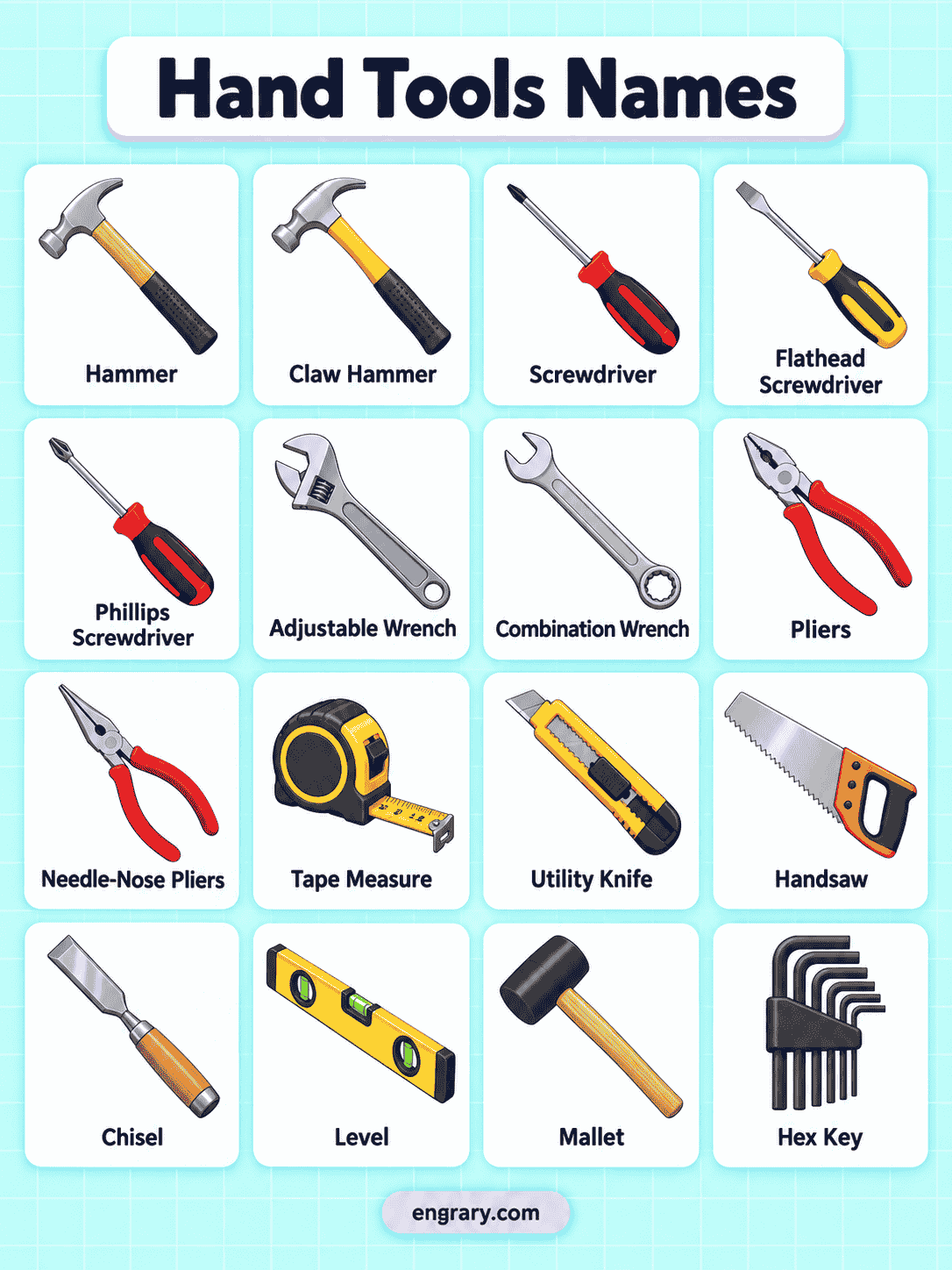
Hand tools are tools that people operate mainly by hand rather than with electricity, batteries, compressed air, or another external power source.
Common examples include hammers, screwdrivers, pliers, wrenches, handsaws, chisels, files, clamps, and measuring tools.
Manual operation defines this category, not size. A small screwdriver and a large sledgehammer both qualify as hand tools because the user supplies the force needed to operate them.
Essential Hand Tools You Should Know
Hand tools help people complete repair, building, measuring, cutting, fastening, and maintenance tasks without relying on large machines. Learning their names makes it easier to recognize common tools and understand basic instructions.
Hammer
A hammer drives nails, removes them, and handles light striking tasks.
Screwdriver
A screwdriver tightens or loosens screws with different head shapes.
Pliers
Pliers grip, bend, twist, and hold wires or small objects.
Adjustable Wrench
An adjustable wrench fits nuts and bolts of different sizes with its movable jaw.
Combination Wrench
A combination wrench has an open end and a ring end for turning nuts and bolts.
Hand Saw
A hand saw cuts wood and similar materials with a toothed blade.
Hacksaw
A hacksaw uses a fine blade to cut metal, plastic, and other hard materials.
Utility Knife
A utility knife cuts cardboard, plastic, rope, and other thin materials.
Tape Measure
A tape measure checks length, width, height, and distance.
Spirit Level
A spirit level shows whether a surface sits horizontally or vertically.
Chisel
A chisel cuts, shapes, or removes material from wood, stone, or metal.
File
A file smooths rough edges and shapes hard surfaces.
Allen Key
An Allen key turns screws and bolts with hexagonal sockets.
Socket Wrench
A socket wrench uses removable sockets to tighten or loosen nuts and bolts.
Wire Cutter
A wire cutter cuts electrical wire, cable, and thin metal.
Needle-Nose Pliers
Needle-nose pliers use long, narrow jaws to grip and bend small parts in tight spaces.
Clamp
A clamp holds materials firmly while someone cuts, drills, glues, or repairs them.
Mallet
A mallet strikes materials with less surface damage than a metal hammer.
Crowbar
A crowbar helps pry, lift, pull, or separate heavy materials.
Hand Drill
A hand drill makes small holes by turning a drill bit manually.
60 Hand Tools and What They’re Used For
The following list contains exactly 60 distinct hand tools. Each tool appears once and sits within the family that best matches its primary use.
Hammers and Mallets
Claw Hammer
Drives nails into wood and pulls them out with its curved claw.
Ball-Peen Hammer
Shapes metal and strikes punches during light metalworking jobs.
Cross-Peen Hammer
Shapes metal and helps start small nails or pins in narrow spaces.
Club Hammer
Delivers short, heavy blows for masonry work, demolition, and chisel striking.
Sledgehammer
Breaks tough materials and handles heavy demolition with powerful two-handed blows.
Rubber Mallet
Positions tiles, wood, and other materials without leaving marks from a metal head.
Screwdrivers and Hex Tools
Flathead Screwdriver
Turns screws with a single straight slot across the head.
Phillips Screwdriver
Fits cross-shaped Phillips screws for tightening and loosening common fasteners.
Pozidriv Screwdriver
Engages Pozidriv screws securely and reduces slipping during turning.
Torx Screwdriver
Fits star-shaped Torx screws found in furniture, machinery, electronics, and vehicles.
Ratcheting Screwdriver
Turns screws repeatedly through a ratchet mechanism without constant handle repositioning.
Allen Key
Tightens and loosens hex-socket screws and bolts with its L-shaped hexagonal shaft.
Pliers and Gripping Tools
Combination Pliers
Grip, bend, twist, and cut wire or other small materials.
Needle-Nose Pliers
Reach narrow spaces and hold small components with long, tapered jaws.
Slip-Joint Pliers
Adjust their jaw opening through a movable pivot to grip different object sizes.
Tongue-and-Groove Pliers
Grip pipes, fittings, and irregular objects with wide adjustable jaws.
Locking Pliers
Clamp tightly onto an object and maintain pressure without continuous hand force.
Linesman Pliers
Grip, twist, bend, and cut electrical wire with strong, broad jaws.
Wrenches and Socket Tools
Adjustable Wrench
Fits several nut and bolt sizes through a movable jaw.
Combination Wrench
Provides an open end for quick access and a box end for a firmer grip.
Open-End Wrench
Turns nuts and bolts from the side with its open jaws.
Box-End Wrench
Surrounds a fastener head to provide secure contact while turning.
Socket Wrench
Accepts interchangeable sockets for tightening and loosening different fastener sizes.
Ratchet
Drives sockets in one direction while allowing the handle to reset without removing the tool.
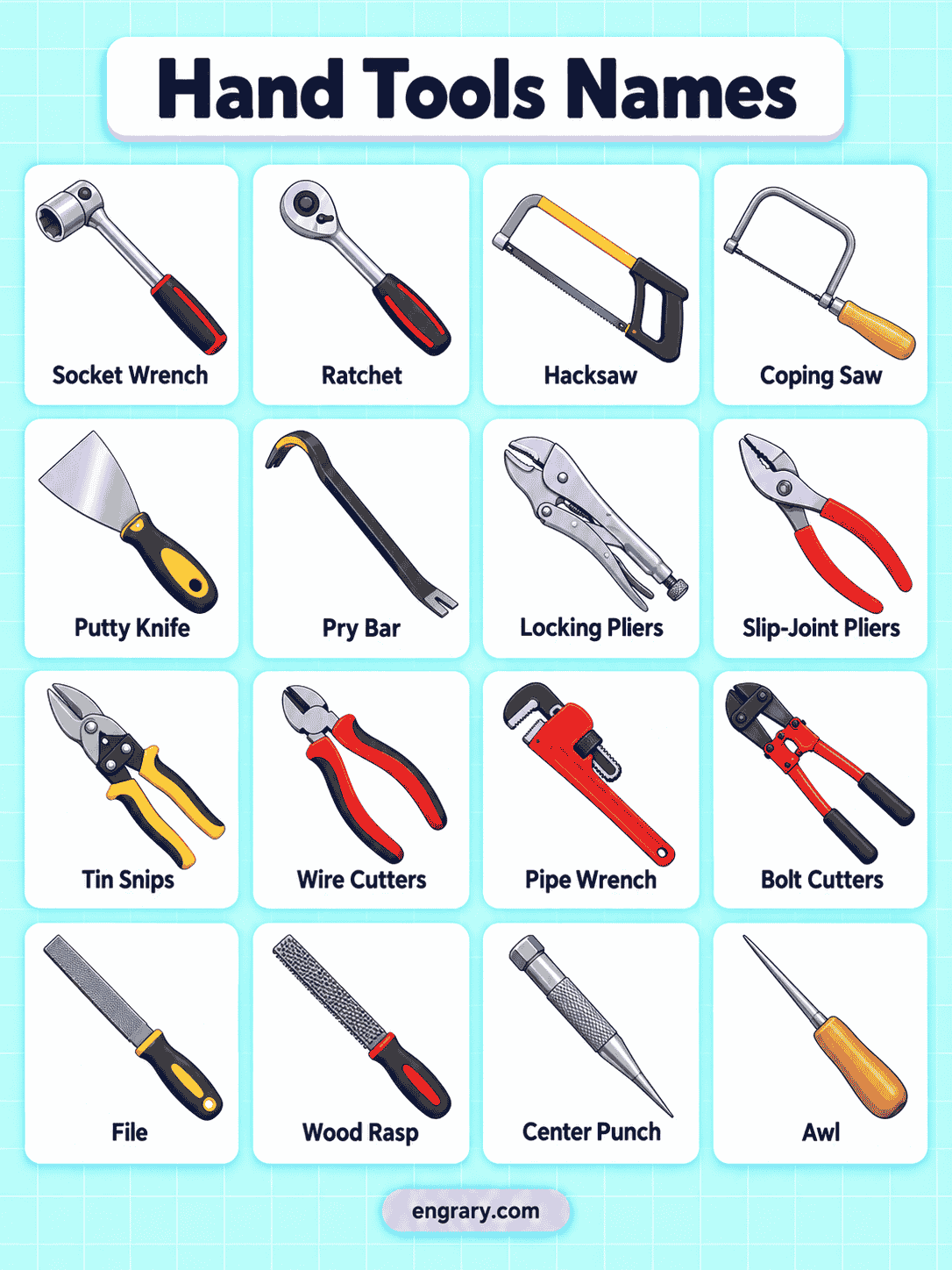
Saws and Manual Cutting Tools
Hand Saw
Cuts wood manually with a long toothed blade.
Hacksaw
Slices through metal, plastic, and small pipes with a fine-toothed replaceable blade.
Coping Saw
Creates curved, detailed, and decorative cuts with a narrow flexible blade.
Backsaw
Makes controlled woodworking cuts with a fine blade reinforced along its back edge.
Utility Knife
Cuts cardboard, carpet, drywall, plastic, and other lightweight materials with a sharp replaceable blade.
Tin Snips
Cut thin sheet metal with short, powerful hand-operated blades.
Chisels, Files, and Shaping Tools
Wood Chisel
Cuts, carves, and shapes wood with a sharpened beveled edge.
Cold Chisel
Cuts and chips metal, masonry, and other hard materials when struck with a hammer.
Hand File
Smooths edges and gradually removes material through rows of small cutting teeth.
Rasp
Shapes wood and other soft materials quickly with its coarse raised teeth.
Hand Plane
Shaves thin layers from wood to flatten, straighten, or smooth a surface.
Block Plane
Trims edges and end grain while handling small woodworking adjustments.
Measuring and Layout Tools
Tape Measure
Checks length, width, height, and distance with a flexible graduated tape.
Steel Ruler
Measures short distances and provides a rigid straight edge for marking.
Spirit Level
Checks horizontal and vertical alignment through liquid-filled bubble vials.
Try Square
Marks and verifies accurate 90-degree angles in woodworking and layout work.
Combination Square
Measures angles, checks square corners, marks lines, and gauges depth.
Marking Gauge
Scores a consistent line parallel to the edge of a wooden board.
Clamps and Holding Tools
C-Clamp
Holds materials firmly during gluing, drilling, cutting, or assembly.
Bar Clamp
Secures wide workpieces through a long bar and sliding adjustable jaw.
Spring Clamp
Provides quick light-pressure holding through spring-loaded jaws.
Bench Vise
Secures a workpiece between adjustable jaws mounted to a workbench.
Hand Screw Clamp
Holds woodworking pieces between two wooden jaws adjusted by threaded screws.
F-Clamp
Applies steady clamping pressure across medium or large workpieces with a sliding jaw.
Prying, Pulling, and Demolition Tools
Crowbar
Lifts, separates, and pries heavy materials through strong leverage.
Pry Bar
Separates boards, lifts fitted pieces, and removes fastened materials with controlled leverage.
Nail Puller
Grips and extracts nails that sit too deep for an ordinary hammer claw.
Wrecking Bar
Handles heavy dismantling, demolition, and forceful prying work.
Cat’s Paw
Digs around and pulls deeply embedded nails from wooden surfaces.
Pinch Bar
Lifts, shifts, or pries heavy objects with a long rigid metal lever.
Manual Drilling, Piercing, and Threading Tools
Awl
Pierces small holes and marks precise points in leather, wood, and similar materials.
Bradawl
Starts narrow holes in wood before screws or nails enter the surface.
Gimlet
Bores small holes in wood through a screw-like point and hand-twisting action.
Brace
Rotates drilling bits manually to bore holes, especially in timber.
Tap Wrench
Holds and turns a tap while creating internal screw threads.
Die Stock
Holds a die securely while cutting external threads on rods or pipes.
Most Useful Hand Tools for Everyday Repairs
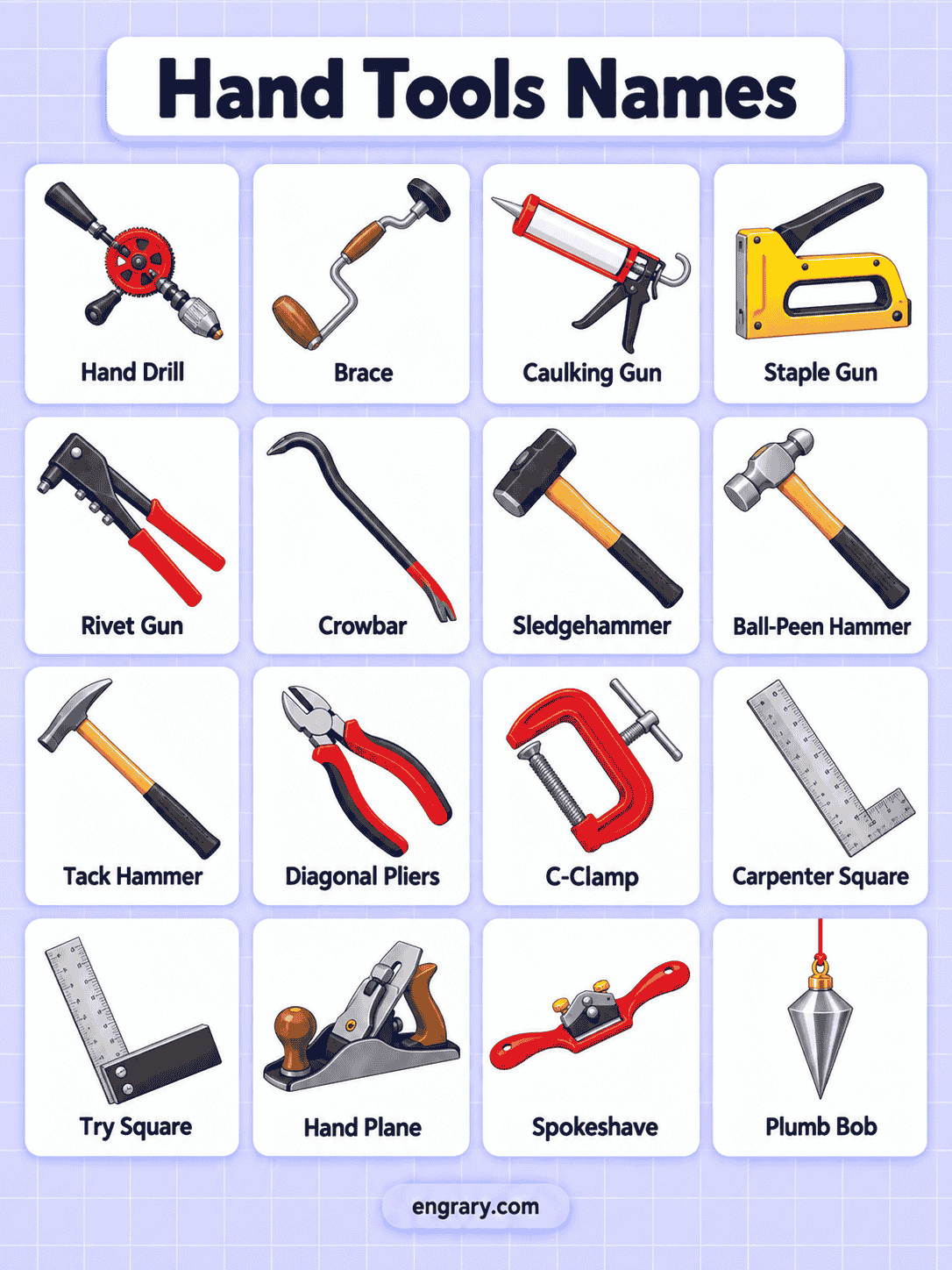
A practical home toolbox does not need all 60 hand tools. A smaller selection can handle many routine repair and maintenance jobs.
For furniture assembly and loose fasteners, Flathead Screwdrivers, Phillips Screwdrivers, Allen Keys, and an Adjustable Wrench cover many common needs. A Claw Hammer handles nails, while Combination Pliers and Needle-Nose Pliers help with gripping, bending, and small-object work.
A Tape Measure helps with furniture placement, picture hanging, and material measurements. A Spirit Level checks alignment, while a Utility Knife handles packaging and lightweight cutting. A Hand Saw covers simple wood-cutting jobs, and a C-Clamp holds pieces firmly during repairs.
Hand Tools Used by Different Trades
Different trades depend on different combinations of hand tools according to the materials and tasks involved.
| Trade | Common Hand Tools |
|---|---|
| Carpenter | Claw Hammer, Wood Chisel, Hand Plane, Try Square, Hand Saw |
| Electrician | Linesman Pliers, Needle-Nose Pliers, Flathead Screwdriver, Phillips Screwdriver, Wire Cutter |
| Plumber | Adjustable Wrench, Tongue-and-Groove Pliers, Pipe Wrench, Basin Wrench |
| Mechanic | Ratchet, Socket Wrench, Combination Wrench, Torque Wrench |
| Mason | Club Hammer, Cold Chisel, Trowel, Spirit Level |
| Woodworker | Block Plane, Wood Chisel, Marking Gauge, Backsaw, C-Clamp |
These trade groups also connect naturally to more specialized vocabulary such as carpenter tools, electrician tools, plumber tools, and mechanic tools.
Hand Tools by Job
Learning tools by task can make their names and functions easier to remember.
For Cutting
Hand Saw, Hacksaw, Coping Saw, Backsaw, Utility Knife, and Tin Snips cut different materials manually.
For Gripping and Holding
Combination Pliers, Needle-Nose Pliers, Locking Pliers, C-Clamp, Bar Clamp, and Bench Vise secure or control materials.
For Tightening and Loosening
Screwdrivers, Allen Keys, Adjustable Wrenches, Combination Wrenches, Socket Wrenches, and Ratchets turn screws, nuts, and bolts.
For Measuring and Layout
Tape Measures, Steel Rulers, Spirit Levels, Try Squares, Combination Squares, and Marking Gauges support accurate measurement and positioning.
For Shaping
Wood Chisels, Cold Chisels, Files, Rasps, Hand Planes, and Block Planes remove or reshape material.
For Prying and Removing
Crowbars, Pry Bars, Nail Pullers, Wrecking Bars, Cat’s Paws, and Pinch Bars separate, lift, or remove materials.
Small Hand Tools vs Heavy Hand Tools
Hand tools vary greatly in weight and size. Their classification depends on manual operation rather than physical size.
| Small Hand Tools | Heavy Hand Tools |
|---|---|
| Allen Key | Sledgehammer |
| Screwdriver | Crowbar |
| Awl | Wrecking Bar |
| Needle-Nose Pliers | Pinch Bar |
| Utility Knife | Club Hammer |
Both groups rely mainly on human force. Smaller tools usually handle detailed or lighter work, while heavier tools suit demolition, lifting, striking, and demanding repair tasks.
Hand Tools Beginners Often Confuse
Several hand tools look similar or perform related jobs, so learners often mix up their names.
Hammer vs Mallet
A hammer usually has a hard metal head for forceful striking. A mallet often has a softer head that reduces surface damage.
Pliers vs Wire Cutters
Pliers mainly grip, bend, twist, or hold materials. Wire cutters focus on cutting wire and thin metal strands.
Wrench vs Adjustable Wrench
A fixed wrench fits a specific fastener size, while an adjustable wrench changes its jaw width to fit several sizes.
Hand Saw vs Hacksaw
A hand saw mainly cuts wood, while a hacksaw commonly cuts metal, plastic, and tubing.
Chisel vs File
A chisel removes material through a sharpened cutting edge. A file smooths or reshapes surfaces gradually through many small teeth.
Clamp vs Vise
A clamp moves between different work locations, while a bench vise normally stays fixed to a workbench.
Crowbar vs Pry Bar
A crowbar generally suits heavier levering and demolition, while a pry bar often provides more controlled separation and removal.
What Is Not a Hand Tool?
Workshops contain many items related to tools, but not all of them qualify as hand tools.
| Item | Correct Category |
|---|---|
| Power Drill | Power tool |
| Circular Saw | Power tool |
| Workbench | Workshop equipment |
| Toolbox | Storage item |
| Screw | Fastener |
| Nail | Fastener |
| Bolt | Fastener |
| Saw Blade | Tool component or accessory |
| Safety Goggles | Protective equipment |
| Work Gloves | Protective equipment |
A screwdriver, for example, is a hand tool, while the screw it turns is a fastener.
Likewise, a hand saw is a tool, while its replacement saw blade is a component or accessory.
FAQs
Common hand tools include hammers, screwdrivers, pliers, wrenches, handsaws, hacksaws, utility knives, chisels, files, tape measures, levels, clamps, and vises.
Useful beginner tools include a claw hammer, flathead screwdriver, Phillips screwdriver, combination pliers, adjustable wrench, Allen key, utility knife, tape measure, spirit level, hand saw, and clamp.
Common manual cutting tools include hand saws, hacksaws, coping saws, backsaws, utility knives, and tin snips.
A clamp is portable and can secure materials in different locations, while a bench vise usually stays attached to a workbench and grips a workpiece between fixed jaws.
Yes. A sledgehammer qualifies as a hand tool because a person operates it manually without electricity, batteries, compressed air, or another external power source.
You May Also Like



Leave a Comment