

Power tools make drilling, cutting, sanding, fastening, shaping, demolition, and outdoor work faster and easier than manual methods alone. Learning common power tools names in English helps you recognize workshop equipment and understand vocabulary used in construction, carpentry, mechanics, woodworking, metalworking, and home repair.
Below, you will learn 50 common power tools and what each one does. The article also explains which tools suit different jobs and trades, how corded and cordless tools differ, which power sources they use, and how to tell apart power tools that look or work similarly.
What Are Power Tools?
Power tools are tools that operate through an external power source such as electricity, rechargeable batteries, compressed air, fuel, or hydraulic pressure.
Examples include drills, circular saws, grinders, sanders, nail guns, routers, and demolition hammers.
Some power tools are portable and move with the user, while others stay fixed on a bench, stand, or workshop floor.
For example:
Cordless Drill
Drills holes and drives screws with rechargeable battery power.
Circular Saw
Makes fast straight cuts with a rotating blade.
Angle Grinder
Cuts, grinds, cleans, and smooths hard materials with interchangeable discs.
Common Power Tools You Should Know
Power tools use electricity, batteries, or compressed air to make cutting, drilling, sanding, fastening, and repair work faster and easier. Learning common power tool names helps beginners and English learners recognize useful equipment found in homes, workshops, and job sites.
Power Drill
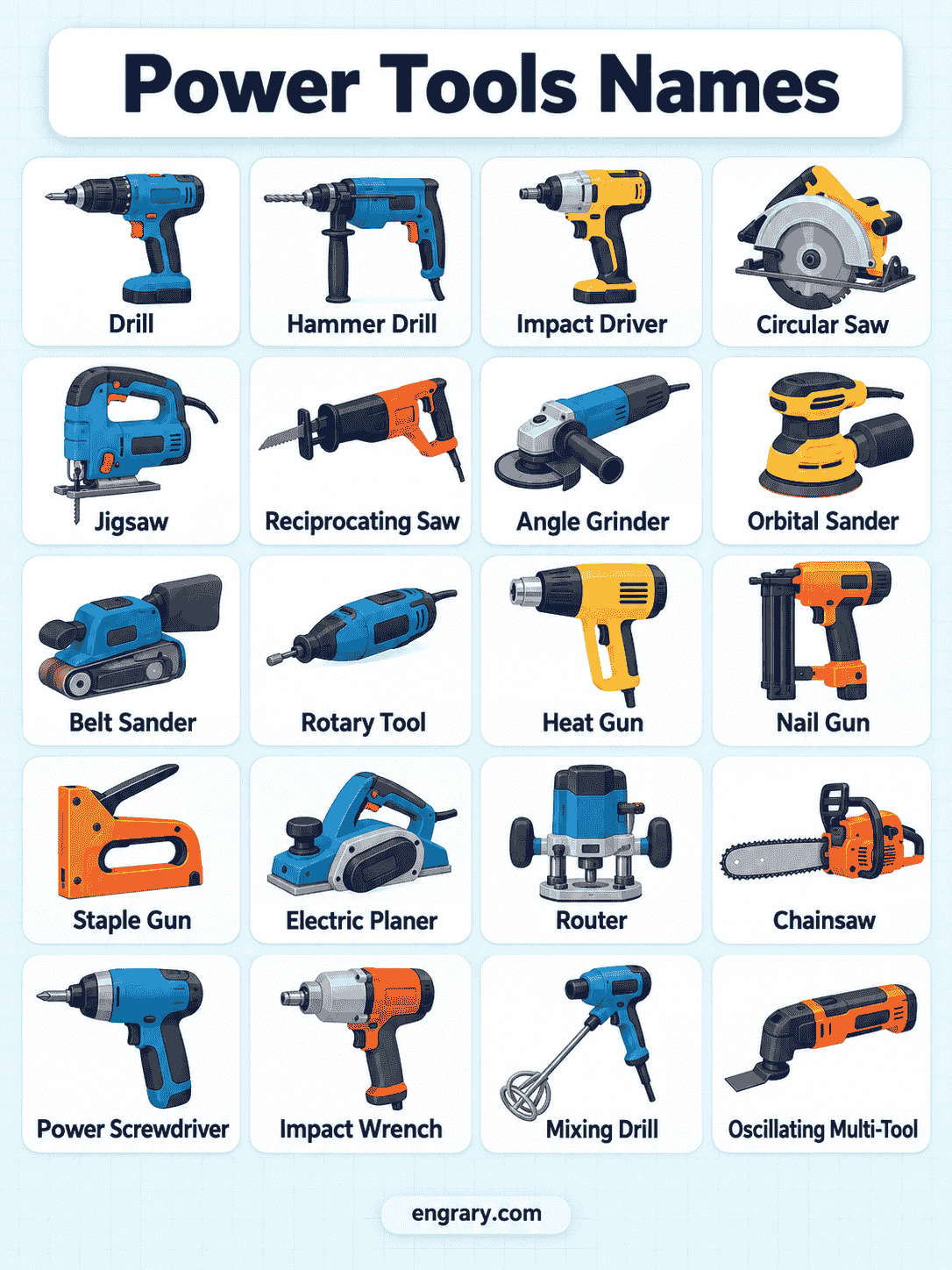
A power drill rotates drill bits to make holes in wood, metal, plastic, and other materials. Many models can also drive screws.
Impact Driver
An impact driver delivers strong rotational force for driving screws and bolts into tough materials.
Circular Saw
A circular saw uses a fast-spinning round blade to make straight cuts through wood, boards, and other materials.
Jigsaw
A jigsaw uses a narrow moving blade to cut curves, shapes, and straight lines in wood, plastic, and thin metal.
Reciprocating Saw
A reciprocating saw moves its blade back and forth rapidly. Workers often use it for demolition and rough cutting.
Miter Saw
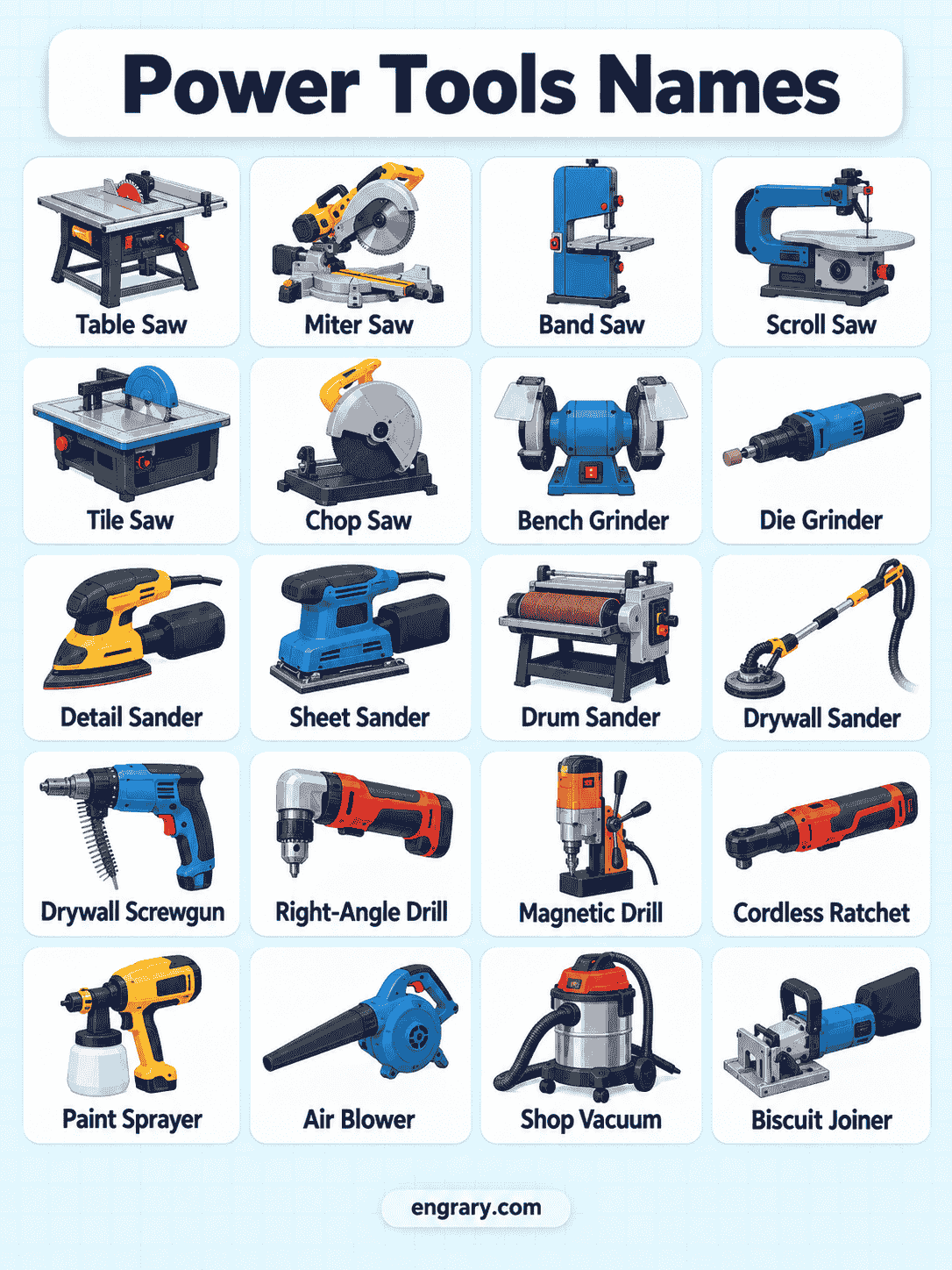
A miter saw makes accurate straight and angled cuts. It works well for trim, frames, molding, and woodworking projects.
Table Saw
A table saw uses a circular blade that rises through a flat table surface. It helps make long, accurate cuts in boards and sheet materials.
Angle Grinder
An angle grinder spins a cutting or grinding disc at high speed. It can cut metal, smooth surfaces, remove rust, and shape materials.
Bench Grinder
A bench grinder has rotating abrasive wheels mounted on a fixed base. People use it to sharpen tools and smooth metal edges.
Orbital Sander
An orbital sander moves a sanding pad in small circular patterns to smooth wood and other surfaces.
Belt Sander
A belt sander uses a continuous loop of sandpaper to remove material quickly from large or rough surfaces.
Rotary Tool
A rotary tool spins small attachments at high speed for cutting, grinding, polishing, engraving, and detailed work.
Power Screwdriver
A power screwdriver uses a motor to tighten or loosen screws quickly.
Hammer Drill
A hammer drill combines rotation with a rapid hammering action to drill into brick, concrete, and masonry.
Rotary Hammer
A rotary hammer delivers stronger hammering force than a standard hammer drill. Workers use it for heavy drilling and chiseling in concrete or stone.
Nail Gun
A nail gun drives nails into wood or other materials quickly using electricity, batteries, gas, or compressed air.
Heat Gun
A heat gun produces a stream of hot air. People use it for removing paint, shrinking tubing, softening adhesives, and other controlled heating tasks.
Electric Planer
An electric planer removes thin layers from wooden surfaces to smooth, level, or reduce their thickness.
Router
A router uses a fast-spinning cutting bit to shape edges, cut grooves, and create decorative patterns in wood.
Air Compressor
An air compressor stores compressed air to power pneumatic tools such as nail guns, spray equipment, and air wrenches.
50 Power Tools and What They Do
Each tool below appears once and sits within the family that best matches its main function.
Drills and Drivers
Corded Drill
Drills holes and drives fasteners while drawing continuous electricity from a power outlet.
Cordless Drill
Handles drilling and screwdriving with rechargeable battery power for greater portability.
Hammer Drill
Combines rotation with rapid hammering action to drill into brick, block, and light masonry.
Rotary Hammer
Delivers stronger rotary and hammering action for demanding drilling in concrete and masonry.
Impact Driver
Drives screws and other fasteners with high rotational force and rapid impacts.
Right-Angle Drill
Reaches narrow spaces with a drill head positioned at a right angle to the body.
Powered Saws
Circular Saw
Makes fast straight cuts through wood, sheet materials, and suitable construction products.
Jigsaw
Creates curved, straight, and detailed cuts with a narrow reciprocating blade.
Reciprocating Saw
Handles rough cutting and demolition through a long blade that moves rapidly back and forth.
Miter Saw
Makes accurate crosscuts, angled cuts, and miters with a mounted circular blade.
Table Saw
Cuts boards and sheet materials by feeding them across a stationary rotating blade.
Band Saw
Cuts straight lines, curves, and irregular shapes with a continuous looped blade.
Scroll Saw
Creates intricate curves and detailed patterns in thin wood and similar materials.
Track Saw
Guides a circular blade along a rail to produce long, accurate straight cuts.
Grinders and Metal-Cutting Tools
Angle Grinder
Cuts, grinds, cleans, and polishes metal, masonry, and other hard surfaces.
Bench Grinder
Sharpens, shapes, cleans, and smooths metal with grinding wheels mounted on a fixed base.
Die Grinder
Performs detailed grinding, deburring, polishing, and shaping with small rotating attachments.
Cut-Off Tool
Slices through metal, bolts, sheet material, and other hard objects with a thin abrasive disc.
Metal Shear
Cuts sheet metal quickly with powered blades while producing relatively clean edges.
Sanders and Surface-Finishing Tools
Random Orbital Sander
Smooths surfaces with random orbital motion that helps reduce visible sanding marks.
Orbital Sander
Handles general surface smoothing and finishing through small repeating orbital movements.
Belt Sander
Removes material rapidly with a continuous abrasive belt.
Detail Sander
Reaches corners, edges, and narrow areas with a small pointed sanding pad.
Polisher
Refines and shines painted, metal, stone, or finished surfaces with rotating polishing pads.
Fastening Power Tools
Nail Gun
Drives nails rapidly into wood and other suitable materials.
Brad Nailer
Fires thin brad nails for lightweight trim, molding, and delicate woodworking.
Finish Nailer
Drives larger finishing nails for trim, baseboards, cabinetry, and similar work.
Pneumatic Stapler
Uses compressed air to drive staples into fabric, wood, sheathing, and other materials.
Impact Wrench
Tightens and loosens nuts and bolts with strong rotational impacts and high torque.
Woodworking Power Tools
Router
Cuts grooves, profiles edges, hollows areas, and shapes wood with high-speed rotating bits.
Laminate Trimmer
Handles light routing, edge trimming, and laminate work with a compact motorized cutter.
Power Planer
Shaves thin layers from wooden surfaces to flatten, resize, or smooth boards.
Biscuit Joiner
Cuts matching slots for compressed wooden biscuits that help align and join boards.
Wood Lathe
Rotates wooden workpieces so they can be shaped into rounded or symmetrical forms.
Demolition and Heavy-Duty Tools
Jackhammer
Breaks concrete, pavement, stone, and other hard surfaces through repeated heavy impacts.
Demolition Hammer
Chips, breaks, and removes concrete, tile, masonry, and similar materials.
Concrete Breaker
Delivers powerful impacts for breaking thick concrete and other dense construction materials.
Wall Chaser
Cuts narrow parallel channels in masonry walls for pipes, conduits, or electrical cables.
Specialty Power Tools
Heat Gun
Produces a stream of hot air for paint removal, heat-shrink tubing, bending plastic, and adhesive work.
Paint Sprayer
Applies paint or coatings as a controlled spray over walls, furniture, and other surfaces.
Rotary Tool
Cuts, grinds, engraves, sands, polishes, and drills small workpieces with interchangeable attachments.
Hot Glue Gun
Heats adhesive sticks and dispenses molten glue for craft, repair, and light assembly work.
Outdoor Power Tools
Chainsaw
Cuts logs, branches, and timber with a motor-driven chain moving around a guide bar.
Hedge Trimmer
Trims hedges and shrubs with rapidly moving cutting blades.
String Trimmer
Cuts grass and weeds around edges, fences, trees, and areas that lawn mowers cannot easily reach.
Leaf Blower
Moves leaves, grass clippings, and light outdoor debris with a strong stream of air.
Pole Saw
Cuts elevated branches with a powered saw mounted on a long pole.
Lawn Mower
Cuts grass evenly across lawns with powered rotating blades.
Brush Cutter
Clears thick grass, weeds, and heavier vegetation with a powered cutting head.
Pressure Washer
Cleans outdoor surfaces by directing water at high pressure.
Power Tools by Job
Different power tools suit different tasks, so grouping them by job makes their uses easier to understand.
Drilling Jobs
Cordless Drills, Hammer Drills, Rotary Hammers, Drill Presses, and Right-Angle Drills create holes in wood, metal, masonry, and other materials.
Fastening Work
Impact Drivers, Cordless Drills, Nail Guns, Pneumatic Staplers, and Impact Wrenches speed up screwdriving, nailing, stapling, and bolt work.
Wood Cutting
Circular Saws, Jigsaws, Miter Saws, Table Saws, Band Saws, Scroll Saws, and Track Saws handle straight, curved, angled, and detailed cuts.
Metal Cutting
Angle Grinders, Cut-Off Tools, Metal Shears, and suitable powered saws cut sheet metal, rods, bolts, and other metal parts.
Sanding and Finishing
Random Orbital Sanders, Orbital Sanders, Belt Sanders, Detail Sanders, and Polishers smooth, refine, or polish surfaces.
Demolition Work
Reciprocating Saws, Jackhammers, Demolition Hammers, and Concrete Breakers cut, chip, and break tough materials.
Outdoor Tasks
Chainsaws, Hedge Trimmers, String Trimmers, Pole Saws, Lawn Mowers, and Brush Cutters handle pruning, grass cutting, vegetation clearing, and other landscape work.
Power Tools Used by Different Trades
Different trades rely on particular power tools according to the materials and jobs they handle.
| Trade | Common Power Tools |
|---|---|
| Carpenter | Circular Saw, Miter Saw, Impact Driver, Power Planer |
| Woodworker | Table Saw, Router, Jigsaw, Random Orbital Sander |
| Electrician | Cordless Drill, Rotary Hammer, Impact Driver, Heat Gun |
| Mechanic | Impact Wrench, Die Grinder, Bench Grinder |
| Metalworker | Angle Grinder, Cut-Off Tool, Metal Shear, Bench Grinder |
| Construction Worker | Rotary Hammer, Circular Saw, Jackhammer, Demolition Hammer |
| Painter or Decorator | Paint Sprayer, Random Orbital Sander, Heat Gun |
| Landscaper | Chainsaw, Hedge Trimmer, String Trimmer, Brush Cutter |
These groups show how the same power tool can serve several professions while specialist trades develop their own larger tool sets.

Corded vs Cordless Power Tools
Power tools can receive electricity directly through a cable or store energy in rechargeable batteries.
| Corded Power Tools | Cordless Power Tools |
|---|---|
| Connect to an electrical outlet | Run on rechargeable batteries |
| Provide continuous power while connected | Offer greater freedom of movement |
| Do not need battery charging | Require charged battery packs |
| Suit long work sessions near power | Suit mobile and remote jobs |
| Corded Drill | Cordless Drill |
| Corded Circular Saw | Cordless Circular Saw |
Neither design changes the basic function of the tool. A corded drill and cordless drill can both drill holes, but their power supply and portability differ.
Power Tools by Power Source
Not every power tool runs directly from an electrical outlet.
| Power Source | How It Works | Example |
|---|---|---|
| Mains Electricity | Draws power through a cord | Table Saw |
| Rechargeable Battery | Stores electrical energy in a removable or built-in battery | Cordless Drill |
| Compressed Air | Uses air pressure supplied by a compressor | Pneumatic Stapler |
| Fuel | Burns petrol or another fuel to power an engine | Chainsaw |
| Hydraulic Power | Uses pressurized fluid to create force | Hydraulic Breaker |
This means power tool is broader than electric tool.
Some tools also exist in several versions. For example, nailers may use batteries, compressed air, or other power systems.
Portable vs Stationary Power Tools
Power tools also differ in how they move and where people operate them.
| Portable Power Tools | Stationary Power Tools |
|---|---|
| Move with the user | Usually stay fixed in one location |
| Often handheld | Commonly mount to a stand, bench, or floor |
| Cordless Drill | Table Saw |
| Angle Grinder | Bench Grinder |
| Jigsaw | Band Saw |
| Circular Saw | Wood Lathe |
A stationary tool is still a power tool even though the user brings the material to the machine rather than carrying the tool to the material.
Power Tools Beginners Often Confuse
Several powered tools look similar or perform related tasks, but their main functions differ.
Drill vs Impact Driver
A drill primarily creates holes and can drive screws. An impact driver specializes in driving fasteners with higher rotational force.
Hammer Drill vs Rotary Hammer
A hammer drill adds light hammering action to rotation for masonry work. A rotary hammer delivers much stronger impact action for heavier concrete drilling.
Circular Saw vs Miter Saw
A circular saw moves across the material during cutting. A miter saw stays mounted while its blade lowers onto the workpiece.
Jigsaw vs Reciprocating Saw
A jigsaw handles controlled curves and detailed cuts. A reciprocating saw focuses more on rough cutting and demolition.
Orbital Sander vs Belt Sander
An orbital sander provides controlled surface smoothing, while a belt sander removes material much more aggressively.
Impact Driver vs Impact Wrench
An impact driver mainly drives screws and smaller fasteners. An impact wrench delivers much higher torque for nuts and bolts.
Angle Grinder vs Bench Grinder
An angle grinder is portable and moves across the workpiece. A bench grinder stays fixed while the material moves against its grinding wheels.
What Is Not a Power Tool?
Many workshop objects support power-tool work without being power tools themselves.
| Item | Correct Category |
|---|---|
| Hammer | Hand tool |
| Drill Bit | Tool accessory or cutting bit |
| Saw Blade | Tool component or accessory |
| Grinding Disc | Abrasive accessory |
| Sanding Disc | Abrasive accessory |
| Battery Pack | Power-tool accessory |
| Extension Cord | Electrical accessory |
| Workbench | Workshop equipment |
| Generator | Power source or equipment |
| Screw | Fastener |
| Safety Goggles | Protective equipment |
For example, a Cordless Drill is a power tool, while the drill bit fitted into it is a cutting accessory.
Likewise, an Angle Grinder is a power tool, while its grinding disc is an accessory or consumable component.
FAQs
Common power tools include cordless drills, impact drivers, circular saws, jigsaws, reciprocating saws, angle grinders, sanders, nail guns, impact wrenches, routers, and heat guns.
Corded tools draw continuous electricity through a cable, while cordless tools run on rechargeable batteries and provide greater portability.
Circular saws, jigsaws, reciprocating saws, miter saws, table saws, band saws, angle grinders, and cut-off tools commonly handle cutting tasks.
Corded drills, cordless drills, hammer drills, rotary hammers, impact drivers, nail guns, staplers, and impact wrenches handle common drilling and fastening jobs.
No. Power tools can run on mains electricity, rechargeable batteries, compressed air, fuel, or hydraulic power.
You May Also Like


Leave a Comment