
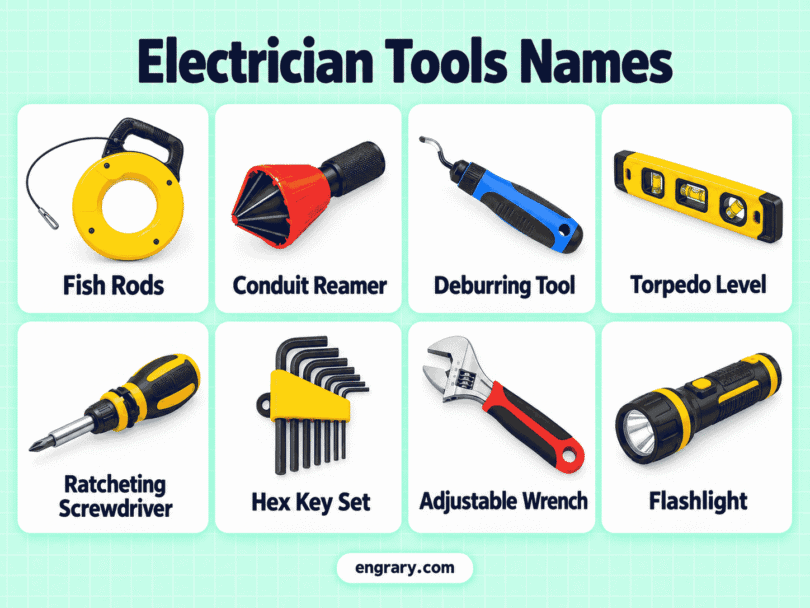
Electricians use specialized tools to test circuits, prepare wires, pull cables, bend conduit, install fittings, terminate conductors, and troubleshoot electrical systems. Learning common electrician tools names in English makes it easier to recognize equipment used in electrical installation, maintenance, testing, communication wiring, and repair work.
This article covers 100 electrician tools with their main uses, from everyday hand tools to testing instruments, conduit tools, cable-pulling equipment, and specialized diagnostic devices. You will also learn which tools suit different electrical jobs, how similar tools differ, and how electrician tools compare with electrical supplies.
Common Electrician Tools Names
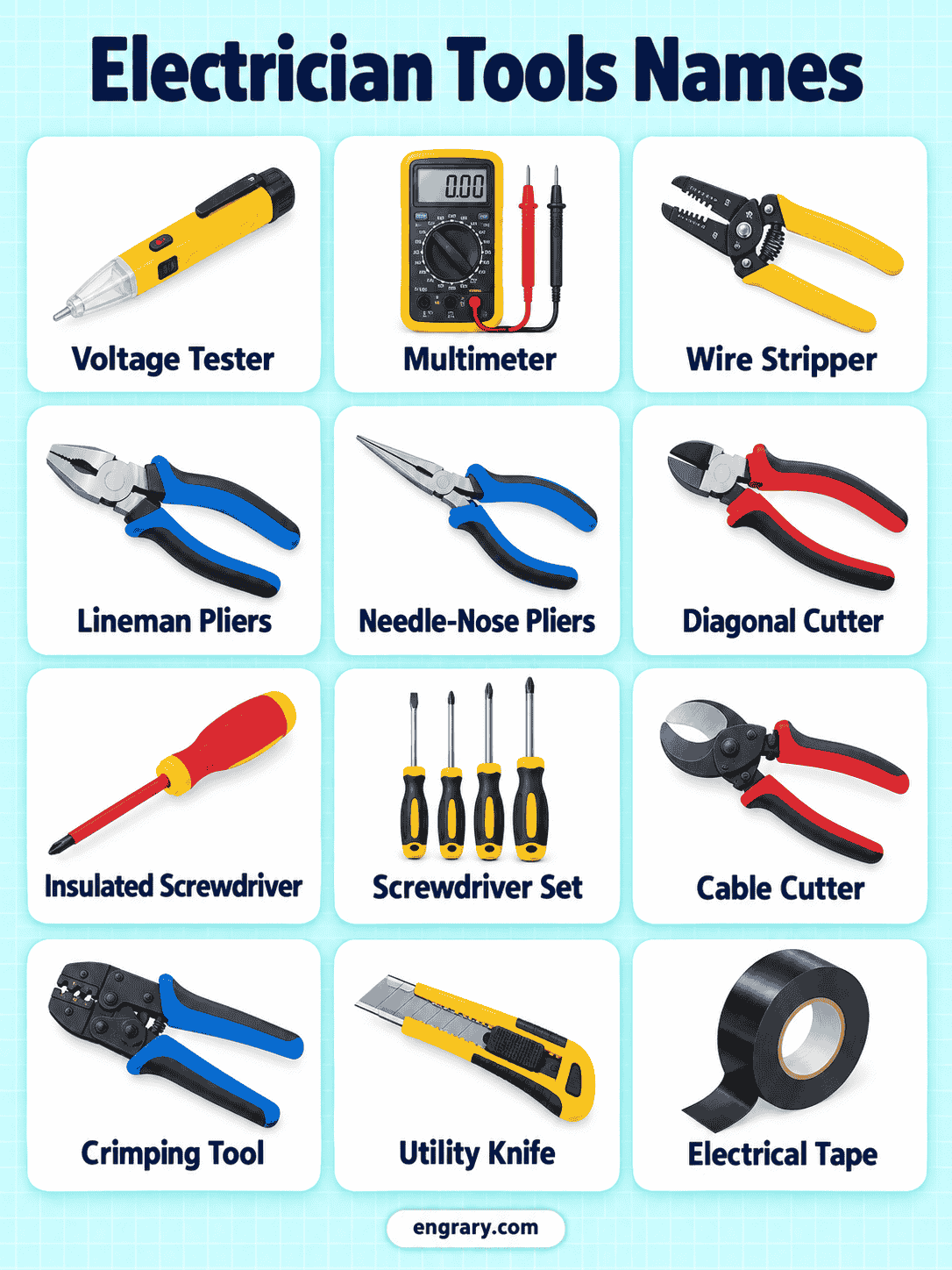
Some electrician tools appear regularly because they handle everyday testing, wiring, cutting, gripping, fastening, and installation jobs. These familiar names provide a quick overview before the complete list.
Digital Multimeter
A digital multimeter measures electrical values such as voltage, resistance, continuity, and current.
Clamp Meter
A clamp meter measures current around a conductor without requiring the conductor to be disconnected.
Non-Contact Voltage Tester
A non-contact voltage tester indicates the possible presence of AC voltage without touching exposed conductors.
Wire Stripper
A wire stripper removes insulation from electrical conductors.
Cable Cutter
A cable cutter cuts electrical cable with shaped cutting jaws.
Linesman Pliers
Linesman pliers grip, twist, bend, and cut wires during electrical work.
Needle-Nose Pliers
Needle-nose pliers reach narrow spaces and hold small wires, terminals, and components.
Diagonal Cutters
Diagonal cutters trim small wires and conductor ends.
Insulated Screwdriver
An insulated screwdriver turns electrical terminals and fasteners while providing insulated protection around the shaft and handle.
Crimping Tool
A crimping tool compresses terminals or connectors onto electrical conductors.
Punchdown Tool
A punchdown tool seats communication wires into insulation-displacement terminals.
Fish Tape
Fish tape helps pull wires through conduit and other enclosed routes.
Fish Rod Set
Fish rods guide cables through wall cavities, ceilings, and similar spaces.
Conduit Bender
A conduit bender forms controlled bends in electrical conduit.
Knockout Punch
A knockout punch creates clean openings in electrical enclosures.
Cordless Drill
A cordless drill makes holes and drives fasteners during installation work.
Impact Driver
An impact driver drives screws and fixings with strong rotational force.
Tape Measure
A tape measure checks cable runs, mounting heights, and equipment spacing.
Torpedo Level
A torpedo level checks boxes, conduit, panels, and fixtures for level or plumb.
Thermal Imaging Camera
A thermal imaging camera shows temperature patterns that can help identify abnormal heating in electrical equipment.
Essential Electrician Tools for Wiring, Testing, and Installation
The following list contains exactly 100 distinct electrician tools, grouped according to their main role in testing, wire preparation, gripping, termination, cable pulling, conduit work, installation, measurement, and troubleshooting.
Electrical Testing Tools
Electrical testing instruments help electricians detect voltage, measure circuit conditions, verify connections, and investigate faults.
Digital Multimeter
Measures voltage, resistance, continuity, and other electrical values through test leads.
Clamp Meter
Measures current by clamping around a conductor and may also provide voltage or resistance measurements.
Non-Contact Voltage Tester
Indicates the possible presence of AC voltage without direct contact with exposed conductors.
Two-Pole Voltage Tester
Checks voltage between two electrical test points through a pair of probes.
Continuity Tester
Checks whether an electrical path remains continuous between two points.
Receptacle Tester
Checks common wiring conditions in compatible electrical outlets.
Insulation Resistance Tester
Measures insulation resistance to help assess electrical insulation condition.
Ground Resistance Tester
Measures resistance associated with grounding systems and earth connections.
Phase Rotation Tester
Checks the phase sequence in three-phase electrical systems.
Circuit Tracer
Helps identify and follow circuits, breakers, or conductors through an electrical system.
Loop Impedance Tester
Measures loop impedance to help assess the electrical path through a circuit.
Earth Leakage Clamp Meter
Measures very small leakage currents by clamping around conductors.
Wire Stripping and Cutting Tools
These tools prepare wires and cables before connection, splicing, or termination.
Wire Stripper
Removes insulation from individual electrical conductors.
Automatic Wire Stripper
Grips and strips insulation through a self-adjusting or mechanically assisted action.
Cable Stripper
Removes the outer jacket from larger electrical cables.
Cable Cutter
Cuts electrical cable while helping reduce crushing or deformation.
Diagonal Cutters
Trim smaller conductors, wire ends, and similar materials.
Electrician’s Scissors
Cut light wire, cable jackets, insulation, tape, and communication cable materials.
Utility Knife
Cuts cable sheathing, insulation materials, packaging, and other light installation materials.
Armored Cable Cutter
Cuts or opens suitable armored cable during preparation and installation.
Coaxial Cable Stripper
Removes layers of insulation from coaxial cable while preserving the conductor and shield arrangement.
Wire Duct Cutter
Cuts plastic wiring duct or trunking cleanly to the required length.
Pliers for Electrical Work
Electricians use different pliers for gripping, twisting, bending, positioning, and holding wires or hardware.
Linesman Pliers
Grip, twist, bend, and cut conductors with strong broad jaws.
Needle-Nose Pliers
Reach tight spaces and handle small wires, terminals, and components.
Long-Reach Pliers
Extend farther into deep or obstructed areas than standard pliers.
Combination Pliers
Handle general gripping, twisting, bending, and light cutting.
Tongue-and-Groove Pliers
Adjust to grip conduit fittings, locknuts, connectors, and larger hardware.
Locking Pliers
Clamp firmly onto hardware or workpieces and maintain pressure without continuous hand force.
Bent-Nose Pliers
Reach around obstacles and position small components with angled jaws.
Round-Nose Pliers
Form loops and bends in wire with smooth rounded jaws.
Screwdrivers and Nut Drivers
Driver tools tighten and loosen terminal screws, panel hardware, fixtures, outlets, switches, and electrical fittings.
Insulated Flathead Screwdriver
Turns slotted terminals and screws with an insulated shaft and handle.
Insulated Phillips Screwdriver
Turns cross-head screws found in electrical equipment, fixtures, and panels.
Torx Screwdriver
Fits star-shaped Torx fasteners used in some electrical equipment and enclosures.
Ratcheting Screwdriver
Speeds repeated turning without requiring constant handle repositioning.
Nut Driver
Turns small nuts and hex-head electrical fasteners.
Hollow-Shaft Nut Driver
Fits over longer threaded studs while turning nuts or hex fasteners.
Stubby Screwdriver
Works in tight areas where a standard-length screwdriver cannot fit.
Torque Screwdriver
Tightens compatible terminals and fasteners to a specified torque setting.
Precision Screwdriver
Handles smaller screws found in control equipment, communication devices, and delicate components.
Insulated Hex Driver
Turns compatible hex fasteners while providing insulated protection.
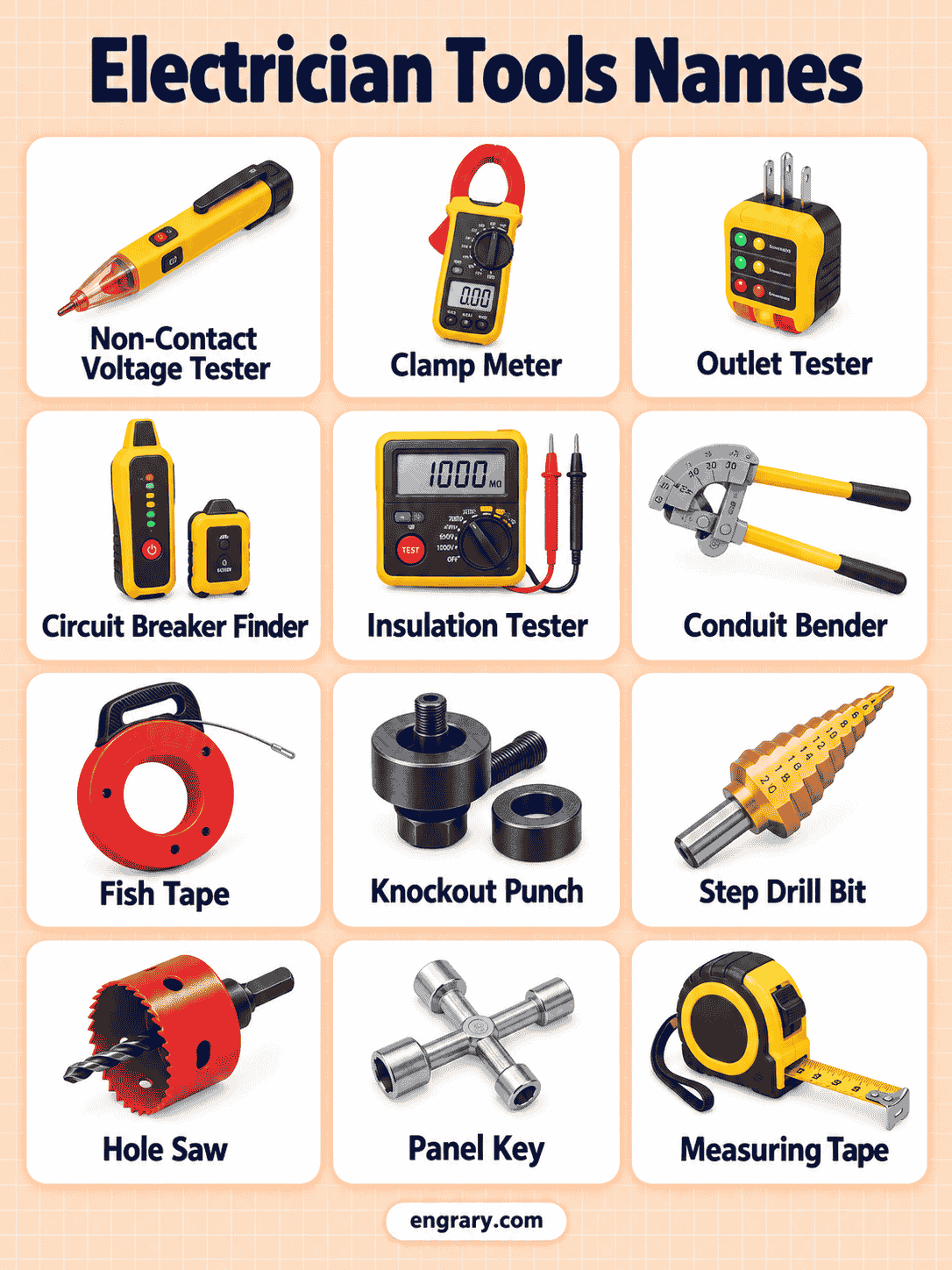
Crimping and Termination Tools
These tools attach terminals, connectors, ferrules, lugs, and communication hardware to prepared conductors.
Crimping Tool
Compresses compatible terminals or connectors onto electrical conductors.
Ratcheting Crimper
Uses a ratcheting mechanism to apply controlled pressure during crimping.
Ferrule Crimper
Crimps ferrules onto the ends of stranded wires.
Cable Lug Crimper
Compresses larger cable lugs onto suitable conductors.
RJ45 Crimper
Attaches compatible modular connectors to network cable.
Punchdown Tool
Seats communication wires into insulation-displacement terminals.
Compression Connector Tool
Compresses compatible coaxial or communication connectors onto prepared cable.
Coaxial Crimper
Crimps suitable connectors onto coaxial cable.
Terminal Extraction Tool
Releases compatible terminals or pins from connector housings without unnecessary damage.
IDC Insertion Tool
Pushes conductors into insulation-displacement contacts on compatible terminals or blocks.
Cable Pulling Tools
Cable-pulling tools help route wires through conduit, walls, ceilings, trays, and other cable paths.
Fish Tape
Pulls conductors through conduit and other enclosed routes with a flexible tape.
Fish Rod Set
Uses connectable rods to guide or retrieve cable through walls and ceiling spaces.
Cable Puller
Provides mechanical force for longer or heavier cable pulls.
Pulling Grip
Grips cable so pulling force can transfer securely along the cable.
Cable Roller
Supports and guides cable while reducing friction along a pulling route.
Magnetic Wire Puller
Uses magnetic components to help guide cable through suitable concealed cavities.
Cable Feeding Tool
Guides cable into conduit, trunking, or other cable routes during installation.
Cable Pulling Winch
Provides controlled mechanical pulling force for demanding cable installations.
Conduit Tools
Conduit tools prepare, bend, cut, thread, and support the tubing that protects electrical conductors.
Conduit Bender
Forms controlled bends in electrical conduit.
Conduit Reamer
Smooths sharp edges after conduit has been cut.
Conduit Cutter
Cuts electrical conduit to the required length.
Deburring Tool
Removes burrs and sharp edges from freshly cut conduit and metal parts.
Knockout Punch
Creates clean openings in electrical boxes, cabinets, and enclosures.
Conduit Threader
Cuts external threads on suitable rigid conduit.
Pipe Vise
Holds conduit securely during cutting, threading, or preparation.
Conduit Level
Checks conduit bends and runs for correct alignment.
PVC Conduit Heater
Softens compatible PVC conduit so it can be formed into controlled bends.
Conduit Offset Bender
Helps form offset bends where conduit must move around an obstacle or change alignment.
Tools for Drilling and Installation
Installation tools help prepare openings, mount electrical equipment, secure cable, and work with building materials.
Cordless Drill
Drills holes and drives fasteners with portable battery power.
Impact Driver
Drives screws and fixings with high rotational force.
Hammer Drill
Combines rotary drilling with hammering action for masonry and similar materials.
Right-Angle Drill
Reaches between joists, studs, cabinets, and other tight areas with an angled head.
Rotary Hammer
Handles heavier drilling in concrete and masonry during demanding installations.
Electric Screwdriver
Speeds lighter repeated screwdriving tasks.
Cable Stapler
Fastens compatible cable securely to suitable structural surfaces.
Hole Punch Tool
Creates controlled holes in compatible sheet materials or enclosure panels.
Stud Punch
Punches openings through compatible metal studs for routing cable or conduit.
Reciprocating Saw
Cuts framing, conduit, cable tray, or other suitable materials during installation and remodeling work.
Measuring and Layout Tools
Measuring and layout tools help electricians position boxes, conduit, fixtures, supports, and equipment accurately.
Tape Measure
Checks cable runs, installation heights, equipment spacing, and distances.
Torpedo Level
Checks level and plumb in compact areas.
Spirit Level
Checks longer conduit runs, panels, fixtures, and equipment for alignment.
Laser Level
Projects reference lines across larger areas for consistent installation heights.
Folding Rule
Measures shorter distances with a rigid folding body.
Electrician’s Pencil
Marks drilling points, routes, box positions, and installation lines.
Digital Angle Gauge
Measures or checks angles during conduit, tray, and equipment layout.
Measuring Wheel
Measures longer floor, corridor, or site distances for cable planning.
Specialty Electrical and Diagnostic Tools
Specialized tools support inspection, identification, communication systems, labeling, and advanced troubleshooting.
Label Maker
Prints labels for circuits, cables, panels, equipment, and identification points.
Thermal Imaging Camera
Displays temperature patterns that can reveal unusual heating in electrical equipment.
Inspection Camera
Shows hidden spaces inside walls, ceilings, cabinets, or equipment through a small camera head.
Cable Fault Locator
Helps locate faults or interruptions along suitable cables.
Tone Generator
Places a tracing tone onto a compatible wire or cable for identification.
Tone Probe
Detects the signal from a tone generator to help identify cables or conductors.
Network Cable Tester
Checks continuity and wiring arrangement in compatible data cables.
Fiber Optic Power Meter
Measures optical power levels in fiber-optic systems.
Light Meter
Measures illumination levels during lighting assessment and commissioning work.
Battery Tester
Checks the condition or electrical output of compatible batteries.
Fuse Puller
Removes compatible fuses more safely and conveniently than using ordinary pliers.
Panel Key
Opens compatible electrical cabinets, enclosures, and service panels that use keyed access.
Wire Marker Printer
Prints identification sleeves or markers for wires and cables.
Cable Tie Tensioning Tool
Applies consistent tension to cable ties and can trim excess tie material.
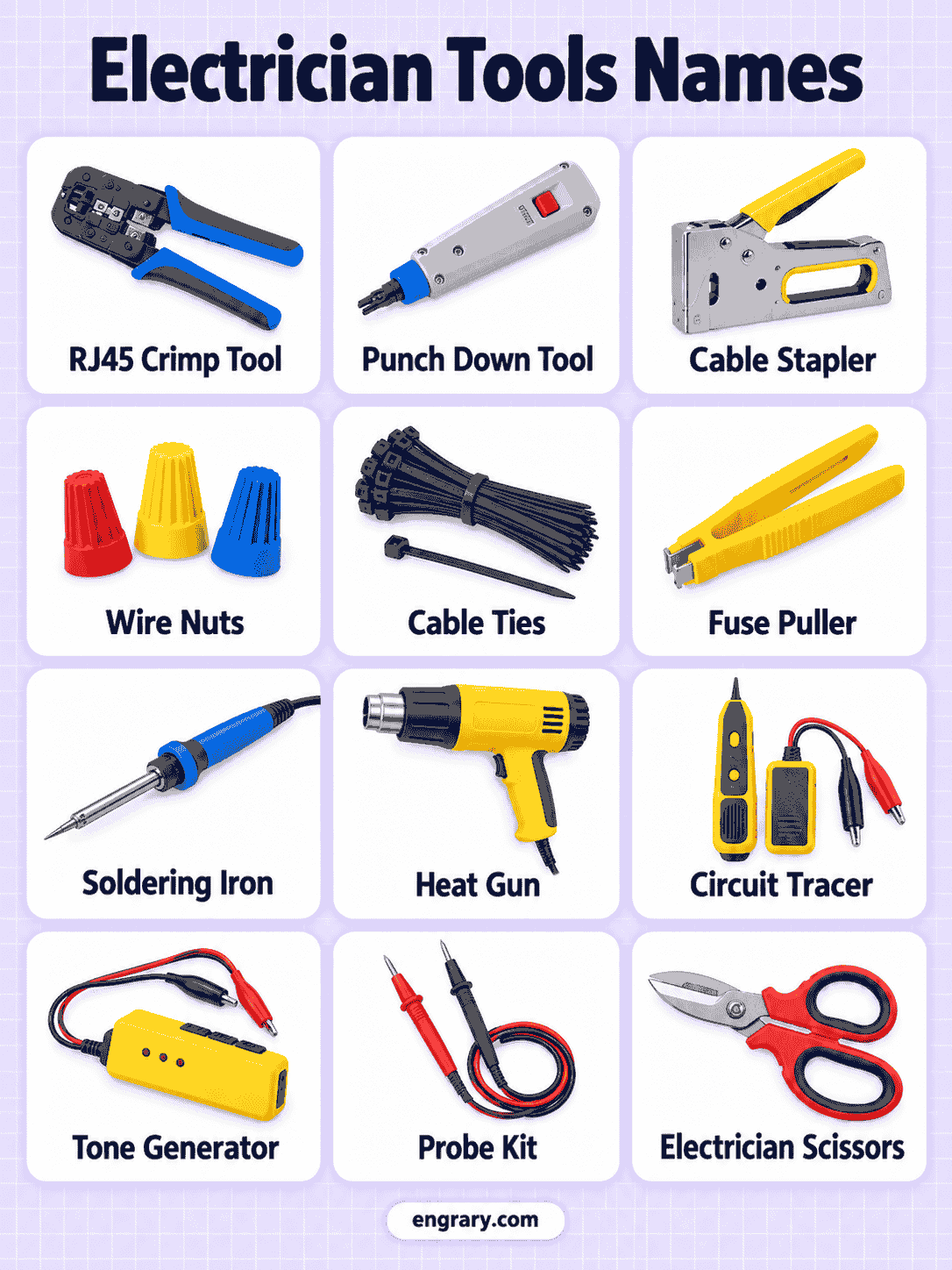
Electrical Work from Testing to Final Connection
Electrical installation usually moves through several stages, and each stage calls for a different tool set.
| Stage | Common Tools |
|---|---|
| Testing | Digital Multimeter, Clamp Meter, Voltage Tester |
| Measuring | Tape Measure, Torpedo Level |
| Stripping | Wire Stripper, Cable Stripper |
| Cutting | Cable Cutter, Diagonal Cutters |
| Pulling | Fish Tape, Fish Rod Set, Cable Puller |
| Conduit Work | Conduit Bender, Reamer, Knockout Punch |
| Terminating | Crimping Tool, Ferrule Crimper, Punchdown Tool |
| Fastening | Insulated Screwdriver, Nut Driver |
| Installation | Cordless Drill, Impact Driver |
| Labeling | Label Maker, Wire Marker Printer |
| Troubleshooting | Multimeter, Thermal Imaging Camera, Circuit Tracer |
The exact sequence changes with the project, but testing, accurate cable preparation, secure termination, and clear identification remain important throughout electrical work.
Tools Used for Different Electrical Jobs
Different electrical tasks require different combinations of hand tools, meters, and installation equipment.
| Electrical Job | Common Tools |
|---|---|
| Outlet and Switch Work | Voltage Tester, Insulated Screwdriver, Wire Stripper |
| Lighting Installation | Non-Contact Voltage Tester, Pliers, Screwdriver |
| Panel Work | Digital Multimeter, Nut Driver, Torque Screwdriver |
| Cable Installation | Fish Tape, Cable Puller, Cordless Drill |
| Conduit Installation | Conduit Bender, Reamer, Conduit Cutter |
| Network Termination | Punchdown Tool, RJ45 Crimper, Network Cable Tester |
| Fiber Work | Fiber Optic Power Meter, Labeling Tools |
| Fault Finding | Digital Multimeter, Clamp Meter, Thermal Imaging Camera |
| Circuit Identification | Circuit Tracer, Tone Generator, Tone Probe |
This grouping shows why a professional electrician’s tool collection includes both mechanical tools and specialized diagnostic instruments.
Hand Tools vs Electrical Testing Instruments
Electrician hand tools physically manipulate wires and hardware, while testing instruments measure or detect electrical conditions.
| Electrician Hand Tools | Electrical Testing Instruments |
|---|---|
| Wire Stripper | Digital Multimeter |
| Linesman Pliers | Clamp Meter |
| Insulated Screwdriver | Two-Pole Voltage Tester |
| Cable Cutter | Insulation Resistance Tester |
| Crimping Tool | Continuity Tester |
Both groups are essential, but they serve very different roles during installation and troubleshooting.
Similar Electrician Tools and How They Differ
Some electrician tools appear similar or handle related tasks, but their designs suit different types of electrical work.
| Tools | Main Difference |
|---|---|
| Digital Multimeter vs Clamp Meter | A multimeter measures several electrical properties through test leads, while a clamp meter can measure current around a conductor without disconnecting it. |
| Two-Pole Voltage Tester vs Non-Contact Voltage Tester | A two-pole tester makes direct probe contact between test points, while a non-contact tester can indicate possible AC voltage without touching exposed conductors. |
| Wire Stripper vs Cable Stripper | A wire stripper removes insulation from individual conductors, while a cable stripper removes the outer jacket from larger cable. |
| Linesman Pliers vs Needle-Nose Pliers | Linesman pliers handle heavier gripping, twisting, and cutting, while needle-nose pliers reach narrow spaces and smaller components. |
| Cable Cutter vs Diagonal Cutters | Cable cutters handle larger cable, while diagonal cutters suit smaller conductors and wire ends. |
| Fish Tape vs Fish Rods | Fish tape suits longer enclosed pulling paths, while fish rods guide cable through walls, ceilings, and cavities. |
| Conduit Bender vs Conduit Reamer | A conduit bender forms bends, while a reamer smooths the conduit ends after cutting. |
| Crimping Tool vs Punchdown Tool | A crimping tool compresses terminals or connectors onto conductors, while a punchdown tool seats wires into insulation-displacement terminals. |
| Circuit Tracer vs Tone Generator | A circuit tracer helps identify electrical circuits or breakers, while a tone generator places a tracing signal onto compatible cable or wire. |
| Label Maker vs Wire Marker Printer | A label maker produces general identification labels, while a wire marker printer specializes in cable and conductor identification. |
The main difference usually comes down to whether the tool tests, cuts, strips, grips, routes, prepares, terminates, or identifies electrical wiring.
Basic Electrician Tools vs Advanced Tool Kit
A basic tool kit handles common wiring and installation work, while an advanced setup adds specialized testing, pulling, identification, and termination capability.
| Basic Electrician Tools | Advanced Tool Kit |
|---|---|
| Non-Contact Voltage Tester | Digital Multimeter |
| Wire Stripper | Automatic Wire Stripper |
| Linesman Pliers | Cable Cutter |
| Insulated Screwdriver | Torque Screwdriver |
| Tape Measure | Laser Level |
| Fish Tape | Cable Pulling Winch |
| Cordless Drill | Right-Angle Drill |
| Basic Crimping Tool | Ratcheting Crimper |
| Receptacle Tester | Circuit Tracer |
| Label Maker | Wire Marker Printer |
Advanced tools expand the range of work an electrician can test, diagnose, install, and document rather than replacing the everyday basics.
Tools Electricians Carry on the Job
Electricians usually keep compact and frequently used tools close at hand rather than carrying every specialist instrument at once.
Common jobsite choices include:
- Non-Contact Voltage Tester
- Insulated Screwdriver
- Linesman Pliers
- Needle-Nose Pliers
- Wire Stripper
- Diagonal Cutters
- Tape Measure
- Utility Knife
- Torpedo Level
- Electrician’s Pencil
The exact set changes with the task. Panel work, conduit installation, cable pulling, network termination, and troubleshooting each require different additions.
Electrician Tools vs Electrical Supplies
Electricians work with both tools and supplies, but the two categories serve different purposes.
| Electrician Tools | Electrical Supplies |
|---|---|
| Wire Stripper | Electrical Wire |
| Crimping Tool | Terminal |
| Insulated Screwdriver | Screw |
| Fish Tape | Cable |
| Cable Cutter | Cable Tie |
| Conduit Bender | Conduit |
| Punchdown Tool | Data Jack |
| Ferrule Crimper | Ferrule |
Tools perform the work, while supplies become part of the installation or support it.
Items such as electrical tape, wire nuts, terminals, connectors, ferrules, cable ties, screws, drill bits, batteries, safety equipment, and tool bags should not be counted as electrician tools.
FAQs
Common electrician tools include digital multimeters, voltage testers, wire strippers, linesman pliers, needle-nose pliers, cable cutters, insulated screwdrivers, crimping tools, fish tape, conduit benders, drills, and levels.
Electricians use tools such as digital multimeters, clamp meters, voltage testers, continuity testers, receptacle testers, insulation resistance testers, circuit tracers, and grounding testers.
Wire strippers, automatic wire strippers, cable strippers, cable cutters, diagonal cutters, and electrician’s scissors prepare or cut conductors and cables.
Electricians use fish tape, fish rods, cable pullers, pulling grips, cable rollers, magnetic pullers, and cable-pulling winches to route conductors through cable paths.
Hand tools physically cut, strip, grip, crimp, fasten, or route wires and hardware. Electrical testing instruments measure or detect conditions such as voltage, current, continuity, resistance, insulation performance, or grounding characteristics.
You May Also Like



Leave a Comment