
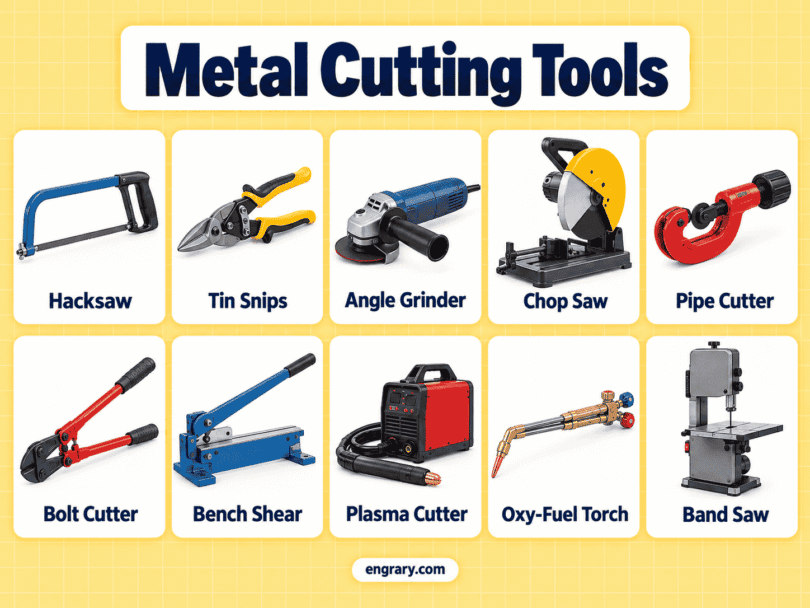
Metal cutting tools come in many forms because sheet, wire, pipe, bar, and machined parts all require different cutting methods. Some tools separate metal with teeth or shearing blades, while others remove small amounts of material to create accurate shapes and surfaces.
This guide covers 50 metal cutting tools names with pictures and uses. It includes common workshop hand tools, snips, nibblers, cutting pliers, chisels, powered saws, and machining cutters, along with simple recognition clues for each one.
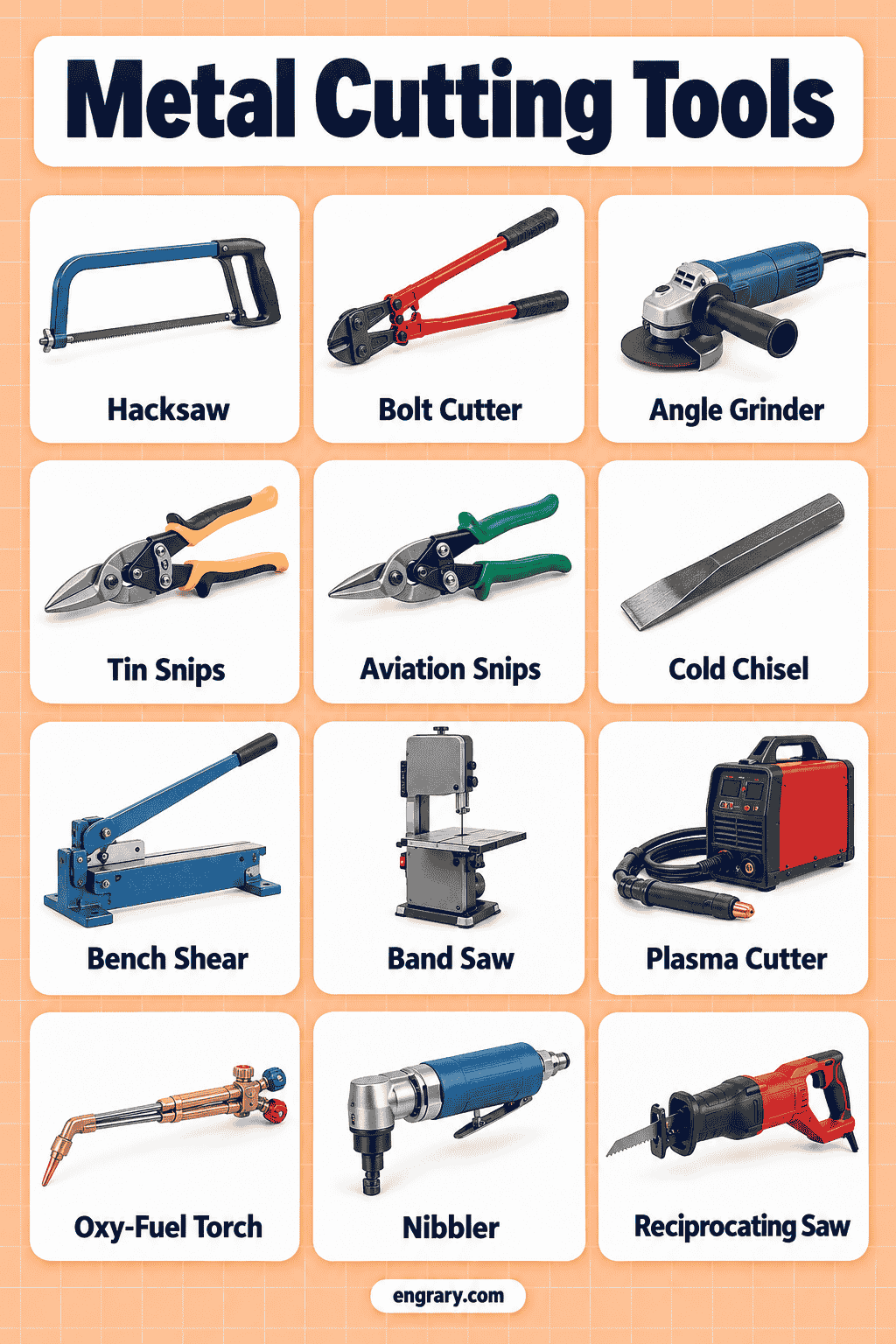
Metal Cutting Tools You’ll See in Workshops
Metal workshops use different cutters because the shape, thickness, and form of the material can change from one job to another. For example, a hacksaw suits general manual cutting, while snips work better on thin sheet and jaw cutters handle wire, cable, or fasteners.
1. Hacksaw
A hacksaw has a thin replaceable blade held under tension inside a metal frame. It is one of the most familiar hand tools for cutting metal rod, pipe, bar, and similar stock.
2. Junior Hacksaw
A junior hacksaw has a smaller frame and shorter blade than a standard hacksaw. Therefore, it works well where a full-size frame would feel bulky.
3. Jeweler’s Saw
A jeweler’s saw has a very thin blade held inside a deep adjustable frame. Its fine blade suits delicate metal-cutting work and small detailed shapes.
4. Tin Snips
Tin snips resemble heavy-duty scissors with short blades and long handles. They cut thin sheet metal through a simple shearing action.
5. Aviation Snips
Aviation snips have short cutting jaws and compound-linkage handles. As a result, they provide more mechanical advantage than basic tin snips.
6. Straight-Cut Snips
Straight-cut snips have jaws shaped mainly for straight or gently curved cuts through thin metal sheet.
7. Left-Cut Snips
Left-cut snips help the cutting line curve toward the left. Their jaw geometry distinguishes them from straight and right-cut versions.
8. Right-Cut Snips
Right-cut snips guide cuts more naturally toward the right. Consequently, they complement left-cut snips when sheet work requires directional curves.
9. Sheet-Metal Shears
Sheet-metal shears use strong paired blades to cut thin metal sheet. Depending on the design, they may be handheld or mounted.
10. Bench Shears
Bench shears attach to a workbench and use a long handle connected to a heavy cutting blade. Their fixed body makes them easy to recognize.
11. Throatless Shears
Throatless shears have an open cutting area that allows sheet metal to move through the tool without a deep enclosing throat. Therefore, they suit curved and irregular cuts.
12. Hand Nibbler
A hand nibbler has a compact cutting head that removes small sections of sheet metal as it advances.
13. Power Nibbler
A power nibbler uses a motor-driven cutting action to remove repeated small pieces of sheet. Unlike snips, it does not rely on two long scissor-like blades.
14. Sheet-Metal Punch
A sheet-metal punch cuts shaped openings in thin metal rather than producing a long continuous cut.
15. Knockout Punch
A knockout punch creates clean round openings in sheet metal. Its punch-and-die form makes it visually different from snips and nibblers.
16. Wire Cutters
Wire cutters use opposed cutting jaws to sever metal wire. Their compact head distinguishes them from long-handled cutters.
17. Diagonal Cutters
Diagonal cutters place angled cutting edges along the sides of the jaws. They are also commonly called side cutters.
18. End-Cutting Pliers
End-cutting pliers place the cutting edges across the front of the head. In contrast, diagonal cutters cut from the sides.
19. Cable Cutters
Cable cutters have shaped jaws designed to surround and cut cable cleanly.
20. Bolt Cutters
Bolt cutters combine heavy cutting jaws with long handles. Their large size and distinctive leverage design make them easy to recognize.
21. Pipe Cutter
A pipe cutter has a circular cutting wheel mounted in an adjustable frame that fits around metal pipe.
22. Tube Cutter
A tube cutter resembles a pipe cutter but usually has a more compact body for smaller-diameter tubing.
23. Cold Chisel
A cold chisel has a solid steel body with a beveled cutting edge. It cuts or separates metal without using saw teeth.
24. Cape Chisel
A cape chisel has a narrow cutting edge designed for grooves and confined metal-cutting work.
25. Diamond-Point Chisel
A diamond-point chisel has a pointed, diamond-shaped cutting end. Its distinctive tip separates it from flat-edged cold chisels.
Hand Saws for Cutting Metal
Manual saws remain useful when the material suits a narrow toothed blade and powered equipment is unnecessary. In addition, their simple construction makes them some of the easiest metal-cutting tools to recognize.
The standard hacksaw, junior hacksaw, and jeweler’s saw already cover the main manual saw forms in this list. Rather than padding the count with minor frame variations, the article now moves into cutting methods that add genuinely different tool types.
Snips and Shears for Sheet Metal Cutting
Sheet-metal cutters work mainly by shearing rather than sawing. Therefore, they use paired cutting edges that pass one another and separate thin metal along a line.
Tin snips provide the simplest form, while aviation snips add compound leverage. Straight-, left-, and right-cut snips then add directional control. For heavier bench work, mounted shears and throatless shears provide larger cutting structures.
Keeping these tools together also prevents the article from drifting into unrelated sheet-metal equipment such as bending brakes, seamers, and forming tools.
Nibblers and Punching Tools for Metal
Nibblers and punches cut sheet differently from snips. Instead of making one continuous shearing line, they remove or punch out small sections of material.
Hand nibblers and power nibblers suit progressive sheet cutting. Meanwhile, sheet-metal punches and knockout punches create defined openings rather than long edge cuts.
This distinction gives the article more depth without turning it into a complete sheet-metal tools guide.
Cutting Pliers for Wire, Cable, and Fasteners
Jaw-cutting tools rely on short opposed cutting edges rather than long saw blades or shearing blades. Their jaw shape usually reveals the material they are meant to handle.
Wire cutters suit general wire. Diagonal cutters place their edges along the side of the head, while end-cutting pliers cut from the front. Cable cutters use shaped jaws for flexible cable, whereas bolt cutters use much longer handles and heavier jaws.
Pipe and Tube Cutting Tools
Round metal stock creates a different cutting challenge from flat sheet. Therefore, dedicated pipe and tube cutters use circular cutting wheels and adjustable frames that fit around the workpiece.
The Pipe Cutter and Tube Cutter already appear in the opening list because they represent the two most recognizable versions of this tool family. Their main difference usually comes from size, construction, and the type of round stock they accommodate.
Chisels for Cutting and Separating Metal
Metal-cutting chisels use sharpened edges instead of teeth. As a result, the shape of the cutting end becomes the main recognition clue.
26. Round-Nose Chisel
A round-nose chisel has a curved cutting edge. It differs from a flat cold chisel because its edge shape suits rounded grooves and similar metal features.
The cold chisel, cape chisel, diamond-point chisel, and round-nose chisel form a compact but useful family. Expanding further would move the article toward specialist machining and engraving tools rather than common metal-cutting vocabulary.
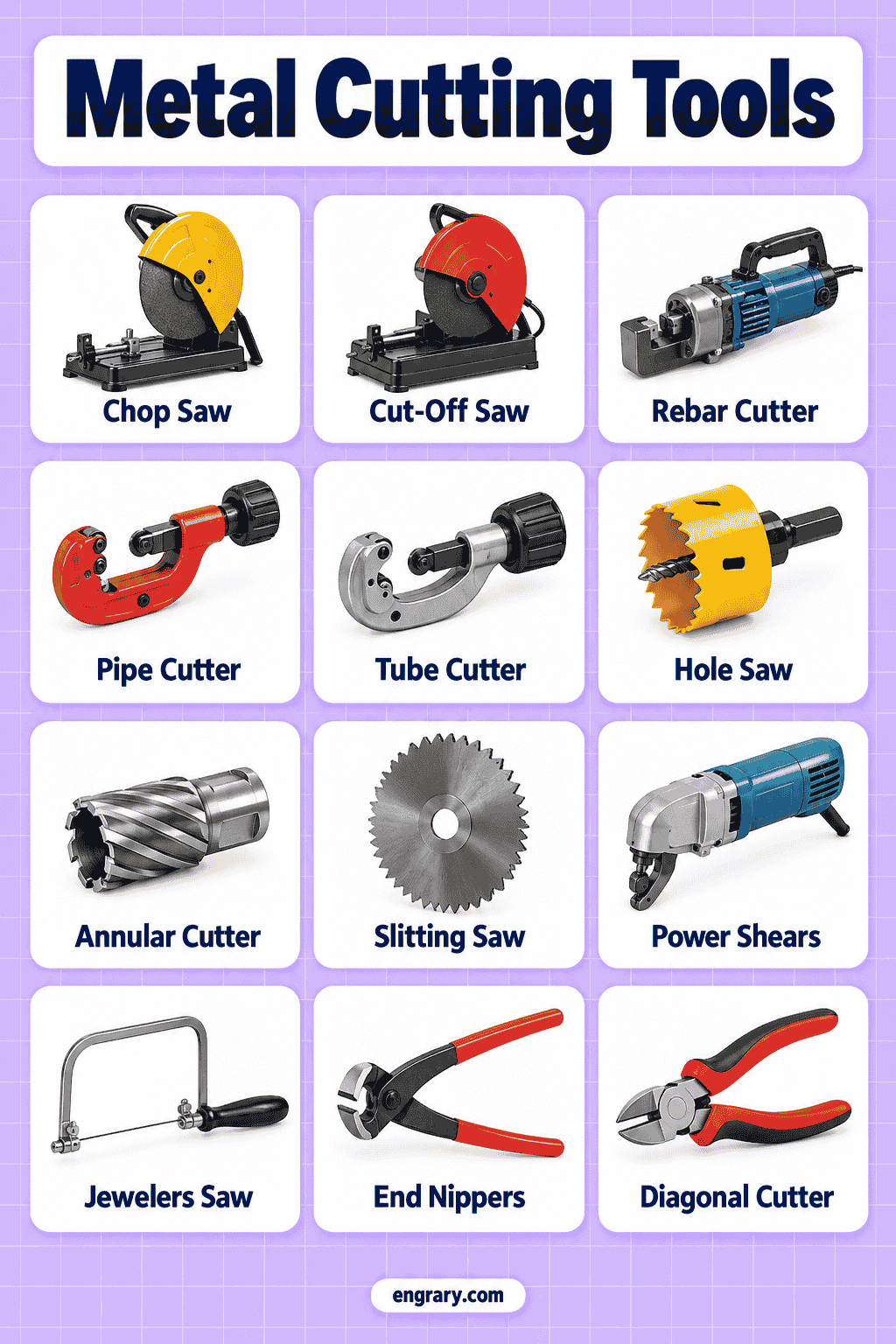
Power Saws for Cutting Metal Stock
Powered saws handle larger or repeated cuts more quickly than manual saws. However, their blade type and machine layout differ considerably, so each design remains visually distinct.
27. Horizontal Band Saw
A horizontal band saw uses a continuous loop blade mounted in a machine that lowers the blade assembly toward metal stock.
28. Vertical Band Saw
A vertical band saw runs a continuous blade vertically through a work table. Unlike the horizontal version, the blade remains upright while the material moves around it.
29. Cold Saw
A cold saw uses a rigid toothed circular blade in a stationary machine. Its solid metal blade distinguishes it from abrasive-wheel machines.
30. Metal-Cutting Circular Saw
A metal-cutting circular saw uses a rotating circular blade in a handheld saw body designed for suitable metal-cutting applications.
31. Abrasive Cut-Off Saw
An abrasive cut-off saw uses a reinforced abrasive wheel rather than a toothed saw blade. Its stationary base and pivoting cutting head resemble a chop-saw layout.
32. Reciprocating Saw
A reciprocating saw uses a straight blade that moves rapidly back and forth from the front of the tool. With an appropriate metal-cutting blade, it can cut several forms of metal stock.
33. Pneumatic Body Saw
A pneumatic body saw has a compact air-powered body and a narrow reciprocating blade. It commonly appears in fabrication and vehicle-body work where space is limited.
Machining Cutters for Removing Metal
Machining uses a different meaning of “cutting.” Instead of simply separating stock into two pieces, machining cutters remove controlled amounts of metal to create accurate shapes, slots, holes, and surfaces.
34. Turning Tool
A turning tool has a single cutting edge held against a rotating workpiece in a lathe. Its compact toolholder-and-tip form differs sharply from saws and shears.
35. Parting Tool
A parting tool has a narrow cutting edge that removes a thin path of metal during lathe work.
36. Boring Tool
A boring tool has a cutting tip mounted on a bar for enlarging or refining an existing hole.
37. Grooving Tool
A grooving tool uses a narrow cutting edge to form grooves in a rotating metal workpiece.
38. End Mill
An end mill is a cylindrical rotating cutter with cutting flutes along its sides and often across its end. It is one of the most recognizable milling cutters.
39. Face Mill
A face mill has a broad circular body fitted with multiple cutting edges or inserts. Therefore, it mainly cuts across a large surface area.
40. Slab Milling Cutter
A slab milling cutter has a wide cylindrical body with cutting teeth around its outside surface.
41. Side-and-Face Cutter
A side-and-face cutter carries cutting teeth around its circumference and along its sides. This geometry allows it to cut slots as well as side surfaces.
42. T-Slot Cutter
A T-slot cutter has a narrow neck leading to a wider cutting head. Its distinctive profile helps form T-shaped slots.
43. Fly Cutter
A fly cutter uses one cutting tool mounted in a rotating body. As it turns, the single cutting edge sweeps across the metal surface.
44. Ball-Nose End Mill
A ball-nose end mill has a rounded cutting end rather than a flat one. Consequently, it suits contoured and curved machined surfaces.
45. Dovetail Milling Cutter
A dovetail milling cutter has an angled cutting head designed to produce undercut or dovetail-shaped features.
46. Woodruff Keyseat Cutter
A Woodruff keyseat cutter has a small disc-shaped cutting head on a narrow shank. It cuts the curved slots used for Woodruff keys.
47. Reamer
A reamer has several straight or helical cutting edges around a cylindrical body. It removes a small amount of metal from an existing hole to improve its size and finish.
48. Broach
A broach is a long multi-tooth cutting tool whose teeth change progressively along its length. Each cutting section removes slightly more material than the one before it.
49. Countersink
A countersink has a conical cutting shape that enlarges the entrance of an existing hole.
50. Counterbore
A counterbore uses a flat-bottomed cutting form to enlarge the upper section of a hole to a larger diameter.
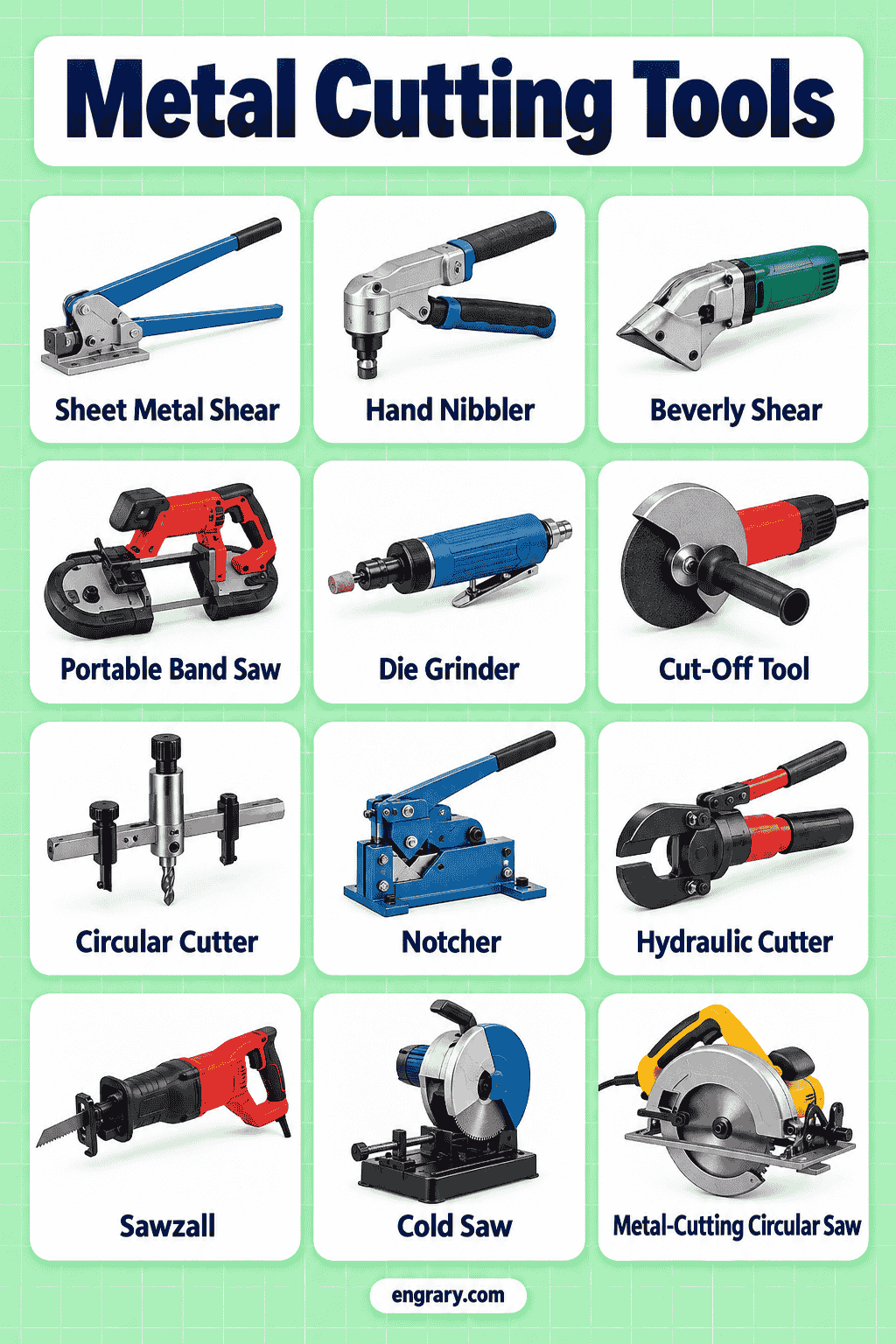
Metal Cutting Tools That Are Easy to Confuse
Several metal-cutting tools look similar or work on related materials. However, their blade style, jaw position, cutting mechanism, or machining geometry usually provides a clear distinction.
| Tools | Main Difference |
|---|---|
| Hacksaw vs Junior Hacksaw | A hacksaw has a larger frame and blade, while a junior hacksaw uses a smaller, more compact design. |
| Tin Snips vs Aviation Snips | Tin snips use a simple scissor-like mechanism, whereas aviation snips add compound linkage for greater leverage. |
| Straight-Cut vs Left/Right Snips | Straight-cut snips favor straighter lines, while left- and right-cut versions guide directional curves more naturally. |
| Snips vs Sheet-Metal Shears | Snips are compact handheld tools, while shears may use larger blades or mounted mechanisms. |
| Hand Nibbler vs Power Nibbler | A hand nibbler relies on manual force, whereas a power nibbler drives the cutting action mechanically. |
| Wire Cutters vs Diagonal Cutters | Wire cutters describe a broad category, while diagonal cutters place angled cutting edges along the sides of the jaws. |
| Diagonal Cutters vs End-Cutting Pliers | Diagonal cutters cut from the sides, whereas end-cutting pliers place their cutting edges across the front. |
| Cable Cutters vs Bolt Cutters | Cable cutters use shaped jaws for cable, while bolt cutters combine heavy jaws with much longer handles. |
| Pipe Cutter vs Tube Cutter | Pipe cutters generally handle larger or heavier round stock, while tube cutters tend to use more compact frames. |
| Band Saw vs Cold Saw | A band saw uses a continuous flexible blade, whereas a cold saw uses a rigid toothed circular blade. |
| Cold Saw vs Abrasive Cut-Off Saw | A cold saw uses teeth to cut, while an abrasive cut-off saw removes material with an abrasive wheel. |
| Turning Tool vs Parting Tool | A turning tool performs general lathe cutting, whereas a parting tool uses a narrow edge for narrow cuts and separation. |
| End Mill vs Face Mill | An end mill cuts with its sides and end, while a face mill uses a wider cutter body mainly for machining broad faces. |
| End Mill vs Slab Milling Cutter | An end mill is a smaller cylindrical cutter for varied milling work, whereas a slab cutter has a wider body for broad peripheral cutting. |
Alternate Names for Metal Cutting Tools
Metalworking terminology varies between workshops, trades, and regions. Therefore, learning common alternate names can make catalogs and technical references easier to understand.
| Main Name | Alternate Name |
|---|---|
| Hacksaw | Hack Saw |
| Aviation Snips | Compound Snips |
| Diagonal Cutters | Side Cutters |
| End-Cutting Pliers | End Nippers |
| Abrasive Cut-Off Saw | Abrasive Chop Saw |
| Metal-Cutting Circular Saw | Metal Circular Saw |
| Parting Tool | Cut-Off Tool in lathe work |
| End Mill | End Milling Cutter |
| Face Mill | Face Milling Cutter |
| Side-and-Face Cutter | Side and Face Milling Cutter |
These alternate terms do not add to the count when they refer to the same tool or cutter.
Frequently Asked Questions
Common metal cutting tools include hacksaws, tin snips, aviation snips, nibblers, wire cutters, bolt cutters, pipe cutters, cold chisels, band saws, cold saws, and several machining cutters.
Tin snips use a simpler scissor-like mechanism. In contrast, aviation snips use compound linkage and often come in straight-, left-, and right-cut designs.
Wire cutters and diagonal cutters suit many smaller wires, while cable cutters have shaped jaws for cable. Bolt cutters, meanwhile, use heavier jaws and long handles for harder fasteners and similar stock.
A cold saw uses a rigid circular toothed blade, whereas a band saw uses a continuous flexible blade that runs around wheels. Therefore, the two machines have very different blade systems and body layouts.
An end mill has a cylindrical body with cutting flutes along its sides and often its end. A face mill, however, uses a wider circular body with several cutting edges to machine broad flat surfaces.
You May Also Like

Leave a Comment