
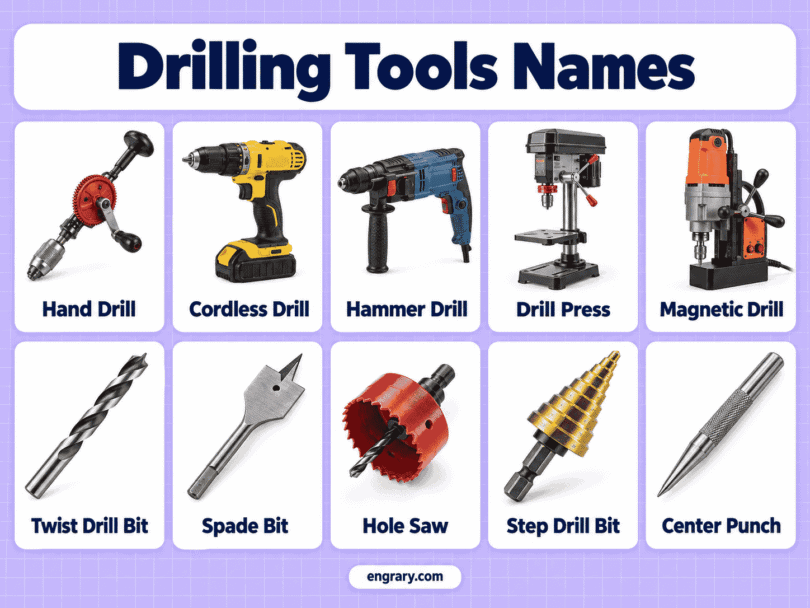
Drilling tools create, enlarge, shape, or finish holes in materials such as wood, metal, masonry, tile, and glass. Because hole size, material, depth, and accuracy can vary, workshops use many different drills, drilling machines, bits, and finishing cutters.
This guide covers 50 drilling tools names with pictures and uses. It includes traditional hand tools, portable drills, stationary drilling machines, common drill bits, specialist bits, and tools for improving an existing hole.
Common Drilling Tools and Equipment
Some drilling tools supply the turning power, while others do the actual cutting. For example, a cordless drill holds and rotates a bit, whereas a Forstner bit, auger bit, or twist drill removes material to create the hole.
1. Hand Drill
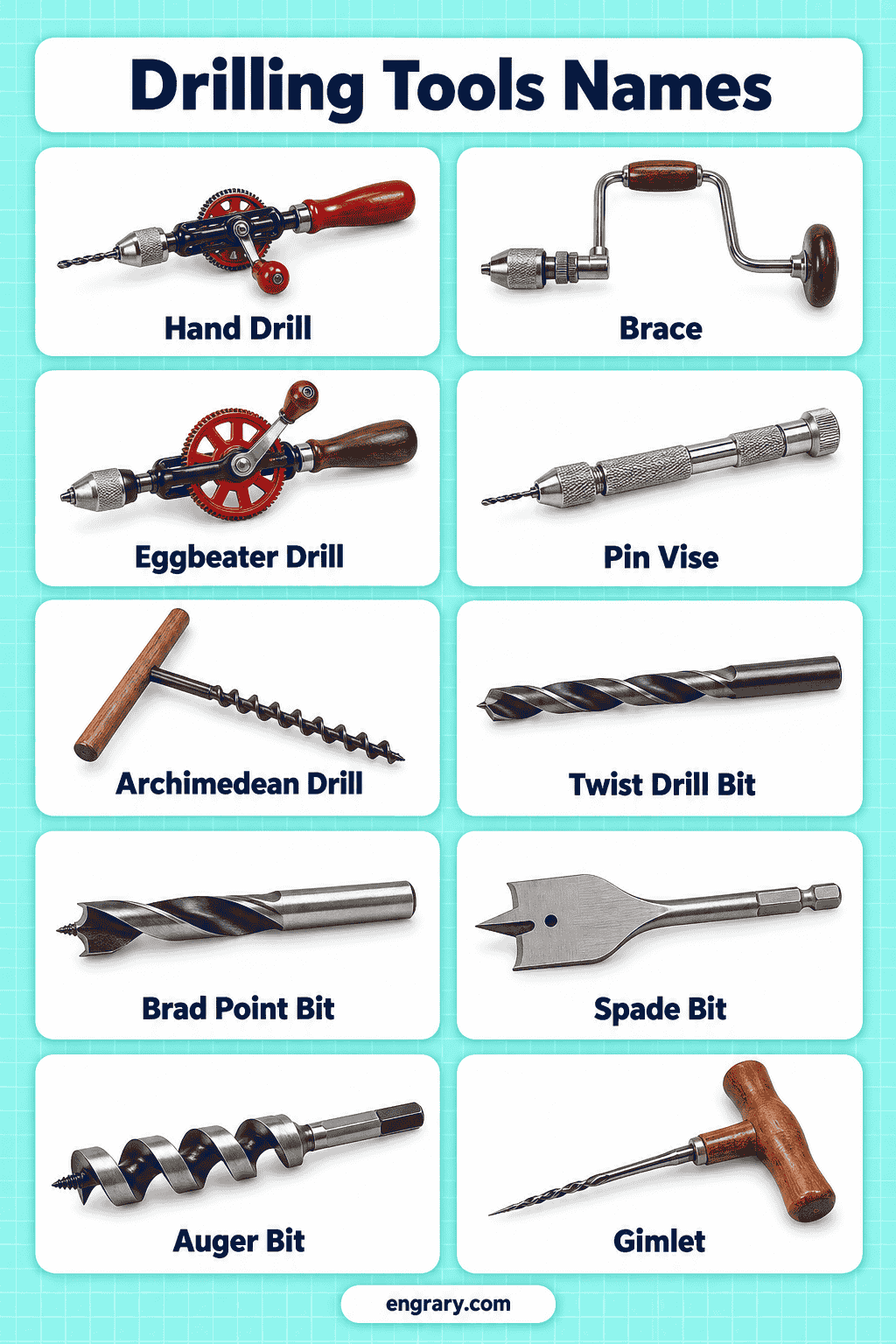
A hand drill has a crank handle, gear wheel, side handle, and chuck. Turning the crank rotates the bit without electricity.
2. Brace
A brace has a distinctive U-shaped crank and a chuck at one end. Its large crank shape provides strong manual turning leverage.
3. Breast Drill
A breast drill resembles a heavy geared hand drill but adds a broad pressure plate behind the main shaft. This plate makes the tool easy to recognize.
4. Push Drill
A push drill has a straight body with an internal spiral or ratcheting mechanism. Pushing the handle rotates the small bit.
5. Corded Drill
A corded drill has a pistol-shaped body, chuck, trigger, and electrical cable. Because it draws power from a cord, it does not need a battery pack.
6. Cordless Drill
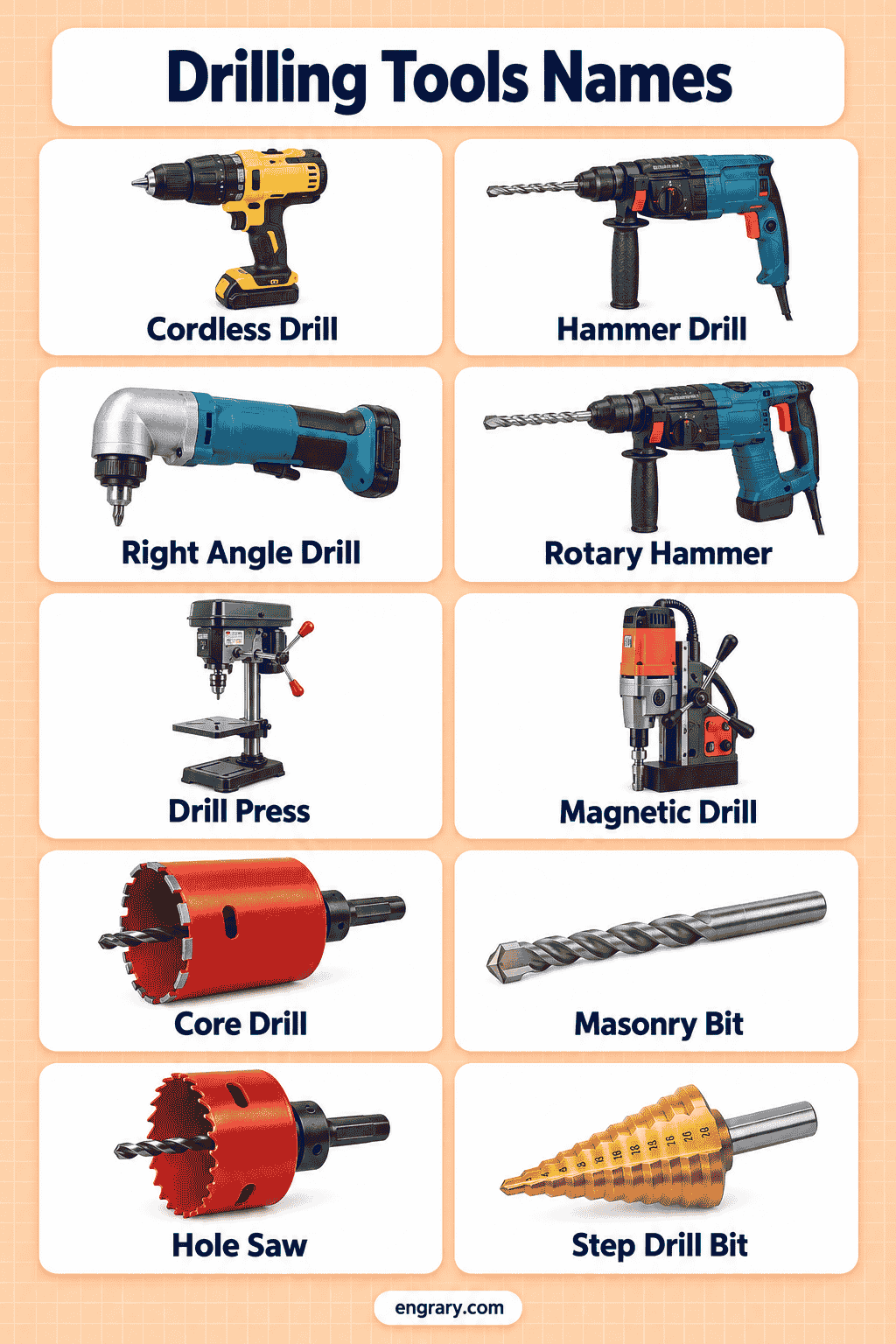
A cordless drill has a pistol-grip body with a rechargeable battery at the base. It is one of the most recognizable portable drilling tools.
7. Drill/Driver
A drill/driver combines a drill-style chuck with adjustable settings for both hole making and general fastening work. However, this article focuses on its drilling role.
8. Right-Angle Drill
A right-angle drill places the chuck at roughly 90 degrees to the main body. Therefore, its short head suits locations where a conventional drill body would be awkward.
9. Hammer Drill
A hammer drill combines rotary motion with a hammering action in the direction of the hole. Its body usually resembles a heavy-duty electric drill.
10. Magnetic Drill
A magnetic drill has a vertical drilling unit mounted on a magnetic base. The base gives the machine its distinctive workshop appearance.
11. Bench Drill
A bench drill has a vertical column, spindle, adjustable table, and base sized for bench mounting. It provides a fixed drilling position rather than a handheld one.
12. Pillar Drill
A pillar drill uses a tall vertical column with a motor and spindle mounted above an adjustable work table. Compared with a bench drill, it usually has a taller floor-standing form.
13. Twist Drill Bit
A twist drill bit has two spiral flutes running around a cylindrical body. It is the most familiar general-purpose drill-bit shape.
14. Brad-Point Bit
A brad-point bit has a sharp center point with cutting spurs around the outer edges. As a result, it is easy to distinguish from a standard twist bit.
15. Spade Bit
A spade bit has a broad, flat paddle-shaped cutting head and a center point. Its simple shape makes it one of the easiest wood bits to recognize.
16. Auger Bit
An auger bit has a screw-like lead point and deep spiral flutes. The large spiral carries removed wood away from the hole.
17. Forstner Bit
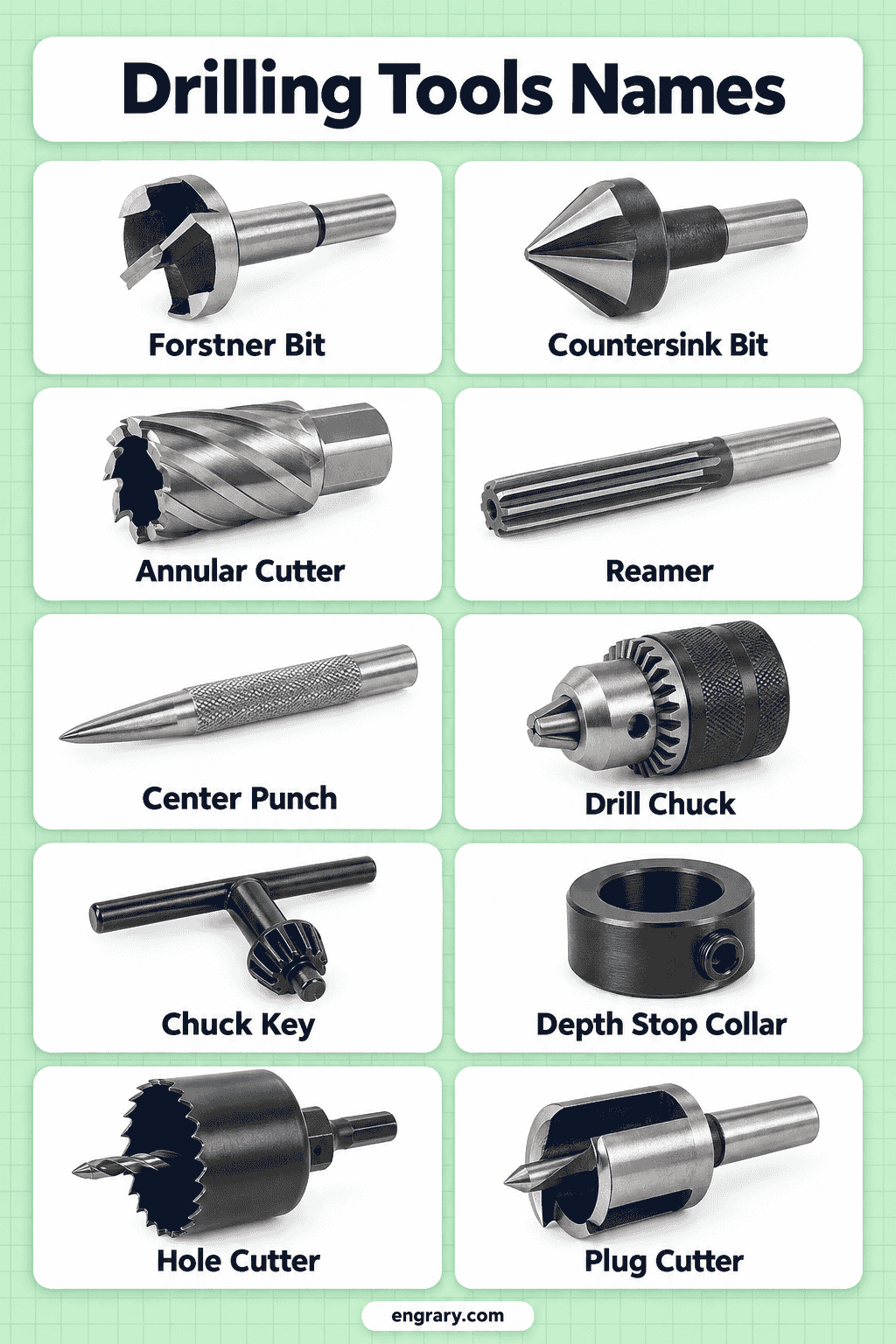
A Forstner bit has a broad cylindrical cutting head with a circular rim. It creates wide, controlled holes and recesses in wood.
18. Hole Saw
A hole saw looks like a hollow circular cup with cutting teeth around its rim. It creates holes much larger than most conventional drill bits.
19. Step Drill Bit
A step drill bit has a cone-shaped body made from progressively larger cutting steps. Each step represents a different hole diameter.
20. Masonry Drill Bit
A masonry drill bit has a hardened cutting tip and spiral body designed for suitable masonry materials. Its reinforced tip distinguishes it from many ordinary twist bits.
Manual Drilling and Boring Tools
Manual drilling tools remain useful vocabulary because they show how holes were made before portable electric drills became common. Moreover, their shapes differ enough to make each type easy to identify in pictures.
21. Gimlet
A gimlet is a small hand-boring tool with a pointed screw-like tip and a cross handle. It creates small starter holes in wood.
22. Pin Vise
A pin vise has a slim cylindrical body with a tiny chuck at one end. It holds very small drill bits for fine manual hole making.
23. Bradawl
A bradawl has a pointed metal shaft attached to a simple handle. It starts small holes or indentations in wood before another tool enlarges them.
Portable Drills
Portable drills bring the motor and chuck into one movable tool body. However, specialized designs change the drive system or body shape to suit different materials and working spaces.
24. Pneumatic Drill
A pneumatic drill uses compressed air rather than an electric motor as its power source. An air connection on the body provides a clear recognition clue.
25. Rotary Hammer
A rotary hammer combines rotation with a strong hammering mechanism in a heavier tool body. It belongs to the drilling family but differs noticeably from a standard portable drill.
26. Core Drill Machine
A core drill machine carries a hollow core-cutting tool rather than a conventional small drill bit. Its design focuses on creating larger circular openings.
Stationary Drilling Machines
Stationary drilling machines hold the spindle in a fixed machine structure. Therefore, they can provide more consistent positioning than handheld drills and also support larger workshop tasks.
27. Radial Drilling Machine
A radial drilling machine mounts the drilling head on a long horizontal arm. The head can move along the arm, which makes the machine visually distinctive.
28. Sensitive Drilling Machine
A sensitive drilling machine is a relatively light drill press designed around precise manual feed. Its compact form suits smaller drilling work.
29. Upright Drilling Machine
An upright drilling machine has a strong vertical column, adjustable table, and overhead spindle assembly. It generally has a heavier structure than smaller bench machines.
30. Gang Drilling Machine
A gang drilling machine places several drilling heads in a row along one table. Consequently, different hole-making operations can occupy separate stations.
31. Multi-Spindle Drilling Machine
A multi-spindle drilling machine uses several spindles in one machine head. Unlike a gang drill, the spindles can work together on multiple holes.
32. Deep-Hole Drilling Machine
A deep-hole drilling machine has a long, specialized arrangement for holes with much greater depth than ordinary drilling work. Its machine layout supports long drilling tools and workpieces.
Common Types of Drill Bits
General drill bits differ in length, flute form, and cutting geometry. Although several belong to the twist-drill family, their proportions give them distinct roles and recognizable forms.
33. Jobber Drill Bit
A jobber drill bit is a common medium-length form of twist drill. It represents the familiar proportions seen in many general drill-bit sets.
34. Straight-Flute Drill
A straight-flute drill has cutting flutes that run lengthwise rather than spiraling around the body. Therefore, it looks noticeably different from a twist drill.
35. Stub Drill
A stub drill has a shorter body than a standard jobber drill. Its reduced length gives it a compact, rigid appearance.
36. Long-Series Drill
A long-series drill has an extended flute and overall length for deeper or less accessible holes. In contrast, a stub drill emphasizes shortness and rigidity.
37. Taper Drill Bit
A taper drill bit gradually increases in diameter along part of its cutting body. Its smooth taper distinguishes it from the clearly stepped profile of a step drill.
Drill Bits for Wood
Wood drilling uses several distinctive cutter shapes because holes may need to be narrow, deep, wide, flat-bottomed, or large in diameter. Brad-point, spade, auger, Forstner, and hole-saw cutters already appear in the opening section.
38. Self-Feed Bit
A self-feed bit has a broad circular cutting head with a prominent feed screw in the center. It creates large holes in wood and looks heavier than a typical spade bit.
Drill Bits for Different Materials
Material-specific bits adapt the cutting tip and body to different surfaces. For example, a glass bit needs a very different tip shape from a masonry or wood-drilling bit.
39. Glass Drill Bit
A glass drill bit usually has a spear-shaped or similarly pointed cutting tip. Its distinctive head separates it visually from ordinary spiral bits.
40. Tile Drill Bit
A tile drill bit has a hard cutting tip shaped for suitable tile materials. Depending on the design, the tip may look spear-shaped or carbide-faced.
41. Diamond Core Bit
A diamond core bit has a hollow cylindrical cutting body with an abrasive diamond cutting edge. It creates larger circular holes in hard suitable materials.
Tools for Starting and Centering Holes
Accurate hole making often begins before the main drill enters the workpiece. Therefore, starting tools help establish the hole location and guide the following cutter.
42. Center Drill
A center drill has a short, stiff body with a small pilot section followed by a wider cutting section. Its combined profile makes it easy to recognize.
43. Spot Drill
A spot drill is a short, rigid cutter that creates a shallow starting feature for a following drill. Unlike a center drill, its geometry focuses primarily on spotting the location.
Tools for Enlarging and Finishing Holes
Drilling does not always end with the first hole. In many cases, another cutter enlarges, shapes, or improves an opening after the initial drilling step.
44. Core Drill Bit
A core drill bit enlarges or refines an existing hole with multiple cutting edges. It should not be confused with the hollow core cutters used for large circular openings.
45. Annular Cutter
An annular cutter has a hollow cylindrical body with cutting teeth around the lower rim. Rather than removing the entire center as chips, it cuts around the circumference of the hole.
46. Countersink
A countersink has a conical cutting head. It creates a tapered recess around the entrance of an existing hole.
47. Counterbore
A counterbore enlarges the upper part of a hole into a larger cylindrical recess. Unlike a countersink, it does not create a simple cone-shaped opening.
48. Reamer
A reamer has several cutting flutes around a cylindrical body. It removes a small amount of material from an existing hole to improve its size and surface.
49. Adjustable Reamer
An adjustable reamer has cutting blades that allow limited diameter adjustment. Therefore, its body looks more mechanically complex than a fixed reamer.
50. Boring Bar
A boring bar carries a cutting edge on a rigid bar-shaped body. In machining, it enlarges or refines a hole that already exists.
Drilling Tools That Are Easy to Confuse
Several drilling tools look similar because they belong to related families. However, body shape, cutting geometry, machine size, and hole type usually reveal the difference.
| Tools | Main Difference |
|---|---|
| Hand Drill vs Brace | A hand drill uses gears and a crank, while a brace uses a large U-shaped crank for direct manual turning. |
| Hand Drill vs Breast Drill | A breast drill has a larger geared body and a broad pressure plate, whereas a hand drill is usually lighter and simpler. |
| Corded Drill vs Cordless Drill | A corded drill draws power through a cable, while a cordless drill carries a rechargeable battery. |
| Bench Drill vs Pillar Drill | A bench drill has a compact bench-mounted form, while a pillar drill usually uses a taller floor-standing column. |
| Drill Press vs Radial Drill | A conventional drill press keeps the spindle close to a vertical column, whereas a radial drill carries the head along a horizontal arm. |
| Twist Drill Bit vs Brad-Point Bit | A twist bit has a conventional pointed end and spiral flutes, while a brad-point bit adds a distinct center spur and outer cutting points. |
| Spade Bit vs Forstner Bit | A spade bit has a flat paddle head, whereas a Forstner bit uses a broad circular cutting rim. |
| Auger Bit vs Spade Bit | An auger bit has deep spiral flutes and a feed screw, while a spade bit has a flat paddle-shaped head. |
| Forstner Bit vs Hole Saw | A Forstner bit uses a solid cutting head, while a hole saw uses a hollow toothed cup. |
| Center Drill vs Spot Drill | A center drill has a combined pilot-and-body geometry, while a spot drill mainly creates a shallow starting location. |
| Twist Drill vs Step Drill | A twist drill has a continuous cylindrical body, while a step drill increases in diameter through visible steps. |
| Countersink vs Counterbore | A countersink creates a conical recess, whereas a counterbore creates a larger cylindrical recess. |
| Drill Bit vs Reamer | A drill bit creates the main hole, while a reamer removes a smaller amount of material to refine an existing hole. |
Alternate Names for Drilling Tools
Drilling terminology varies between workshops, regions, and trades. Therefore, knowing common alternate names can make catalogs and tool references easier to understand.
| Main Name | Alternate Name |
|---|---|
| Hand Drill | Eggbeater Drill |
| Brace | Bit Brace |
| Spade Bit | Paddle Bit |
| Cordless Drill | Battery Drill |
| Twist Drill Bit | Twist Drill |
| Pillar Drill | Pillar Drilling Machine |
| Bench Drill | Bench Drilling Machine |
| Drill Press | Drilling Machine in general workshop use |
| Hole Saw | Hole Cutter in some contexts |
| Step Drill Bit | Step Bit |
These alternate terms do not count as additional tools when they refer to the same basic design.
Frequently Asked Questions
Common drilling tools include hand drills, braces, corded drills, cordless drills, bench drills, pillar drills, twist drill bits, spade bits, auger bits, Forstner bits, hole saws, and step drill bits.
A hand drill usually rotates the chuck through a crank and gear mechanism. In contrast, a brace has a large U-shaped crank that turns the bit directly.
A spade bit has a flat paddle-shaped cutting head, while a Forstner bit uses a broad circular cutting rim. Therefore, the two tools look very different even though both can create relatively wide holes in wood.
Wood drilling commonly uses brad-point, spade, auger, and Forstner bits. Twist and step drills commonly appear in metalworking, while masonry, glass, tile, and diamond-core bits use tip designs suited to their respective materials.
A countersink creates a conical recess at a hole entrance, whereas a counterbore creates a larger cylindrical recess. A reamer serves a different purpose because it refines the size and surface of an existing hole.
You May Also Like

Leave a Comment