

HVAC technicians use specialized tools to install, test, maintain, and troubleshoot heating, ventilation, air-conditioning, and refrigeration systems. Learning common HVAC tools names in English helps students, technicians, and English learners recognize equipment used for refrigerant service, electrical testing, airflow measurement, tubing work, duct installation, and system diagnosis.
This article covers 100 HVAC tools with clear explanations of their main uses. The list includes tools for charging refrigerant, pulling a vacuum, recovering refrigerant, detecting leaks, checking airflow and temperature, testing electrical systems, working with copper tubing, servicing ducts, and clearing condensate lines.
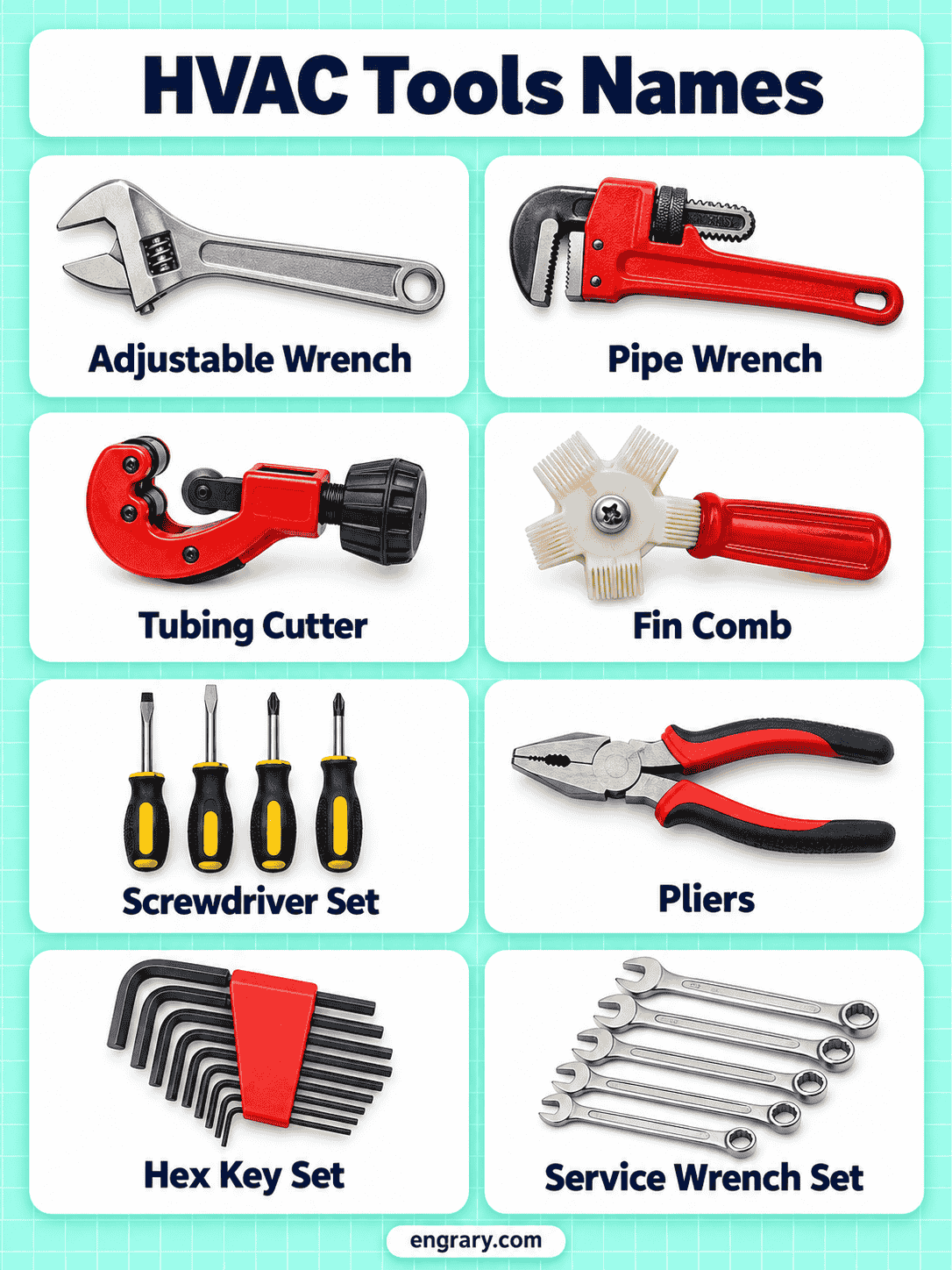
Common HVAC Tools Used by Technicians
HVAC work combines hand tools with specialized gauges, meters, pumps, and diagnostic instruments. These familiar names appear regularly during installation and service calls.
Digital Refrigerant Manifold
Digital sensors display system pressures and help technicians evaluate refrigerant performance.
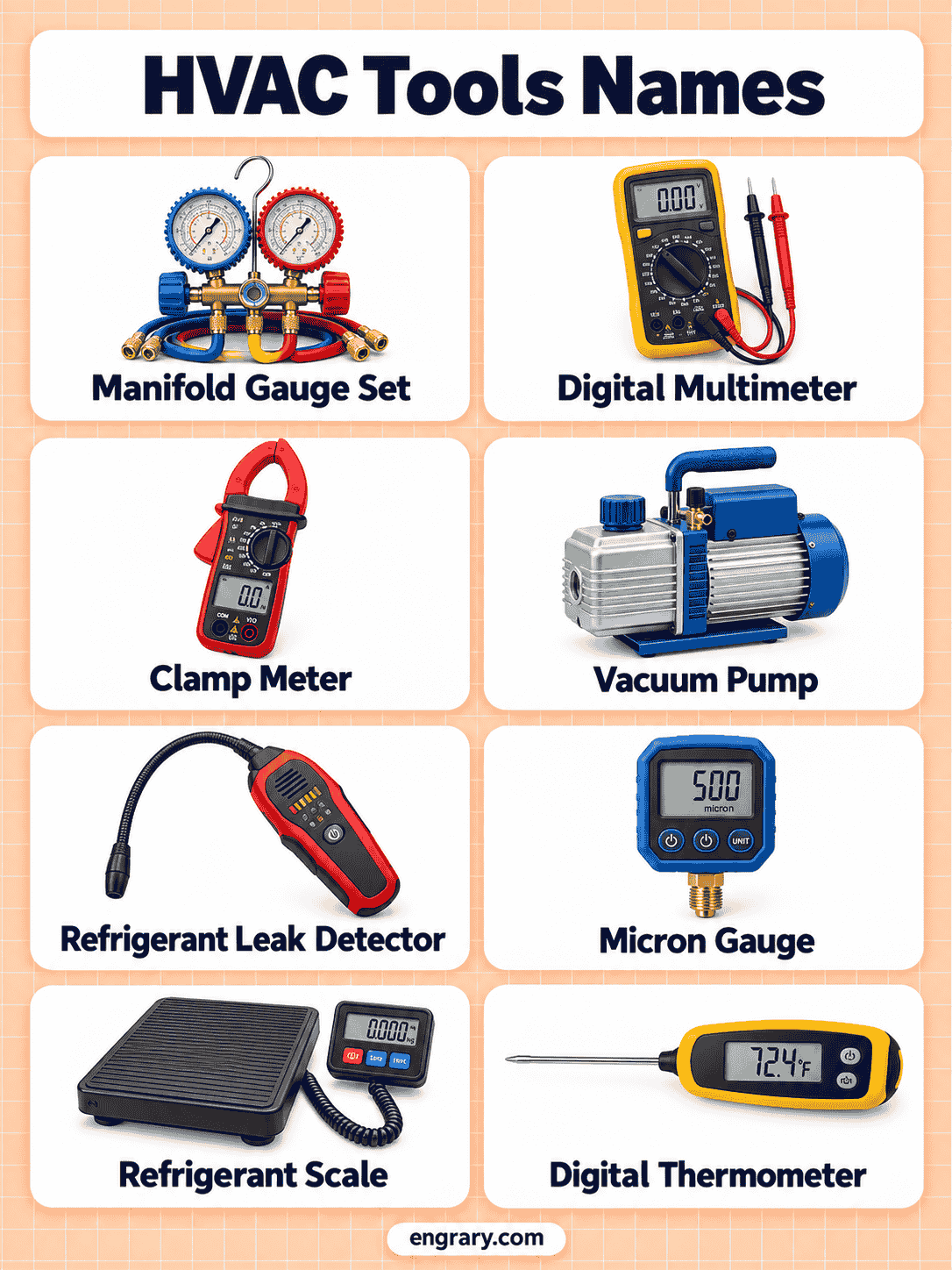
Vacuum Pump
A powerful pump removes air, moisture, and non-condensable gases from a sealed refrigeration system.
Micron Gauge
Deep vacuum can be measured accurately with this sensitive electronic instrument.
Refrigerant Recovery Machine
The machine transfers refrigerant from an HVAC system into an approved recovery cylinder.
Refrigerant Charging Scale
Precise weight readings help technicians add or recover the correct amount of refrigerant.
Electronic Refrigerant Leak Detector
A sensitive probe helps locate small refrigerant leaks around joints and components.
HVAC Clamp Meter
Electrical current and other circuit values can be checked without disconnecting the conductor for every measurement.
Digital Manometer
Small pressure differences in ducts, gas systems, and HVAC equipment can be measured accurately.
Digital Psychrometer
Temperature and humidity readings help evaluate indoor air and HVAC performance.
Anemometer
Air velocity measurements help technicians assess airflow through ducts, grilles, and registers.
Infrared Thermometer
Surface temperature can be checked quickly without direct contact.
Tubing Cutter
A rotating cutting wheel produces a clean cut through copper and other compatible tubing.
Flaring Tool
The forming cone creates a flared tubing end for compatible mechanical connections.
Tube Bender
Controlled leverage forms smooth bends while reducing the risk of tubing collapse.
Brazing Torch
A concentrated flame provides the heat needed for suitable refrigerant-line brazing work.
Nitrogen Regulator
Controlled pressure from a nitrogen cylinder supports pressure testing and selected brazing procedures.
Combustion Analyzer
Combustion gases can be measured to evaluate suitable fuel-burning heating equipment.
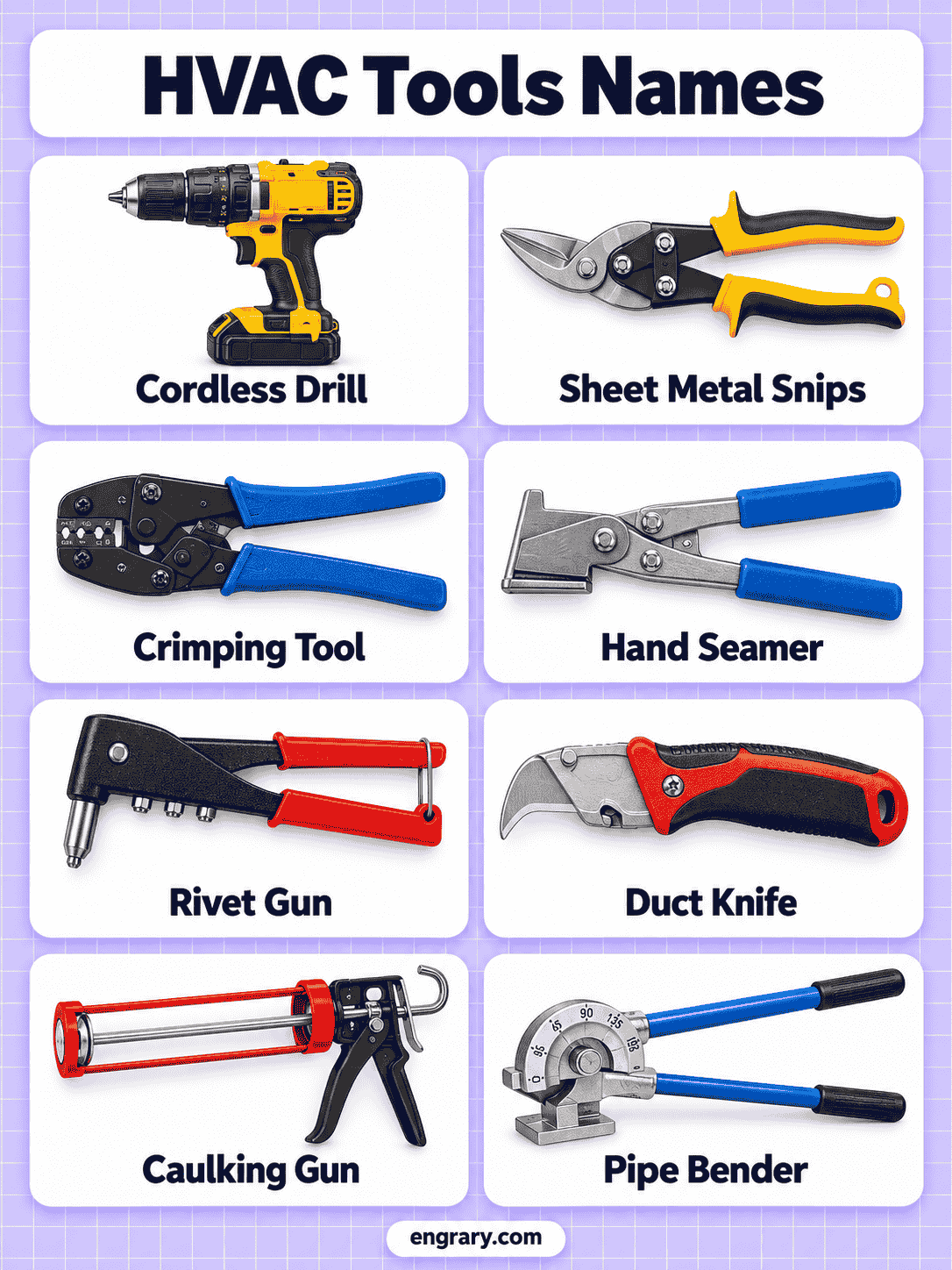
Cordless Drill
Portable battery power supports drilling and fastening during HVAC installation.
Tin Snips
Strong cutting blades trim thin sheet metal used in ductwork and fittings.
Wet/Dry Vacuum
Suction clears debris, water, and suitable condensate-line blockages during service work.
Tools for Refrigerant Charging and Pressure Checks
Refrigerant service requires tools that connect safely to system ports, measure pressure, control flow, and track refrigerant weight.
Analog Manifold Gauge Set
Mechanical gauges display high- and low-side refrigerant pressures during system service.
Digital Refrigerant Manifold
Electronic pressure sensors provide detailed system readings and calculations on compatible equipment.
Charging Hose Set
Flexible service hoses connect manifolds, refrigerant cylinders, pumps, and HVAC systems.
Low-Loss Refrigerant Hose
A specialized fitting reduces refrigerant release when the hose is disconnected.
Ball-Valve Refrigerant Hose
An integrated shutoff valve gives the technician direct control over refrigerant flow at the hose end.
Refrigerant Charging Scale
Accurate weight measurement helps control the amount of refrigerant transferred.
Core Removal Tool
The tool removes valve cores while helping maintain access to a pressurized or evacuated system.
Valve Core Tool
A small driver installs or removes Schrader-type valve cores.
Refrigerant Adapter Set
Different fittings connect service hoses to compatible refrigerant ports and equipment.
Refrigerant Piercing Pliers
Special jaws create temporary service access on suitable sealed tubing.
Schrader Core Depressor Tool
An adjustable tip controls how far a valve core opens during hose connection.
HVAC Service Wrench
Square and hex openings turn service valves and access fittings on compatible HVAC equipment.
Tools for Pulling and Confirming a Deep Vacuum
Evacuation removes moisture, air, and other unwanted gases before refrigerant is introduced into a sealed system.
Vacuum Pump
High-flow pumping lowers system pressure during evacuation.
Micron Gauge
Very low absolute pressure readings show how deeply the system has been evacuated.
Vacuum Manifold
Large internal passages help connect evacuation equipment while reducing flow restriction.
Vacuum-Rated Hose
A wide, durable hose supports high-flow evacuation with less restriction than many standard charging hoses.
Evacuation Hose Kit
Matched large-diameter hoses create an efficient path between the HVAC system and vacuum pump.
Vacuum Isolation Valve
Closing the valve isolates the pump so technicians can observe whether system pressure rises.
Vacuum Tee
Multiple vacuum connections allow gauges, hoses, and pumps to share a common evacuation point.
Vacuum Pump Oil Drain Pan
A dedicated container catches used pump oil during maintenance and oil changes.
Equipment for Recovering and Managing Refrigerant
Recovery equipment allows technicians to remove and contain refrigerant before opening or repairing a system.
Refrigerant Recovery Machine
An internal compressor transfers refrigerant from the system into a recovery container.
Recovery Cylinder
A dedicated pressure vessel stores recovered refrigerant during service.
Recovery Hose
Heavy-duty hose connects the HVAC system, recovery machine, and recovery cylinder.
Refrigerant Identifier
The instrument analyzes refrigerant so technicians can identify compatible or contaminated contents.
Cylinder Heater
Controlled warming increases cylinder pressure when suitable transfer conditions require it.
Recovery Tank Overfill Switch
A level-sensing connection can stop compatible equipment before the recovery cylinder becomes overfilled.
Refrigerant Transfer Pump
Mechanical pumping assists with moving refrigerant between suitable containers or systems.
Recovery Cylinder Scale
Weight readings help monitor how much refrigerant enters a recovery cylinder.
Tools for Finding Refrigerant and Gas Leaks
Small leaks can reduce system performance and allow refrigerant or fuel gas to escape. Different detectors suit different gases and testing methods.
Electronic Refrigerant Leak Detector
A sensitive electronic sensor reacts when refrigerant reaches the probe.
Ultrasonic Leak Detector
High-frequency sound produced by escaping gas helps identify certain leaks.
UV Leak Detection Lamp
Ultraviolet light reveals compatible fluorescent dye around a leak location.
UV Dye Injector
The injector introduces an approved fluorescent dye into a compatible system.
Nitrogen Regulator
Cylinder pressure is reduced to a controlled test pressure before nitrogen enters the system.
Pressure Test Gauge
Stable gauge readings help technicians observe whether a sealed system loses pressure.
Combustible Gas Leak Detector
A dedicated sensor checks for leaks from compatible combustible gases.
Trace Gas Leak Detector
Sensitive detection equipment locates approved trace gases used during specialized pressure testing.
Tools for Measuring Airflow, Temperature, and Humidity
Air-side measurements help technicians evaluate comfort, ventilation, temperature change, and system airflow.
Digital Psychrometer
Dry-bulb temperature, humidity, and related air properties can be measured electronically.
Hot-Wire Anemometer
A heated sensing element measures lower air velocities inside ducts and at outlets.
Vane Anemometer
A small rotating vane converts moving air into an air-velocity reading.
Airflow Hood
The capture hood measures air volume directly at suitable supply or return grilles.
Infrared Thermometer
Non-contact sensing provides quick surface-temperature readings.
Pipe Clamp Thermometer
A spring-loaded sensor grips refrigerant tubing to measure line temperature.
Thermocouple Thermometer
Interchangeable probes measure air, pipe, surface, or other temperatures depending on probe type.
Pocket Thermometer
Compact construction makes quick air and surface checks convenient during service calls.
Hygrometer
Relative humidity readings help evaluate indoor moisture conditions.
Temperature-Humidity Data Logger
Recorded readings show how temperature and humidity change over an extended period.
Electrical Tools Used for HVAC Diagnosis and Controls
Motors, capacitors, contactors, thermostats, control boards, and heating equipment all require accurate electrical testing.
HVAC Clamp Meter
A clamp-style sensor measures current around a conductor while also supporting other HVAC electrical checks on suitable models.
Digital Multimeter
Test leads measure voltage, resistance, continuity, and other circuit values.
Non-Contact Voltage Tester
An electronic sensor indicates the possible presence of AC voltage without touching bare conductors.
Capacitance Meter
Capacitor values can be checked against their rated specification.
Insulation Resistance Tester
High-resistance measurements help evaluate electrical insulation condition.
Phase Rotation Meter
Three-phase sequence can be identified before connecting or troubleshooting compatible motors.
Circuit Tracer
Signals help follow circuits, conductors, or breakers through an electrical installation.
Test Light
A simple illuminated indicator provides a quick check for voltage in suitable circuits.
Alligator Clip Test Lead Set
Spring-loaded clips hold meter connections securely during hands-free measurements.
Fuse Puller
Insulated gripping jaws remove suitable fuses without ordinary pliers.
Wire Stripper
Sized openings remove insulation while preserving the conductor underneath.
Crimping Tool
Mechanical pressure secures compatible terminals and connectors onto prepared wires.
Tools for Gas Pressure and Combustion Checks
Heating service often requires measurements that differ from refrigerant-side air-conditioning work.
Digital Manometer
Electronic sensing measures small gas, static, and differential pressures.
Dual-Port Manometer
Two pressure connections allow direct differential-pressure comparison.
Combustion Analyzer
Flue-gas measurements help evaluate combustion performance on suitable heating appliances.
Carbon Monoxide Detector
A dedicated sensor checks for carbon monoxide around equipment and occupied spaces.
Draft Gauge
Small pressure readings show chimney or flue draft conditions.
Gas Leak Detector
A sensitive probe helps locate leaks around compatible gas valves, joints, and piping.
Smoke Pump Tester
A hand-operated smoke source helps visualize draft and airflow around suitable combustion equipment.
Differential Pressure Gauge
Pressure differences across filters, coils, ducts, and other components can be compared directly.
Tools for Cutting, Flaring, Swaging, and Bending Tubing
Copper and other HVAC tubing must be cut and formed accurately before joints can be made.
Tubing Cutter
A rotating wheel gradually slices through tubing while keeping the cut relatively square.
Mini Tubing Cutter
Its compact frame works where a full-size cutter cannot rotate freely.
Reamer
A tapered cutting edge removes internal burrs after tubing has been cut.
Deburring Tool
Sharp inner and outer edges are scraped away before assembly.
Flaring Tool
A forming cone reshapes the tubing end for a compatible flare fitting.
Swaging Tool
The tool expands one tube end so another tube can fit inside it.
Tube Bender
A shaped former creates controlled bends while supporting the tubing wall.
Spring Tube Bender
A flexible spring reduces kinking while softer tubing is bent by hand.
Tube Expander
Mechanical expansion enlarges tubing ends for compatible joining methods.
Pinch-Off Pliers
Special jaws temporarily close suitable soft tubing during selected refrigeration work.
Capillary Tube Cutter
A fine cutting mechanism trims small capillary tubing without crushing the opening excessively.
Brazing Torch
High heat joins suitable refrigerant tubing with brazing alloy.
Tools for Duct Installation and Sheet-Metal Work
Duct systems require cutting, folding, crimping, joining, and shaping tools that differ from refrigerant-service equipment.
Tin Snips
Strong manual blades make straight cuts through light sheet metal.
Aviation Snips
Compound leverage improves control when making straight or curved cuts.
Duct Crimper
Formed jaws create a reduced crimped end so round duct sections can fit together.
Hand Seamer
Wide flat jaws bend and flatten sheet-metal edges.
Sheet-Metal Nibbler
Small repeated cuts allow controlled shapes and openings in thin metal.
Duct Cutter
A dedicated cutting tool trims suitable duct material cleanly.
Hole Cutter
Adjustable cutting geometry creates round openings for ducts, fittings, and accessories.
Duct Stretcher
Hooked jaws pull sheet-metal edges together during duct assembly.
Sheet-Metal Folding Tool
A straight bending edge forms controlled folds along duct material.
Duct Notcher
Special jaws remove small sections from sheet metal so corners and joints can form correctly.
Tools for Installation, Fastening, and Service Access
HVAC installation often involves drilling through framing, driving screws, opening service areas, and inspecting spaces that are difficult to see directly.
Cordless Drill
Portable power handles drilling and ordinary screwdriving during installation.
Impact Driver
Rapid rotational impacts drive screws and fasteners efficiently.
Nut Driver Set
Socket-style tips fit common hex-head screws used on HVAC panels and equipment.
Magnetic Bit Holder
Magnetic retention keeps compatible driver bits and fasteners easier to control.
Step Drill
A stepped cutting profile creates several hole sizes in thin sheet metal.
Hole Saw Arbor
The arbor supports compatible hole saws when larger circular openings are required.
Inspection Mirror
An angled reflective surface reveals components hidden behind equipment or ductwork.
Inspection Camera
A flexible camera probe shows areas inside ducts, cabinets, walls, and other confined spaces.
Tools for Condensate and Drain-Line Service
Blocked condensate lines can cause water problems and equipment shutdowns, so technicians often carry tools specifically for clearing them.
Condensate Drain Cleaner
Pressure or suction helps loosen buildup inside suitable condensate piping.
Wet/Dry Vacuum
Strong suction can remove water and debris from accessible drain lines.
Drain Snake
A flexible cable reaches deeper obstructions that simple suction cannot clear.
Condensate Line Flush Gun
A controlled burst of gas or pressure helps clear compatible drain tubing.
HVAC Tools Used During Common Service Tasks
Different service calls require different combinations of HVAC tools.
| HVAC Service Task | Common Tools |
|---|---|
| Refrigerant Charging | Digital Manifold, Charging Scale, Hose Set |
| System Evacuation | Vacuum Pump, Micron Gauge, Evacuation Hose |
| Refrigerant Recovery | Recovery Machine, Recovery Cylinder, Scale |
| Leak Detection | Electronic Leak Detector, Nitrogen Regulator, Pressure Gauge |
| Airflow Check | Anemometer, Psychrometer, Airflow Hood |
| Electrical Diagnosis | Clamp Meter, Multimeter, Voltage Tester |
| Furnace Service | Combustion Analyzer, Manometer, CO Detector |
| Copper Line Work | Tubing Cutter, Flaring Tool, Tube Bender |
| Duct Installation | Aviation Snips, Crimper, Hand Seamer |
| Condensate Service | Wet/Dry Vacuum, Drain Snake, Flush Gun |
HVACR manufacturers currently group professional equipment into many of these same service areas, including manifolds, recovery and vacuum, leak detection, airflow, electrical measurement, manometers, and combustion testing.
Refrigerant-Side Tools and Air-Side Tools
Technicians work on both the refrigeration circuit and the air-moving side of an HVAC system.
| Refrigerant-Side Tools | Air-Side Tools |
|---|---|
| Refrigerant Manifold | Psychrometer |
| Charging Scale | Anemometer |
| Vacuum Pump | Airflow Hood |
| Micron Gauge | Manometer |
| Leak Detector | Thermometer |
| Recovery Machine | Differential Pressure Gauge |
Refrigerant-side tools focus on pressure, charging, evacuation, recovery, and leak testing. Air-side instruments help evaluate temperature, humidity, airflow, and pressure through ducts and equipment.
HVAC Tools That Are Easy to Confuse
Several HVAC tools work together or produce related measurements, but each has a different purpose.
| Tools | Main Difference |
|---|---|
| Manifold Gauge vs Micron Gauge | A manifold measures normal refrigerant service pressures, while a micron gauge measures the deep vacuum reached during evacuation. |
| Vacuum Pump vs Recovery Machine | A vacuum pump removes air and moisture after refrigerant is absent, while a recovery machine removes refrigerant from the system. |
| Psychrometer vs Hygrometer | A psychrometer provides temperature and humidity-related HVAC measurements, while a hygrometer focuses primarily on humidity. |
| Anemometer vs Airflow Hood | An anemometer measures air velocity, while an airflow hood measures air volume at a grille or register. |
| Clamp Meter vs Digital Multimeter | A clamp meter excels at current measurement around a conductor, while a multimeter commonly uses test leads for broader electrical measurements. |
| Flaring Tool vs Swaging Tool | A flaring tool forms an outward flare, while a swaging tool expands tubing so another tube can fit inside it. |
| Reamer vs Deburring Tool | A reamer mainly cleans the inner tubing opening, while a deburring tool removes rough edges from inner or outer surfaces. |
| Tin Snips vs Aviation Snips | Tin snips use simple manual leverage, while aviation snips use compound leverage for easier controlled cutting. |
Tools Found in an HVAC Technician’s Service Bag
A field technician usually carries portable tools that cover common electrical, temperature, pressure, and fastening tasks.
Typical service-bag tools include:
- HVAC Clamp Meter
- Digital Multimeter
- Non-Contact Voltage Tester
- Digital Psychrometer
- Infrared Thermometer
- Refrigerant Leak Detector
- HVAC Service Wrench
- Nut Driver Set
- Wire Stripper
- Crimping Tool
- Inspection Mirror
- Compact Manometer
Larger equipment such as vacuum pumps, recovery machines, cylinders, scales, and combustion analyzers may travel separately until the service call requires them.
HVAC Tools for Installation and HVAC Tools for Service
Installation and service work overlap, but technicians often rely on different tool combinations.
| HVAC Installation Work | HVAC Service Work |
|---|---|
| Cordless Drill | Digital Manifold |
| Impact Driver | Clamp Meter |
| Hole Saw | Leak Detector |
| Tube Bender | Psychrometer |
| Brazing Torch | Micron Gauge |
| Duct Crimper | Manometer |
| Tin Snips | Combustion Analyzer |
| Flaring Tool | Inspection Camera |
Installation tools primarily help place, connect, and secure equipment. Service tools focus more on measurement, diagnosis, charging, testing, and troubleshooting.
Items Used Alongside HVAC Tools
HVAC work also depends on materials and consumables that should not be confused with tools.
Refrigerant
The working fluid absorbs and releases heat as it circulates through a compatible refrigeration system.
Brazing Alloy
Filler metal forms strong joints between suitable tubing and fittings.
Nitrogen
Controlled nitrogen flow supports pressure testing and selected brazing procedures.
Vacuum Pump Oil
Proper oil helps a vacuum pump reach and maintain deep vacuum performance.
Electrical Terminals
Connectors attach prepared wires to suitable equipment and controls.
Duct Sealant
Sealing material helps reduce unwanted air leakage from suitable duct joints.
Insulation Tape
Specialized tape helps finish or seal compatible insulation and HVAC materials.
Condensate Treatment Products
Approved maintenance products can help reduce buildup in suitable drain systems.
These materials support HVAC work but do not count toward the 100-tool list.
FAQs About HVAC Tools
What are the most common HVAC tools?
Common HVAC tools include refrigerant manifolds, vacuum pumps, micron gauges, recovery machines, charging scales, leak detectors, clamp meters, psychrometers, manometers, tubing cutters, flaring tools, and cordless drills.
Which tools are used for refrigerant charging?
Technicians commonly use a refrigerant manifold, charging hoses, refrigerant scale, service wrench, valve tools, and compatible adapters during charging and refrigerant-service work.
What tools are used to pull a vacuum on an HVAC system?
A vacuum pump creates the low pressure, while a micron gauge measures the depth of the vacuum. Large vacuum-rated hoses, core-removal tools, and isolation valves can support an efficient evacuation setup.
Which HVAC tools are used for electrical troubleshooting?
Clamp meters, digital multimeters, non-contact voltage testers, capacitance meters, insulation testers, phase meters, circuit tracers, and test leads support electrical diagnosis.
What tools are used for HVAC airflow testing?
Psychrometers, vane and hot-wire anemometers, airflow hoods, thermometers, hygrometers, and differential-pressure instruments help technicians evaluate air movement and air conditions.
You May Also Like

Leave a Comment