
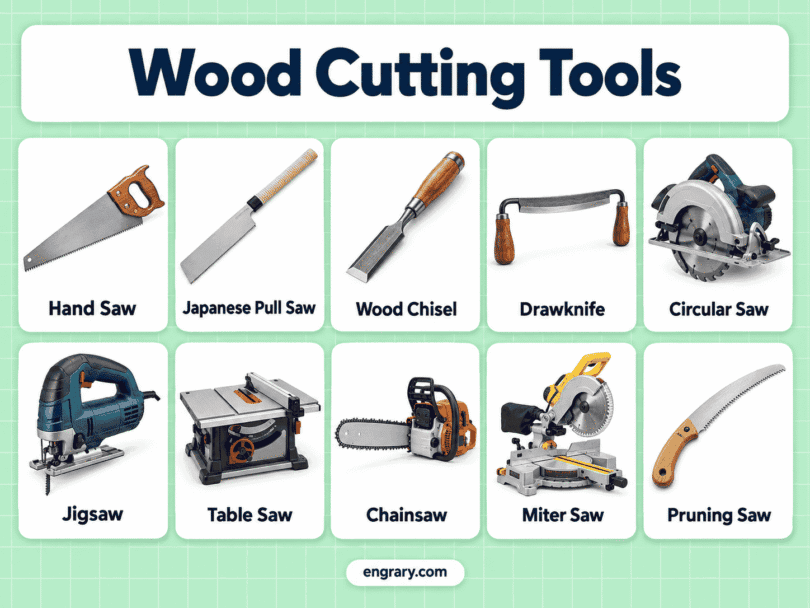
Wood cutting tools come in many forms for making straight cuts, rip cuts, crosscuts, joinery cuts, curves, and detailed shapes. Because each type of cut places different demands on the blade, woodworkers use different saws and edge-cutting tools for different jobs.
In this guide, you’ll learn 40 wood cutting tools names with pictures and uses. The list focuses on genuine tools for cutting wood, while leaving sanding, drilling, shaping, and finishing tools outside the main count.
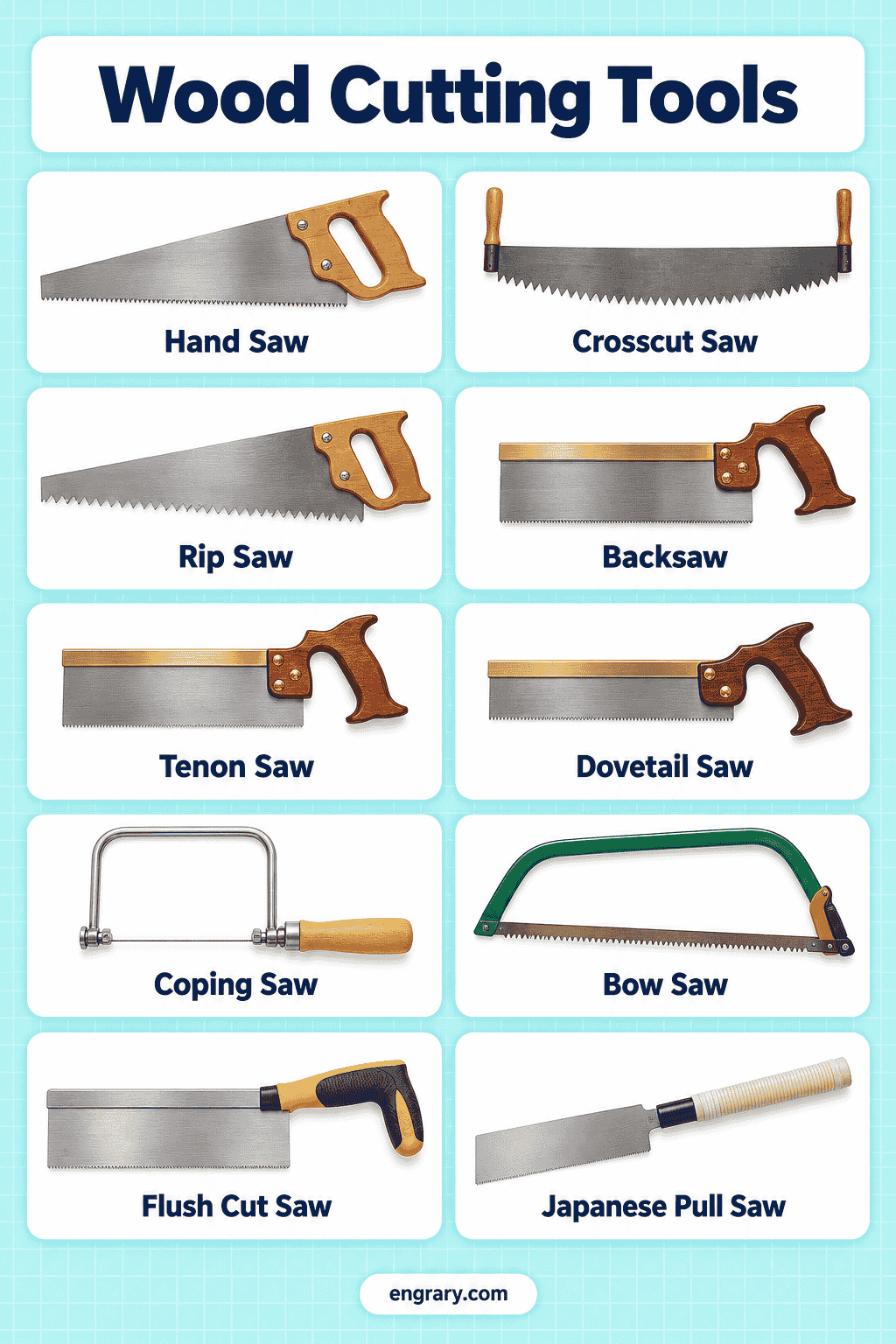
Wood Cutting Tools for Common Woodworking Cuts
Woodworkers use different cutting tools because grain direction, cut depth, accuracy, and shape all affect the result. For example, some saws work best along the grain, while others handle crosscuts, joinery, curves, panels, or fine detail work.
1. Hand Saw
A hand saw has a broad toothed blade attached to a handle. It handles many general woodworking cuts, especially when a simple manual saw is enough.
2. Panel Saw
A panel saw has a broad, tapering blade and a traditional hand-saw handle. Because of its size and shape, it works well for cutting boards and panels by hand.
3. Rip Saw
A rip saw uses teeth designed mainly for cutting in the same direction as the wood grain. As a result, it removes wood efficiently during rip cuts.
4. Crosscut Saw
A crosscut saw uses teeth shaped for cutting across wood fibers. In contrast to a rip saw, it focuses on severing the grain cleanly rather than following it.
5. Tenon Saw
A tenon saw has a rectangular blade with a rigid reinforced back. Therefore, the stiff blade helps keep joinery cuts straight and controlled.
6. Dovetail Saw
A dovetail saw is a smaller, finer backsaw used for detailed joinery. Its fine teeth and shallow blade help with precise cuts.
7. Carcass Saw
A carcass saw is a medium-sized backsaw for accurate crosscuts and joinery work. It usually sits between a tenon saw and a smaller dovetail saw in size and cutting purpose.
8. Coping Saw
A coping saw has a very thin blade held inside a deep U-shaped frame. Because the blade is narrow, it can follow curves more easily than a broad hand saw.
9. Fret Saw
A fret saw uses an extremely thin blade inside a very deep frame. Consequently, it suits intricate shapes and delicate internal cuts.
10. Keyhole Saw
A keyhole saw has a narrow pointed blade that fits into small openings. It is especially useful when the cut begins inside a panel rather than at an outer edge.
11. Compass Saw
A compass saw also has a narrow blade, but it usually has more blade depth than a keyhole saw. Therefore, it works well for curved and internal cuts in wood.
12. Bow Saw
A bow saw holds a long narrow blade under tension inside a curved frame. Its large frame makes it easy to recognize among hand saws.
13. Frame Saw
A frame saw holds a narrow blade inside a rigid wooden or metal frame. Because the frame keeps the blade tight, it can make controlled straight cuts.
14. Japanese Pull Saw
A Japanese pull saw has a thin blade and straight handle. Unlike many Western hand saws, it cuts mainly on the pull stroke.
15. Ryoba Saw
A Ryoba saw has teeth on both edges of its blade. Usually, one edge suits rip cuts while the other suits crosscuts, so one saw can handle both grain directions.
16. Dozuki Saw
A Dozuki saw has a fine blade reinforced by a rigid back. Therefore, it excels at precise joinery cuts that need a thin kerf.
17. Kataba Saw
A Kataba saw has a single-edged blade without a rigid back. Because the blade lacks a spine, it can make deeper cuts than many backsaws.
18. Flush-Cut Saw
A flush-cut saw has a thin flexible blade that can trim projecting wood close to a surrounding surface. For example, woodworkers use this type of saw where a protruding piece must end nearly level with the workpiece.
19. Veneer Saw
A veneer saw has a short fine-toothed blade designed for thin wood veneer. Its compact form helps maintain control across delicate sheet material.
20. Circular Saw
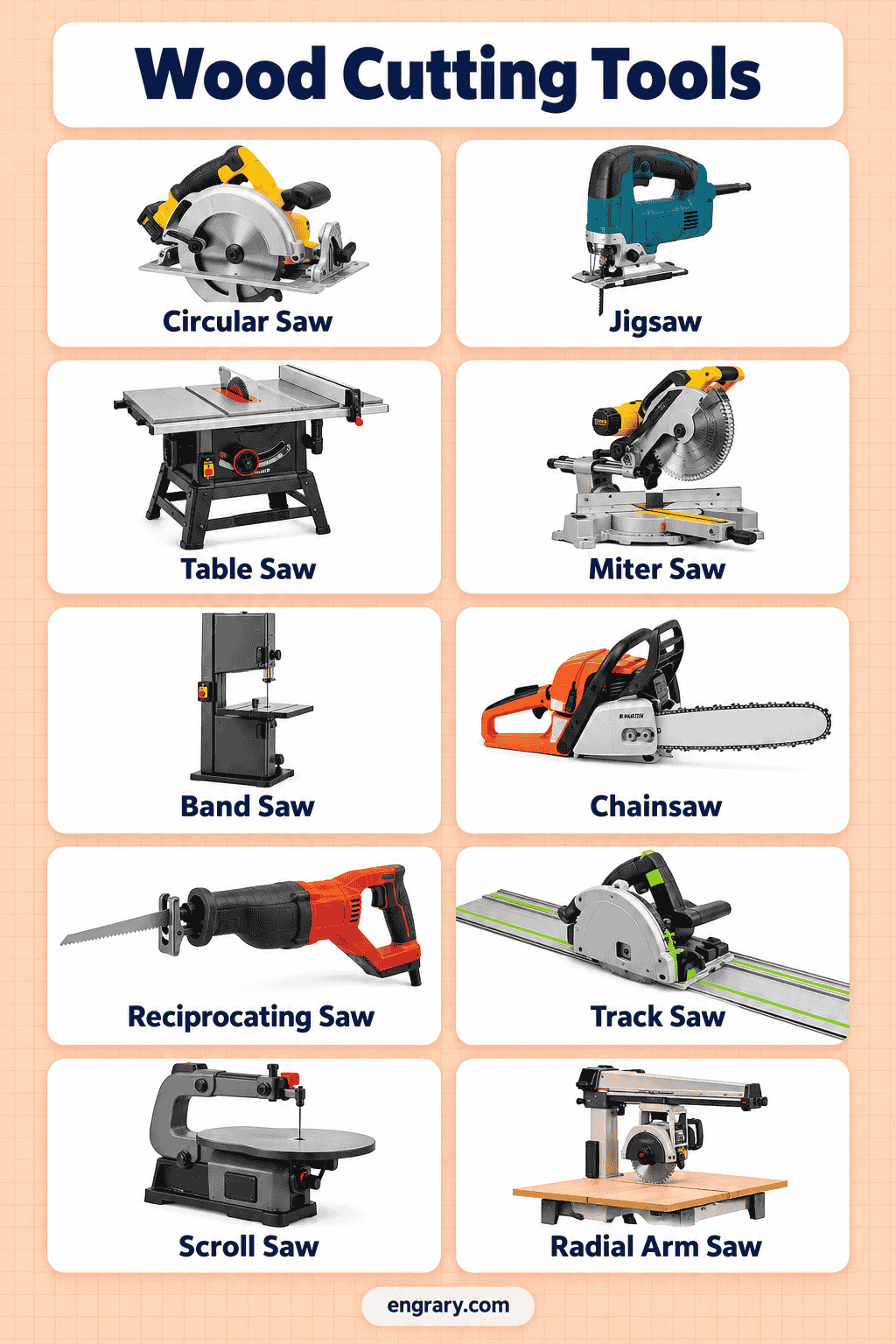
A circular saw uses a rotating round blade inside a handheld power-tool body. It handles many straight cuts in boards, sheet wood, and panels.
21. Track Saw
A track saw resembles a circular saw, but it runs along a guide rail. As a result, it offers more controlled straight cuts across sheet goods and panels.
22. Table Saw
A table saw uses a circular blade that projects upward through a flat table. Instead of moving the saw across the wood, the operator feeds the workpiece past the blade.
23. Miter Saw
A miter saw mounts a circular blade on a pivoting arm above a supporting base. Because the blade lowers onto the workpiece, the tool works especially well for repeated crosscuts and angled cuts.
24. Jigsaw
A jigsaw uses a narrow vertical blade that moves up and down through a flat base plate. Consequently, it can follow curves more easily than most circular-blade saws.
25. Band Saw
A band saw uses a continuous narrow blade that travels around wheels inside the machine. It can make straight cuts, curves, and other controlled cuts depending on the setup.
Saws for Rip Cuts and Crosscuts
Rip cuts and crosscuts follow different directions relative to the grain. Therefore, sawmakers use different tooth patterns to help each saw cut efficiently in its intended direction.
26. Rip-Cut Panel Saw
A rip-cut panel saw combines a traditional broad hand-saw blade with teeth designed for cutting along the grain. Because of that tooth pattern, it suits longer rip cuts through boards.
27. Crosscut Panel Saw
A crosscut panel saw uses teeth shaped to sever wood fibers across the grain. In comparison with a rip-cut panel saw, it produces a cleaner cross-grain cut.
28. Two-Man Crosscut Saw
A two-man crosscut saw has a long blade with a handle at each end. It is mainly associated with cutting large timber across the grain.
Backsaws for Joinery and Precision Work
Backsaws have a stiff reinforcement along the top edge of the blade. Because this reinforcement limits blade flex, they work well for accurate joinery and precision cuts.
29. Gent’s Saw
A Gent’s saw is a small fine-toothed backsaw with a straight handle. Its compact blade makes it useful for delicate joinery and model-scale woodworking.
30. Mitre Box Saw
A mitre box saw is a fine-toothed backsaw designed to work with a mitre box. Therefore, the box guides the blade while the saw makes straight or angled cuts.
Japanese Saws for Fine Wood Cutting
Japanese saws generally use thin blades and cut on the pull stroke. As a result, they can combine fine kerfs with good control in joinery and trimming work.
31. Azebiki Saw
An Azebiki saw has a short curved blade that can begin a cut within the face of a board. Because of this shape, it differs clearly from straight-backed Japanese saws.
32. Kugihiki Saw
A Kugihiki saw has a very flexible blade for flush trimming. It can cut projecting wood close to a surface while minimizing damage to the surrounding area.
Saws for Curves, Shapes, and Internal Cuts
Curved and internal cuts need narrow blades because broad blades resist changes in direction. Therefore, these saws focus more on maneuverability than on long straight cuts.
33. Scroll Saw
A scroll saw is a stationary power tool with a very fine vertical blade. It handles intricate curves and internal shapes with more control than larger saws.
34. Pad Saw
A pad saw has a narrow blade held in a compact handle. Because of its slim form, it can work inside smaller openings and curved cutouts.
Power Saws for Straight, Angled, and Detailed Cuts
Powered woodworking saws differ mainly in blade movement, machine layout, and the way the workpiece meets the blade. Consequently, each type suits a different mix of straight, angled, or detailed cutting.
35. Sliding Miter Saw
A sliding miter saw mounts the cutting head on rails that move forward and backward. Therefore, it can cut wider boards than a basic fixed-arm miter saw.
36. Compound Miter Saw
A compound miter saw can position its blade for both miter and bevel angles. As a result, it handles compound angled cuts that involve more than one plane.
37. Portable Band Saw
A portable band saw uses a continuous loop blade inside a handheld body. Although workers often use it on other materials, some models can also cut suitable wood sections.
Chisels and Edge-Cutting Tools for Wood
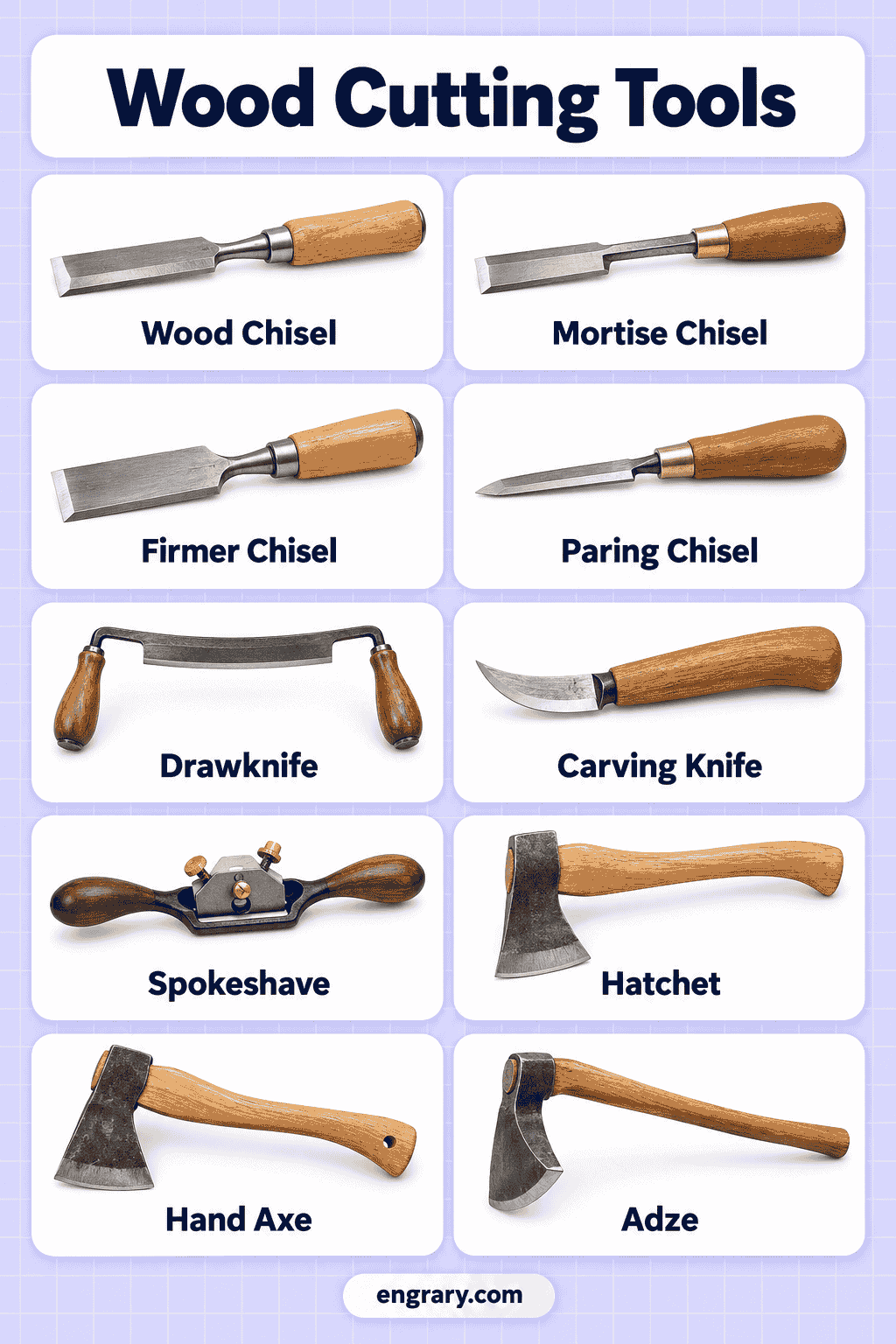
Not every wood cut requires a saw. Chisels cut with a sharpened edge, so they can remove wood from joints, recesses, and other areas where a saw may not fit.
38. Wood Chisel
A wood chisel has a flat sharpened blade and a handle. It cuts and removes wood in many general joinery and fitting tasks.
39. Mortise Chisel
A mortise chisel has a thick, strong blade designed for deeper cuts in narrow joints. Because of its heavier construction, it handles demanding joint work better than a thin chisel.
40. Paring Chisel
A paring chisel has a long, relatively thin blade for fine trimming. It removes small amounts of wood when accuracy matters more than heavy cutting force.
Wood Cutting Tools That Are Easy to Confuse
Many wood-cutting tools look similar at first. However, differences in tooth pattern, blade stiffness, frame design, and cutting direction make them easier to identify.
| Tools | Main Difference |
|---|---|
| Rip Saw vs Crosscut Saw | A rip saw cuts mainly along the grain, whereas a crosscut saw cuts across the grain. |
| Hand Saw vs Panel Saw | Hand saw is a broad general term, while panel saw usually refers to a traditional broad-bladed saw for boards and panels. |
| Tenon Saw vs Dovetail Saw | A tenon saw is generally larger and deeper; by contrast, a dovetail saw is smaller and finer for delicate joinery. |
| Tenon Saw vs Carcass Saw | A tenon saw often handles deeper joinery cuts, while a carcass saw usually favors finer controlled crosscuts. |
| Coping Saw vs Fret Saw | A coping saw has a shallower frame and slightly stronger blade, whereas a fret saw usually has a deeper frame and finer blade. |
| Coping Saw vs Keyhole Saw | A coping saw holds its blade in a frame, while a keyhole saw uses a narrow unsupported blade. |
| Japanese Pull Saw vs Western Hand Saw | A Japanese pull saw cuts mainly on the pull stroke, whereas many Western hand saws cut primarily on the push stroke. |
| Circular Saw vs Track Saw | A circular saw works as a general handheld saw; however, a track saw follows a guide rail for more controlled straight cuts. |
| Circular Saw vs Table Saw | A circular saw moves across the wood, while a table saw keeps the blade fixed as the workpiece moves past it. |
| Miter Saw vs Table Saw | A miter saw lowers its blade onto the workpiece, whereas a table saw cuts as the workpiece travels across the table. |
| Jigsaw vs Scroll Saw | A jigsaw is portable and handheld, while a scroll saw is stationary and better suited to intricate cuts. |
| Band Saw vs Scroll Saw | A band saw uses a continuous loop blade, while a scroll saw uses a fine reciprocating blade. |
Alternate Names for Wood Cutting Tools
Woodworking terminology changes across regions and traditions. Therefore, learning alternate names can make tool identification easier when reading manuals, catalogs, or woodworking guides.
| Main Name | Alternate Name |
|---|---|
| Hand Saw | Handsaw |
| Back Saw | Backsaw |
| Miter Saw | Mitre Saw |
| Japanese Pull Saw | Pull Saw |
| Keyhole Saw | Pad Saw in some contexts |
| Dovetail Saw | Fine Backsaw in some contexts |
| Flush-Cut Saw | Flush Saw |
| Circular Saw | Handheld Circular Saw |
| Table Saw | Saw Bench in some regions |
| Coping Saw | Coping Frame Saw |
These alternate terms do not count as extra tools when they refer to the same or closely related design.
Frequently Asked Questions
Common wood cutting tools include hand saws, rip saws, crosscut saws, tenon saws, dovetail saws, coping saws, circular saws, jigsaws, table saws, miter saws, band saws, and wood chisels.
A rip saw mainly cuts along the wood grain. In contrast, a crosscut saw cuts across the grain and severs the fibers more cleanly in that direction.
Both tools belong to the backsaw family. However, a tenon saw is generally larger and suits deeper joinery cuts, while a dovetail saw is smaller and finer.
Coping saws, fret saws, keyhole saws, compass saws, jigsaws, band saws, and scroll saws can all handle curved or detailed wood cutting. However, their blade size and machine format make them suitable for different levels of detail.
A circular saw is a general handheld power saw with a rotating blade. A track saw uses a similar blade system, but it runs along a guide rail for more controlled straight cuts.
You May Also Like

Leave a Comment