

Cutting tools are used to separate, slice, shear, trim, or remove material from wood, metal, plastic, fabric, wire, pipe, and other workpieces. Learning cutting tools names with pictures and uses makes it easier to recognize different saws, snips, cutters, chisels, and powered cutting tools.
This guide covers 50 cutting tools names with short descriptions and simple recognition clues. The list includes common workshop hand tools, saws, snips, cutting pliers, chisels, power saws, and specialized cutters for different materials.
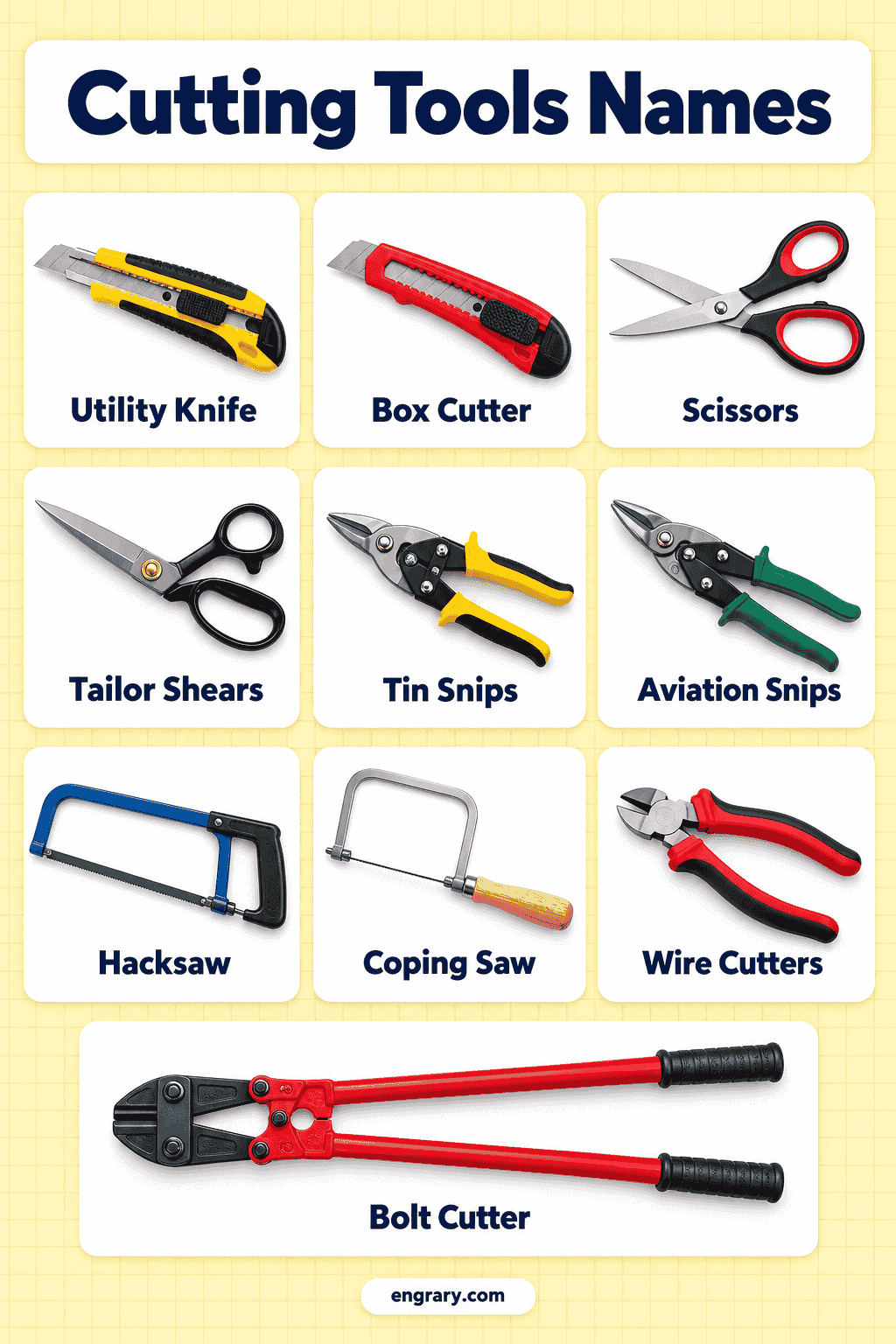
Cutting Tools Commonly Found in Workshops
Workshops use many cutting tools because different materials and jobs require different blade shapes, cutting mechanisms, and tool sizes. The following tools are among the most recognizable examples used for sawing, shearing, slicing, clipping, and controlled material removal.
1. Hand Saw
A hand saw has a long toothed blade attached to a handle. It is commonly used for manually cutting wood and similar materials.
2. Crosscut Saw
A crosscut saw has teeth shaped to cut across the grain of wood. Its blade usually resembles a traditional hand saw.
3. Rip Saw
A rip saw has teeth designed mainly for cuts that follow the direction of wood grain.
4. Hacksaw
A hacksaw has a narrow replaceable blade held under tension inside a metal frame. It is commonly associated with cutting metal, plastic, and similar materials.
5. Coping Saw
A coping saw has a very thin blade stretched across a deep U-shaped frame. Its narrow blade is easy to recognize.
6. Keyhole Saw
A keyhole saw has a narrow pointed blade that tapers toward the tip. Its slim shape suits smaller openings and confined cuts.
7. Tenon Saw
A tenon saw has a rectangular toothed blade reinforced along its upper edge with a rigid back.
8. Dovetail Saw
A dovetail saw is a smaller fine-toothed backsaw used for controlled and precise woodworking cuts.
9. Bow Saw
A bow saw has a long narrow blade stretched across a large curved frame.
10. Japanese Pull Saw
A Japanese pull saw has a thin flexible blade designed to cut as the saw is pulled toward the user.
11. Utility Knife
A utility knife has a replaceable sharp blade held inside a compact handle. Many designs use a retractable blade.
12. Craft Knife
A craft knife has a small pointed blade attached to a pen-like handle for fine cutting work.
13. Rotary Cutter
A rotary cutter has a circular blade mounted at the end of a handheld body. It rolls across the material while cutting.
14. Glass Cutter
A glass cutter has a small hardened cutting wheel mounted in a compact handle for scoring glass surfaces.
15. Pipe Cutter
A pipe cutter has a circular cutting wheel and an adjustable frame that fits around pipe.
16. Tube Cutter
A tube cutter resembles a pipe cutter but is commonly sized and shaped for smaller tubing.
17. Tin Snips
Tin snips resemble heavy scissors with short sturdy blades and longer handles. They are designed for cutting thin sheet material.
18. Aviation Snips
Aviation snips have compound-linkage handles and short cutting jaws, giving them a distinctive mechanical appearance.
19. Straight-Cut Snips
Straight-cut snips have blades arranged primarily for straight cuts through thin sheet material.
20. Left-Cut Snips
Left-cut snips are designed to make curved or directional cuts more easily toward the left.
21. Right-Cut Snips
Right-cut snips are shaped to make directional cuts more easily toward the right.
22. Wire Cutters
Wire cutters have short cutting jaws designed specifically to sever wire.
23. Diagonal Cutters
Diagonal cutters have angled cutting edges positioned across the sides of the jaws. They are also called side cutters.
24. End-Cutting Pliers
End-cutting pliers have cutting edges positioned across the end of the head rather than along the sides.
25. Bolt Cutters
Bolt cutters have a compact heavy cutting head attached to very long handles that provide strong leverage.

Hand Saws for Wood, Metal, and General Cutting
Hand saws differ in blade thickness, tooth pattern, frame design, and cutting direction. These differences make each type easier to recognize and better suited to particular kinds of manual cutting.
26. Flush-Cut Saw
A flush-cut saw has a thin flexible blade designed to make cuts close to a surface without a bulky rigid back.
27. Panel Saw
A panel saw is a traditional hand saw with a broad blade and handle, commonly used on boards and sheet-like wood products.
28. Compass Saw
A compass saw has a narrow pointed blade that works well for curved or internal cuts in softer materials.
29. Fret Saw
A fret saw has a very deep frame and extremely thin blade designed for fine curved or decorative cutting.
30. Junior Hacksaw
A junior hacksaw is a smaller version of a full-size hacksaw with a compact frame and narrow replaceable blade.
Snips and Shears for Thin Materials
Shearing tools cut by bringing two edges past each other. They are especially useful for thin materials where a saw would be unnecessary or awkward.
31. Sheet-Metal Shears
Sheet-metal shears have strong paired blades designed for cutting thin metal sheet.
32. Bench Shears
Bench shears are mounted to a bench or solid surface and use a long handle to operate a larger shearing blade.
33. Hand Shears
Hand shears have two blades and handles that work together in a scissor-like cutting action.
Cutters and Cutting Pliers
Cutting pliers use opposed jaws rather than long saw blades. Their head shape and handle length usually indicate the type of material they are meant to cut.
34. Cable Cutters
Cable cutters have curved or shaped cutting jaws designed to cut electrical cable and similar flexible material.
35. Nippers
Nippers have short jaws with cutting edges near the front of the head. They are used for clipping or cutting small projecting material.
36. Ratchet Cable Cutter
A ratchet cable cutter uses a staged ratcheting mechanism to close its cutting jaws progressively.
Chisels and Edge-Cutting Tools
Chisels cut or remove material with a sharpened edge rather than teeth or paired shearing blades. Their blade width and construction vary according to the material and type of work.
37. Wood Chisel
A wood chisel has a sharpened flat blade and handle designed for cutting or removing wood.
38. Firmer Chisel
A firmer chisel has a relatively thick rectangular blade suited to general woodworking cuts.
39. Mortise Chisel
A mortise chisel has a strong thick blade designed for heavier cutting in narrow woodworking joints.
40. Cold Chisel
A cold chisel is made from hardened steel and has a beveled cutting edge for working on metal.
Power Saws for Workshop Cutting
Powered saws use motor-driven blades to cut material faster than manual saws. Their blade orientation and machine shape make the main types easy to distinguish.
41. Circular Saw
A circular saw has a round toothed blade partly enclosed by a guard and mounted in a handheld power-tool body.
42. Jigsaw
A jigsaw has a narrow vertical blade that moves up and down through a flat base plate.
43. Reciprocating Saw
A reciprocating saw has a straight blade projecting from the front of the tool and moving rapidly back and forth.
44. Miter Saw
A miter saw has a circular blade mounted on a pivoting arm above a work table.
45. Table Saw
A table saw has a circular blade projecting upward through the surface of a flat table.
46. Band Saw
A band saw uses a continuous looped blade that travels around wheels inside the machine.
47. Scroll Saw
A scroll saw has a fine vertical blade mounted in a stationary machine for intricate curved cutting.
Specialized Cutters for Specific Materials
Some cutting tools are designed around a particular material or cutting style. Their shapes often make their intended role easy to identify.
48. PVC Pipe Cutter
A PVC pipe cutter has curved jaws that close around plastic pipe, often with a ratcheting handle mechanism.
49. Laminate Cutter
A laminate cutter is designed to score or cut laminate flooring and similar thin panel materials.
50. Hot Wire Cutter
A hot wire cutter uses a heated wire element to cut suitable foam materials cleanly.

Cutting Tools That Are Easy to Confuse
Several cutting tools appear similar because they work on related materials. Blade form, tooth design, frame shape, and cutting mechanism provide the clearest differences.
| Tools | Main Difference |
|---|---|
| Crosscut Saw vs Rip Saw | A crosscut saw is designed for cutting across wood grain, while a rip saw is designed for cutting along the grain. |
| Hand Saw vs Hacksaw | A hand saw normally has a broad wood-cutting blade, while a hacksaw uses a narrow replaceable blade held in a frame. |
| Coping Saw vs Keyhole Saw | A coping saw holds a thin blade in a deep frame, while a keyhole saw uses a narrow unsupported pointed blade. |
| Tenon Saw vs Dovetail Saw | Both are backsaws, but a dovetail saw is generally smaller and finer than a tenon saw. |
| Tin Snips vs Aviation Snips | Tin snips use a simpler shear design, while aviation snips usually have compound-action handles and directional variants. |
| Wire Cutters vs Bolt Cutters | Wire cutters have compact jaws for smaller wire, while bolt cutters use long handles and heavier jaws for harder material. |
| Diagonal Cutters vs End Cutters | Diagonal cutters cut from the sides of the head, while end cutters place the cutting edges across the front. |
| Circular Saw vs Jigsaw | A circular saw uses a rotating round blade, while a jigsaw uses a narrow reciprocating vertical blade. |
| Jigsaw vs Reciprocating Saw | Both use reciprocating blades, but a jigsaw works through a base plate while a reciprocating saw projects its blade from the front. |
| Miter Saw vs Table Saw | A miter saw lowers a blade onto the workpiece, while a table saw passes material across a blade projecting through a table. |
| Band Saw vs Scroll Saw | A band saw uses a continuous looped blade, while a scroll saw uses a fine reciprocating blade for intricate cuts. |
Alternate Names for Cutting Tools
Cutting-tool terminology varies by trade, region, and manufacturer. Learning common alternate names makes tool identification easier.
| Main Name | Alternate Name |
|---|---|
| Hand Saw | Handsaw |
| Tin Snips | Tinner’s Snips |
| Aviation Snips | Compound Snips |
| Diagonal Cutters | Side Cutters |
| End-Cutting Pliers | End Nippers |
| Utility Knife | Box Cutter in some contexts |
| Reciprocating Saw | Recip Saw |
| Miter Saw | Mitre Saw |
| Japanese Pull Saw | Pull Saw |
| Junior Hacksaw | Mini Hacksaw |
Alternate terms should not be counted as additional tools when they refer to the same or closely related design.
Frequently Asked Questions
Common cutting tools include hand saws, hacksaws, utility knives, tin snips, wire cutters, bolt cutters, chisels, circular saws, jigsaws, and reciprocating saws.
A crosscut saw is designed primarily to cut across wood grain, while a rip saw is designed to cut along the direction of the grain.
Tin snips use a simpler scissor-like construction, while aviation snips generally use compound-action handles and are available in directional cutting designs.
Wire cutters and diagonal cutters suit smaller wire, cable cutters are designed for cable, and bolt cutters use long handles with heavy jaws for harder metal items.
A jigsaw has a narrow vertical blade working through a flat base, which makes it easy to recognize as a workshop cutting tool. A reciprocating saw has a longer blade projecting from the front of the tool and a different body shape.
You May Also Like


Leave a Comment