
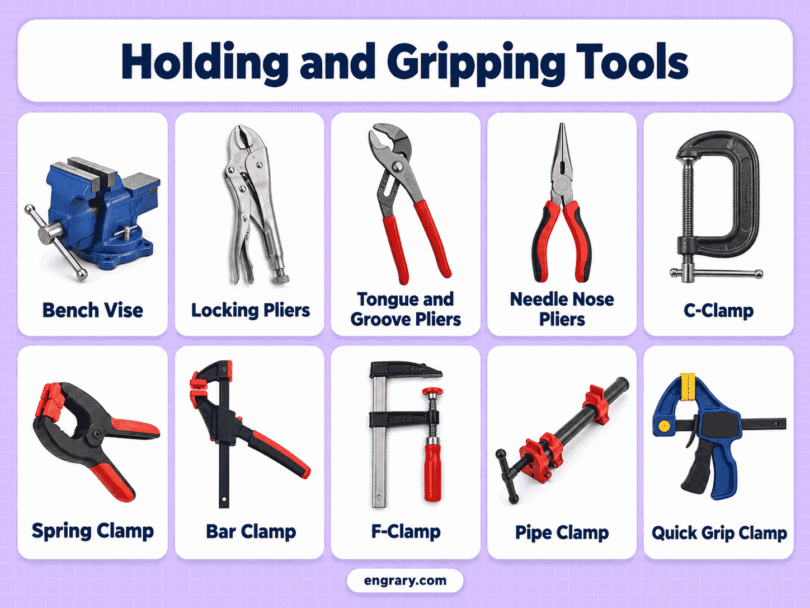
Holding and gripping tools help control, clamp, position, or stabilize a workpiece during workshop tasks. Some tools, such as pliers and tongs, rely on hand pressure, while clamps and vises hold an object securely without continuous hand force.
This guide covers 42 holding and gripping tools names with pictures and uses. It includes pliers, clamps, vises, tongs, pincers, and precision gripping tools, along with simple recognition clues to make each one easier to identify.
Common Tools for Holding and Gripping Workpieces
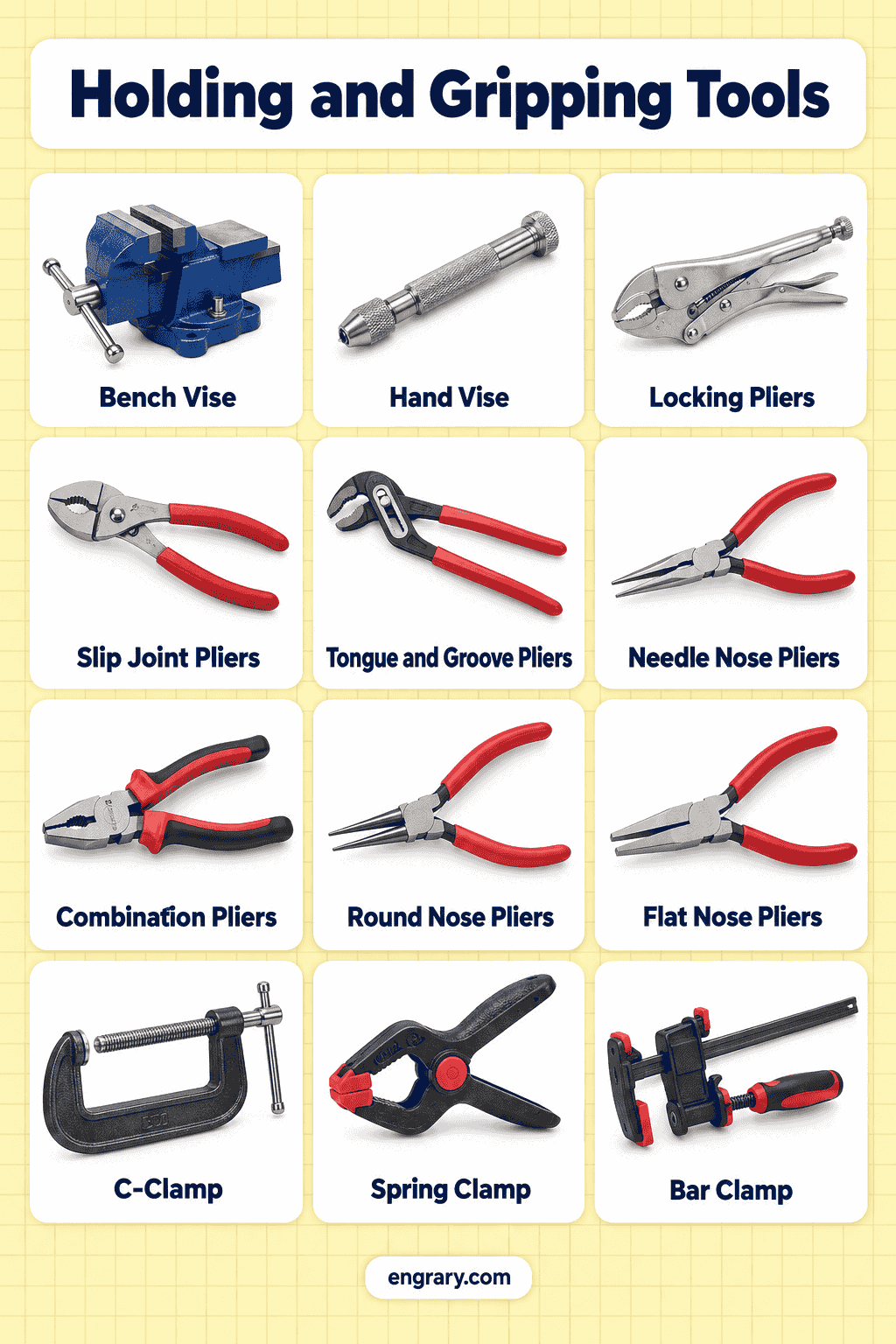
Different tools hold objects in different ways. For example, pliers grip through shaped jaws, clamps apply pressure across a frame or bar, and vises hold workpieces between fixed and moving jaws.
1. Combination Pliers
Combination pliers have broad serrated jaws, a central pivot, and sturdy handles. They grip, bend, and hold a wide range of small objects.
2. Needle-Nose Pliers
Needle-nose pliers have long, narrow jaws that taper to a fine point. Their slim shape makes them easy to recognize.
3. Long-Nose Pliers
Long-nose pliers also have extended jaws, but the jaws are usually broader and less sharply tapered than those of needle-nose pliers.
4. Flat-Nose Pliers
Flat-nose pliers have broad, flat jaw faces. They hold flat material more evenly than narrow pointed pliers.
5. Round-Nose Pliers
Round-nose pliers have smooth, tapered jaws with a rounded cross-section. Their cylindrical jaw shape distinguishes them from flat-nose designs.
6. Bent-Nose Pliers
Bent-nose pliers have long jaws that curve near the tip. As a result, they can grip objects from an angled position.
7. Duckbill Pliers
Duckbill pliers have long, broad, flat jaws that resemble the shape of a duck’s bill. They provide a wide gripping surface.
8. Slip-Joint Pliers
Slip-joint pliers have an adjustable pivot that changes the jaw opening. Therefore, one tool can grip more than one size of object.
9. Tongue-and-Groove Pliers
Tongue-and-groove pliers have angled jaws and several adjustment positions along the joint. Their wide opening range makes them visually distinct.
10. Water-Pump Pliers
Water-pump pliers have long handles, angled serrated jaws, and an adjustable joint. They are closely related to tongue-and-groove pliers.
11. Locking Pliers
Locking pliers have an adjustment screw at the end of one handle and a release lever inside the other. Once closed, the jaws remain locked on the workpiece.
12. Linesman Pliers
Linesman pliers have broad, short jaws and heavy handles. Their robust head gives them a much stronger appearance than long-nose pliers.
13. C-Clamp
A C-clamp has a rigid C-shaped frame with a threaded screw and swivel pad. Turning the screw moves the pad toward the fixed side of the frame.
14. F-Clamp
An F-clamp has a long straight bar with one fixed jaw and one sliding jaw. Its overall shape resembles the letter F.
15. Bar Clamp
A bar clamp uses a long rail or bar with jaws that move along its length. It holds wider workpieces than many smaller clamps.
16. Sash Clamp
A sash clamp has a long rail with a screw-operated head at one end and an adjustable stop at the other. It is commonly associated with long woodworking assemblies.
17. Spring Clamp
A spring clamp has two jaws connected by a strong spring. Its clothespin-like shape makes it one of the easiest clamps to recognize.
18. Quick-Grip Clamp
A quick-grip clamp has a long bar, sliding jaw, and trigger-style handle. Squeezing the trigger moves the jaw inward.
19. Corner Clamp
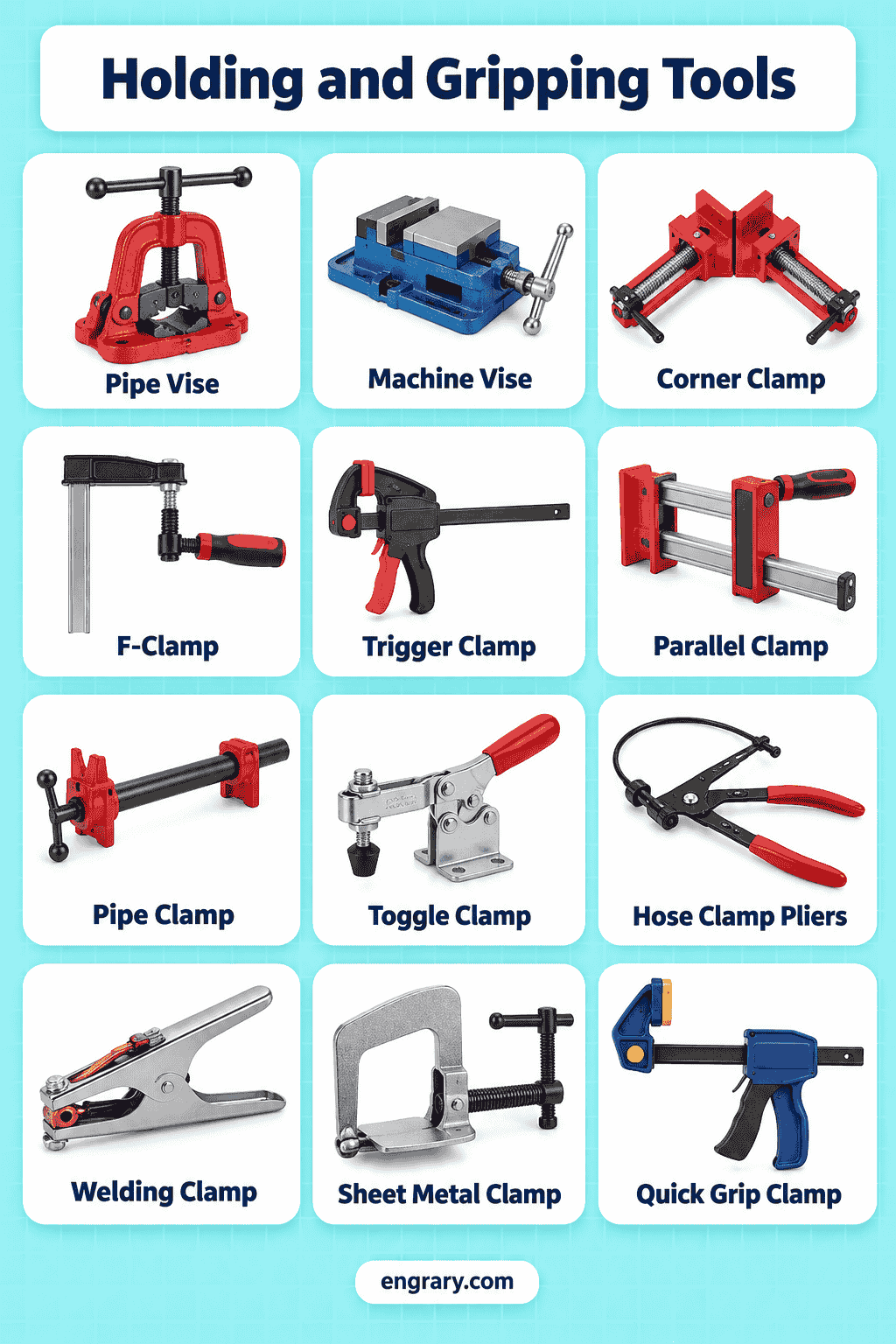
A corner clamp holds two pieces at a set angle, usually around a right angle. Its body forms a clear corner-supporting shape.
20. Pipe Clamp
A pipe clamp uses a length of pipe as the main rail with clamp jaws attached to it. Its working length depends on the pipe used.
21. Bench Vise
A bench vise has a heavy metal body with two horizontal jaws and a screw mechanism. It mounts directly to a workbench.
22. Machine Vise
A machine vise has a low, rigid body designed for mounting on a machine table. It usually looks more compact than a general bench vise.
23. Pipe Vise
A pipe vise uses shaped jaws or a chain arrangement to grip round pipe securely.
24. Hand Vise
A hand vise is a small portable vise with compact jaws and a handheld body. It holds small parts that would be awkward in a full-size vise.
25. Woodworking Vise
A woodworking vise has wide jaws designed to hold wooden workpieces. It commonly mounts to the front or underside of a workbench.
Pliers for General Gripping Work
General gripping pliers rely on jaw pressure and leverage through a central pivot. Although many pliers can perform more than one task, this section focuses on types whose main purpose includes holding, bending, or controlling a workpiece.
26. Parallel-Action Pliers
Parallel-action pliers keep their jaws nearly parallel as they open and close. Therefore, they apply more even contact across flat surfaces than conventional pivoting pliers.
27. Soft-Jaw Pliers
Soft-jaw pliers have protective jaw surfaces that reduce marking on delicate parts. Their jaw covers distinguish them from standard serrated pliers.
Long-Nose, Flat-Nose, and Shaped-Jaw Pliers
Jaw shape strongly affects how a pair of pliers grips an object. Narrow jaws reach into confined areas, while broad or rounded jaws spread pressure differently.
28. Snipe-Nose Pliers
Snipe-nose pliers have very long, slender jaws that taper to a narrow tip. They resemble long-nose pliers but usually have an even slimmer profile.
29. Chain-Nose Pliers
Chain-nose pliers have smooth, tapering jaws with flat inner faces and rounded outer edges. They provide controlled gripping on small objects.
30. Bail-Making Pliers
Bail-making pliers have two round jaws of different diameters. Their distinctive stepped jaw sizes make them easy to identify.
Adjustable and Locking Pliers
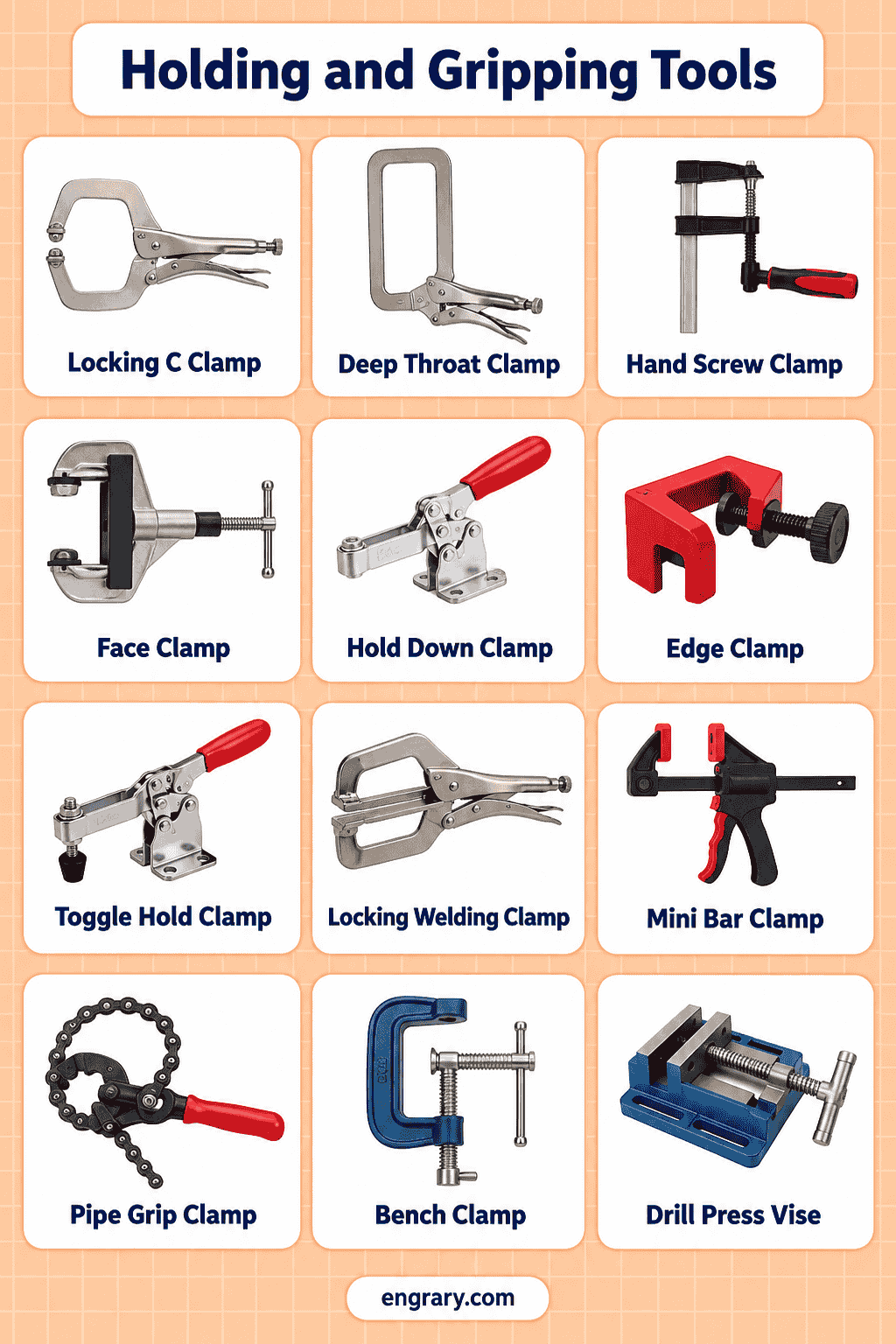
Adjustable gripping tools change jaw opening to fit different workpiece sizes. Locking designs go a step further by maintaining clamping pressure after the user releases the handles.
31. Curved-Jaw Locking Pliers
Curved-jaw locking pliers have rounded serrated jaws shaped to grip cylindrical or irregular objects more securely.
32. Long-Nose Locking Pliers
Long-nose locking pliers combine narrow extended jaws with a locking mechanism. This gives them the reach of long-nose pliers with the holding force of a locking design.
Clamps for Holding Workpieces
Clamps apply pressure across a workpiece and remain in position without constant hand force. Their frame, rail, jaw, or strap design usually reveals the kind of object they are meant to hold.
33. Parallel Clamp
A parallel clamp has large jaws designed to remain parallel as they close. It provides broad, even pressure across larger workpieces.
34. Toggle Clamp
A toggle clamp uses a lever mechanism that locks into position after closing. Its compact linkage system makes it visually distinctive.
35. Band Clamp
A band clamp uses a flexible strap that wraps around the outside of a workpiece or assembly. It suits shapes that are difficult to hold with straight jaws.
36. Toolmaker’s Clamp
A toolmaker’s clamp has two small parallel jaws connected by screws. Its compact all-metal design suits small precision workpieces.
Vises for Bench and Machine Work
Vises provide independent workholding by moving one jaw toward another with a screw or similar mechanism. Different vise designs suit benches, machine tables, pipe, and woodworking tasks.
37. Leg Vise
A leg vise has a long vertical movable jaw supported by a leg extending toward the floor. Its tall structure makes it easy to distinguish from a bench vise.
38. Face Vise
A face vise mounts to the front face of a woodworking bench. It has broad jaws for holding boards and similar wooden pieces.
Tongs and Pincers
Tongs and pincers grip objects through paired handles and opposing jaws. However, their head shapes differ from conventional pliers.
39. Utility Tongs
Utility tongs have long handles connected to broad gripping ends. They provide extra reach between the user’s hands and the object.
40. Flat Tongs
Flat tongs have broad, flat gripping jaws. Their jaw shape suits flat stock better than rounded tong designs.
41. Pincers
Pincers have a rounded head with jaws that meet near the end of the tool. Their head shape differs clearly from long-jaw pliers.
Precision Gripping Tools
Small objects often need lighter, more precise gripping tools. These tools use narrow tips rather than large serrated jaws.
42. Tweezers
Tweezers have two narrow spring-like arms that meet at the tips when squeezed. They hold very small components that ordinary pliers would be too large to grip.
Holding and Gripping Tools That Are Easy to Confuse
Many holding tools look similar because they share jaws, pivots, bars, or screws. However, their jaw shape, adjustment method, locking action, or mounting style usually reveals the difference.
| Tools | Main Difference |
|---|---|
| Combination Pliers vs Linesman Pliers | Combination pliers have a more general-purpose head, while linesman pliers have shorter, heavier jaws and a more robust build. |
| Needle-Nose vs Long-Nose Pliers | Needle-nose pliers taper to a finer point, while long-nose pliers generally have slightly broader extended jaws. |
| Flat-Nose vs Round-Nose Pliers | Flat-nose pliers have broad flat faces, whereas round-nose pliers use cylindrical tapered jaws. |
| Slip-Joint vs Tongue-and-Groove Pliers | Slip-joint pliers offer limited pivot adjustment, while tongue-and-groove pliers provide several adjustment positions and a wider jaw range. |
| Tongue-and-Groove vs Water-Pump Pliers | These terms often overlap, although water-pump pliers commonly describe heavy adjustable pliers with angled serrated jaws. |
| Slip-Joint vs Locking Pliers | Slip-joint pliers require continuous hand pressure, while locking pliers stay clamped after the handles close. |
| C-Clamp vs F-Clamp | A C-clamp uses a rigid C-shaped frame, while an F-clamp uses a long bar with a sliding jaw. |
| F-Clamp vs Quick-Grip Clamp | An F-clamp usually uses a screw to apply pressure, while a quick-grip clamp uses a trigger-style mechanism. |
| Bar Clamp vs Pipe Clamp | A bar clamp uses a solid bar or rail, while a pipe clamp uses a length of pipe as its rail. |
| Spring Clamp vs Quick-Grip Clamp | A spring clamp closes through spring force, whereas a quick-grip clamp uses a trigger-controlled sliding jaw. |
| Bench Vise vs Machine Vise | A bench vise mounts to a workbench for general holding, while a machine vise has a compact body designed for a machine table. |
| Bench Vise vs Woodworking Vise | A bench vise commonly has metal jaws, while a woodworking vise uses wider jaws suited to wooden workpieces. |
| Bench Vise vs Pipe Vise | A bench vise has general-purpose parallel jaws, while a pipe vise uses a holding profile designed around round pipe. |
| Pliers vs Pincers | Pliers usually have longer gripping jaws, while pincers have a rounded head with jaws meeting at the end. |
| Pliers vs Tongs | Pliers use a compact pivoted body, while tongs generally have longer handles and provide greater distance from the object. |
Alternate Names for Holding and Gripping Tools
Tool terminology varies by region, trade, and manufacturer. Therefore, the same holding tool may appear under more than one name.
| Main Name | Alternate Name |
|---|---|
| C-Clamp | G-Clamp |
| Locking Pliers | Vise Grips / Clamping Pliers |
| Bench Vise | Bench Vice |
| Machine Vise | Machine Vice |
| Tongue-and-Groove Pliers | Groove-Joint Pliers |
| Water-Pump Pliers | Pump Pliers |
| Needle-Nose Pliers | Long-Nose Pliers in some usage |
| Quick-Grip Clamp | Trigger Clamp |
| Pipe Vise | Pipe Vice |
| Woodworking Vise | Woodworker’s Vice in some regions |
Alternate terms do not add to the count when they refer to the same basic tool.
Frequently Asked Questions
Common holding and gripping tools include combination pliers, needle-nose pliers, slip-joint pliers, locking pliers, C-clamps, F-clamps, spring clamps, bench vises, machine vises, pipe vises, tongs, and tweezers.
Slip-joint pliers usually offer a limited change in pivot position. In contrast, tongue-and-groove pliers provide several adjustment positions and a much wider jaw opening.
Ordinary pliers need continuous hand pressure to keep gripping. Locking pliers, however, use an adjustment and locking mechanism that keeps the jaws clamped after the handles close.
A C-clamp uses a rigid C-shaped frame and screw, while an F-clamp uses a long bar with one fixed jaw and one sliding jaw.
A bench vise mounts to a workbench for general holding tasks. A machine vise has a lower, more compact body designed to secure workpieces on a machine table.
You May Also Like

Leave a Comment