
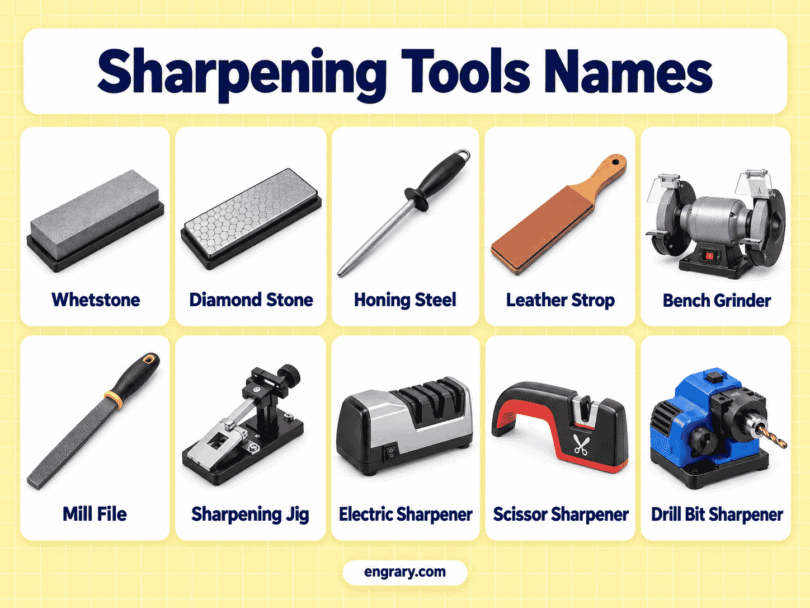
Sharpening tools restore, refine, and maintain the cutting edges of workshop tools. Because different edges have different shapes and levels of wear, sharpening systems range from flat stones and shaped abrasives to honing guides, strops, files, and powered machines.
This guide covers 38 sharpening tools names with pictures and uses. Each description focuses on what the tool looks like, where it fits in edge maintenance, and how it differs from similar sharpening equipment.
Common Sharpening Tools and Their Uses
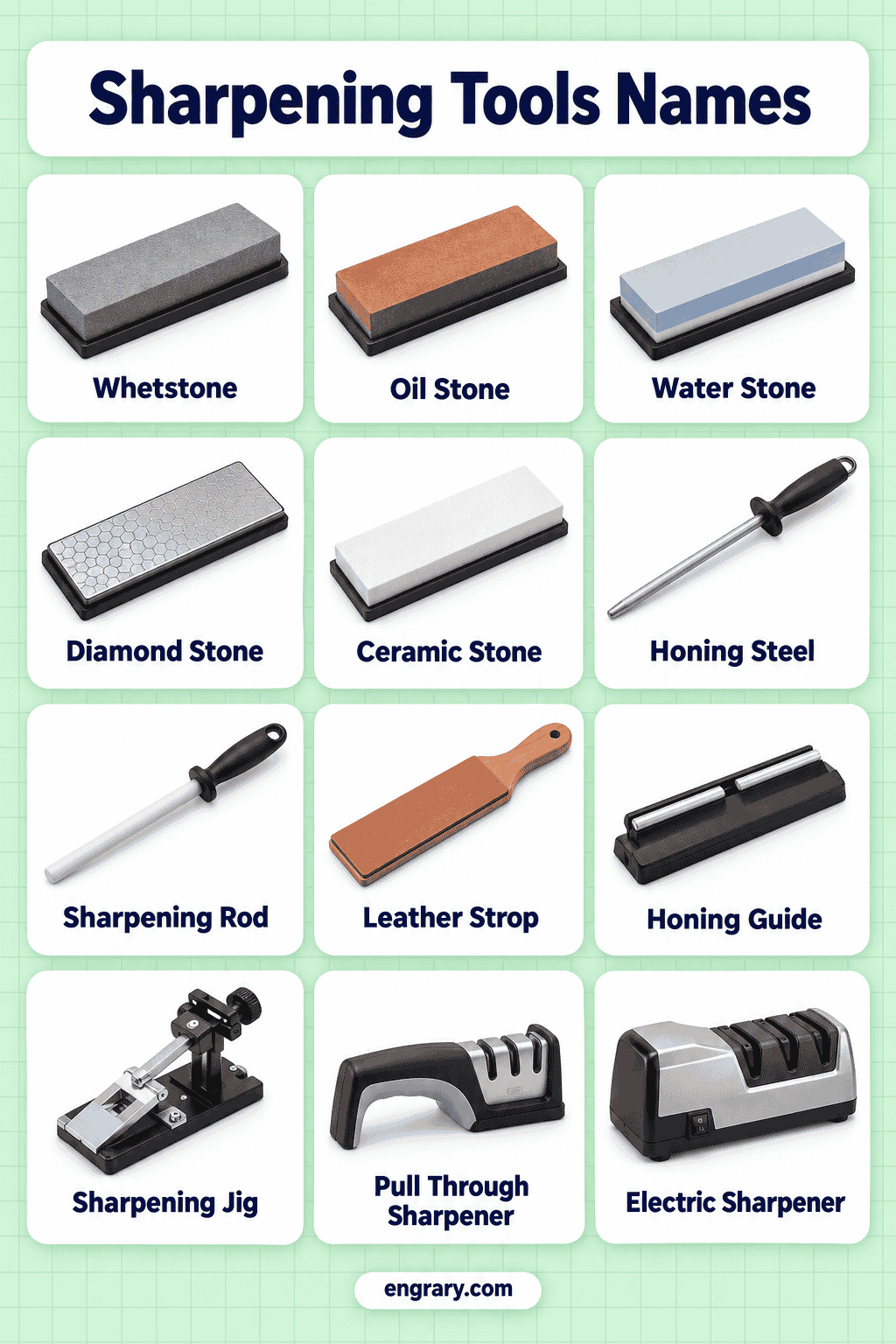
Sharpening does not rely on one tool alone. For example, coarse abrasives can restore an edge, finer tools refine it, and strops provide final polishing. Guides and jigs, meanwhile, help keep the cutting edge positioned consistently.
1. Whetstone
A whetstone is a flat abrasive stone for sharpening cutting edges. The term broadly covers sharpening stones rather than one specific abrasive material.
2. Bench Stone
A bench stone is a rectangular sharpening stone large enough to rest on a stable work surface. Its size distinguishes it from compact pocket stones.
3. Water Stone
A water stone is an abrasive sharpening stone associated with water during sharpening. It usually comes as a rectangular block in different abrasive grades.
4. Oil Stone
An oil stone is a durable sharpening stone traditionally paired with honing oil. Compared with many water stones, it often has a harder, slower-wearing surface.
5. Diamond Stone
A diamond stone has a rigid plate coated with industrial diamond abrasive. Therefore, it looks more like a textured plate than a traditional natural stone.
6. Ceramic Stone
A ceramic stone uses a hard ceramic abrasive surface to refine cutting edges. Its dense, smooth-looking body makes it easy to distinguish from coarse stones.
7. Combination Stone
A combination stone has two different abrasive grades in one block. Usually, each face provides a different level of sharpening or refinement.
8. Pocket Stone
A pocket stone is a small portable sharpening stone. Its compact size makes it noticeably smaller than a standard bench stone.
9. Slip Stone
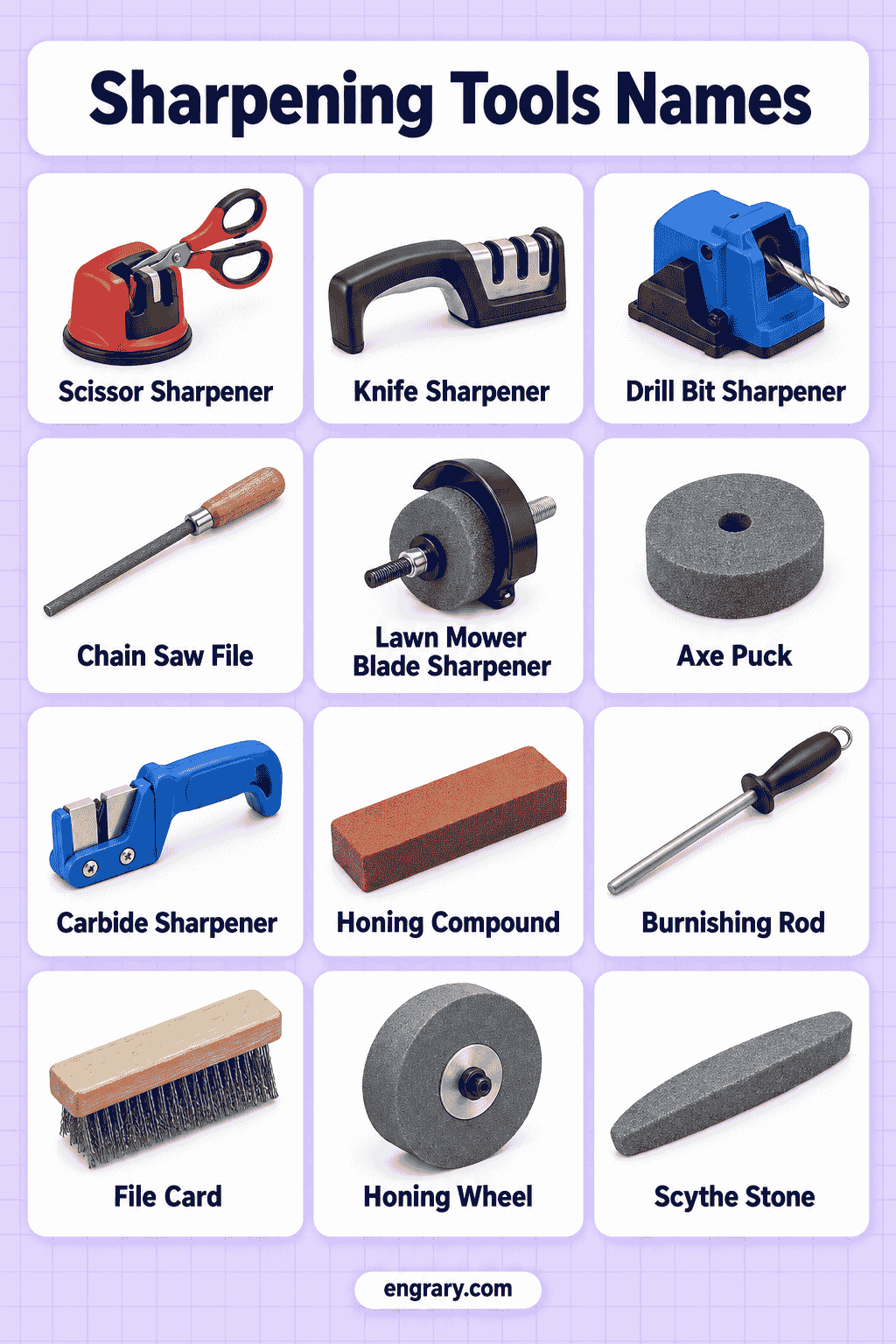
A slip stone has a narrow or shaped abrasive profile rather than a broad flat surface. Consequently, it suits curved and profiled cutting edges.
10. Gouge Stone
A gouge stone has shaped surfaces that match curved edge profiles. Its rounded or grooved form separates it from flat sharpening stones.
11. Round Sharpening Stone
A round sharpening stone has a cylindrical or rounded abrasive surface. It helps maintain cutting edges that a flat stone cannot contact evenly.
12. Cone Sharpening Stone
A cone sharpening stone narrows toward one end. As a result, different parts of the cone can match different curved profiles.
13. Mill File
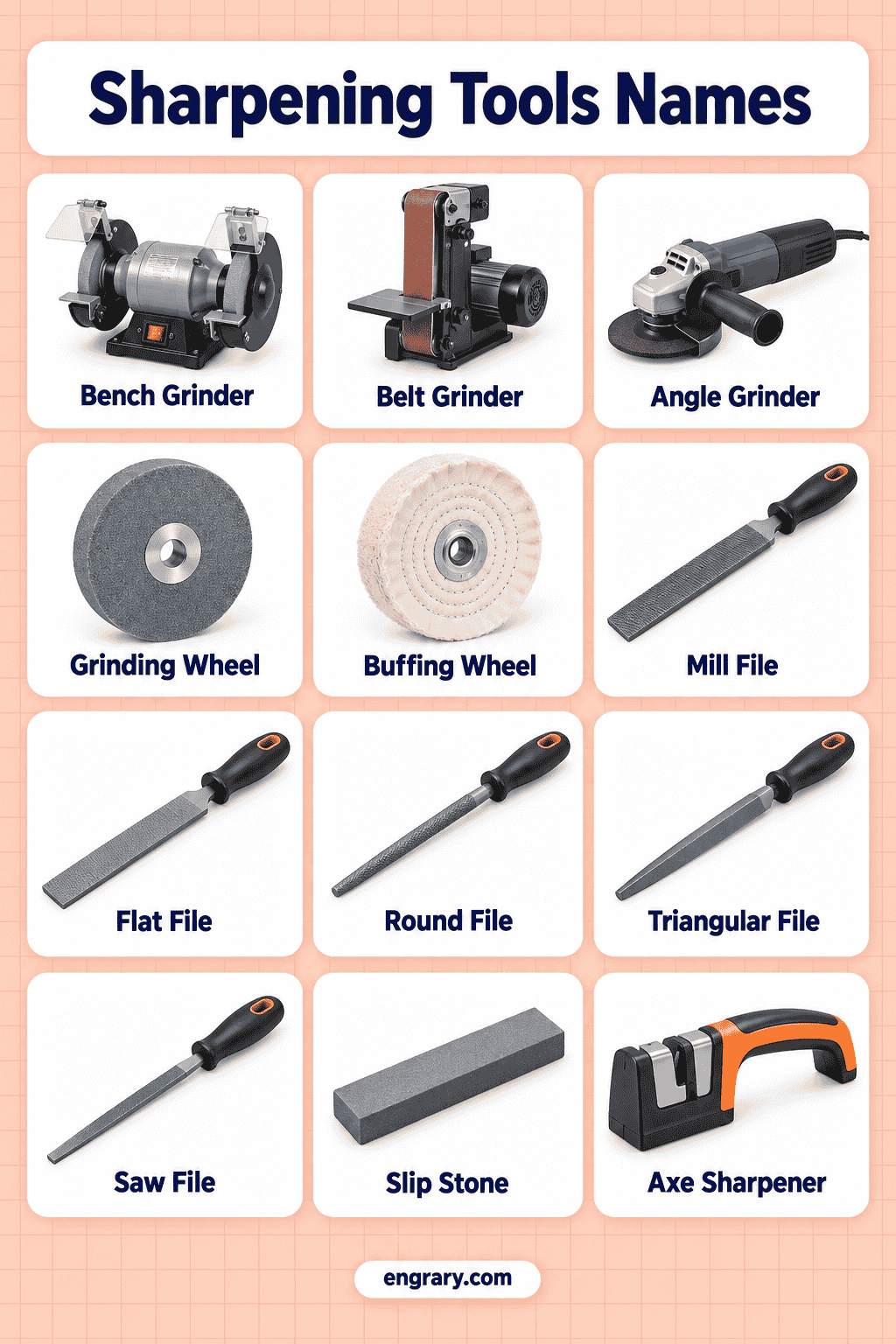
A mill file has a flat rectangular body with relatively fine teeth. In sharpening work, it can maintain suitable straight cutting edges.
14. Triangular Saw File
A triangular saw file has a three-sided cross-section with cutting teeth on its faces. Its shape matches the spaces between many traditional saw teeth.
15. Round Sharpening File
A round sharpening file has a cylindrical body with cutting teeth around its surface. Its rounded profile suits certain curved or rounded edge forms.
16. Honing Rod
A honing rod has a long narrow shaft with a handle. It helps maintain and refine suitable cutting edges between heavier sharpening sessions.
17. Ceramic Honing Rod
A ceramic honing rod uses a hard ceramic surface instead of plain steel. Therefore, it can provide light abrasive refinement as well as edge maintenance.
18. Diamond Honing Rod
A diamond honing rod has an abrasive diamond-coated surface. Its textured rod form combines the familiar honing-rod shape with a stronger abrasive action.
19. Honing Guide
A honing guide holds a chisel, plane blade, or similar edge tool at a consistent position against a sharpening surface. It usually has a small clamping body and roller.
20. Angle Guide
An angle guide has a wedge, block, or reference shape that helps establish a consistent sharpening angle. Unlike a honing guide, it may not clamp the blade directly.
21. Leather Strop
A leather strop provides a smooth leather surface for final edge refinement. It may appear as a hanging strip or leather fixed to a rigid backing.
22. Paddle Strop
A paddle strop mounts leather or another stropping surface onto a handheld rigid paddle. Its handle and flat body make it easy to recognize.
Types of Sharpening Stones
Sharpening stones differ in abrasive material, size, shape, and surface characteristics. Therefore, choosing between them usually depends on the edge being maintained and the type of refinement required.
Whetstones, bench stones, water stones, oil stones, diamond stones, ceramic stones, combination stones, and pocket stones cover the main flat-stone vocabulary in this guide.
Rather than counting coarse, medium, and fine grades as separate tools, it is better to treat grit as a property of the stone. This keeps the terminology accurate and prevents unnecessary repetition.
Shaped Sharpening Stones for Curved Edges
Curved and profiled cutting edges do not always contact a flat bench stone evenly. For that reason, sharpening tools also come in rounded, tapered, and specially shaped forms.
Slip stones, gouge stones, round sharpening stones, and cone sharpening stones already appear in the main list. Their curved profiles help distinguish them visually from standard rectangular stones.
Files and Honing Rods for Sharpening
Files and rods support edge maintenance when a flat stone does not suit the tool shape. However, their working surfaces differ substantially.
Mill files and saw files use cutting teeth, while ceramic and diamond honing rods rely on abrasive surfaces. Standard honing rods, meanwhile, focus more heavily on routine edge maintenance.
23. Saw File Guide
A saw file guide holds or positions a file relative to saw teeth. Its small guiding frame helps distinguish it from the sharpening file itself.
Guides for Holding the Correct Sharpening Angle
Angle-control tools help keep an edge positioned consistently during sharpening. They are especially useful for tools whose cutting edge benefits from a repeatable bevel.
24. Sharpening Jig
A sharpening jig holds a tool or blade in a fixed relationship to a sharpening surface or machine. Its frame and adjustment points make it more elaborate than a simple angle guide.
25. Tool Rest
A tool rest provides a stable support surface near a sharpening wheel or other system. It supports the tool while helping maintain a consistent position.
26. Chisel Honing Guide
A chisel honing guide has a clamp or carriage sized around chisel blades. It belongs to the honing-guide family but has a clearly chisel-focused holding design.
27. Plane-Blade Honing Guide
A plane-blade honing guide has a wider clamping arrangement for plane irons and other broad blades. Its wider capacity distinguishes it from narrower chisel guides.
Leather Strops and Stropping Tools
Stropping provides a final refining stage after heavier sharpening or honing. Rather than rebuilding an edge, a strop focuses on improving its final condition.
28. Bench Strop
A bench strop fixes a leather or similar stropping surface to a flat base. Unlike a paddle strop, it stays on the work surface rather than relying on a handheld body.
Stropping compounds may support these tools, but they are sharpening materials rather than independent tools. Therefore, they do not add to the numbered count.
Powered Tools for Sharpening
Powered sharpening equipment uses motor-driven abrasive surfaces to restore or refine cutting edges. Because these machines can remove material quickly, this article focuses only on their recognition and broad purpose rather than operating procedures.
29. Bench Grinder
A bench grinder has a central motor with abrasive wheels mounted on one or both sides. Its stationary body usually includes guards and small tool-support areas near the wheels.
30. Wet Grinder
A wet grinder uses a large abrasive wheel together with a water-based cooling arrangement. Its large slow-moving wheel and water tray create a distinctive appearance.
31. Slow-Speed Grinder
A slow-speed grinder resembles a bench grinder but belongs to a sharpening-focused machine class that runs its abrasive wheels at lower speed than many general grinders.
32. Belt Sharpener
A belt sharpener uses a continuous abrasive belt that runs around rollers. The narrow moving belt distinguishes it from wheel-based sharpening machines.
33. Electric Tool Sharpener
An electric tool sharpener is a powered machine designed specifically around edge maintenance. Its exact body shape varies, although most combine a motor with a dedicated abrasive system.
34. Grinding Wheel
A grinding wheel is a rigid circular abrasive wheel mounted on a compatible machine. In sharpening applications, it removes material from worn cutting edges.
35. Sharpening Wheel
A sharpening wheel is a wheel intended specifically for edge-maintenance systems. Depending on the design, it may use bonded abrasive or another sharpening surface.
Tools for Flattening Stones and Dressing Grinding Wheels
Sharpening equipment also needs maintenance. Stones can lose flatness, while grinding wheels can become uneven or loaded with debris. Therefore, dedicated maintenance tools help restore their working surfaces.
36. Flattening Stone
A flattening stone is a coarse flat abrasive block designed to restore the surface of a sharpening stone. Its face often includes grooves that help distinguish it from ordinary sharpening stones.
37. Lapping Plate
A lapping plate provides a rigid, very flat surface for flattening stones or carrying out precision surface work. It usually looks like a thick flat plate rather than a conventional abrasive block.
38. Wheel Dresser
A wheel dresser has a hard working surface or dressing element that refreshes the face of a grinding wheel. Its main purpose is maintaining the abrasive wheel rather than sharpening the cutting tool directly.
A Stone Grader and Truing Tool also belong to sharpening-system maintenance. However, they are not counted separately here because the 38-tool list already covers the main sharpening categories without padding the count with closely overlapping maintenance equipment.
Sharpening Tools That Are Easy to Confuse
Several sharpening tools look similar because they share abrasive surfaces or perform related stages of edge maintenance. However, their material, shape, size, or function usually reveals the difference.
| Tools | Main Difference |
|---|---|
| Whetstone vs Water Stone | Whetstone is a broad term for a sharpening stone, while a water stone is a specific type associated with water. |
| Water Stone vs Oil Stone | A water stone commonly works with water, whereas an oil stone traditionally uses honing oil. |
| Water Stone vs Diamond Stone | A water stone uses a bonded abrasive body, while a diamond stone uses diamond abrasive on a rigid plate. |
| Bench Stone vs Pocket Stone | A bench stone is larger and suited to a stable work surface, while a pocket stone is compact and portable. |
| Flat Stone vs Slip Stone | A flat stone has a broad level surface, whereas a slip stone has a shaped profile for curved edges. |
| Sharpening Stone vs Honing Stone | Sharpening stone is a broad term, while honing stone often describes a finer abrasive used during edge refinement. |
| Honing Rod vs Sharpening Stone | A honing rod has a long narrow form, while a sharpening stone provides a broader abrasive surface. |
| Diamond Stone vs Ceramic Stone | A diamond stone uses diamond abrasive on a plate, while a ceramic stone uses a solid ceramic abrasive body. |
| Honing Guide vs Angle Guide | A honing guide usually clamps and carries the blade, whereas an angle guide mainly provides a reference for positioning. |
| Bench Grinder vs Wet Grinder | A bench grinder uses exposed abrasive wheels on a stationary motor, while a wet grinder combines sharpening with a water-based cooling arrangement. |
| Grinding Wheel vs Sharpening Stone | A grinding wheel rotates on a machine, while a sharpening stone normally provides a stationary abrasive surface. |
| Lapping Plate vs Flattening Stone | A lapping plate provides a rigid flat surface, while a flattening stone is an abrasive block designed specifically to restore stone flatness. |
| Sharpening vs Honing vs Stropping | Sharpening restores the edge, honing refines it, and stropping provides a final stage of edge refinement. |
Alternate Names for Sharpening Tools
Sharpening terminology varies across trades and regions. Therefore, the same basic tool may appear under slightly different names.
| Main Name | Alternate Name |
|---|---|
| Whetstone | Sharpening Stone |
| Oil Stone | Oilstone |
| Water Stone | Waterstone |
| Bench Stone | Benchstone |
| Leather Strop | Stropping Leather |
| Honing Guide | Sharpening Guide in some contexts |
| Wheel Dresser | Grinding Wheel Dresser |
| Diamond Stone | Diamond Sharpening Plate in some contexts |
| Pocket Stone | Pocket Sharpening Stone |
| Saw File | Saw Sharpening File |
These alternate names do not count as separate tools when they refer to the same basic design.
Frequently Asked Questions
Common sharpening tools include whetstones, water stones, oil stones, diamond stones, ceramic stones, sharpening files, honing rods, honing guides, leather strops, bench grinders, and wet grinders.
Whetstone is a general term for a sharpening stone. A water stone, however, is a specific sharpening-stone type associated with water during sharpening.
Sharpening restores or reshapes a worn cutting edge by removing material. Honing follows with finer edge refinement and maintenance.
A bench grinder uses motor-driven abrasive wheels in a compact stationary machine. A wet grinder adds a water-based cooling arrangement and commonly uses a larger sharpening-focused wheel.
A lapping plate provides a rigid, highly flat surface for flattening or precision work. A flattening stone, in contrast, is a coarse abrasive block designed mainly to restore the flat surface of sharpening stones.
You May Also Like

Leave a Comment