
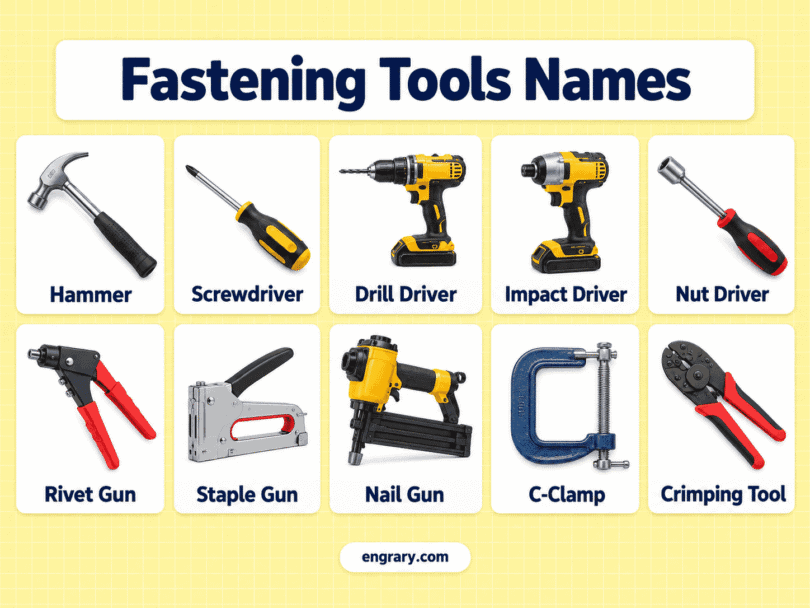
Fastening tools help install, tighten, drive, set, or secure fasteners such as screws, nuts, bolts, nails, staples, and rivets. Because each fastener has a different head, shape, or installation method, workshops use many different screwdrivers, wrenches, tackers, riveters, and powered drivers.
This guide covers 42 fastening tools names with pictures and uses. It focuses on genuine tools rather than the fasteners themselves, and each description includes a simple recognition clue to make identification easier.
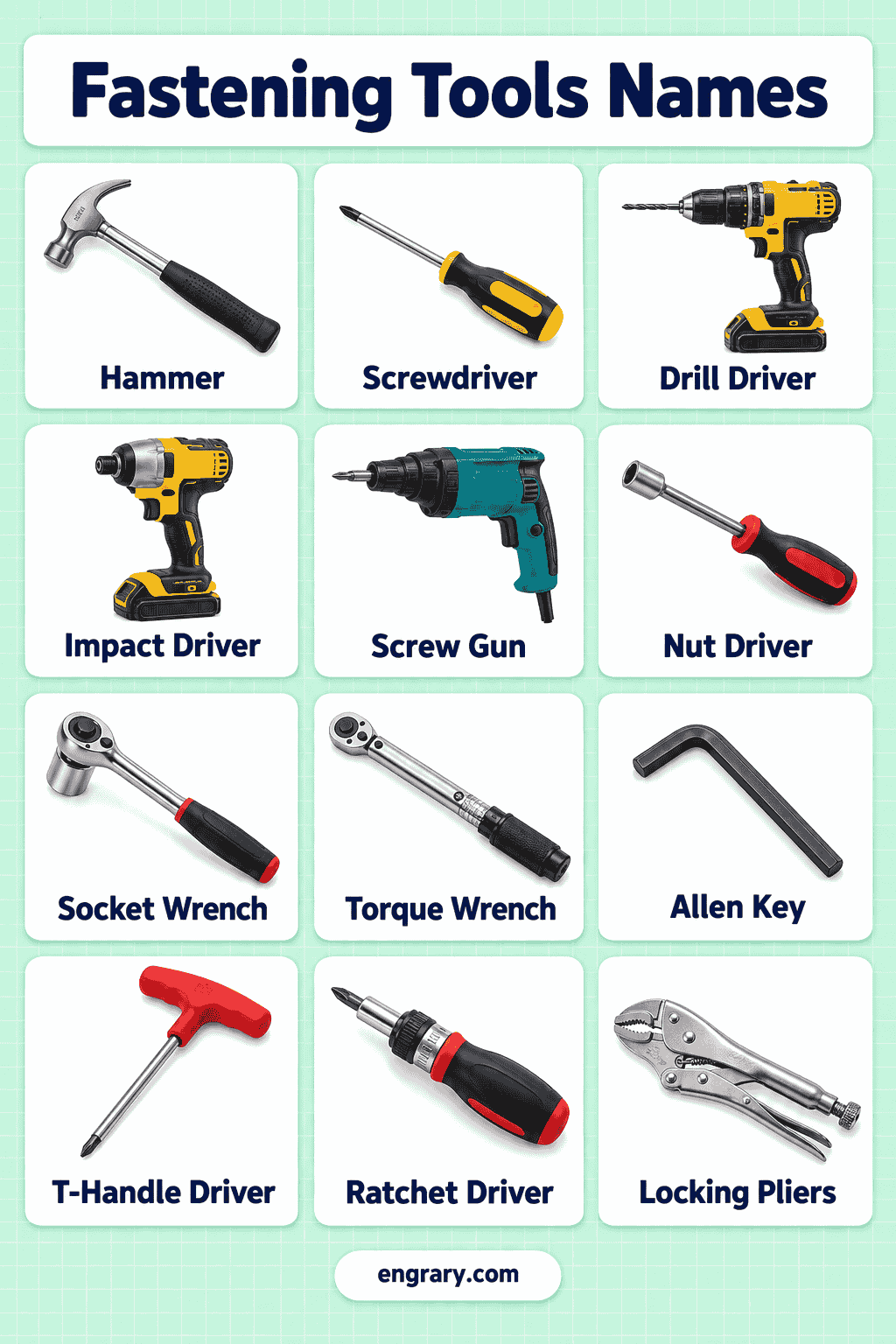
Common Tools for Screws, Bolts, Nails, and Rivets
Fastening work changes depending on the fastener being installed. For example, screwdrivers match specific screw-head profiles, while wrenches turn nuts and bolts, tackers install staples, and riveters set rivets.
1. Flat-Head Screwdriver
A flat-head screwdriver has a single flat blade at the tip. It fits slotted screw heads and remains one of the easiest screwdrivers to recognize.
2. Phillips Screwdriver
A Phillips screwdriver has a cross-shaped tip. Because the tip matches a cross recess, it differs clearly from a flat-blade screwdriver.
3. Pozidriv Screwdriver
A Pozidriv screwdriver also has a cross-shaped tip, but it includes additional smaller ribs between the main blades. Therefore, its profile looks more detailed than a Phillips tip.
4. Torx Screwdriver
A Torx screwdriver has a six-lobed star-shaped tip. Its distinctive profile makes it easy to identify in a tool set.
5. Robertson Screwdriver
A Robertson screwdriver has a square-shaped tip. It fits matching square-recess screws.
6. Stubby Screwdriver
A stubby screwdriver has a very short handle and shaft. Its compact size helps it fit where a standard screwdriver would feel too long.
7. Ratcheting Screwdriver
A ratcheting screwdriver has a handle with an internal ratchet mechanism. As a result, the handle can turn the driver repeatedly without fully repositioning the hand.
8. Offset Screwdriver
An offset screwdriver has a bent or angled body rather than a straight shaft. Its unusual shape helps with fasteners in confined spaces.
9. Precision Screwdriver
A precision screwdriver has a slim handle and very small tip. It commonly appears in sets for small screws and delicate assemblies.
10. Hex Key
A hex key is an L-shaped metal rod with a hexagonal cross-section. It fits fasteners with matching internal hex sockets.
11. T-Handle Hex Key
A T-handle hex key places the hex shaft below a T-shaped handle. Therefore, it provides a very different grip from a simple L-shaped key.
12. Folding Hex Key Set
A folding hex key set holds several hex keys inside one folding handle. The layout resembles a compact pocket-tool design.
13. Hex Driver
A hex driver has a screwdriver-style handle with a hexagonal driving tip. Unlike a basic hex key, it uses a full handle rather than an L-shaped rod.
14. Nut Driver
A nut driver looks like a screwdriver but ends in a hollow socket rather than a blade or bit tip. It turns small nuts and hex-head fasteners.
15. Socket Wrench
A socket wrench drives removable sockets that fit over nuts and bolt heads. Its square drive distinguishes it from fixed-jaw wrenches.
16. Ratchet
A ratchet has a compact geared head and square drive for interchangeable sockets. The ratcheting mechanism allows repeated turning without removing the socket after every movement.
17. Combination Wrench
A combination wrench has an open jaw at one end and a closed ring at the other. Both ends usually fit the same fastener size.
18. Adjustable Wrench
An adjustable wrench has one fixed jaw and one movable jaw. A small adjustment mechanism changes the opening to fit different fastener sizes.
19. Torque Wrench
A torque wrench has a long handle and a mechanism for setting or indicating tightening torque. Its elongated form distinguishes it from a standard ratchet.
20. Breaker Bar
A breaker bar has a long rigid handle and square socket drive. Unlike a ratchet, it does not rely on a ratcheting mechanism.
21. Claw Hammer
A claw hammer has a striking face on one side and a curved claw on the other. It drives nails and can also remove them.
22. Tack Hammer
A tack hammer has a small head designed around light fastening work. Its narrow form suits small nails and tacks.
23. Nail Set
A nail set is a short punch-like metal tool with a small tip. It helps place a nail head slightly below the surrounding wood surface.
24. Staple Gun
A staple gun has a rectangular body with a squeeze handle. It drives staples into suitable materials.
25. Hand Riveter
A hand riveter has plier-like handles and a narrow nosepiece. It installs blind rivets through a manual squeezing action.
Screwdrivers for Different Screw Heads
Screwdrivers differ mainly in the shape of the tip. Therefore, matching the tip profile to the screw head is the key recognition point.
26. Tri-Wing Screwdriver
A Tri-Wing screwdriver has a three-winged tip. Its three-part profile makes it visually distinct from cross-shaped and star-shaped drivers.
27. Spanner Screwdriver
A spanner screwdriver has a forked two-pin or two-prong tip. It fits matching security-style screw heads.
28. Clutch-Head Screwdriver
A clutch-head screwdriver has a bow-tie or butterfly-like tip profile. Its unusual shape sets it apart from common Phillips and Torx drivers.
Hex Keys and Hex Drivers
Hex fastening tools all engage internal hexagonal sockets, but their handles and body shapes vary. For instance, an L-key is compact, while a T-handle or driver-style tool offers a larger grip.
The Hex Key, T-Handle Hex Key, Folding Hex Key Set, and Hex Driver already appear in the opening section because they represent the main recognizable forms.
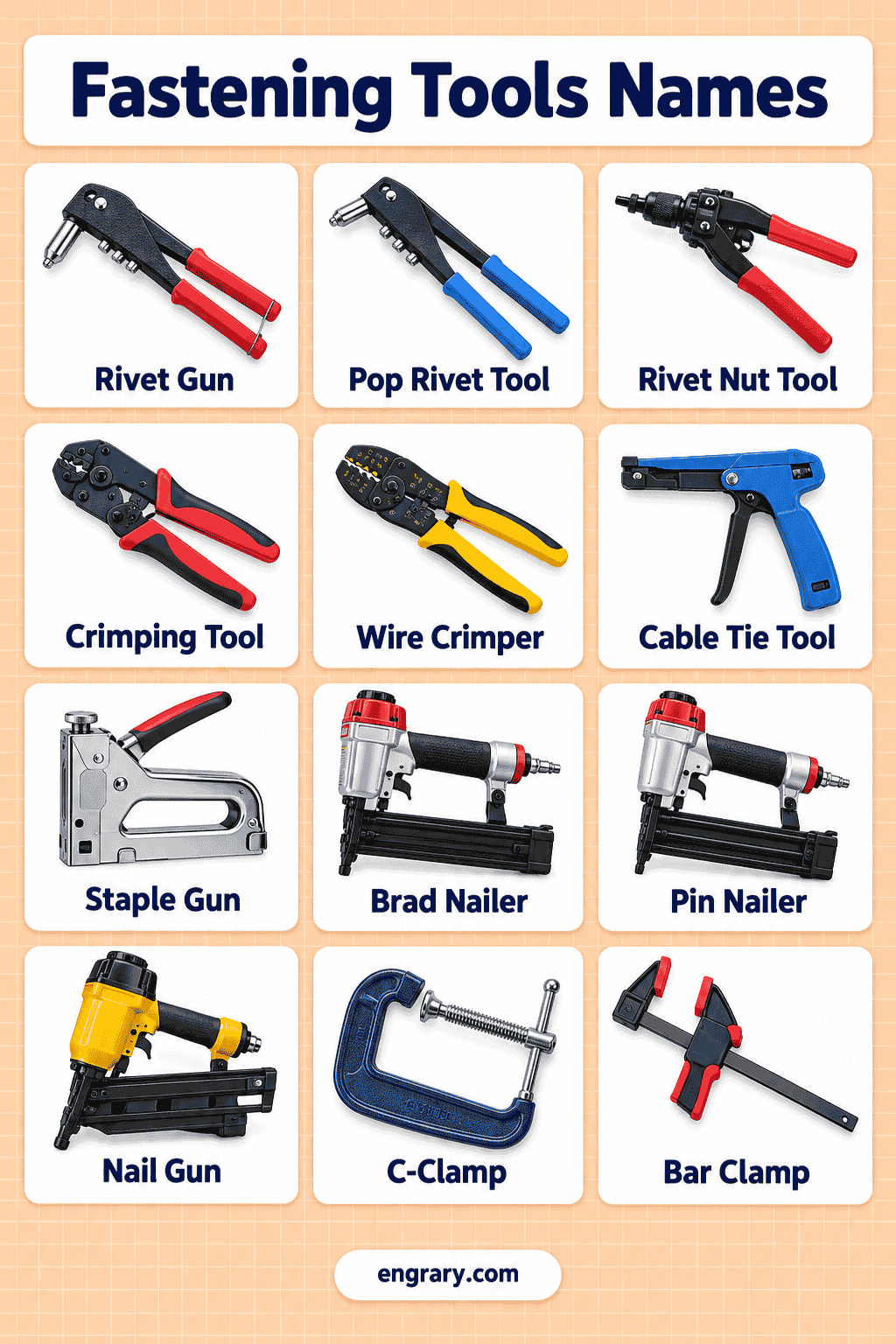
Wrenches and Drivers for Nuts and Bolts
Threaded fasteners often use external hex heads or nuts. Consequently, wrenches and socket tools rely on jaws, rings, or sockets rather than screwdriver-style tips.
29. Open-End Wrench
An open-end wrench has open U-shaped jaws at one or both ends. It grips the flat sides of nuts and bolt heads.
30. Box-End Wrench
A box-end wrench has a closed ring that surrounds the fastener head. Because it contacts more sides than an open jaw, its appearance is easy to distinguish.
31. Ratcheting Wrench
A ratcheting wrench combines a ring-shaped end with an internal ratcheting mechanism. It looks similar to a box-end wrench but allows repeated turning without removing the tool.
32. Flex-Head Ratchet
A flex-head ratchet has a ratcheting socket head mounted on a pivot. Therefore, the head can angle relative to the handle.
Nail-Driving and Nail-Setting Tools
Nails can be installed manually or with powered tools. However, this article keeps the hammer family limited so it does not drift into a general hammer-types topic.
33. Brad Nailer
A brad nailer has a gun-shaped body and narrow nose designed for small brad nails. It commonly appears in light trim and finishing work.
34. Finish Nailer
A finish nailer has a similar gun-like body but is built around larger finishing nails than a brad nailer.
Staplers and Tackers
Staplers and tackers install staples rather than screws or nails. Their bodies vary from squeeze-handle tools to hammer-like designs.
35. Hammer Tacker
A hammer tacker has a long handle and installs staples through a hammer-like striking motion. Its shape looks very different from a conventional staple gun.
36. Cable Tacker
A cable tacker resembles a staple gun but uses fastening hardware suited to securing certain cables without crushing them.
37. Multi-Tacker
A multi-tacker has a hand-tool body designed to accept more than one compatible fastener format. Its broader fastening capability distinguishes it from a basic stapler.
38. Electric Stapler
An electric stapler uses an electric drive rather than only hand pressure to set staples.
Riveting Tools
Riveting tools secure materials with rivets or rivet nuts. Their handle length, head orientation, and mandrel system provide the main recognition clues.
39. Lever Riveter
A lever riveter has long handles that provide more leverage than a compact hand riveter.
40. Swivel-Head Riveter
A swivel-head riveter has a head that can pivot to different angles. Therefore, the nose can approach fasteners from positions a fixed-head tool cannot.
41. Rivet Nut Tool
A rivet nut tool has handles and a mandrel-based head for installing threaded rivet nuts. It differs from a standard riveter because it sets an internally threaded insert rather than an ordinary blind rivet.
Powered Fastening Tools
Powered tools speed up repeated fastening jobs and use motors or impact mechanisms instead of relying entirely on hand force.
42. Impact Driver
An impact driver has a compact pistol-grip body and a short driver-bit holder at the front. It combines rotation with an impact mechanism for screw-driving and similar fastening work.
Other powered fastening tools, such as electric screwdrivers, impact wrenches, powered staplers, and powered riveters, belong to the same broader family. However, they are not added as extra numbered entries here because the 42-tool count already gives this article strong coverage without unnecessary padding.
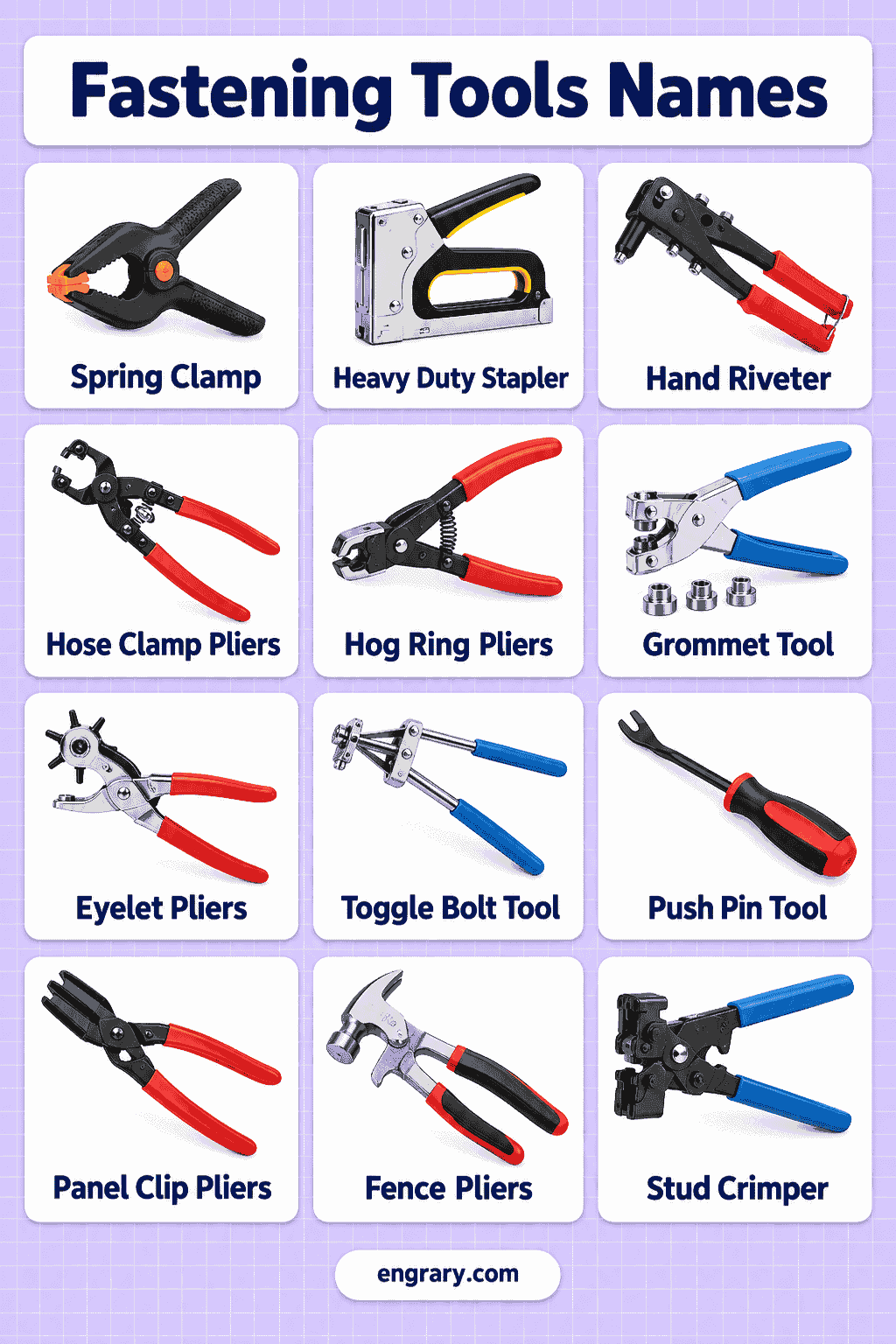
Fastening Tools That Are Easy to Confuse
Several fastening tools work on similar fasteners, yet their tip shape, drive system, handle design, or fastening method makes them different.
| Tools | Main Difference |
|---|---|
| Flat-Head vs Phillips Screwdriver | A flat-head screwdriver has one flat blade, while a Phillips screwdriver has a cross-shaped tip. |
| Phillips vs Pozidriv Screwdriver | A Phillips tip has a simple cross profile, whereas Pozidriv adds smaller secondary ribs. |
| Phillips vs Torx Screwdriver | Phillips uses a cross-shaped profile, while Torx uses a six-lobed star shape. |
| Hex Key vs Hex Driver | A hex key is usually an L-shaped rod, while a hex driver uses a screwdriver-style handle. |
| Nut Driver vs Socket Wrench | A nut driver has a fixed socket on a screwdriver-style handle, while a socket wrench accepts interchangeable sockets. |
| Ratchet vs Breaker Bar | A ratchet uses an internal ratcheting mechanism, whereas a breaker bar uses a long rigid handle without ratcheting. |
| Socket Wrench vs Torque Wrench | A socket wrench turns socket fasteners generally, while a torque wrench also measures or controls tightening torque. |
| Combination Wrench vs Adjustable Wrench | A combination wrench has fixed-size ends, while an adjustable wrench changes jaw width. |
| Staple Gun vs Hammer Tacker | A staple gun uses a squeeze handle, whereas a hammer tacker sets staples with a striking motion. |
| Staple Gun vs Brad Nailer | A staple gun installs staples, while a brad nailer installs small brad nails. |
| Hand Riveter vs Lever Riveter | A hand riveter has shorter plier-like handles, while a lever riveter uses longer handles for greater leverage. |
| Riveter vs Rivet Nut Tool | A riveter installs ordinary blind rivets, while a rivet nut tool installs threaded inserts. |
| Electric Screwdriver vs Impact Driver | An electric screwdriver focuses on powered screw driving, while an impact driver adds an impact mechanism and a more robust driver format. |
| Impact Driver vs Impact Wrench | An impact driver commonly accepts driver bits, while an impact wrench uses a square drive for sockets. |
Alternate Names for Fastening Tools
Fastening terminology varies by region and trade. Therefore, learning common alternate terms can make catalogs and tool lists easier to understand.
| Main Name | Alternate Name |
|---|---|
| Hex Key | Allen Key / Allen Wrench |
| Flat-Head Screwdriver | Slotted Screwdriver |
| Socket Wrench | Socket Spanner in some regions |
| Ratcheting Wrench | Ratchet Spanner in some regions |
| Hand Riveter | Rivet Gun in some contexts |
| Staple Gun | Hand Tacker in some contexts |
| Adjustable Wrench | Adjustable Spanner |
| Phillips Screwdriver | Cross-Head Screwdriver in general vocabulary |
| Breaker Bar | Power Bar in some regions |
| Nail Set | Nail Punch |
These alternate terms do not count as additional tools when they refer to the same basic design.
Frequently Asked Questions
Common fastening tools include screwdrivers, hex keys, nut drivers, socket wrenches, ratchets, combination wrenches, adjustable wrenches, hammers, staple guns, riveters, and impact drivers.
Both use cross-shaped tips. However, a Pozidriv tip has additional smaller ribs between the main blades, while a Phillips tip uses a simpler cross profile.
A hex key is usually an L-shaped hexagonal rod. In contrast, a hex driver has a screwdriver-style handle with a hex-shaped driving end.
A staple gun installs staples by squeezing a handle, whereas a hammer tacker uses a striking motion similar to a hammer.
An impact driver commonly uses driver bits for screws and similar fasteners. An impact wrench, however, uses a square drive and sockets for nuts and bolts.
You May Also Like

Leave a Comment