
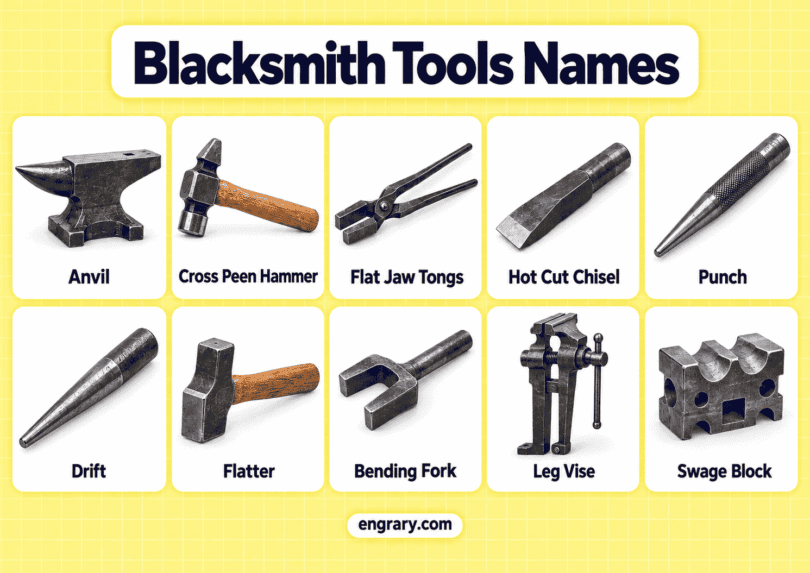
A traditional blacksmith shop has a visual language of its own: the long horn of an anvil, unusual tong jaws, wedge-shaped hammer peens, square-shanked hardy tools, and heavy blocks covered with grooves and recesses. Once these shapes become familiar, many blacksmith tools names are much easier to remember.
This guide focuses on identifying the equipment, hand tools, anvil features, holding tools, and specialized forming tools associated with blacksmithing. The descriptions explain what each item looks like and its general role without turning the page into operating instructions for hot-metal work.
Tools You Will Recognize Around a Blacksmith’s Forge
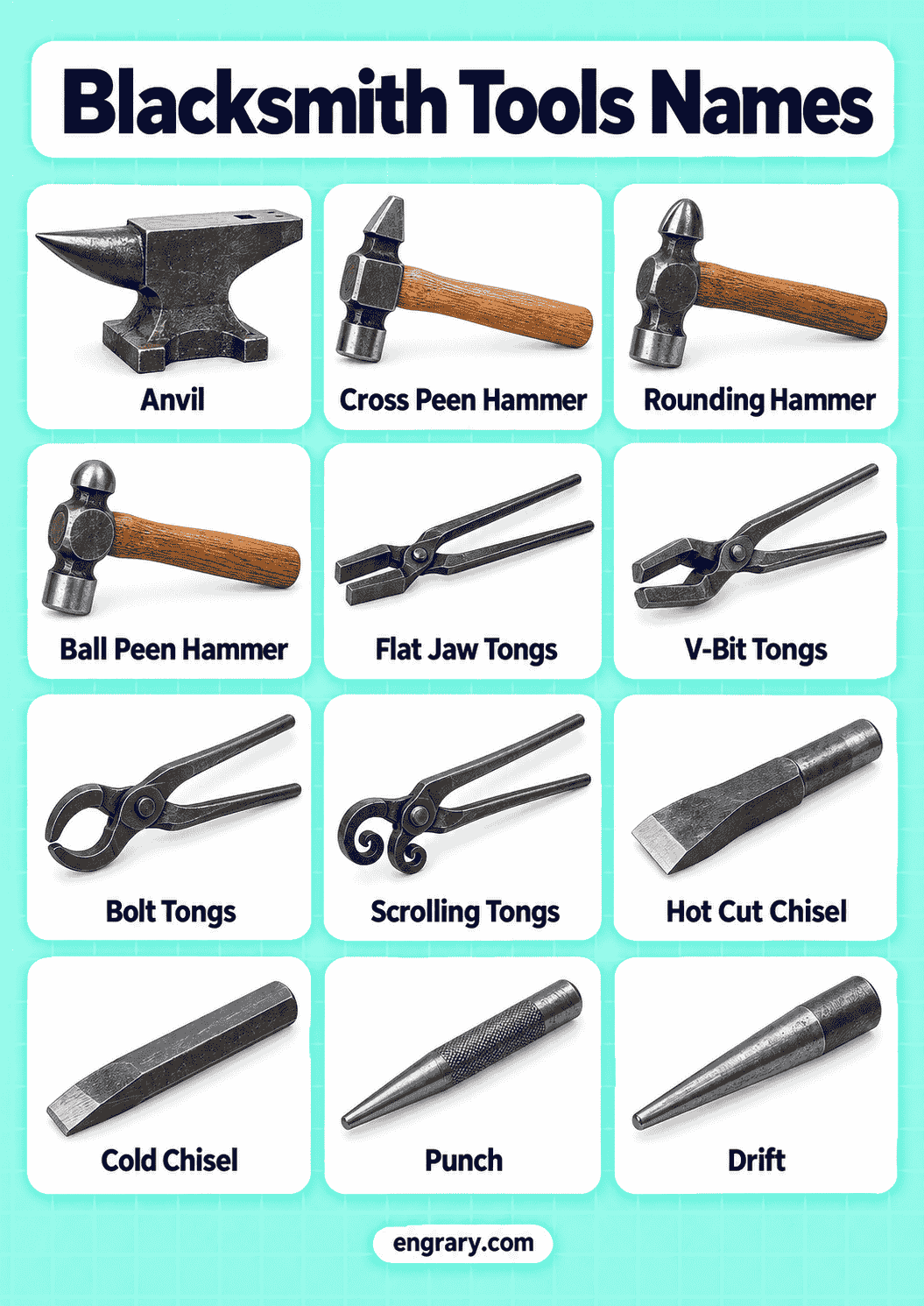
A few distinctive objects immediately signal a blacksmith shop. The forge provides the heated-work area, the anvil provides the main supporting surface, and specialized hammers, tongs, vises, punches, fullers, swages, and hardy tools make up much of the surrounding vocabulary. Public blacksmith education resources similarly place anvils, forges, tongs, hammers, punches, and mandrels among the core tools visitors are likely to encounter.
Forge
The main heating station of a blacksmith shop, usually recognizable by a hearth or enclosed heating area with air-supply equipment nearby.
Anvil
A heavy metal support with a broad flat face and projecting horn used as the central work surface in traditional forging.
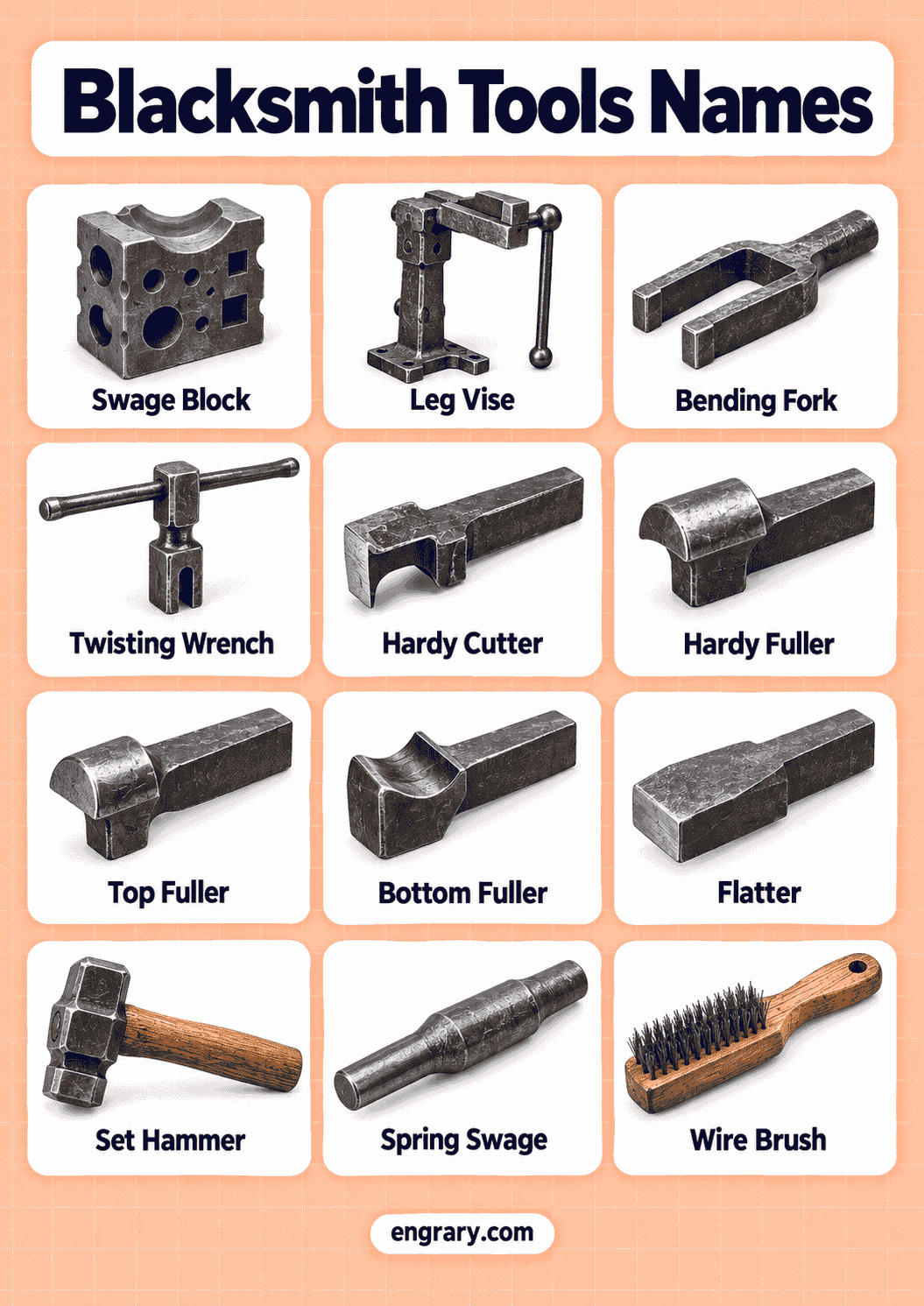
Post Vise
A heavy vise with a long supporting leg that extends toward the floor, giving it a very different appearance from an ordinary bench vise.
Cross-Peen Hammer
A forging hammer with one flat face and a narrow wedge-shaped peen positioned across the direction of the handle.
Rounding Hammer
A hammer that typically combines a flatter striking face with a rounded face.
Wolf Jaw Tongs
Versatile tongs with jaws containing several gripping profiles rather than one simple flat surface.
V-Bit Tongs
Tongs with opposing V-shaped grooves designed around round or square stock shapes.
Flat Jaw Tongs
Tongs with broad, relatively flat gripping surfaces.
Hot Chisel
A blacksmith cutting tool with a wedge-shaped working edge intended for hot-work environments.
Hot Cut Hardy
An anvil-mounted cutting tool with a cutting edge above a square shank.
Punch
A solid striking tool with a shaped point used to create or begin an opening.
Drift
A solid shaped tool used to refine the size or form of an existing opening rather than start it.
Fuller
A rounded forming tool with a narrow working profile that concentrates force into a smaller area.
Flatter
A handled tool with a broad flat working face used for smoothing or flattening forged surfaces.
Swage
A shaped forming tool whose working surface corresponds to a particular profile.
Swage Block
A heavy multipurpose block containing numerous holes, grooves, curves, and shaped recesses.
Bending Fork
A fork-shaped forming tool with two upright prongs.
Cone Mandrel
A large tapered conical support used as a recognizable blacksmith forming surface.
Bellows
An expandable air-moving device traditionally associated with supplying air to a forge.
Wire Brush
A stiff metal-bristled brush commonly seen around forge work for surface cleaning.
Forge Equipment and Traditional Fire Tools
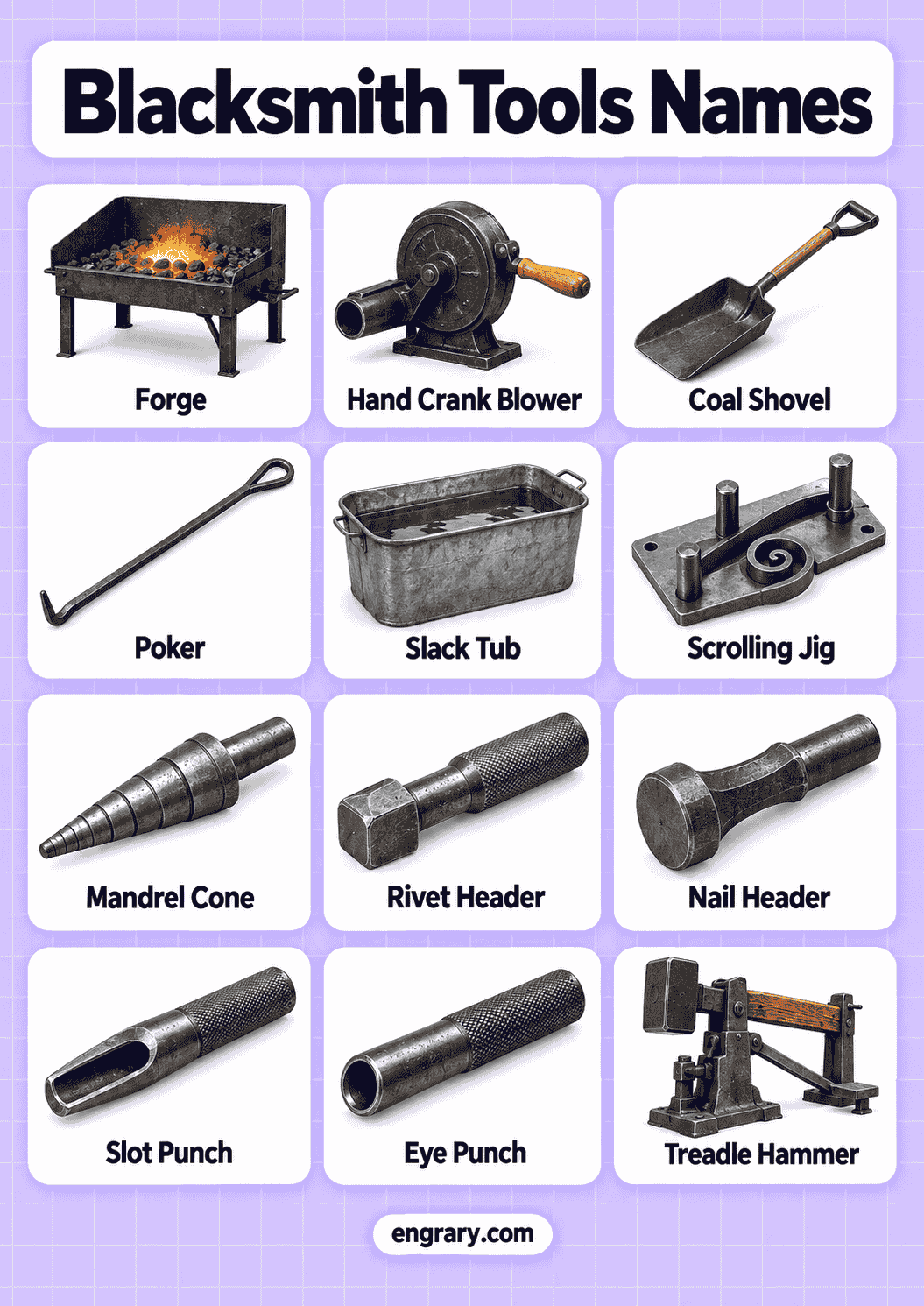
The forge area has its own vocabulary beyond the word forge. These names describe the heating station, air-supply components, and simple tools associated with maintaining the forge area. They belong in a blacksmith identification guide because many are visually distinctive even though they are not striking or forming tools.
Forge
A forge is the heating station associated with blacksmithing. Traditional versions often appear as open hearths, while other designs use enclosed heating chambers.
Forge Hearth
The forge hearth is the main body or working platform around a traditional fire area. Its broad structure supports the components associated with the forge.
Firepot
A firepot is the recessed area in many solid-fuel forge designs where the fire is concentrated.
Tuyere
A tuyere is the air-delivery opening or component that introduces air into the forge fire. It is normally less visually prominent than the forge itself but forms part of traditional forge terminology.
Bellows
Bellows consist of an expandable chamber that moves air when opened and compressed. Their broad folding body makes traditional versions especially recognizable.
Hand-Crank Blower
A hand-crank blower is a mechanical air-moving unit with a visible crank handle and blower housing.
Forge Hood
A forge hood is the metal hood positioned above some forge setups to capture rising smoke and gases.
Coal Shovel
A coal shovel is a small shovel associated with moving solid forge fuel. It often has a wider scoop than a general garden trowel.
Fire Rake
A fire rake usually has a long handle and a small transverse working head for arranging material around a forge fire.
Fire Poker
A fire poker is a long metal rod used around the forge area. Its simple narrow form separates it from larger rakes and shovels.
Anvil Parts and Features
The anvil deserves more than a single definition because several blacksmith terms actually refer to parts of the anvil rather than separate tools. A typical London-pattern anvil, for example, combines a broad face with a projecting horn, and educational blacksmith resources identify it as one of the central pieces of shop equipment.
Anvil Face
The face is the broad, flat upper working surface and one of the easiest anvil features to identify.
Horn
The horn projects outward from one end of the anvil and gradually narrows. Its tapered shape is one of the most recognizable features of a traditional anvil.
Heel
The heel is the projecting section at the opposite end from the horn.
Step
The step is a lower flat area found between the main face and horn on many traditional anvil patterns.
Hardy Hole
The hardy hole is the square opening through the anvil face. Its square shape is important because hardy tools commonly have matching square shanks.
Pritchel Hole
The pritchel hole is the smaller round opening found in the face of many anvils. Its circular shape distinguishes it from the square hardy hole.
Hardy Hole and Hardy Tool Are Not the Same Thing
The hardy hole is part of the anvil. A hardy tool, by contrast, is a separate tool with a square shank made to fit that hole. This simple relationship explains the names of several specialized blacksmith tools that appear later in the article.
Blacksmith Hammer Names
Blacksmith hammers are easiest to identify by looking at the shape and orientation of their working faces. A narrow wedge, rounded face, broad flat surface, or heavy double-faced head usually provides a stronger clue than handle length alone.
Cross-Peen Hammer
A cross-peen hammer combines a flat face with a narrow wedge-shaped peen positioned across the handle.
Straight-Peen Hammer
A straight-peen hammer also has a wedge-shaped peen; however, the peen runs in the same general direction as the handle.
Rounding Hammer
A rounding hammer generally combines a flatter face with a rounded forging face. The contrast between those two faces distinguishes it from a symmetrical sledgehammer.
Ball-Peen Hammer
A ball-peen hammer has one flat face and a rounded ball-shaped peen on the opposite side.
Sledgehammer
A sledgehammer has a much larger, heavier double-faced head and a long handle compared with ordinary hand hammers.
Set Hammer
A set hammer has a relatively compact working face and a separate struck end. Visually, it resembles a specialized handled top tool more than an ordinary two-faced hammer.
Flatter
A flatter has a broad, flat square or rectangular working face beneath a handled body. Blacksmiths Depot describes flatters as finishing tools used to produce flatter surfaces and distinguish them from set hammers.
Blacksmith Tongs Names
Blacksmith tongs are one of the richest tool-name families because the jaw shape changes according to the stock profile the tool is intended to grip. Centaur Forge likewise distinguishes tong styles by jaw geometry and the shapes they hold, including flat jaw, box jaw, wolf jaw, V-bit, and other patterns.
Wolf Jaw Tongs
Wolf jaw tongs have several gripping grooves and surfaces in their jaws. The multi-profile “mouth” makes them visually different from simpler flat-jaw designs.
V-Bit Tongs
V-bit tongs have V-shaped grooves in the jaws. Centaur Forge describes them as suitable for gripping round or square stock profiles.
V-Bit Bolt Tongs
V-bit bolt tongs combine V-shaped gripping areas with a shorter, wider jaw arrangement. Their mouth differs visibly from longer straight V-bit designs.
Flat Jaw Tongs
Flat jaw tongs use broad, simple gripping faces suited to flat stock shapes. Their relatively plain jaws make them among the easiest tong patterns to recognize.
Box Jaw Tongs
Box jaw tongs have side guides that partially surround flat stock and help prevent sideways movement. Their box-like lower jaw gives the tool its name.
Offset Box Jaw Tongs
Offset box jaw tongs place the gripping area away from the centerline of the reins. That offset makes their silhouette noticeably asymmetrical.
Duckbill Tongs
Duckbill tongs have wide flattened jaws that resemble a duck’s bill. Specialist catalogs describe them as one of the flat-stock tong styles.
Pick-Up Tongs
Pick-up tongs generally have narrow jaws intended for handling smaller objects. Their light, tapered gripping ends distinguish them from heavy stock-holding patterns.
Rivet Tongs
Rivet tongs have smaller rounded gripping areas associated with small round pieces such as rivets. Centaur Forge lists them as a distinct tong style.
Scrolling Tongs
Scrolling tongs have long tapered round jaws and resemble oversized needle-nose pliers. Their narrow tips make them visually distinctive among blacksmith tongs.
Why Blacksmith Tongs Have Different Jaw Shapes
Tong patterns are closely related to the shape of the material being held. Flat-jaw and box-jaw patterns correspond naturally to flat stock, while V-shaped jaws can contact round or square profiles. This relationship between jaw shape and stock shape is one of the easiest ways to remember blacksmith tong names.
Blacksmith Vises and Workholding Tools
Blacksmith workholding equipment must be easy to identify separately from the tong family. The most recognizable example is the post vise, whose long support leg gives it a silhouette rarely seen on ordinary bench vises.
Post Vise
A post vise, also called a leg vise, has heavy jaws and a long vertical leg running from the vise body toward the floor. Treating post vise and leg vise as alternate names avoids counting the same tool twice.
Bench Vise
A bench vise mounts directly to a bench without the long support leg associated with the traditional post vise.
Holdfast
A holdfast is a simple clamping tool with a long stem and bent holding arm. Its hooked form makes it visually different from a screw-operated vise.
Blacksmith Clamp
A blacksmith clamp is a broad category of heavy clamping tools used around metalworking setups. Shapes vary, so the exact jaw and frame design provide the best recognition clues.
Hot and Cold Cutting Tools for Blacksmithing
Blacksmith cutting terminology becomes clearer when handheld chisels are separated from tools that mount in the anvil. The important identification difference is whether the tool has a conventional hand-held body or a square hardy shank beneath the cutting edge.
Hot Chisel
A hot chisel has a wedge-shaped cutting edge and a struck end. It is associated by name with heated metal rather than cold stock.
Cold Chisel
A cold chisel is another solid metal cutting tool with a beveled edge, but the name distinguishes it from tools intended for hot work.
Blacksmith Chisel
A blacksmith chisel is a broad term for forged cutting tools used in smithing. Individual examples may have different edge widths and profiles.
Hot Cut Hardy
A hot cut hardy has a cutting edge above a square shank that fits the anvil’s hardy hole. The vertical square shank is its strongest recognition clue.
Cutting Hardy
A cutting hardy is the broader name for hardy-mounted cutting tools. Its basic appearance combines a wedge-like working edge with a square mounting shank.
Blacksmith Punches and Drifts Names
Punches and drifts may look similar because both are solid shaped tools, but they are not interchangeable names. Blacksmiths Depot defines a punch as a tool that creates a hole and a drift as a tool that enlarges or shapes a hole after it exists.
Round Punch
A round punch has a rounded working end that creates a circular or near-circular opening.
Square Punch
A square punch has a square-ended working profile that gives the tool a visibly different tip.
Slot Punch
A slot punch has an elongated working shape rather than a round or square point.
Hot Punch
A hot punch is a punch associated with making openings in heated work. Its general appearance is still that of a solid struck tool with a shaped end.
Round Drift
A round drift has a smooth rounded cross-section and a gradual taper for refining round openings.
Square Drift
A square drift has a square cross-section along its working body.
Slot Drift
A slot drift has an elongated or rectangular profile corresponding to slot-shaped openings.
Punch vs Drift
A simple vocabulary rule helps:
Punch → begins or creates the opening.
Drift → enlarges, shapes, or refines an existing opening.
That distinction is more useful than identifying either tool only by overall length because their shapes can vary.
Fullers, Flatters, and Swages
These names belong to specialized forming tools and are often confused because all three can influence the shape or surface of forged material. Their working faces provide the easiest distinction. Blacksmiths Depot describes fullers as rounded or parabolic forming tools, swages as shaped tools for refining profiles, and flatters as broad finishing tools.
Top Fuller
A top fuller is a handled upper tool with a rounded or curved working nose. It is applied from above rather than seated in the anvil.
Bottom Fuller
A bottom fuller provides a complementary rounded working profile from below and commonly uses a square hardy shank. Top and bottom fullers can form a matched pair.
Flatter
A flatter has a much broader, flatter working surface than a fuller. This large face is the key visual distinction.
Top Swage
A top swage is a handled upper forming tool with a shaped recess or profile.
Bottom Swage
A bottom swage provides a corresponding lower profile and may fit the hardy hole.
Hand Swage
A hand swage is a handheld shaped forming tool rather than a large multiprofile block.
Fuller, Flatter, and Swage at a Glance
A fuller has a concentrated rounded working profile.
A flatter presents a broad flat face.
A swage has a shaped profile designed around a particular form.
Those visible working surfaces are the fastest way to distinguish the names.
Tools That Fit the Hardy Hole
The hardy hole turns the anvil into a support for several interchangeable tools. Most tools in this family share a simple recognition pattern: a working head above a square shank.
Hot Cut Hardy
A cutting head sits above the square mounting shank.
Bottom Fuller
A rounded forming surface sits above the square shank.
Bottom Swage
A shaped recessed surface sits above the square shank.
Bending Fork
A bending fork usually has two upright prongs above its square shank, giving it a fork-like appearance.
Hardy Cone
A hardy cone has a small tapered cone above the square shank.
Hardy Bending Tool
A hardy bending tool is a broader name for anvil-mounted bending fixtures. Designs vary, but the square mounting shank connects them to the same tool family.
Swage Blocks, Mandrels, and Heading Tools
Some blacksmith tools are neither ordinary hand tools nor hardy-hole inserts. Instead, they provide large shaped surfaces, holes, or supports that help identify them as independent forming equipment.
Swage Block
A swage block is a heavy block containing multiple openings, grooves, curves, and recessed profiles. Its many different working shapes make it one of the most visually distinctive blacksmith tools.
Cone Mandrel
A cone mandrel is a tall tapered conical form. The City of Pickering includes cone mandrels among the recognizable tools in its educational blacksmith toolbox.
Heading Tool
A heading tool has a shaped opening or working area associated with forming heads on suitable forged pieces.
Heading Plate
A heading plate is a heavy plate containing one or more holes. Its multiple openings distinguish it from a single handheld heading tool.
Bick Iron
A bick iron, sometimes shortened to bick, provides a smaller projecting horn-like surface for localized shaping and support.
Forming Block
A forming block is a general shaped support containing grooves, recesses, or curved working surfaces. It may resemble a simplified swage block depending on its design.
Cleaning and Finishing Tools at the Forge
The final appearance of forged work often brings a smaller group of general-purpose tools into the blacksmith shop. These items are less distinctive than tongs or hardy tools, so this section stays intentionally compact.
Wire Brush
A wire brush has stiff metal bristles and a handle. The dense metallic bristle head makes it easy to distinguish from ordinary cleaning brushes.
Hand File
A hand file has a hardened toothed surface for manual smoothing and fitting.
Rasp
A rasp resembles a file but has larger, individually raised teeth that produce a much rougher-looking surface.
Scraper
A scraper has a shaped hardened edge rather than the toothed face of a file.
Scale Brush
A scale brush is a stiff brush used around metalworking environments and may resemble a heavy-duty wire brush.
Key Differences Between Similar Blacksmith Tools
Several blacksmith terms sound related even though they identify different objects. These are the distinctions most useful for readers learning the vocabulary.
| Tools | Main Difference |
|---|---|
| Punch vs Drift | A punch creates or begins an opening, while a drift shapes, enlarges, or refines an opening that already exists. |
| Fuller vs Flatter | A fuller has a concentrated rounded forming profile, while a flatter has a broad flat working face. |
| Hardy Tool vs Hardy Hole | A hardy tool is the removable square-shanked tool; the hardy hole is the square opening in the anvil. |
| Post Vise vs Bench Vise | A post vise has a long supporting leg, whereas a bench vise mounts directly to a bench. |
| Swage vs Swage Block | A swage is an individual shaped forming tool, while a swage block provides many profiles in one heavy block. |
Frequently Asked Questions
Some of the most recognizable names include forge, anvil, post vise, forging hammer, blacksmith tongs, chisel, punch, drift, fuller, flatter, swage, hardy tool, swage block, cone mandrel, and wire brush.
The square opening is called the hardy hole. Hardy tools have square shanks designed to fit this opening.
A hardy tool is an anvil-mounted tool with a square shank. The working head may be designed for cutting, bending, fullering, swaging, or another specialized purpose.
A punch creates or begins a hole, while a drift enlarges, shapes, or brings an existing hole to a particular form.
Different jaws correspond to different stock shapes. Flat, box, V-shaped, and multi-profile jaws make it easier to identify which tong pattern is intended for flat, round, square, or other stock forms.
You May Also Like



Leave a Comment