

Masonry tools have distinctive shapes that often reveal their purpose before you know their names. A broad triangular trowel carries mortar, a plumb bob hangs from a cord, a brick hammer combines a striking face with a cutting edge, while jointers and rakers work directly on mortar joints.
Learning mason tools names through their appearance and role makes brick, block, mortar, and stone tools easier to recognize. This guide covers the tools masons use for laying, aligning, handling mortar, finishing joints, cutting bricks, dressing stone, and cleaning completed masonry work.
Masonry Tools Beginners Should Recognize
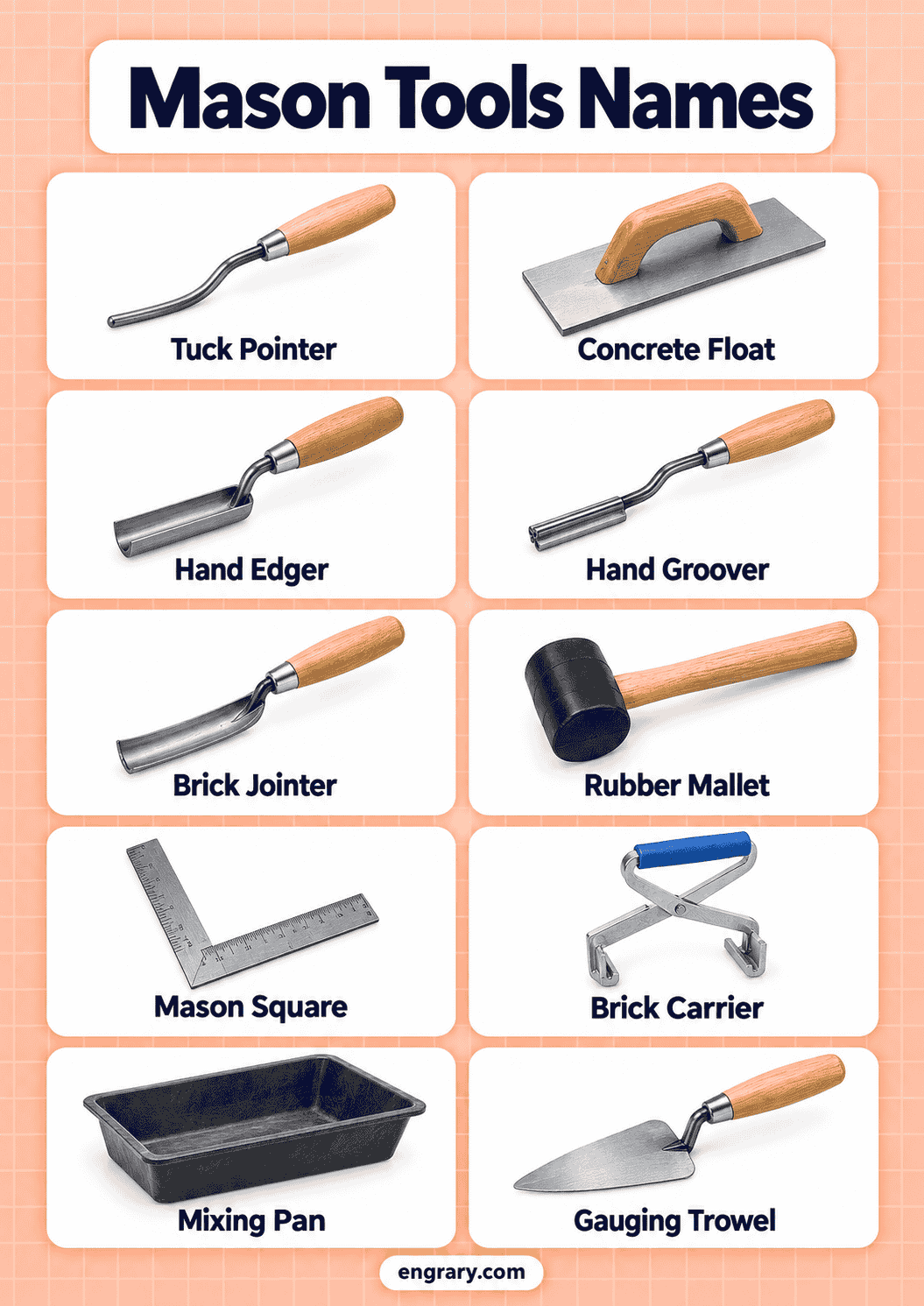
A masonry site contains several tools that appear repeatedly during brick, block, and mortar work. These names give beginners a useful visual starting point before the later sections explore the more specialized differences between trowels, line tools, joint tools, hammers, chisels, and stone-working equipment.
Brick Trowel
A broad triangular trowel used to carry, spread, and shape mortar during brick and block laying.
Pointing Trowel
A smaller triangular trowel used for detailed mortar work, repairs, and narrow areas.
Margin Trowel
A narrow rectangular trowel that fits into confined spaces and along masonry edges.
Gauging Trowel
A compact leaf-shaped trowel used for handling smaller amounts of mortar and similar materials.
Tuck Pointer
A narrow straight-bladed tool used for placing or finishing mortar in slender joints.
Mason’s Line
A tightly stretched cord that gives masons a straight visual reference along a course of brick or block.
Line Pins
Long pointed pins that hold a mason’s line in position.
Line Blocks
Small blocks used to support and position mason’s line at wall ends or corners.
Spirit Level
A straight tool with bubble vials used to check horizontal and vertical alignment.
Boat Level
A short compact level used where a full-length spirit level would be inconvenient.
Plumb Bob
A pointed weight suspended from a cord that provides a gravity-based vertical reference.
Mason’s Square
A rigid right-angle tool used to check and lay out 90-degree corners.
Straightedge
A long rigid bar used to check whether masonry surfaces remain straight.
Gauge Rod
A marked reference rod used to maintain consistent brick or block course heights.
Mortar Hawk
A flat square board with a handle underneath for holding mortar close to the work.
Mortar Pan
A shallow container used to hold or move mortar; in South Asian construction, a similar pan is often called a ghamela.
Mortar Board
A flat platform on which mortar can be kept near the mason while working.
Brick Jointer
A shaped metal tool used to compress and finish mortar joints.
Joint Raker
A tool used to remove or recess mortar from a joint to a consistent depth.
Brick Hammer
A masonry hammer with a flat striking face on one side and a chisel-like edge on the other.
Club Hammer
A short-handled heavy hammer, also called a lump hammer, often used with masonry chisels.
Bolster Chisel
A thick chisel with a wide cutting edge used for brick and block work.
Scutch Hammer
A masonry hammer designed to accept replaceable scutch combs or cutting inserts.
Pitching Chisel
A broad-edged stone chisel, also called a mason pitcher, used in stone masonry.
Tooth Chisel
A stone-working chisel with several teeth across its working edge.
Masonry Brush
A stiff-bristled brush used to remove loose mortar, dust, and debris from masonry surfaces.
Mortar Hoe
A long-handled mixing tool with a broad head used for preparing or moving mortar.
Hand Tracer
A broad-edged stone tool used for controlled splitting or tracing along stone.
These familiar tools cover the main activities a mason encounters: laying, alignment, mortar handling, joint finishing, brick cutting, stone dressing, and cleanup.
Masonry Trowel Names and How Their Shapes Differ
The word trowel covers several masonry tools rather than one universal design. Their blade shape, width, and length usually provide the fastest way to tell them apart.
Brick Trowel
A brick trowel has a large triangular steel blade with a pointed toe and raised handle. Its broad blade suits carrying and spreading mortar during brick and block laying.
Pointing Trowel
A pointing trowel has a smaller triangular blade. Compared with a brick trowel, its compact size makes it better suited to detailed mortar work and repairs.
Margin Trowel
A margin trowel has a long, narrow rectangular blade. Its slim profile makes it easy to recognize beside wider triangular masonry trowels.
Gauging Trowel
A gauging trowel commonly has a smaller leaf-shaped or rounded-point blade. It is associated with handling and mixing smaller quantities of mortar or similar materials.
Bucket Trowel
A bucket trowel has a relatively broad, short blade suited to scooping material from buckets or containers.
Tuck Pointer
A tuck pointer has a very narrow straight blade. Instead of carrying large amounts of mortar, it works in slender joints and detailed areas.
Philadelphia Pattern Brick Trowel
A Philadelphia pattern brick trowel has a broad blade with a strong heel area. Its profile differs subtly from other brick-trowel patterns.
London Pattern Brick Trowel
A London pattern brick trowel has a distinctive blade outline with a different heel and shoulder shape from the Philadelphia pattern.
The easiest distinction to remember is simple: brick trowels are larger for general mortar work, while pointing and tuck-pointing tools become progressively smaller and narrower for detailed joint work.
Tools Masons Use to Keep Walls Straight, Level, and Plumb
Masonry depends on reference lines and repeated alignment checks. These tools do not all perform the same job: some establish a straight course, others check horizontal or vertical position, and several work together as a system.
Mason’s Line
A mason’s line, also called a brick line, is a tightly stretched cord used as a straight visual guide along a masonry course.
Line Pins
Line pins are long pointed metal pins used to anchor the line. Their slender pointed bodies distinguish them from line blocks.
Line Blocks
Line blocks support a mason’s line at wall corners or ends. They grip or rest against masonry rather than being driven into a joint.
Corner Blocks
Corner blocks are shaped holders used to position string lines around masonry corners.
Spirit Level
A spirit level contains liquid-filled bubble vials that show whether a surface is level or plumb.
Boat Level
A boat level is a short compact spirit level. Its smaller body suits limited spaces and quick checks.
Plumb Bob
A plumb bob is a pointed metal weight hanging from a cord. Gravity gives it a naturally vertical reference line.
Plumb Rule
A plumb rule is a longer straight rule associated with checking vertical alignment using a suspended reference.
Mason’s Square
A mason’s square has two rigid arms fixed at 90 degrees and helps establish right-angle corners.
Straightedge
A straightedge provides a long rigid reference for checking whether a masonry surface remains straight.
Gauge Rod
A gauge rod carries repeated course markings that help maintain consistent masonry heights.
The mason’s line gives the visual straight reference, while line pins or blocks hold it. Levels, plumb tools, squares, and straightedges then check other aspects of alignment.
Tools for Holding and Handling Mortar
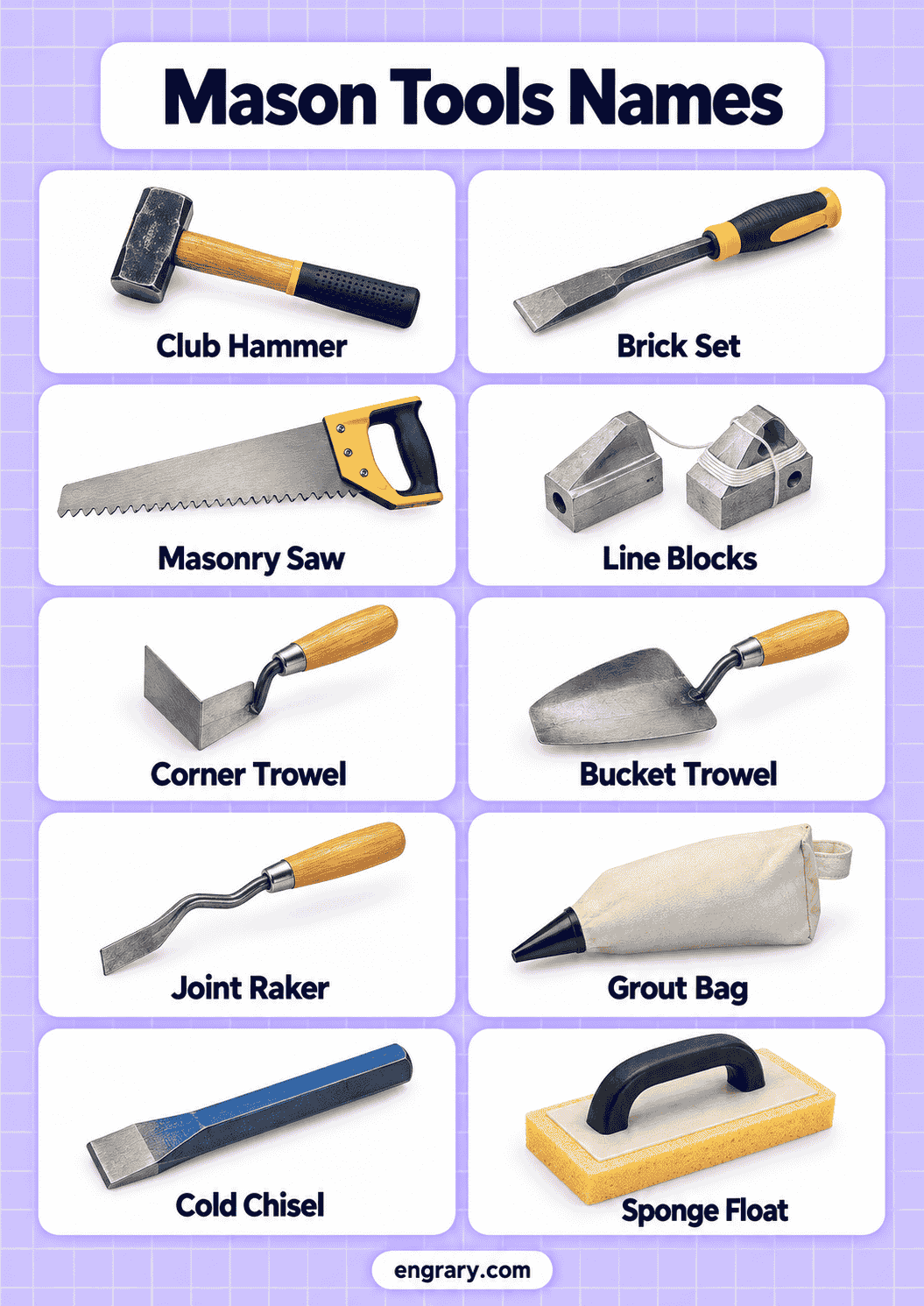
Mortar has to be mixed, carried, kept close to the work, and transferred efficiently onto a trowel. The shape of the board, pan, or handle usually gives these tools away.
Mortar Hawk
A mortar hawk has a flat square board with a vertical handgrip underneath. The underside handle is its clearest recognition feature.
Mortar Board
A mortar board is a larger flat platform that rests near the work area. Unlike a hawk, it does not normally have a central handheld grip underneath.
Mortar Pan
A mortar pan is a shallow basin used for holding or moving mortar. In Pakistan and other South Asian regions, ghamela is a familiar alternate term for a similar construction pan.
Mortar Hoe
A mortar hoe has a long handle and broad mixing head. Some designs have holes or openings in the head.
Mortar Bucket
A mortar bucket is a sturdy container used to hold or move mortar in smaller quantities.
Shovel
A shovel is a general construction tool used for moving sand, mortar ingredients, and other loose materials. Because it is not uniquely masonry-specific, it plays a supporting role rather than a central one.
A quick identification rule is useful here: a hawk is handheld from underneath, while a mortar board rests as a working platform.
Brick Joint Tools: Jointers, Rakers, and Pointers
Mortar joints require their own vocabulary because shaping a joint is different from removing mortar from it. Joint tools are often small, but their working profiles make them highly distinctive.
Brick Jointer
A brick jointer is a shaped metal tool used to compress and form mortar joints. Many designs resemble a bent steel rod with differently sized curved ends.
Concave Jointer
A concave jointer has a rounded profile that forms a smooth inward-curving mortar joint.
V-Jointer
A V-jointer has an angular working edge that creates a V-shaped recess.
Grapevine Jointer
A grapevine jointer creates a narrow recessed line along the mortar joint.
Joint Raker
A joint raker removes mortar rather than compressing it. Designs may use a projecting nail-like point, wheel, or similar raking component.
Tuck Pointer
A tuck pointer uses a very narrow straight blade for placing or finishing mortar in narrow joint areas.
Slicker
A slicker is a narrow shaped metal tool used for smoothing and finishing specific joint profiles.
Joint Brush
A joint brush has narrow stiff bristles that help remove loose material around mortar joints.
Masonry Brush
A masonry brush is usually broader and serves more general cleaning around brick, block, and mortar surfaces.
The easiest distinction is:
Jointer → shapes and compresses mortar
Raker → removes or recesses mortar
Pointer → works mortar into narrow joint areas
Hammers and Chisels Used for Brick Cutting
Brick-cutting tools often work in pairs. The hammer provides the striking force, while the chisel supplies the cutting edge. Their head and blade shapes make them relatively easy to identify.
Brick Hammer
A brick hammer has a flat striking face on one side and a chisel-like cutting edge on the other.
Mason’s Hammer
A mason’s hammer is a broader trade name for hammer patterns designed around brick or stone work. Depending on the design, one side may be pointed or chisel-shaped.
Club Hammer
A club hammer, also called a lump hammer, has a short handle and a heavy double-faced head.
Bolster Chisel
A bolster chisel, or brick bolster, has a very broad cutting edge on a thick steel body.
Cold Chisel
A cold chisel has a narrower beveled cutting edge than a typical brick bolster.
A useful visual distinction is that a brick hammer combines a striking face and cutting edge in one tool, whereas a club hammer usually works with a separate chisel.
Scutching Tools and Their Replaceable Cutting Edges
Scutching tools are a strong piece of mason vocabulary because the holder and the cutting insert have different names. Generic construction lists often miss this relationship.
Scutch Hammer
A scutch hammer has a hammer-like head designed to accept replaceable scutch combs or blades.
Scutch Chisel
A scutch chisel has a solid chisel body with a slot or head designed to hold a replaceable insert.
Scutch Comb
A scutch comb is a replaceable toothed insert. Its row of teeth gives it a comb-like appearance.
Scutch Blade
A scutch blade is a replaceable straight-edged insert rather than a toothed comb.
The relationship is simple:
Scutch hammer or chisel → holder
Scutch comb or blade → replaceable working edge
That distinction prevents four related terms from being treated as synonyms.
Stone Mason Chisels Worth Knowing
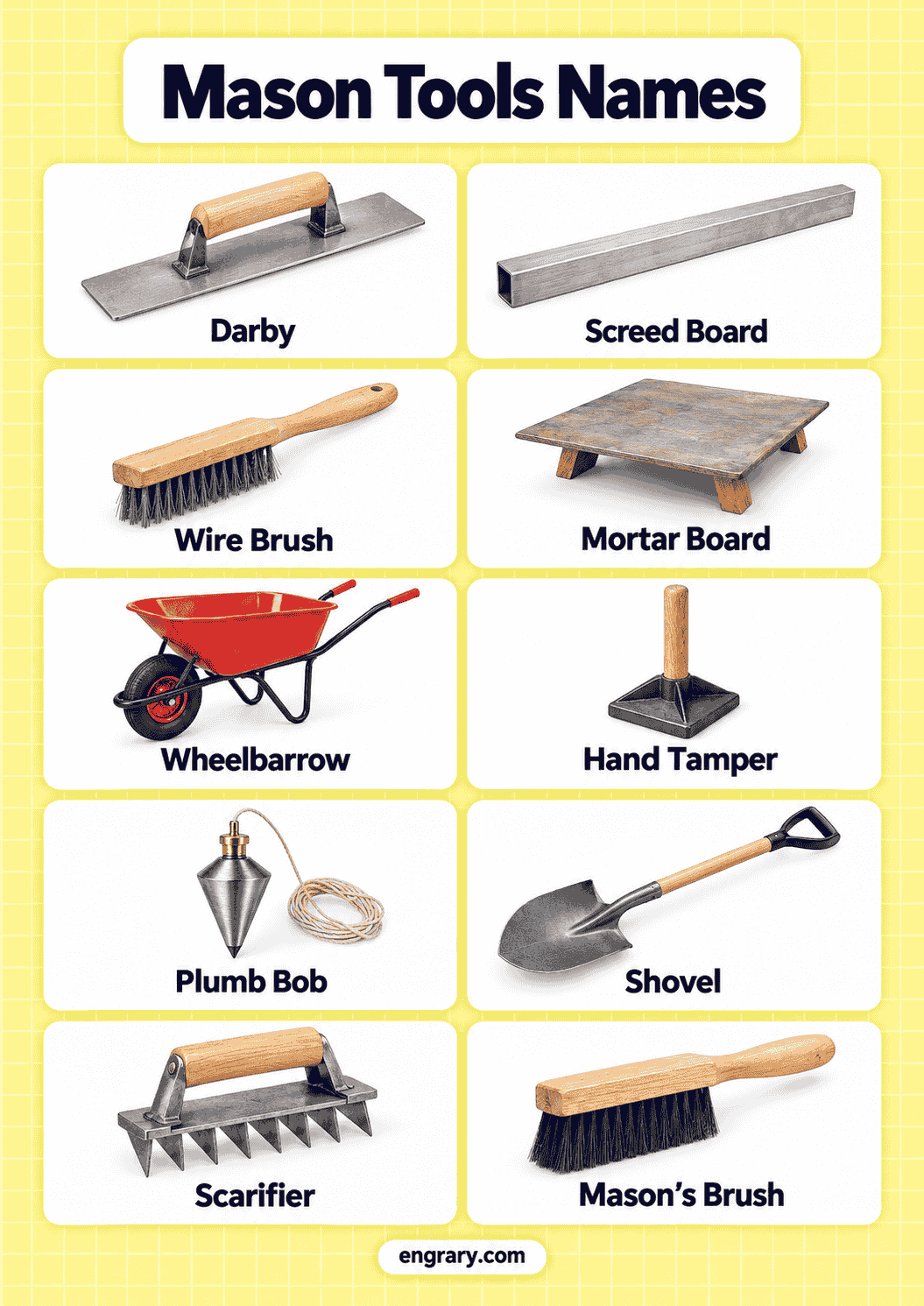
The word mason covers more than bricklaying, so selected stone-working tools belong naturally in this guide. However, the focus should stay on visually distinctive names rather than turning the article into a full stonemasonry manual.
Pitching Chisel
A pitching chisel, also called a mason pitcher, has a broad, heavy cutting edge and thick body.
Point Chisel
A point chisel, sometimes called a moil point, ends in a single narrow point rather than a wide blade.
Tooth Chisel
A tooth chisel, also called a claw chisel, has several teeth across its working edge.
Drove Chisel
A drove chisel, sometimes called a boaster, has a broad straight edge without the teeth seen on a claw chisel.
Hand Tracer
A hand tracer has a robust steel body and broad cutting edge associated with controlled stone splitting or tracing.
Splitting Chisel
A splitting chisel has a wedge-shaped edge designed around separating stone.
These tools become easier to remember by studying their working ends: pointed, toothed, broad, or wedge-shaped.
Stone Masonry Hammer Names
Stone masonry introduces several hammer patterns beyond the familiar brick and club hammer. Their working faces often reveal whether the tool is intended for rough reduction, surface treatment, or striking chisels.
Spalling Hammer
A spalling hammer has a heavy head associated with rough stone work and removing larger unwanted pieces.
Scabbling Hammer
A scabbling hammer has toothed or pointed working faces. The patterned head provides its most obvious recognition feature.
Mash Hammer
A mash hammer is a compact heavy striking hammer used with masonry and stone tools. Its short handle and substantial head resemble a club hammer.
Bush Hammer
A bush hammer has a working face covered with multiple small pyramidal or pointed projections, producing a highly recognizable textured head.
This section stays intentionally small because bricklaying remains the central search intent, while stone tools add controlled breadth to the broader word mason.
Masonry Cleaning and Joint Finishing Tools
Once masonry joints have been shaped or repaired, smaller tools help clean loose material and refine the visible surface. These tools support the finishing stage without becoming a general construction-cleaning list.
Masonry Brush
A masonry brush has stiff bristles suited to cleaning brick, block, stone, and mortar surfaces.
Joint Brush
A joint brush has a narrower bristle arrangement designed to work along mortar-joint lines.
Scraper
A scraper has a rigid working edge that removes small deposits or loose material.
Joint Slicker
A joint slicker has a narrow shaped metal end used for smoothing or refining mortar joints.
Hand Brush
A hand brush is a compact stiff-bristled tool for clearing dust and loose debris.
Mason Tool Names That Have More Than One Common Name
Masonry vocabulary changes by region, manufacturer, and trade tradition. Instead of counting alternate terms as different tools, it is more accurate to connect them under the same entry.
Mason’s Line / Brick Line
Both names describe the tensioned reference string used to guide straight courses.
Club Hammer / Lump Hammer
Both commonly describe a short-handled, heavy striking hammer.
Bolster Chisel / Brick Bolster
Both names refer to a broad masonry chisel used around brick and block work.
Pitching Chisel / Mason Pitcher
Both terms describe a broad-edged stone-masonry tool.
Point Chisel / Moil Point
Both names refer to a stone-working tool with a narrow pointed end.
Tooth Chisel / Claw Chisel
These names describe a stone chisel whose cutting edge is divided into several teeth.
Drove Chisel / Boaster
Regional and trade vocabulary may use either term for a broad straight-edged stone-dressing chisel.
Mortar Pan / Ghamela
Mortar pan is common English-language terminology, while ghamela is widely understood across South Asian construction work.
Frequently Asked Questions
Common mason tools include brick and pointing trowels, mason’s line, line pins or blocks, spirit levels, plumb tools, mortar boards, jointers, joint rakers, brick hammers, club hammers, bolster chisels, and masonry brushes.
A brick trowel has a larger triangular blade for general mortar-laying work, while a pointing trowel has a smaller blade for detailed mortar and joint work.
A mason’s line, or brick line, provides the straight visual reference. Line pins or line blocks hold the cord in position.
A brick jointer shapes and compresses the exposed mortar joint, while a joint raker removes mortar to create a recessed depth.
Common hand tools include brick hammers, club or lump hammers, bolster chisels, cold chisels, and scutching tools. Stone masonry also uses specialized pitching, point, tooth, drove, and splitting chisels.
You May Also Like



Leave a Comment