

Bricklaying uses a surprisingly specialized set of tools. Some spread and shape mortar, while others keep courses straight, check level and plumb, finish joints, cut bricks, or support accurate setting out. Many tools look similar at first, but their blade shape, working edge, size, or position around the wall usually makes them easier to identify.
Learning bricklaying tools names by appearance and purpose is especially useful for beginners, apprentices, and anyone trying to identify tools from pictures. This guide focuses specifically on tools used in brickwork rather than the wider range of equipment found across general masonry and construction.
Bricklaying Tools Beginners Should Recognize
A bricklayer normally works with several tool families at the same time. Trowels handle mortar, lines and levels control alignment, jointing tools shape exposed mortar, and hammers and chisels help with brick cutting. The following are some of the most recognizable names found around bricklaying work.
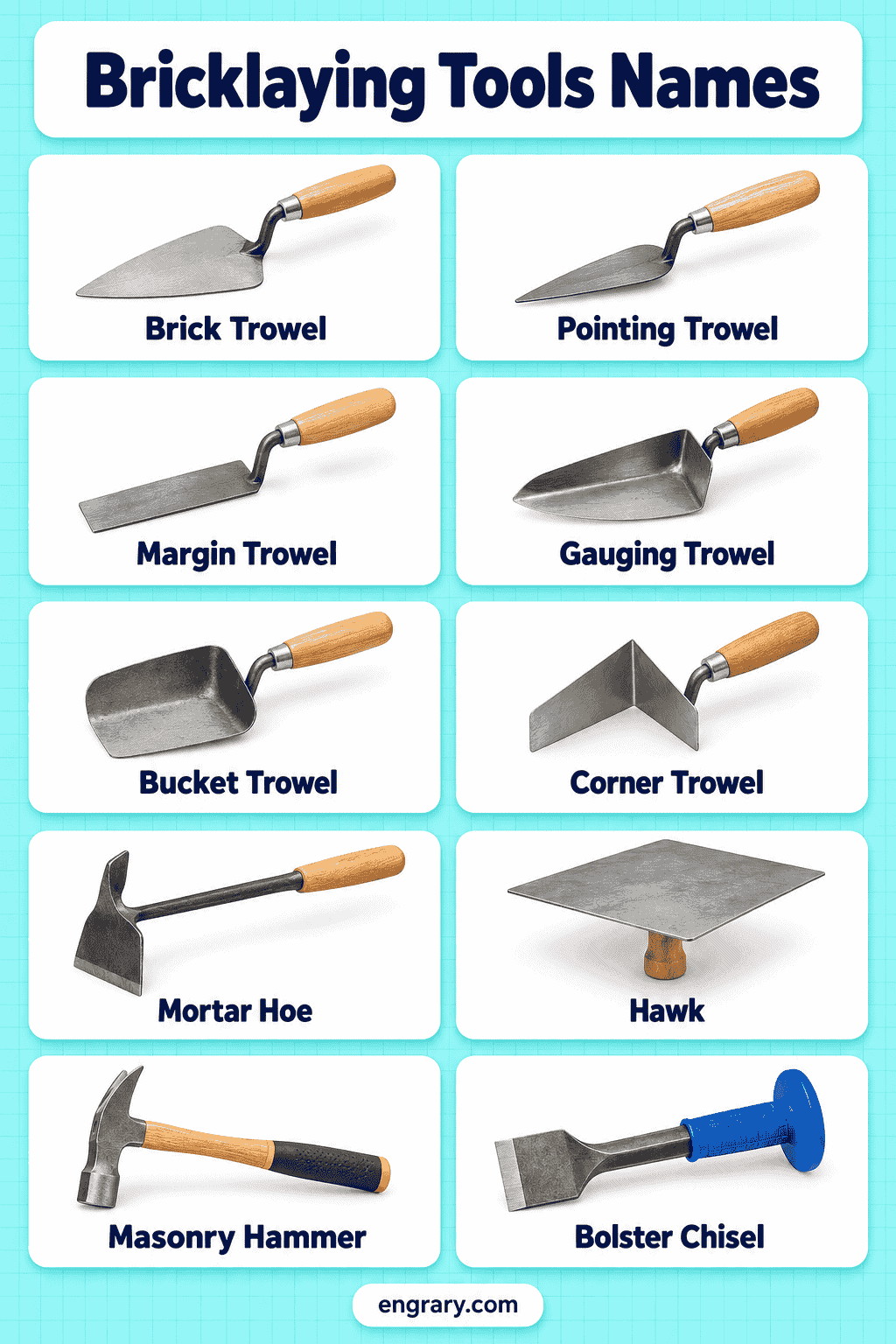
Brick Trowel
A broad triangular trowel used for carrying, spreading, and shaping mortar while laying bricks.
Pointing Trowel
A smaller triangular trowel used for detailed mortar work and narrow areas.
Margin Trowel
A narrow rectangular trowel useful in confined spaces and along edges.
Gauging Trowel
A compact leaf-shaped trowel used for handling smaller amounts of mortar.
Bucket Trowel
A broad, shorter-bladed trowel used for scooping mortar from buckets or containers.
Mason’s Line
A tightly stretched cord that gives the bricklayer a straight visual reference along a course.
Line Pins
Long pointed pins used to hold the mason’s line in position.
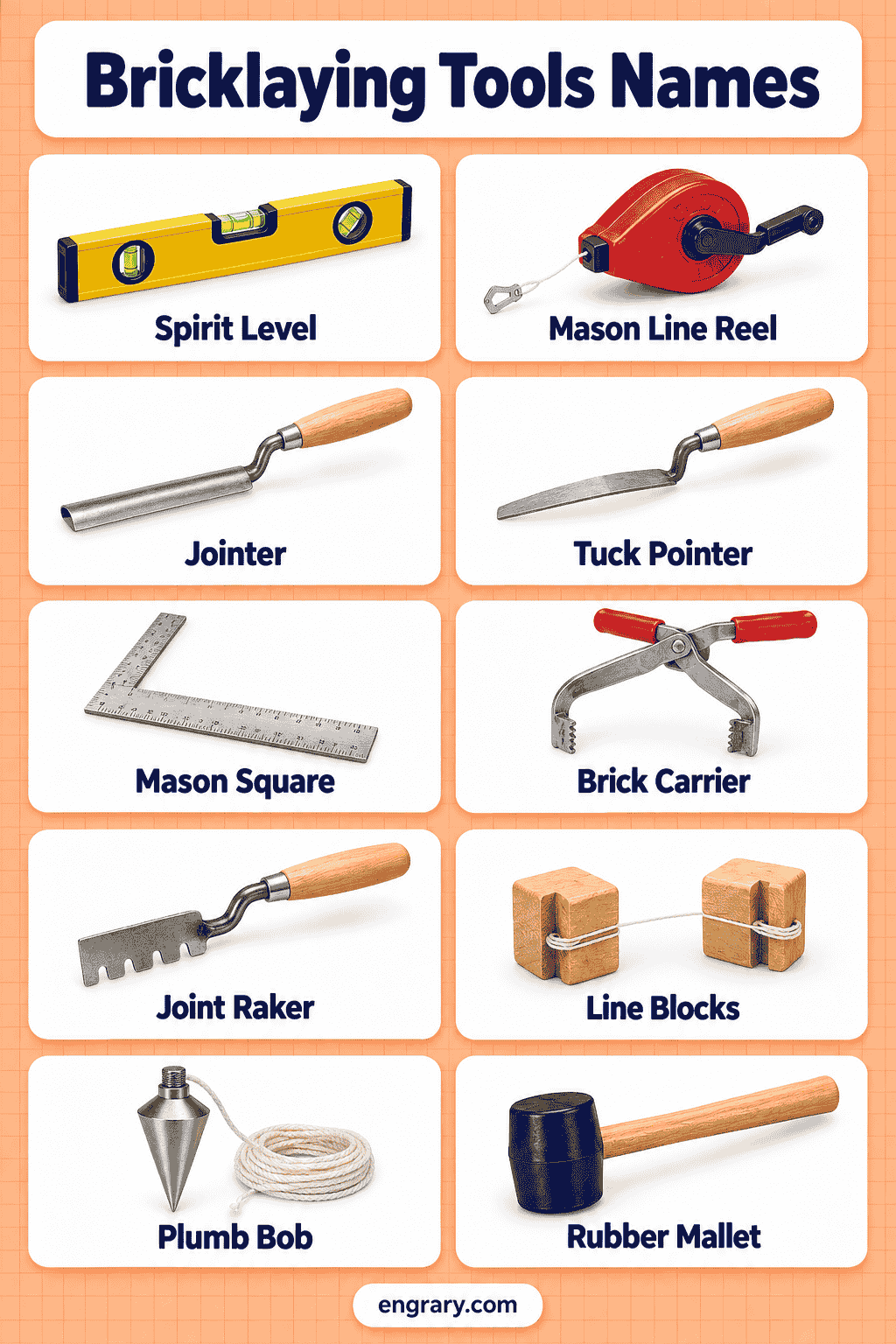
Line Blocks
Small blocks that support a brick line at wall ends or corners.
Tingle
A small support used along longer runs of brick line to reduce sag.
Gauge Rod
A marked reference rod used to keep brick courses and joint spacing consistent.
Spirit Level
A straight tool with bubble vials used to check horizontal and vertical alignment.
Boat Level
A shorter compact level used where a full-length level would be awkward.
Plumb Bob
A pointed weight hanging from a cord that gives a gravity-based vertical reference.
Mason’s Square
A rigid right-angle tool used for checking and setting 90-degree corners.
Straightedge
A long rigid bar used to check whether brickwork remains straight.
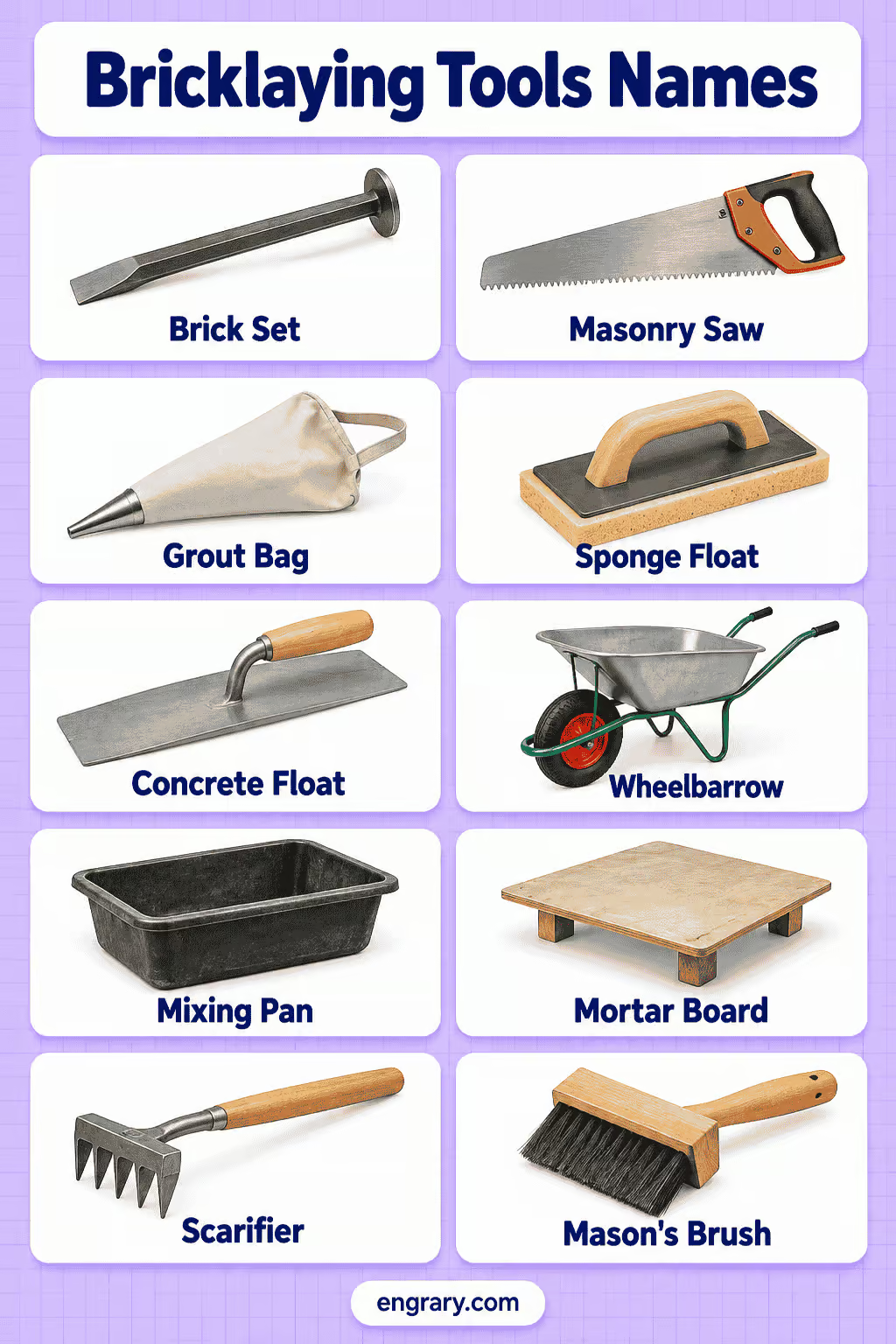
Mortar Board
A flat platform used to hold mortar close to the working area.
Mortar Hawk
A square board with a vertical handle underneath for holding mortar by hand.
Brick Jointer
A shaped metal tool used to compress and finish mortar joints.
Joint Raker
A tool used to remove or recess mortar from a joint to a controlled depth.
Tuck Pointer
A very narrow straight-bladed tool used for detailed mortar-joint work.
Brick Hammer
A hammer with a flat striking face on one side and a chisel-like edge on the other.
Club Hammer
A short-handled heavy hammer, also called a lump hammer, commonly used with masonry chisels.
Bolster Chisel
A broad-edged masonry chisel used for cutting or trimming bricks.
Brick Profile
A long straight profile positioned at a wall corner to support accurate line setting.
Profile Clamp
A clamp used to secure a brick profile in position.
Line Reel
A reel that stores and dispenses brick line neatly between uses.
These familiar tools cover the main activities in bricklaying: mortar handling, setting out, course control, joint finishing, alignment, and brick cutting.
Brick Trowel Patterns and Specialist Trowels
Bricklaying uses more than one trowel pattern. The fastest way to tell them apart is to look at the blade’s width, heel shape, length, and overall outline. Some are general laying tools, while others suit detail work or narrow joints.
London Pattern Brick Trowel
A London pattern brick trowel has a pointed triangular blade with a comparatively narrower heel area. Its profile is one of the classic brick-trowel shapes.
Philadelphia Pattern Brick Trowel
A Philadelphia pattern brick trowel has a broader heel and fuller blade than many London-pattern versions. The wider rear portion provides the strongest visual distinction.
Brick Trowel
A brick trowel is the general laying tool with a broad triangular blade and raised handle. It carries and spreads mortar during brickwork.
Pointing Trowel
A pointing trowel has a much smaller triangular blade. It is useful for detailed mortar work, repairs, and narrow areas around joints.
Margin Trowel
A margin trowel uses a narrow rectangular blade rather than the triangular form of a brick trowel. Its long slim shape makes it easy to identify.
Gauging Trowel
A gauging trowel commonly has a rounded or leaf-like blade. Its compact size separates it from full-size brick trowels.
Bucket Trowel
A bucket trowel has a broader short blade suited to scooping mortar from a bucket or tub.
Buttering Trowel
A buttering trowel is a smaller trowel associated with applying mortar directly to individual masonry units or confined areas.
Cross-Joint Trowel
A cross-joint trowel has a narrow blade suited to working mortar into vertical or cross joints between bricks.
Tuck Pointer
A tuck pointer has a very narrow straight blade. It looks more like a slim metal strip than a conventional triangular trowel.
London and Philadelphia Brick Trowels
Both are brick trowels, but the heel and blade profile differ. London-pattern trowels generally appear narrower toward the heel, while Philadelphia-pattern blades usually have a broader rear section. They should be treated as patterns within the same tool family rather than completely unrelated tools.
Brick Lines, Pins, Blocks, and Tingles
A straight brick course depends heavily on the line system. The line itself provides the reference, but other tools hold, tension, support, or position it. Learning these names together makes the system much easier to understand.
Brick Line
A brick line, also called a mason’s line, is a strong cord stretched between reference points along a course.
Line Pins
Line pins are long pointed metal pins that help hold the line at the required position.
Line Blocks
Line blocks sit against or grip the end of a wall and support the line without needing a pointed pin.
Corner Blocks
Corner blocks are shaped line holders used around masonry corners.
Tingle
A tingle supports the line between its main end points, particularly on longer runs where the line might sag.
Line Reel
A line reel stores brick line and allows it to be wound and unwound more neatly.
The system is easy to remember:
Brick line → provides the straight reference
Pins or blocks → hold the line
Tingle → supports the line between the ends
Gauge Rods, Levels, and Plumb Tools
A brick wall must remain consistent in more than one direction. Bricklayers check course height, horizontal level, vertical plumb, straightness, and right-angle corners with several different tools rather than relying on one universal measuring device.
Gauge Rod
A gauge rod is marked with repeated course heights. The regular markings help maintain consistent brick and mortar-joint spacing up a wall.
Spirit Level
A spirit level has a long straight body with bubble vials. It can check both horizontal level and vertical plumb.
Bricklayer’s Level
A bricklayer’s level is a spirit level suited to masonry work, usually with a relatively long rigid body for checking courses and wall faces.
Boat Level
A boat level is a much shorter level with a compact body, useful for quick checks in smaller spaces.
Plumb Bob
A plumb bob is a pointed weight suspended from a cord. Gravity establishes the vertical reference.
Plumb Rule
A plumb rule is a long straight rule associated with vertical checking using a hanging reference line.
Mason’s Square
A mason’s square provides a rigid 90-degree reference when setting out corners.
Straightedge
A straightedge is a long rigid bar used to check straightness along brickwork. Unlike a spirit level, it does not necessarily contain a bubble vial.
Level, Plumb, and Course Height Are Different Checks
A level checks horizontal or vertical orientation through its vials. A plumb bob establishes vertical direction through gravity. Meanwhile, a gauge rod controls repeated course heights. These tools work toward accuracy, but they do different jobs.
Brick Profiles and Modern Line-Setting Tools
Traditional line pins remain familiar, but many bricklayers also use profile systems that provide a fixed vertical reference at wall corners. These tools deserve separate coverage because they look very different from pins and blocks.
Brick Profile
A brick profile is a long straight metal section fixed vertically near a wall corner. Brick line can be positioned along the profile at different course heights.
Corner Profile
A corner profile is arranged specifically around a corner or return. Its tall straight body provides a reference for both alignment and line position.
Profile Clamp
A profile clamp secures the profile to the masonry or supporting structure. Its clamping mechanism is usually the most recognizable feature.
Line Holder
A line holder attaches to or works with a profile system to keep the brick line at the desired height and position.
Traditional line pins and modern profiles serve a similar broad goal—maintaining accurate line references—but their physical setup and appearance are very different.
Mortar Boards, Hawks, and Bricklayer Handling Tools
Bricklayers need mortar within easy reach, but not every container serves the same purpose. Some tools act as working platforms, while others are handheld or simply transport mortar.
Mortar Board
A mortar board is a flat platform positioned near the bricklayer so mortar remains accessible during laying.
Mortar Hawk
A mortar hawk has a flat square board with a central vertical handle underneath. Unlike a mortar board, it is designed to be held in one hand.
Mortar Pan
A mortar pan is a shallow container used to hold or transport mortar.
Mortar Bucket
A mortar bucket is a deeper container used to carry smaller quantities of mortar around a work area.
Bucket Trowel
A bucket trowel has a broad blade shaped for scooping mortar from buckets and similar containers.
The visual difference is straightforward: boards and hawks present flat working surfaces, while pans and buckets are containers.
Brick Joint Tools and Joint Profiles
The visible mortar between bricks can be shaped into different profiles. Bricklayers use jointers, slickers, rakers, and narrow pointing tools for these details, and the working end usually tells you which tool you are looking at.
Brick Jointer
A brick jointer is a shaped metal tool that compresses and smooths mortar joints. Many versions resemble a curved steel rod.
Concave Jointer
A concave jointer has a rounded working profile that creates an inward-curving mortar joint.
V-Jointer
A V-jointer forms an angular V-shaped groove in the mortar.
Grapevine Jointer
A grapevine jointer produces a narrow recessed line through the joint face.
Sled Runner
A sled runner is a longer joint-finishing tool designed to move along horizontal mortar joints with a consistent profile.
Slicker
A slicker is a slim shaped tool used for smoothing narrower or flatter mortar joints.
Joint Raker
A joint raker removes mortar from the joint rather than compacting it. Many designs have a small projecting raking point or wheel.
Tuck Pointer
A tuck pointer uses a narrow straight blade to place or finish mortar in narrow joint areas.
The key distinction is:
Jointer → shapes and compacts mortar
Raker → removes and recesses mortar
Pointer → works mortar into narrow joints
Tools Used to Cut and Shape Bricks
Brick cutting does not require the large family of specialized stone chisels used in stonemasonry. A smaller group of hammers and chisels covers the main hand-tool vocabulary for bricklaying.
Brick Hammer
A brick hammer has a flat striking face on one side and a narrow chisel-like cutting edge on the other.
Club Hammer
A club hammer, also called a lump hammer, has a short handle and heavy double-faced head. It commonly works with separate masonry chisels.
Bolster Chisel
A bolster chisel, also called a brick bolster, has a very wide cutting edge. The broad blade makes it especially easy to distinguish from a cold chisel.
Cold Chisel
A cold chisel has a narrower beveled cutting edge and a solid steel body.
A brick hammer combines striking and cutting surfaces in one tool, while a club hammer and bolster form a two-tool cutting combination.
Bricklaying Tool Names That Vary by Region or Trade
Bricklaying terminology is not completely universal. Manufacturers, training systems, and regional trades sometimes use different names for essentially the same tool. Alternate names should therefore be treated as vocabulary variants rather than counted as additional tools.
Brick Line / Mason’s Line
Both describe the tensioned string used as a straight course reference.
Club Hammer / Lump Hammer
Both commonly refer to a short-handled heavy striking hammer.
Bolster / Brick Bolster
Both names refer to the broad masonry chisel used around brick and block work.
Jointer / Striker
Some bricklaying traditions use striker for joint-finishing tools or the action of striking a mortar joint.
Plumb Bob / Plummet
Both terms can refer to a suspended weight used to establish a vertical reference.
Brick Trowel / Mason’s Trowel
Mason’s trowel is sometimes used broadly, while brick trowel more specifically identifies the familiar triangular laying trowel used in brickwork.
Recognizing these alternate names helps readers understand tool catalogs, training material, and regional bricklaying vocabulary without inflating the article with duplicate entries.
Frequently Asked Questions
Common bricklaying tools include brick trowels, pointing trowels, mason’s lines, line pins, line blocks, tingles, gauge rods, spirit levels, plumb tools, mortar boards, jointers, joint rakers, brick hammers, club hammers, and bolster chisels.
A brick trowel has a larger triangular blade for general mortar laying, while a pointing trowel has a smaller blade for detailed mortar and joint work.
A brick line provides the main straight reference. Line pins or line blocks hold it at the ends, while a tingle can support a longer line between those points. Brick profiles provide another line-setting method.
A brick jointer compresses and shapes the visible mortar joint, while a joint raker removes mortar to create a recessed joint depth.
Common hand tools include a brick hammer, club or lump hammer, bolster chisel, and cold chisel. The brick hammer combines a striking face and cutting edge, while a club hammer normally works with a separate chisel.
You May Also Like



Leave a Comment