
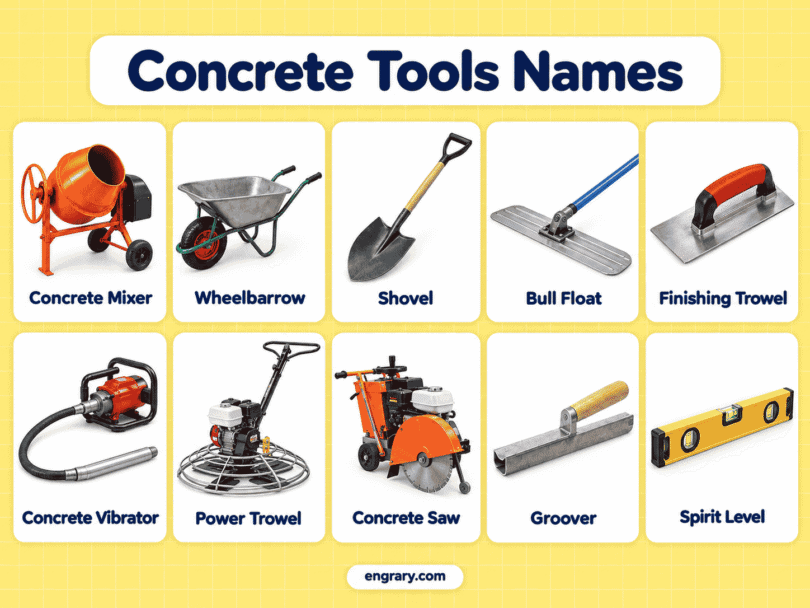
Concrete work uses a distinctive mix of tools for moving fresh concrete, leveling the surface, floating, edging, forming grooves, finishing, texturing, and consolidation. Many of these tools look similar at first, but differences in blade shape, handle length, working edge, or power source make them easier to identify.
Learning concrete tools names with pictures and simple uses helps beginners recognize equipment on construction sites, in workshops, and in training materials. This guide focuses on the tools most closely connected with concrete placement and finishing, from screeds and bull floats to fresnos, groovers, vibrators, and power trowels.
Concrete Tools You Will See Around a Fresh Pour
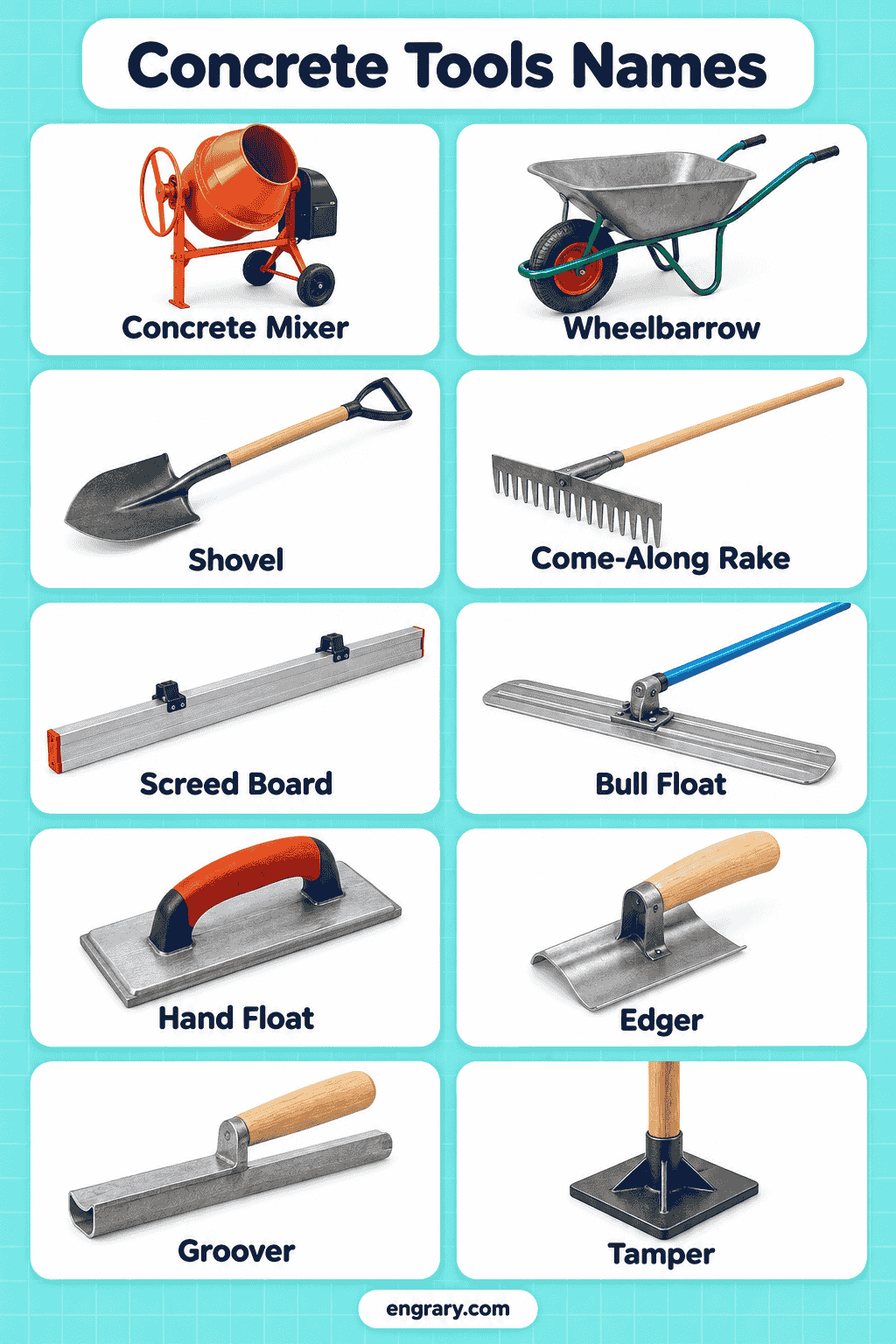
A concrete pour brings several tool families together at once. Some move the fresh mix, some establish the surface level, and others refine edges, joints, texture, or finish. These are some of the most recognizable names beginners are likely to encounter.
Screed Board
A long straight board or metal member used to strike off excess concrete and establish an even surface.
Bull Float
A large rectangular floating head attached to long extension handles for working across a slab.
Hand Float
A compact rectangular tool with a handle mounted directly above the blade.
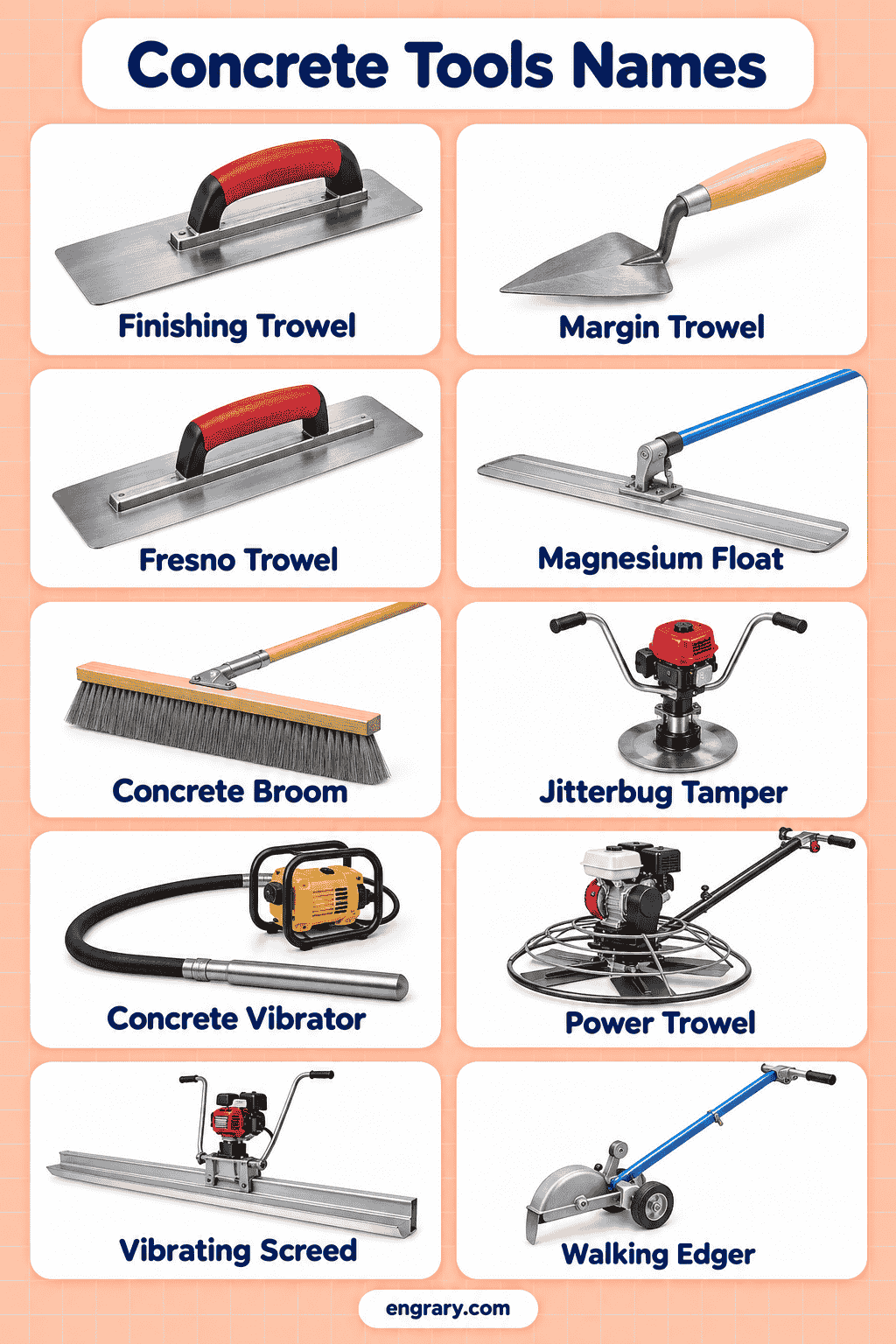
Magnesium Float
A lightweight hand float made with a magnesium blade and commonly used in concrete finishing.
Wood Float
A hand float with a wooden working surface that gives it a noticeably different appearance from metal floats.
Darby
A long, narrow handheld float used for smoothing and leveling fresh concrete over a wider area than a small hand float.
Concrete Finishing Trowel
A thin rectangular steel blade with an arched handle used for finer concrete surface finishing.
Fresno
A long steel finishing blade attached to extension handles so it can be used from the slab perimeter.
Concrete Edger
A small finishing tool with a shaped edge used around the outside perimeter of concrete slabs.
Walking Edger
A long-handled version of an edger that allows the operator to work while standing farther from the slab edge.
Concrete Groover
A flat finishing tool with a projecting rib or bit underneath that forms a groove in fresh concrete.
Walking Groover
A groover attached to a long handle for forming grooves from a standing position.
Concrete Come-Along
Another common name for a concrete placing tool with a broad head designed for moving fresh concrete.
Concrete Broom
A wide, long-handled broom used to create a textured surface rather than for ordinary cleaning.
Concrete Tamper
A flat or grid-like tool associated with pressing or working the surface of certain concrete mixes.
Check Rod
A long straight concrete flatwork tool used for checking and correcting surface flatness.
Paver’s Straightedge
A long straight finishing tool used across concrete or paving surfaces to identify and correct irregularities.
Concrete Placer
A long-handled tool with a wide head used to push or pull fresh concrete into position.
Power Screed
A powered screeding tool that combines a long screed blade with mechanical vibration or movement.
Power Trowel
A motorized finishing machine with rotating blades underneath a circular protective guard.
Needle Vibrator
A concrete vibrator with a narrow vibrating head connected by a flexible shaft.
Surface Vibrator
A vibrator that applies vibration from the top or surface rather than from inside the concrete.
Concrete Mixer
A rotating drum or powered machine used to mix cement, aggregates, water, and other concrete ingredients.
Concrete Bucket
A heavy-duty container designed to hold or move concrete.
Knee Board
A flat board used by finishers to spread body weight while accessing areas of a slab.
These tools cover the main vocabulary around placing, screeding, floating, finishing, edging, joint formation, texturing, and consolidation.
Bull Floats, Hand Floats, and Darbies
Concrete floats belong to one of the most important tool families in flatwork. Although the names are related, their size, reach, handle arrangement, and material can make them look very different.
Bull Float
A bull float has a large rectangular head attached to one or more long handles. Its long reach is the easiest visual clue.
Magnesium Bull Float
A magnesium bull float uses a lightweight magnesium head. It keeps the familiar long-handle bull-float shape while differing in blade material.
Wood Bull Float
A wood bull float has a wooden floating surface rather than a metal one. The long handle and large head still distinguish it from handheld wood floats.
Hand Float
A hand float is much smaller and places the handle directly above the working blade. It is used close to the surface rather than from the slab edge.
Magnesium Float
A magnesium float has a smooth lightweight metal blade and a curved or raised handle above it.
Wood Float
A wood float has a wooden base with a top-mounted handle. Its material gives it a thicker and more traditional appearance than metal finishing tools.
Darby
A darby is a longer handheld floating tool. It usually has one or more handles positioned along an elongated blade.
The main visual distinction is simple: a bull float uses a long pole, while a hand float or darby is controlled directly by hand.
Screeds, Check Rods, and Straightedges
Concrete flatwork uses several long straight tools, but they are not all exactly the same. Some strike off fresh concrete, while others help check or refine the surface after the initial leveling stage.
Screed Board
A screed board is a long straight board drawn across fresh concrete to remove excess material and establish the surface plane.
Screed Bar
A screed bar performs the same broad strikeoff role but commonly uses a metal section instead of timber.
Hand Screed
A hand screed is a manually operated screeding tool rather than a powered or vibrating version.
Straightedge
A straightedge is any long rigid straight reference used to check or control surface flatness. In simple concrete work, a straightedge may also serve as a screeding member.
Check Rod
A check rod is a long straight flatwork tool used after initial strikeoff to identify and adjust surface irregularities.
Paver’s Straightedge
A paver’s straightedge is a long professional finishing tool designed for checking and refining broad concrete or paving surfaces.
Bump Cutter
A bump cutter is a long finishing tool associated with removing or reducing high spots in fresh flatwork.
Power Screed
A power screed combines a long screed blade with a powered mechanism to assist surface leveling.
Vibratory Screed
A vibratory screed adds mechanical vibration to the screeding process and is visually identifiable by its motorized or vibrating assembly.
These names overlap in purpose, so they should not be treated as unrelated equipment. A screed generally refers to the strikeoff tool or function, while straightedges, check rods, and bump cutters belong to the broader family of long surface-control tools.
Concrete Trowels, Fresnos, and Powered Finishing Tools
Concrete trowels range from small hand tools to large motorized machines. Their common purpose is surface finishing, but their scale and working method make them easy to separate visually.
Concrete Finishing Trowel
A concrete finishing trowel has a thin rectangular steel blade with slightly rounded corners and a handle mounted above it.
Steel Trowel
A steel trowel is another common name for a finishing trowel with a smooth metal blade used in concrete flatwork.
Pool Trowel
A pool trowel typically has a rounded or more flexible blade profile that differs from the squarer outline of a standard finishing trowel.
Midget Trowel
A midget trowel is a smaller finishing trowel designed for tighter spaces and detailed areas.
Fresno
A Fresno uses a long steel blade mounted to extension handles. Its pole-operated form distinguishes it immediately from a handheld trowel.
Power Trowel
A power trowel is a motorized machine with rotating finishing blades beneath a circular guard.
Walk-Behind Power Trowel
A walk-behind power trowel has a long control handle extending from the machine so the operator guides it from behind.
Ride-On Power Trowel
A ride-on power trowel is a larger machine with a seat and multiple rotating blade assemblies beneath the operator.
The progression is easy to recognize: hand trowel → long-handled Fresno → motorized power trowel.
Edgers and Groovers Used on Concrete Slabs
Edgers and groovers are both compact finishing tools, so beginners often confuse them. The easiest way to tell them apart is to examine what happens along the underside or side of the blade.
Hand Edger
A hand edger has a flat blade with one side shaped to form a rounded slab perimeter.
Walking Edger
A walking edger uses the same broad edge-forming idea but connects to a long handle.
Concrete Groover
A concrete groover has a projecting rib or bit underneath its blade. That projection forms a groove in the surface.
Walking Groover
A walking groover places the grooving blade on an extension handle so it can be guided from farther away.
Bi-Directional Groover
A bi-directional groover is designed so the tool can work effectively while moving in more than one direction along the joint line.
The basic distinction is:
Edger → shapes the slab perimeter
Groover → forms a groove or joint line
That difference makes these two tools easier to identify even when their upper handles look similar.
Concrete Placers and Fresh-Mix Handling Tools
Before the surface can be screeded and finished, fresh concrete has to be moved into the required area. Some of the tools here are concrete-specific, while others are general construction tools used in a concrete setting.
Concrete Placer
A concrete placer has a long handle and a wide flat or angled head that pushes or pulls fresh concrete.
Concrete Come-Along
A concrete come-along is a common trade term for a concrete placing tool. The wide working head separates it visually from a garden rake.
Concrete Rake
A concrete rake has a long handle and broad head designed around moving fresh material rather than combing soil.
Square-Point Shovel
A square-point shovel has a broad flat-ended blade. In concrete work, it may help move or distribute fresh mix in smaller areas.
Concrete Bucket
A concrete bucket is a heavy-duty container intended to hold and transfer concrete.
Concrete Buggy
A concrete buggy is a wheeled carrier built for moving larger quantities of fresh concrete around a jobsite.
Wheelbarrow
A wheelbarrow is a general transport tool with one or two front wheels and two handles. It may be used for moving concrete or its ingredients over shorter distances.
The most concrete-specific names in this group are concrete placer, come-along, concrete bucket, and concrete buggy. Generic tools such as shovels and wheelbarrows should remain supporting vocabulary rather than the focus of the article.

Brooms and Tampers Found in Concrete Flatwork
Concrete surface tools are not limited to smooth steel blades. Brooms and tampers have very different working faces, which makes them especially easy to identify from pictures.
Concrete Broom
A concrete broom has a wide row of bristles attached to a long handle. It is made for texturing concrete surfaces rather than sweeping debris.
Finishing Broom
A finishing broom is another term for a broad concrete broom used during surface finishing.
Texture Broom
A texture broom emphasizes the surface-pattern role of the tool and may have different bristle stiffness or width depending on the design.
Concrete Tamper
A concrete tamper has a flat or patterned working head attached to handles. Its appearance differs clearly from a broom or float.
Hand Tamper
A hand tamper is a smaller manually controlled version with a compact working plate.
Jitterbug
A jitterbug is a traditional name for a concrete tamper with a grid-like or mesh-style working face.
Roller Tamper
A roller tamper uses a rolling cylindrical component rather than a flat plate.
These tools should be identified by their working surface: bristles on brooms, plates or grids on tampers, and rollers on roller tampers.
Concrete Vibrator Names and How They Differ
Concrete vibrators form another family where one generic term hides several different tool types. Their names usually describe where the vibration is applied.
Concrete Vibrator
A concrete vibrator is the broad name for equipment that applies vibration to fresh concrete for consolidation.
Internal Vibrator
An internal vibrator works from within the fresh concrete. It commonly uses a vibrating head connected to a flexible shaft.
Needle Vibrator
A needle vibrator is a common type of internal vibrator with a long, narrow vibrating head.
Pencil Vibrator
A pencil vibrator is a smaller, slimmer internal vibrator used where a standard head would be too large.
External Vibrator
An external vibrator applies vibration from outside the concrete rather than placing the head inside the mix.
Form Vibrator
A form vibrator is an external vibrator attached to formwork so vibration transfers through the form.
Surface Vibrator
A surface vibrator works from the top of the concrete surface rather than internally.
Screed Vibrator
A screed vibrator applies vibration through or alongside the screeding assembly.
Double-Beam Screed Vibrator
A double-beam screed vibrator combines parallel screed members with a vibration mechanism, creating a distinctive frame-like appearance.
These names should not all be counted as completely unrelated tools. Needle and pencil vibrators belong to the internal-vibrator family, while form vibrators belong to the external-vibrator family.
Concrete Tool Names That Are Easy to Confuse
Several concrete tools look similar because they share rectangular blades, long handles, or overlapping finishing roles. The simplest way to distinguish them is by reach, blade material, working edge, and whether they operate by hand or power.
| Tools | Main Difference |
|---|---|
| Bull Float vs Hand Float | A bull float has a large head on a long pole; a hand float is compact and controlled directly by hand. |
| Bull Float vs Darby | A bull float is pole-operated across a slab, while a darby is a long handheld float. |
| Float vs Trowel | Floats are broader surface-working tools; steel trowels provide a finer finishing blade. |
| Screed vs Bull Float | A screed strikes off and establishes the surface plane; a bull float works the surface afterward. |
| Edger vs Groover | An edger shapes the slab perimeter; a groover creates a joint or groove. |
| Hand Trowel vs Fresno | A hand trowel is controlled directly above the blade; a Fresno uses extension handles. |
| Fresno vs Power Trowel | A Fresno is manually pole-operated; a power trowel uses motorized rotating blades. |
| Internal vs Surface Vibrator | An internal vibrator works within fresh concrete; a surface vibrator applies vibration from above. |
Frequently Asked Questions
Common concrete tools include screeds, bull floats, hand floats, darbies, finishing trowels, fresnos, edgers, groovers, concrete placers, brooms, vibrators, power screeds, and power trowels.
A bull float has a large floating head attached to long handles, while a hand float is a compact tool with its handle mounted directly above the blade.
A screed removes excess fresh concrete and establishes the general surface plane. A bull float is then used across the surface as part of the later floating stage.
An edger forms and smooths the outside edge of a concrete slab, while a groover creates a groove or joint line within the slab surface.
Several tools can be involved depending on the required finish. Hand floats, finishing trowels, fresnos, concrete brooms, and power trowels are all recognizable concrete finishing tools.
You May Also Like



Leave a Comment