
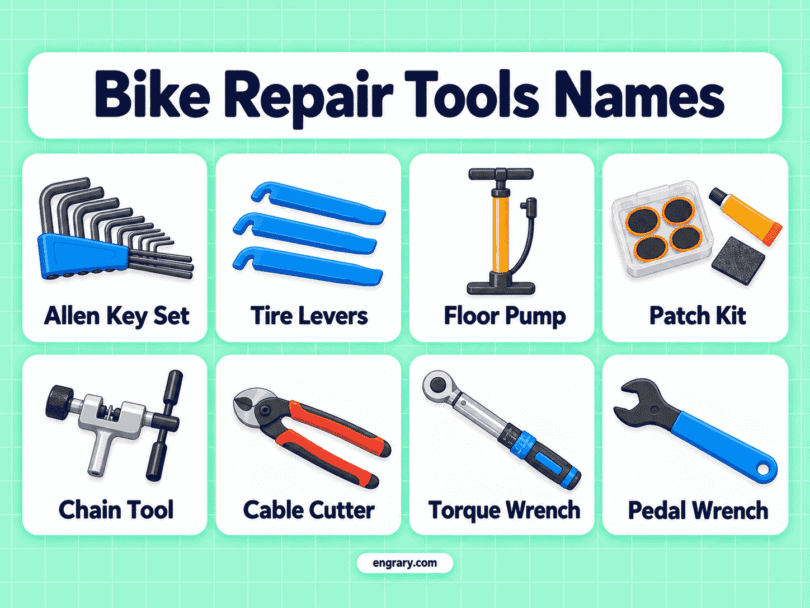
Bike repair tools help cyclists fix flat tires, adjust brakes and gears, service chains, remove cassettes, work on cranks, true wheels, and maintain suspension components. Learning common bike repair tools names in English makes it easier to understand bicycle maintenance, recognize workshop equipment, and prepare for roadside repairs.
This article covers 80 bicycle repair tools with clear explanations of their main uses. You will also see which tools suit the repairs cyclists perform most often, what belongs in a roadside kit, how home-workshop tools differ from portable tools, and which bicycle tools are easy to confuse.
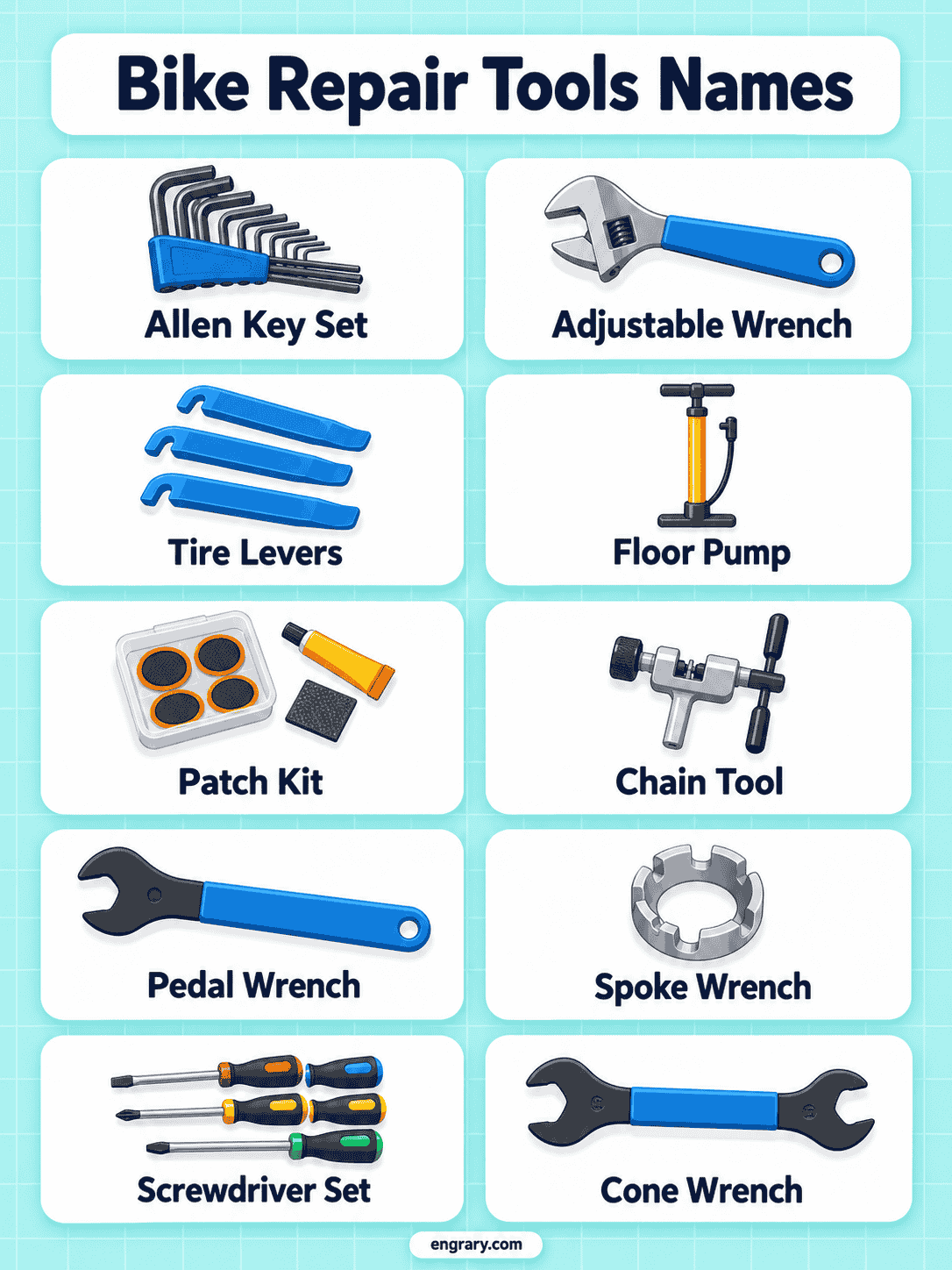
Familiar Bike Repair Tools Most Riders Recognize
Some bicycle tools appear frequently because they handle everyday adjustments, punctures, drivetrain maintenance, and basic workshop repairs.
Hex Key
A hex key turns the internal hex bolts found throughout most modern bicycles.
Bike Multi-Tool
Several compact repair tools fold into one portable unit for roadside adjustments.
Torque Wrench
Controlled torque helps tighten sensitive bicycle components to the specified setting.
Tire Lever
A thin hooked edge lifts a tire bead over the rim during tire or tube removal.
Floor Pump
Its large barrel moves plenty of air for efficient tire inflation at home.
Mini Pump
A compact pump provides portable tire inflation during rides.
Chain Tool
A hardened pin pushes chain rivets during chain removal, shortening, or repair.
Master Link Pliers
Special jaws open or close compatible chain quick links.
Chain Wear Gauge
Simple measuring points show how much a bicycle chain has elongated through wear.
Spoke Wrench
A small fitted head turns spoke nipples during wheel truing.
Pedal Wrench
The thin open jaw fits pedal flats for pedal removal and installation.
Cassette Lockring Tool
A splined tool engages the cassette lockring during cassette removal or fitting.
Chain Whip
A short length of chain holds the cassette while the lockring is loosened.
Crank Puller
Mechanical pressure draws compatible crank arms from the bottom-bracket spindle.
Bottom Bracket Tool
The shaped interface fits specific bottom-bracket cups or cartridges.
Cable Cutter
Sharp shaped jaws cut brake and shift cables cleanly.
Cone Wrench
Its thin profile fits narrow hub cones and locknuts.
Repair Stand
A raised clamp supports the bicycle at a comfortable working height.
Shock Pump
High-pressure, low-volume pumping adjusts air suspension accurately.
Truing Stand
A stable frame holds a wheel while its lateral and radial alignment are checked.
Tools for Fixing the Parts That Wear Most
The following list contains exactly 80 distinct bike repair tools, organized around the bicycle systems they actually service.
Hex, Torx, and Fastening Tools
Modern bicycles use many hex and Torx fasteners, so accurate fitting and controlled tightening matter during routine maintenance.
L-Hex Key
The simple L-shaped design provides good leverage for common bicycle bolts.
T-Handle Hex Key
A cross handle makes repeated turning faster during workshop repairs.
P-Handle Hex Key
Its ergonomic grip combines leverage with comfortable control for frequent use.
Ball-End Hex Key
An angled ball end reaches hex bolts that cannot be approached perfectly straight.
Torx Key
Star-shaped tips fit Torx bolts used on many brake rotors and components.
Three-Way Hex Wrench
Three commonly used hex sizes meet in one compact Y-shaped tool.
Bike Multi-Tool
Portable folding tools combine hex keys, screwdrivers, and other roadside functions.
Torque Wrench
Adjustable torque settings help protect carbon parts and precision fasteners from overtightening.
Preset Torque Key
A fixed torque limit provides quick tightening for compatible components.
Bit Ratchet
A compact ratcheting handle turns interchangeable bits in confined spaces.
Tire, Tube, and Inflation Tools
Flat tires and pressure problems are among the most common bicycle repairs, so tire tools belong in both home and roadside kits.
Tire Lever
A thin hooked blade lifts the tire bead away from the rim.
Bead Jack
For stubborn tires, mechanical leverage pulls the final section of bead onto the rim.
Floor Pump
A large barrel delivers high air volume for efficient workshop inflation.
Mini Pump
Its portable size makes emergency inflation practical during a ride.
CO₂ Inflator
Compressed gas rapidly inflates a tire through a compatible cartridge system.
Tire Pressure Gauge
Accurate readings help riders set tire pressure for the bike, tire, and riding conditions.
Tubeless Plug Tool
A pointed insertion tool pushes repair plugs into suitable tubeless punctures.
Valve Core Tool
Small slots engage removable valve cores for installation or service.
Tubeless Sealant Injector
A syringe-style body delivers sealant through a compatible valve or opening.
Tire Seating Tool
Controlled gripping force helps position difficult tire beads around the rim.
Chain and Drivetrain Tools
Drivetrain tools support chain repair, cassette removal, wear checks, derailleur alignment, and routine transmission maintenance.
Chain Tool
A threaded driving pin pushes chain rivets during installation or removal.
Master Link Pliers
Specially shaped jaws open and close compatible reusable quick links.
Chain Wear Gauge
Calibrated contact points indicate when chain elongation reaches a replacement threshold.
Cassette Lockring Tool
Splines engage a cassette lockring so it can be loosened or tightened.
Chain Whip
A chain section wraps around sprockets to stop the cassette from rotating.
Freewheel Remover
A shaped interface fits compatible threaded freewheels during removal.
Chain Hook
The hooked wire holds loose chain ends together while a connection is repaired.
Derailleur Hanger Alignment Gauge
A long reference arm checks and corrects derailleur-hanger alignment against the rear wheel.
Chain Cleaning Tool
Rotating internal brushes scrub the chain while it passes through a cleaning chamber.
Chainring Nut Wrench
A narrow holding tool prevents compatible chainring nuts from spinning during bolt removal.
Crank, Pedal, and Bottom Bracket Tools
Crankset service requires tools designed for pedals, crank arms, bearings, preload caps, and different bottom-bracket standards.
Pedal Wrench
A long thin jaw fits pedal flats while providing useful leverage.
Crank Puller
A threaded body and press pin separate compatible crank arms from the spindle.
Crank Cap Tool
The shaped head removes or adjusts compatible crank preload caps.
Bottom Bracket Tool
A dedicated interface engages matching bottom-bracket cups or cartridges.
Bottom Bracket Socket
The socket-style body allows certain bottom brackets to be turned with a ratchet or torque wrench.
Hollowtech Preload Tool
A small splined tool adjusts the preload cap on compatible two-piece cranksets.
Bearing Press
Controlled pressing force installs compatible bicycle bearings squarely into their seats.
Bearing Puller
Internal or external gripping surfaces remove bearings without excessive prying.
Cup-and-Cone Bottom Bracket Wrench
Thin jaws fit traditional adjustable cups and lockrings.
Spindle Tool
A dedicated interface holds or adjusts compatible crank or bottom-bracket spindles.
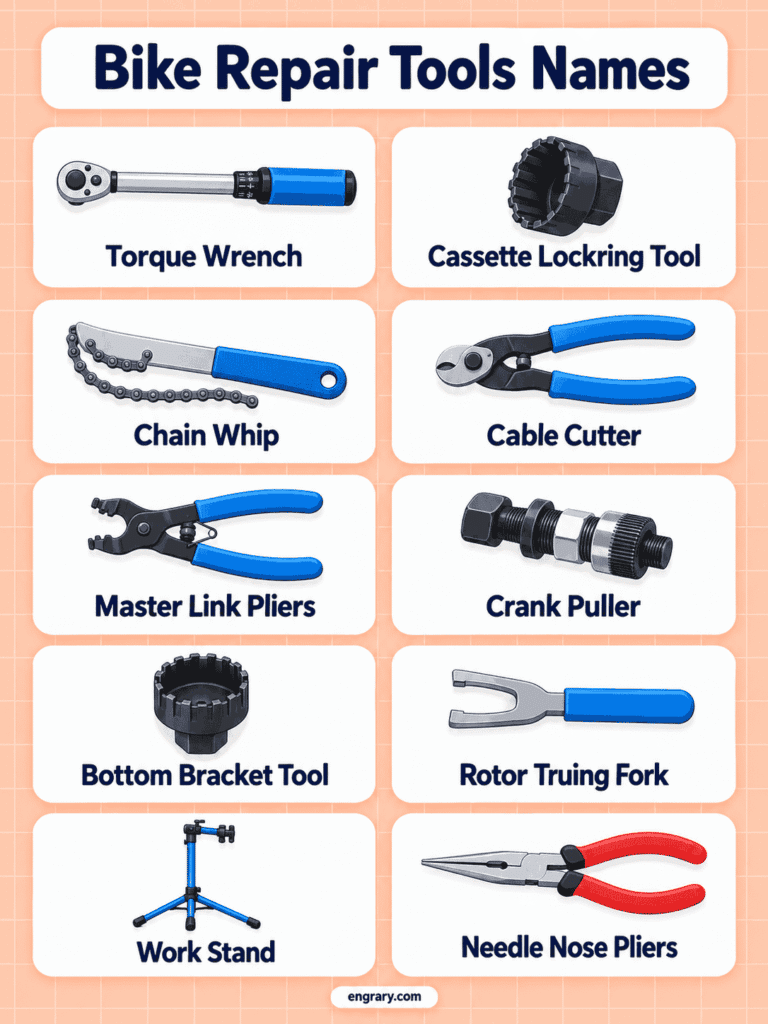
Brake and Cable Tools
Mechanical and hydraulic brake systems require different tools for cables, housings, rotors, pads, and hydraulic fluid service.
Cable Cutter
Shaped cutting edges slice inner brake and shift cables cleanly.
Housing Cutter
Strong jaws cut cable housing while limiting crushing around the cut.
Cable Puller
A gripping mechanism tensions inner cable while the fixing bolt is secured.
Hydraulic Brake Bleed Kit
Syringes, fittings, or bleed cups move fluid and air through compatible hydraulic brake systems.
Brake Pad Spreader
A flat wedge gently pushes hydraulic brake pistons apart before pad installation.
Rotor Truing Fork
Narrow slots provide controlled leverage for straightening slightly bent disc rotors.
Rotor Wear Gauge
Precision contact surfaces check disc-rotor thickness against service limits.
Cable Tension Gauge
Measured cable force helps set tension consistently in selected mechanical systems.
Disc Brake Gap Tool
A thin spacer helps establish even pad clearance around the rotor.
Cable Crimper
Small crimping jaws secure end caps onto cut brake or shift cables.
Wheel, Spoke, and Hub Tools
Wheel maintenance depends on precise adjustments because spoke tension, hub bearings, and rim alignment all affect how the wheel runs.
Spoke Wrench
A correctly sized slot turns spoke nipples during tension adjustment.
Truing Stand
Adjustable indicators reveal lateral and radial movement as the wheel rotates.
Dishing Gauge
Measurements from both sides show whether the rim sits centrally over the hub.
Spoke Tension Meter
Deflection readings estimate individual spoke tension for wheel building and diagnosis.
Bladed Spoke Holder
A narrow slot prevents aerodynamic spokes from twisting while their nipples are adjusted.
Cone Wrench
Extra-thin jaws fit traditional hub bearing cones and locknuts.
Axle Vise
Soft or shaped jaws hold hub axles securely during service.
Nipple Driver
A slender driver speeds initial spoke-nipple installation during wheel building.
Spoke Driver
The tool turns nipples quickly before final tensioning with a spoke wrench.
Hub Bearing Press
Sized drifts apply straight controlled force when installing compatible hub bearings.
Headset, Fork, and Suspension Tools
Front-end maintenance includes headset installation, steerer preparation, fork servicing, and air-suspension setup.
Headset Wrench
Thin open jaws fit traditional threaded headset locknuts and adjusting cups.
Crown Race Setter
A tubular driver presses a crown race evenly onto the fork crown.
Crown Race Puller
Controlled lifting force removes a race from the base of the fork steerer.
Headset Cup Press
Opposing press plates install headset cups squarely into the frame.
Star Nut Setter
A guided driver places a star nut to the correct depth inside a metal steerer.
Fork Seal Driver
A correctly sized driver seats suspension fork seals evenly.
Shock Pump
Fine pressure control adjusts air forks and rear shocks without losing much air during disconnection.
Suspension Socket
A precisely sized socket fits delicate suspension top caps and service fittings.
Seal Pick
A small hooked tip removes seals and O-rings from narrow suspension grooves.
Fork Cutting Guide
A clamping guide keeps the saw aligned while trimming a fork steerer.
Tools for Setup, Alignment, and Workshop Support
These supporting tools improve measurement, alignment, holding, cutting, and general repair accuracy around the bicycle.
Bicycle Repair Stand
A stable clamp raises and rotates the bike for easier access during maintenance.
Vernier Caliper
Precise jaws measure diameters, thicknesses, and component dimensions.
Steel Rule
A rigid straight scale provides quick measurements around the workshop.
Straightedge
A long flat reference helps check alignment and surface straightness.
Frame Alignment Gauge
Reference points help identify misalignment in compatible bicycle frames.
Dropout Alignment Gauge
Matched gauges compare and correct the alignment of frame or fork dropouts.
Pick Set
Fine hooks and points lift seals, clean grooves, and manipulate small components.
Small Hacksaw
A fine-tooth blade cuts suitable handlebars, steerers, bolts, and other workshop materials.
Bench Vise with Soft Jaws
Protective jaw inserts hold bicycle components without damaging finished surfaces.
Thread Chasing Tool
Matched cutting profiles clean or restore damaged threads in compatible bicycle parts.
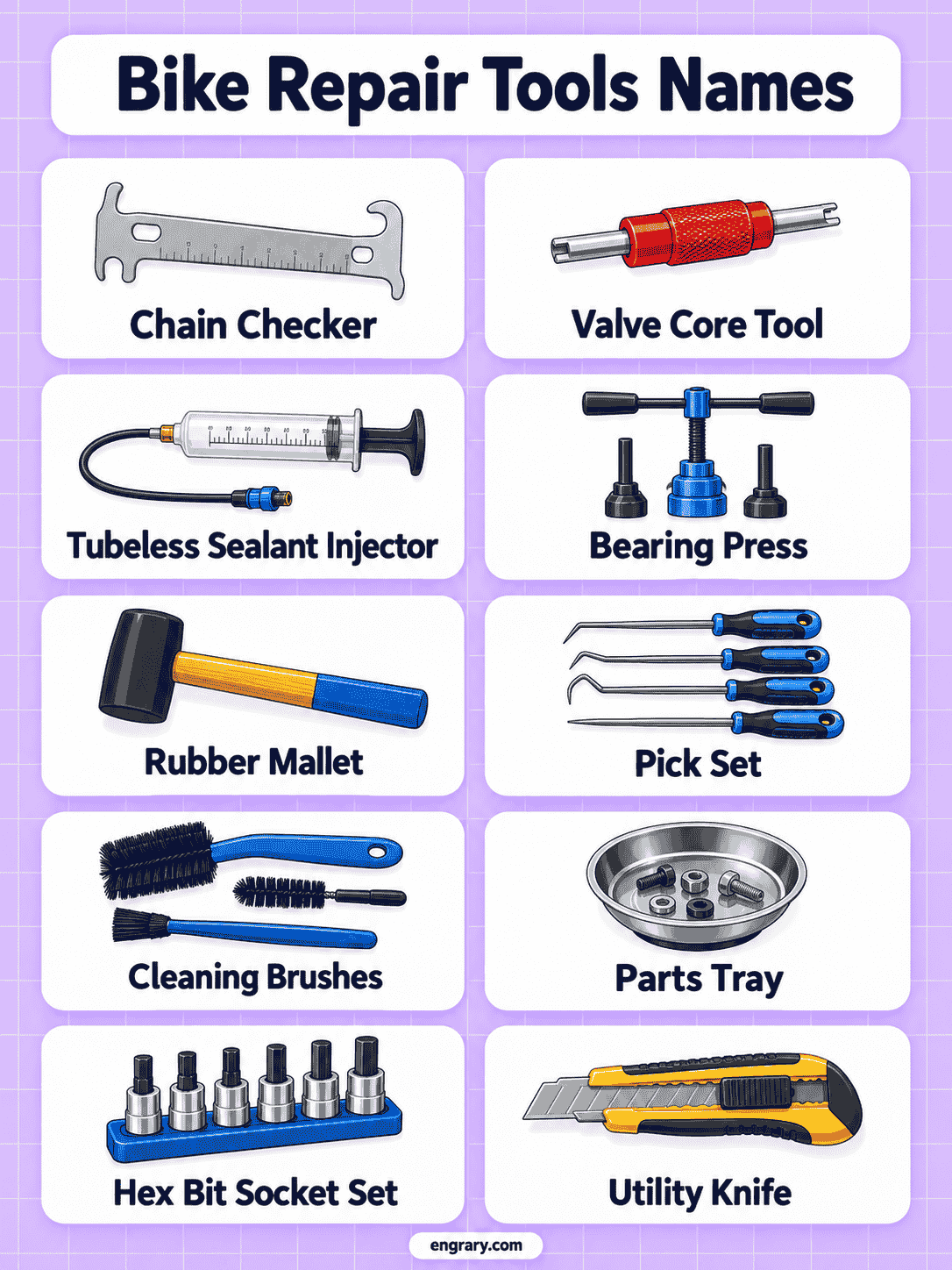
Tools for the Repairs Cyclists Do Most Often
Most cyclists encounter a relatively small group of recurring repairs, even though a full workshop contains many specialized tools.
| Common Bike Repair | Useful Tools |
|---|---|
| Flat Tire | Tire Lever, Mini Pump, Valve Core Tool |
| Tubeless Puncture | Plug Tool, CO₂ Inflator, Valve Core Tool |
| Chain Repair | Chain Tool, Master Link Pliers |
| Brake Adjustment | Hex Keys, Cable Cutter, Pad Spreader |
| Gear Adjustment | Hex Keys, Cable Puller, Hanger Alignment Gauge |
| Cassette Removal | Chain Whip, Cassette Lockring Tool |
| Crank Removal | Crank Puller, Hex Key |
| Wheel Truing | Spoke Wrench, Truing Stand |
| Suspension Setup | Shock Pump |
| Carbon Component Tightening | Torque Wrench |
The exact tools depend on the bicycle, but tire, chain, brake, and gear work account for many everyday maintenance jobs.
Roadside Tools vs Home Workshop Tools
Roadside repair tools prioritize small size and portability. Workshop equipment can be larger because it focuses more on leverage, accuracy, and specialized service.
| Roadside Repair Tools | Home Workshop Tools |
|---|---|
| Bike Multi-Tool | Full Hex-Key Set |
| Tire Levers | Bicycle Repair Stand |
| Mini Pump | Floor Pump |
| Compact Chain Tool | Chain Wear Gauge |
| Master Link Pliers | Truing Stand |
| CO₂ Inflator | Torque Wrench |
| Tubeless Plug Tool | Bottom Bracket Tool |
A roadside kit helps a rider get moving again, while a home workshop supports deeper maintenance and component replacement.
Tools for Drivetrain, Brakes, Wheels, and Suspension
Specialized bicycle systems require their own tool families.
| Bike System | Typical Tools |
|---|---|
| Drivetrain | Chain Tool, Chain Whip, Cassette Lockring Tool |
| Brakes | Bleed Kit, Rotor Truing Fork, Cable Cutter |
| Wheels | Spoke Wrench, Truing Stand, Tension Meter |
| Crankset | Crank Puller, Bottom Bracket Tool |
| Pedals | Pedal Wrench, Hex Key |
| Hubs | Cone Wrench, Hub Bearing Press |
| Suspension | Shock Pump, Fork Seal Driver |
| Headset | Headset Cup Press, Crown Race Setter |
This system-based view helps explain why some bike tools appear only during specific repairs.
Bike Tools That Are Easy to Confuse
Several bicycle tools work together or look similar, but each performs a different job.
| Tools | Main Difference |
|---|---|
| Chain Tool vs Master Link Pliers | A chain tool pushes chain pins, while master link pliers open or close compatible quick links. |
| Chain Whip vs Cassette Lockring Tool | A chain whip holds the cassette still, while the lockring tool turns the cassette lockring. |
| Floor Pump vs Shock Pump | A floor pump moves more air for tires, while a shock pump produces high pressure in small amounts for suspension. |
| Pedal Wrench vs Cone Wrench | A pedal wrench turns pedal flats, while a cone wrench fits thin hub-bearing cones and locknuts. |
| Truing Stand vs Dishing Gauge | A truing stand checks wheel straightness, while a dishing gauge checks whether the rim sits centrally over the hub. |
| Spoke Wrench vs Nipple Driver | A spoke wrench adjusts spoke tension, while a nipple driver speeds early spoke installation. |
| Crank Puller vs Bottom Bracket Tool | A crank puller removes crank arms, while a bottom bracket tool removes or installs the bottom bracket. |
| Tire Lever vs Bead Jack | A tire lever helps remove a tire bead, while a bead jack helps fit a stubborn bead onto the rim. |
Choosing the correct tool reduces unnecessary force and makes bicycle work more controlled.
Tools Worth Carrying on Every Ride
A compact repair kit can solve many of the problems that would otherwise end a ride early.
Useful tools include:
- Bike Multi-Tool
- Tire Levers
- Mini Pump
- CO₂ Inflator
- Compact Chain Tool
- Master Link Pliers
- Valve Core Tool
- Tubeless Plug Tool
Riders do not need to carry every item on every trip. The best kit depends on tire type, drivetrain, ride length, terrain, and access to help.
What Belongs in the Repair Kit Besides Tools
A complete bike repair kit also contains supplies and replacement parts that support the tools.
Spare Tube
A replacement tube provides a quick solution when a punctured tube cannot be repaired immediately.
Patch Kit
Patches and adhesive can seal many small inner-tube punctures.
Tubeless Tire Plugs
Repair plugs fill punctures that sealant alone cannot close.
Chain Quick Link
A compatible spare link can reconnect a broken or shortened chain.
Tubeless Sealant
Liquid sealant closes many small punctures inside a tubeless tire.
Chain Lubricant
Lubrication reduces friction and wear between chain components.
Cable End Caps
Small caps cover freshly cut cable ends and help prevent fraying.
Cleaning Cloth
A compact cloth removes dirt, grease, and excess lubricant during maintenance.
These items are useful for repair, but they are supplies or replacement parts rather than tools and therefore do not count toward the 80-tool list.
FAQs
Common bike repair tools include hex keys, tire levers, pumps, chain tools, master link pliers, spoke wrenches, pedal wrenches, torque wrenches, cassette tools, and bike multi-tools.
A practical roadside set can include a bike multi-tool, tire levers, mini pump, compact chain tool, master link pliers, valve core tool, and tubeless plug tool when the bike uses tubeless tires.
Chain tools push chain pins, while master link pliers handle compatible quick links. A chain hook can also keep loose chain ends together during repair.
Spoke wrenches, truing stands, dishing gauges, spoke tension meters, nipple drivers, and bladed spoke holders support wheel adjustment and building.
Mechanical brakes may require hex keys, cable cutters, housing cutters, cable pullers, and crimpers. Hydraulic systems commonly need a compatible bleed kit, pad spreader, and rotor tools.
You May Also Like



Leave a Comment