

Drills come in many forms because hole-making work can require different body shapes, chuck positions, drilling actions, mounting systems, and machine layouts. Some drills are handheld, while others use columns, magnetic bases, radial arms, multiple spindles, or fixed industrial frames.
This guide covers 35 types of drills with pictures and uses. Each description focuses on visible features such as the body, chuck, handle, column, drilling head, mounting system, or spindle arrangement, making the different drill types easier to recognize.
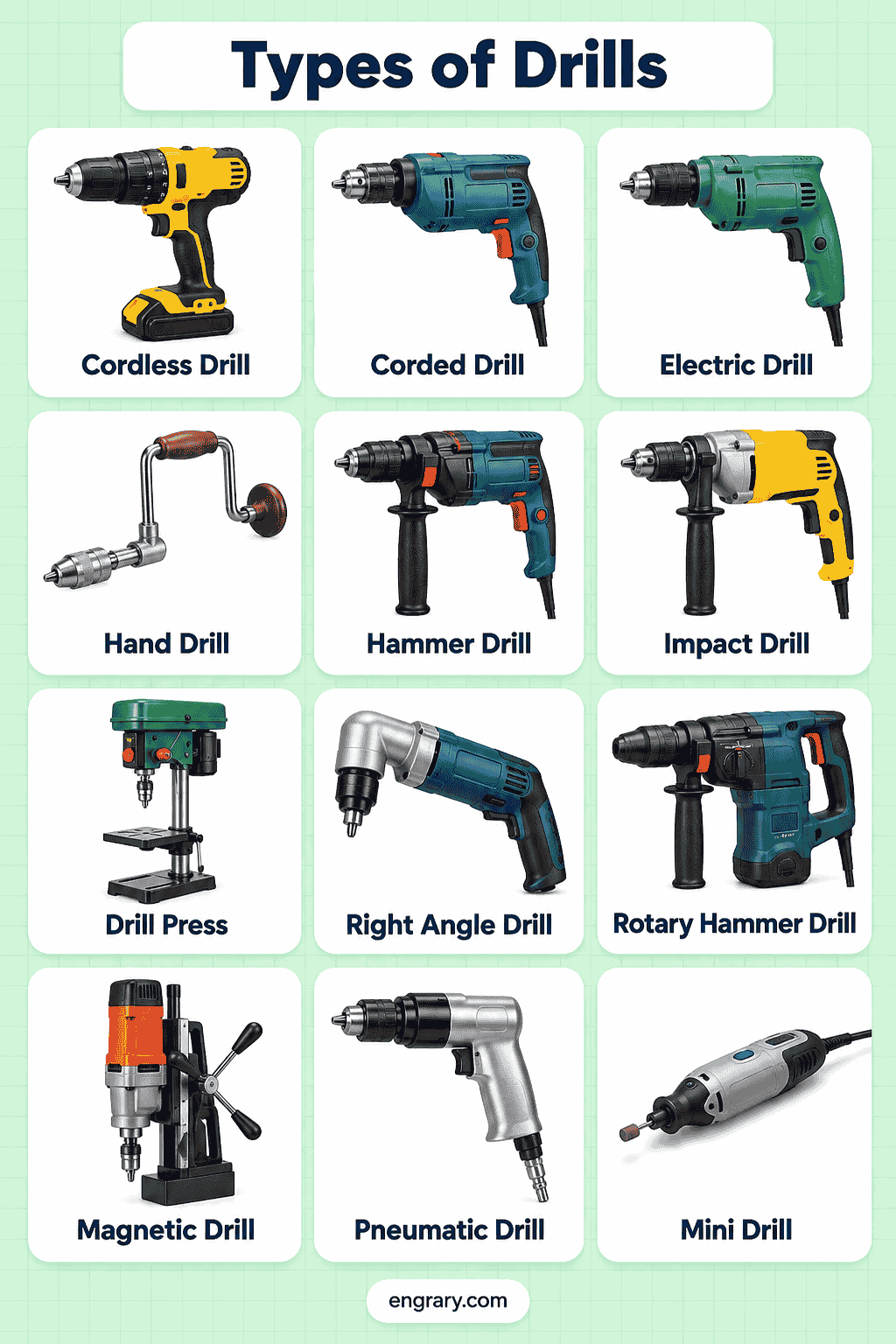
Drills You Can Identify by Their Body and Chuck
The shape of the body and position of the chuck provide the quickest clues when identifying a drill. Handheld models may use pistol, spade, or D-shaped handles, while stationary drills rely on columns, tables, and fixed drilling heads.
1. Drill/Driver
A drill/driver has a pistol-style body, rotating chuck, trigger, and adjustable clutch or control ring. It is the familiar general-purpose form that many other handheld drills resemble.
2. Corded Drill
A corded drill has a handheld motor body connected directly to an electrical power cord. Unlike a cordless model, it does not carry a removable battery pack beneath or inside the handle.
3. Cordless Drill
A cordless drill has a compact motor body with a rechargeable battery attached to the handle or base. The visible battery pack provides the easiest recognition clue.
4. Pistol-Grip Drill
A pistol-grip drill places the handle below and behind the motor body, producing the familiar pistol-like silhouette. Many modern electric drills use this basic body arrangement.
5. Spade-Handle Drill
A spade-handle drill has a large rear handle shaped like a wide loop or spade. Its elongated body and large rear grip distinguish it from a compact drill/driver.
6. D-Handle Drill
A D-handle drill has a rear grip shaped like the letter D. The enclosed handle gives the tool a different silhouette from open pistol-grip and spade-handle designs.
7. Hand Drill
A hand drill uses a crank, gears, and a small chuck instead of an electric motor. Its large exposed gear wheel makes it easy to recognize.
8. Brace
A brace has a U-shaped or crank-shaped frame with a chuck at one end and a rotating grip in the middle. Its sweeping curved body is completely different from a geared hand drill.
9. Breast Drill
A breast drill resembles a large geared hand drill but includes a broad plate at the top or rear of the body. That plate provides its most distinctive visual feature.
10. Push Drill
A push drill has a narrow cylindrical body similar to a large screwdriver. Its internal spiral mechanism converts a pushing movement into rotary motion.
11. Pin Vise
A pin vise is a very small hand-held drilling tool with a miniature chuck at one end. Its slim cylindrical body is designed around tiny drills and precision work.
12. Pneumatic Drill
A pneumatic drill uses compressed air rather than an electric motor. Many models have a compact metal body connected to an air hose fitting.
13. Drill Press
A drill press holds the drilling head above a table on a rigid column. The spindle moves vertically while the machine body remains stationary.
14. Benchtop Drill Press
A benchtop drill press has a short column, compact table, and small base designed for mounting on a workbench. Its reduced height distinguishes it from floor-standing models.
15. Floor Drill Press
A floor drill press has a tall vertical column mounted on a large floor base. The table sits partway up the column, creating a noticeably taller machine than a benchtop press.
16. Sensitive Drill Press
A sensitive drill press is a lighter drill-press form built around small, controlled drilling work. It typically has a compact drilling head and relatively small work table.
17. Upright Drill Press
An upright drill press is a robust vertical drilling machine with a heavy column, table, and geared drilling head. Its industrial construction is generally heavier than that of a light sensitive drill press.
18. Rock Drill
A rock drill is a heavy drilling machine with a robust cylindrical or elongated body associated with rock and hard mineral drilling. Its construction looks substantially heavier than a normal workshop drill.
19. Mill-Drill Machine
A mill-drill machine combines a vertical drilling spindle with an adjustable machine table associated with light milling and drilling work. The cross-moving table distinguishes it from a conventional drill press.
20. CNC Drilling Machine
A CNC drilling machine uses a computer-controlled drilling head and automated positioning system. Its enclosed or semi-enclosed machine frame and control panel provide strong recognition clues.
Drills with Angled and Offset Heads
Changing the position of the chuck can completely alter the shape of a drill. Angled-head designs place the drilling axis away from the normal forward-facing position of a standard drill.
21. Right-Angle Drill
A right-angle drill has a long body with a short head that positions the chuck roughly 90 degrees to the main housing. Its sideways-facing chuck is the clearest identification feature.
22. Stud and Joist Drill
A stud and joist drill uses a larger, heavier right-angle body with substantial gearing and handles. It resembles a heavy-duty version of the more compact right-angle drill.
Drills That Combine Rotation with Hammering
Some drills add a hammering action to ordinary rotary movement. Although Hammer Drills and Rotary Hammers may appear similar, their bodies and internal percussion systems differ significantly.
23. Hammer Drill
A hammer drill resembles a conventional electric drill but adds a forward hammering action while the chuck rotates. Many models have a larger front housing and auxiliary side handle.
24. Rotary Hammer
A rotary hammer has a larger, more robust body built around a stronger percussion mechanism. Its heavy front housing and specialized chuck arrangement distinguish it from a conventional hammer drill.
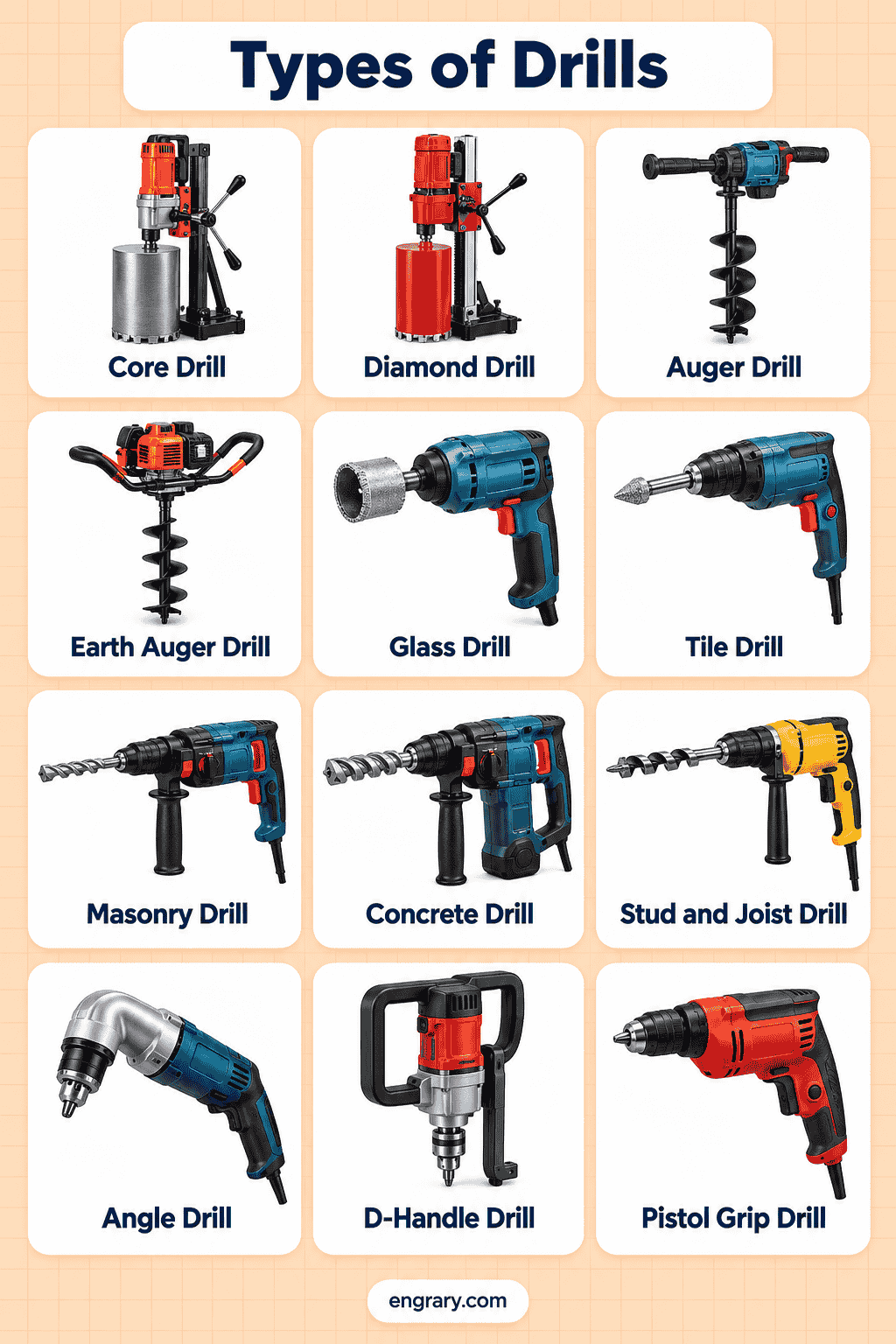
Core and Magnetic Drills
Some drilling machines use specialized mounting or cutting systems rather than the normal handheld drill arrangement. Core and magnetic drills are especially easy to recognize from their larger frames and bases.
25. Core Drill
A core drill has a large motor body designed around cylindrical core-cutting tools. Depending on the model, it may appear as a heavy handheld machine or part of a supported drilling system.
26. Stand-Mounted Core Drill
A stand-mounted core drill places the drilling motor on a rigid vertical frame. The motor travels along the stand rather than being supported entirely by hand.
27. Magnetic Drill
A magnetic drill has a vertical drilling head mounted above a heavy magnetic base. Its compact drill-press-like arrangement makes it easy to distinguish from both handheld drills and conventional floor drill presses.
Benchtop, Floor, and Upright Drill Presses
Drill presses differ in overall height, column construction, head size, and work-table arrangement. Benchtop, floor, sensitive, and upright types have already appeared in the opening section because they are among the most recognizable stationary drill forms.
The most useful distinction is visual: benchtop models are compact, floor models are tall and freestanding, while upright industrial presses generally use heavier columns and drilling heads.
Radial and Movable-Head Drilling Machines
Some drilling machines move the drilling head rather than keeping it fixed directly above one point on the table. Their arms, tracks, or rotating structures create very different silhouettes from ordinary drill presses.
28. Radial Drill Press
A radial drill press mounts the drilling head on a horizontal arm extending from a vertical column. The arm and movable head give the machine a broad sideways profile.
29. Turret Drilling Machine
A turret drilling machine has several tool positions arranged around a rotating turret or indexing head. The multi-position head is its main visual difference from a single-spindle drill press.
Gang and Multi-Spindle Drilling Machines
Production drilling can use several heads or several spindles rather than one drilling point. These machine layouts are much larger and more complex than ordinary workshop drill presses.
30. Gang Drill
A gang drill has several separate drilling heads arranged in a row along one table or work area. Each head appears as an individual drilling station.
31. Multi-Spindle Drill
A multi-spindle drill uses several drilling spindles operating from one machine arrangement. The cluster of spindles distinguishes it from a gang drill with separate stations.
Drills Built for Deep, Horizontal, and Production Work
Industrial drilling machines often change the spindle orientation, feed arrangement, or degree of automation to handle specialized production requirements.
32. Deep-Hole Drilling Machine
A deep-hole drilling machine has an elongated layout designed around long drilling axes. Its extended bed or support structure makes it easy to distinguish from a conventional vertical drill press.
33. Horizontal Drilling Machine
A horizontal drilling machine positions its spindle parallel to the floor instead of vertically above a work table. The sideways-facing spindle is its main recognition feature.
34. Automatic Drilling Machine
An automatic drilling machine uses powered feed, positioning, or cycle controls to perform repeated drilling operations with reduced manual movement. Its control system and production-style frame distinguish it from basic drill presses.
35. Gun Drilling Machine
A gun drilling machine is a specialized form of deep-hole drilling equipment with a long horizontal machine bed and supported drilling arrangement. Its stretched machine layout reflects its deep-hole drilling role.
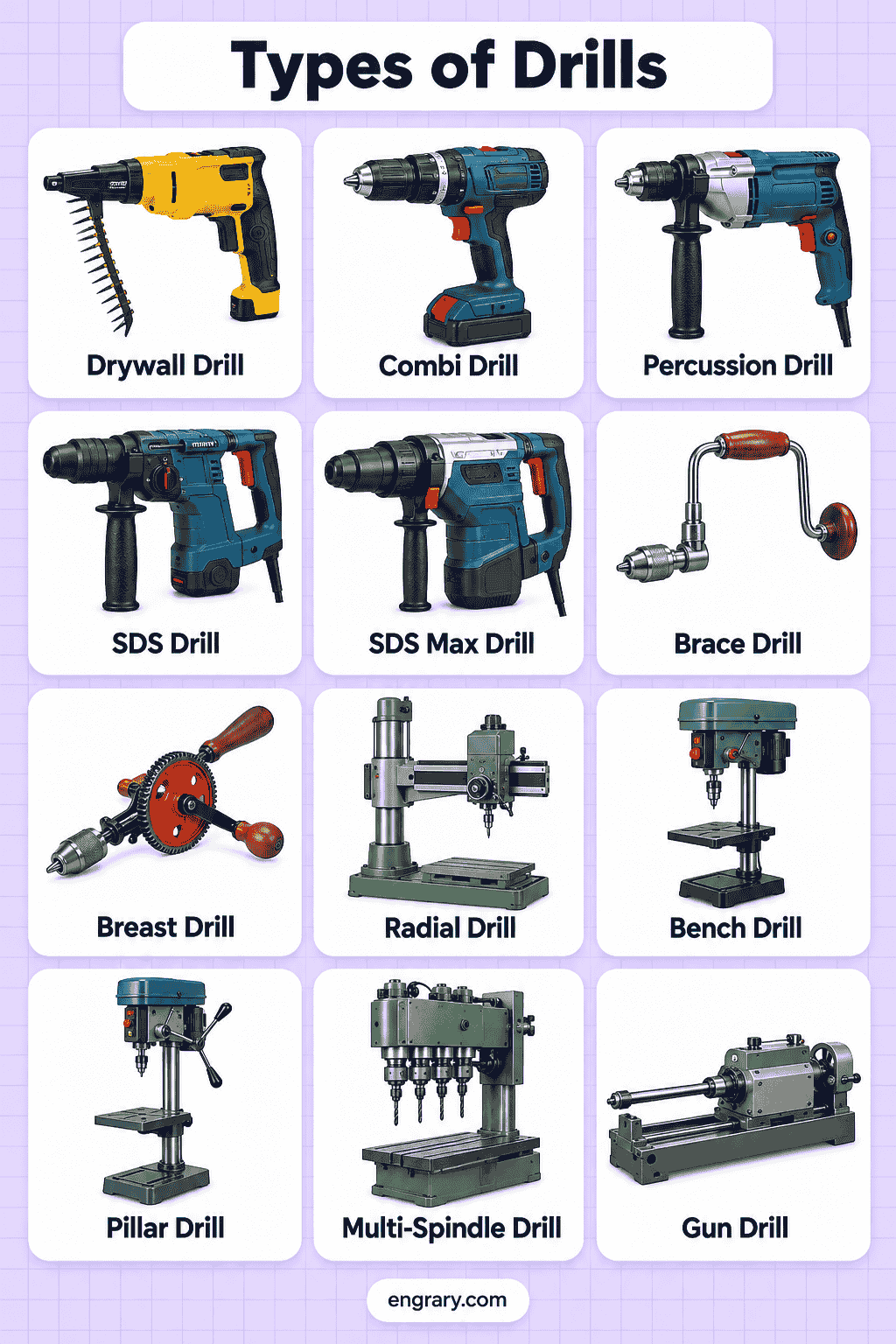
How to Tell Similar Drills Apart
Many drills look related because they use rotating chucks or vertical drilling heads. Looking at the body shape, percussion mechanism, support system, and spindle arrangement usually reveals the difference.
| Drills | Main Difference |
|---|---|
| Drill/Driver vs Hammer Drill | A drill/driver uses ordinary rotary drilling, while a hammer drill adds a forward hammering action. |
| Hammer Drill vs Rotary Hammer | A hammer drill resembles a conventional drill, while a rotary hammer has a larger body and stronger percussion mechanism. |
| Drill/Driver vs Impact Driver | A drill/driver uses a chuck and steady rotary action, while an impact driver uses a hex collet and rotational impact mechanism. |
| Standard Drill vs Right-Angle Drill | A standard drill points the chuck forward, while a right-angle drill turns the drilling axis roughly 90 degrees. |
| Right-Angle vs Stud and Joist Drill | Both use angled heads, but stud and joist drills generally have larger bodies and heavier gearing. |
| Core Drill vs Rotary Hammer | A core drill is built around cylindrical core cutting, while a rotary hammer uses a percussion drilling mechanism. |
| Magnetic Drill vs Drill Press | A magnetic drill uses a portable magnetic base, while a conventional drill press uses a permanent column and base. |
| Benchtop vs Floor Drill Press | A benchtop press is short and bench-mounted, while a floor model is tall and freestanding. |
| Drill Press vs Radial Drill Press | A standard drill press keeps its head aligned with the column, while a radial drill moves the head along an extended arm. |
| Sensitive vs Upright Drill Press | Sensitive drills are lighter and more precision-focused, while upright presses generally use heavier industrial construction. |
| Gang Drill vs Multi-Spindle Drill | Gang drills use several separate drilling stations, while multi-spindle machines use multiple spindles in one coordinated arrangement. |
| Hand Drill vs Brace | A hand drill uses exposed gears and a crank, while a brace uses a large crank-shaped frame. |
| Corded vs Cordless Drill | A corded drill receives power through a cable, while a cordless drill carries a battery pack. |
| Drill vs Drill Bit | A drill is the complete tool or machine, while a drill bit is the removable cutting component. |
| Drill vs Driver | A drill is primarily identified by its drilling chuck and rotary hole-making role, while a driver is primarily designed around turning fasteners. |
Other Names Used for the Same Drills
Drill terminology varies between manufacturers, trades, and regions. These alternate names should not increase the numbered count when they refer to the same basic drill type.
| Main Name | Other Common Names |
|---|---|
| Drill/Driver | Drill Driver |
| Hammer Drill | Hammer Drill Driver in overlapping usage |
| Rotary Hammer | Rotary Hammer Drill |
| Rotary Hammer | Combi Hammer / Combination Hammer in some contexts |
| Magnetic Drill | Mag Drill / Magnetic Drill Press |
| Benchtop Drill Press | Bench Drill |
| Floor Drill Press | Pillar Drill in some regional usage |
| Pneumatic Drill | Air Drill |
| Hand Drill | Eggbeater Drill |
| Right-Angle Drill | Angle Drill |
Because names can overlap, the body shape, chuck position, percussion system, base, column, and spindle arrangement usually provide more reliable identification clues than the name alone.
Questions People Ask About Drills
Major drill types include Drill/Drivers, Corded and Cordless Drills, Hammer Drills, Rotary Hammers, Right-Angle Drills, Core Drills, Magnetic Drills, Drill Presses, Radial Drills, Gang Drills, and Multi-Spindle Drilling Machines.
A drill/driver uses ordinary rotary movement for drilling and driving. A hammer drill adds a rapid forward hammering action while the chuck rotates.
Both combine rotation with percussion, but a rotary hammer uses a heavier hammering mechanism and generally has a larger, more robust body than a hammer drill.
A magnetic drill has a compact vertical head mounted on a magnetic base, so the machine can attach to suitable metal surfaces. A standard drill press uses a fixed column, table, and permanent base.
Look at the chuck direction, handle shape, front housing, battery or air connection, magnetic base, support column, radial arm, and number of drilling spindles. These visible features usually reveal the drill family quickly.
You May Also Like


Leave a Comment