
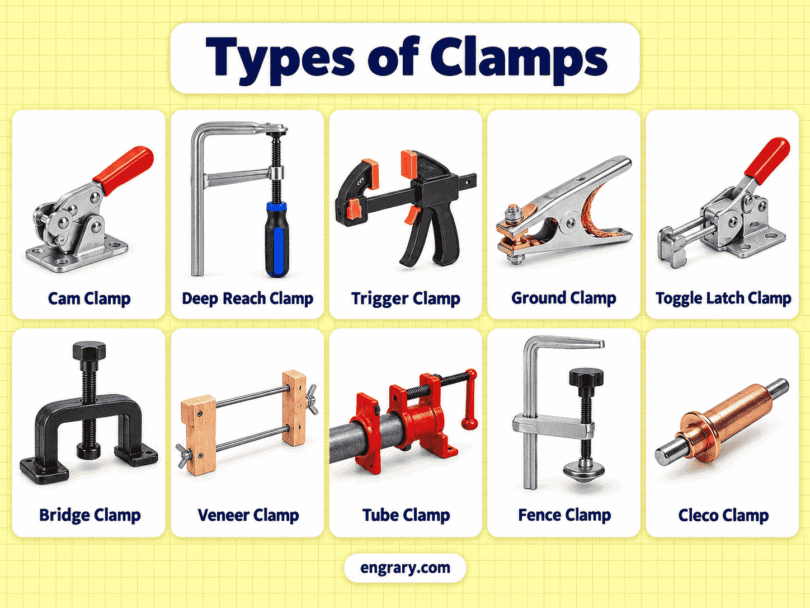
Clamps hold workpieces firmly by applying pressure through jaws, bars, screws, springs, straps, or mounted mechanisms. Although many clamps perform the same basic job, their frames and pressure systems can look completely different.
In this guide, you’ll learn 40 types of clamps with pictures and uses, from familiar C-Clamps and Bar Clamps to Toggle, Bench-Mounted, Wraparound, and Metalworking Clamps. The descriptions also highlight simple visual clues that make each type easier to recognize.
Clamps Identified by Their Jaws and Pressure
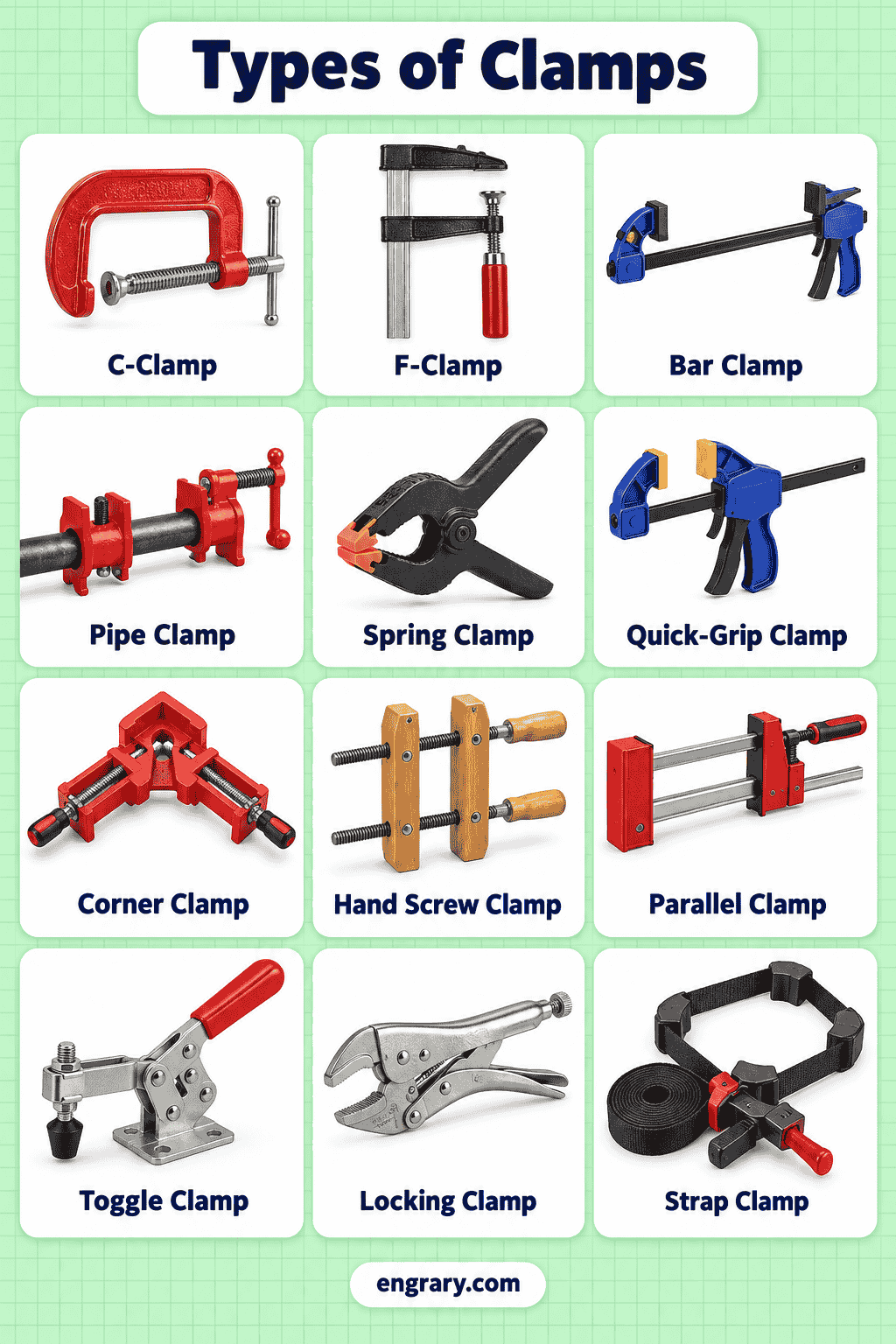
The easiest way to recognize a clamp is to look at its frame, jaws, and the way it creates pressure. Some use threaded screws, while others rely on springs, triggers, sliding jaws, levers, straps, or bench-mounted mechanisms.
1. C-Clamp
A C-Clamp has a rigid C-shaped metal frame with a threaded screw passing through one end. Turning the screw moves a pressure pad toward the opposite side of the frame.
2. F-Clamp
An F-Clamp has one fixed jaw and one sliding jaw attached to a long straight bar. Its overall shape resembles the letter F, which gives the clamp its name.
3. Bar Clamp
A Bar Clamp uses a long rigid bar to support widely spaced jaws. One jaw remains fixed while the other slides along the bar to accommodate different workpiece widths.
4. Parallel Clamp
A Parallel Clamp has large, deep jaws designed to remain parallel as pressure increases. Its broad jaw faces and heavy rectangular bar make it easy to distinguish from a standard F-Clamp.
5. Pipe Clamp
A Pipe Clamp uses a length of round pipe as its main supporting body. Separate clamp heads attach to the pipe, giving the tool a distinctive long cylindrical frame.
6. Spring Clamp
A Spring Clamp has two pivoting handles, a central spring, and opposing jaws. Its clothespin-like appearance makes it one of the easiest clamp types to recognize.
7. Trigger Clamp
A Trigger Clamp has a long bar and a movable jaw controlled by a squeeze trigger. Repeated trigger movement advances the jaw toward the workpiece.
8. Ratcheting Hand Clamp
A Ratcheting Hand Clamp resembles a Spring Clamp but uses a ratcheting handle mechanism to lock the jaws at different openings. The locking handle distinguishes it from a simple spring-operated design.
9. Handscrew Clamp
A Handscrew Clamp has two broad wooden jaws connected by two threaded screws. Adjusting the screws can change both the opening and angle between the jaws.
10. Corner Clamp
A Corner Clamp holds two pieces at an angle, most commonly around a right-angle joint. Its two-direction jaw arrangement clearly differs from a standard straight-line clamp.
11. Band Clamp
A Band Clamp uses a flexible strap or band wrapped around the outside of an assembly. Instead of pressing between two jaws, it applies inward pressure around the perimeter.
12. Edge Clamp
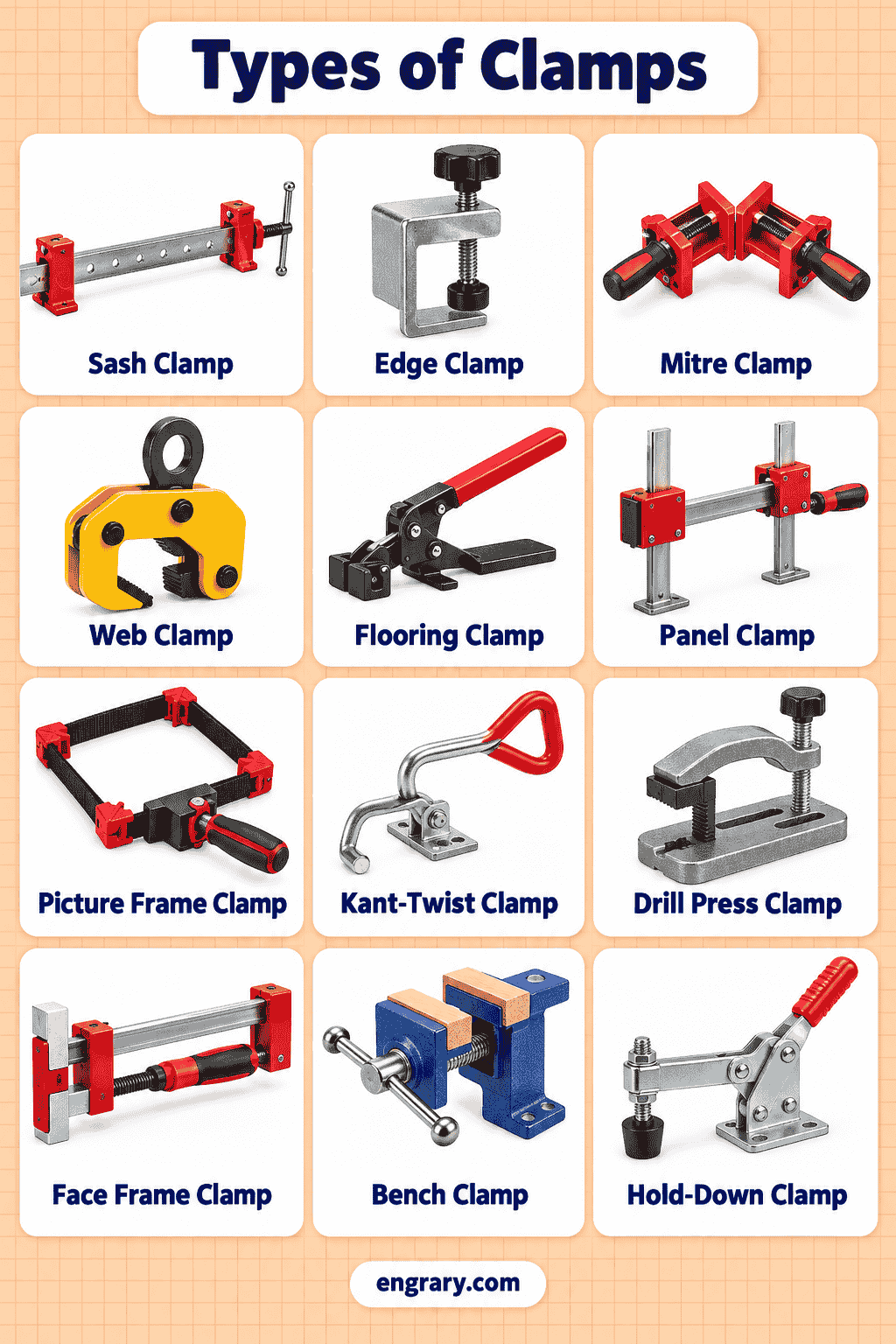
An Edge Clamp applies pressure directly toward the edge of a workpiece. Many versions use multiple screws or contact pads so the pressure acts from more than one direction.
13. Face Clamp
A Face Clamp has broad contact pads positioned to press two faces together. Its jaw arrangement is often wider and flatter than that of a conventional C-Clamp.
14. Toggle Clamp
A Toggle Clamp uses a hinged linkage that locks over center when the handle moves into position. It often has a base plate, lever, clamping arm, and adjustable pressure pad.
15. Bench Clamp
A Bench Clamp attaches to a workbench or fixture rather than acting as a completely free-standing clamp. Its mounting base is usually the easiest feature to identify.
16. T-Track Clamp
A T-Track Clamp mounts into a grooved track using a T-bolt or similar fitting. A vertical clamping arm presses the workpiece against the bench or fixture surface.
17. Dog Clamp
A Dog Clamp fits into a bench dog hole and applies pressure against a workpiece from that mounting point. Its post-like base distinguishes it from track-mounted clamps.
18. Cam Clamp
A Cam Clamp uses a rotating cam or eccentric lever to create clamping pressure. It usually requires less screw adjustment than a traditional threaded clamp.
19. Lever Clamp
A Lever Clamp has a long bar with a lever-operated movable jaw. The large external lever is its main visual difference from screw-operated F-Clamps.
20. Frame Clamp
A Frame Clamp holds several sides or corners of a frame assembly at the same time. Depending on the design, it may use rigid corner blocks, rods, or a dedicated multi-corner frame.
Screw-Operated Clamps
Screw-operated clamps create pressure gradually as a threaded spindle advances a jaw or pressure pad. Beyond the familiar C-Clamp and F-Clamp, several specialized designs change the throat depth, frame shape, or precision of the screw mechanism.
21. Deep-Reach Clamp
A Deep-Reach Clamp has an extended throat that positions its screw and pressure pad much farther from the edge of a workpiece. Its unusually long frame is the main recognition clue.
22. Sash Clamp
A Sash Clamp has a very long metal bar with one fixed head and one adjustable head. Its extended frame is associated with holding wide assemblies such as doors, frames, and panels.
Quick-Action Clamps
Some clamps sacrifice a traditional threaded spindle for faster jaw movement. Springs and compact gripping mechanisms make these clamps easy to position for light holding work.
23. Pinch Clamp
A Pinch Clamp uses spring tension and two small contact points that pinch the workpiece together. It is usually compact and much smaller than a conventional Spring Clamp.
24. Miter Spring Clamp
A Miter Spring Clamp uses strong spring tension to pull the two sides of a mitered joint together. Its small spring body and pointed contact ends create a distinctive appearance.
Toggle Clamps
Toggle clamps use hinged linkages rather than long bars or threaded frames. Their handle position and clamping-arm direction create several recognizable forms.
25. Horizontal Toggle Clamp
A Horizontal Toggle Clamp has a handle that lies relatively low or horizontal when the clamp is locked. Its clamping arm extends forward from a bench- or fixture-mounted base.
26. Vertical Toggle Clamp
A Vertical Toggle Clamp has a handle that stands upright when the mechanism is open or locked, depending on the design. Its tall lever gives it a noticeably different profile from a horizontal version.
27. Push-Pull Toggle Clamp
A Push-Pull Toggle Clamp moves a straight plunger forward and backward rather than swinging a clamping arm downward. The horizontal plunger is its main identifying feature.
28. Latch Toggle Clamp
A Latch Toggle Clamp has a hook or catch that pulls two parts toward each other when its lever closes. Its hook-and-latch arrangement differs from ordinary hold-down toggle clamps.
Clamps for Angles and Frames
Some clamps are shaped around joints rather than straight opposing faces. They help hold corners, miters, panels, and multi-sided assemblies by directing pressure toward specific angles.
29. Miter Clamp
A Miter Clamp is shaped to hold two angled pieces together at a miter joint. Its jaws or contact points meet the workpiece from opposing diagonal directions.
30. 4-Way Pressure Clamp
A 4-Way Pressure Clamp applies force from several directions across a larger assembly. Its multi-bar or multi-jaw arrangement distinguishes it from simple two-jaw clamps.
Wraparound Clamps
Wraparound clamps surround round or irregular objects instead of pressing between two rigid jaws. Their flexible bands, chains, or circular bodies allow pressure to follow the outside shape of the workpiece.
31. Hose Clamp
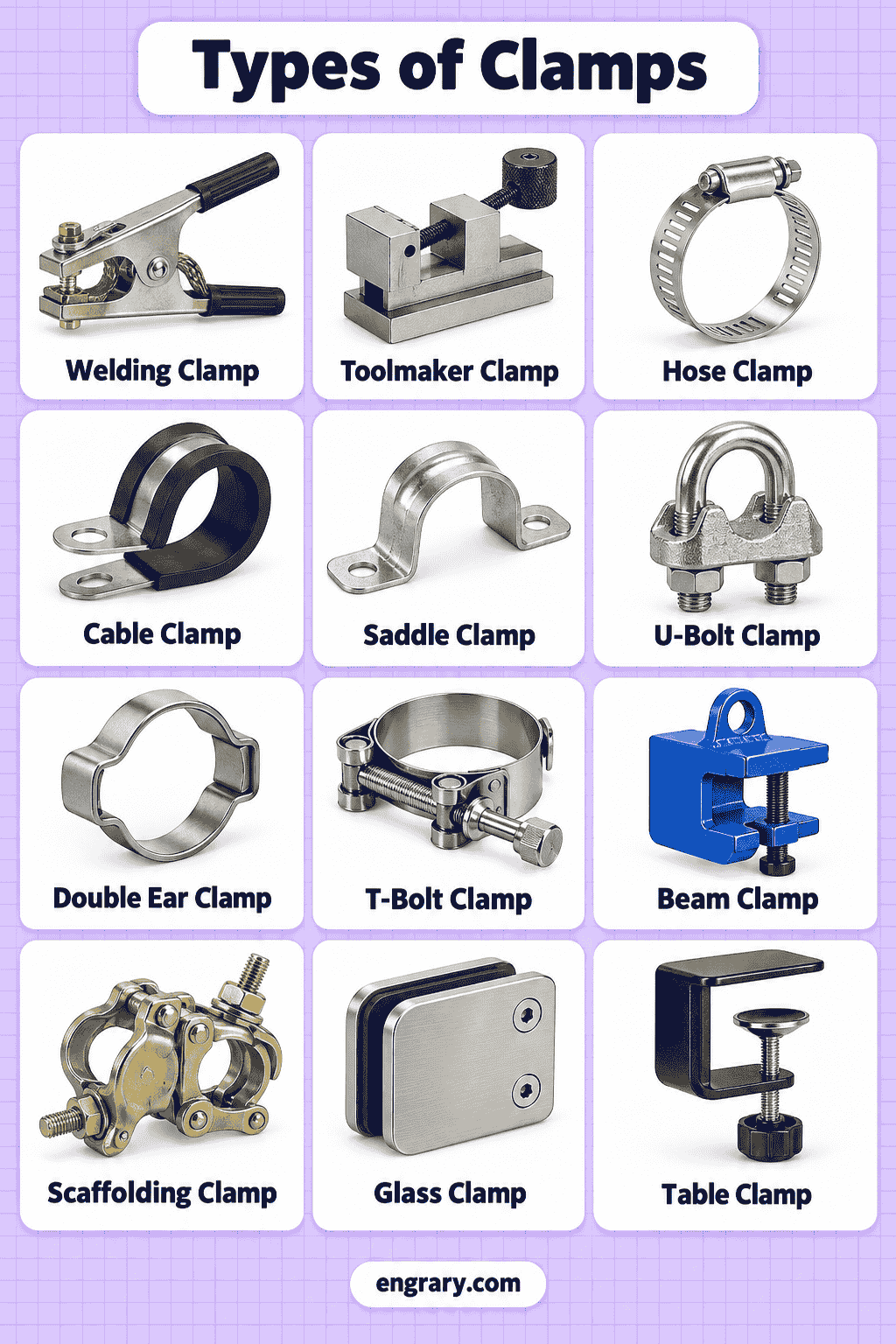
A Hose Clamp forms a circular metal band around a hose, tube, or similar round object. A small screw or tightening mechanism reduces the diameter of the band.
32. Chain Clamp
A Chain Clamp uses a linked metal chain that wraps around a round or irregular object. The flexible chain allows the clamp to follow shapes that rigid jaws cannot easily surround.
Bench-Mounted Clamps
Mounted clamps use the bench, machine table, or fixture as part of the holding system. Instead of squeezing between two free jaws, many of these designs apply downward pressure against a fixed surface.
33. Drill-Press Clamp
A Drill-Press Clamp attaches to or works with the slotted table of a drill press. Its low-profile arm and table-mounting hardware distinguish it from ordinary handheld clamps.
34. Hold-Down Clamp
A Hold-Down Clamp presses a workpiece downward against a bench, table, or fixture. The pressure direction is vertical rather than between two opposing jaws.
35. Fixture Clamp
A Fixture Clamp mounts permanently or temporarily to a jig or production fixture. Its compact body is designed around repeatable workholding rather than general free-standing use.
Clamps for Metalworking and Special Jobs
Some clamp designs use unusual frames, locking mechanisms, or jaw shapes for metalworking and other specialized holding tasks. Their construction often looks very different from common woodworking clamps.
36. Kant-Twist Clamp
A Kant-Twist Clamp has an open metal frame with offset jaws and a threaded screw. Its unusual angled frame helps distinguish it immediately from C- and F-style clamps.
37. Welding Clamp
A Welding Clamp is a metalworking clamp shaped to hold metal pieces in alignment. Depending on the design, it may use screw jaws, angled contacts, or locking mechanisms.
38. Locking C-Clamp
A Locking C-Clamp combines large C-shaped jaws with a locking-handle mechanism. Instead of using a long threaded screw like a standard C-Clamp, its handles lock the jaws into position.
39. Sheet-Metal Clamp
A Sheet-Metal Clamp has broad or specially shaped jaws designed around thin sheet material. Its wide contact surfaces help distinguish it from narrow-jaw general-purpose clamps.
40. Toolmaker’s Clamp
A Toolmaker’s Clamp is a compact metal clamp with two parallel jaws connected by threaded screws. Its small, precise construction gives it a very different appearance from large workshop clamps.
How to Tell Similar Clamps Apart
Several clamp types share bars, jaws, or screw mechanisms, so they can look similar at first. The fastest way to separate them is to compare the frame, jaw movement, pressure source, and mounting system.
| Clamp Types | Main Difference |
|---|---|
| C-Clamp vs F-Clamp | A C-Clamp has a rigid curved frame, while an F-Clamp has a sliding jaw on a straight bar. |
| F-Clamp vs Bar Clamp | An F-Clamp is a common screw-operated bar design, while Bar Clamp can describe a broader family of long-bar clamps. |
| Bar Clamp vs Parallel Clamp | A Parallel Clamp has larger jaws designed to stay parallel, while standard Bar Clamps may use narrower jaw faces. |
| Bar Clamp vs Pipe Clamp | A Bar Clamp uses a flat or rectangular bar, while a Pipe Clamp uses a round pipe as its main body. |
| Trigger Clamp vs Spring Clamp | A Trigger Clamp advances its jaw by squeezing a trigger, while a Spring Clamp relies on constant spring pressure. |
| Trigger Clamp vs F-Clamp | A Trigger Clamp uses a squeeze mechanism, while an F-Clamp usually uses a threaded screw. |
| Spring Clamp vs Ratcheting Hand Clamp | A Spring Clamp closes through spring force, while a Ratcheting Hand Clamp locks through incremental ratchet positions. |
| Handscrew Clamp vs C-Clamp | A Handscrew Clamp has two jaws and two screws, while a C-Clamp has a rigid frame and one main spindle. |
| Corner Clamp vs Band Clamp | A Corner Clamp holds a specific angled joint, while a Band Clamp wraps around an entire assembly. |
| Corner Clamp vs Frame Clamp | A Corner Clamp usually controls one corner, while a Frame Clamp can hold several sides or corners together. |
| Edge Clamp vs Face Clamp | An Edge Clamp directs pressure toward an edge, while a Face Clamp presses surfaces together face-to-face. |
| Cam Clamp vs Screw Clamp | A Cam Clamp uses a rotating cam mechanism, while a screw clamp builds pressure through threaded movement. |
| Toggle Clamp vs Bench Clamp | A Toggle Clamp describes a linkage mechanism, while Bench Clamp describes a clamp mounted to a workbench. |
| T-Track Clamp vs Dog Clamp | A T-Track Clamp mounts in a track, while a Dog Clamp anchors through a bench dog hole. |
| Lever Clamp vs Trigger Clamp | A Lever Clamp locks through a large lever, while a Trigger Clamp advances by repeated squeezing. |
| Locking C-Clamp vs C-Clamp | A Locking C-Clamp uses locking handles, while a conventional C-Clamp tightens through a threaded spindle. |
Other Names Used for the Same Clamps
Clamp terminology varies between regions, workshops, and manufacturers. Some names describe exactly the same clamp, while others overlap strongly enough that they should not be counted separately.
| Main Name | Other Name or Overlapping Term |
|---|---|
| C-Clamp | G-Clamp |
| F-Clamp | F-Style Clamp |
| Trigger Clamp | Quick-Action Clamp |
| Trigger Clamp | One-Hand Clamp / Quick-Grip Clamp in overlapping usage |
| Corner Clamp | Angle Clamp |
| Band Clamp | Strap Clamp |
| Handscrew Clamp | Hand Screw Clamp |
| Magnetic/fixture-style hold-down | Bench Hold-Down in some contexts |
| Pipe Clamp | Pipe Bar Clamp in some product terminology |
| Lever Clamp | Lever-Action Clamp |
When names overlap, the frame shape, jaw movement, pressure mechanism, and mounting method provide more reliable identification clues than the label alone.
Questions People Ask About Clamps
Common types include C-Clamps, F-Clamps, Bar Clamps, Parallel Clamps, Pipe Clamps, Spring Clamps, Trigger Clamps, Handscrew Clamps, Corner Clamps, Band Clamps, Toggle Clamps, and Bench-Mounted Clamps.
A C-Clamp has a fixed curved frame with a threaded spindle. An F-Clamp uses a long straight bar with one fixed jaw and one adjustable sliding jaw.
Both use long bars, but a Parallel Clamp has larger jaw faces designed to remain parallel as they close. A conventional Bar Clamp usually has a simpler and narrower jaw arrangement.
A Trigger Clamp moves its jaw along a bar through repeated squeezing. A Spring Clamp closes automatically because its central spring keeps the jaws under pressure.
Start with the frame and jaws, then look at how the clamp creates pressure. Screws, springs, triggers, cams, toggle linkages, bands, tracks, and bench mounts all provide strong identification clues.
You May Also Like



Leave a Comment