
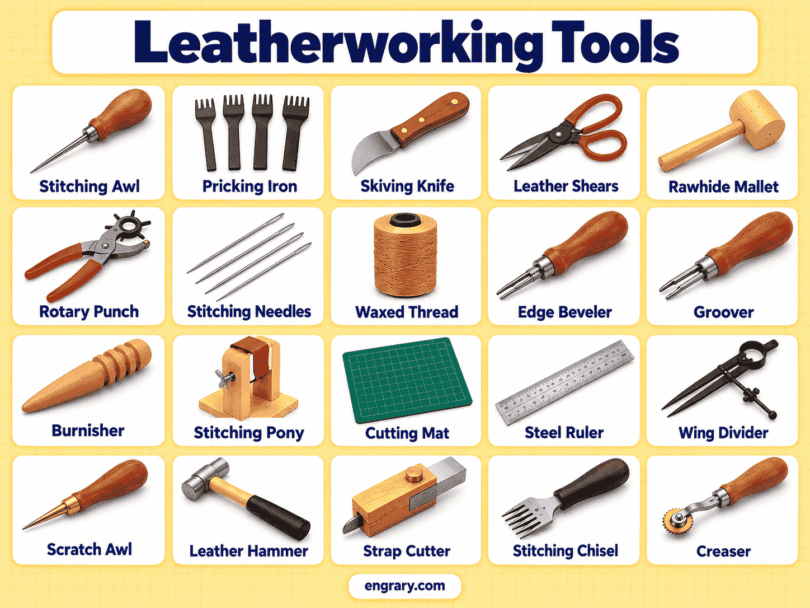
Leatherworkers use specialized tools to measure, cut, punch, stitch, shape, decorate, and finish leather. Since many leathercraft tools have similar handles or working ends, learning their names along with their visible features makes them much easier to identify.
This guide covers 60 leatherworking tools names with pictures and uses, from common awls and punches to edge tools, skiving tools, stamping equipment, and workshop machines. Each description focuses on what the tool looks like and the main leatherworking task it performs.
Common Leatherworking Tools and Their Uses
A typical leathercraft bench contains cutting, marking, stitching, punching, edge-finishing, and striking tools. The following 20 tools are among the most recognizable and useful across different types of leatherwork.
1. Scratch Awl
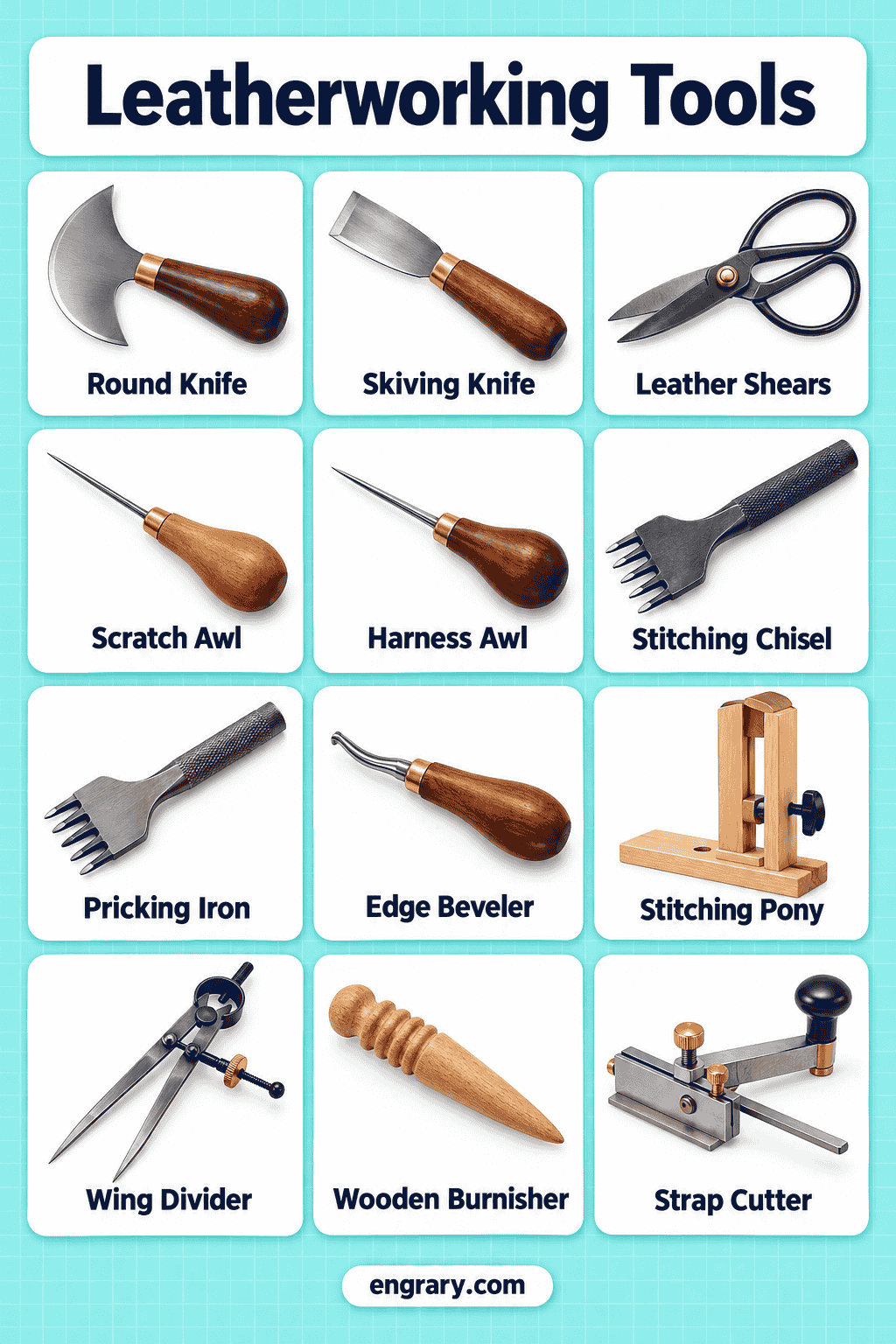
A scratch awl has a pointed metal shaft fixed into a handle. Leatherworkers use the sharp point to mark reference lines, locate holes, and transfer layout marks onto leather.
2. Stitching Awl
A stitching awl has a narrow pointed blade designed for leather sewing work. It helps prepare or refine individual stitching holes, especially during traditional hand stitching.
3. Wing Divider
A wing divider has two pointed legs connected by an adjustable joint. Leatherworkers use it to transfer measurements and mark consistent lines parallel to an edge.
4. Steel Ruler
A steel ruler provides a rigid measuring edge that resists damage better than a soft plastic ruler. It helps measure leather pieces and mark straight layout lines.
5. Utility Knife
A utility knife has a straight handle with a replaceable cutting blade. Leatherworkers commonly use it for general trimming and straight cuts in suitable leather.
6. Rotary Cutter
A rotary cutter has a circular blade mounted at the end of a handheld body. Its wheel-like blade makes it easy to distinguish from straight-bladed leather knives.
7. Round Knife
A round knife has a broad curved blade with a handle centered behind it. Leatherworkers recognize it as a traditional tool for cutting and shaping heavier leather.
8. Leather Shears
Leather shears resemble heavy-duty scissors with sturdy blades. They handle trimming and cutting jobs that suit a scissor-style action.
9. Stitching Chisel
A stitching chisel has several evenly spaced teeth arranged along its working end. Leatherworkers use it to create regularly spaced openings for hand stitching.
10. Pricking Iron
A pricking iron also has a row of evenly spaced teeth, but traditional versions primarily mark stitch position and angle. Modern designs sometimes overlap with stitching chisels in both name and use.
11. Edge Beveler
An edge beveler has a small notched cutting end. It removes the sharp corner from a leather edge, giving the edge a softer and more rounded profile.
12. Edge Creaser
An edge creaser has a narrow working tip that forms a decorative or guiding line close to the edge. Unlike an edge beveler, it does not primarily remove the edge corner.
13. Edge Burnisher
An edge burnisher has smooth grooves or rounded surfaces that contact the leather edge. Leatherworkers use it to smooth and polish prepared edges.
14. Strap Cutter
A strap cutter has an adjustable guide and cutting blade mounted in a compact frame. It helps produce leather strips of a consistent width.
15. Revolving Punch
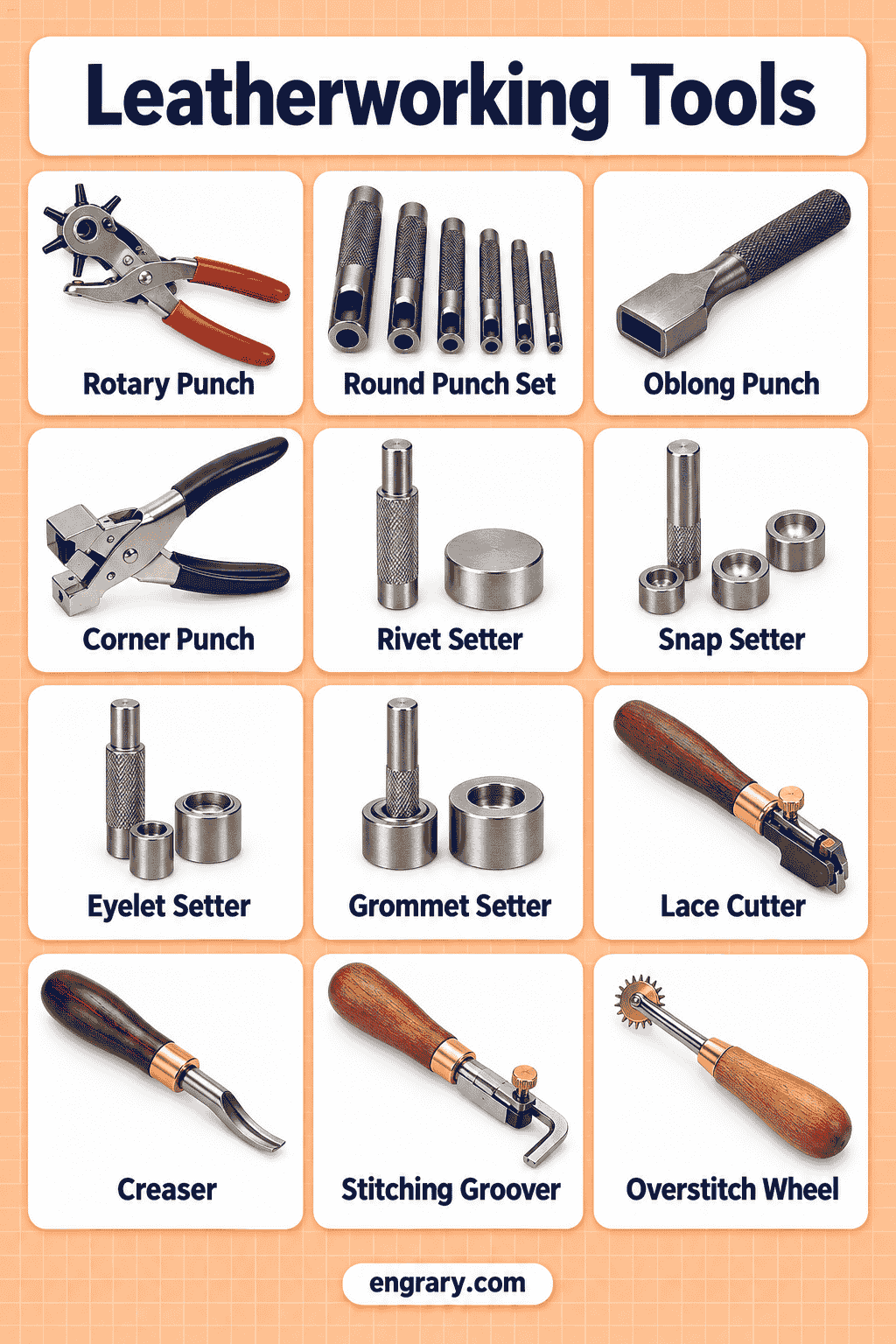
A revolving punch looks like heavy pliers with a rotating wheel that carries several punch sizes. Rotating the wheel lets the user select a different hole diameter.
16. Drive Punch
A drive punch is an individual hollow punch with a circular cutting end. Unlike a revolving punch, it comes as a separate tool rather than several sizes on one rotating head.
17. Rawhide Mallet
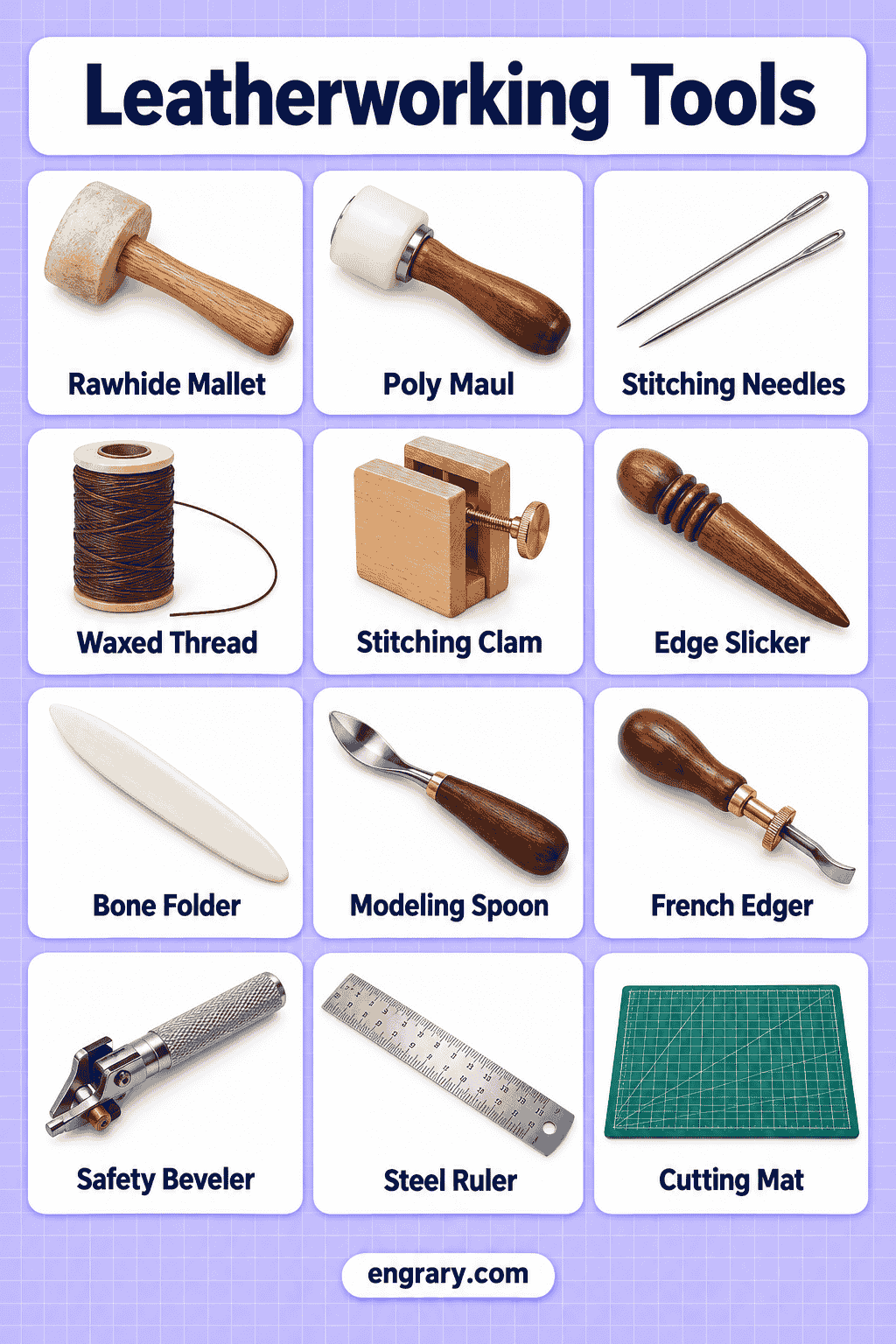
A rawhide mallet has a cylindrical head made from compressed rawhide. Its non-metal striking surface suits many leathercraft jobs where a steel hammer would be inappropriate.
18. Poly Mallet
A poly mallet has a durable synthetic striking head. Leatherworkers commonly pair it with punches and other leathercraft tools that need controlled striking.
19. Stitching Pony
A stitching pony is a compact clamp that holds leather pieces upright. By securing the work, it leaves both hands available for hand stitching.
20. Swivel Knife
A swivel knife has a small cutting blade below a rotating finger-controlled yoke. It is strongly associated with decorative leather carving and tooling.
Measuring and Marking Tools for Leatherwork
Accurate leatherwork begins with consistent measurements and clear layout marks. Rulers and dividers handle basic dimensions, while gauges and styluses help with more specialized measuring and tracing.
21. Steel Square
A steel square has two straight edges arranged at a right angle. Besides measuring, it helps leatherworkers check and mark square corners.
22. Leather Thickness Gauge
A leather thickness gauge measures the thickness of leather or hide. Depending on the design, it may use a dial, digital display, or mechanical scale.
23. Ballpoint Stylus
A ballpoint stylus has a smooth rounded tip instead of a cutting edge. Leatherworkers use it to trace or transfer designs without using a sharp blade.
The steel ruler, wing divider, and scratch awl from the opening section also belong to this measuring and marking group.
Leather Cutting and Trimming Tools
Different leather forms call for different cutting-tool shapes. Some tools handle general trimming, while others specialize in straps, lace, curves, or detailed pattern work.
24. Clicker Knife
A clicker knife has a short, sturdy blade and compact handle designed for controlled leather pattern cutting. Its smaller form distinguishes it from the broad traditional round knife.
25. Draw Gauge
A draw gauge combines an adjustable guide with a cutting blade. Leatherworkers use it for producing consistent strips and straps from larger leather pieces.
26. Lace Cutter
A lace cutter has a compact guide-and-blade arrangement for producing narrow leather strips. It serves more delicate strip-cutting work than larger strap tools.
Utility knives, rotary cutters, round knives, leather shears, and strap cutters from the first section provide additional cutting options.
Leather Punches for Holes and Shaped Cuts
Punches create openings and shaped cutouts without relying on long cutting blades. Their cutting ends vary from simple circles to elongated slots and decorative strap-end profiles.
27. Arch Punch
An arch punch has a hollow cutting body with an arched side profile. Leatherworkers use different sizes to create clean circular holes.
28. Oblong Punch
An oblong punch has an elongated cutting opening rather than a round one. It creates slot-shaped holes commonly associated with straps and hardware openings.
29. Belt Punch
A belt punch creates round holes suited to belts, straps, and similar leather pieces. Depending on the design, it may appear as an individual punch or within a punch set.
30. Strap-End Punch
A strap-end punch has a shaped cutting edge designed to form a finished end on a leather strap. Different profiles create different end shapes.
Together with revolving and drive punches, these tools cover many common leather-punching tasks.
Hand Stitching Tools for Leather
Hand stitching requires more than a needle and thread. Leatherworkers also need tools to establish spacing, prepare holes, guide stitch placement, and hold the work securely.
31. Lacing Awl
A lacing awl has a narrow working blade designed for openings used with leather lace or similar materials. Its purpose differs from the general marking role of a scratch awl.
32. Overstitch Wheel
An overstitch wheel has a small toothed wheel at the end of a handle. Rolling the wheel leaves evenly spaced impressions that help maintain consistent stitch spacing.
33. Stitch Groover
A stitch groover has an adjustable guide and a small cutting or grooving tip. It creates a narrow recessed line that can guide the position of hand stitching.
34. Harness Needles
Harness needles are strong hand-sewing needles with blunt or rounded points. Leatherworkers commonly use them for saddle-stitching and other hand-sewn leather projects.
35. Stitching Horse
A stitching horse is a larger holding system than a typical stitching pony. It supports leather securely while the craftsperson performs extended hand-stitching work.
Stitching chisels, pricking irons, stitching awls, and stitching ponies from earlier sections also form part of this group.
Leather Edge Tools for Beveling and Burnishing
Finished leather edges often require several different tools. One tool may shape the corner, while another smooths, compresses, or decorates the prepared edge.
36. Wooden Slicker
A wooden slicker has smooth grooves or shaped surfaces made for leather edges. It performs a similar finishing role to an edge burnisher and is often called a leather slicker.
37. Strap Edger
A strap edger has a shaped cutting end designed for the edges of belts and straps. Its form helps create a consistent edge profile along long leather pieces.
38. Western Edger
A Western edger is a specialized leather edge-cutting tool with a distinctive working profile. Leatherworkers often associate it with saddlery, belts, and traditional Western leathercraft.
The edge beveler, edge creaser, and burnisher from the first section complete the main edge-tool group.
Skiving and Thinning Tools for Leather
Skiving reduces thickness in selected areas, while splitting generally reduces thickness more evenly across a larger piece. These tools are especially useful when leather edges, folds, or layered areas would otherwise become bulky.
39. Safety Skiver
A safety skiver has a small replaceable blade held in a compact hand tool. Leatherworkers use it for localized thinning and edge preparation.
40. French Skiver
A French skiver has a broad cutting edge with an open or recessed center near the tip. Its distinctive shape suits controlled thinning across wider areas.
41. Skiving Knife
A skiving knife has a sharp, usually angled blade designed for thinning leather by hand. Its broad blade distinguishes it from awls and narrow detail cutters.
42. Leather Splitter
A leather splitter passes leather beneath or through a fixed cutting blade to reduce thickness more evenly. It handles broader thickness reduction than a small hand skiver.
43. Strap Splitter
A strap splitter performs the same general thinning function on narrower strips and straps. Its layout is especially suited to belts, harness pieces, and similar long components.
Mallets, Mauls, and Hammers Used in Leatherworking
Leathercraft striking tools differ in head material, weight distribution, and purpose. Mallets and mauls often work with punches or stamps, while small hammers handle hardware and more specialized bench tasks.
44. Leather Maul
A leather maul has a cylindrical striking head aligned around the handle. Its balanced shape makes it easy to recognize beside a conventional mallet.
45. Rubber Mallet
A rubber mallet has a soft rubber head that delivers impact without the hard steel face of a traditional hammer. Leatherworkers use it where a softer striking surface is useful.
46. Tack Hammer
A tack hammer has a lightweight head with a narrow face suited to small tacks and similar hardware. It commonly appears in upholstery and traditional leatherwork.
47. Tap-Off Hammer
A tap-off hammer is a specialist leathercraft hammer used during tooling and finishing work. Its smooth striking face distinguishes it from heavy general workshop hammers.
Rawhide and poly mallets from the opening section also belong to this group.
Leather Carving and Stamping Tools
Decorative leather tooling uses cutters, stamps, modeling tools, and firm support surfaces. Rather than treating every stamp pattern as a completely separate tool category, this section focuses on the most recognizable forms.
48. Modeling Spoon
A modeling spoon has smooth rounded working ends used to press, shape, and refine tooled leather surfaces. Since it does not cut like a swivel knife, it suits gentler modeling work.
49. Leather Stamp
A leather stamp is a small metal tool with a shaped design on its working end. Striking the opposite end transfers the pattern into suitable leather.
50. Basketweave Stamp
A basketweave stamp carries an interlocking geometric design on its face. Repeated impressions can create the woven appearance that gives the tool its name.
51. Veiner Stamp
A veiner stamp has a curved decorative face with fine lines or ridges. Leatherworkers use it as one of several specialized stamps for decorative tooling patterns.
52. Tooling Slab
A tooling slab provides a hard, stable surface beneath leather during stamping and carving. Stone slabs are common because they resist flexing under repeated strikes.
The swivel knife and leather maul listed earlier also play central roles in decorative tooling.
Rivet, Snap, and Grommet Setting Tools
Leather hardware requires tools that match the shape of the fastener being installed. Rivets, snaps, and grommets are hardware, while the setters and anvils used with them are tools.
53. Rivet Setter
A rivet setter has a shaped working end that matches the head or post of a leather rivet. It helps seat the hardware while protecting its visible shape.
54. Snap Setter
A snap setter has a profile designed for snap components. Because snap parts have different shapes from rivets, their setting tools are not always interchangeable.
55. Grommet Setter
A grommet setter shapes and secures grommet components around a prepared opening. Its working ends match the rounded form of the hardware.
56. Setting Anvil
A setting anvil is a small metal support with shaped recesses or working surfaces. It supports rivets, snaps, and similar hardware while the matching setter works from above.
Hardware such as rivets, snaps, eyelets, and grommets belongs to the supplies category, so these pieces are not counted as additional tools.
Tools Used for Belts and Leather Straps
Belts and straps require several tools already covered in this guide. Instead of repeating them as new entries, it is more useful to understand how their roles connect.
A strap cutter or draw gauge creates consistent strips, while a strap splitter can reduce thickness. Meanwhile, a strap edger refines long edges, and a strap-end punch creates a finished shape at the end.
For holes and hardware placement, leatherworkers may also use a belt punch, revolving punch, or suitable setting tools. Together, these tools cover the main measuring, cutting, shaping, and hardware-related needs of strap work.
Leather Holding and Bench Support Tools
Holding and support tools do not necessarily cut or shape leather themselves. Instead, they stabilize the work, protect the bench, or provide a suitable surface for punching, cutting, and tooling.
57. Cutting Mat
A cutting mat provides a flat work surface beneath leather during layout and cutting. Many versions include printed grid lines that also help with alignment and measurement.
58. Poundo Board
A Poundo-style board is a dense resilient surface placed beneath leather during punching and striking work. It protects both the workbench and the cutting edges of suitable tools.
Stitching ponies, stitching horses, and tooling slabs also belong to this wider group of support equipment.
Specialist Leatherworking Machines
Larger workshops may use machines for repeated cutting, sewing, or production work. These machines belong in a comprehensive leatherworking reference, but they should remain separate from the basic hand-tool sections.
59. Clicker Press
A clicker press applies controlled pressure to cutting dies placed over leather. Leather workshops use it when they need repeatable shapes across multiple pieces.
60. Leather Sewing Machine
A leather sewing machine is built to handle materials and assemblies that may be too demanding for ordinary domestic machines. Depending on the machine type, it may appear in bag making, upholstery, saddlery, footwear, and other leatherwork.
The numbered list stops here at exactly 60 leatherworking tools. Leather, thread, glue, dyes, edge paint, rivets, snaps, replacement blades, and other consumables or materials are not counted as additional tools.
How to Tell Similar Leatherworking Tools Apart
Several leathercraft tools look similar until you compare their tips, teeth, blades, or overall construction. These differences help identify the correct name and general purpose.
| Tools | Main Difference |
|---|---|
| Stitching Chisel vs Pricking Iron | A stitching chisel generally creates stitching openings, while a traditional pricking iron mainly establishes spacing and angle. |
| Scratch Awl vs Stitching Awl | A scratch awl mainly marks leather, while a stitching awl relates more directly to stitching holes. |
| Edge Beveler vs Edge Creaser | A beveler removes the sharp edge corner, while a creaser forms a line near the edge. |
| Edge Beveler vs Burnisher | A beveler changes the edge profile, while a burnisher smooths and polishes the prepared edge. |
| Revolving Punch vs Drive Punch | A revolving punch carries several sizes on a rotating head, while a drive punch is an individual striking tool. |
| Skiver vs Splitter | A skiver thins selected areas, while a splitter reduces thickness more uniformly across a piece or strip. |
| Mallet vs Maul | A mallet has a conventional head across the handle, while a maul uses a cylindrical striking head around the handle axis. |
| Stitching Pony vs Stitching Horse | A pony is a compact clamp, while a horse is a larger support system for hand stitching. |
| Strap Cutter vs Draw Gauge | Both produce strips, but their construction and adjustment systems differ. |
| Round Knife vs Clicker Knife | A round knife has a broad curved blade, while a clicker knife uses a smaller blade for controlled pattern cutting. |
Other Names Used for Leatherworking Tools
Leathercraft terminology varies between countries, suppliers, and traditional trades. As a result, the same or closely related tool may appear under more than one name.
An edge burnisher may also be called a slicker, especially when the tool has smooth grooves for working different edge thicknesses. Likewise, suppliers sometimes use edger as a broader name for certain edge-beveling tools.
A draw gauge may appear as a strap-cutting gauge, while a leather maul may be sold as a tooling maul. Some craftspeople also use the terms round knife and head knife for closely related traditional leather knives, although blade shapes can vary.
Terminology around pricking irons and stitching chisels can also overlap in modern product catalogs. Traditional usage distinguishes their roles more clearly, so the tool’s tooth design and intended function matter more than the label alone.
FAQs
Beginners often start with a ruler, scratch awl, utility knife, stitching chisel, stitching awl, edge beveler, punch, mallet, burnisher, and stitching pony. However, the ideal starter set depends on whether the person plans to make wallets, belts, bags, saddlery, or decorative tooled leather.
Leatherworkers use several tools for holes. Revolving punches provide multiple round sizes in one tool, while drive punches and belt punches provide individual hole sizes. Stitching chisels create regularly spaced openings for hand stitching.
A stitching chisel generally creates stitching openings directly. In traditional leatherwork, a pricking iron primarily establishes stitch spacing and angle before an awl completes the holes, although modern terminology sometimes overlaps.
Common edge tools include edge bevelers, creasers, burnishers or slickers, strap edgers, and Western edgers. Each performs a different job, from changing the edge profile to smoothing or decorating the finished edge.
Leatherworking tools are reusable items such as awls, punches, knives, mallets, chisels, and setters. In contrast, leather, thread, glue, dyes, rivets, snaps, edge finishes, and similar materials or consumables belong to leathercraft supplies.
You May Also Like

Leave a Comment