
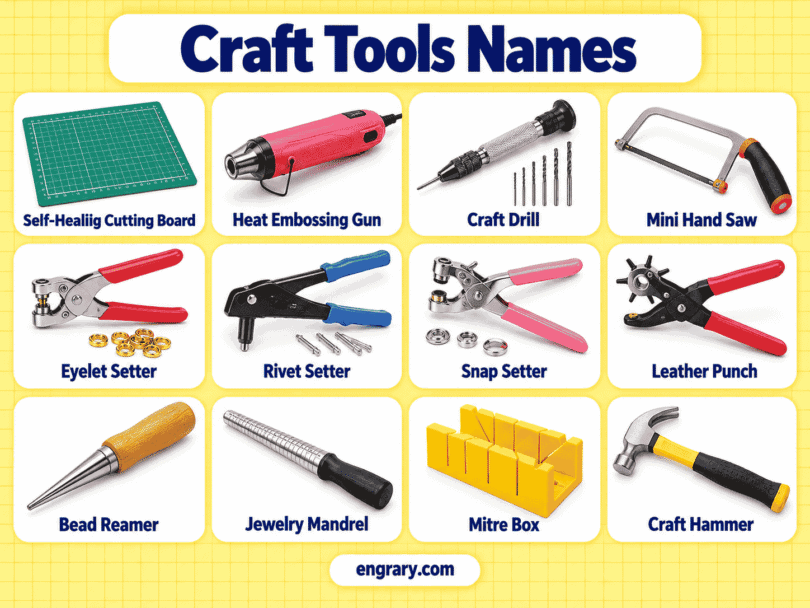
Crafting brings together many activities, from paper folding and stamping to fabric work, fiber crafts, beading, and decorative assembly. Crafters use different tools to cut materials, measure layouts, create folds, punch shapes, position small pieces, apply adhesive, and add decorative details.
Learning craft tools names with pictures and uses makes these items easier to identify and understand. This guide covers 60 genuine craft tools and pieces of equipment while keeping paper, yarn, beads, ribbon, glue, paint, and other consumable materials outside the main count.
Craft Tools You Can Easily Recognize
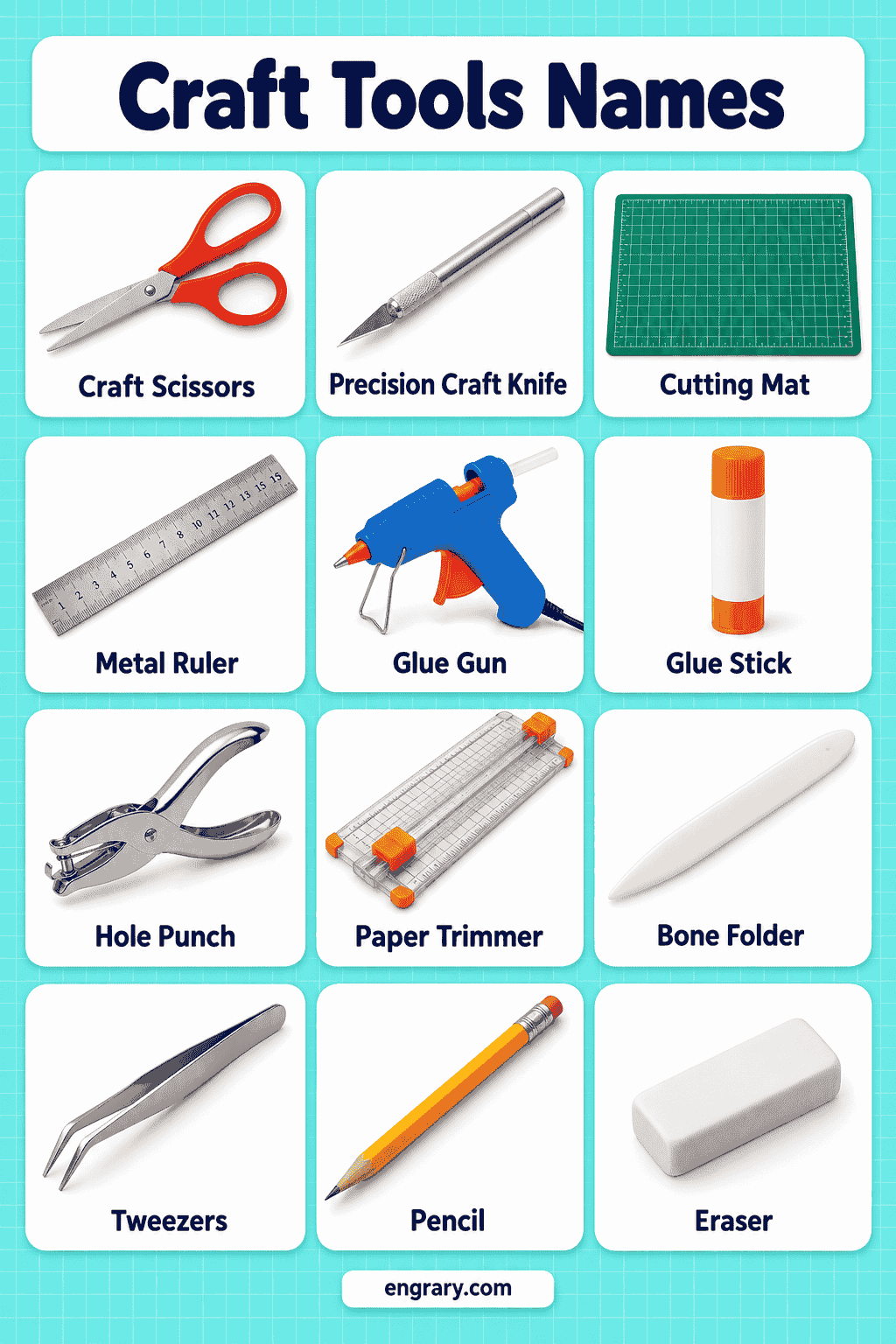
Many craft tools have distinctive shapes that make them easy to identify once you know what to look for. These 20 examples represent cutting, folding, punching, holding, stamping, fabric, and jewelry crafts.
1. Craft Scissors
Craft scissors have two cutting blades joined at a pivot with finger loops at one end. Crafters use them for freehand cutting of paper, lightweight fabric, and other suitable craft materials.
2. Paper Trimmer
A paper trimmer has a flat measured base with a guided cutting mechanism. It helps create straight, consistent cuts in paper and cardstock.
3. Rotary Cutter
A rotary cutter has a circular blade mounted at the end of a handheld grip. Crafters use it for controlled cuts in suitable craft materials, often together with a cutting mat.
4. Cutting Mat
A cutting mat provides a durable work surface that protects the table beneath it. Many versions include printed grids and measurements that also help with alignment.
5. Ruler
A ruler provides a straight measuring edge for craft layouts. It helps with spacing, straight lines, borders, and repeated measurements.
6. Bone Folder
A bone folder has a smooth, flat body with tapered or rounded ends. Crafters use it to sharpen paper folds, flatten creases, and smooth folded edges.
7. Scoring Tool
A scoring tool creates a controlled groove where paper or cardstock needs to fold. Its narrow tip helps establish a neat fold line without cutting through the material.
8. Hole Punch
A hole punch cuts clean circular openings in paper or similar craft material. Handheld and tabletop designs are common.
9. Shape Punch
A shape punch cuts decorative forms such as circles, flowers, or stars from paper. Different punch designs create different shapes, but they belong to the same general tool type.
10. Corner Rounder Punch
A corner rounder punch trims a sharp paper corner into a smooth curve. Paper slides into a guide so the punch can create a consistent rounded edge.
11. Craft Tweezers
Craft tweezers have narrow tips that grip small decorative pieces. They help position tiny paper shapes, beads, stickers, and other details.
12. Reverse-Action Tweezers
Reverse-action tweezers stay closed until the user squeezes them open. Their reverse grip can hold small pieces without constant hand pressure.
13. Hot Glue Gun
A hot glue gun is a handheld adhesive applicator with a heated internal mechanism. It dispenses melted adhesive for suitable craft assembly work.
14. Tape Runner
A tape runner looks like a small handheld dispenser. Rolling it across a surface transfers a narrow strip of dry adhesive from an internal refill.
15. Rubber Stamp
A rubber stamp has a raised design mounted on a backing or handle. Crafters press the inked design onto paper and other compatible surfaces to repeat an image or pattern.
16. Stencil
A stencil is a reusable sheet with cutout openings that form letters, shapes, or patterns. The openings guide repeated decorative designs.
17. Embossing Stylus
An embossing stylus has a slim handle with a rounded tip. Crafters press the tip against suitable material to create raised or recessed decorative details.
18. Die-Cutting Machine
A die-cutting machine is a tabletop device that applies controlled pressure to cut shapes from suitable craft materials with compatible dies or systems.
19. Embroidery Hoop
An embroidery hoop consists of two circular or oval rings that hold fabric under tension. It keeps the working area stable during embroidery and other fabric crafts.
20. Round-Nose Pliers
Round-nose pliers have smooth, tapered cylindrical jaws. Beaders and jewelry crafters use their shape to form curved wire details and loops.
Cutting Tools Used in Different Crafts
Craft projects often require different cutting tools because paper, thread, fabric, and decorative edges do not respond the same way. These tools give crafters more control over specific cutting jobs.
21. Precision Scissors
Precision scissors have short, narrow blades with fine tips. Their compact shape supports detailed freehand cuts in small craft pieces.
22. Decorative-Edge Scissors
Decorative-edge scissors have patterned blades that create scalloped, zigzag, or other shaped edges instead of a straight cut.
23. Thread Snips
Thread snips have short blades and a compact body for clipping thread ends. Their small size makes them convenient for embroidery, sewing, and fiber crafts.
Craft scissors, paper trimmers, and rotary cutters from the opening section complete the main cutting-tool group.
Measuring and Layout Tools for Craft Projects
Accurate layouts help craft pieces align neatly and keep repeated elements consistent. Measuring tools become especially useful for cards, paper construction, fabric crafts, and geometric projects.
24. Metal Ruler
A metal ruler provides a firm straight edge with durable measurement markings. Its rigid construction works well for repeated craft layouts.
25. Grid Ruler
A grid ruler is usually transparent and includes a printed measurement grid. Crafters can see the material underneath while checking spacing and alignment.
26. T-Square
A T-square has a long straight blade joined to a shorter crosspiece. The shape helps establish straight horizontal lines and right-angle relationships.
27. Compass
A compass has two hinged legs that help create circles and arcs. It also allows crafters to transfer equal distances across a layout.
The standard ruler from the first section remains one of the simplest tools for everyday craft measurements.
Tools for Folding and Scoring Paper
Paper crafts often depend on crisp folds and accurately placed crease lines. Scoring creates the fold path, while folding tools sharpen and flatten the finished crease.
28. Scoring Board
A scoring board has a flat surface covered with parallel grooves and measurement markings. Crafters guide a scoring tool along the grooves to create straight fold lines.
29. Paper Creaser
A paper creaser has a smooth working edge that presses and flattens folded paper. It helps create a sharper finish after the fold takes shape.
A scoring tool creates the groove before folding, while a bone folder strengthens and smooths the crease afterward.
Punches Used for Craft Shapes and Edges
Punching tools cut repeatable openings, decorative shapes, and edge details. Their built-in guides make them easy to recognize in paper-crafting collections.
30. Border Punch
A border punch creates a repeating decorative pattern along the edge of paper or cardstock. Aligning guides help continue the pattern across longer edges.
31. Eyelet Punch
An eyelet punch creates a small opening that can accept an eyelet or similar decorative fitting in compatible craft projects.
32. Tag Punch
A tag punch cuts a tag-shaped piece from paper or cardstock. Some models also create the small hole used for ribbon or string.
Hole punches, shape punches, and corner rounders from the opening section complete this craft-tool family.
Tools for Holding and Positioning Small Pieces
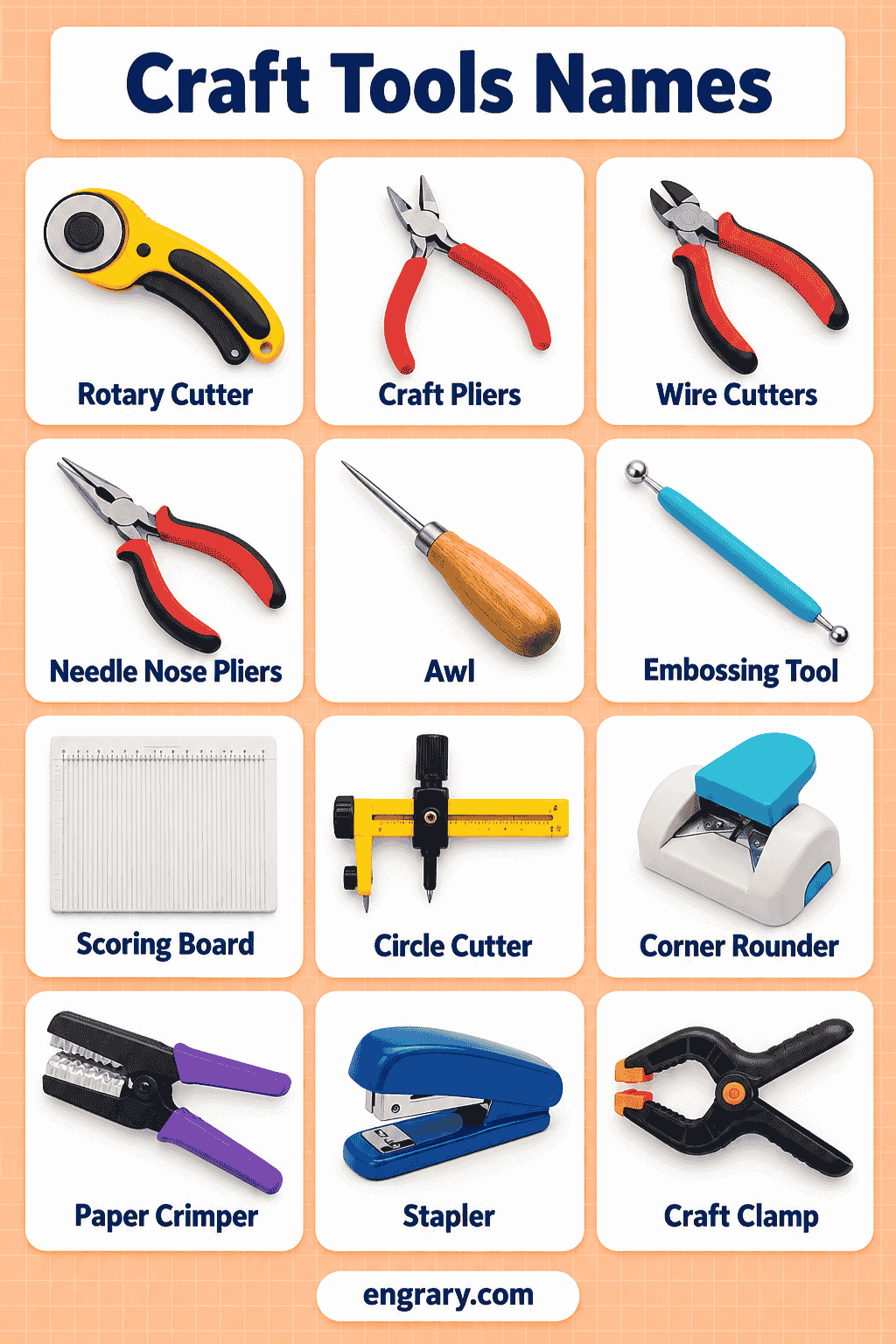
Small craft components can shift easily during assembly. Holding tools improve control while crafters align delicate pieces, embellishments, paper layers, or fabric sections.
33. Mini Clamp
A mini clamp uses spring or screw pressure to hold small craft pieces together temporarily. Its compact size suits work that does not need a full workshop clamp.
34. Craft Clip
A craft clip grips layers without piercing them. It works especially well for fabric, folded materials, and temporary positioning.
35. Pick-Up Tool
A pick-up tool has a tacky, wax-like, or gripping tip that lifts very small embellishments and places them more accurately.
36. Piercing Tool
A piercing tool has a narrow pointed shaft for making small controlled openings in suitable craft materials. Paper crafters often use this general tool around detailed assembly work.
Regular and reverse-action tweezers from the opening section also belong to this precision group.
Tools for Applying Adhesives
Adhesive tools control where glue or tape goes, while the adhesive itself remains a consumable supply. Keeping that distinction clear prevents a craft-tools list from turning into a shopping list of glue products.
37. Precision Glue Applicator
A precision glue applicator has a narrow nozzle or fine dispensing tip. It directs small amounts of suitable liquid adhesive into detailed areas.
38. Glue Spreader
A glue spreader has a flat or shaped edge that distributes adhesive across a surface. Its reusable body helps produce a more even layer.
The hot glue gun and tape runner from the opening section are also adhesive-application tools. Glue sticks, liquid glue, glue dots, and double-sided tape are supplies rather than additional tools.
Tools Used for Stamping and Embossing
Stamping repeats inked designs, while embossing creates raised or recessed surface details. Both craft processes use specialized tools to improve positioning and pressure.
39. Clear Stamp Block
A clear stamp block is a transparent rigid block that holds reusable clear stamps. Its see-through construction helps crafters position the stamp over the intended area.
40. Stamp Positioning Tool
A stamp positioning tool holds paper and stamps in fixed positions. Its guided setup helps place repeated impressions in the same location.
41. Ink Blending Tool
An ink blending tool has a handle with a soft foam or brush-style applicator. Crafters use it to spread and soften ink effects across paper surfaces.
42. Embossing Mat
An embossing mat provides a slightly flexible support surface under material during manual embossing work.
43. Embossing Machine
An embossing machine applies pressure to create raised or recessed patterns with compatible plates, folders, or accessories.
The embossing stylus from the opening group offers a hand-controlled alternative for smaller details.
Paper-Crafting Tools and Equipment
Paper crafting combines trimming, folding, shaping, die cutting, and decorative construction. Several tools in this group handle jobs that ordinary scissors or rulers cannot perform as efficiently.
44. Paper Crimper
A paper crimper feeds paper between textured rollers to create repeated ridges or corrugated patterns.
45. Envelope Punch Board
An envelope punch board combines measurement guides, scoring channels, and a punch so crafters can prepare envelope shapes in different sizes.
46. Die Pick Tool
A die pick tool has a fine point that helps release small paper pieces from intricate die-cut openings and detailed shapes.
Paper trimmers, scoring boards, punches, and die-cutting machines also play major roles in paper crafting.
Tools Used for Fabric and Fiber Crafts
Fabric and fiber crafts use tools for cutting, marking, stitching, holding, looping, and weaving. This section includes representative tools without duplicating the much broader sewing-tool category.
47. Fabric Scissors
Fabric scissors have sharp blades designed to cut textile materials cleanly. Crafters often keep them separate from general craft scissors to preserve the cutting edge.
48. Fabric Marker
A fabric marker places visible temporary guides on compatible textile surfaces. Crafters use those lines for placement, decorative layouts, and stitching guides.
49. Needle Threader
A needle threader has a fine wire or hook that pulls thread through a small needle eye.
50. Crochet Hook
A crochet hook has a hooked tip at the end of a slim shaft. Fiber crafters use it to form and connect loops of yarn or thread.
51. Knitting Needle
A knitting needle is a long, smooth tool with a pointed working end. Knitters use one or more needles to form interlocking loops.
52. Yarn Needle
A yarn needle has a large eye that accommodates thicker yarn. Its relatively blunt form suits many finishing and assembly tasks in fiber crafts.
53. Pom-Pom Maker
A pom-pom maker uses paired or hinged forms to hold yarn while a crafter builds a rounded pom-pom shape.
54. Weaving Shuttle
A weaving shuttle carries yarn or thread through the warp during weaving. Its long, narrow body helps pass material back and forth.
55. Hand Loom
A hand loom holds warp threads under tension while a crafter weaves material through them. Small craft looms come in several reusable shapes and sizes.
Tools Used for Beading and Jewelry Crafts
Beading uses gripping, cutting, and hole-cleaning tools that can handle small components. A few representative examples give the article broad craft coverage without recreating a full jewelry-making tools guide.
56. Chain-Nose Pliers
Chain-nose pliers have tapered jaws with flat inner gripping surfaces. Beaders use them to hold, bend, and position small wire components.
57. Flush Cutter
A flush cutter has short angled jaws designed to leave one side of a wire cut relatively flat. It handles fine craft wire rather than paper or fabric.
58. Bead Reamer
A bead reamer has a narrow abrasive point that cleans or slightly refines holes in compatible beads.
Round-nose pliers from the opening section complete the core beading-tool group in this article.
Tracing and Template Tools for Crafts
Tracing tools help crafters repeat shapes, transfer layouts, and work from patterns without drawing every element freehand.
59. Template
A template provides a reusable outline, opening, or shape that guides repeated craft forms. Templates may support boxes, lettering, geometric shapes, or decorative layouts.
60. Light Box
A light box, also called a light pad, illuminates work from beneath. The transmitted light makes underlying lines easier to see through suitable paper for tracing and layout work.
How to Tell Similar Craft Tools Apart
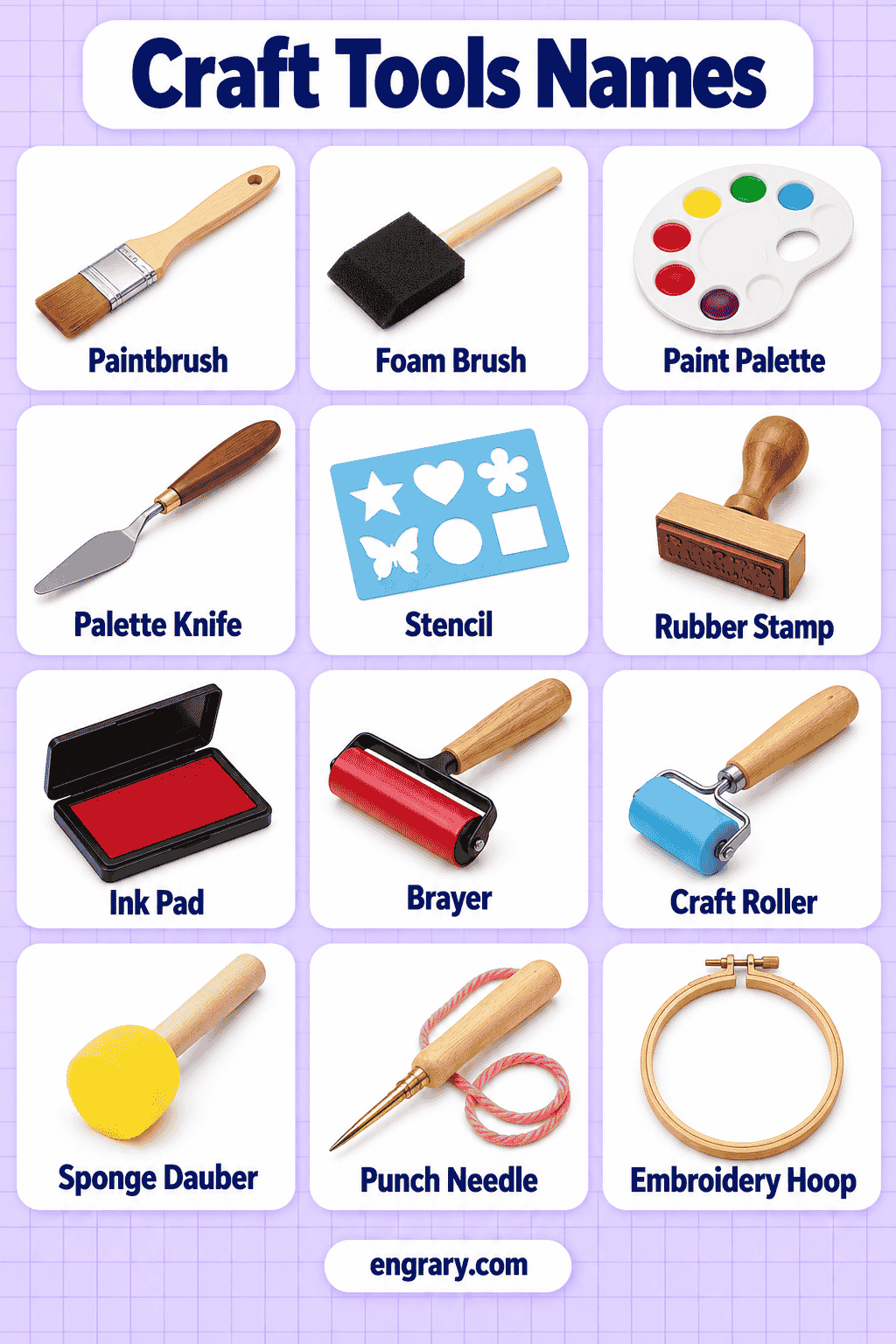
Several craft tools perform related jobs but differ in their shape, working method, or the result they create.
| Often Confused | Main Difference |
|---|---|
| Craft Scissors vs Paper Trimmer | Scissors make freehand cuts; a trimmer guides straight cuts |
| Paper Trimmer vs Rotary Cutter | A trimmer follows a fixed guide; a rotary cutter uses a rolling circular blade |
| Bone Folder vs Scoring Tool | Bone folders sharpen folds; scoring tools create fold lines |
| Scoring Tool vs Embossing Stylus | Scoring creates fold grooves; embossing creates decorative impressions |
| Hole Punch vs Shape Punch | Hole punches make basic openings; shape punches create decorative cutouts |
| Corner Punch vs Border Punch | Corner punches shape corners; border punches repeat designs along edges |
| Regular vs Reverse Tweezers | Regular tweezers close when squeezed; reverse tweezers open when squeezed |
| Glue Gun vs Tape Runner | Glue guns dispense heated adhesive; tape runners transfer dry adhesive |
| Rubber Stamp vs Clear Stamp | Rubber stamps usually have opaque raised designs; clear stamps allow easier visual positioning |
| Die-Cutting vs Embossing Machine | Die cutting creates cut shapes; embossing creates raised or recessed patterns |
| Stencil vs Template | Stencils mainly guide designs through openings; templates provide broader shape or layout guides |
| Craft Tool vs Craft Supply | A tool performs work; a supply becomes part of a project or gets consumed |
Other Names Used for Craft Tools
Craft terminology varies between brands, regions, and creative hobbies. Knowing alternate names helps readers recognize the same tool without counting it twice.
A paper trimmer may also appear as a paper cutter, although some larger paper cutters use different mechanisms.
People may call a bone folder a paper folder, while scoring tool and scoring stylus often describe closely related fold-making tools.
A craft punch may appear as a paper punch, and manufacturers often market shape punches as decorative punches.
A tape runner can also appear as an adhesive runner, while hot glue gun commonly shortens to glue gun.
The names light box and light pad often overlap, while craft tweezers may appear as precision tweezers.
A die-cutting machine may simply be called a die cutter. These alternate names should not increase the primary count when they describe the same basic tool.
Difference Between Craft Tools and Craft Supplies
Craft tools perform reusable jobs, while supplies and materials either become part of the project or get consumed during the creative process.
| Category | What It Means | Examples |
|---|---|---|
| Craft Tools | Reusable objects that perform a task | Scissors, bone folder, punch, tweezers |
| Craft Equipment | Larger reusable devices or machines | Die-cutting machine, embossing machine |
| Craft Materials | Materials incorporated into the project | Paper, cardstock, felt, yarn, ribbon, beads |
| Adhesives and Consumables | Products that gradually get used up | Glue, tape, glue dots, ink, paint |
For example, a hot glue gun counts as a craft tool, while the adhesive loaded into it counts as a consumable. Likewise, a crochet hook is a tool, while yarn is the material it works with.
Questions People Ask About Craft Tools
Common examples include craft scissors, rulers, paper trimmers, cutting mats, bone folders, punches, tweezers, glue guns, scoring tools, and stamping tools. The exact set depends on the type of craft project.
Paper crafters commonly use paper trimmers, scissors, bone folders, scoring boards, punches, tweezers, stamp tools, die-cutting equipment, and templates.
A craft tool performs a reusable task such as cutting, folding, measuring, or gripping. A craft supply usually becomes part of the project or gets consumed, such as paper, ribbon, glue, yarn, or paint.
Scoring tools establish the fold line, while bone folders and paper creasers sharpen and flatten the finished crease. A scoring board can also guide repeated straight fold lines.
A beginner can start with craft scissors, a ruler, cutting mat, paper trimmer, bone folder, basic punch, tweezers, and an adhesive applicator. Additional tools depend on whether the person prefers paper, fabric, fiber, stamping, or beading crafts.
You May Also Like

Leave a Comment