
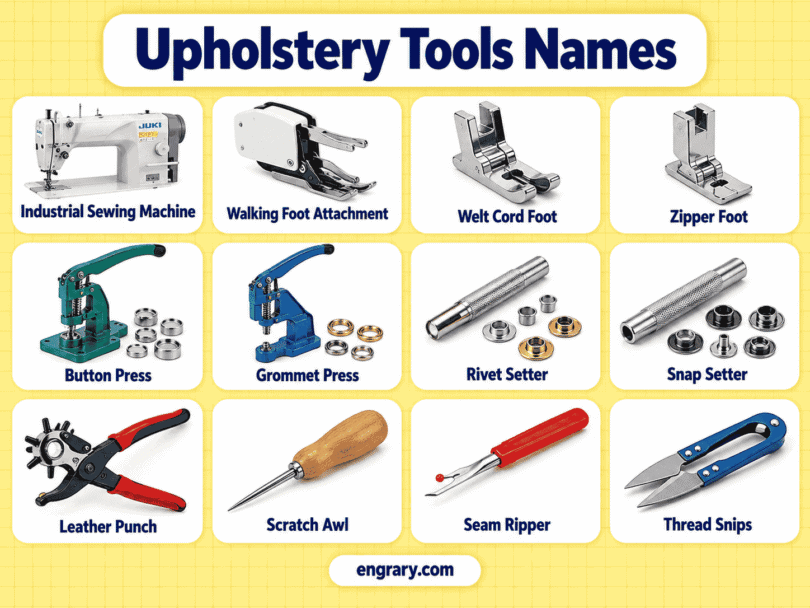
Upholstery work involves removing old coverings, measuring and cutting new materials, stretching webbing, fastening fabric, shaping padding, stitching heavy layers, and finishing furniture details. Upholsterers rely on specialized tools to handle each of these jobs accurately.
Learning upholstery tools names with pictures and uses makes professional and traditional tools easier to recognize. This guide covers 52 upholstery tools and pieces of equipment, including stripping tools, staple guns, webbing stretchers, needles, regulators, foam cutters, spring tools, and buttoning equipment.
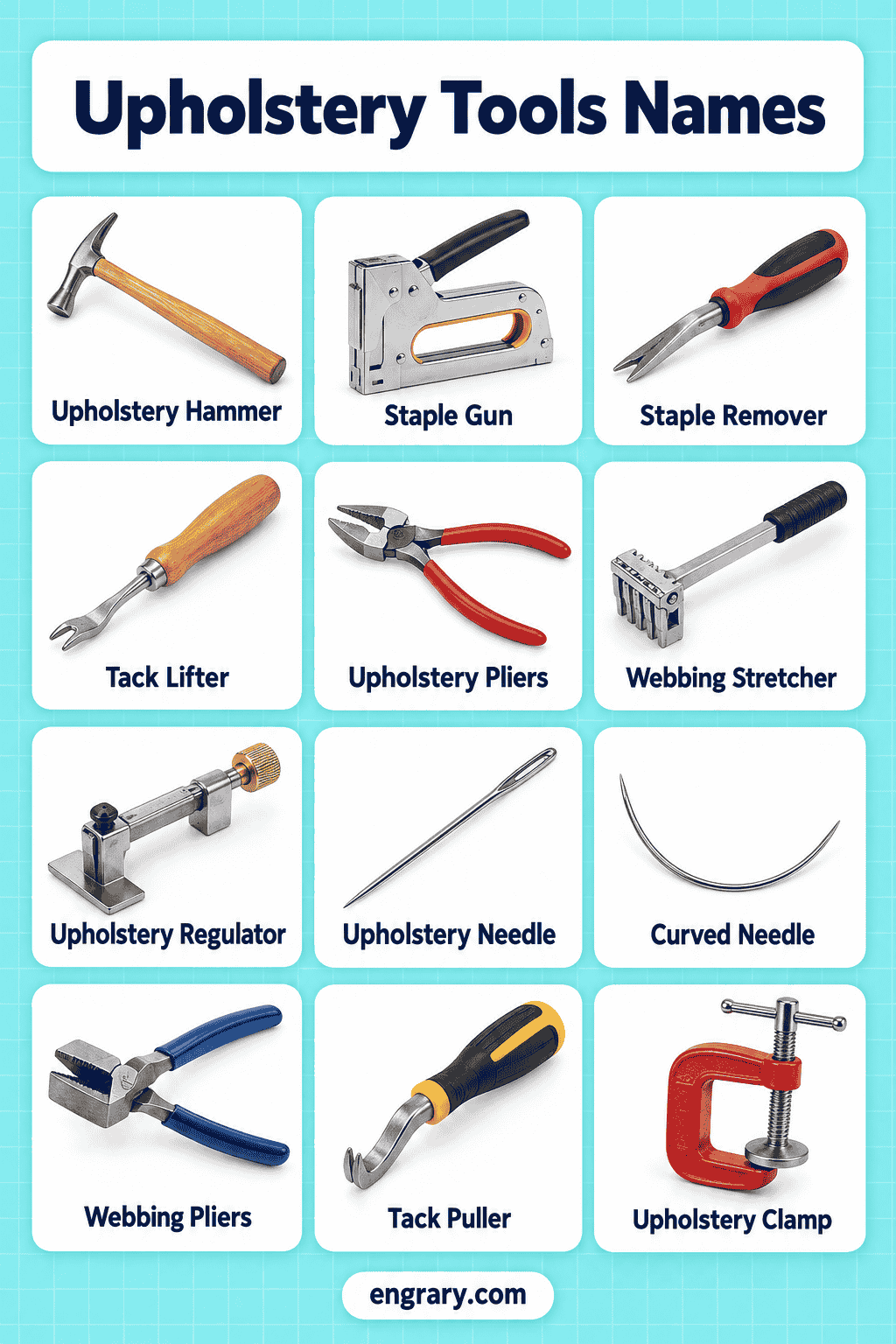
Tools Found on an Upholsterer’s Workbench
An upholsterer’s workbench usually contains a mix of stripping, cutting, gripping, fastening, stretching, sewing, and shaping tools. These 20 items represent many of the tools learners encounter first.
1. Magnetic Tack Hammer
A magnetic tack hammer has a narrow head with a magnetized face that can hold an upholstery tack. Its lightweight shape suits traditional furniture work and small fastening jobs.
2. Tack Lifter
A tack lifter has a slim forked tip that slips beneath old upholstery tacks. Its narrow head provides more control than a large pry tool.
3. Staple Remover
A staple remover lifts upholstery staples from wooden furniture frames. Its shaped tip fits beneath the staple crown so users can remove old coverings more cleanly.
4. Ripping Chisel
A ripping chisel has a strong metal blade that reaches beneath stubborn tacks, staples, and old upholstery layers. Upholsterers commonly pair it with a suitable mallet during stripping work.
5. Webbing Stretcher
A webbing stretcher grips structural upholstery webbing and helps pull it taut across a furniture frame before fastening.
6. Upholstery Regulator
An upholstery regulator has a long, slender metal shaft with a handle. Upholsterers use it to reposition and smooth stuffing beneath upholstery layers, making it one of the most distinctive traditional upholstery tools.
7. Upholstery Shears
Upholstery shears have long, strong blades for cutting furniture fabric and other flexible covering materials. Their larger size handles heavier textiles better than small sewing scissors.
8. Curved Upholstery Needle
A curved upholstery needle has an arched metal shaft that helps sew through shaped or difficult-to-reach furniture areas.
9. Straight Upholstery Needle
A straight upholstery needle has a long, rigid shaft for hand stitching through upholstery layers, padding, or heavy fabric.
10. Manual Staple Gun
A manual staple gun uses hand pressure to drive staples into suitable furniture frames. Its compact body makes it common in basic upholstery kits.
11. Pneumatic Staple Gun
A pneumatic staple gun uses compressed air to drive upholstery staples. Professional workshops often use this type for repetitive fastening work.
12. Needle-Nose Pliers
Needle-nose pliers have long, narrow jaws that reach into tight furniture corners. They help grip small fasteners, wire, or other difficult-to-reach pieces.
13. Duckbill Pliers
Duckbill pliers have broad, flat jaws that resemble a duck’s bill. Their wide gripping surface spreads pressure across fabric and trim.
14. Hog Ring Pliers
Hog ring pliers have shaped jaws that hold and close upholstery hog rings. Furniture makers commonly use them with springs, wire, or certain upholstery attachments.
15. Upholstery Skewer
An upholstery skewer is a long, strong pin that temporarily holds fabric, padding, or folds in position before final fastening.
16. Tape Measure
A flexible tape measure follows straight and curved furniture surfaces. Upholsterers use it to check frame dimensions, fabric requirements, cushions, and finished sections.
17. Tailor’s Chalk
Tailor’s chalk creates temporary marks on upholstery fabric. It helps identify cutting lines, matching points, and layout positions without making permanent marks.
18. Foam Cutter
A foam cutter has a long cutting edge made for shaping cushioning foam. Its form handles thick foam more effectively than ordinary fabric scissors.
19. Rubber Mallet
A rubber mallet delivers firm blows without leaving the same surface marks as a metal hammer. Upholsterers use it when a softer striking face suits the furniture or tool.
20. Upholstery Sewing Machine
An upholstery sewing machine handles thicker fabrics and layered materials used in cushions, furniture covers, piping, and similar upholstery work.
Stripping and Fastener-Removal Tools
Reupholstery usually begins with stripping away the old covering and removing fasteners from the frame. Specialized removal tools help separate fabric, staples, brads, and tacks while giving the upholsterer better control.
21. Cranked Ripping Chisel
A cranked ripping chisel has an angled shaft that creates extra clearance between the handle and furniture frame. This shape helps the blade reach beneath old upholstery fasteners.
22. Brad Puller
A brad puller grips or lifts small brads and nails from furniture frames. Its narrow working end suits fasteners that ordinary pliers may struggle to reach.
23. End-Cutting Pliers
End-cutting pliers have cutting edges across the front of their jaws. Their rounded head can grip protruding nails, staples, or wire close to a surface.
Tack lifters, staple removers, and ripping chisels may appear similar in photographs, but they handle different levels of stripping work. A tack lifter focuses on individual tacks, while a heavier ripping chisel tackles more demanding removal.
Measuring and Marking Tools for Upholstery
Accurate measurements help upholsterers plan fabric cuts, align patterns, and keep corners square. Most tools in this group also appear in other trades, but they remain useful around an upholstery bench.
24. Upholstery Ruler
An upholstery ruler provides a long straight measuring edge for fabric, foam, and furniture sections. Clear markings make repeated layout work easier.
25. Combination Square
A combination square combines a straight rule with an adjustable square head. It helps check right angles, mark straight lines, and measure short distances.
26. Framing Square
A framing square has two rigid arms set at a right angle. Its larger size helps check and mark square corners on furniture frames and work surfaces.
27. Straightedge
A straightedge provides a long, flat reference edge for drawing or checking straight lines across upholstery fabric, foam, or pattern material.
Tape measures and tailor’s chalk from the opening section complete the core measuring and marking group.
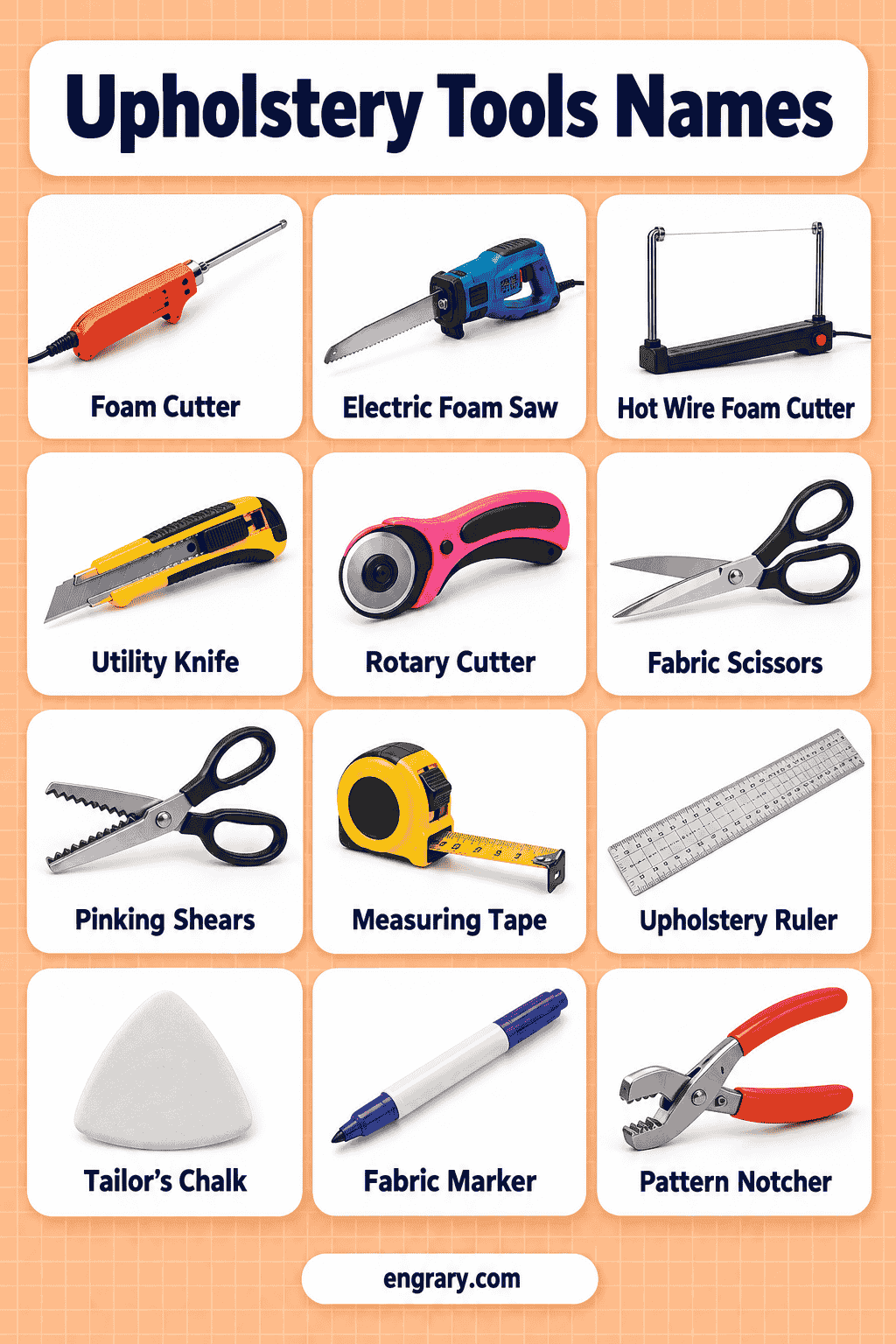
Fabric and Foam Cutting Tools
Furniture upholstery combines soft fabric with much thicker cushioning materials. As a result, upholsterers use different cutting tools for cloth, thread, foam, seams, and general trimming.
28. Thread Snips
Thread snips have short blades that quickly clip loose thread around stitched upholstery. Their compact shape makes them convenient beside a sewing machine.
29. Rotary Cutter
A rotary cutter has a circular blade that rolls across fabric. It works especially well for long, controlled cuts when paired with a suitable cutting surface.
30. Electric Foam Knife
An electric foam knife uses powered cutting blades to handle thick cushioning foam. Upholsterers use this equipment when shaping larger foam pieces.
31. Utility Knife
A utility knife has a replaceable or retractable blade that handles general workshop cutting and trimming. It works best on materials suited to this type of blade rather than as a replacement for fabric shears.
32. Seam Ripper
A seam ripper has a small hooked blade that cuts individual stitches. It helps open old sewn seams or correct stitching without using large scissors.
Upholstery shears remain the better choice for broad fabric cutting, while foam cutters handle thick cushioning material.
Tools for Tacking and Stapling Upholstery
Fastening tools attach fabric, webbing, trim, and other upholstery layers to furniture frames. Modern work relies heavily on staples, while traditional upholstery often uses tacks.
33. Electric Staple Gun
An electric staple gun uses an electric motor to drive fasteners. It reduces the repeated hand pressure required by a manual stapler.
34. Nailhead Spacer
A nailhead spacer helps maintain even distances between decorative upholstery nails or nailheads. Its marked or shaped edge supports a more consistent decorative line.
35. Tack Setter
A tack setter has a narrow working end that helps position or seat small upholstery tacks and decorative fasteners in controlled areas.
36. Hog Ring Gun
A hog ring gun closes hog rings more quickly than basic hand pliers. Workshops may use it where furniture construction requires repeated ring fastening.
Manual, electric, and pneumatic staplers all perform the same broad fastening job, but they differ in their power source and working speed.
Webbing and Stretching Tools
Webbing creates support beneath seats and other upholstered sections. Upholsterers need controlled tension so the webbing remains firm without distorting the frame.
37. Gooseneck Webbing Stretcher
A gooseneck webbing stretcher has a curved neck that braces against the furniture frame while the gripping end tensions the webbing.
38. Bat-Type Webbing Stretcher
A bat-type webbing stretcher has a broad wooden body with gripping points at one end. Its simple shape gives leverage while tightening webbing.
39. Webbing Pliers
Webbing pliers have wide jaws that grip upholstery webbing while the user pulls it into position. Unlike a frame-braced webbing stretcher, the pliers rely mainly on hand grip.
The term webbing strainer may also appear as another name for certain webbing stretchers.
Gripping and Holding Tools for Upholstery
Furniture coverings often need temporary support before final fastening. Gripping and holding tools help control fabric, padding, and small components while an upholsterer checks alignment.
40. Upholstery Pliers
Upholstery pliers have strong jaws that grip and pull fabric or other upholstery material. Their design provides more leverage than gripping material by hand.
41. Upholstery Pins
Upholstery pins temporarily secure fabric, padding, or trim during fitting. Their stronger construction suits heavier materials better than delicate dressmaking pins.
42. Upholstery Clamp
An upholstery clamp holds furniture parts, fabric, or workpieces firmly while the upholsterer adjusts or assembles a section.
Needle-nose pliers, duckbill pliers, hog ring pliers, and skewers from the opening group also perform important gripping or holding roles.
Needles and Sewing Tools Used in Upholstery
Hand stitching remains important in traditional furniture work, concealed seams, buttoning, spring work, and difficult areas where a machine cannot reach.
43. Buttoning Needle
A buttoning needle has an extra-long shaft that can pass through deep padding and upholstery layers during buttoning work.
44. Double-Pointed Upholstery Needle
A double-pointed needle has a point at both ends. Traditional upholsterers use this distinctive form for specific stitching and edge-building tasks.
45. Spring Needle
A spring needle is a strong upholstery needle suited to traditional spring and foundation work where thick materials require a substantial hand-sewing tool.
46. Tufting Needle
A tufting needle has a long shaft that reaches through thick cushions or padded furniture sections. It supports deep buttoning and tufted upholstery work.
Straight and curved upholstery needles provide additional options when the stitch path or furniture shape changes.
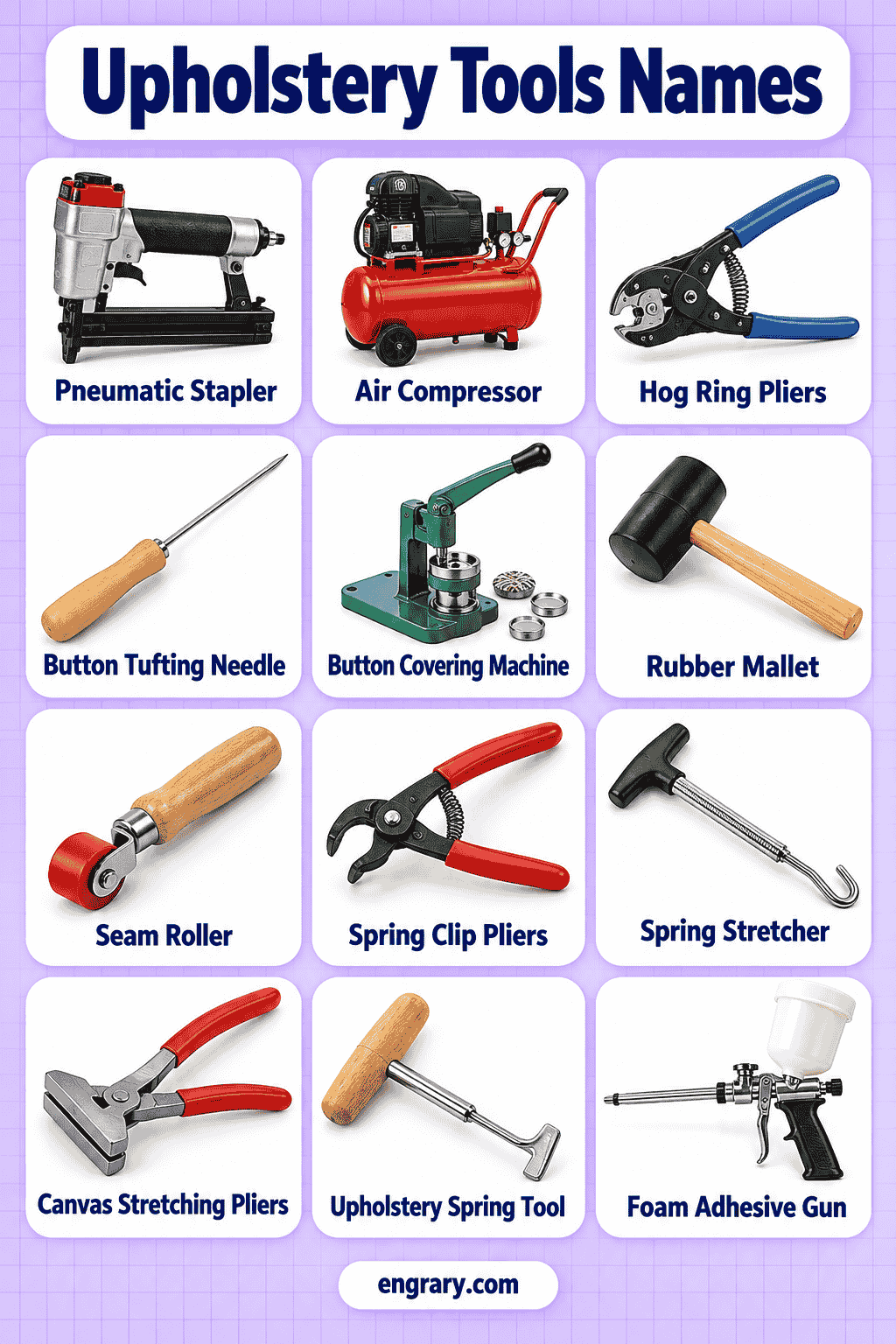
Stuffing and Regulating Tools
Traditional upholstery often uses loose or layered stuffing that needs careful shaping. These specialist tools help distribute filling, refine corners, and control material beneath the outer covering.
47. Stuffing Iron
A stuffing iron has a long, narrow metal working end, often with a shaped or toothed edge. Upholsterers use it to push and arrange filling in corners, curves, and other areas that fingers cannot reach easily.
48. Fabric Tucking Tool
A fabric tucking tool has a narrow metal end that pushes fabric into channels, gaps, seams, or tight furniture edges. Its slim profile helps create cleaner finishing lines in confined areas. Specialized upholstery suppliers group tucking and regulating tools together for detailed fabric and padding work.
The upholstery regulator differs from the stuffing iron. A regulator mainly adjusts and redistributes stuffing beneath upholstery layers, while a stuffing iron pushes filling into shaped or confined areas.
Spring and Frame Tools
Traditional sprung seats require tools that help position, shape, and tension spring systems. These tools appear less often in simple modern upholstery kits, but they remain part of professional and restoration vocabulary.
49. Spring Stretcher
A spring stretcher helps control or tension upholstery springs during furniture construction and repair.
50. Spring Bender
A spring bender grips spring or edge wire so an upholsterer can adjust its shape during frame and foundation work.
A rubber mallet and suitable gripping pliers may also support frame-related work, but they already appear earlier in the main count.
Buttoning and Tufting Tools
Deep buttons and tufted details require more than an ordinary sewing needle. Specialized buttoning tools help create covered buttons and prepare them for decorative upholstery.
51. Button Press
A button press uses interchangeable dies or fittings to assemble fabric-covered upholstery buttons. The press helps create consistent buttons for tufted furniture.
52. Button Cutter
A button cutter cuts fabric pieces to the size and shape needed for covered buttons. It works alongside button-making equipment during decorative upholstery preparation.
The primary list contains exactly 52 upholstery tools and pieces of equipment. Upholstery fabric, foam, webbing, batting, springs, tacks, staples, hog rings, and twine do not count toward the total because they function as materials, fasteners, or consumable supplies.
How to Tell Similar Upholstery Tools Apart
Several upholstery tools look similar or perform related jobs. Comparing their shape and primary function makes them much easier to identify.
| Often Confused | Main Difference |
|---|---|
| Tack Lifter vs Staple Remover | Tack lifters focus on tacks; staple removers fit beneath staple crowns |
| Tack Lifter vs Ripping Chisel | Tack lifters handle controlled removal; ripping chisels tackle heavier stripping |
| Magnetic Tack Hammer vs Regular Hammer | A magnetic tack hammer has a narrow, magnetized head for upholstery tacks |
| Manual vs Pneumatic Stapler | One relies on hand pressure; the other uses compressed air |
| Webbing Stretcher vs Webbing Pliers | A stretcher creates leverage against the frame; pliers grip and pull the webbing |
| Upholstery Shears vs Foam Cutter | Shears cut fabric; foam cutters shape cushioning foam |
| Straight vs Curved Upholstery Needle | Straight needles follow a direct path; curved needles reach around shaped areas |
| Regulator vs Stuffing Iron | Regulators redistribute stuffing; stuffing irons push filling into confined areas |
| Needle-Nose vs Duckbill Pliers | Needle-nose jaws reach narrow spaces; duckbill jaws provide a broad grip |
| Upholstery Machine vs Domestic Sewing Machine | Upholstery machines handle heavier fabric and layered furniture work |
Other Names Used for Upholstery Tools
Upholstery terminology varies between countries, workshops, and manufacturers. Learning alternate names helps readers recognize the same tool even when suppliers use different wording.
A tack lifter may also appear as a tack puller, while sellers may call a staple remover a staple lifter or staple puller.
The names webbing stretcher and webbing strainer often describe tools that tension upholstery webbing. Likewise, people may refer to a magnetic tack hammer simply as a magnetic upholstery hammer.
Upholstery shears can overlap with the term fabric shears, although upholstery shears generally suggest robust scissors suitable for furniture textiles.
An upholstery regulator is often shortened to regulator, while an upholstery skewer may simply appear as a skewer in traditional upholstery tool lists.
Alternate names should not increase the main count when they describe the same basic tool.
Upholstery Tools vs Materials and Fasteners
Upholstery projects require tools, equipment, materials, and fasteners, but these groups do not mean the same thing.
| Category | What It Includes | Examples |
|---|---|---|
| Hand Tools | Reusable tools controlled by hand | Tack lifter, regulator, shears, webbing stretcher |
| Powered Equipment | Tools or machines with powered mechanisms | Pneumatic stapler, electric foam knife, sewing machine |
| Upholstery Materials | Materials that become part of the furniture | Fabric, foam, batting, webbing, burlap |
| Fasteners | Items that attach upholstery components | Tacks, staples, hog rings |
| Sewing Supplies | Consumable materials used during stitching | Upholstery thread, twine |
For example, a webbing stretcher is a tool, while webbing itself becomes part of the furniture. Similarly, a staple gun is a tool, but staples are fasteners.
Keeping these groups separate prevents a tool-name article from becoming an inflated list of general upholstery supplies.
Questions People Ask About Upholstery Tools
Useful beginner tools include a tack lifter, staple remover, upholstery shears, webbing stretcher, regulator, tack hammer, staple gun, tape measure, skewers, and basic upholstery needles. The exact kit depends on whether the project uses modern or traditional construction.
A staple remover or staple lifter fits beneath upholstery staples and helps lift them from the furniture frame. For heavier stripping work, an upholsterer may choose a stronger removal tool such as a ripping chisel.
A webbing stretcher grips support webbing and creates tension across the furniture frame before fastening. This helps form a firm foundation beneath the seat or upholstery layers.
An upholstery regulator is a long, slender hand tool that helps reposition and smooth stuffing beneath upholstery coverings. Its distinctive shaft makes it easy to distinguish from most ordinary sewing tools.
Upholstery tools perform reusable jobs such as cutting, stretching, gripping, fastening, or shaping. Materials such as fabric, foam, batting, webbing, and burlap become part of the finished furniture.
You May Also Like

Leave a Comment