
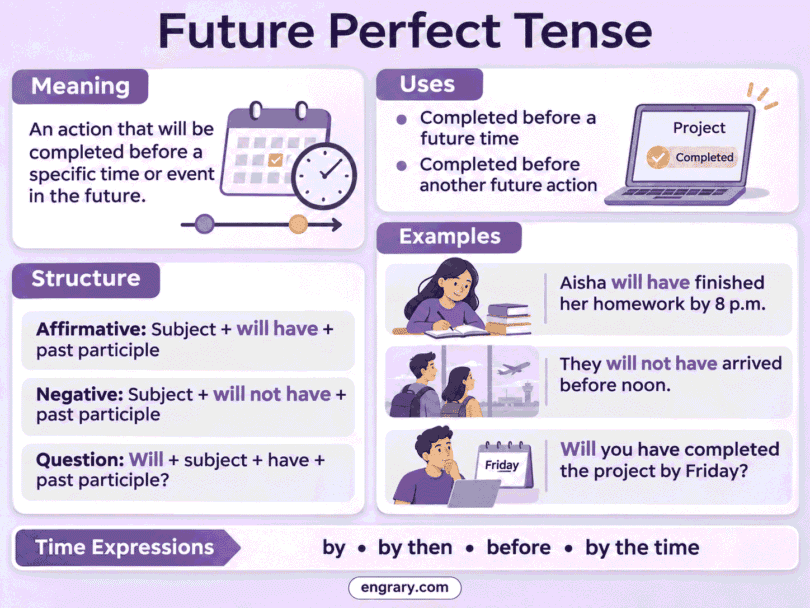
The future perfect tense describes an action, event, or state that will be complete before a particular time or another event in the future. It uses will have + past participle, as in will have finished, will have gone, and will have written. In other words, the speaker moves mentally to a future point and looks back at what will already be complete.
This guide explains the future perfect tense through clear structures, natural examples, and practical comparisons. In addition, it covers deadlines, duration, future time clauses, passive forms, adverb placement, questions, contractions, common mistakes, and the difference between the future perfect and related tenses.
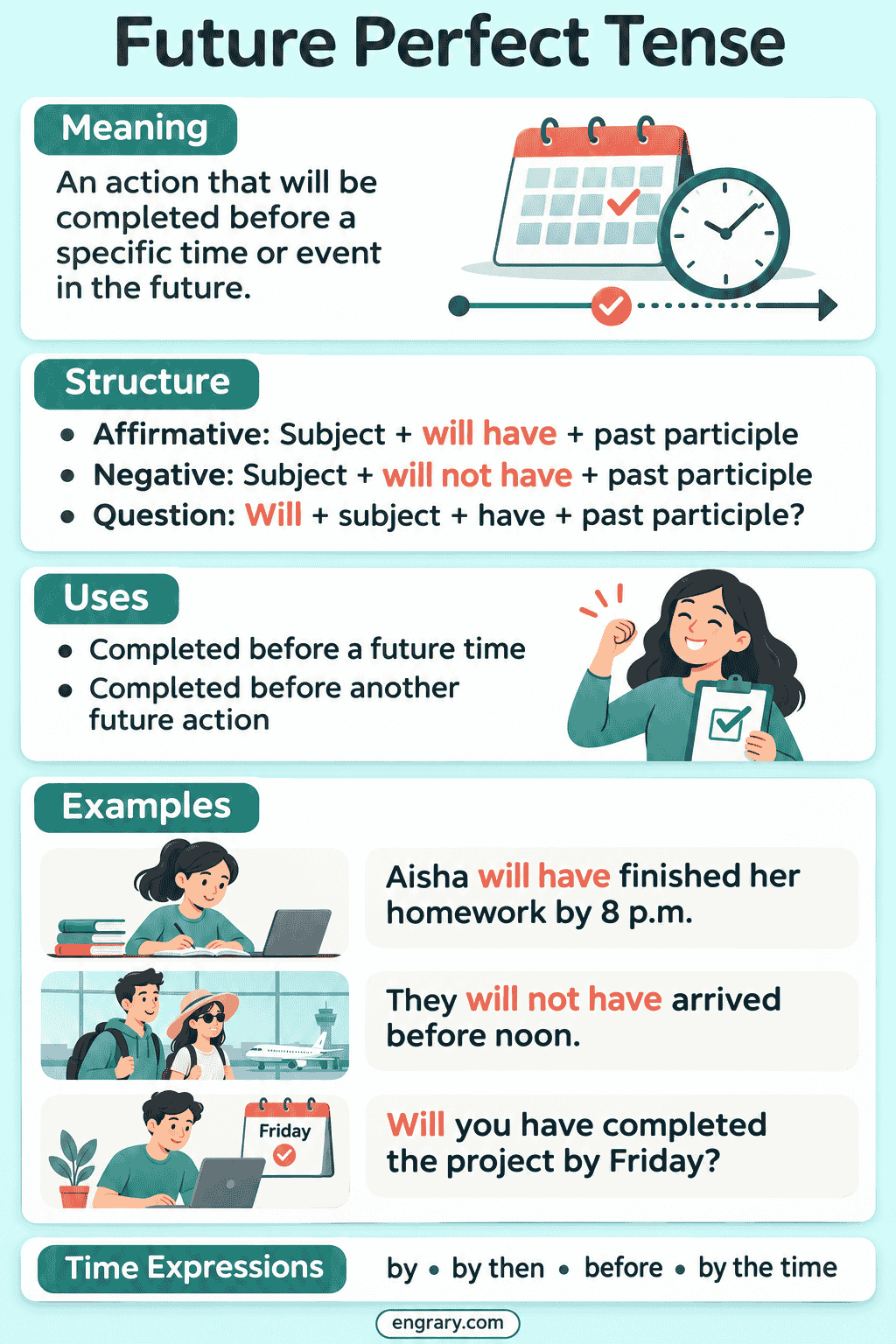
Future Perfect Tense at a Glance
The future perfect connects two points in future time. First, an action or state begins or occurs. Later, the speaker reaches a future reference point and views that earlier action as complete.
By 8 p.m., Hana will have finished the report.
In this example, Hana may finish at any time before 8 p.m. or, depending on the context, at 8 p.m. The phrase by 8 p.m. sets the deadline; it does not say that she will work continuously until that exact moment.
| Feature | Explanation | Example |
|---|---|---|
| Basic form | Will have + past participle | She will have finished. |
| Main meaning | Completion before a future point | She will have finished by Friday. |
| Negative | Will not have + past participle | She will not have finished by Friday. |
| Question | Will + subject + have + past participle? | Will she have finished by Friday? |
| Common time marker | By or by the time | By noon, she will have finished. |
| Passive form | Will have been + past participle | The report will have been finished. |
The future reference point may appear in the same sentence, or the surrounding context may provide it. For example, The guests will arrive at eight. I will have prepared everything remains clear because the first sentence establishes eight o’clock as the relevant future point.
Structure of the Future Perfect Tense
The future perfect uses will, have, and the past participle of the main verb. Both will and have remain unchanged with every subject.
| Sentence type | Structure | Example |
|---|---|---|
| Affirmative | Subject + will have + past participle | Amir will have arrived by noon. |
| Negative | Subject + will not have + past participle | Amir will not have arrived by noon. |
| Yes-or-no question | Will + subject + have + past participle? | Will Amir have arrived by noon? |
| Wh-question | Wh-word + will + subject + have + past participle? | When will Amir have arrived? |
| Passive | Subject + will have been + past participle | The order will have been delivered. |
Traditional grammar sometimes uses shall have with I and we, as in We shall have completed the work by Friday. However, will have is standard with all subjects in modern English. Therefore, learners can safely use will have in most formal and informal situations.
Affirmative Future Perfect Sentences
An affirmative sentence follows this pattern:
Subject + will have + past participle + future reference
- I will have completed the course by June.
- You will have received the parcel by tomorrow.
- She will have saved enough money before the trip.
- He will have written ten chapters by the end of the year.
- We will have reached the hotel before sunset.
- They will have built the new library by 2030.
In speech and informal writing, speakers usually contract the subject and will:
- I’ll have finished by six.
- She’ll have left before we arrive.
- They’ll have completed the repairs by Monday.
Although these sentences describe future events, the perfect form emphasizes completion. For instance, She will finish the report tomorrow announces a future action, whereas She will have finished the report by tomorrow views the report as complete at tomorrow’s reference point.
Negative Future Perfect Sentences
A negative sentence places not after will:
Subject + will not have + past participle + future reference
The contraction won’t have is common in both speech and writing.
- I will not have completed the application by noon.
- Sara won’t have reached the airport before rush hour.
- The builders won’t have finished the roof by Friday.
- We won’t have saved enough money by the end of the month.
- The students will not have read every chapter before the test.
- He won’t have recovered fully by the start of the season.
The choice between by and until changes the meaning. She won’t have finished by six means that the work will remain incomplete at six. By contrast, She won’t have finished until six means that six is the earliest expected completion time.
Future Perfect Questions and Short Answers
Future perfect questions place will before the subject.
Yes-or-No Questions
Will + subject + have + past participle?
- Will you have completed the assignment by Friday?
- Will Maya have arrived before the meeting starts?
- Will they have repaired the road by next month?
- Will the children have gone to bed by ten?
Standard short answers repeat will or won’t, not the entire perfect construction.
| Question | Affirmative answer | Negative answer |
|---|---|---|
| Will she have arrived? | Yes, she will. | No, she won’t. |
| Will they have finished? | Yes, they will. | No, they won’t. |
| Will you have eaten? | Yes, I will. | No, I won’t. |
Wh-Questions
A Wh-question places the question word before will:
Wh-word + will + subject + have + past participle?
- When will you have completed the project?
- How many books will she have read by June?
- How much money will they have raised by Friday?
- Where will the team have travelled by the end of the tour?
- Why will the company have closed the branch before December?
Negative Questions and Question Tags
A negative question can express expectation, surprise, or a request for confirmation:
- Won’t the guests have arrived by then?
- Won’t she have completed the course before June?
Question tags also repeat will or won’t:
- She will have finished by then, won’t she?
- They won’t have left yet, will they?
Main Uses of the Future Perfect Tense
The future perfect has several related uses. In each case, a later future point provides the viewpoint.
Actions Completed Before a Future Time
The most common use describes an action that will be complete no later than a stated future time.
- By Friday, I will have submitted the report.
- The team will have completed the first stage by July.
- By midnight, the storm will have passed.
- She will have graduated by next summer.
Here, by introduces a deadline. Therefore, the action can finish before the stated time; it does not need to finish at that exact moment.
Actions Completed Before Another Future Event
The future reference point can also be another action.
- By the time you arrive, we will have eaten dinner.
- The train will have left before we reach the station.
- As soon as the manager arrives, the staff will have prepared the room.
- When the doors open, hundreds of people will have gathered outside.
The future perfect marks the action that occurs first. Meanwhile, the present simple normally appears in the time clause that names the later future event.
Future Results and Achievements
Writers often use the future perfect for goals, targets, and expected achievements.
- By December, the company will have opened three new offices.
- By the age of thirty, Noor will have visited twenty countries.
- The researchers will have tested all the samples by the end of the week.
- By 2035, the city will have planted one million trees.
These examples emphasize the result visible at the future reference point. Consequently, the tense works well for plans, forecasts, progress reports, and milestones.
Quantities and Accumulated Results
The future perfect can answer how much, how many, or how often by a future point.
- By December, she will have written twelve articles.
- At the end of the trip, we will have travelled 2,000 kilometres.
- Next month, Hamza will have completed fifty deliveries.
- By the final round, the teams will have played eighteen matches.
In these cases, the simple form emphasizes a total or completed amount rather than an activity’s duration.
Duration Up to a Future Point
The tense can also measure how long a state will have continued.
- Next month, we will have lived here for ten years.
- By June, I will have known Farah for five years.
- In January, they will have been married for twenty-five years.
- By 2030, she will have owned the shop for a decade.
Importantly, the situation does not necessarily end at the reference point. For example, We will have lived here for ten years does not imply that we will move immediately afterward.
Predictions and Confident Expectations
The future perfect can present a result that the speaker confidently expects.
- The medicine will have reduced the swelling by tomorrow.
- By the day after the holiday ends, the roads will have become quieter.
- By the next review, the team’s performance will have improved.
- The package will probably have reached the warehouse by morning.
Unlike a fixed deadline, these examples often express a reasoned prediction about the result that will exist later.
Assumptions About Completed Events
In formal and especially British English, will have + past participle can express an assumption about a recent or completed event.
- You will have heard the news already.
- They will have arrived by now.
- The director will have received our message.
The speaker does not necessarily know the facts but considers the conclusion likely. In everyday American English, speakers may instead say You have probably heard the news or I assume they have arrived.
Future Reference Points and Deadlines
A future reference point tells the reader when to evaluate completion. It can take several forms:
| Reference type | Example |
|---|---|
| Clock time | I will have finished by 8 p.m. |
| Date | She will have graduated by June 15. |
| End of a period | They will have moved by the end of the month. |
| Future event | We will have eaten before the guests arrive. |
| Life stage | By the time he turns thirty, he will have qualified as a doctor. |
| Implied context | Call after six; I will have finished by then. |
The phrase by Friday means no later than Friday. Depending on the context, the action may finish before Friday or at some point on Friday. However, it does not normally mean that the action will happen exactly on Friday.
Time Expressions Used with the Future Perfect
Time expressions help establish the future viewpoint, although the context can sometimes do that work on its own.
| Time expression | Function | Example |
|---|---|---|
| By | Sets a deadline | I will have finished by six. |
| By then | Refers to an established future point | She will have left by then. |
| By the time | Introduces another future event | By the time you arrive, we will have eaten. |
| Before | Places completion earlier than an event | He will have left before the meeting starts. |
| By the end of | Marks the end of a period | They will have finished by the end of May. |
| In two years’ time | Sets a point two years from now | I will have graduated in two years’ time. |
| Two weeks from now | Counts forward from the present | We will have moved two weeks from now. |
| For | Introduces duration | She will have worked here for ten years. |
| Since | Introduces a starting point | By June, he will have lived here since 2020. |
With since, the starting point may be a noun phrase or a clause:
- By July, she will have worked here since 2022.
- By July, she will have worked here since she graduated.
Nevertheless, some future-perfect sentences with since can sound formal. Therefore, choose examples that have a clear future viewpoint and a genuinely continuing state.
By, Until, Before, and By the Time
These expressions establish different relationships in time.
| Expression | Meaning | Example |
|---|---|---|
| By | Completion no later than a future point | I will have finished by six. |
| Until | Continuation up to a future point | I will work until six. |
| Not until | No completion before that point | I won’t have finished until six. |
| Before | One event occurs earlier than another | I will have finished before you arrive. |
| By the time | Something is already complete when another event occurs | By the time you arrive, I will have finished. |
Use by when the deadline matters. In contrast, use until when an action or state continues up to a particular time. As a result, I will have stayed until Friday can sound unnatural without a suitable context, while I will stay until Friday directly expresses continuation.
In, Within, and For with Future Time
Although these expressions can all refer to time, they answer different questions.
| Expression | Meaning | Example |
|---|---|---|
| In two hours | At a point two hours from now | In two hours, I will have finished. |
| Within two hours | At any time before two hours have passed | I will have finished within two hours. |
| For two hours | Duration | By noon, I will have worked for two hours. |
The phrase in two hours can occasionally describe the time needed to perform an action. Therefore, context should make it clear whether the speaker means two hours from now or during a two-hour period.
Present-Tense Verbs in Future Time Clauses
English normally uses a present form after conjunctions that introduce future time clauses. Common conjunctions include by the time, before, when, once, as soon as, and until.
| Incorrect | Correct |
|---|---|
| By the time you will arrive, we will have eaten. | By the time you arrive, we will have eaten. |
| Before she will return, I will have finished. | Before she returns, I will have finished. |
| When they will reach the hotel, the kitchen will have closed. | When they reach the hotel, the kitchen will have closed. |
| Once he will approve the design, we will have completed the first stage. | Once he approves the design, we will have completed the first stage. |
Sometimes a present perfect form emphasizes completion inside the time clause:
- Once you have completed the form, submit it.
- As soon as they have finished, we can begin.
These clauses have future meaning, but have completed and have finished are present perfect forms. Therefore, avoid once you will have completed and as soon as they will have finished in ordinary future time clauses.
Adverb Placement in Future Perfect Sentences
Adverbs such as already, just, never, probably, and yet add information about timing, likelihood, or experience.
| Adverb | Natural position | Example |
|---|---|---|
| Already | Usually between will and have | She will already have left. |
| Just | After have | They will have just arrived. |
| Never | Usually between will and have | I will never have seen such a view before. |
| Probably | Between will and have | She will probably have finished. |
| Certainly | Between will and have | They will certainly have noticed the change. |
| Yet | Usually at the end of a negative or question | Will they have finished yet? |
| By then | At the beginning or end | By then, we will have moved. |
The patterns will already have left and will have already left both occur, although the first often sounds more natural. Likewise, will never have seen is usually more idiomatic than will have never seen. Therefore, the table shows the most useful neutral positions for learners.
Future Perfect with Regular and Irregular Verbs
Regular verbs normally add -ed to form the past participle. Irregular verbs, however, use special forms that learners need to memorize.
| Base verb | Simple past | Past participle | Future perfect example |
|---|---|---|---|
| finish | finished | finished | She will have finished. |
| complete | completed | completed | We will have completed it. |
| write | wrote | written | He will have written the report. |
| go | went | gone | They will have gone home. |
| eat | ate | eaten | I will have eaten by then. |
| take | took | taken | She will have taken the test. |
| see | saw | seen | We will have seen the results. |
| build | built | built | They will have built the bridge. |
| choose | chose | chosen | You will have chosen a topic. |
| do | did | done | He will have done the work. |
Always place the past participle after will have. For example, write will have gone, not will have went, and will have written, not will have wrote.
Duration and State Verbs
State verbs describe conditions, possession, thoughts, feelings, and relationships rather than deliberate activities. Common examples include know, own, believe, understand, belong, have, and be.
- By July, I will have known him for ten years.
- Next year, they will have owned the house for a decade.
- By graduation, she will have understood the system for several months.
- In May, we will have been members for five years.
These verbs usually avoid continuous forms. Consequently, will have been knowing and will have been owning normally sound unnatural.
Dynamic verbs may use either the future perfect simple or continuous, depending on the emphasis:
- By noon, I will have worked for six hours.
- By noon, I will have been working for six hours.
The first sentence presents six hours as an accumulated amount. The second emphasizes the continuing activity and its duration.
Will Have Outside the Future Perfect
Not every sentence containing will have uses the future perfect. A true future perfect places a past participle after will have.
| Pattern | Function | Example |
|---|---|---|
| Will have + noun | Simple future possession or experience | She will have a new office next year. |
| Will have + past participle | Future perfect | She will have completed the office move by June. |
| Will have + object + adjective | Simple future with a complement | They will have the room ready by noon. |
In They will have the room ready, ready describes the room. By contrast, They will have prepared the room contains the past participle prepared and forms the future perfect.
Three Uses of Will Have Been
The phrase will have been can belong to three grammatical patterns. The word or phrase that follows shows which one the speaker intends.
| Pattern | Structure | Example | Meaning |
|---|---|---|---|
| Future perfect of be | Will have been + noun/adjective | She will have been a teacher for twenty years. | A state or role lasting to a future point |
| Future perfect passive | Will have been + past participle | The room will have been cleaned. | A completed passive action |
| Future perfect continuous | Will have been + verb-ing | She will have been teaching for twenty years. | Duration of an ongoing activity |
Therefore, been does not automatically make a sentence continuous or passive. Instead, examine the element that follows it.
Future Perfect Passive
The passive future perfect follows this structure:
Subject + will have been + past participle
It emphasizes the action or its receiver rather than the performer.
| Active sentence | Passive sentence |
|---|---|
| The builders will have completed the bridge by July. | The bridge will have been completed by July. |
| The staff will have reviewed every application by Friday. | Every application will have been reviewed by Friday. |
| The company will have delivered the equipment before noon. | The equipment will have been delivered before noon. |
Use the passive when the performer is unknown, obvious, or less important. Otherwise, the active form usually sounds clearer and more direct.
Future Perfect and Future Simple
The future simple announces a future action, decision, prediction, or state. The future perfect, on the other hand, looks back at a completed action from a later future point.
| Future simple | Future perfect |
|---|---|
| She will finish the report tomorrow. | She will have finished the report by tomorrow. |
| They will move next month. | They will have moved by the end of next month. |
| The meeting will start at ten. | The meeting will have started by ten fifteen. |
The word by often signals the change in viewpoint. Nevertheless, context—not one time expression alone—ultimately determines the tense.
Future Perfect and Present Perfect
Both forms connect an earlier situation to a reference point. However, the present perfect uses the present as its reference point, while the future perfect uses a future point.
| Present perfect | Future perfect |
|---|---|
| She has completed the course. | She will have completed the course by June. |
| We have lived here for ten years. | Next year, we will have lived here for ten years. |
| They have opened three stores. | By December, they will have opened three stores. |
Therefore, choose the present perfect when the result matters now. Choose the future perfect when the result will matter or become measurable later.
Future Perfect and Future Continuous
The future perfect emphasizes completion, whereas the future continuous describes an activity in progress at a future time.
| Future perfect | Future continuous |
|---|---|
| At eight, I will have finished dinner. | At eight, I will be eating dinner. |
| By noon, she will have written the report. | At noon, she will be writing the report. |
| They will have landed before sunset. | They will be flying at sunset. |
Thus, the action finishes before the reference point in the future perfect. In the future continuous, the action continues at that point.
Future Perfect and Future Perfect Continuous
Both forms look back from a future point. However, they emphasize different features of the situation.
| Future perfect simple | Future perfect continuous |
|---|---|
| Emphasizes completion, result, or quantity | Emphasizes duration or ongoing activity |
| She will have written five chapters. | She will have been writing for five hours. |
| Often answers how much or how many | Often answers how long |
| Works naturally with state verbs | Usually works with dynamic verbs |
Sometimes either form works, but the emphasis changes:
- By noon, he will have repaired bicycles for six hours.
- By noon, he will have been repairing bicycles for six hours.
The first sentence treats the period as an accumulated amount of work. The second focuses on the activity continuing over that period. If the result matters more, the simple form usually fits better: By noon, he will have repaired six bicycles.
Future Perfect and Perfect Modals
Future perfect forms and perfect modals both contain have + past participle, but they do not express the same meaning.
| Form | Structure | Example | Meaning |
|---|---|---|---|
| Future perfect | Will have + past participle | She will have finished by noon. | Expected completion before a future point |
| Modal perfect | May/might have + past participle | She may have finished already. | Possibility about a completed event |
| Deduction | Must have + past participle | She must have finished. | Strong conclusion about the past |
| Conditional perfect | Would have + past participle | She would have finished. | Imagined or unreal result |
Accordingly, will have finished establishes or predicts completion, while might have finished expresses uncertainty. Meanwhile, would have finished normally depends on an unreal or unstated condition.
Contractions in the Future Perfect
Standard contractions shorten the subject and will, or combine will not as won’t.
| Full form | Standard contraction |
|---|---|
| I will have | I’ll have |
| You will have | You’ll have |
| He will have | He’ll have |
| She will have | She’ll have |
| We will have | We’ll have |
| They will have | They’ll have |
| Will not have | Won’t have |
Highly compressed forms such as I’ll’ve and won’t’ve may occur in rapid speech. However, they are uncommon in standard writing, so learners should prefer I’ll have and won’t have.
Necessary, Optional, and Unnatural Use
The future perfect adds value when completion before a future reference point matters. Nevertheless, another future form may work when a time expression already makes the sequence clear.
| Use | Example | Explanation |
|---|---|---|
| Helpful emphasis | By Friday, I will have finished the report. | The report will already be complete at the deadline. |
| Optional contrast | I will finish before you arrive. / I will have finished before you arrive. | Both show order, but the perfect emphasizes prior completion. |
| Simple future preferred | I will call you tonight. | No earlier completion needs emphasis. |
| Future continuous preferred | At eight, I will be working. | The action will be in progress then. |
| Simple past required | I finished yesterday. | A finished past time does not take the future perfect. |
Avoid forcing the tense into a sentence without a meaningful future viewpoint. For example, I will have eaten tomorrow can sound incomplete unless the context supplies a relevant deadline or later event. A clearer version would be I will have eaten by the time the meeting starts tomorrow.
Punctuation with Future Time Clauses
When a dependent time clause comes first, place a comma after it:
- By the time you arrive, we will have finished.
- Before the guests enter, the staff will have checked every table.
When the independent clause comes first, writers normally omit the comma:
- We will have finished by the time you arrive.
- The staff will have checked every table before the guests enter.
This change in clause order does not change the timeline. The future perfect still marks the earlier action.
Common Mistakes with the Future Perfect
| Incorrect | Correct | Explanation |
|---|---|---|
| She will has finished. | She will have finished. | Have remains unchanged after will. |
| They will have complete it. | They will have completed it. | Use the past participle. |
| He will have went home. | He will have gone home. | Gone is the past participle of go. |
| She will have wrote the letter. | She will have written the letter. | Written is the correct participle. |
| Will she has arrived? | Will she have arrived? | Use have after the subject. |
| By the time you will arrive, I will have left. | By the time you arrive, I will have left. | Use the present simple in the time clause. |
| I will have finished until six. | I will have finished by six. | Use by for a deadline. |
| I will have finished yesterday. | I finished yesterday. | A finished past time requires the simple past. |
| I will have been knowing her for years. | I will have known her for years. | State verbs normally avoid continuous forms. |
| The work will have complete by Friday. | The work will have been completed by Friday. | The passive requires been + past participle. |
Another frequent mistake involves unnecessary repetition. Once the writer establishes a future reference point, every following sentence does not need the future perfect. Instead, use it only where prior completion, duration, quantity, or result matters.
Future Perfect Quick Reference
- Form the tense with will have + past participle.
- Keep have unchanged with every subject.
- Use will not have or won’t have for negatives.
- Move will before the subject to form questions.
- Use by for deadlines and until for continuation.
- Use the present simple in ordinary future time clauses.
- Use the correct past participle after have.
- Use for with a duration and since with a starting point.
- Use the simple form for completion, results, quantities, and most state verbs.
- Use the continuous form when duration or ongoing activity matters more.
- Use will have been + past participle for the passive.
- Make sure the sentence has an explicit or contextually clear future reference point.
- Use the tense selectively rather than placing every future action in the perfect form.
FAQs
The future perfect describes an action, event, or state that will be complete before a specific future time or another future event. For example, By Friday, I will have completed the report views the completed report from Friday’s perspective.
Use subject + will have + past participle for affirmative sentences. Add not after will for negatives, and move will before the subject for questions. For example: She will have arrived, She will not have arrived, and Will she have arrived?
By establishes a deadline and means no later than: I will have finished by six. Until shows continuation or identifies the earliest completion point in a negative sentence: I will work until six or I won’t have finished until six.
The future perfect simple emphasizes completion, result, or quantity: She will have written five chapters. In contrast, the future perfect continuous emphasizes duration or ongoing activity: She will have been writing for five hours.
Yes. A sentence such as Next month, we will have lived here for ten years measures the duration up to next month but does not necessarily mean that the situation will end then. The speakers may continue living there afterward.
You May Also Like

Leave a Comment