
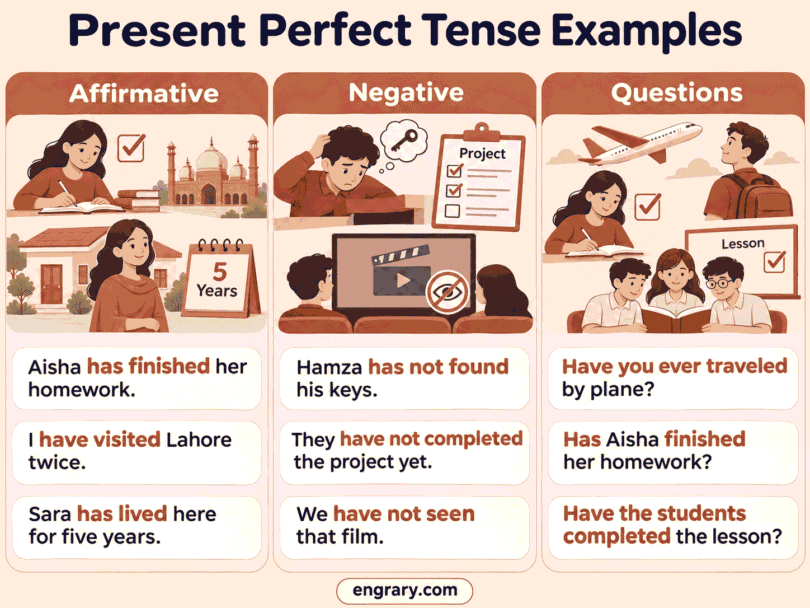
Present perfect tense examples show how English connects an earlier action, experience, or state with the present. The tense uses have or has followed by a past participle, as in I have finished, she has written, and they have arrived. Depending on the context, it can express a current result, a life experience, a continuing situation, or an action within an unfinished period.
Below are 130 present perfect examples arranged by sentence form and meaning. The collection includes affirmative statements, negatives, yes-or-no questions, Wh-questions, recent actions, experiences, duration, repeated events, and present results. In addition, the supporting tables compare related forms and correct common mistakes.
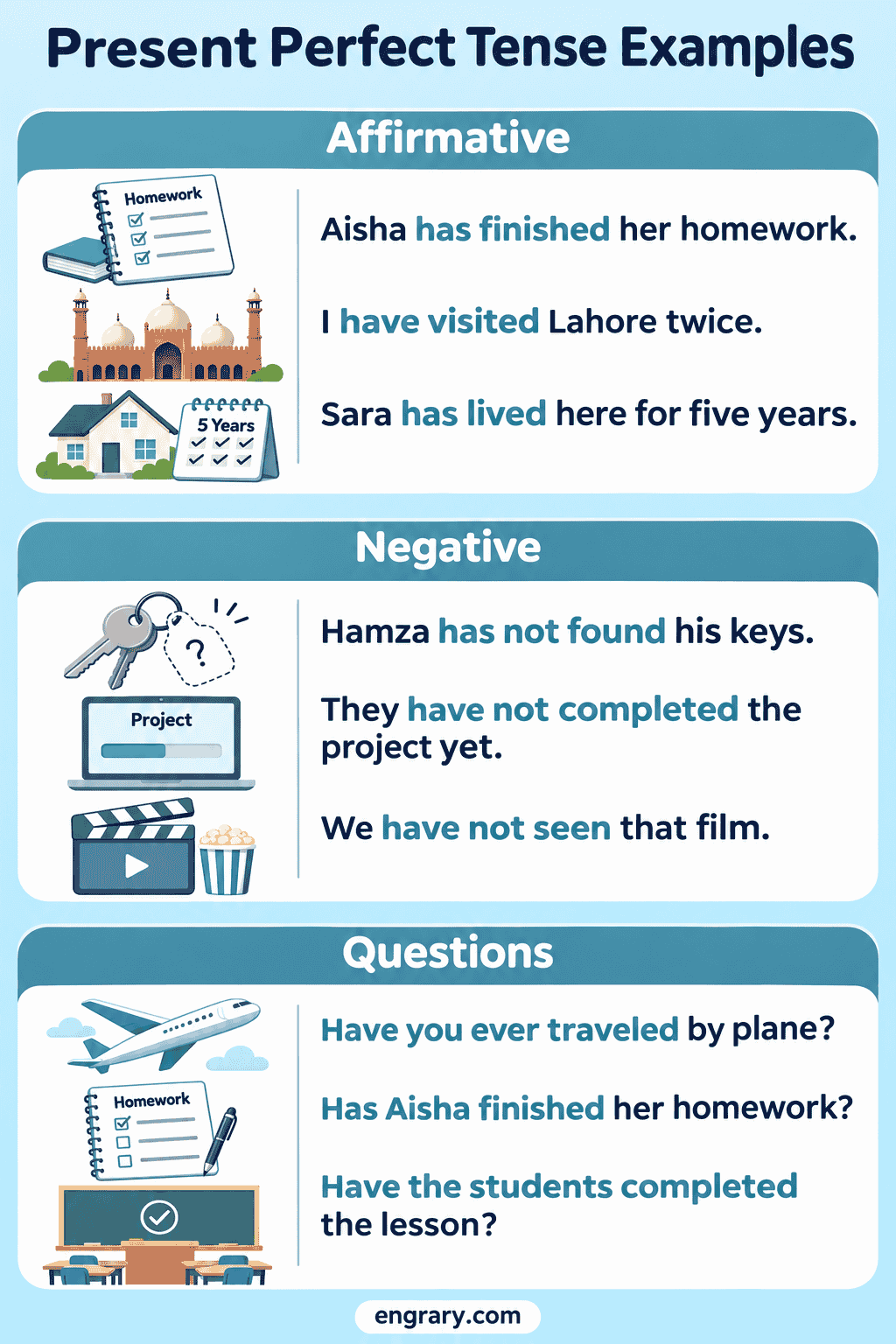
Present Perfect Tense Examples at a Glance
The present perfect looks back from now to an earlier time. Therefore, the exact past time is often unstated because the speaker focuses on the current connection.
| Point | Structure or example |
|---|---|
| Basic structure | Subject + have/has + past participle |
| Affirmative | She has completed the report. |
| Negative | She hasn’t completed the report. |
| Question | Has she completed the report? |
| Short answer | Yes, she has. / No, she hasn’t. |
| Main idea | An earlier action or state connects with the present. |
Use have with I, you, we, and they. However, use has with he, she, it, and singular nouns. In both cases, the main verb must appear as a past participle.
Structure Used in Present Perfect Sentences
| Sentence type | Structure | Example |
|---|---|---|
| Affirmative | Subject + have/has + past participle | They have arrived. |
| Negative | Subject + haven’t/hasn’t + past participle | They haven’t arrived. |
| Yes-or-no question | Have/Has + subject + past participle? | Have they arrived? |
| Wh-question | Wh-word + have/has + subject + past participle? | Where have they gone? |
| Negative question | Haven’t/Hasn’t + subject + past participle? | Haven’t they arrived? |
130 Present Perfect Tense Examples
Every numbered item below contains a genuine present perfect construction. Moreover, the examples use varied subjects, contexts, and past participles so that learners can recognize the tense in natural English.
Common Present Perfect Examples
These common sentences introduce the tense through everyday situations.
- I have finished my breakfast.
- She has cleaned the kitchen.
- We have packed our bags for the trip.
- Hamza has found his missing notebook.
- The children have gone to bed.
- My sister has started a new job.
- They have moved into a larger apartment.
- The bus has arrived at the station.
- You have made excellent progress this term.
- Our teacher has explained the lesson clearly.
- I have saved enough money for a new laptop.
- The shop has closed for the day.
- We have booked our train tickets.
- My phone has stopped working.
- The weather has become much cooler.
Affirmative Present Perfect Sentences
Affirmative examples confirm that an action, event, or change has occurred.
- I have completed all my assignments.
- Ayesha has written three articles this month.
- We have planted vegetables in the garden.
- The company has opened a new office in Karachi.
- He has learned how to repair bicycles.
- Our neighbors have bought an electric car.
- The baby has fallen asleep.
- Scientists have developed a faster testing method.
- You have improved your pronunciation considerably.
- My parents have renovated their house.
- The team has won four matches this season.
- I have read every chapter in the book.
- The city has built two new public libraries.
- She has chosen a practical research topic.
- We have received your application.
Negative Present Perfect Sentences
Negative sentences use have not, has not, haven’t, or hasn’t before the past participle.
- I haven’t checked my email yet.
- She hasn’t replied to the invitation.
- We have not decided where to stay.
- The train hasn’t left the platform.
- He has never driven in heavy snow.
- They haven’t completed the bridge repairs.
- My brother hasn’t seen this film.
- The rain has not stopped since morning.
- You haven’t answered my question.
- The clinic hasn’t received the test results.
- I have never forgotten her kindness.
- Our class hasn’t studied that chapter yet.
- Sara still hasn’t found her glasses.
- The mechanic hasn’t fixed the engine.
- We haven’t had any problems so far.
Yes-or-No Questions
Yes-or-no questions place have or has before the subject.
- Have you finished your homework?
- Has Bilal called the customer?
- Have they reached the hotel safely?
- Has the meeting started yet?
- Have we chosen the right route?
- Has your sister ever visited Peshawar?
- Have the students submitted their projects?
- Has the temperature dropped since noon?
- Have I explained the process clearly?
- Has this medicine helped you?
Wh-Questions
Wh-questions ask for specific information about a present perfect action or situation.
- Where have you put the house keys?
- Why has the computer stopped responding?
- What have they discussed at the meeting?
- Who has taken my blue pen?
- How many countries has she visited?
- How long have you known your best friend?
- Which design has the client selected?
- How much money have we raised so far?
- What has changed since your last visit?
- Why haven’t the lights come on?
Present Perfect Examples for Life Experiences
Life-experience examples do not state a specific finished time. Instead, they describe what someone has or has not experienced up to now.
- I have travelled by train across Pakistan several times.
- She has never tasted dragon fruit.
- Have you ever spoken in front of a large audience?
- My cousins have climbed several high mountains.
- Ahmed has visited Türkiye twice.
- We have never stayed in a desert camp.
- Has your mother ever learned another language?
- I have met people from many different cultures.
- They have seen the northern lights once.
- Our teacher has taught students from five countries.
- Have you ever ridden a horse on a beach?
- Sana has not travelled abroad before.
Examples with Just, Already, and Yet
Just describes a very recent action, already shows earlier-than-expected completion, and yet commonly appears in questions and negatives about expected events.
- The guests have just arrived.
- I have just sent the revised document.
- The rain has just started.
- She has just returned from the pharmacy.
- We have already paid the electricity bill.
- Hamid has already reserved a table.
- The children have already eaten dinner.
- Our manager has already approved the request.
- I haven’t received the parcel yet.
- Has the doctor called you yet?
- They haven’t announced the results yet.
- Has your brother finished university yet?
Examples with For and Since
Use for with a period of time and since with a starting point. Additionally, since can introduce a clause describing when the situation began.
- I have lived in this neighborhood for eight years.
- She has worked at the hospital since 2021.
- We have known each other since primary school.
- The museum has remained closed for three months.
- He has owned this shop since his father retired.
- They have been married for twenty-five years.
- My aunt has taught English since she graduated.
- The village has needed a new bridge for a long time.
- How long have you had this camera?
- I have wanted to read that novel since January.
- Our family has used the same recipe for generations.
- Business has improved since the store launched its website.
Present Perfect Examples with Current Results
In these examples, an earlier event produces a visible or important result now.
- I have lost my wallet, so I cannot pay for lunch.
- She has broken her glasses, so she cannot read the sign.
- The rain has flooded the road, so traffic cannot pass.
- Someone has locked the door, so we cannot enter.
- The baby has fallen asleep, so please lower your voice.
- We have missed the bus, so we need to call a taxi.
- He has forgotten his password, so he cannot sign in.
- The wind has damaged the roof, so water is entering the house.
- I have left my notebook at home, so I cannot show you the figures.
- The printer has run out of paper, so we cannot print the report.
Examples for Repeated Actions and Unfinished Time
These sentences refer to repeated events or periods that still include the present.
- He has called me three times today.
- We have attended two workshops this week.
- The machine has stopped twice this morning.
- She has read six novels this year.
- Our team has completed four tasks so far.
- I have visited my grandparents several times this month.
- The school has organized three community events this term.
- Temperatures have risen steadily over the past few weeks.
Examples for Changes, Achievements, and First-Time Experiences
The present perfect can summarize progress, accomplishments, and experiences measured up to now.
- Technology has transformed the way people communicate.
- Our town has grown rapidly during the past decade.
- She has earned three professional qualifications.
- Researchers have discovered a more efficient process.
- This is the first time I have travelled alone.
- It is the best meal we have ever eaten.
Examples with Been, Gone, and Been In
Been to means that someone visited and returned, gone to means that the person remains away, and been in emphasizes time spent in a place.
- I have been to Multan several times.
- Sara has gone to the market, so she is not at home.
- We have been in Islamabad for four days.
- Have your parents ever been to Gilgit?
- The director has gone to a conference and will return on Friday.
Present Perfect Questions with Short Answers
Short answers repeat have or has instead of repeating the past participle.
| Question | Affirmative answer | Negative answer |
|---|---|---|
| Have you finished? | Yes, I have. | No, I haven’t. |
| Has she arrived? | Yes, she has. | No, she hasn’t. |
| Have they eaten? | Yes, they have. | No, they haven’t. |
| Has the rain stopped? | Yes, it has. | No, it hasn’t. |
Negative questions can express surprise, concern, or an expectation. For example, Haven’t you finished yet? suggests that the speaker expected completion earlier.
Examples with Regular and Irregular Verbs
Present perfect sentences always use a past participle. Regular verbs generally add -ed, although their spelling may change. In contrast, irregular verbs use forms that learners must recognize separately.
Regular Past Participles
| Base verb | Past participle | Example |
|---|---|---|
| work | worked | She has worked here since June. |
| finish | finished | We have finished the project. |
| study | studied | He has studied English for two years. |
| stop | stopped | The rain has stopped. |
| live | lived | They have lived here since 2020. |
Irregular Past Participles
| Base verb | Simple past | Past participle | Example |
|---|---|---|---|
| go | went | gone | She has gone home. |
| see | saw | seen | I have seen that film. |
| write | wrote | written | He has written three articles. |
| eat | ate | eaten | They have already eaten. |
| take | took | taken | Someone has taken my seat. |
| know | knew | known | We have known her for years. |
| break | broke | broken | The branch has broken. |
Therefore, use has gone, not has went, and have written, not have wrote.
Present Perfect and Simple Past Examples
The present perfect connects an earlier situation with now, whereas the simple past places an event inside a completed past period.
| Present perfect | Simple past |
|---|---|
| I have visited Islamabad several times. | I visited Islamabad last year. |
| She has completed three lessons today. | She completed three lessons yesterday. |
| We have known each other for years. | We met at university in 2018. |
| He has lost his phone. | He lost his phone on Monday. |
| They have lived here since 2020. | They lived there from 2015 to 2020. |
Expressions such as yesterday, last week, two days ago, and in 2020 identify finished past time. Consequently, they normally require the simple past. However, unfinished periods such as today, this week, and this year can take the present perfect when they still include now.
Present Perfect Simple and Continuous Examples
Both forms connect the past with the present. However, the simple form often focuses on a result, total, completion, or state, while the continuous form emphasizes an activity, process, or duration.
| Present perfect simple | Present perfect continuous |
|---|---|
| She has written five emails. | She has been writing emails for an hour. |
| They have painted the room. | They have been painting the room. |
| He has read three chapters. | He has been reading since breakfast. |
| I have known her for years. | I have been knowing her is normally incorrect. |
Stative verbs such as know, own, believe, and understand usually favor the present perfect simple. Meanwhile, dynamic verbs often allow either form when the intended emphasis differs.
Present Perfect Passive Examples
The present perfect passive emphasizes an action’s receiver or result.
Structure: subject + have/has + been + past participle
| Active sentence | Passive sentence |
|---|---|
| The team has completed the project. | The project has been completed. |
| Someone has stolen my bicycle. | My bicycle has been stolen. |
| They have cancelled the flight. | The flight has been cancelled. |
| Workers have repaired the road. | The road has been repaired. |
Although the form contains two participles, been supports the passive construction, while the final participle names the action.
Common Mistakes in Present Perfect Sentences
The following corrections address errors with auxiliaries, participles, time expressions, and word choice.
| Incorrect | Correct | Explanation |
|---|---|---|
| She has went home. | She has gone home. | Use the past participle after has. |
| He have finished. | He has finished. | Use has with a singular third-person subject. |
| I have seen her yesterday. | I saw her yesterday. | Use the simple past with a finished time. |
| Did you ever visit Japan? | Have you ever visited Japan? | Use the present perfect for an unspecified experience. |
| I live here since 2020. | I have lived here since 2020. | The situation began earlier and continues now. |
| We have waited since two hours. | We have waited for two hours. | Use for with a period. |
| I haven’t never tried it. | I have never tried it. | Avoid a double negative. |
| She has been knowing him for years. | She has known him for years. | Know is normally stative. |
| He has been to the office and is still there. | He has gone to the office and is still there. | Use gone when the person has not returned. |
Present Perfect Sentence Quick Reference
| Feature | Rule or example |
|---|---|
| Affirmative | Subject + have/has + past participle |
| Negative | Subject + haven’t/hasn’t + past participle |
| Question | Have/Has + subject + past participle? |
| Experience | I have visited Türkiye twice. |
| Continuing state | She has lived here for six years. |
| Present result | He has broken his glasses. |
| Recent action | They have just arrived. |
| Unfinished time | We have completed two tasks today. |
| Finished time | Use the simple past. |
FAQs
Examples include I have finished my work, she has travelled abroad, we haven’t received the message, and has he called you? Each sentence contains have or has followed by a past participle and connects an earlier situation with the present.
Affirmative sentences follow subject + have/has + past participle, as in They have arrived. Negative sentences add not after the auxiliary or use haven’t or hasn’t, as in They haven’t arrived and she hasn’t replied.
In a yes-or-no question, place have or has before the subject: Have you finished? In a Wh-question, begin with a question word and then use the auxiliary, subject, and past participle: Where have they gone?
Common expressions include for, since, just, already, yet, ever, never, recently, lately, so far, and up to now. Nevertheless, context determines the tense because the same expression may carry different meanings in different situations.
Present perfect examples connect an earlier action or state with now, while simple-past examples place an event in a completed past period. For instance, I have visited Lahore several times describes experience up to now, whereas I visited Lahore last summer identifies a finished past time.
You May Also Like


Leave a Comment