

Perfect continuous tenses describe activities that began before present, past, or future reference points and continued, repeated, or remained relevant up to those points. They combine a form of have, the past participle been, and the -ing form of the main verb, as in has been studying, had been studying, and will have been studying.
Below are 120 perfect continuous tense examples divided equally among the present, past, and future forms. The collection includes affirmative sentences, negative sentences, yes/no questions, wh-questions, and short answers. In addition, comparison tables explain duration, reference points, stative verbs, and common errors.
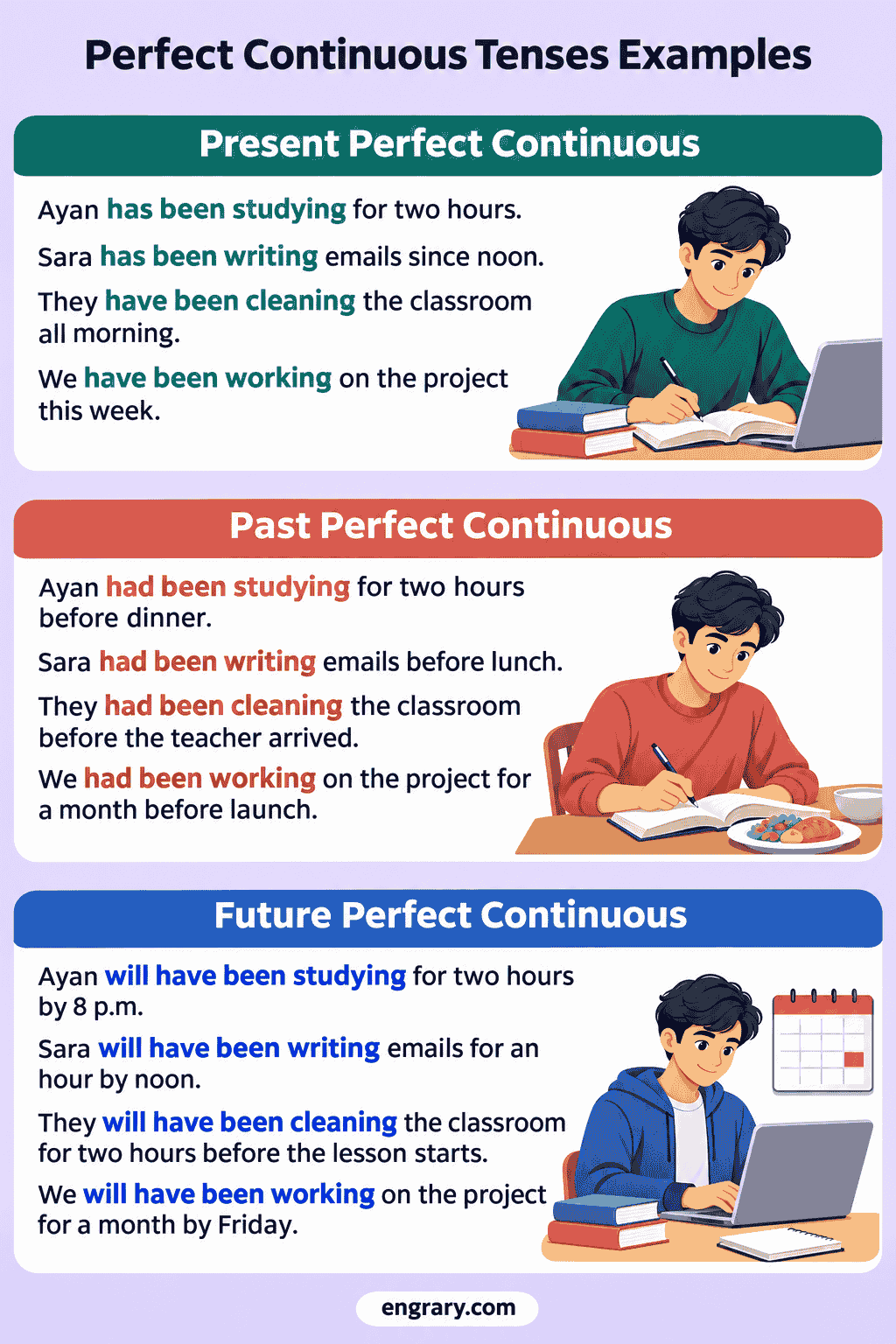
Perfect Continuous Tense Examples at a Glance
Perfect continuous forms combine the perfect and continuous aspects. The perfect aspect connects an earlier activity to a later reference point, while the continuous aspect emphasizes activity, repetition, development, or duration.
| Tense | Structure | Reference point | Main meaning | Example |
|---|---|---|---|---|
| Present perfect continuous | have/has been + verb-ing | Now | Activity continuing or relevant up to now | She has been studying for two hours. |
| Past perfect continuous | had been + verb-ing | A past point | Activity continuing before a later past point | She had been studying before dinner. |
| Future perfect continuous | will have been + verb-ing | A future point | Duration continuing up to a future point | She will have been studying for two hours by dinner. |
Use this memory guide:
- Have/has been + verb-ing refers to activity before and up to now.
- Had been + verb-ing refers to activity before and up to a past point.
- Will have been + verb-ing refers to activity continuing up to a future point.
The terms perfect continuous and perfect progressive refer to the same forms. British grammar materials often prefer continuous, whereas American materials frequently use progressive.
Structures of Perfect Continuous Tenses
Affirmative Structures
| Tense | Structure | Example |
|---|---|---|
| Present perfect continuous | Subject + have/has + been + verb-ing | They have been waiting. |
| Past perfect continuous | Subject + had + been + verb-ing | They had been waiting. |
| Future perfect continuous | Subject + will have + been + verb-ing | They will have been waiting. |
Negative Structures
| Tense | Structure | Example |
|---|---|---|
| Present perfect continuous | Subject + have/has not + been + verb-ing | They have not been waiting. |
| Past perfect continuous | Subject + had not + been + verb-ing | They had not been waiting. |
| Future perfect continuous | Subject + will not have + been + verb-ing | They will not have been waiting. |
Question Structures
| Tense | Structure | Example |
|---|---|---|
| Present perfect continuous | Have/Has + subject + been + verb-ing? | Have they been waiting? |
| Past perfect continuous | Had + subject + been + verb-ing? | Had they been waiting? |
| Future perfect continuous | Will + subject + have + been + verb-ing? | Will they have been waiting? |
Short Answers
| Tense | Positive answer | Negative answer |
|---|---|---|
| Present perfect continuous | Yes, they have. | No, they haven’t. |
| Past perfect continuous | Yes, they had. | No, they hadn’t. |
| Future perfect continuous | Yes, they will. | No, they won’t. |
Every perfect continuous form contains been, and the main verb always takes its -ing form. To form a question, move the first auxiliary before the subject. Similarly, place not after the first auxiliary to form a negative. Do not add do, does, or did.
Negative Questions
| Tense | Full form | Contracted form |
|---|---|---|
| Present perfect continuous | Has she not been studying? | Hasn’t she been studying? |
| Past perfect continuous | Had they not been waiting? | Hadn’t they been waiting? |
| Future perfect continuous | Will he not have been working? | Won’t he have been working? |
Negative questions can express surprise, expectation, or a request for confirmation.
Formation of the -ing Form
The final verb in a perfect continuous construction takes its present-participle or -ing form.
| Spelling rule | Base verb | -ing form |
|---|---|---|
| Add -ing | work | working |
| Remove final silent e | write | writing |
| Keep final double e | see | seeing |
| Double the final consonant | run | running |
| Change ie to y | lie | lying |
| Keep final y | study | studying |
| Do not double final w | snow | snowing |
| Do not double final x | fix | fixing |
American English generally uses traveling, while British English often uses travelling. Both spellings are correct within their respective systems.
Contractions in Perfect Continuous Forms
| Full form | Contraction | Example |
|---|---|---|
| I have been | I’ve been | I’ve been reading. |
| She has been | She’s been | She’s been studying. |
| He has not been | He hasn’t been | He hasn’t been sleeping well. |
| We have not been | We haven’t been | We haven’t been waiting long. |
| They had been | They’d been | They’d been working all day. |
| She had not been | She hadn’t been | She hadn’t been feeling well. |
| I will have been | I’ll have been | I’ll have been working for six hours. |
| They will not have been | They won’t have been | They won’t have been waiting long. |
The contraction she’s can mean she is or she has. The following word reveals the meaning: She’s working means she is working, while She’s been working means she has been working. Likewise, she’d can mean she had or she would.
40 Present Perfect Continuous Examples
The present perfect continuous connects an activity to now. It can describe an activity that continues, one that recently stopped, repeated behavior, a temporary situation, or a developing trend.
Affirmative Present Perfect Continuous Sentences
- I have been learning Spanish for six months.
- Sana has been preparing for her examination all week.
- The children have been playing in the garden since breakfast.
- It has been raining, so the roads are wet.
- Customers have been reporting the same problem lately.
- My brother has been looking for a new apartment.
- Prices have been rising steadily this year.
- The mechanic has been checking the engine for an hour.
- We have been discussing the new plan recently.
- Nadia has been working from home this month.
- The farmers have been growing vegetables on this land for years.
- You have been improving your pronunciation quickly.
- The company has been developing a new mobile application.
- I have been exercising regularly since January.
- Our neighbors have been renovating their house all summer.
- The baby has been sleeping peacefully for two hours.
- Scientists have been investigating the cause of the problem.
- She has been calling the support team every morning.
- The river has been rising since the heavy rain began.
- Community volunteers have been cleaning the park today.
These examples express duration, repetition, temporary situations, and current development. Example 4 may describe rain that continues or rain that has just stopped and left wet roads.
Negative Present Perfect Continuous Sentences
- I have not been sleeping well lately.
- She hasn’t been attending her evening classes.
- The printer hasn’t been working properly since Monday.
- We haven’t been watching much television recently.
- Ahmed has not been feeling well today.
- They have not been following the new procedure.
- My phone hasn’t been charging correctly this week.
- The students haven’t been practicing their pronunciation regularly.
- He has not been answering my messages.
- The buses haven’t been running on time lately.
Present Perfect Continuous Questions and Short Answers
- Have you been waiting long? No, I haven’t.
- Has she been working from home? Yes, she has.
- How long have they been living here? They have been living here for four years.
- Have the students been practicing regularly? Yes, they have.
- Why has he been calling you? He has been asking about the project.
- Has it been raining all morning? No, it hasn’t.
- What have you been reading lately? I have been reading a history book.
- Where has the dog been hiding? It has been hiding under the table.
- Since when have you been managing this office? I have been managing it since March.
- Has the technician been repairing the computer? Yes, she has.
In these questions, how long and since when ask about duration or starting points. Meanwhile, why often asks about repeated behavior or evidence visible now.
Recently Stopped Activities with Present Results
| Activity | Present evidence |
|---|---|
| She has been running. | She is out of breath. |
| It has been raining. | The ground is wet. |
| He has been painting. | His hands are covered in paint. |
| They have been cooking. | The kitchen smells wonderful. |
Therefore, the present perfect continuous does not always describe an unfinished activity.
Finished Past-Time Restrictions
The present perfect continuous normally avoids expressions that identify a finished past period.
| Incorrect | Correct |
|---|---|
| I have been studying yesterday. | I studied yesterday. |
| She has been working last week. | She worked last week. |
| They have been traveling in 2020. | They traveled in 2020. |
40 Past Perfect Continuous Examples
The past perfect continuous describes an activity leading up to another past event or reference point. It often emphasizes duration, explains a past result, or provides background information in a narrative.
Affirmative Past Perfect Continuous Sentences
- The farmers had been working since sunrise before the rain started.
- Fatima had been studying for hours when her friend called.
- We had been driving for a long time before we found a hotel.
- The dog was muddy because it had been running through the garden.
- He had been teaching at the college before he moved abroad.
- The company had been losing customers for several months.
- They had been building the bridge for a year when funding stopped.
- I had been trying to contact you before my phone died.
- The road was flooded because it had been raining all night.
- She had been staying with relatives before she rented an apartment.
- The athletes had been training together before the competition began.
- Someone had been leaving anonymous messages on his phone.
- The children had been sleeping when the alarm sounded.
- Engineers had been testing the system before the power failed.
- We had been meeting every Friday until the office closed.
- The patient had been recovering steadily before the infection returned.
- Her eyes were tired because she had been reading for hours.
- The team had been discussing the proposal before the manager arrived.
- Local businesses had been expanding until the economy slowed.
- He had been practicing the speech before the microphone stopped working.
Negative Past Perfect Continuous Sentences
- She had not been working there for very long when she received a promotion.
- We hadn’t been expecting so many guests.
- The machine hadn’t been operating properly before it stopped.
- The children had not been sleeping well before the holiday.
- He hadn’t been exercising regularly, so the race felt difficult.
- They had not been following the safety instructions.
- I hadn’t been using the computer before it crashed.
- The school had not been offering evening classes until that year.
- She hadn’t been checking her email while she was traveling.
- The workers had not been wearing protective gloves before the inspection.
Past Perfect Continuous Questions and Short Answers
- Had you been waiting long when the bus arrived? Yes, I had.
- Had she been feeling ill before the meeting? No, she hadn’t.
- How long had they been traveling before they rested? They had been traveling for eight hours.
- Had the workers been repairing the roof? Yes, they had.
- Why had he been avoiding the manager? He had been worrying about the deadline.
- Had it been raining before you left? No, it hadn’t.
- What had the researchers been studying before the project ended? They had been studying water quality.
- Where had the children been playing before dinner? They had been playing near the river.
- How long had she been teaching before she retired? She had been teaching for thirty years.
- Had the company been developing that product for long? No, it hadn’t.
Past perfect continuous questions commonly pair with a later simple-past event. For example, How long had they been waiting when the bus arrived? places the waiting before the arrival.
40 Future Perfect Continuous Examples
The future perfect continuous measures an activity or its duration up to a future point. It appears most naturally with work anniversaries, study milestones, travel duration, long projects, training periods, and waiting times.
Affirmative Future Perfect Continuous Sentences
- By July, I will have been studying English for three years.
- Next week, she will have been working here for six months.
- By noon, the crew will have been traveling for ten hours.
- They will have been living in Karachi for a decade by 2030.
- By the end of the season, the players will have been training together for a year.
- When you arrive, I will have been cooking for two hours.
- By Friday, the researchers will have been collecting data for a month.
- In December, he will have been running the business for twenty years.
- By sunset, the hikers will have been walking for nine hours.
- Next January, my mother will have been teaching for twenty-five years.
- By the review meeting, the engineers will have been testing the system for six weeks.
- The builders will have been constructing the hospital for two years by May.
- By graduation, Mariam will have been studying medicine for five years.
- When the doors open, the crowd will have been waiting since dawn.
- By the end of the month, we will have been using the new software for a year.
- In June, the volunteers will have been serving the community for a decade.
- By midnight, it will have been raining for twelve hours.
- When the train reaches Lahore, the passengers will have been traveling all night.
- By the final match, the team will have been practicing together for eight months.
- Next summer, the scientists will have been researching the disease for fifteen years.
Negative Future Perfect Continuous Sentences
- I will not have been working here for a full year until September.
- She won’t have been studying for very long when the test begins.
- We won’t have been waiting long when the doors open.
- They will not have been traveling for twelve hours by noon.
- The builders will not have been working on the site for a year by May.
- He won’t have been teaching for ten years until next January.
- The researchers will not have been collecting data long enough by Friday.
- I won’t have been living here for five years by December.
- The athletes will not have been training together for a full season by the final.
- The company won’t have been operating in the city for a decade until 2032.
Future Perfect Continuous Questions and Short Answers
- Will you have been living here for five years by June? Yes, I will.
- Will she have been working all day by then? No, she won’t.
- How long will they have been traveling by noon? They will have been traveling for eight hours.
- Will the team have been training for a year by the final? Yes, it will.
- How long will he have been studying medicine by graduation? He will have been studying it for five years.
- Will we have been waiting for more than an hour? No, we won’t.
- What will the scientists have been researching for a decade by then? They will have been researching renewable energy.
- Where will you have been working for five years by March? I will have been working at the city hospital.
- Will the builders have been constructing the bridge for two years by May? Yes, they will.
- Since when will she have been managing the branch by December? She will have been managing it since June.
Future Perfect Continuous Usage Notes
The future perfect continuous occurs less often than the present and past forms. It usually needs a stated duration or a clear future endpoint. Moreover, the activity may begin now or later in the future.
Use the form when duration matters:
By June, she will have been teaching for ten years.
Choose a simpler future form when duration does not matter:
She will teach a lesson tomorrow.
English can also use be going to have been, although this pattern is less common:
By the time the plane arrives, we are going to have been waiting for five hours.
Examples with For, Since, and How Long
| Expression | Function | Present example | Past example | Future example |
|---|---|---|---|---|
| for | Introduces duration | She has been reading for two hours. | She had been reading for two hours before dinner. | She will have been reading for two hours by dinner. |
| since | Introduces a starting point | He has been working since Monday. | He had been working since Monday when the office closed. | By Friday, he will have been working since Monday. |
| how long | Asks about duration | How long have you been waiting? | How long had you been waiting? | How long will you have been waiting by noon? |
For introduces a length of time, whereas since introduces a starting point. Meanwhile, how long asks about duration. Since can also introduce a clause: They have been waiting since the shop opened.
Common Errors with For and Since
| Incorrect | Correct | Reason |
|---|---|---|
| She has been studying since three hours. | She has been studying for three hours. | Use for with duration. |
| He has been working for Monday. | He has been working since Monday. | Use since with a starting point. |
| They had been waiting since two hours. | They had been waiting for two hours. | Two hours expresses duration. |
Common Time Expressions by Tense
| Present | Past | Future |
|---|---|---|
| lately | before | by |
| recently | when | by then |
| this week | until then | by next year |
| today | by the time | by the time |
| for | for | for |
| since | since | since |
| how long | how long | how long |
These expressions provide clues, but they do not select a tense automatically. The intended reference point still determines the correct form.
The Same Activity Across All Three Forms
| Present perfect continuous | Past perfect continuous | Future perfect continuous |
|---|---|---|
| I have been waiting for an hour. | I had been waiting for an hour before the bus arrived. | I will have been waiting for an hour by noon. |
| She has been studying since breakfast. | She had been studying before her friend called. | She will have been studying for four hours by lunch. |
| They have been building the house for months. | They had been building it before funding stopped. | They will have been building it for a year by June. |
| He has been teaching since 2015. | He had been teaching for ten years before becoming principal. | He will have been teaching for twenty years by 2035. |
| We have been traveling all day. | We had been traveling for hours before we rested. | We will have been traveling for ten hours by sunset. |
Perfect Continuous Tenses in a Short Paragraph
Hira has been preparing for an important presentation all week. Before meeting her teacher yesterday, she had been researching the topic for several days and had been organizing her notes into sections. By the time she presents it on Friday, she will have been working on the project for nearly two weeks.
| Verb phrase | Tense | Reference point | Meaning |
|---|---|---|---|
| has been preparing | Present perfect continuous | Now | Preparation has continued up to now. |
| had been researching | Past perfect continuous | Yesterday’s meeting | Research continued before the meeting. |
| had been organizing | Past perfect continuous | Yesterday’s meeting | Organization occurred over an earlier period. |
| will have been working | Future perfect continuous | Friday | The activity will reach a duration of nearly two weeks. |
Perfect Continuous and Perfect Simple Examples
| Perfect continuous | Perfect simple | Difference |
|---|---|---|
| She has been writing all morning. | She has written five pages. | Activity or duration versus quantity |
| He had been repairing the car. | He had repaired the car. | Earlier process versus completed result |
| They will have been building for a year. | They will have built the house. | Future duration versus future completion |
| I have been cleaning the kitchen. | I have cleaned the kitchen. | Recent activity versus completed result |
| They have been calling customers. | They have called fifty customers. | Repeated process versus total number |
Perfect simple forms commonly emphasize results, quantities, achievements, or states. In contrast, perfect continuous forms emphasize activities, processes, repetition, or duration. However, a perfect continuous form does not always describe an unfinished activity; a recently stopped activity can still leave visible evidence.
Perfect Continuous and Ordinary Continuous Examples
| Ordinary continuous | Perfect continuous | Difference |
|---|---|---|
| She is studying. | She has been studying for two hours. | Activity now versus activity leading up to now |
| She was studying. | She had been studying before dinner. | Activity at a past point versus activity leading up to it |
| She will be studying at eight. | She will have been studying for two hours by eight. | Activity at a future point versus duration leading up to it |
Stative Verbs in Perfect Continuous Sentences
Stative verbs normally describe states rather than activities. Therefore, they usually take perfect simple forms.
Common stative verbs include:
- know
- believe
- understand
- own
- belong
- need
- want
- prefer
- remember
- seem
- contain
- consist
Stative-Verb Corrections
| Incorrect | Correct |
|---|---|
| I have been knowing her for years. | I have known her for years. |
| He had been owning the house since 2010. | He had owned the house since 2010. |
| She has been wanting a new phone. | She has wanted a new phone. |
| We had been understanding the problem. | We had understood the problem. |
Some verbs can express a state or an activity, so their meanings determine the form.
| Stative meaning | Dynamic meaning |
|---|---|
| I have had this car for years. | I have been having problems with the engine. |
| She has thought that for years. | She has been thinking about the offer. |
Been and Being
Learners sometimes confuse these two forms of be.
- Been appears in perfect constructions: She has been working.
- Being appears in continuous forms of be or passive constructions: The road is being repaired.
- Incorrect: She has being working.
- Correct: She has been working.
Passive Perfect Continuous Forms
Passive perfect continuous forms are grammatically possible, but they usually sound awkward. Therefore, active wording or another structure often communicates the meaning more clearly.
| Awkward form | Natural alternative |
|---|---|
| The road has been being repaired. | Workers have been repairing the road. |
| The building had been being renovated. | The building had been under renovation. |
| The system will have been being tested. | Engineers will have been testing the system. |
Common Errors in Perfect Continuous Sentences
| Incorrect sentence | Correct sentence | Explanation |
|---|---|---|
| She has been work all day. | She has been working all day. | Use an -ing verb after been. |
| They have being waiting. | They have been waiting. | Use the past participle been. |
| He had been waited for an hour. | He had been waiting for an hour. | Use a present participle after been. |
| I will have being studying. | I will have been studying. | Use the sequence will have been. |
| She has been studying since three hours. | She has been studying for three hours. | Use for with duration. |
| We have been living here for Monday. | We have been living here since Monday. | Use since with a starting point. |
| I have been knowing him for years. | I have known him for years. | Know is normally stative. |
| Did they have been working? | Had they been working? | Do not use did. |
| Has she been work here? | Has she been working here? | Use the -ing form. |
| By the time she will arrive, we will have been waiting for an hour. | By the time she arrives, we will have been waiting for an hour. | Use the present simple in a future time clause. |
Tips for Recognizing Perfect Continuous Forms
- First, find a form of have.
- Next, check for the word been.
- Confirm that an -ing verb follows been.
- Identify the present, past, or future reference point.
- Look for duration, repetition, activity, development, or visible evidence.
- Use for with duration and since with a starting point.
- Check whether a stative verb requires a perfect simple form.
- Do not use will inside most future time clauses.
- Finally, compare the intended focus: activity and duration or result and quantity.
FAQs
The three forms are the present perfect continuous, past perfect continuous, and future perfect continuous. The present form connects an activity to now, the past form connects it to a later past point, and the future form measures its duration up to a future point.
Every perfect continuous form contains a form of have, followed by been and the -ing form of the main verb. The three patterns are have/has been working, had been working, and will have been working.
No. They often describe activities continuing at the reference point, but they can also describe recently stopped activities with visible results. For example, The ground is wet because it has been raining remains natural even if the rain has stopped.
For introduces a duration, while since introduces a starting point. For example, She has been studying for three hours identifies the length of the activity, whereas She has been studying since noon identifies when it began.
Perfect simple forms commonly emphasize a result, quantity, achievement, or state. In contrast, perfect continuous forms emphasize an activity, process, repetition, or duration. For example, She has written five pages focuses on quantity, while She has been writing all morning focuses on the activity.
You May Also Like

Leave a Comment