
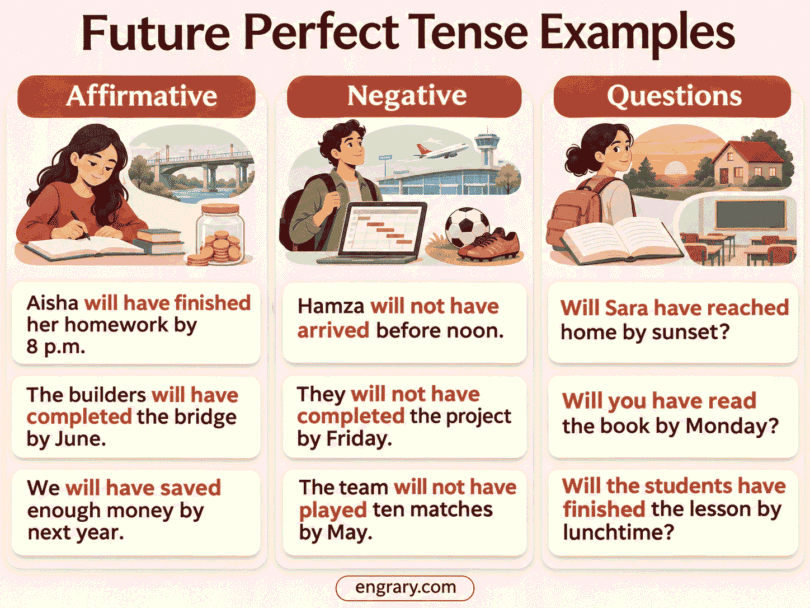
The future perfect tense describes an action, event, or state that will be complete before a particular future time or another future event. It uses will have + past participle, as in will have finished, will have written, and will have gone. The speaker moves mentally to a future reference point and looks back at what will already be complete.
Below are 140 future perfect tense examples in sentences, organized by form and meaning. In addition to affirmative statements, negatives, questions, time markers, goals, duration, predictions, and passive constructions, the guide explains reference points, adverb placement, related forms, and common errors.
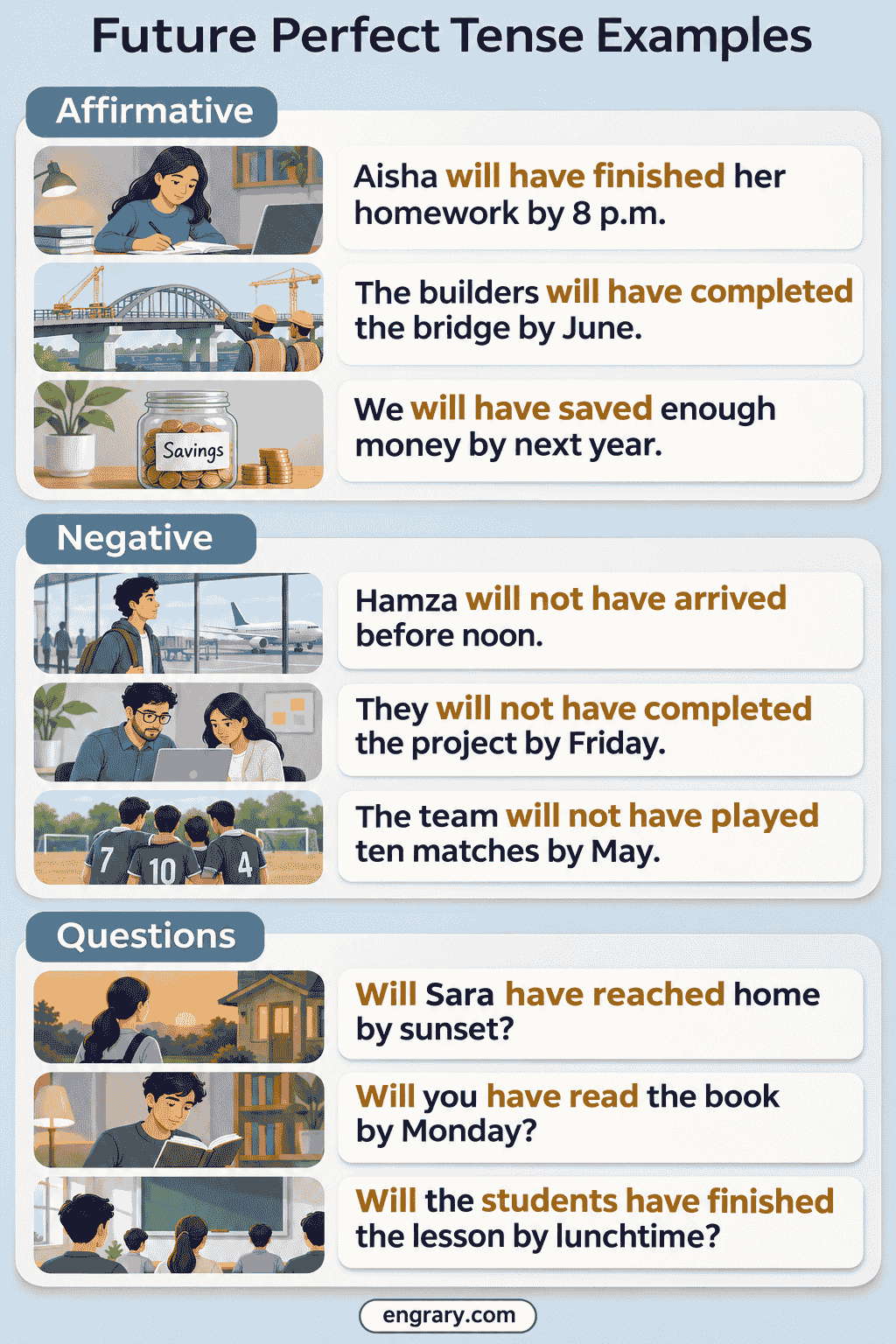
Future Perfect Tense Examples at a Glance
The future perfect connects an earlier future action to a later future reference point. For example, in By Friday, Lina will have submitted the report, the submission will occur no later than Friday.
| Sentence type | Structure | Example |
|---|---|---|
| Affirmative | Subject + will have + past participle | Lina will have finished by Friday. |
| Negative | Subject + will not have + past participle | Lina will not have finished by Friday. |
| Yes-or-no question | Will + subject + have + past participle? | Will Lina have finished by Friday? |
| Wh-question | Wh-word + will + subject + have + past participle? | When will Lina have finished? |
| Passive | Subject + will have been + past participle | The work will have been finished. |
The future reference point may appear directly in the sentence, or the surrounding context may establish it. However, isolated examples usually sound clearest when they include a deadline, another future event, or an expression such as by then.
Structure Used in Future Perfect Sentences
Both will and have remain unchanged with every subject. The main verb, meanwhile, takes its past-participle form.
| Function | Formula | Model sentence |
|---|---|---|
| Statement | Subject + will have + past participle | They will have arrived by noon. |
| Negative | Subject + will not have + past participle | They will not have arrived by noon. |
| Question | Will + subject + have + past participle? | Will they have arrived by noon? |
| Short answer | Yes, subject + will. / No, subject + won’t. | Yes, they will. |
| Passive | Subject + will have been + past participle | The parcel will have been delivered. |
In everyday English, contractions such as I’ll have, she’ll have, they’ll have, and won’t have sound natural. Therefore, the examples below use both full and contracted forms.
140 Future Perfect Tense Examples
Common Future Perfect Examples
- I will have finished my homework by eight o’clock.
- Maya will have cooked dinner before the guests arrive.
- They will have completed the project by Friday.
- We will have reached the airport before rush hour begins.
- Omar will have read the entire book by Monday.
- My sister will have saved enough money for the laptop by June.
- The manager will have reviewed the proposal before the meeting starts.
- The courier will have delivered the parcel by tomorrow afternoon.
- Our class will have taken the final exam by this time next week.
- The children will have gone to bed before their parents return.
- I’ll have cleaned the kitchen by the time you get home.
- The mechanic will have repaired the car before our trip begins.
Affirmative Future Perfect Sentences
- Sara will have completed her degree by next summer.
- The workers will have built the new entrance by the end of May.
- He will have written six reports before the quarter ends.
- We’ll have chosen a venue by tomorrow evening.
- The gardeners will have planted every tree before the rainy season begins.
- Aisha will have learned the basic commands by the end of the course.
- The research team will have collected enough data by September.
- My parents will have returned from their journey before the festival.
- The store will have opened its second branch by next year.
- Daniel will have paid the final instalment by December.
- The chef will have prepared all the dishes before the doors open.
- By sunrise, the rescue team will have crossed the mountain pass.
- You’ll have received the confirmation email within twenty-four hours.
- The software will have become more stable after the next update.
- By the end of the season, the young player will have broken several records.
- Our neighbours will have moved into their new house before school begins.
Negative Future Perfect Sentences
- I will not have completed the application by noon.
- Nadia won’t have reached the station before the last train leaves.
- The builders will not have finished the roof by Friday.
- We won’t have saved enough money by the end of this month.
- The students will not have read every chapter before the test.
- He won’t have recovered fully by the first match of the season.
- The shop will not have received the new stock before Monday.
- They won’t have solved every technical problem by launch day.
- My brother will not have learned to drive before he starts university.
- The river won’t have returned to its normal level by tomorrow morning.
- By Friday, the committee will still not have reached a decision.
- At noon, the parcel will still not have arrived.
- She won’t have completed the training until the final assessment ends.
- The museum will not have reopened by the time the tourists arrive.
Yes-or-No Questions
- Will you have submitted the assignment by Friday?
- Will Fatima have arrived before the ceremony begins?
- Will they have repaired the road by next month?
- Will the children have eaten dinner before the film starts?
- Will we have saved enough money by the end of the year?
- Will the doctor have received the test results by tomorrow?
- Will your team have completed the survey within two weeks?
- Will the train have left by the time we reach the platform?
- Will he have read all the instructions before assembling the desk?
- Will the snow have melted by early spring?
Wh-Questions
- When will you have completed the renovation?
- How many chapters will Lina have written by June?
- How much money will the charity have raised by Friday?
- Where will the expedition have travelled by the end of the month?
- Why will the company have closed the branch before December?
- Who will have approved the final design by tomorrow?
- Which countries will the students have visited before the tour ends?
- How long will you have owned the house by next summer?
- What will the scientists have discovered by the end of the study?
- How often will the team have practised before the championship begins?
Examples with Future Time Markers
- By six o’clock, I will have finished the presentation.
- She will already have left by the time we arrive.
- They will have moved to Lahore by then.
- By tomorrow, the editor will have checked the final draft.
- We will have completed the first phase by next Friday.
- By the end of the year, Karim will have repaid the loan.
- The guests will have arrived before the music begins.
- By the time the sun sets, the hikers will have reached the campsite.
- The technicians will have restored the service within three hours.
- In two years’ time, my cousin will have graduated from university.
- Two weeks from now, the family will have settled into its new home.
- The plane will have just landed when the shuttle reaches the terminal.
- When we meet on Monday, will the council have approved the plan yet?
- By now, the director will have seen our message.
- At nine tomorrow morning, the students will have entered the examination hall.
- By next winter, the village will have had reliable electricity for five years.
Future Goals, Results, and Quantities
- By graduation, Hana will have earned three professional certificates.
- The company will have opened five new branches by 2030.
- By December, I will have saved fifty thousand rupees.
- The author will have published four novels by the end of next year.
- Our reading group will have finished twenty books before summer.
- By the end of the journey, we will have travelled more than 3,000 kilometres.
- The courier will have completed one hundred deliveries by Friday evening.
- By the final round, each team will have played twelve matches.
- The community will have planted ten thousand trees before the campaign ends.
- By next spring, the builders will have completed sixty new homes.
- The hospital will have treated more than a thousand patients by the end of the programme.
- By the final lesson, the students will have mastered fifty new expressions.
- By graduation, Sana will have attended five international conferences.
- The band will have performed in twelve cities by the end of its tour.
Duration and Continuing States
- Next month, we will have lived in this neighbourhood for ten years.
- By June, I will have known Farah for five years.
- In January, my parents will have been married for thirty years.
- By 2030, she will have owned the shop for a decade.
- Next week, Hamid will have belonged to the club for twenty years.
- By the end of this term, the school will have had the same principal for six years.
- In May, I will have been a member of the committee for three years.
- By next winter, they will have had the farm for a full decade.
- When the lease ends, we will have occupied the office for five years.
- By August, the twins will have attended the same school since kindergarten.
- Next Friday, the library will have served the community for fifty years.
- By retirement, Professor Ali will have taught at the university for four decades.
Predictions and Assumptions
- The medicine will probably have reduced the swelling by tomorrow.
- By the next review, the team’s performance will have improved considerably.
- The roads will have become quieter by the morning after the holiday.
- The lake will have frozen completely before the coldest week ends.
- Our sales will certainly have increased by the end of the campaign.
- By the time the backup process finishes, the missing files will have reappeared.
- You will already have heard the announcement.
- They will have arrived at the hotel by now.
- The director will probably have received our letter already.
- Everyone will have noticed the new sign by now.
Passive Future Perfect Sentences
- The bridge will have been completed by July.
- Every application will have been reviewed before Friday.
- The medical supplies will have been delivered by tomorrow morning.
- The damaged road will have been repaired before winter begins.
- The examination results will have been announced by the end of the week.
- The research paper will have been published before the conference.
- All outstanding payments will have been processed by Monday.
- The building will have been inspected before the tenants move in.
- The revised policy will have been approved by the next board meeting.
- The classrooms will have been cleaned before the students return.
Advanced and Contextual Examples
- The guests are arriving at eight, so I’ll have prepared everything before then.
- Call me after the meeting; I will have read the proposal by then.
- We are leaving next Monday, and Zara will have returned before our departure.
- Won’t the train have departed by the time we reach the station?
- Won’t your team have completed the inspection before noon?
- She will have finished the report by Friday, won’t she?
- They won’t have left before the announcement, will they?
- When she retires next month, she will never have taken a day of unpaid leave.
- The scientists will certainly have identified the cause by the next briefing.
- By the time you open this message, I will have boarded the plane.
- I will have boarded the plane by the time you open this message.
- Before the guests enter, the staff will have checked every table.
- The staff will have checked every table before the guests enter.
- By the time the reception begins, the committee will have chosen its new chairperson.
- When the shop closes tonight, we will have served more than five hundred customers.
- As soon as the final bus departs, every passenger will have reached their assigned seat.
Future Perfect Questions with Short Answers
Short answers repeat will or won’t rather than the complete verb phrase. As a result, they sound direct and natural.
| Question | Affirmative answer | Negative answer |
|---|---|---|
| Will she have arrived? | Yes, she will. | No, she won’t. |
| Will they have finished? | Yes, they will. | No, they won’t. |
| Will you have eaten? | Yes, I will. | No, I won’t. |
| Will the shop have closed? | Yes, it will. | No, it won’t. |
Negative questions often express expectation or surprise: Won’t she have arrived by then? Question tags also repeat the auxiliary: She will have finished, won’t she?
Examples with Regular and Irregular Verbs
Regular verbs normally add -ed to form the past participle. In contrast, irregular verbs use forms that learners need to recognize and remember.
| Base verb | Simple past | Past participle | Future perfect example |
|---|---|---|---|
| finish | finished | finished | She will have finished by noon. |
| complete | completed | completed | They will have completed the work. |
| write | wrote | written | He will have written five pages. |
| go | went | gone | We will have gone home. |
| eat | ate | eaten | I will have eaten by then. |
| take | took | taken | She will have taken the test. |
| see | saw | seen | They will have seen the results. |
| build | built | built | The workers will have built the wall. |
Always use the past participle after will have. Therefore, write will have written, not will have wrote, and will have gone, not will have went.
Future Reference Points in Sentences
A future reference point establishes when the speaker will evaluate completion. It may appear directly or come from the surrounding context.
| Reference type | Example |
|---|---|
| Clock time | I will have finished by eight. |
| Date | She will have graduated by June 15. |
| End of a period | They will have moved by the end of May. |
| Another event | We will have eaten before the guests arrive. |
| Future life stage | By thirty, he will have qualified as a doctor. |
| Earlier context | Call after six; I will have finished by then. |
The phrase by Friday means no later than Friday, not necessarily exactly on Friday. Meanwhile, at eight presents eight o’clock as the point from which the speaker views the completed action.
At, By, In, Within, and For with Future Time
These expressions answer different time-related questions.
| Expression | Meaning | Example |
|---|---|---|
| At six | The future reference point itself | At six, I will have finished. |
| By six | Completion no later than six | I will have finished by six. |
| In two hours | At a point two hours from now | In two hours, I will have finished. |
| Within two hours | Before two hours have passed | I will have finished within two hours. |
| For two hours | Duration | By noon, I will have worked for two hours. |
Thus, by establishes a deadline, whereas for introduces duration. Within, on the other hand, sets the maximum amount of time allowed for completion.
By, Until, Before, and By the Time
| Expression | Meaning | Example |
|---|---|---|
| By | Completion no later than a point | I will have finished by six. |
| Until | Continuation up to a point | I will work until six. |
| Not until | No completion before a point | I won’t have finished until six. |
| Before | Completion earlier than another event | I will have finished before you arrive. |
| By the time | Completion viewed from another event | By the time you arrive, I will have finished. |
Use by when completion matters. In contrast, use until when an action continues up to a certain point. For this reason, the future perfect appears more naturally with not until than with affirmative until constructions.
Adverb Placement in Future Perfect Sentences
The position of an adverb affects the rhythm and emphasis of the sentence.
| Adverb | Natural pattern | Example |
|---|---|---|
| Already | will already have + participle | She will already have left. |
| Just | will have just + participle | They will have just arrived. |
| Never | will never have + participle | He will never have seen snow before. |
| Probably | will probably have + participle | The train will probably have departed. |
| Certainly | will certainly have + participle | They will certainly have noticed. |
| Still not | will still not have + participle | She will still not have finished. |
| Yet | Usually at the end | Will they have arrived yet? |
Other placements sometimes occur. However, these patterns provide clear, neutral models for learners.
Will Have Had in Future Perfect Sentences
The phrase will have had is grammatical. Will introduces the construction, the first have forms the perfect, and had serves as the past participle of the main verb have.
- By Friday, I will have had enough time to review the report.
- Next month, she will have had the car for ten years.
- By the final lesson, students will have had several opportunities to practise.
Although the repeated forms may look unusual, each one performs a different grammatical job.
Three Patterns with Will Have Been
The words that follow will have been reveal the intended structure.
| Pattern | Example | Function |
|---|---|---|
| Future perfect of be | She will have been a teacher for twenty years. | Continuing state or role |
| Future perfect passive | The room will have been cleaned. | Completed passive action |
| Future perfect continuous | She will have been teaching for twenty years. | Duration of an activity |
Therefore, will have been does not automatically make a sentence passive or continuous. A noun or adjective can complete the perfect form of be, a past participle creates the passive, and an -ing form creates the continuous.
Future Perfect in Time and Condition Clauses
English normally avoids will in dependent clauses beginning with when, before, once, as soon as, if, and unless. Instead, use the present simple or present perfect when the clause refers to the future.
| Incorrect | Correct |
|---|---|
| By the time you will arrive, we will have eaten. | By the time you arrive, we will have eaten. |
| Once you will have finished, call me. | Once you have finished, call me. |
| If you will have completed it by six, we can leave. | If you have completed it by six, we can leave. |
| Unless they will have inspected it, the building cannot open. | Unless they have inspected it, the building cannot open. |
The present perfect in once you have finished emphasizes completion, but it is not the future perfect because it does not contain will.
Clause Order and Punctuation
Changing the clause order does not change the sequence of events.
| Time clause first | Main clause first |
|---|---|
| By the time you arrive, we will have finished dinner. | We will have finished dinner by the time you arrive. |
| Before the guests enter, the staff will have checked the room. | The staff will have checked the room before the guests enter. |
Use a comma after an introductory time clause. However, writers normally omit the comma when the independent clause comes first.
Future Perfect and Future Simple Examples
The future simple reports a future action, whereas the future perfect views that action as complete from a later future point.
| Future simple | Future perfect | Difference |
|---|---|---|
| She will finish the report tomorrow. | She will have finished the report by tomorrow. | Future action versus prior completion |
| They will move next month. | They will have moved by the end of next month. | Future event versus completed result |
| The meeting will start at ten. | The meeting will have started by ten fifteen. | Starting time versus later viewpoint |
Sometimes both forms work: I will finish before you arrive and I will have finished before you arrive. Nevertheless, the perfect form places stronger emphasis on the completed result.
Future Perfect and Future Perfect Continuous Examples
Both forms look back from a future point, but they emphasize different features.
| Future perfect | Future perfect continuous | Main emphasis |
|---|---|---|
| She will have written five chapters. | She will have been writing for five hours. | Quantity versus duration |
| He will have repaired six bicycles. | He will have been repairing bicycles all morning. | Result versus activity |
| We will have lived here for ten years. | We will have been living here for ten years. | State or accumulated period versus ongoing activity |
State verbs such as know, own, believe, and understand normally use the simple form. Moreover, none of the future perfect continuous examples above belongs to the numbered list of 140 future perfect sentences.
Active and Passive Future Perfect Examples
| Active form | Passive form |
|---|---|
| The staff will have reviewed every application. | Every application will have been reviewed. |
| The builders will have completed the bridge. | The bridge will have been completed. |
| The company will have delivered the equipment. | The equipment will have been delivered. |
The active form emphasizes the performer. By contrast, the passive form focuses on the action or its receiver.
Necessary, Optional, and Unnatural Examples
| Use | Example | Explanation |
|---|---|---|
| Helpful | By Friday, I will have finished the report. | Emphasizes completion before a deadline |
| Optional | I will finish before you arrive. / I will have finished before you arrive. | Both show order; the perfect adds emphasis |
| Unclear without context | I will have eaten tomorrow. | The future viewpoint remains incomplete |
| Clear revision | I will have eaten before the meeting tomorrow. | Adds a meaningful reference point |
Use the tense when completion, quantity, duration, or a future result matters. Otherwise, a simpler future form may communicate the idea more naturally.
Will Have Outside the Future Perfect
Not every sentence containing will have uses the future perfect.
| Pattern | Example | Function |
|---|---|---|
| Will have + noun | She will have a new office. | Simple future possession |
| Will have + past participle | She will have completed the move. | Future perfect |
| Will have + object + adjective | They will have the room ready. | Simple future with a complement |
A true future perfect construction requires a past participle after will have, although an adverb may appear between the auxiliary and participle.
Common Mistakes in Future Perfect Sentences
| Incorrect | Correct | Reason |
|---|---|---|
| She will has finished. | She will have finished. | Have remains unchanged after will. |
| They will have complete it. | They will have completed it. | Use the past participle. |
| He will have went home. | He will have gone home. | Gone is the correct participle. |
| She will have wrote the report. | She will have written the report. | Use written, not wrote. |
| Will she has arrived? | Will she have arrived? | Use have in questions. |
| By the time you will arrive, we will have eaten. | By the time you arrive, we will have eaten. | Use the present simple in the time clause. |
| I will have finished until six. | I will have finished by six. | Use by for a deadline. |
| The bridge will have completed. | The bridge will have been completed. | Passive forms require been. |
In addition, avoid treating every will have phrase as future perfect or placing future perfect continuous sentences in a simple future perfect list.
Future Perfect Sentence Quick Reference
- Use will have + past participle.
- Keep have unchanged with every subject.
- Use will not have or won’t have for negatives.
- Move will before the subject to form questions.
- Use by for deadlines and until for continuation.
- Use the present simple or present perfect in ordinary future time and condition clauses.
- Use for with duration and since with a starting point.
- Use the simple form for completion, results, quantities, experiences, and state verbs.
- Use will have been + past participle for the passive.
- Include an explicit or contextually clear future reference point.
- Use the future perfect selectively rather than for every future action.
- Keep future perfect continuous forms separate from future perfect simple examples.
FAQs
Examples include She will have finished by noon, They will have left before we arrive, and Next year, we will have lived here for ten years. Each sentence uses will have + past participle and connects the situation to a future reference point.
No. The surrounding context can provide the future reference point. For example, The guests will arrive at eight. I will have prepared everything remains clear because the first sentence establishes eight o’clock as the relevant point.
By sets a completion deadline: I will have finished by six. Until emphasizes continuation or the earliest completion time: I will work until six or I won’t have finished until six.
Yes. Next year, we will have lived here for ten years measures the state up to next year without implying that it will end then. The speakers may continue living there afterward.
The future perfect emphasizes completion, result, quantity, or state, as in She will have written five chapters. The future perfect continuous emphasizes duration or ongoing activity, as in She will have been writing for five hours.
You May Also Like

Leave a Comment