
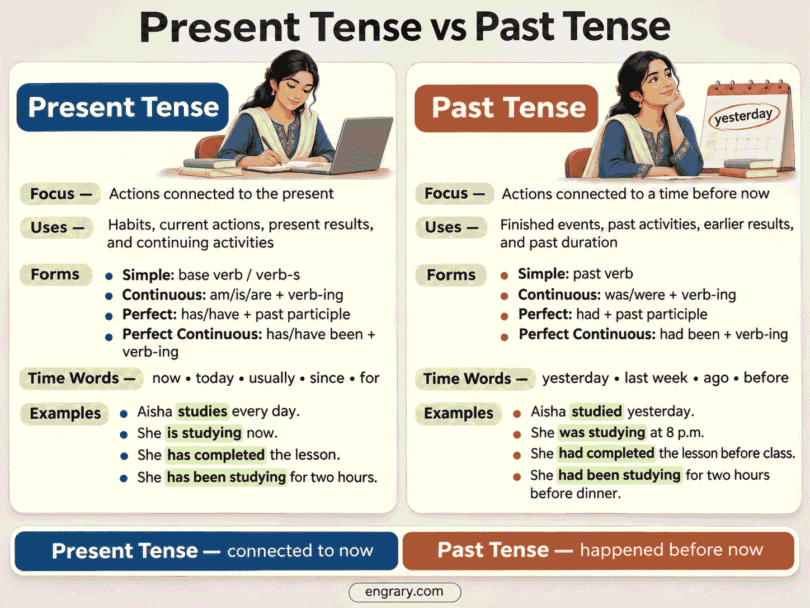
Present tense and past tense establish two different viewpoints in time. Present forms usually describe facts, habits, states, and activities connected to now. In contrast, past forms usually describe situations located before now. Compare She works in a bank with She worked in a bank. The first sentence presents her employment as current, whereas the second places it in the past.
However, the difference involves more than present time versus past time. English combines tense with aspect, so a speaker can present an action as simple, continuing, completed, or continuing over a period. Moreover, grammatical tense does not always match real-world time. For example, a present form can describe a future schedule, while a past form can express an unreal present wish. This guide compares all four present forms with their past counterparts and explains their structures, uses, time expressions, and common errors.
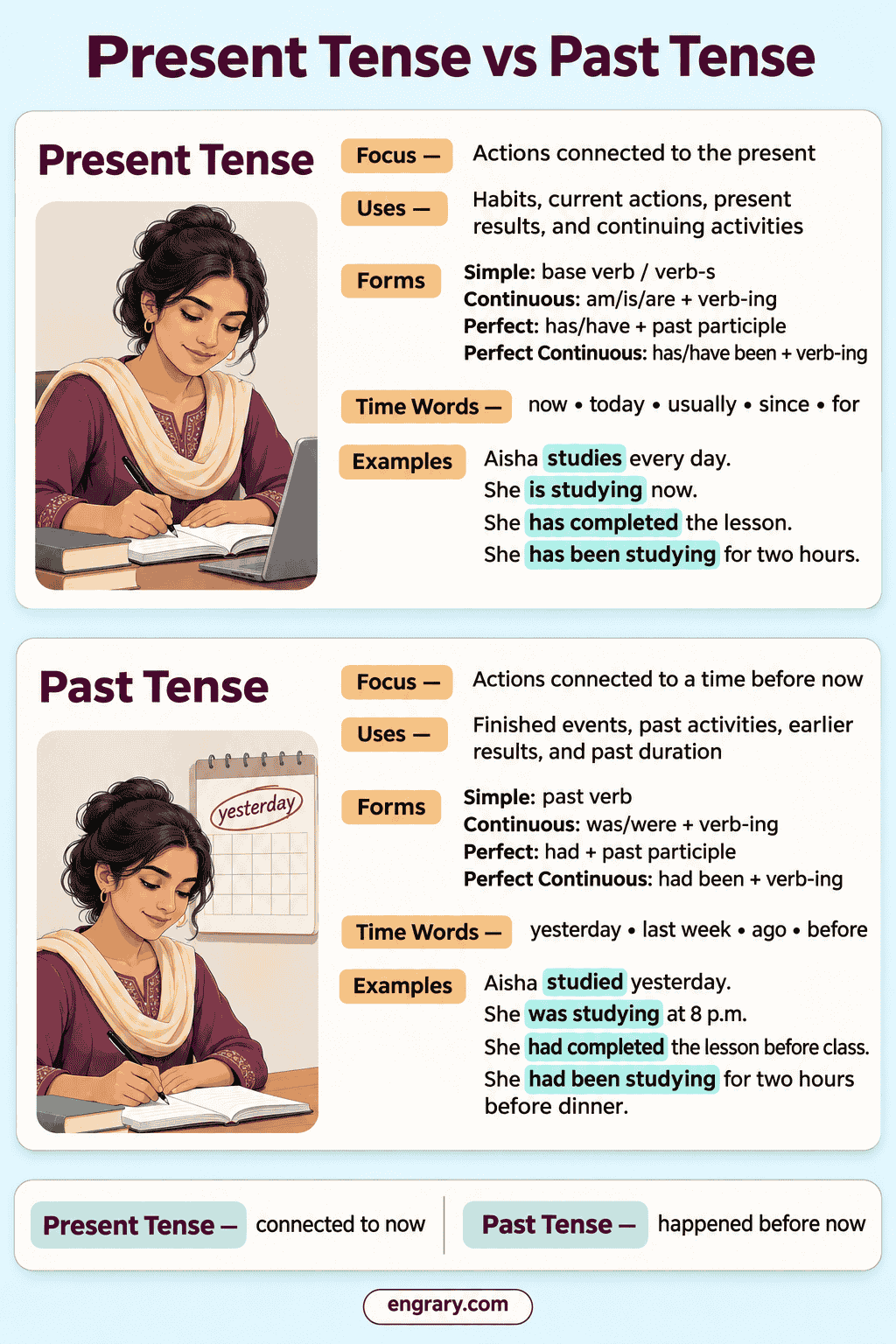
Present Tense and Past Tense at a Glance
The present tense uses the present as its main reference point. Therefore, it can describe what happens regularly, what is true now, what is developing, or what began earlier and remains connected to the present. The past tense, on the other hand, moves that reference point to a time before now. It can describe a finished event, an activity in progress at a past moment, or one past event that occurred before another.
Aspect adds another layer of meaning. The simple aspect presents a fact, state, habit, or event as a whole. The continuous aspect focuses on an activity in progress. Meanwhile, the perfect aspect looks back from a later reference point, and the perfect continuous aspect emphasizes continuing activity or duration before that point.
| Feature | Present Tense | Past Tense |
|---|---|---|
| Main reference point | Now or a period connected to now | A time or period before now |
| Habits | Current habits | Former habits |
| States | States that are true now | States that were true earlier |
| Continuing actions | Activities happening now or around now | Activities in progress at a past moment |
| Completed actions | Earlier actions connected to the present | Actions in a finished past period |
| Duration | Duration continuing until now | Duration continuing until a past point |
| Basic example | She works in Lahore. | She worked in Lahore. |
The following four pairs form the core of the comparison:
| Present Form | Past Form | Main Contrast |
|---|---|---|
| Present simple | Past simple | Current facts and habits vs finished past situations |
| Present continuous | Past continuous | Activity continuing now vs activity continuing at a past moment |
| Present perfect | Past perfect | Earlier situation connected to now vs situation before another past point |
| Present perfect continuous | Past perfect continuous | Duration until now vs duration until a past point |
Four Present Tense Forms
English has four main present forms. Although each one relates to the present, each presents the situation differently.
Present Simple
Structure: Subject + base verb or verb with -s/-es
The present simple describes routines, repeated actions, general truths, and relatively permanent states. In addition, it can refer to scheduled future events and appear in live commentary or narrative summaries.
- I walk to work every morning.
- Sana teaches English at a local college.
- Water boils at 100°C at sea level.
- They live near the city center.
- The train leaves at six tomorrow.
With he, she, and it, most verbs take -s or -es. Thus, we say I work but she works. However, the verb be has the special present forms am, is, and are.
Present Continuous
Structure: Subject + am/is/are + verb-ing
The present continuous focuses on an action in progress now or around now. It also describes temporary situations, changing conditions, and fixed future arrangements.
- I am reading the report now.
- They are staying with relatives this week.
- The weather is getting warmer.
- More people are using online banking.
- We are meeting the manager tomorrow.
Usually, stative verbs such as know, believe, own, need, and understand do not appear in continuous forms when they describe a state. Therefore, I know the answer is normally correct, while I am knowing the answer is not.
Present Perfect
Structure: Subject + has/have + past participle
The present perfect looks back from the present. It can describe experiences, recent events with present results, repeated actions in an unfinished period, and states or actions that began earlier and continue now.
- I have visited Karachi several times.
- She has just finished her assignment.
- We have lived here since 2020.
- They have called three times today.
- He has never flown in a helicopter.
The exact past time usually remains unstated because the connection to now matters more. Consequently, a finished expression such as yesterday normally requires the past simple rather than the present perfect.
Present Perfect Continuous
Structure: Subject + has/have been + verb-ing
The present perfect continuous emphasizes an activity or its duration from the past until now. It can also describe a recent activity that explains a visible present result.
- I have been studying for two hours.
- It has been raining since morning.
- She has been working here since May.
- They have been practicing all week.
- His clothes are dirty because he has been gardening.
This form often highlights the process, whereas the present perfect may highlight a result or completed amount. Compare She has written five pages with She has been writing for two hours.
Four Past Tense Forms
The four past forms use a past reference point. Nevertheless, they differ in whether they present a situation as complete, continuing, earlier than another past event, or continuing up to a past point.
Past Simple
Structure: Subject + past form of the verb
The past simple describes completed events, former habits, past states, and sequences of actions in finished periods.
- I visited Islamabad last year.
- She worked there for five years.
- We played outside every evening.
- He opened the door, entered the room, and switched on the light.
- They were tired after the journey.
Regular verbs usually add -ed, while irregular verbs change in different ways. For example, work becomes worked, but go becomes went.
Past Continuous
Structure: Subject + was/were + verb-ing
The past continuous focuses on an activity that was underway at a particular past moment. It often provides background, shows two simultaneous activities, or describes an action interrupted by a shorter event.
- I was studying at eight o’clock.
- They were eating when we arrived.
- She was cooking while he was setting the table.
- The wind was blowing, and the rain was falling heavily.
- We were driving home when the car stopped.
In interrupted-action sentences, the continuing background activity usually takes the past continuous, while the shorter event takes the past simple.
Past Perfect
Structure: Subject + had + past participle
The past perfect looks back from a later point in the past. In other words, it identifies an action, experience, or state that came before another past situation.
- The train had left before we reached the station.
- She had never flown before that trip.
- He was tired because he had slept poorly.
- By noon, the team had completed the inspection.
- I recognized the street because I had visited it before.
The past perfect becomes especially useful when the order of two past events might otherwise seem unclear. However, when words such as before or after already make the order obvious, speakers sometimes use the past simple for both events.
Past Perfect Continuous
Structure: Subject + had been + verb-ing
The past perfect continuous emphasizes activity or duration before a later past point. It can also explain the cause of a past condition or result.
- They had been waiting for an hour when the bus arrived.
- She had been working all day, so she felt exhausted.
- It had been raining before the sky cleared.
- We had been driving for three hours when we stopped.
- His hands were dirty because he had been repairing the engine.
As with the present perfect continuous, the focus usually falls on the process or duration rather than the completed result.
Present and Past Tense Structure Comparison
The auxiliary verb often reveals both the tense and the aspect. Therefore, learning complete verb phrases is more useful than memorizing isolated verb endings.
| Tense Pair | Present Structure | Past Structure |
|---|---|---|
| Simple | subject + base verb/verb with -s | subject + past form |
| Continuous | am/is/are + verb-ing | was/were + verb-ing |
| Perfect | has/have + past participle | had + past participle |
| Perfect continuous | has/have been + verb-ing | had been + verb-ing |
Here are all eight forms with the verb work:
| Form | Example |
|---|---|
| Present simple | She works. |
| Past simple | She worked. |
| Present continuous | She is working. |
| Past continuous | She was working. |
| Present perfect | She has worked. |
| Past perfect | She had worked. |
| Present perfect continuous | She has been working. |
| Past perfect continuous | She had been working. |
Present Simple vs Past Simple
The present simple describes current habits, states, and general facts. In contrast, the past simple describes habits, states, and events located in a finished past period.
| Present Simple | Past Simple |
|---|---|
| She walks to school every day. | She walked to school yesterday. |
| They live in Multan. | They lived in Multan in 2022. |
| I usually drink tea. | I drank tea this morning. |
| He works at a bank. | He worked at a bank for six years. |
| We meet every Friday. | We met last Friday. |
Time context can completely change the meaning. For instance, He teaches mathematics suggests that teaching is his current occupation. By comparison, He taught mathematics places that work in the past and may imply that he no longer teaches it.
The same contrast applies to habits:
- I take the bus to work. This is my current routine.
- I took the bus to work when I lived downtown. This was my routine during a past period.
For repeated past habits, English can also use used to or would:
- We used to visit our grandparents every summer.
- After dinner, my grandfather would tell us stories.
However, would normally describes repeated actions rather than past states. Therefore, We used to live there sounds natural, while We would live there does not express the same former state.
Present Continuous vs Past Continuous
Both continuous forms emphasize an unfolding activity. The key difference lies in the reference point: the present continuous relates the activity to now, whereas the past continuous relates it to a past moment.
| Present Continuous | Past Continuous |
|---|---|
| I am writing an email now. | I was writing an email when you called. |
| She is preparing dinner. | She was preparing dinner at seven. |
| They are playing outside. | They were playing outside when it began to rain. |
| The city is growing quickly. | The city was growing quickly at that time. |
| We are discussing the plan. | We were discussing the plan during lunch. |
The present continuous can describe a temporary current situation: I am working from home this month. The past continuous can place a similar temporary situation within a past period: I was working from home during the renovations.
Moreover, the past continuous often creates the background for a shorter event: We were having dinner when the lights went out. Here, were having describes the activity already in progress, whereas went out identifies the event that interrupted it.
Present Perfect vs Past Perfect
Both perfect forms connect an earlier situation to a later reference point. Nevertheless, the present perfect uses now as that point, while the past perfect uses a later moment in the past.
| Present Perfect | Past Perfect |
|---|---|
| She has finished the report, so you can read it now. | She had finished the report before the meeting began. |
| I have never seen snow. | I had never seen snow before that trip. |
| They have left the office. | They had left the office when I arrived. |
| We have completed the first stage. | We had completed the first stage by Friday. |
| He has lived abroad before. | He had lived abroad before he joined the company. |
Consider the different viewpoints in these sentences:
- Maya has eaten, so she is not hungry now.
- Maya had eaten, so she was not hungry when we arrived.
The first sentence explains a present condition. In contrast, the second explains a condition at a past time.
Present Perfect Continuous vs Past Perfect Continuous
These forms emphasize duration or continuing activity. Once again, the main distinction is the endpoint from which the speaker looks back.
| Present Perfect Continuous | Past Perfect Continuous |
|---|---|
| I have been waiting for an hour. | I had been waiting for an hour when the bus arrived. |
| She has been teaching since 2019. | She had been teaching for ten years before she retired. |
| It has been raining all morning. | It had been raining before the sky cleared. |
| We have been driving since dawn. | We had been driving for hours when we stopped. |
| They have been renovating the house. | They had been renovating the house before they moved. |
The present form connects the activity to now. The past form, by contrast, views the activity from a later point in the past.
Present Perfect vs Past Simple
Learners often confuse the present perfect with the past simple because both can describe earlier events. However, their viewpoints differ significantly.
Use the present perfect when an earlier event remains relevant now, when the exact past time is unimportant, or when the time period continues. Use the past simple when the event belongs to a specific or understood finished time.
| Present Perfect | Past Simple |
|---|---|
| Connects an earlier event to now | Places an event in a finished past period |
| Usually avoids a specific finished time | Commonly states a specific finished time |
| Can describe unfinished duration | Describes duration that ended in the past |
| I have visited London twice. | I visited London in 2024. |
| She has lived here for five years. | She lived there for five years before moving. |
Compare these examples:
- I have spoken to him today. Today is still continuing.
- I spoke to him yesterday. Yesterday is a finished period.
- Have you ever eaten sushi? The question asks about experience at any time before now.
- Did you eat sushi at the restaurant last night? The question refers to a specific finished occasion.
Do not combine the present perfect with finished past expressions such as yesterday, last year, two days ago, or in 2018.
- Incorrect: We have met yesterday.
- Correct: We met yesterday.
Forms of Be in the Present and Past
The verb be does not use do, does, or did to form simple negatives and questions. Instead, its own forms change according to the subject and tense.
| Subject | Present Form | Past Form |
|---|---|---|
| I | am | was |
| He, she, it | is | was |
| You, we, they | are | were |
Examples:
- I am tired. / I was tired yesterday.
- She is at home. / She was at home this morning.
- You are early. / You were early yesterday.
- They are busy. / They were busy last week.
For negatives, place not after the form of be: He is not ready and He was not ready. For questions, place the form of be before the subject: Is he ready? and Was he ready?
Do, Does, and Did
In the simple forms, most verbs need do, does, or did for negatives and questions. Use do with I, you, we, and they. Use does with he, she, and it. Meanwhile, use did with every subject in the past simple.
After do, does, or did, the main verb stays in its base form. This rule also applies after don’t, doesn’t, and didn’t.
| Incorrect | Correct |
|---|---|
| Does she works here? | Does she work here? |
| He doesn’t likes coffee. | He doesn’t like coffee. |
| Did they arrived early? | Did they arrive early? |
| She didn’t went home. | She didn’t go home. |
Compare the complete patterns:
- She works here.
- She does not work here.
- Does she work here?
- She worked here.
- She did not work here.
- Did she work here?
Affirmative, Negative, and Question Forms
Each tense uses its first auxiliary verb to form negatives and questions. In a negative sentence, add not after that auxiliary. In a question, move the auxiliary before the subject.
Simple Forms
| Sentence Type | Present Simple | Past Simple |
|---|---|---|
| Affirmative | She works here. | She worked here. |
| Negative | She does not work here. | She did not work here. |
| Question | Does she work here? | Did she work here? |
| Short answer | Yes, she does. | Yes, she did. |
Continuous Forms
| Sentence Type | Present Continuous | Past Continuous |
|---|---|---|
| Affirmative | They are studying. | They were studying. |
| Negative | They are not studying. | They were not studying. |
| Question | Are they studying? | Were they studying? |
| Short answer | Yes, they are. | Yes, they were. |
Perfect Forms
| Sentence Type | Present Perfect | Past Perfect |
|---|---|---|
| Affirmative | He has finished. | He had finished. |
| Negative | He has not finished. | He had not finished. |
| Question | Has he finished? | Had he finished? |
| Short answer | Yes, he has. | Yes, he had. |
Perfect Continuous Forms
| Sentence Type | Present Perfect Continuous | Past Perfect Continuous |
|---|---|---|
| Affirmative | She has been working. | She had been working. |
| Negative | She has not been working. | She had not been working. |
| Question | Has she been working? | Had she been working? |
| Short answer | Yes, she has. | Yes, she had. |
Regular and Irregular Verb Changes
The past simple and past participle of a regular verb usually end in -ed. However, spelling changes sometimes occur.
Regular Past Forms
| Base Verb | Past Form | Rule |
|---|---|---|
| work | worked | Add -ed |
| live | lived | Add -d after final e |
| study | studied | Change consonant + y to -ied |
| stop | stopped | Double the final consonant and add -ed |
Irregular verbs do not follow one standard pattern. Therefore, learners need to study their past forms and past participles together.
Irregular Past Forms
| Base Form | Present Form | Past Form | Past Participle |
|---|---|---|---|
| go | go/goes | went | gone |
| see | see/sees | saw | seen |
| write | write/writes | wrote | written |
| eat | eat/eats | ate | eaten |
| take | take/takes | took | taken |
| begin | begin/begins | began | begun |
| speak | speak/speaks | spoke | spoken |
| choose | choose/chooses | chose | chosen |
| come | come/comes | came | come |
| know | know/knows | knew | known |
Remember that the past perfect always uses the past participle after had. Thus, had went is incorrect, while had gone is correct.
Time Expressions with Present and Past Forms
Time expressions can guide tense selection, but they do not operate as inflexible rules. Context still determines the speaker’s intended viewpoint.
Common Present-Time Expressions
- now
- currently
- at present
- every day
- usually
- often
- already
- just
- yet
- so far
- since
- for
Examples include She usually arrives early, We are currently reviewing the application, They have already left, and I have known him for ten years.
Common Past-Time Expressions
- yesterday
- last week
- ago
- in 2020
- then
- at that time
- when
- while
- before
- by the time
Examples include She arrived yesterday, We were living abroad at that time, He had left by the time I called, and They had been traveling for hours before they stopped.
Words such as for and since can occur with different tenses. For example, I have lived here for five years means the situation continues now, whereas I lived there for five years describes a finished period.
Present Forms with Future and Past Meanings
Grammatical present tense does not always describe present time. In several common patterns, present forms refer to the future or make a past narrative feel immediate.
Present Simple for Schedules
Use the present simple for fixed schedules, programs, and timetables:
- The train leaves tomorrow at six.
- The semester begins next Monday.
- The film starts at eight tonight.
Present Continuous for Arrangements
Use the present continuous for personal arrangements that have already been organized:
- We are meeting the client tomorrow.
- She is flying to Dubai next week.
- I am having lunch with Ali on Friday.
Narrative Present for Past Events
Speakers and writers sometimes use present forms to make a past story more vivid:
- The detective enters the room and notices an open window.
- Suddenly, the driver turns around and tells everyone to get off.
Similarly, summaries and commentaries often use the present simple even when the original event or story belongs to the past.
Past Forms with Present or Future Meanings
Past forms can express distance rather than past time. That distance may represent an unreal situation, an unlikely condition, a wish, or a polite attitude.
Hypothetical Situations
- If I had more time, I would learn another language.
- If she knew the answer, she would tell us.
In these examples, had and knew describe unreal or hypothetical present conditions, not completed past events.
Wishes
- I wish I knew the answer.
- He wishes he lived closer.
- We wish the weather were warmer.
The past form shows that the present reality differs from the wish.
Polite Language
- I wanted to ask about the position.
- Did you need any help?
- I wondered if you could check this form.
Here, the past form creates social distance and makes the request sound less direct.
Tense Changes in Reported Speech
When a reporting verb appears in the past, the tense in the original statement often moves one step back. This change is known as backshift.
| Direct Speech | Reported Speech |
|---|---|
| “I work here.” | She said that she worked there. |
| “I am studying.” | He said that he was studying. |
| “I have finished.” | She said that she had finished. |
| “I saw him.” | He said that he had seen him. |
However, backshift may be unnecessary when a fact remains true or the speaker wants to emphasize its continuing validity. For example, The teacher said that water boils at 100°C and Nadia said that she lives in Lahore can retain the present tense. Both backshifted and non-backshifted forms may be possible in some contexts, but the intended viewpoint must remain clear.
Present and Past Tenses in Passive Voice
The passive voice shifts attention from the performer to the action or receiver. To form it, use the appropriate tense of be followed by a past participle.
| Active Sentence | Passive Sentence |
|---|---|
| The company produces these parts. | These parts are produced by the company. |
| The company produced these parts. | These parts were produced by the company. |
| The team is repairing the road. | The road is being repaired. |
| The team was repairing the road. | The road was being repaired. |
| They have completed the project. | The project has been completed. |
| They had completed the project. | The project had been completed. |
The tense remains the same even though the sentence changes from active to passive. For instance, produces and is produced are both present simple, while produced and was produced are both past simple.
Tense Consistency and Meaningful Shifts
Clear writing maintains a logical time viewpoint. Therefore, verbs describing events within the same time frame should normally use compatible tenses.
Consistent past sequence:
- She opened the letter, read the message, and placed it on the table.
Unnecessary shift:
- Incorrect: She opened the letter and reads the message.
- Correct: She opened the letter and read the message.
Nevertheless, a tense shift is correct when the time or viewpoint genuinely changes:
- She opened the letter yesterday, and now she understands the problem.
- I worked in a bank for six years, but I teach at a college now.
In each case, the past form describes an earlier situation, while the present form describes the current result or condition.
Common Present and Past Tense Mistakes
Many errors result from using the wrong auxiliary, mixing a finished time with the present perfect, or selecting an incorrect verb form.
- Incorrect: He go to school every day.
Correct: He goes to school every day. - Incorrect: She did not went home.
Correct: She did not go home. - Incorrect: I am knowing the answer.
Correct: I know the answer. - Incorrect: We have met yesterday.
Correct: We met yesterday. - Incorrect: When I arrived, they have left.
Correct: When I arrived, they had left. - Incorrect: He was work at eight.
Correct: He was working at eight. - Incorrect: I live here since 2020.
Correct: I have lived here since 2020. - Incorrect: Did she was tired?
Correct: Was she tired? - Incorrect: They had ate before we arrived.
Correct: They had eaten before we arrived. - Incorrect: She has been finished the report.
Correct: She has finished the report.
To prevent these errors, first identify the reference point. Next, decide whether the sentence emphasizes a fact, an activity in progress, an earlier completed event, or duration. Finally, select the auxiliary and main verb form that match that meaning.
Present and Past Tense Selection Guide
Use this table as a practical decision guide:
| Intended Meaning | Recommended Form | Example |
|---|---|---|
| Current habit or routine | Present simple | I exercise every morning. |
| Former habit | Past simple | I exercised every morning at school. |
| Fact or state true now | Present simple | She owns a bakery. |
| State that ended in the past | Past simple | She owned a bakery years ago. |
| Action happening now | Present continuous | They are eating lunch. |
| Action in progress at a past moment | Past continuous | They were eating at noon. |
| Earlier event connected to now | Present perfect | I have lost my keys. |
| Event before another past event | Past perfect | I had lost my keys before I left. |
| Activity continuing until now | Present perfect continuous | He has been studying for hours. |
| Activity continuing until a past point | Past perfect continuous | He had been studying before dinner. |
| Fixed future arrangement | Present continuous | We are leaving tomorrow. |
| Future schedule | Present simple | The bus arrives at nine. |
| Unreal present situation | Past simple | If I knew, I would tell you. |
When choosing a tense, follow this sequence:
- Identify the reference point: now or before now.
- Decide whether the time period is finished or still connected to the present.
- Determine whether the focus falls on a fact, a continuing activity, a prior result, or duration.
- Choose the appropriate auxiliary verb.
- Check the main verb form, especially after do, does, did, and had.
Key Points to Remember
- Present forms generally use now as their reference point, whereas past forms use a point before now.
- The simple aspect presents habits, facts, states, and events as wholes.
- The continuous aspect focuses on an activity in progress.
- The perfect aspect connects an earlier situation to a later reference point.
- The perfect continuous aspect emphasizes continuing activity or duration.
- Use the base verb after do, does, and did.
- Use a past participle after has, have, and had in perfect constructions.
- Distinguish unfinished periods connected to now from finished past periods.
- Use time expressions as helpful clues rather than absolute rules.
- Shift tense only when the time, reference point, or viewpoint changes.
FAQs
Present tense generally connects a situation to now, whereas past tense places its main reference point before now. However, aspect adds more precise meaning. As a result, a present or past form can describe a simple situation, an activity in progress, an earlier completed event, or duration.
The four present forms are present simple, present continuous, present perfect, and present perfect continuous. Their past counterparts are past simple, past continuous, past perfect, and past perfect continuous. Each present form has a corresponding past form with the same aspect but a different reference point.
Yes. The present simple can describe scheduled future events, while the present continuous can describe fixed future arrangements. In addition, speakers and writers sometimes use the narrative present to make a past story, summary, or commentary feel more immediate.
Yes. Past forms can express unreal present conditions, wishes, politeness, and hypothetical situations. In these uses, the past form communicates distance or unreality rather than ordinary past time. For example, I wish I knew refers to a present lack of knowledge.
A tense shift is correct when the time, reference point, or viewpoint genuinely changes. For example, She called me yesterday, but she feels better now correctly moves from a past event to a present condition. However, an unexplained shift within the same time frame usually creates an error.
You May Also Like


Leave a Comment