
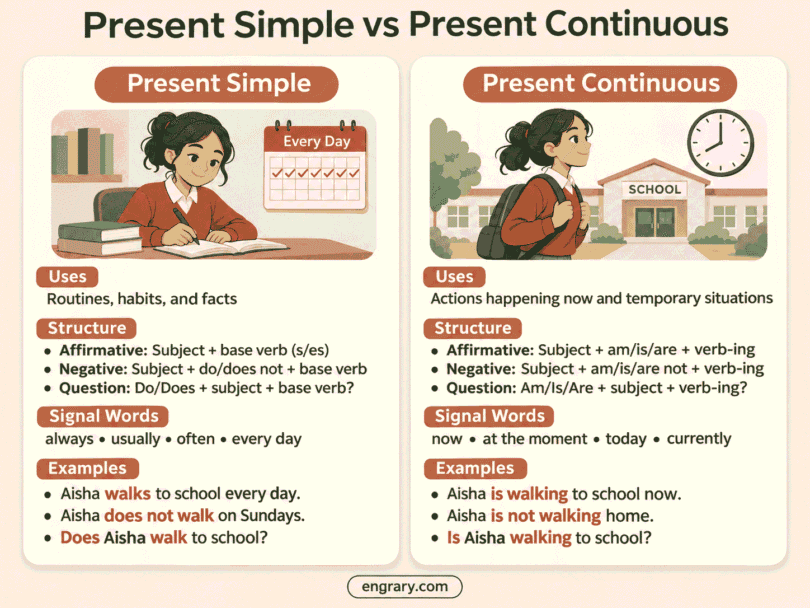
The present simple and present continuous both describe present time, but they show situations from different viewpoints. The present simple usually presents a fact, routine, state, or stable situation. In contrast, the present continuous presents an activity in progress, a temporary situation, a developing change, or an organized future arrangement.
Choosing between them requires more than looking for words such as now or usually. Instead, consider what the speaker wants to emphasize. This guide compares the two tenses side by side and explains their structures, uses, time expressions, stative verbs, future meanings, and most common errors.
Present Simple and Present Continuous at a Glance
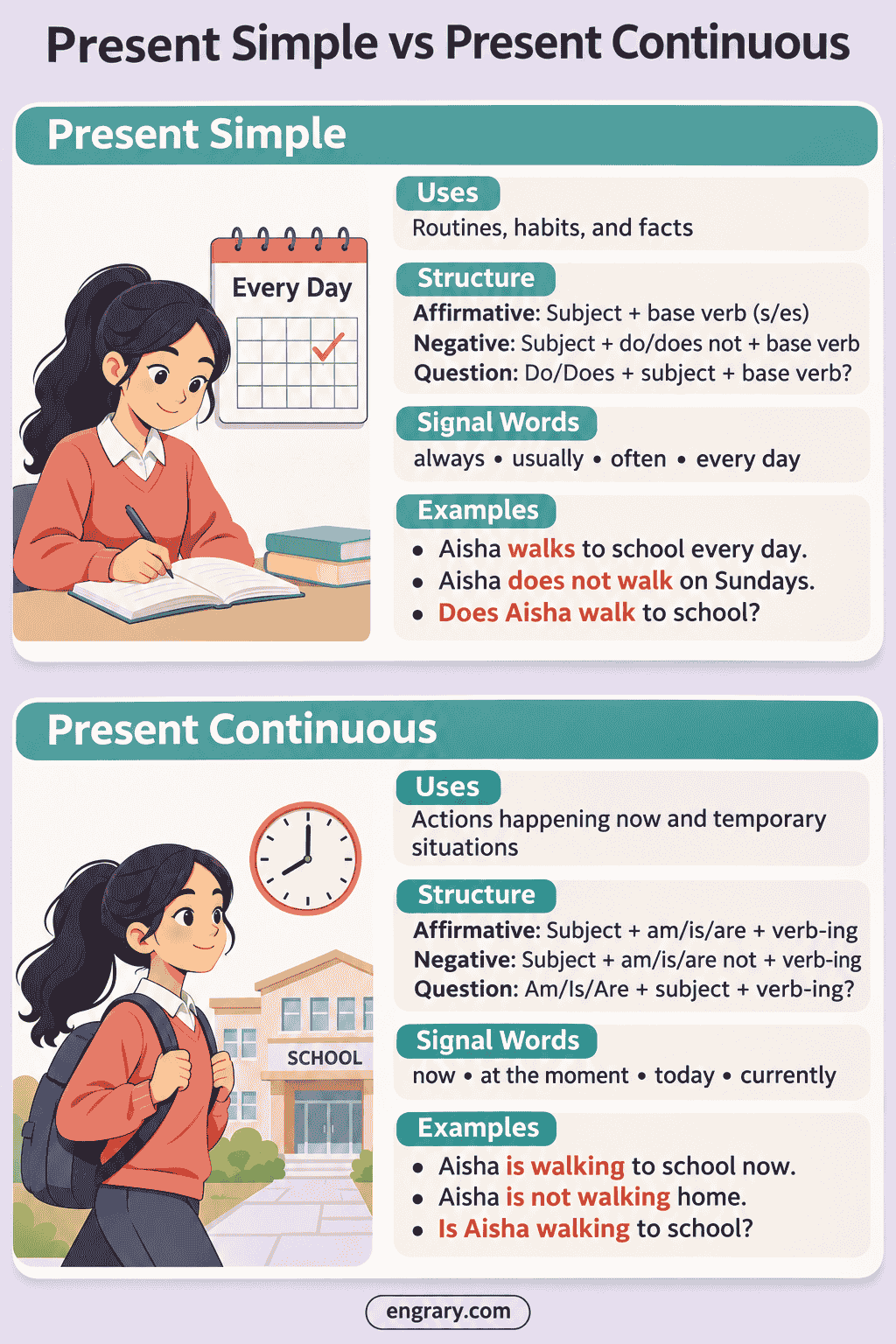
The clearest distinction is general meaning versus activity in progress. However, the full contrast also includes stable versus temporary situations, official schedules versus personal arrangements, and states versus active behaviour.
| Feature | Present simple | Present continuous |
|---|---|---|
| Core meaning | General, regular, or stable | In progress, temporary, or changing |
| Basic structure | Subject + base verb | Subject + am/is/are + verb-ing |
| Routine | She walks to work every day. | — |
| Happening now | — | She is walking to work now. |
| Stable situation | He lives in Lahore. | — |
| Temporary situation | — | He is living in Lahore this month. |
| Official schedule | The class starts at nine. | — |
| Personal arrangement | — | We are meeting at nine. |
A useful first rule is simple:
- Use the present simple for what is generally true or regularly happens.
- Use the present continuous for what is happening, developing, or viewed as temporary.
Nevertheless, meaning remains more important than any single signal word. For example, I understand now contains now, but understand describes a state, so the present simple is natural.
Present Simple and Present Continuous Structures
The present simple uses the base form of the verb with most subjects. However, it usually adds -s or -es with he, she, and it. Negatives and questions normally require do or does.
The present continuous always contains two parts: a present form of be and a verb-ing form. Therefore, neither part can be omitted.
| Sentence type | Present simple | Present continuous |
|---|---|---|
| Affirmative | She works. | She is working. |
| Negative | She does not work. | She is not working. |
| Yes-or-no question | Does she work? | Is she working? |
| Wh-question | Where does she work? | Where is she working? |
| Positive short answer | Yes, she does. | Yes, she is. |
| Negative short answer | No, she doesn’t. | No, she isn’t. |
After does or doesn’t, use the base verb. Consequently, Does she works? is incorrect because the third-person marker already appears in does.
Present Simple with Be
The verb be follows its own pattern in the present simple. It does not use do or does in negatives or questions.
| Form | Present simple with be | Present simple with an ordinary verb |
|---|---|---|
| Affirmative | She is busy. | She works. |
| Negative | She is not busy. | She does not work. |
| Question | Is she busy? | Does she work? |
| Short answer | Yes, she is. | Yes, she does. |
Use am with I, is with third-person singular subjects, and are with you, we, they, and plural nouns. Thus, say Are you ready?, not Do you be ready?
Main Uses of the Present Simple
The present simple presents information as general, repeated, stable, or officially scheduled. It also appears in instructions, summaries, commentaries, and statements made through speaking.
Habits and Routines
Use the present simple for regular actions and repeated patterns.
- I check my email every morning.
- Nadia walks to college on weekdays.
- We usually eat dinner at eight.
- The children visit their grandparents twice a month.
Frequency expressions often support this meaning. Still, the habit itself—not the expression—determines the tense.
General Truths and Facts
Use the present simple for scientific facts, definitions, and statements considered generally true.
- Water boils at 100°C at sea level.
- The Earth moves around the Sun.
- Plants need light to grow.
- Islamabad is the capital of Pakistan.
Stable and Long-Term Situations
Use the present simple when the speaker views a situation as stable or long-lasting.
- My aunt lives in Multan.
- He works for a software company.
- They own a small farm.
- Sara studies economics.
Stable does not mean permanent forever. Rather, the speaker presents the situation as an established part of life.
States, Feelings, and Opinions
Many verbs describe states instead of unfolding activities. Therefore, they usually take the present simple.
- I believe your explanation.
- She wants a glass of water.
- This bag belongs to Hamza.
- We understand the problem.
Schedules and Timetables
Use the present simple for fixed schedules, timetables, programs, and official events, even when they refer to the future.
- The train leaves at 6:30 tomorrow morning.
- The semester begins next Monday.
- The museum opens at ten.
- The match starts after the news.
Instructions, Demonstrations, and Directions
The present simple can describe the steps in a process.
- First, you add the flour.
- Then, the machine cuts the material.
- You turn left at the traffic lights.
- Finally, the program saves the file.
Commentary, Summaries, and Performative Verbs
Sports commentators often use the present simple for rapid actions: The striker passes, the winger shoots, and the goalkeeper saves. Writers also use it for plot summaries: The main character leaves home and discovers a hidden city.
In addition, some verbs perform an action through speech itself:
- I promise to call.
- We agree to the revised terms.
- I apologize for the delay.
- I suggest a shorter route.
Main Uses of the Present Continuous
The present continuous presents an activity as unfolding, limited, changing, or connected to an arrangement.
Actions Happening Now
Use it for an activity in progress at the moment of speaking.
- Please wait; I am speaking to a customer.
- The baby is sleeping.
- Look! The children are crossing the road.
- Someone is knocking at the door.
Activities Around the Present
The activity does not need to occur at the exact second of speaking. It can form part of a wider unfinished project or current period.
- I am reading a book about architecture.
- She is preparing for her final examinations.
- We are developing a new website.
- They are learning how to use the equipment.
The speaker may not be reading, preparing, developing, or learning at that precise moment. Nevertheless, the activity remains in progress around the present.
Temporary Situations
Use the present continuous when the speaker views a situation as temporary.
- I am staying with my cousin this week.
- Bilal is working from home until Friday.
- They are using a rented car while theirs is at the garage.
- She is teaching an evening class this term.
A temporary situation may continue for minutes, months, or even years. What matters is the speaker’s belief that it has a limited duration.
Changing and Developing Situations
Use the continuous form for trends, gradual developments, and changing conditions.
- Food prices are rising.
- Your English is improving.
- More people are working remotely.
- The weather is becoming warmer.
These changes occur around the present; they do not need to be visible at the exact moment of speaking.
Repeated Behaviour with Always
The present continuous with always, constantly, continually, or forever can express an emotional response to repeated behaviour.
- He is always losing his keys.
- You are constantly interrupting me.
- My neighbour is always helping elderly people.
- The children are forever asking interesting questions.
Depending on the context, the emotion may be irritation, criticism, admiration, surprise, or affection.
Future Arrangements
Use the present continuous for an organized personal plan, especially when the time, place, booking, or participants have already been arranged.
- I am meeting the dentist at three tomorrow.
- We are flying to Dubai on Friday.
- Sara is having lunch with her manager next week.
- They are moving into their new apartment in June.
An intention without an arrangement may require another future form. Therefore, the present continuous normally suggests more than a general hope or idea.
New and Contrasting Behaviour
The present continuous can emphasize behaviour or a pattern that differs from the past.
- These days, he is exercising regularly.
- More customers are paying by phone instead of cash.
- My daughter is becoming more independent.
- You are speaking much more confidently now.
Routines and Actions Happening Now
The same verb can describe either a routine or a current action. Consequently, context determines the tense.
| Routine or general pattern | Action happening now |
|---|---|
| I read before bed. | I am reading now. |
| She teaches science. | She is teaching a class. |
| They play on Saturdays. | They are playing at the moment. |
| He drives to work. | He is driving to work now. |
| We cook at home. | We are cooking dinner. |
The present simple answers questions about a person’s usual life. In contrast, the present continuous tells us what is in progress.
What Do You Do and What Are You Doing
These similar-looking questions ask for different information.
| Question | Typical meaning | Natural answer |
|---|---|---|
| What do you do? | Job, role, or usual activity | I teach mathematics. |
| What are you doing? | Activity happening now or around now | I’m preparing a lesson. |
| What do you do on Fridays? | Regular Friday routine | I work from home. |
| What are you doing on Friday? | Organized future plan | I’m meeting a client. |
The time phrase can completely change the intended question. Therefore, learners should interpret the whole situation rather than translate the verb form alone.
Stable and Temporary Situations
Some situations can use either tense, but the speaker’s viewpoint changes.
| Stable or established view | Temporary or limited view |
|---|---|
| She lives with her parents. | She is living with her parents this month. |
| I work in Karachi. | I am working in Karachi this week. |
| He studies engineering. | He is studying at home today. |
| They teach at a college. | They are teaching a summer course. |
The continuous form does not prove that the situation is objectively short. Instead, it shows that the speaker views it as temporary, changing, or connected to the current period.
Temporary Repeated Activities
Repetition does not always require the present simple. Use the present continuous when a repeated activity belongs to a temporary period.
- She usually drives, but she is walking to work this week.
- I am eating less sugar these days.
- We are taking the bus while our car is being repaired.
- He is attending extra classes this month.
By contrast, use the present simple when the repeated activity represents a normal routine: She walks to work every day.
Always with Both Tenses
The position of always may remain similar, but the speaker’s attitude changes.
| Form | Meaning | Example |
|---|---|---|
| Present simple + always | Neutral or expected habit | She always arrives early. |
| Present continuous + always | Emotionally marked repetition | She is always arriving late. |
The present continuous does not automatically express annoyance. For example, He is always helping people may show admiration. Tone and context reveal the attitude.
Be and Being
The simple form of be generally describes identity, condition, or a characteristic. In contrast, being often describes temporary behaviour.
| Present simple | Present continuous | Difference |
|---|---|---|
| He is rude. | He is being rude. | Characteristic versus current behaviour |
| She is helpful. | She is being especially helpful today. | General quality versus temporary behaviour |
| They are quiet. | They are being unusually quiet. | Usual state versus present conduct |
Do not normally use being for temporary age, nationality, profession, or physical identity. Say She is twenty, not She is being twenty.
Future Schedules and Arrangements
Both tenses can refer to the future. However, they present future events differently.
| Future meaning | Present simple | Present continuous |
|---|---|---|
| Official timetable | The flight leaves at nine. | — |
| Published program | The conference opens on Monday. | — |
| Confirmed personal arrangement | — | We are flying at nine. |
| Organized meeting | — | I am meeting the manager on Monday. |
Sometimes both are possible with a change of viewpoint. The meeting starts at ten presents an official schedule, whereas We are starting the meeting at ten presents an organized plan involving the speakers.
Future Time and Conditional Clauses
English normally uses a present form after when, before, after, as soon as, until, if, and unless when the clause refers to the future.
- I will call you when I arrive.
- We will leave as soon as the rain stops.
- If she needs help, she will ask.
- Unless the train leaves on time, we will miss the connection.
Do not add will merely because the clause refers to future time. However, a present continuous form is possible when the clause describes an activity in progress:
- Call me if you are working late.
- Please be quiet when the baby is sleeping.
Zero Conditional and General Results
Use the present simple in both parts of a zero conditional when one situation regularly or generally produces another.
- If water reaches 100°C, it boils.
- When I feel tired, I take a short break.
- If the alarm sounds, the doors lock automatically.
- Plants grow faster when they receive enough light.
These statements describe general relationships rather than one specific future event.
Stative Verbs and Continuous Forms
Stative verbs usually describe thoughts, emotions, possession, perception, measurement, or composition. Because they present conditions rather than unfolding actions, they commonly take the present simple.
| Category | Common stative verbs |
|---|---|
| Thoughts and opinions | know, believe, understand, remember, agree |
| Feelings and preferences | like, love, hate, prefer, want |
| Possession | own, belong, possess, have |
| Senses and appearance | see, hear, seem, appear, smell |
| Measurement and composition | weigh, measure, contain, consist |
Natural examples include I know the answer, She prefers tea, and This box contains tools. Forms such as I am knowing or The box is containing are normally incorrect in these meanings.
Still, stative-verb guidance is not an absolute ban. Some verbs become dynamic when their meaning changes, while others allow both forms in particular contexts.
Verbs That Change Meaning
Several verbs can describe either a state or an activity. Therefore, the intended meaning controls the tense.
| Verb | Present simple meaning | Present continuous meaning |
|---|---|---|
| think | Hold an opinion: I think it is useful. | Consider: I am thinking about the offer. |
| have | Possess: She has a car. | Experience: She is having lunch. |
| see | Understand or perceive: I see your point. | Meet: I am seeing the dentist. |
| taste | Have a flavour: The soup tastes salty. | Test the flavour: The chef is tasting the soup. |
| smell | Have a smell: The flowers smell lovely. | Use the nose deliberately: She is smelling the flowers. |
| be | Show a characteristic: He is polite. | Show temporary behaviour: He is being polite. |
| look | Appear: You look tired. | Direct the eyes: She is looking outside. |
| weigh | Have a weight: The parcel weighs two kilos. | Measure: He is weighing the parcel. |
| appear | Seem: She appears calm. | Perform publicly: She is appearing on television. |
Stative Verbs with Flexible Forms
Some verbs allow both forms, sometimes with only a slight difference.
| Present simple | Present continuous | Typical distinction |
|---|---|---|
| I feel tired. | I am feeling tired. | General current state versus temporary emphasis |
| My head aches. | My head is aching. | State versus active current experience |
| The dress fits better now. | The dress is fitting better now. | Result versus developing improvement |
| I hope for good news. | I am hoping for good news. | Neutral state versus active temporary expectation |
Usage varies by verb and context. Accordingly, learners should study the meaning of the whole expression instead of applying a rigid “never continuous” rule.
Sensory Verbs with Can
English often uses can with involuntary perception.
| Natural form | Usually unnatural for involuntary perception |
|---|---|
| I can see a bird. | I am seeing a bird. |
| I can hear music. | I am hearing music. |
| I can smell smoke. | I am smelling smoke. |
Continuous forms become possible when the verb describes a deliberate activity or another meaning. For example, The doctor is seeing a patient describes a meeting, while She is smelling the flowers describes an intentional action.
Time Expressions for Both Tenses
Time expressions can suggest a likely tense, but they do not determine it automatically.
| Common present simple clues | Common present continuous clues |
|---|---|
| always | now |
| usually | right now |
| often | at the moment |
| sometimes | currently |
| every day | today |
| on Mondays | this week |
| rarely | these days |
| never | for the time being |
Overlapping expressions demonstrate why context matters:
| Expression | Present simple meaning | Present continuous meaning |
|---|---|---|
| today | Today is Thursday. | I am working from home today. |
| now | I now understand the rule. | I am reading the rule now. |
| this week | The shop closes early this week. | The shop is closing early this week. |
| always | She always helps me. | She is always helping other people. |
Frequency Adverb Placement
Frequency adverbs normally appear before an ordinary present simple verb, after a simple form of be, or between be and the main verb in a continuous construction.
| Verb type | Typical pattern | Example |
|---|---|---|
| Ordinary present simple verb | Subject + adverb + main verb | He usually walks. |
| Present simple be | Subject + be + adverb | He is usually early. |
| Present continuous | Subject + be + adverb + verb-ing | He is always losing things. |
The adverbs always, usually, often, sometimes, rarely, and never follow these common patterns, although emphasis may occasionally change their position.
Third-Person Singular Spelling
With he, she, it, or a singular noun, the present simple affirmative usually adds -s or -es.
| Verb pattern | Change | Example |
|---|---|---|
| Most verbs | Add -s | work → works |
| Ends in -s, -sh, -ch, -x, or -o | Add -es | watch → watches |
| Consonant + y | Change y to ies | study → studies |
| Vowel + y | Add -s | play → plays |
| Irregular form | Special change | have → has |
The ending has three common pronunciations: /s/ in works, /z/ in plays, and /ɪz/ in watches. However, the spelling rule remains the same regardless of pronunciation.
Verb-Ing Spelling Rules
The main verb in the present continuous takes an -ing form.
| Verb pattern | Change | Example |
|---|---|---|
| Most verbs | Add -ing | work → working |
| Final silent e | Remove e | write → writing |
| Short stressed vowel + consonant | Double the final consonant | run → running |
| Final ie | Change ie to y | lie → lying |
| British/American variation | Possible consonant difference | travelling/traveling |
Do not remove both parts of the continuous structure. Working alone is not a complete present continuous verb phrase; it needs am, is, or are.
Questions, Negatives, and Short Answers
The two tenses use different auxiliaries, so their negatives, questions, and short answers also differ.
| Form | Present simple | Present continuous |
|---|---|---|
| Negative | do/does not + base verb | am/is/are not + verb-ing |
| Yes-or-no question | Do/Does + subject + base verb? | Am/Is/Are + subject + verb-ing? |
| Wh-question | Wh-word + do/does + subject + base verb? | Wh-word + am/is/are + subject + verb-ing? |
| Positive short answer | Yes, subject + do/does. | Yes, subject + am/is/are. |
| Negative short answer | No, subject + don’t/doesn’t. | No, subject + am not/isn’t/aren’t. |
Do not mix the auxiliaries. Say Do you work here? or Are you working here?, not Do you working here? or Are you work here?
Subject and Object Questions
When the question word is the subject of a present simple question, do not add do or does. Object questions, however, need the usual auxiliary.
| Question type | Present simple | Present continuous |
|---|---|---|
| Subject question | Who works here? | Who is working here? |
| Object question | Who does she work with? | Who is she working with? |
In Who works here?, who performs the action. In Who does she work with?, she performs the action and who represents the other person.
Contractions in Natural English
Contractions are common in conversation and informal writing.
| Full form | Contraction |
|---|---|
| I am | I’m |
| you are | you’re |
| he is / she is | he’s / she’s |
| we are / they are | we’re / they’re |
| do not / does not | don’t / doesn’t |
| is not / are not | isn’t / aren’t |
Use I’m not for the negative first-person continuous form. Also remember that ’s can represent is or has. In She’s working, it means she is because an -ing form follows it.
Negative Forms with Different Meanings
Changing the tense can change the scope of the negative statement.
| Present simple negative | Present continuous negative |
|---|---|
| I do not work on Fridays. | I am not working this Friday. |
| She does not wear glasses. | She is not wearing her glasses today. |
| They do not stay here. | They are not staying here tonight. |
| He does not drive to work. | He is not driving to work this week. |
The present simple denies a usual pattern or general situation. In contrast, the present continuous denies an activity within a current or temporary period.
Cases Where Both Tenses Are Possible
Some verbs can use either tense when the speaker changes the viewpoint.
| Present simple viewpoint | Present continuous viewpoint | Difference |
|---|---|---|
| I work in Islamabad. | I am working in Islamabad. | Regular job versus current assignment |
| She lives with her sister. | She is living with her sister. | Stable residence versus temporary arrangement |
| He studies business. | He is studying for an examination. | General field versus current activity |
| They teach English. | They are teaching a summer course. | Profession versus temporary course |
| She wears glasses. | She is wearing glasses today. | Usual appearance versus present appearance |
Neither form is automatically more correct. Instead, each communicates a different way of viewing the situation.
Present Simple and Present Continuous in Context
The following comparisons show how everyday context guides the choice.
| Context | Present simple | Present continuous |
|---|---|---|
| Work | Amir manages a bank. | Amir is meeting a customer. |
| Education | Hina studies biology. | Hina is preparing for a test. |
| Home | We cook at home most evenings. | We are cooking dinner now. |
| Travel | The bus stops near my house. | The bus is approaching the stop. |
| Health | I exercise three times a week. | I am recovering from an injury. |
| Technology | The app stores encrypted data. | The app is downloading an update. |
| Weather | It rarely rains here in June. | It is raining heavily now. |
| Plans | The event begins at seven. | We are meeting outside at six thirty. |
Present Simple and Present Continuous Decision Guide
Use this table when both forms seem possible.
| Intended meaning | Preferred tense |
|---|---|
| General truth or fact | Present simple |
| Habit or routine | Present simple |
| Stable state | Present simple |
| Timetable or official schedule | Present simple |
| Action happening now | Present continuous |
| Activity around now | Present continuous |
| Temporary repeated activity | Present continuous |
| Developing change | Present continuous |
| Organized personal arrangement | Present continuous |
| Stative meaning | Usually present simple |
| Temporary active meaning | Present continuous may be possible |
Follow three steps:
- Identify the intended meaning.
- Decide whether the speaker views the situation as general or in progress.
- Choose the correct auxiliary and verb form.
Correct and Incorrect Examples
| Incorrect | Correct | Explanation |
|---|---|---|
| She work every day. | She works every day. | Add -s with a third-person singular subject. |
| Does he works here? | Does he work here? | Use the base verb after does. |
| I am go to school now. | I am going to school now. | Use the verb-ing form. |
| They working today. | They are working today. | Include am, is, or are. |
| I am knowing the answer. | I know the answer. | Know normally expresses a state. |
| Look! It rains. | Look! It is raining. | Use the continuous for an action happening now. |
| I am agree. | I agree. | Agree is a verb, not an adjective requiring be. |
| Are you work today? | Are you working today? | Use a verb-ing form after are. |
| Do you working here? | Do you work here? | Use the base verb after do. |
| He doesn’t works. | He doesn’t work. | Do not add -s after doesn’t. |
Common Mistakes with Present Simple and Present Continuous
- Forgetting third-person singular -s: Use works, studies, and watches with he, she, and it in affirmative present simple sentences.
- Keeping the -s after does: Use the base verb after does or doesn’t.
- Omitting the form of be: A present continuous verb phrase requires am, is, or are.
- Using the base verb after be: Add the -ing form after am, is, or are.
- Adding do to simple forms of be: Ask Is she ready?, not Does she be ready?
- Overusing continuous forms with stative meanings: Prefer I understand to I am understanding in normal contexts.
- Treating time expressions as absolute rules: The word now can appear with either tense when the meaning supports it.
- Confusing routines with temporary repetition: A repeated activity can use the continuous when it belongs to a temporary period.
- Confusing schedules with arrangements: Use the simple for official schedules and the continuous for organized personal plans.
- Assuming every long situation needs the simple: A long situation can still be temporary from the speaker’s viewpoint.
- Using the simple for a visible current action: Say The dog is running, not The dog runs, when describing what is happening now.
- Choosing the continuous solely because of today: First determine whether the sentence expresses a state, schedule, routine, or temporary activity.
FAQs
The present simple usually describes facts, routines, states, and stable situations. In contrast, the present continuous describes activities happening now or around now, temporary situations, changing conditions, and organized future arrangements.
Yes. Verbs such as live, work, study, and teach may use either tense, but the viewpoint changes. The simple form presents the situation as established or general, whereas the continuous form presents it as temporary, current, or still developing.
Both tenses can use always. The present simple normally describes a neutral habit, while the present continuous often adds an emotional attitude toward repeated behaviour. That attitude may express irritation, criticism, admiration, affection, or surprise.
Stative verbs normally describe conditions such as knowledge, preference, possession, or perception rather than unfolding activities. Therefore, they usually take the present simple. However, some become dynamic when their meaning changes, as with think, have, see, taste, and be.
The present simple commonly describes official schedules and timetables, whereas the present continuous describes organized personal arrangements. Thus, a train leaves at a scheduled time, but travellers are meeting at the station as part of their plan.
You May Also Like

Leave a Comment