
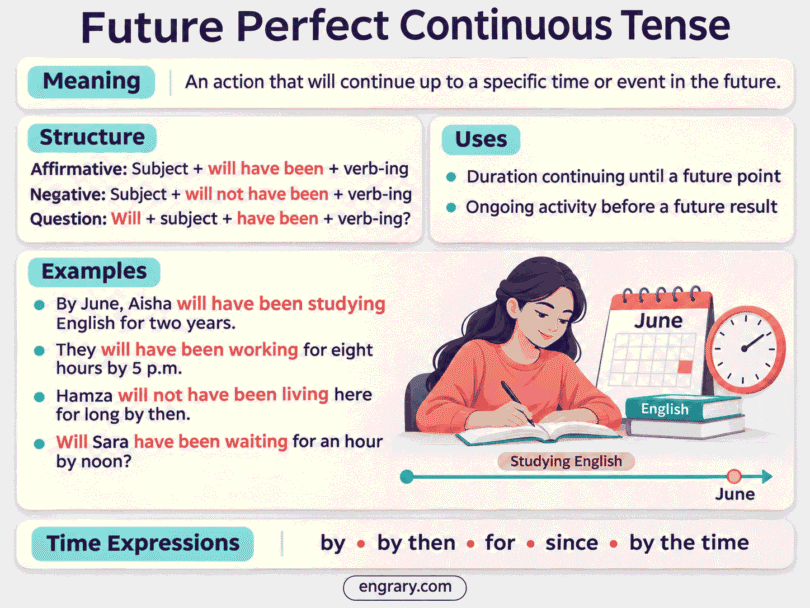
The future perfect continuous tense describes how long an activity will have continued by a particular time or event in the future. It follows the structure will have been + verb-ing, as in By noon, she will have been working for four hours. The tense looks backward from an imagined future point and emphasizes accumulated duration, process, or repeated activity.
In addition, this form can predict a future result, describe a temporary situation, mark a milestone, or express a deduction with by now. This guide explains its timeline, sentence structures, main uses, time expressions, related tenses, stative verbs, natural alternatives, and common mistakes.
Future Perfect Continuous Tense at a Glance
The future perfect continuous connects an earlier starting point with a later future reference point. Although the activity reaches that point, it does not necessarily end there.
| Feature | Explanation | Example |
|---|---|---|
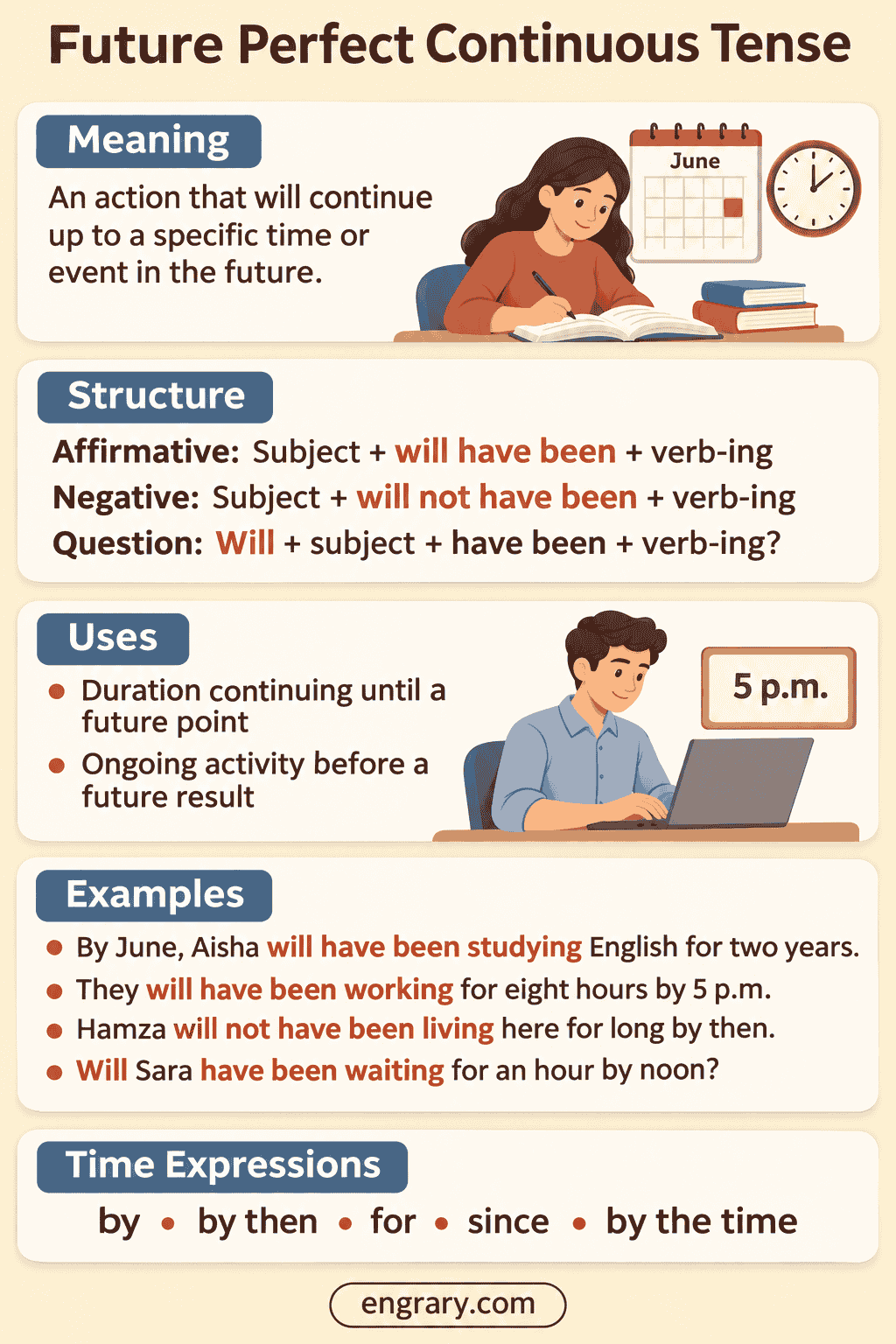
| Structure | will have been + verb-ing | She will have been studying. |
| Accumulated duration | Activity continues toward a future point | By noon, she will have been studying for four hours. |
| Negative | will not have been + verb-ing | She will not have been studying for long. |
| Question | Will + subject + have been + verb-ing? | Will she have been studying for four hours? |
| Common expressions | for, since, by, by the time | By June, she will have been working for a year. |
The same structure applies to every subject. Therefore, use will have been with I, you, he, she, it, we, and they.
Meaning and Timeline of the Future Perfect Continuous
The basic timeline follows this pattern:
Starting point → continuing or repeated activity → future reference point
Consider this example:
By noon, she will have been working for four hours.
| Timeline element | Information |
|---|---|
| Starting point | She starts working at 8 a.m. |
| Activity | The work continues. |
| Future reference point | Noon |
| Accumulated duration | Four hours |
| Later continuation | Not confirmed |
The sentence establishes four hours of activity by noon. However, she may continue working, stop at noon, or finish shortly beforehand if the context supports that meaning.
Starting Points in the Past, Present, and Future
The activity does not need to begin at the moment of speaking. It may start in the past, present, or future, provided that it begins before the chosen future reference point.
| Starting point | Example | Timeline |
|---|---|---|
| Past | By next June, I will have been working here for ten years. | The work began years ago. |
| Present | If I continue now, I will have been studying for three hours by midnight. | The studying is happening now. |
| Future | She starts at nine. By noon, she will have been working for three hours. | The work begins later. |
Consequently, the tense can describe a current activity extending into the future or an activity that has not started yet.
Structure of the Future Perfect Continuous Tense
The verb phrase contains four elements:
- Will: the modal auxiliary
- Have: the perfect auxiliary
- Been: the past participle of be
- Verb-ing: the present participle of the main verb
| Subject | Complete form |
|---|---|
| I | I will have been working. |
| You | You will have been working. |
| He, she, it | She will have been working. |
| We | We will have been working. |
| They | They will have been working. |
Affirmative Sentences
Structure: Subject + will have been + verb-ing + remaining information.
- By noon, I will have been studying for four hours.
- Next June, she will have been teaching for ten years.
- By the time we arrive, they will have been waiting for an hour.
- The machine will have been running continuously for a week by Friday.
Negative Sentences
Structure: Subject + will not have been + verb-ing + remaining information.
- By noon, I will not have been working for long.
- She will not have been living there for a full year by June.
- They will not have been waiting for more than twenty minutes when the doors open.
- He will not have been using the equipment before the inspection.
The contracted form is won’t have been:
- I won’t have been waiting for long.
- She won’t have been working there for a year yet.
Yes/No Questions
Structure: Will + subject + have been + verb-ing + remaining information?
- Will you have been waiting for an hour by noon?
- Will she have been working here for ten years next June?
- Will they have been traveling all day when they arrive?
- Will it have been raining for six hours by midnight?
Wh-Questions
Structure: Wh-word + will + subject + have been + verb-ing + remaining information?
- How long will you have been working here by June?
- What will she have been studying before the examination?
- Where will they have been staying during the project?
- Why will he have been traveling for so long?
Negative Questions
Negative questions can express surprise, concern, or an expectation:
- Won’t you have been waiting too long by then?
- Will she not have been working for six hours by noon?
- Why won’t they have been living there for a full year by June?
Subject Questions
In subject questions, who or what performs the activity:
- Who will have been managing the office by then?
- Which team will have been handling the project for the longest period?
- What will have been causing the repeated delays?
Short Answers
| Question | Affirmative answer | Negative answer |
|---|---|---|
| Will you have been waiting? | Yes, I will. | No, I won’t. |
| Will she have been working? | Yes, she will. | No, she won’t. |
| Will they have been studying? | Yes, they will. | No, they won’t. |
Short answers repeat will or won’t. They do not normally repeat have been and the main verb.
Main Uses of the Future Perfect Continuous Tense
The tense mainly emphasizes duration leading to a future point. Nevertheless, it can also highlight repetition, future evidence, temporary circumstances, and accumulated experience.
Duration Up to a Future Point
Use the tense when the length of an activity matters:
- By June, she will have been teaching for ten years.
- By midnight, we will have been traveling for eight hours.
- Next week, I will have been learning Spanish for a year.
- When the course ends, they will have been studying together for six months.
Activities Continuing Beyond the Future Point
The context can confirm that an activity will continue afterward:
- By noon, I will have been working for four hours, and I will continue until five.
- When you arrive, we will have been studying for an hour, but we will not finish until lunch.
- By June, she will have been researching the topic for a year, and the project will continue through December.
Activities Ending at the Future Point
The later event may also mark a clear endpoint:
- When the final bell rings, the students will have been writing for three hours.
- By the time his shift ends, he will have been driving for ten hours.
- When the doors close, the staff will have been serving customers for twelve hours.
Activities Stopping Shortly Before a Future Result
Sometimes the activity will stop shortly before a predicted future condition:
- When he arrives, he will be tired because he will have been driving all night.
- Her clothes will be wet because she will have been walking in the rain.
- The room will feel warm because the children will have been exercising there.
The activity may have stopped, but its result will still matter at the future reference point.
Future Causes and Expected Results
The tense often explains why a future condition will exist:
- She will need a break because she will have been studying since dawn.
- The players will feel exhausted because they will have been training in the heat.
- His hands will be dirty because he will have been repairing the engine.
- The roads may be flooded because it will have been raining all day.
Repeated Activities Over a Future Period
The activity can repeat rather than continue without interruption:
- By June, she will have been attending classes twice a week for a year.
- By December, they will have been meeting every Friday for six months.
- Next month, he will have been calling clients daily for a year.
- By the end of the term, the teacher will have been giving weekly quizzes for four months.
Temporary Future Situations
Use the tense to emphasize a limited arrangement extending toward a future point:
- By the end of June, we will have been staying with relatives for two months.
- When her contract ends, she will have been working in Dubai for a year.
- By Friday, I will have been using a borrowed laptop for three weeks.
- Next month, they will have been operating from a temporary office for half a year.
Future Milestones and Accumulated Experience
The tense can mark a milestone when an activity verb expresses the ongoing experience:
- Next month, the company will have been operating for a decade.
- By June, she will have been teaching for twenty years.
- Next week, we will have been working together for five years.
- By the end of the season, he will have been coaching the team for a decade.
Do not treat They will have been married for twenty years as future perfect continuous. That sentence contains no activity verb ending in -ing.
Predictions and Deductions with By Now
The construction can express a confident deduction about an activity’s probable duration up to now:
- They will have been traveling for six hours by now.
- She will have been waiting for nearly an hour by now.
- The technicians will have been testing the system all morning by now.
Here, will expresses inference rather than a straightforward future prediction.
Completion and Continuation at the Future Point
The tense alone does not state what happens after the future reference point. Context supplies that information.
| Situation | Example | Interpretation |
|---|---|---|
| Continues afterward | By noon, I will have been working for four hours, and I will continue until five. | The activity continues. |
| Ends at that point | When my shift ends, I will have been working for ten hours. | The activity ends. |
| Stops shortly before | He will be tired because he will have been driving all night. | The driving may have just stopped. |
| Continuation unknown | By noon, she will have been studying for four hours. | The sentence leaves the later situation unstated. |
Duration Without For and Since
Although for and since frequently appear with the tense, they are not compulsory. Other expressions can show duration:
- By noon, she will have been working all morning.
- Next Friday, they will have been traveling throughout the week.
- By the end of the match, it will have been raining the entire time.
- By then, we will have been waiting several hours.
Time Expressions with the Future Perfect Continuous
For and Since
Use for with a period and since with a starting point.
| Expression | Function | Example |
|---|---|---|
| for | Duration | She will have been working for five hours. |
| since | Starting point | She will have been working since eight. |
| since + clause | Starting event | She will have been working since the office opened. |
By and For
By establishes the future reference point, whereas for states the accumulated duration.
| Expression | Function |
|---|---|
| by Friday | Future reference point |
| for five days | Accumulated duration |
Combined example: By Friday, we will have been working for five days.
By and By the Time
Use by before a time or noun phrase. Use by the time before a clause.
- By noon, I will have been working for four hours.
- By next week, she will have been living here for a year.
- By the time you arrive, I will have been working for four hours.
- By the time the course ends, they will have been studying for six months.
Reference Points Without By
Other expressions can establish the future point directly:
- Next June, I will have been working here for ten years.
- This time tomorrow, we will have been traveling for twelve hours.
- When she retires, she will have been teaching for forty years.
- At noon, he will have been driving for six hours.
Approximate and Exact Duration
Modifiers make duration more precise and natural:
- By noon, she will have been waiting for nearly two hours.
- Next month, I will have been working here for exactly ten years.
- By the time they arrive, they will have been traveling for more than a day.
- By Friday, the technicians will have been testing the equipment for at least a week.
Logical Time Calculations
The duration must match the starting point and reference time.
| Starting time | Future point | Correct duration |
|---|---|---|
| 8 a.m. | Noon | Four hours |
| Monday | Friday | Four days, depending on the exact time |
| January 2025 | January 2030 | Five years |
For example, if she starts at 8 a.m., By noon, she will have been working for four hours is logical. Saying five hours would create an inaccurate timeline.
Future Time Clauses
After when, before, after, until, by the time, if, and unless, English normally uses a present form for future meaning. Do not add will inside the time or condition clause.
| Incorrect | Correct |
|---|---|
| By the time you will arrive, I will have been waiting for an hour. | By the time you arrive, I will have been waiting for an hour. |
| When she will retire, she will have been teaching for forty years. | When she retires, she will have been teaching for forty years. |
| Before he will leave, he will have been working for ten hours. | Before he leaves, he will have been working for ten hours. |
| If she will continue, she will have been studying for three hours by noon. | If she continues, she will have been studying for three hours by noon. |
| Unless the rain will stop, it will have been falling for a day by morning. | Unless the rain stops, it will have been falling for a day by morning. |
Negative Duration and Absence of Activity
Negative constructions can express different meanings:
| Negative sentence | Meaning |
|---|---|
| By noon, I won’t have been waiting for long. | The duration will remain short. |
| By June, she won’t have been working there for a full year. | The stated duration will not yet be complete. |
| He won’t have been using the machine before the test. | The activity will not occur during the preceding period. |
Therefore, a negative sentence may deny the activity itself or only the proposed duration.
Adverb Placement in Future Perfect Continuous Sentences
| Adverb | Natural example |
|---|---|
| already | By noon, she will already have been working for six hours. |
| probably | She will probably have been waiting for an hour. |
| continuously | The machine will have been running continuously for a week. |
| regularly | They will have been meeting regularly for six months. |
| gradually | The situation will have been gradually improving for weeks. |
Modal adverbs such as probably usually follow will. Meanwhile, manner and frequency adverbs commonly appear close to the main verb. Avoid forcing still into this construction when a simpler form sounds more natural.
Contractions and Natural Pronunciation
| Full form | Contraction |
|---|---|
| I will have been working | I’ll have been working |
| You will have been studying | You’ll have been studying |
| She will have been waiting | She’ll have been waiting |
| They will have been traveling | They’ll have been traveling |
| I will not have been working | I won’t have been working |
In natural speech, speakers often reduce the unstressed auxiliaries. The main verb and important duration words usually receive more stress. Pronouncing every auxiliary with equal force can make the sentence sound unusually slow, although the grammar remains correct.
Present Participle Spelling Rules
| Base verb | Present participle | Rule |
|---|---|---|
| work | working | Add -ing. |
| write | writing | Remove the final silent e. |
| run | running | Double the final consonant. |
| lie | lying | Change ie to y. |
| panic | panicking | Add k before -ing. |
| travel | travelling/traveling | British and American variants |
Stative and Dynamic Verbs
Stative verbs describe conditions such as possession, knowledge, belief, preference, or understanding. Consequently, they do not normally use continuous forms.
| Incorrect | Correct |
|---|---|
| I will have been knowing her for ten years. | I will have known her for ten years. |
| He will have been owning the shop for a decade. | He will have owned the shop for a decade. |
| They will have been believing the story for years. | They will have believed the story for years. |
| She will have been understanding the topic for months. | She will have understood the topic for months. |
Some verbs can express an activity when their meanings change:
| Stative or result-focused meaning | Dynamic activity |
|---|---|
| She will have thought about the issue. | She will have been thinking about the issue. |
| He will have had the car for years. | He will have been having trouble with the car. |
| The soup will have tasted unusual. | The chef will have been tasting the soup. |
The expression will have been wanting sometimes appears in informal English, but the future perfect simple is safer for formal explanations of the state want.
Punctual Verbs in the Future Perfect Continuous
Punctual and achievement verbs describe an event that happens at a single point. Therefore, they do not normally use the continuous form for one completed event.
| Unnatural construction | Natural construction |
|---|---|
| She will have been arriving at noon. | She will have arrived by noon. |
| The race will have been starting at ten. | The race will have started by ten. |
| He will have been recognizing the problem. | He will have recognized the problem. |
However, some punctual verbs can appear in the continuous when they describe repetition:
- By noon, guests will have been arriving for three hours.
- By next week, the machine will have been stopping unexpectedly for a month.
- By Friday, deliveries will have been arriving late for several weeks.
Quantity and Completed Results
Use the future perfect for a completed total or result. Use the future perfect continuous for process, duration, or repeated effort.
| Future perfect | Future perfect continuous | Main contrast |
|---|---|---|
| She will have written five reports. | She will have been writing reports for a month. | Quantity versus duration |
| They will have repaired ten bicycles. | They will have been repairing bicycles all week. | Completed total versus process |
| He will have made twenty calls. | He will have been calling clients all morning. | Exact number versus repeated effort |
| We will have read three chapters. | We will have been reading for two hours. | Completed amount versus activity |
Future Perfect and Future Perfect Continuous
| Future perfect | Future perfect continuous | Main contrast |
|---|---|---|
| She will have completed the report. | She will have been writing the report. | Completion versus process |
| He will have repaired five bikes. | He will have been repairing bikes. | Quantity versus activity |
| They will have made ten calls. | They will have been calling all morning. | Exact total versus repetition |
| I will have known her for a decade. | I will have been working with her for a decade. | State versus activity |
Future Continuous and Future Perfect Continuous
| Future continuous | Future perfect continuous | Main contrast |
|---|---|---|
| At noon, she will be working. | By noon, she will have been working for four hours. | Activity at that moment versus preceding duration |
| They will be traveling tomorrow. | By tomorrow evening, they will have been traveling for a day. | Future activity versus accumulated duration |
| I will be waiting when you arrive. | I will have been waiting for an hour when you arrive. | Activity in progress versus duration |
Present Perfect Continuous and Future Perfect Continuous
| Present perfect continuous | Future perfect continuous | Reference point |
|---|---|---|
| I have been studying for two hours. | By midnight, I will have been studying for five hours. | Now versus a future point |
| It has been raining all morning. | By noon, it will have been raining for six hours. | Present duration versus future duration |
| They have been living here since June. | By December, they will have been living here for six months. | Duration until now versus accumulated future duration |
Simple Future and Future Perfect Continuous
| Simple future | Future perfect continuous | Main contrast |
|---|---|---|
| I will work tomorrow. | By noon, I will have been working for four hours. | Future event versus accumulated duration |
| They will travel next week. | By Friday, they will have been traveling for three days. | Future action versus duration |
| She will teach next year. | Next year, she will have been teaching for a decade. | Future fact versus milestone |
Noncontinuous Will Have Been Constructions
The words will have been do not automatically create the future perfect continuous. The construction also needs an -ing participle that expresses the main activity.
| Construction | Classification |
|---|---|
| She will have been working. | Future perfect continuous |
| They will have been married for twenty years. | Future perfect of the state be married |
| He will have been a teacher for a decade. | Future perfect with a noun complement |
| She will have been at home for an hour. | Future perfect with a place complement |
| The road will have been repaired. | Future perfect passive |
| The road will have been being repaired. | Future perfect continuous passive |
A useful test is simple: if no main activity verb ends in -ing, the sentence is not future perfect continuous.
Future Viewed from the Past with Would Have Been
The structure would have been + verb-ing has two important uses.
| Use | Example |
|---|---|
| Future viewed from the past | She knew that by June she would have been working there for ten years. |
| Reported future duration | He said that by noon he would have been driving for six hours. |
| Unreal conditional result | Without the interruption, she would have been working for six hours by noon. |
Although the construction resembles the future perfect continuous, it uses would to express a past viewpoint or an unreal result.
Shall Have Been and Going to Have Been
Modern English normally uses will have been. Nevertheless, formal or traditional British English may use shall with I or we:
- By June, we shall have been working together for ten years.
An expected plan can occasionally use be going to have been + verb-ing:
- By December, she is going to have been working there for a year.
This form is grammatical but often sounds heavy. Therefore, will have been working usually provides the clearer choice.
Rare Passive Forms and Natural Alternatives
The passive future perfect continuous is grammatically possible, but it sounds extremely awkward.
| Awkward passive construction | Natural alternative |
|---|---|
| The road will have been being repaired for a month. | Workers will have been repairing the road for a month. |
| The system will have been being tested for a week. | Engineers will have been testing the system for a week. |
| The building will have been being renovated for a year. | The building will have been under renovation for a year. |
Whenever possible, use an active subject or another natural construction.
Natural Alternatives in Everyday English
The future perfect continuous is precise, but it is relatively uncommon. Speakers often choose a simpler sentence when the exact grammatical viewpoint is unnecessary.
| Future perfect continuous | Natural alternative |
|---|---|
| By June, I will have been working here for ten years. | In June, I will reach ten years at the company. |
| By noon, she will have been waiting for two hours. | At noon, her wait will reach two hours. |
| By next week, they will have been living here for a year. | Next week marks one year since they moved here. |
Use the future perfect continuous when accumulated duration, sustained effort, repetition, or an expected future result deserves emphasis.
Common Mistakes with the Future Perfect Continuous
| Mistake | Incorrect sentence | Correct sentence |
|---|---|---|
| Omitting will | She have been working for hours by noon. | She will have been working for hours by noon. |
| Omitting have | She will been working for hours. | She will have been working for hours. |
| Omitting been | She will have working for hours. | She will have been working for hours. |
| Confusing been and being | She will have being working. | She will have been working. |
| Using a past participle | They will have been worked all day. | They will have been working all day. |
| Incorrect negative order | She will have not been working. | She will not have been working. |
| Incorrect question order | Will have you been waiting? | Will you have been waiting? |
| Adding will to a time clause | By the time you will arrive, I will have been waiting. | By the time you arrive, I will have been waiting. |
| Confusing by and for | She will have been working by five years. | She will have been working for five years. |
| Confusing for and since | She will have been working since five years. | She will have been working for five years. |
| Using a stative verb | I will have been knowing him for years. | I will have known him for years. |
| Using the continuous for a total | She will have been writing five reports. | She will have written five reports. |
| Assuming completion | By noon, he will have been working for four hours, so he will have finished. | By noon, he will have been working for four hours; he may continue. |
| Misclassifying a state | They will have been married for ten years is future perfect continuous. | It is future perfect with the state be married. |
| Misspelling the participle | She will have been runing. | She will have been running. |
Quick Reference for the Future Perfect Continuous
| Feature | Rule or example |
|---|---|
| Basic structure | Subject + will have been + verb-ing |
| Negative | Subject + will not have been + verb-ing |
| Question | Will + subject + have been + verb-ing? |
| Main meaning | Accumulated activity or duration up to a future point |
| Other uses | Repetition, future causes, milestones, temporary situations, and deductions |
| Common expressions | for, since, by, by then, by the time, how long |
| Short answers | Yes, I will. No, she won’t. |
| Main restrictions | Avoid most stative verbs, single punctual events, and completed quantities. |
| Time-clause rule | Use a present form after when, by the time, if, and similar conjunctions. |
FAQs
The future perfect continuous describes how long an activity will have continued by a future time or event. For example, By noon, I will have been working for four hours looks backward from noon and emphasizes the accumulated duration of the work.
The affirmative structure is subject + will have been + verb-ing. For negatives, use will not have been. For questions, place will before the subject: Will she have been working? The structure remains the same with every subject.
Use it to emphasize duration leading to a future point, repeated activity over a future period, an expected future condition caused by an activity, a temporary arrangement, or accumulated experience. It can also express a deduction with by now.
The future perfect emphasizes a completed result or quantity: She will have written five reports. In contrast, the future perfect continuous emphasizes the activity, process, duration, or repetition: She will have been writing reports for a month.
Most stative verbs do not normally take continuous forms. Therefore, say I will have known her for ten years, not I will have been knowing her for ten years. However, some verbs can use the continuous when they express an activity, as in I will have been thinking about the problem for hours.
You May Also Like

Leave a Comment