
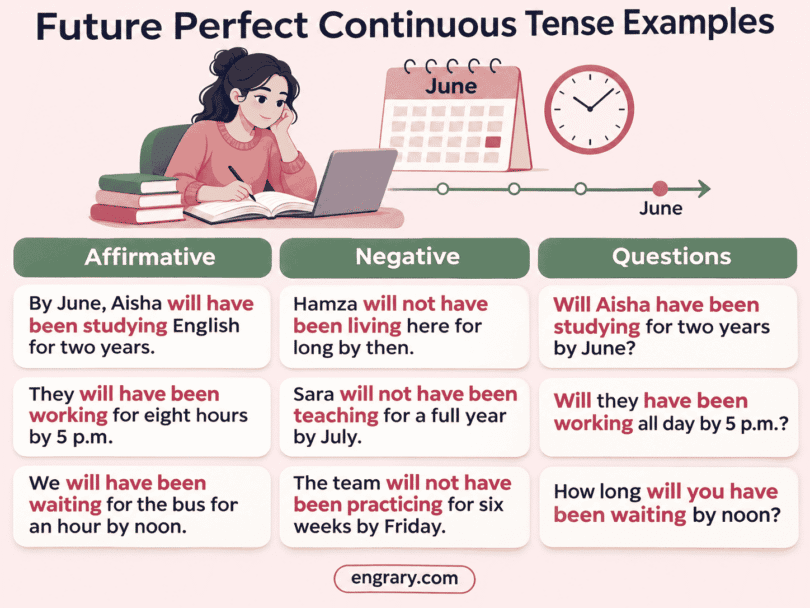
The future perfect continuous tense shows how long an activity will have continued up to a particular point in the future. It uses will have been + verb-ing, as in will have been working. The activity may begin in the past, present, or future; however, the speaker measures its duration from a later future reference point.
Below are 160 future perfect continuous tense examples in sentences. The collection includes affirmative statements, negative statements, yes-or-no questions, Wh-questions, negative questions, short answers, future milestones, and future causes and results. In addition, the supporting tables explain the most important structures, time expressions, comparisons, and common mistakes without repeating the numbered examples.
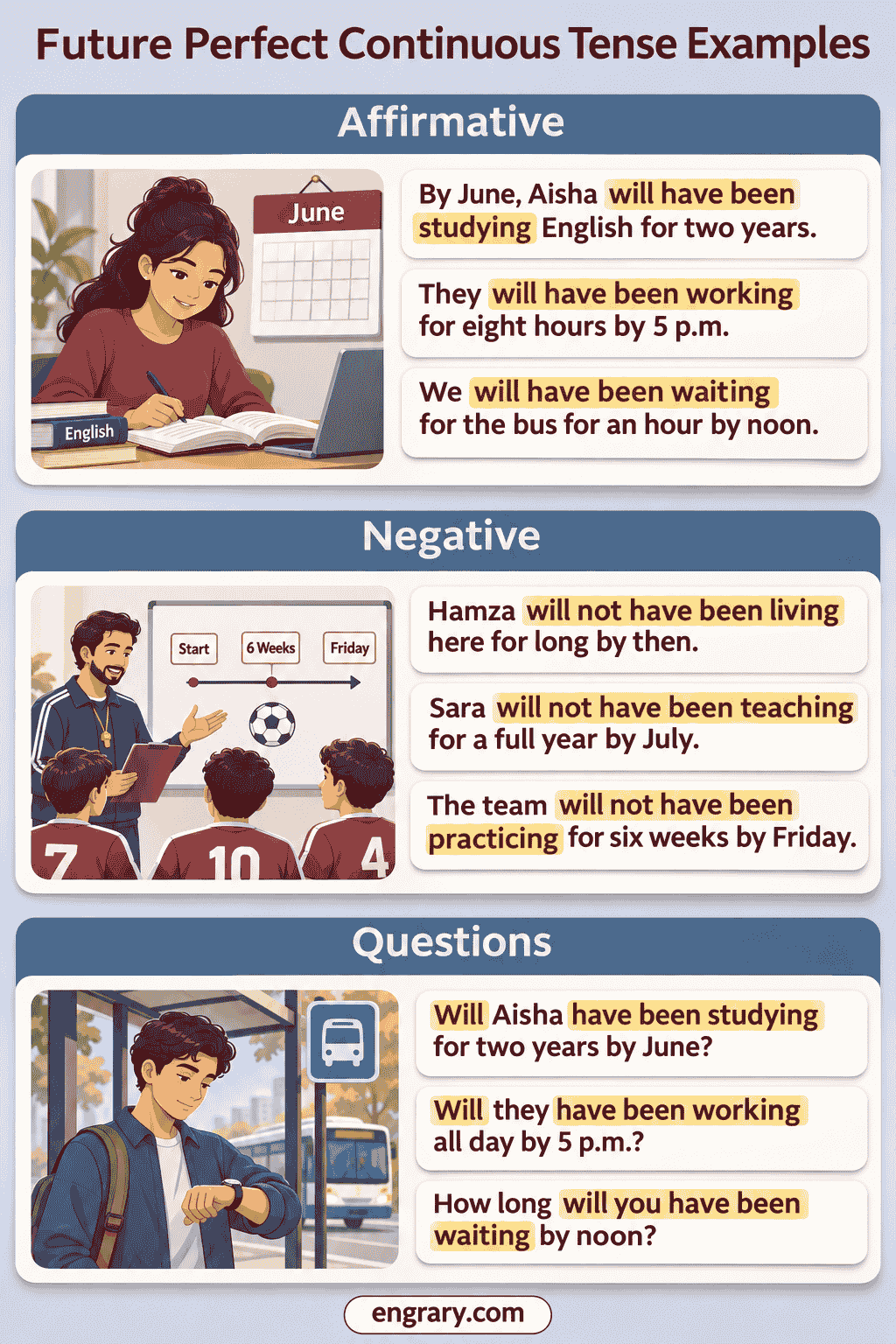
Future Perfect Continuous Tense Examples at a Glance
The future perfect continuous, also called the future perfect progressive, combines future time, perfect aspect, and continuous aspect. Therefore, it looks forward to a future moment and then looks back over the duration of an activity.
The complete verb phrase contains three auxiliaries followed by an -ing form:
will + have + been + verb-ing
| Sentence type | Structure | Main examples |
|---|---|---|
| Affirmative | Subject + will have been + verb-ing | 1–50 |
| Negative | Subject + will not have been + verb-ing | 51–80 |
| Yes-or-no question | Will + subject + have been + verb-ing? | 81–100 |
| Wh-question | Wh-word + will + subject + have been + verb-ing? | 101–120 |
| Negative question | Won’t + subject + have been + verb-ing? | 121–130 |
| Short answer | Yes, subject + will. / No, subject + won’t. | 131–140 |
The tense usually emphasizes duration, not merely future activity. For instance, a sentence may measure an activity up to noon, graduation, an anniversary, an arrival, or another future milestone. Still, the form does not always tell us whether the activity continues after that point; context supplies that information.
Future Perfect Continuous Sentence Structures
The auxiliary will stays the same with every subject. Next, have been forms the perfect construction, while the present participle presents the activity as ongoing or repeated. In negative statements, not follows will. In questions, meanwhile, will moves before the subject.
| Form | Pattern |
|---|---|
| Affirmative | Subject + will have been + verb-ing + time expression |
| Negative | Subject + will not have been + verb-ing + time expression |
| Contracted negative | Subject + won’t have been + verb-ing + time expression |
| Yes-or-no question | Will + subject + have been + verb-ing + time expression? |
| Wh-question | Wh-word + will + subject + have been + verb-ing + time expression? |
| Negative question | Won’t + subject + have been + verb-ing + time expression? |
| Short answer | Yes, subject + will. / No, subject + won’t. |
Affirmative Future Perfect Continuous Tense Examples
Affirmative sentences describe an activity whose duration will extend toward a future reference point. The following examples use varied subjects, verbs, starting points, and real-life situations.
Work and Professional Life
- By June, I will have been working at the hospital for five years.
- Next month, Aisha will have been managing the shop for a full year.
- By the time the new branch opens, Omar will have been training its staff for six weeks.
- At the end of this quarter, our team will have been developing the software for nine months.
- By Friday, the engineers will have been testing the bridge for ten days.
- When the conference begins, she will have been preparing her presentation for three weeks.
- By 2030, Mr. Khan will have been teaching at this college for twenty years.
- At noon, the technicians will have been repairing the network for four hours.
- By the time the audit ends, we will have been reviewing the accounts for nearly a month.
- Next January, Elena will have been running her design studio for a decade.
Education and Learning
- By graduation, I will have been studying computer science for four years.
- When the examination starts, the students will have been revising for several weeks.
- By December, Noor will have been learning Japanese for eighteen months.
- At the end of the semester, we will have been researching climate policy for twelve weeks.
- By next summer, he will have been writing his thesis for a year.
- When the exchange program ends, they will have been attending classes abroad for six months.
- By the final lesson, you will have been practising these pronunciation patterns for ten weeks.
- At the end of today’s session, the children will have been reading for two hours.
- By the time she earns her certificate, Maya will have been taking evening classes for eight months.
- Next April, Professor Ali will have been supervising doctoral students for fifteen years.
Daily Life and Personal Activities
- By lunchtime, I will have been cooking for three hours.
- When the guests arrive, we will have been cleaning the house all morning.
- By sunset, my father will have been gardening for most of the day.
- At eight o’clock, Sara will have been waiting for the delivery for ninety minutes.
- By the end of the month, they will have been saving for their wedding for two years.
- When the charity walk finishes, I will have been walking for nearly six hours.
- By next week, Hamza will have been caring for the injured bird for a month.
- At midnight, the neighbours will have been celebrating for five hours.
- By the time the paint dries, we will have been renovating the room for three days.
- Next Saturday, she will have been practising yoga every morning for six months.
Travel and Movement
- By the time we reach Lahore, we will have been driving for five hours.
- When the plane lands, the passengers will have been flying for nearly fourteen hours.
- By noon, the hikers will have been climbing for six hours.
- At the next station, I will have been travelling by train since dawn.
- By the time the ship reaches port, the crew will have been sailing for three weeks.
- When you meet us at the lake, we will have been cycling for two hours.
- By the end of her tour, Leila will have been travelling across Asia for four months.
- At nine o’clock, the rescue team will have been searching the mountain for twelve hours.
- By the time he reaches the office, Bilal will have been commuting for almost two hours.
- When the runners cross the finish line, they will have been racing since early morning.
Technology, Projects, and Long-Term Activities
- By midnight, the server will have been processing requests for twenty-four hours without a break.
- When the update finishes, the system will have been installing files for forty minutes.
- By the launch date, our developers will have been building the application for eleven months.
- At the end of the trial, the sensors will have been collecting data for thirty days.
- By Monday, the security team will have been monitoring the network for a full week.
- When the laboratory closes, the machine will have been running continuously for ten hours.
- By the final review, we will have been documenting the project for six months.
- At the end of the campaign, the organization will have been raising awareness for one hundred days.
- By next winter, the builders will have been restoring the old theatre for two years.
- When the research phase concludes, scientists will have been tracking the animals for five seasons.
Negative Future Perfect Continuous Tense Examples
Negative sentences can deny an activity, its continuation, or a stated duration. Importantly, a negative form does not always mean that the activity never occurs. It may simply mean that the activity will not reach the specified length of time.
Activities Below an Expected Duration
- By July, I will not have been working here for a full year.
- At noon, she will not have been waiting for more than twenty minutes.
- By graduation, Amir will not have been studying engineering for four complete years.
- When the bus arrives, we will not have been standing outside for very long.
- By next week, the builders will not have been repairing the roof for a month.
- At the end of this term, Mia will not have been teaching this class for a whole semester.
- By December, they will not have been living in Karachi for two years.
- When the race begins, he will not have been training for the recommended twelve weeks.
- By the deadline, our group will not have been working on the proposal for more than ten days.
- At sunset, the photographers will not have been waiting for more than an hour.
Activities That Will Not Continue
- By Friday, the factory will not have been operating continuously because it will close for maintenance.
- When you arrive, I will not have been sleeping; I will have been reading.
- By the end of the month, she will not have been attending the course because she plans to withdraw tomorrow.
- At six o’clock, the children will not have been playing outside because rain will move the game indoors.
- By January, we will not have been using the old system because the replacement launches in December.
- When the manager returns, the staff will not have been waiting idly; they will have started the meeting.
- By next summer, he will not have been commuting to the city because his new job is remote.
- At midnight, the machine will not have been running all day because the technician will switch it off at noon.
- By the time the guests arrive, we will not have been cooking for hours because the meal is already prepared.
- When the road reopens, drivers will not have been travelling along this route during the closure.
Corrected Assumptions and Expectations
- By March, Sana will not have been leading the department for ten years, despite what the report claims.
- When the exhibition opens, the artist will not have been preparing it alone; several assistants will have helped.
- By tomorrow, I will not have been practising for a week, as you assumed.
- At the end of the shift, the nurses will not have been working without breaks.
- By the anniversary, they will not have been dating for five years; it will be four.
- When the repairs finish, the crew will not have been fixing the same problem the entire time.
- By the final interview, she will not have been applying only to local companies.
- At the end of the experiment, researchers will not have been measuring temperature alone.
- By the time we leave, the guide will not have been speaking for the entire tour.
- When the results appear, the analysts will not have been examining just one set of figures.
Yes-or-No Questions in the Future Perfect Continuous
Yes-or-no questions place will before the subject. Although how long questions appear more frequently with this tense, yes-or-no questions are useful when a speaker wants to confirm an expected duration or continuing activity.
- Will you have been working here for five years by June?
- Will Amina have been studying French for a year by the end of the course?
- Will they have been waiting long when our train arrives?
- Will he have been driving for six hours by the next rest stop?
- Will the children have been sleeping for long when we get home?
- Will your team have been developing the website for three months by launch day?
- Will she have been teaching online for a decade by 2030?
- Will we have been hiking for four hours by lunchtime?
- Will the machine have been running continuously when the inspection begins?
- Will Farah have been training for the marathon for six months by race day?
- Will the scientists have been collecting data long enough by the end of the trial?
- Will you have been living in Islamabad for two years by next April?
- Will the crew have been filming all night when the director arrives?
- Will the patient have been taking the medicine for a week by the appointment?
- Will the company have been operating for fifty years by its next anniversary?
- Will the students have been preparing for the debate since Monday?
- Will we have been using the new software for a month by the review meeting?
- Will the workers have been building the tunnel for three years by completion day?
- Will your brother have been travelling for long when he reaches Turkey?
- Will the volunteers have been distributing food all morning by noon?
Wh-Questions in the Future Perfect Continuous
Wh-questions request specific information. Because this tense often measures duration, how long is especially common. Nevertheless, other question words can ask about the activity, place, reason, people involved, or period measured.
Questions with How Long
- How long will you have been working at the clinic by December?
- How long will Sara have been studying architecture when she graduates?
- How long will they have been waiting by the time the doors open?
- How long will he have been driving when he reaches the border?
- How long will we have been travelling when the ferry docks?
- How long will the developers have been testing the application by Friday?
- How long will your parents have been living in their new house by then?
- How long will the baby have been sleeping when the doctor arrives?
- How long will the engineers have been monitoring the equipment before the trial ends?
- How long will Nadia have been teaching English by her retirement date?
Questions with Other Wh-Words
- What will you have been working on by the time the supervisor checks your progress?
- Where will the researchers have been collecting samples before they return to the laboratory?
- Why will the workers have been digging near the road for three weeks?
- Who will have been managing the branch while the director is abroad?
- Which project will your team have been developing for the longest period by June?
- How many months will she have been learning Arabic when she moves to Dubai?
- What will the children have been practising before the school concert begins?
- Where will the rescue teams have been searching by nightfall?
- Why will the server have been running continuously for forty-eight hours by then?
- How many years will they have been producing electric vehicles by 2035?
Negative Questions in the Future Perfect Continuous
Negative questions often express surprise, expectation, or a request for confirmation. Contracted forms with won’t usually sound more conversational. In contrast, full forms with will not can add formality or emphasis.
- Won’t you have been working here for ten years by January?
- Won’t she have been studying for six hours by midnight?
- Won’t they have been travelling all day when they reach the hotel?
- Won’t the children have been waiting long enough by then?
- Won’t he have been training for the race for several months by June?
- Will the technicians not have been monitoring the system overnight?
- Will your team not have been preparing the report for two weeks by Friday?
- Will the builders not have been working on the stadium for a year by the opening ceremony?
- Won’t we have been using this equipment for five years by the replacement date?
- Will the researchers not have been recording the results throughout the experiment?
Short Answers in the Future Perfect Continuous
A short answer ends with will or won’t. Therefore, speakers do not normally repeat the full phrase have been + verb-ing. Each item below presents one question-and-answer exchange.
- Will you have been studying for three hours by noon? Yes, I will.
- Will Imran have been working here for a year by May? No, he won’t.
- Will she have been waiting long when we arrive? Yes, she will.
- Will they have been travelling all night? No, they won’t.
- Will we have been living here for ten years by 2030? Yes, we will.
- Will the machine have been running for twelve hours by then? No, it won’t.
- Will your parents have been managing the restaurant for twenty years by July? Yes, they will.
- Will I have been training long enough by race day? Yes, you will.
- Will the students have been preparing since Monday? No, they won’t.
- Will Maya have been teaching the class for a full term? Yes, she will.
Duration and Future-Milestone Examples
Future milestones provide natural reference points for measuring an activity. Consequently, birthdays, anniversaries, graduations, deadlines, arrivals, and retirement dates commonly appear with this tense.
- By her thirtieth birthday, Lina will have been running her own business for seven years.
- On their anniversary, my grandparents will have been living together for fifty years.
- By graduation day, the class will have been learning together for four academic years.
- When Mr. Ahmed retires, he will have been serving the community for thirty-five years.
- By the project deadline, our team will have been collaborating for sixteen months.
- When the train reaches Quetta, we will have been travelling for almost a full day.
- At the end of the language course, Hina will have been speaking English every day for twenty weeks.
- By New Year’s Day, the family will have been rebuilding its home for nine months.
- At the company’s centenary, it will have been manufacturing tools for one hundred years.
- When the expedition reaches base camp, the climbers will have been ascending for six demanding days.
Future Causes and Results
An extended activity can explain a condition that will exist later. In these examples, the future perfect continuous supplies the cause, while another clause presents the expected result.
- Sara will feel tired because she will have been studying all night.
- The travellers will be hungry because they will have been driving since early morning.
- By the final match, the players will feel confident because they will have been training together for months.
- By the time he stops, his legs will ache because he will have been cycling across the hills for five hours.
- When the interview begins, Amna will speak confidently because she will have been practising her answers all week.
- The engineers will understand the fault better because they will have been examining the system for several days.
- When the guests arrive, the kitchen will smell wonderful because the cooks will have been baking since dawn.
- By evening, the volunteers will need a break because they will have been carrying supplies all day.
- The researcher will know the habitat well because she will have been observing it for an entire season.
- When the support team resolves the issue, its members will feel relieved because they will have been troubleshooting it for hours.
Future Reference Points and Duration
Every numbered example contains or implies a future reference point. The activity begins earlier, continues for a period, and is measured from that later point.
| Element | Function | Article reference |
|---|---|---|
| Starting point | Shows when the activity begins | Example 34: since dawn |
| Duration | Shows how long the activity continues | Example 31: for five hours |
| Future reference point | Shows when the speaker measures the duration | Example 31: by the time we reach Lahore |
The starting point may lie in the past, present, or future. For example, the work in Example 1 may already be in progress. Conversely, a speaker could describe an activity that starts later but still accumulates duration before its future reference point.
Logical Time Calculations
Duration must agree logically with the starting and reference times. Therefore, writers should check the timeline rather than inserting an arbitrary number.
| Starting point | Future reference point | Correct duration |
|---|---|---|
| 8:00 a.m. | Noon | Four hours |
| January 2025 | January 2030 | Five years |
| Monday morning | Friday morning | Four days |
| Early June | Early September | About three months |
Example 24 follows the same logic: if Sara begins waiting at 6:30, her waiting time reaches ninety minutes at 8:00. Similarly, Example 31 requires a departure roughly five hours before the travellers reach Lahore.
Continuation, Completion, and Recent Activity
The future perfect continuous views an activity through its duration, but it does not automatically state what happens next. At the reference point, the activity may still be continuing, may end at that moment, or may have ended shortly before it.
| Possible situation | Article reference | Interpretation |
|---|---|---|
| Activity continues | Example 7 | The teaching may continue beyond 2030. |
| Activity ends at the reference point | Example 40 | The racing ends at the finish line. |
| Activity ends shortly before the result | Example 151 | The studying may stop before Sara feels tired. |
As a result, writers should avoid saying that this tense always describes an unfinished action or always marks a completed one. Context determines the boundary.
Negative Duration and Negative Activity
Negative examples express two distinct ideas. First, they may reject the stated duration. Example 51 allows the speaker to work at the company, but the employment will not yet total one year. Second, they may deny that the activity continues through the relevant period, as Example 65 does after a system replacement.
| Negative meaning | Article references |
|---|---|
| Duration remains below a stated amount | 51–60 |
| Activity stops or does not continue | 61–70 |
| Speaker corrects an assumption | 71–80 |
This distinction makes negative examples clearer and prevents the mistaken belief that will not have been working must mean “will never work.”
Examples with For and Since
Both expressions connect naturally with duration, but they answer different questions.
| Expression | Purpose | Article references |
|---|---|---|
| for | Gives the length of the activity | 1, 21, 31, 141 |
| since | Gives the activity’s starting point | 34, 40, 96, 152 |
Use for with a period such as five hours, three weeks, or ten years. In contrast, use since with a starting point such as Monday, dawn, or 2025. Context must also supply a future point from which the duration is measured.
Examples with By and By the Time
The preposition by sets a future limit or reference point. Meanwhile, by the time introduces an event that serves as that point.
| Expression | Function | Article references |
|---|---|---|
| by + future time | Sets a future date, hour, or milestone | 1, 5, 11 |
| by then | Refers to a previously identified future point | 107, 119, 136 |
| by the time + clause | Uses a future event as the reference point | 3, 9, 31 |
| when + clause | Identifies the future event directly | 6, 16, 32 |
In future time clauses, English normally uses a present form rather than will. Therefore, the clause in Example 31 uses we reach, not we will reach. The main clause carries the future meaning.
Future Time Clauses
Future perfect continuous sentences can use several conjunctions to establish conditions and reference points.
| Connector | Typical role |
|---|---|
| when | Introduces a future event |
| before | Places one event earlier than another |
| after | Places one event later than another |
| by the time | Sets the limit for accumulated duration |
| until | Marks the endpoint of an activity |
| once | Introduces the event that follows completion or progress |
| if | Introduces a condition |
| unless | Introduces a negative condition |
After these connectors, use a present form when the clause refers to the future. Additionally, ensure that the main clause has a genuine duration to measure; otherwise, a simpler future form may sound more natural.
Stative and Dynamic Verbs
Stative verbs describe conditions, possession, opinions, or relationships rather than deliberate activities. Consequently, they usually avoid continuous forms.
| Unnatural continuous form | Natural perfect form |
|---|---|
| will have been knowing | will have known |
| will have been owning | will have owned |
| will have been believing | will have believed |
| will have been belonging | will have belonged |
| will have been understanding | will have understood |
However, meaning can change the grammar. The verb think may describe an opinion, but thinking about a problem describes an activity. Likewise, have can express possession or an activity such as having lessons. Choose the form according to the intended meaning.
Verb-Ing Spelling Rules
The main verb always takes an -ing form. Nevertheless, its spelling may change.
| Base verb | Verb-ing form | Main change |
|---|---|---|
| work | working | Add -ing |
| write | writing | Remove final silent e |
| run | running | Double the final consonant |
| lie | lying | Change ie to y |
| travel | travelling / traveling | British / American spelling |
These spelling changes affect only the main verb. The auxiliaries will have been remain unchanged with every subject.
Adverb Placement and Contractions
Adverbs usually appear after will, after been, or before the main verb, depending on their meaning and emphasis.
| Placement | Pattern |
|---|---|
| Probability | will probably have been + verb-ing |
| Continuity | will have been continuously + verb-ing |
| Frequency | will have been regularly + verb-ing |
| Negative | will not have been + verb-ing |
In everyday speech and informal writing, speakers frequently contract the subject with will: I’ll, you’ll, she’ll, we’ll, and they’ll. They also contract will not to won’t. The full forms remain useful when a speaker wants emphasis or a formal tone.
Noncontinuous Will Have Been Constructions
Not every construction containing will have been belongs to the future perfect continuous. The -ing form is essential.
| Pattern | Grammar label |
|---|---|
| will have been + verb-ing | Future perfect continuous |
| will have been + noun or adjective | Future perfect of be |
| will have been + past participle | Future perfect passive |
For instance, the pattern in Examples 1–160 contains a present participle such as working, studying, or travelling. A noun, adjective, or passive participle creates a different construction.
Future Perfect and Future Perfect Continuous
Both tenses look back from a future reference point. However, the future perfect usually emphasizes completion, result, or quantity, whereas the future perfect continuous emphasizes duration or process.
| Feature | Future perfect | Future perfect continuous |
|---|---|---|
| Structure | will have + past participle | will have been + verb-ing |
| Main focus | Completed result or amount | Duration or continuing process |
| Natural question | How much or how many? | How long? |
| Suitable verb types | Dynamic and many stative verbs | Mainly dynamic verbs |
| Article illustration | Compare a completed thesis with Example 15’s writing process | Examples 1–160 |
Choose the future perfect when the completed result matters. In contrast, choose the future perfect continuous when the length or ongoing nature of the activity matters more.
Future Continuous and Future Perfect Continuous
The future continuous locates an activity in progress at a future time. The future perfect continuous adds the duration accumulated before that time.
| Feature | Future continuous | Future perfect continuous |
|---|---|---|
| Structure | will be + verb-ing | will have been + verb-ing |
| Focus | Activity in progress then | Duration accumulated by then |
| Main time question | What will be happening? | How long will it have been happening? |
| Article reference | — | Example 8 measures four hours by noon. |
Present Perfect Continuous and Future Perfect Continuous
The principal difference is the reference point. The present perfect continuous measures duration up to the present, whereas the future perfect continuous measures it from a future point.
| Feature | Present perfect continuous | Future perfect continuous |
|---|---|---|
| Structure | has/have been + verb-ing | will have been + verb-ing |
| Reference point | Present | Future |
| Typical question | How long has it been happening? | How long will it have been happening? |
| Article reference | — | Examples 101–110 |
Natural Alternatives in Everyday English
The future perfect continuous is precise, but it is relatively specialized. Therefore, speakers sometimes replace it with an anniversary statement, a duration noun, or a simpler future form.
| Intended focus | Future perfect continuous choice | Possible everyday alternative |
|---|---|---|
| Employment anniversary | Example 1 | June marks five years at the hospital. |
| Company age | Example 149 | The company turns one hundred. |
| Duration of a wait | Example 103 | The wait reaches a stated length. |
| Scheduled activity without duration | A simpler form may be clearer | Use the future continuous or simple future. |
Still, the longer form remains natural when the speaker genuinely wants to highlight accumulated duration, repeated effort, or the cause of a future result.
Correct and Incorrect Forms
The following table isolates common construction errors without adding new example sentences.
| Incorrect form | Correct form | Reason |
|---|---|---|
| will has been studying | will have been studying | Use have after will. |
| will have being waiting | will have been waiting | Use the past participle been. |
| will have been work | will have been working | Use the present participle. |
| will not been working | will not have been working | Keep have in the negative form. |
| will have been know | will have known | Stative know normally avoids a continuous form. |
| by the time she will arrive | by the time she arrives | Use a present form in a future time clause. |
Common Mistakes with Future Perfect Continuous Examples
- *Using has after will: Modal verbs take the base form, so will have remains the same with every subject.
- Omitting been: The complete auxiliary sequence is will have been.
- Using the wrong main-verb form: Add the present participle, not the base form or past participle.
- Misplacing not: Put it after will, or use the contraction won’t.
- Adding will to a future time clause: Use a present form after when, by the time, before, after, if, and similar connectors.
- **Confusing for and since: Use for with a duration and since with a starting point.
- Forcing stative verbs into continuous forms: Prefer a suitable perfect form with verbs such as know, own, and believe.
- Confusing duration with quantity: Use the future perfect for a completed number of tasks and the future perfect continuous for time spent doing them.
- Assuming that the activity must continue: The action may continue, stop at the future point, or finish shortly before it.
- Using the tense without a meaningful reference point: Supply a future time or make it unmistakable from context.
Additional Meaning of Will Have Been Doing
Although will have been + verb-ing often measures duration up to a future point, it can occasionally express a confident assumption about an activity. In that use, will signals the speaker’s expectation rather than straightforward future time. Because the surrounding context controls this interpretation, learners should not classify every matching phrase automatically as a future-duration example.
The 160 numbered sentences in this article use the future-duration pattern. This consistency keeps the collection focused while acknowledging the form’s less common modal meaning.
FAQs
The future perfect continuous tense describes the duration of an ongoing or repeated activity as measured from a future reference point. It uses will have been + verb-ing and often appears with expressions such as for three hours, since Monday, by June, or by the time someone arrives.
Use subject + will have been + verb-ing for an affirmative statement. Add not after will for a negative statement, and move will before the subject to form a question. The auxiliaries do not change according to the subject.
Use it when duration or continuing effort matters at a future point. It can describe an activity that continues to that point, ends there, or finishes shortly beforehand. Moreover, it can explain a future result, as Examples 151–160 demonstrate.
Yes. Use for to state a period of time and since to identify the starting point. However, the sentence must also establish or imply the future point from which the speaker measures that duration.
The future perfect emphasizes a completed result, amount, or achievement by a future time. In contrast, the future perfect continuous emphasizes the duration or ongoing process leading up to that time. Therefore, the best choice depends on whether the speaker wants to highlight what will be complete or how long the activity will have continued.
You May Also Like

Leave a Comment