
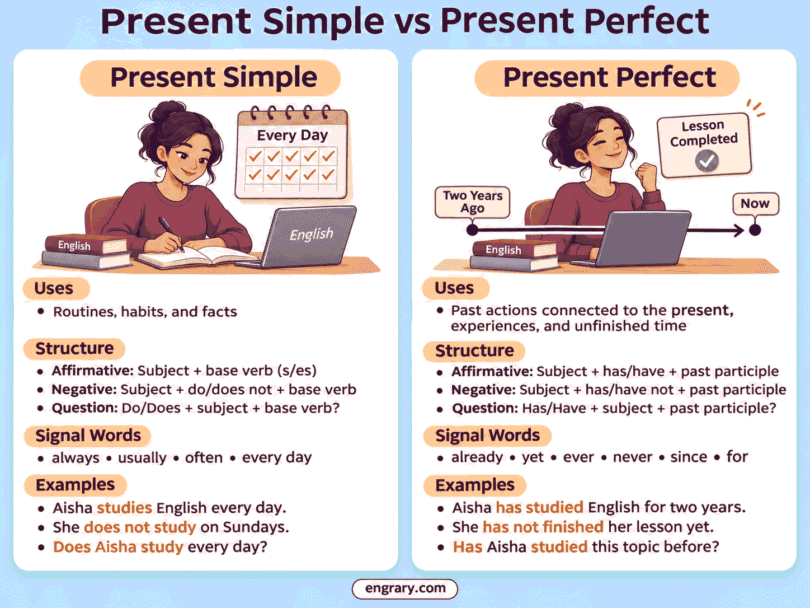
The present simple and present perfect both relate to the present, but they express different time relationships. The present simple describes what is generally true, currently the case, or regularly happens. In contrast, the present perfect looks back from now and connects an earlier action, experience, result, or state to the present.
The difference becomes clearer when the two forms appear side by side. This guide compares their structures, uses, questions, time expressions, stative verbs, participles, negative meanings, and common mistakes. It also explains how context determines whether a present perfect situation continues now or represents a completed experience.
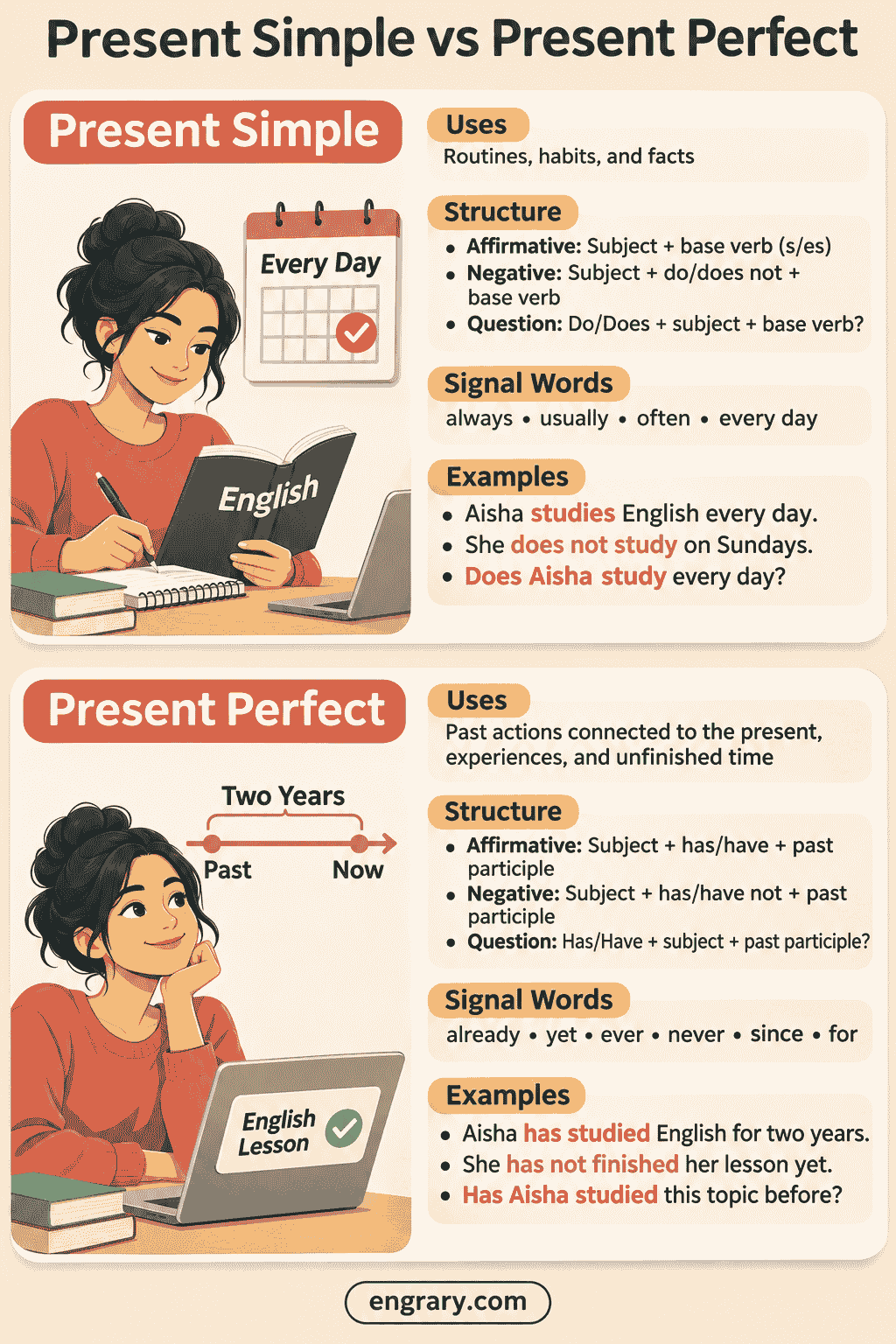
Present Simple and Present Perfect at a Glance
The present simple focuses directly on a present fact, state, routine, or general pattern. The present perfect, however, creates a bridge between an earlier time and now.
| Feature | Present simple | Present perfect |
|---|---|---|
| Core focus | Present fact, state, or routine | Earlier situation connected to now |
| Structure | Subject + base verb | Subject + have/has + past participle |
| Routine | I visit them every year. | — |
| Accumulated repetition | — | I have visited them five times. |
| Current state | I know her. | — |
| Duration until now | — | I have known her for ten years. |
| Typical question | How often do you visit? | How many times have you visited? |
| Time viewpoint | Present or general time | Earlier time viewed from the present |
A useful decision rule is straightforward:
- Use the present simple for what is true or usual.
- Use the present perfect when an earlier situation matters now.
Nevertheless, the present connection can take several forms. It may involve duration, experience, an unfinished period, accumulated repetition, a current result, or relevance to the present conversation.
Present Simple and Present Perfect Structures
The present simple uses the base verb with most subjects and usually adds -s or -es with he, she, and it. Its negatives and questions normally require do or does.
The present perfect uses have or has followed by a past participle. Use has with he, she, it, and singular nouns; use have with I, you, we, they, and plural nouns.
| Sentence type | Present simple | Present perfect |
|---|---|---|
| Affirmative | She works. | She has worked. |
| Negative | She does not work. | She has not worked. |
| Yes-or-no question | Does she work? | Has she worked? |
| Wh-question | Where does she work? | Where has she worked? |
| Positive short answer | Yes, she does. | Yes, she has. |
| Negative short answer | No, she doesn’t. | No, she hasn’t. |
After does or doesn’t, use the base form. After perfect auxiliary have or has, use a past participle. Therefore, Does she works? and Has she work? are both incorrect.
Main Uses of the Present Simple
The present simple presents information as general, repeated, stable, or scheduled.
Habits and Routines
Use the present simple for regular actions and repeated patterns.
- I check my messages every morning.
- Hina walks to college on weekdays.
- We usually eat dinner at eight.
- The children visit their grandparents twice a month.
General Truths and Facts
Use it for scientific facts, definitions, and statements considered generally true.
- Water boils at 100°C at sea level.
- The Earth moves around the Sun.
- Plants need light to grow.
- Islamabad is the capital of Pakistan.
Current States
Use the present simple for knowledge, possession, preferences, relationships, and other current conditions.
- I know the answer.
- She owns a small shop.
- They prefer tea without sugar.
- This bag belongs to Ali.
Stable and Long-Term Situations
The present simple also describes situations that the speaker views as established.
- My aunt lives in Multan.
- He works for a software company.
- We study at the same university.
- The clinic serves several nearby villages.
Stable does not mean permanent forever. Instead, the speaker presents the situation as a normal part of current life.
Schedules and Timetables
Use the present simple for official schedules and timetables, even when the reference is future.
- The train leaves at 6:30 tomorrow.
- The semester begins next Monday.
- The museum opens at ten.
- The program ends after the news.
Instructions, Commentary, and Summaries
The present simple can explain a process: First, you add the flour. Then, the machine mixes the ingredients. It also appears in live commentary and summaries: The striker passes, the winger shoots, and the goalkeeper saves.
Main Uses of the Present Perfect
The present perfect connects an earlier situation to the present. However, that connection changes according to context.
Continuing States
Use the present perfect for a state that began earlier and remains true now.
- I have known Sana for ten years.
- He has owned the house since 2018.
- We have lived here for six years.
- She has wanted this job since graduation.
Life Experiences
Use the present perfect for experiences at an unspecified time before now.
- I have visited Turkey twice.
- She has never flown alone.
- Have you ever tried Korean food?
- They have attended several international conferences.
The exact time is not the focus. If a speaker identifies a finished past time, another tense normally becomes necessary.
Past Actions with Present Results
An earlier action may create a condition that matters now.
- Hamza has lost his keys, so he cannot open the door.
- The rain has flooded the road, so traffic is moving slowly.
- I have finished the report, so you can review it.
- Someone has used all the milk, so the bottle is empty.
The present result may be stated directly or inferred from context.
Accumulated Repetition
Use the present perfect to summarize or count occurrences up to now.
- I have called her three times today.
- We have held four meetings this month.
- He has read six books this year.
- They have visited us several times.
The tense reports the total so far. It does not guarantee another occurrence in the future.
Unfinished Time Periods
Use the present perfect when an action occurs within a period that includes the present.
- I have answered twenty emails today.
- She has completed two assignments this week.
- We have received several orders this month.
- The team has won five matches this season.
Speaker viewpoint matters. A time period such as today or this week does not automatically require the present perfect.
Recent Actions and News
The present perfect often introduces recent events or news.
- The company has just announced a new policy.
- Scientists have recently discovered a new species.
- Our neighbours have moved to another city.
- The bus has already left.
Changes and Achievements
Use the tense to review change, progress, or achievement up to now.
- Medical treatment has improved greatly.
- She has become more confident.
- The company has opened three new branches.
- Our team has reached its annual target.
Current States and Duration Until Now
The present simple identifies a current state. The present perfect can add the state’s earlier beginning or accumulated duration.
| Current state | State continuing from the past |
|---|---|
| I know her. | I have known her for ten years. |
| He owns the house. | He has owned the house since 2018. |
| We live in Lahore. | We have lived in Lahore for six years. |
| She works here. | She has worked here since May. |
| They like the neighbourhood. | They have liked it since they moved there. |
The present perfect does more than confirm the present state. It also asks the listener to consider the period leading to now.
Continuing and Completed Present Perfect Meanings
The present perfect does not always mean that an action or situation continues. Time expressions and context decide the interpretation.
| Sentence | Likely interpretation |
|---|---|
| I have worked here for five years. | I probably still work here. |
| I have worked here before. | I may not work here now. |
| She has lived in Dubai since 2020. | She probably still lives there. |
| She has lived in Dubai twice. | Both periods may be finished. |
| They have visited us three times. | The visits are complete; future visits remain possible. |
Expressions such as for five years and since 2020 often create a continuing interpretation. Conversely, before, twice, or a completed quantity may describe finished experiences.
Routines and Accumulated Repetition
Both tenses can describe repeated actions, but their viewpoints differ.
| Routine or usual pattern | Accumulated repetition up to now |
|---|---|
| I call my parents every week. | I have called them three times this week. |
| She travels abroad every year. | She has travelled abroad six times. |
| We eat at that restaurant often. | We have eaten there several times. |
| He reads every evening. | He has read four books this month. |
| They visit us each summer. | They have visited us five times. |
The present simple describes a pattern without counting its total. Meanwhile, the present perfect looks back over a period and summarizes what has occurred.
General Experience and Regular Behaviour
Regular behaviour forms part of a person’s usual life, whereas an experience belongs to that person’s history up to now.
| Regular behaviour | Experience before now |
|---|---|
| I travel by train. | I have travelled across Europe by train. |
| She reads historical fiction. | She has read every novel in the series. |
| He cooks Thai food. | He has cooked Thai food before. |
| They attend international conferences. | They have attended conferences in five countries. |
The present perfect usually leaves the exact time unstated because the experience, not its date, is central.
Present Facts and Present Results
A present simple sentence may state a condition directly. In contrast, a present perfect sentence can identify the earlier action that produced it.
| Present fact or condition | Earlier action with a present result |
|---|---|
| The door is open. | Someone has opened the door. |
| She is tired. | She has worked all day. |
| The floor is clean. | Ali has cleaned the floor. |
| We have no milk. | Someone has used all the milk. |
| The computer is off. | The system has shut down. |
The present perfect does not encode one specific result automatically. Instead, the listener infers the relevant connection from the situation.
One Completed Action and a Habitual Action
The same verb can describe either a role or a completed action.
| Habit, role, or general function | Completed action relevant now |
|---|---|
| She cleans the office. | She has cleaned the office. |
| He repairs computers. | He has repaired my computer. |
| They deliver our food. | They have delivered the food. |
| I write reports. | I have written the report. |
The present simple tells us what someone usually does. The present perfect tells us what that person has completed or achieved by now.
Have and Has in Both Tenses
In the present simple, have or has may function as the main verb. In the present perfect, it functions as an auxiliary and must be followed by a past participle.
| Construction | Role of have/has | Example |
|---|---|---|
| Present simple | Main verb | She has a laptop. |
| Present perfect | Auxiliary verb | She has bought a laptop. |
| Present simple negative | doesn’t have | She doesn’t have a laptop. |
| Present perfect negative | hasn’t + participle | She hasn’t bought a laptop. |
| Present simple question | Does + subject + have | Does she have a laptop? |
| Present perfect question | Has + subject + participle | Has she bought a laptop? |
This distinction prevents mixed forms such as Does she has bought?
Have, Have Had, and Has Had
The verb have can appear twice because one form acts as an auxiliary and the other as the main verb’s past participle.
| Form | Meaning |
|---|---|
| I have a car. | Present possession |
| I have had this car for five years. | Possession continuing from the past |
| She has a headache. | Present condition |
| She has had a headache since morning. | Condition continuing until now |
| They have a problem. | Present state |
| They have had the problem for weeks. | Duration of the state |
In have had, the first word forms the present perfect, while had carries the meaning of possession or experience.
Have Got for Present Possession
In British English, have got commonly expresses present possession.
| Form | Meaning |
|---|---|
| I have a car. | Present possession |
| I have got a car. | Present possession, common in British English |
| I’ve got a car. | Contracted form of have got |
| I have bought a car. | Earlier purchase connected to now |
Although have got resembles a present perfect form, speakers commonly use it as a present possession construction. Therefore, learners should not interpret every have/has + got combination as an ordinary completed-action meaning.
Form Recognition
The presence of have or has alone does not create the present perfect.
| Sentence | Grammatical form |
|---|---|
| I have breakfast at seven. | Present simple |
| She has two brothers. | Present simple |
| I have eaten breakfast. | Present perfect |
| She has visited her brothers. | Present perfect |
The present perfect requires have/has + past participle. A simple form of have followed by a noun remains present simple.
Do and Have in Questions
Present simple questions normally use do or does. Present perfect questions move auxiliary have or has before the subject.
| Present simple question | Present perfect question |
|---|---|
| Do you work here? | Have you worked here before? |
| Does she know him? | Has she known him for long? |
| Where do you live? | How long have you lived there? |
| What do they usually do? | What have they done so far? |
Do not use do and perfect auxiliary have together to form one question.
Subject Questions in Both Tenses
When who or what represents the subject, the present simple does not use do or does. The present perfect still requires has or have.
| Present simple subject question | Present perfect subject question |
|---|---|
| Who works here? | Who has worked here before? |
| Who calls you every day? | Who has called you today? |
| What causes the problem? | What has caused the problem? |
In these examples, the question word performs the action rather than receiving it.
How Often, How Many Times, and How Long
These question forms reveal three important viewpoints.
| Question | Purpose | Typical tense |
|---|---|---|
| How often do you visit? | Frequency of a routine | Present simple |
| How many times have you visited? | Accumulated number up to now | Present perfect |
| How long have you lived here? | Duration until now | Present perfect |
| When do you visit? | Regular time or schedule | Present simple |
Thus, how often asks about a usual pattern, while how many times asks for a total and how long asks for duration.
Negative Meanings in Both Tenses
The present simple negative denies a fact, state, or habitual pattern. The present perfect negative denies an occurrence, experience, or completed result up to now.
| Present simple negative | Present perfect negative |
|---|---|
| I do not visit him. | I have not visited him yet. |
| She does not read novels. | She has not read this novel. |
| They do not travel abroad. | They have never travelled abroad. |
| He does not call me. | He has not called me today. |
Context determines whether a present perfect negative describes an unfinished expectation, absence of experience, or lack of a current result.
Always, Never, and Still
These adverbs can appear with both tenses, but their meanings and positions differ.
| Present simple | Present perfect | Contrast |
|---|---|---|
| I always drink tea after lunch. | I have always preferred tea. | Routine versus continuing preference |
| I never drink coffee. | I have never drunk coffee. | Regular non-habit versus no experience up to now |
| She still lives in Lahore. | She still has not replied. | Continuing state versus expected event not completed |
| He always arrives early. | He has always arrived early. | Habit versus record up to now |
With a negative present perfect, still normally appears before have or has. It emphasizes that an expected change has not occurred.
For and Since
Use for with a length of time and since with a starting point.
| Expression | Function | Example |
|---|---|---|
| for | Length of time | We have lived here for six years. |
| since | Starting point | We have lived here since 2020. |
| since + clause | Starting event | We have lived here since I started university. |
Common patterns include for three days, for a long time, since Monday, and since 2020. In a since clause that identifies the starting event, the verb commonly uses the past simple: since I started university.
Do not use the present simple to express duration from an earlier point to now. I live here since 2020 is incorrect in standard English; use I have lived here since 2020.
Time Expressions for Both Tenses
Time expressions provide useful clues, but meaning remains more important.
| Common present simple clues | Common present perfect clues |
|---|---|
| every day | ever |
| usually | never |
| often | already |
| normally | yet |
| generally | just |
| once a week | recently |
| on Mondays | so far |
| rarely | up to now |
| always | for and since |
Some expressions appear with both forms. For example, always can describe either a routine or a record extending to now. Similarly, today can introduce a present fact or an unfinished period.
Yet, Already, Just, Ever, Never, and Still
These adverbs express different relationships to expectation and experience.
| Adverb | Main meaning | Typical position |
|---|---|---|
| just | Very recently completed | Between have/has and the participle |
| already | Before now or earlier than expected | Usually between have/has and the participle |
| yet | Expected but not completed or confirmed | End of questions and negatives |
| still | Expected change has not happened | Before negative have/has |
| ever | At any time up to now | Between have/has and the participle |
| never | At no time up to now | Between have/has and the participle |
Because never already carries negative meaning, do not add not: use I have never seen it, not I have not never seen it.
Speaker Viewpoint with Today and This Week
Expressions such as today, this morning, this week, and this year do not select a tense automatically.
| Intended meaning | Example |
|---|---|
| Present fact | Today is Thursday. |
| Regular schedule | I work from home on Fridays. |
| Accumulated result in an unfinished period | I have answered ten emails today. |
| Present state | This week is unusually quiet. |
| Completed past viewpoint | A past form may be natural if the speaker treats the period as finished. |
For instance, a speaker may view this morning as unfinished at 10 a.m. but finished later in the afternoon. Context and viewpoint control the choice.
Finished and Unfinished Time
The present perfect generally avoids expressions that locate an action in a finished past period.
| Time relationship | Preferred form |
|---|---|
| General or regular time | Present simple |
| Unfinished period connected to now | Present perfect |
| Finished past time | Usually past simple |
Finished expressions include yesterday, last week, in 2019, two days ago, and when I was a child. Therefore, I have seen him yesterday is incorrect in standard usage; a past form is required.
This distinction does not turn the article into a present perfect versus past simple guide. Instead, it prevents a common present perfect error.
Present Perfect with Stative Verbs
Stative verbs describe knowledge, possession, preference, emotion, relationship, or condition. They commonly use the present perfect simple when a state began earlier and continues now.
| Present state | Duration of the state |
|---|---|
| I know him. | I have known him for years. |
| She owns the shop. | She has owned it since 2020. |
| They like the area. | They have liked it since they moved there. |
| He wants a new job. | He has wanted a new job for months. |
| This bag belongs to me. | This bag has belonged to me since school. |
Because these verbs describe states, they often avoid the present perfect continuous. For example, I have known her is natural, whereas I have been knowing her is not.
Regular and Irregular Past Participles
The present perfect always requires a past participle. Regular verbs usually add -ed, although spelling may change.
| Base verb | Past participle |
|---|---|
| work | worked |
| finish | finished |
| visit | visited |
| study | studied |
| stop | stopped |
Irregular verbs require learned forms.
| Base verb | Past participle |
|---|---|
| be | been |
| go | gone |
| see | seen |
| do | done |
| write | written |
| know | known |
| take | taken |
| speak | spoken |
| buy | bought |
| make | made |
| Incorrect form | Correct form |
|---|---|
| have went | have gone |
| has saw | has seen |
| have wrote | have written |
| has took | has taken |
| have did | have done |
Been and Gone
Both forms come from go or be constructions, but they communicate different situations.
| Form | Meaning | Example |
|---|---|---|
| has/have been to | Visited and returned | Sara has been to Turkey twice. |
| has/have gone to | Went there and has not returned yet | Sara has gone to Turkey. |
The surrounding context should confirm whether the person has returned.
First-Time and Superlative Patterns
English commonly uses the present perfect after an ordinal expression such as the first time.
- This is the first time I have driven abroad.
- It is the second time she has won the award.
- This is the third time they have changed the schedule.
The present perfect also follows superlatives when a speaker reviews experience up to now.
- It is the best film I have ever seen.
- This is the most interesting book she has ever read.
- That was the longest journey they have ever taken.
The reference period usually includes the speaker’s life or experience up to the present.
Contractions in Natural English
Contractions are common in speech and informal writing.
| Full form | Contraction |
|---|---|
| I have | I’ve |
| you have | you’ve |
| we have | we’ve |
| they have | they’ve |
| he has | he’s |
| she has | she’s |
| have not | haven’t |
| has not | hasn’t |
The contraction ’s can mean is or has. The following word normally reveals the meaning.
| Contracted form | Full form |
|---|---|
| She’s tired. | She is tired. |
| She’s finished. | She has finished. |
| He’s working. | He is working. |
| He’s written the report. | He has written the report. |
Present Simple and Present Perfect Passive Forms
Both tenses can appear in the passive voice when the receiver or result of the action matters more than the agent.
| Present simple passive | Present perfect passive |
|---|---|
| The rooms are cleaned every day. | The rooms have been cleaned. |
| The reports are checked weekly. | The reports have been checked. |
| The road is repaired each summer. | The road has been repaired. |
| The orders are processed overnight. | The orders have been processed. |
The present simple passive describes a routine or general process. In contrast, the present perfect passive reports a completed action with present relevance.
Present Perfect in Future Time Clauses
Both the present simple and present perfect can refer to future time after conjunctions such as when, after, once, and as soon as.
| Present simple time clause | Present perfect time clause |
|---|---|
| I will call when I finish. | I will call when I have finished. |
| We will leave after she arrives. | We will leave after she has arrived. |
| You can rest once you complete the work. | You can rest once you have completed the work. |
The present perfect emphasizes that one action will be complete before the next action occurs. However, the present simple is often natural when the sequence is already clear.
British and American Usage
British English often prefers the present perfect with just, already, and yet. Informal American English may use the past simple in similar contexts. For instance, an American speaker may choose a simple past form where a British speaker prefers I’ve just finished.
This variation does not change the central present simple versus present perfect distinction. Both varieties use the present perfect for many experiences, durations, unfinished periods, and present-result meanings.
Present Simple and Present Perfect in Context
| Context | Present simple | Present perfect |
|---|---|---|
| Work | She manages a bank. | She has managed it for six years. |
| Education | He studies engineering. | He has completed three semesters. |
| Travel | They travel every summer. | They have visited eight countries. |
| Technology | The app stores documents. | The app has saved your changes. |
| Health | I exercise every morning. | I have completed ten training sessions. |
| Home | We clean on Saturdays. | We have cleaned the kitchen. |
| Relationships | I know her well. | I have known her since school. |
| Achievement | He plays chess. | He has won three tournaments. |
Present Simple and Present Perfect Decision Guide
| Intended meaning | Preferred tense |
|---|---|
| General fact | Present simple |
| Current state without duration | Present simple |
| Habit or routine | Present simple |
| Earlier state continuing now | Present perfect |
| Life experience | Present perfect |
| Earlier action with a present result | Present perfect |
| Number of occurrences up to now | Present perfect |
| Activity in an unfinished period | Present perfect |
| Official schedule | Present simple |
| Finished past time | Usually past simple |
Use three steps:
- Decide whether the sentence describes a general present situation or looks back from now.
- Identify routine, duration, experience, result, or accumulated number.
- Choose the correct auxiliary and verb form.
Correct and Incorrect Examples
| Incorrect | Correct | Explanation |
|---|---|---|
| I live here since 2020. | I have lived here since 2020. | The state began earlier and continues now. |
| She has work here for years. | She has worked here for years. | Use a past participle after has. |
| Does he has a car? | Does he have a car? | Use the base form after does. |
| Has she works here before? | Has she worked here before? | Use a past participle after has. |
| I have seen him yesterday. | I saw him yesterday. | A finished past time normally requires the past simple. |
| We know each other for years. | We have known each other for years. | Use the present perfect for duration until now. |
| He has went home. | He has gone home. | Use the correct irregular participle. |
| I have not finished already. | I have not finished yet. | Yet is natural for an expected negative result. |
| Did she has lunch every day? | Does she have lunch every day? | Use present simple does + have for a routine. |
| Have you work here before? | Have you worked here before? | Use the past participle after have. |
Common Mistakes with Present Simple and Present Perfect
- Using the present simple with since for duration: Use the present perfect when a state begins earlier and continues now.
- Using a base verb after have or has: A present perfect construction requires a past participle.
- Using do or does to form a present perfect question: Move have or has before the subject instead.
- Adding third-person -s after does: Use the base verb after does and doesn’t.
- Confusing main-verb have with auxiliary have: Look for a past participle after the auxiliary.
- Using the present perfect with a finished past time: Expressions such as yesterday and last year normally require the past simple.
- Confusing habits with accumulated repetition: Use the present simple for a routine and the present perfect for a total up to now.
- Using for and since interchangeably: Use for with a length of time and since with a starting point.
- Misplacing yet, already, and just: Their usual positions and meanings differ.
- Using an incorrect irregular participle: Learn forms such as gone, seen, written, and taken.
- Confusing been and gone: Been to normally suggests a completed visit; gone to suggests the person remains away.
- Assuming every present perfect situation continues: Context determines whether the action or state continues.
- Treating signal words as fixed rules: Meaning and viewpoint remain more important than a keyword.
FAQs
The present simple describes facts, routines, current states, and stable situations. In contrast, the present perfect connects an earlier event, experience, result, or state to the present. Therefore, I work here identifies a current situation, while I have worked here for five years adds its earlier beginning and duration.
Yes. The present simple can state what is true now, while the present perfect can show how long that state has continued or how it developed. For example, I know her describes a current relationship, whereas I have known her since school connects that relationship to its past starting point.
Use the present perfect when for or since measures a state or activity from an earlier time to now. Use for with a length of time and since with a starting point. However, these words can have other meanings, so the intended time relationship still controls the tense.
How often usually asks about the frequency of a routine, so it commonly takes the present simple. How many times asks for an accumulated total up to now, so it commonly takes the present perfect. Meanwhile, how long asks for duration and often takes the present perfect when the situation continues now.
Yes. The action itself may be complete, but its result, relevance, experience, or unfinished time period connects it to the present. For example, a completed repair may matter because the machine now works. Nevertheless, the tense does not automatically state a specific present result; context supplies that connection.
You May Also Like

Leave a Comment