
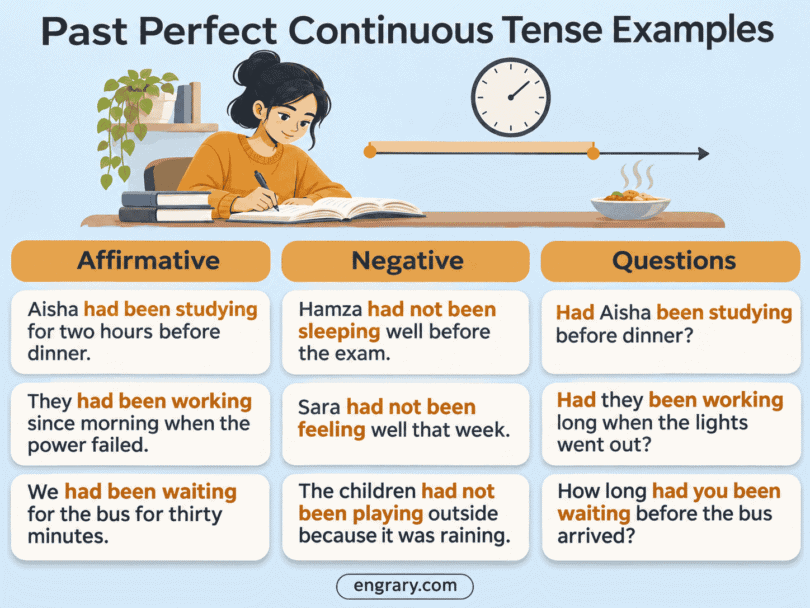
The past perfect continuous tense describes an activity that began before a particular point in the past and continued until or shortly before that point. It follows the structure had been + verb-ing, as in They had been waiting for an hour when the bus arrived. The tense commonly emphasizes duration, process, repetition, or the cause of a past result.
Below are 155 past perfect continuous tense examples organized by sentence form and meaning. The examples include affirmative and negative statements, varied questions, sentences with for and since, continuing and recently stopped activities, past causes, repeated actions, reported speech, conditionals, and advanced contexts.
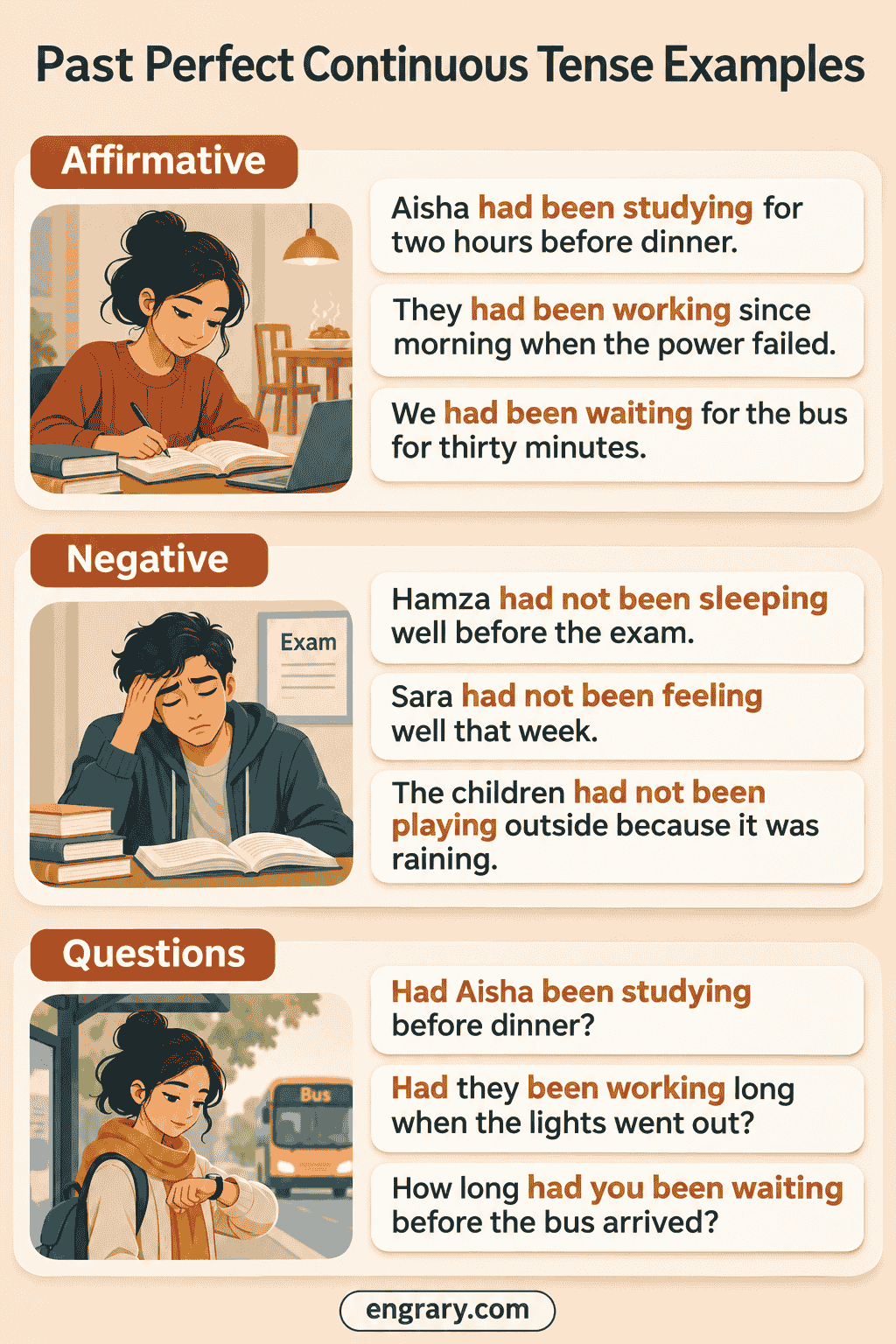
Past Perfect Continuous Examples at a Glance
The past perfect continuous looks backward from a later past point to an earlier period of activity. The auxiliary had stays the same with every subject.
| Sentence type | Structure | Example |
|---|---|---|
| Affirmative | Subject + had been + verb-ing | She had been studying for hours. |
| Negative | Subject + had not been + verb-ing | She had not been studying for long. |
| Yes/no question | Had + subject + been + verb-ing? | Had she been studying for hours? |
| Wh-question | Wh-word + had + subject + been + verb-ing? | How long had she been studying? |
The tense has two central meanings:
- Continuing activity: They had been waiting for an hour when the bus arrived.
- Recently stopped activity: The ground was wet because it had been raining.
In the first sentence, the waiting continued until the bus arrived. In the second, the rain had probably stopped, but its past result remained visible.
Structure Used in Past Perfect Continuous Sentences
Every construction contains three verb elements:
- Had: the past auxiliary used with every subject
- Been: the past participle of be
- Verb-ing: the present participle of the main verb
Affirmative Sentences
Structure: Subject + had been + verb-ing + remaining information.
- I had been reading before the lights went out.
- She had been working there when the company changed owners.
Negative Sentences
Structure: Subject + had not been + verb-ing + remaining information.
- We had not been waiting long when the doors opened.
- He had not been sleeping well before the examination.
The usual contraction is hadn’t been.
Yes/No Questions
Structure: Had + subject + been + verb-ing + remaining information?
- Had you been waiting long before the doctor arrived?
- Had it been raining before you left home?
Wh-Questions
Structure: Wh-word + had + subject + been + verb-ing + remaining information?
- What had you been doing before I called?
- How long had they been living there when they moved?
Negative and Subject Questions
Negative questions often express surprise, concern, or an expectation:
- Hadn’t she been feeling well?
- Why hadn’t they been answering their phones?
In a subject question, who or what performs the activity, so no additional subject appears:
- Who had been using the printer?
- What had been causing the delay?
Contractions and Short Answers
| Full form | Contraction | Example |
|---|---|---|
| I had been | I’d been | I’d been waiting for an hour. |
| She had been | She’d been | She’d been studying all morning. |
| Had not been | Hadn’t been | They hadn’t been working that day. |
Short answers repeat had or hadn’t: Yes, I had and No, she hadn’t. Do not say Yes, I’d, because ’d cannot stand alone at the end of a short answer.
155 Past Perfect Continuous Tense Examples
Only the sentences in the following numbered list count toward the advertised total. Each example contains had been or hadn’t been followed by an -ing form, and each one includes a clear or contextually meaningful later past reference point.
Common Past Perfect Continuous Examples
- I had been studying for two hours when my friend called.
- She had been working all day before she went home.
- They had been waiting for the bus when the rain started.
- We had been traveling for six hours when we reached the hotel.
- He had been cooking dinner before the guests arrived.
- It had been raining all morning, so the roads were wet.
- You had been reading that book before the teacher collected it.
- The children had been playing outside when the lights came on.
- My brother had been practicing the guitar before the concert began.
- Sara had been sleeping for an hour when the alarm rang.
- The workers had been repairing the road before traffic resumed.
- I had been looking for my keys when I found them under the sofa.
- The dog had been barking before its owner returned.
- We had been discussing the plan when the manager entered.
- The students had been preparing for the test before the school closed.
Affirmative Past Perfect Continuous Sentences
- I had been organizing my notes before the lesson started.
- You had been making steady progress when the course ended.
- Amina had been learning French before she moved to Paris.
- Hamza had been fixing his bicycle when his father offered to help.
- The baby had been crying before its mother picked it up.
- We had been following the map when we discovered a shorter route.
- They had been saving money before they bought their first home.
- My parents had been growing vegetables before the drought began.
- The company had been developing the software when a competitor released a similar product.
- Scientists had been monitoring the volcano before it erupted.
- She had been teaching at the college when she received the award.
- The mechanic had been examining the engine before he identified the fault.
- Local volunteers had been collecting supplies when the storm reached the coast.
- I had been considering a career change before the promotion became available.
- She had been writing her novel when the publisher contacted her.
- We had been walking along the beach when the sun disappeared behind the clouds.
- The hospital had been expanding its services before funding was reduced.
- Engineers had been testing the bridge when they detected a structural weakness.
- The farmer had been checking the fields before the heavy rain arrived.
- Our team had been preparing the presentation when the meeting was postponed.
Negative Past Perfect Continuous Sentences
- I had not been feeling well before the doctor examined me.
- She had not been sleeping properly before her holiday began.
- We had not been receiving updates when the system suddenly went offline.
- He had not been following the diet before his health check.
- They had not been maintaining the building before the roof leaked.
- The printer had not been working correctly before it stopped completely.
- You hadn’t been listening when the teacher explained the final step.
- Bilal hadn’t been attending the meetings before the manager spoke to him.
- The students hadn’t been submitting their work when the new deadline was announced.
- My phone hadn’t been charging properly before I replaced the cable.
- The team hadn’t been practicing regularly before the tournament began.
- I hadn’t been exercising for long when my knee started hurting.
- The buses hadn’t been running on schedule before the timetable changed.
- The children hadn’t been sleeping for long when the thunder woke them.
- Our neighbors hadn’t been making much noise before the celebration started.
Yes/No Questions
- Had you been waiting long before the train arrived?
- Had she been studying all evening when the power failed?
- Had they been living there for years before they moved?
- Had it been raining before the match was canceled?
- Had we been following the correct path when we reached the river?
- Had your brother been looking for work before he received that offer?
- Had the children been watching television when you entered the room?
- Had the machine been making that sound before it broke down?
- Had you been practicing your speech before the audience arrived?
- Had the teacher been explaining the topic when the bell rang?
- Had the company been losing money before it closed the branch?
- Had the patient been experiencing pain before the nurse arrived?
Wh-, Negative, and Subject Questions
- What had you been doing before the lights went out?
- Where had Sana been working before she joined our company?
- Why had they been arguing when the teacher entered?
- How had he been managing the shop before his assistant arrived?
- How long had you been learning English when you took the examination?
- Which project had the engineers been developing before funding ended?
- What had she been searching for when you saw her?
- Why hadn’t the baby been sleeping before the doctor examined him?
- Hadn’t they been following the instructions when the accident occurred?
- Why hadn’t you been answering your phone before I came over?
- Who had been using my computer before it crashed?
- What had been causing the strange noise before the motor stopped?
- Who had been calling the office before it closed?
- Which department had been handling the complaints before the policy changed?
- What had the researchers been investigating when the laboratory lost power?
Examples with For and Since
- I had been working on the report for three hours when my laptop shut down.
- She had been learning to drive for six months before she passed the test.
- We had been standing in line for forty minutes when the doors opened.
- The farmers had been waiting for rain for several weeks before the storm arrived.
- My cousin had been staying with us for a month when she found an apartment.
- The children had been rehearsing for weeks before they performed the play.
- He had been wearing glasses for years before he chose contact lenses.
- The team had been training for months when the championship began.
- They had been running the shop since 2016 when the landlord sold the building.
- Nadia had been studying since dawn when her sister brought breakfast.
- We had been using that software since January when the company replaced it.
- The baby had been crying since midnight when the doctor arrived.
- The river had been rising since Monday when officials issued the warning.
- I had been working remotely since the office closed when the company changed its policy.
- She had been sleeping better since she changed her routine, but the improvement ended when the illness returned.
- They had been saving money since they got married when an unexpected expense arose.
Activities Continuing Before a Past Point
- I had been writing an email when the internet connection failed.
- She had been cleaning the kitchen when the water supply stopped.
- We had been walking along the trail when the fog became thicker.
- The technicians had been installing the equipment when the supervisor arrived.
- He had been painting the bedroom when the paint ran out.
- The researchers had been analyzing the data when they noticed an unusual pattern.
- You had been talking for nearly an hour when the call disconnected.
- Our teacher had been reviewing the final chapter when the fire alarm rang.
- The construction crew had been widening the road when winter weather halted the project.
- I had been watching the lecture when my computer restarted.
- The nurse had been monitoring the patient when his condition suddenly changed.
- We had been searching the forest when darkness began to fall.
- The chef had been preparing the main course when the oven stopped working.
- The committee had been discussing the proposal when the chairperson called for a vote.
Recently Stopped Activities and Past Evidence
- I was out of breath because I had been running.
- Her hands were covered in flour because she had been baking.
- The ground was wet because it had been raining.
- His eyes were red because he had been crying.
- The children’s clothes were muddy because they had been playing outside.
- He looked exhausted because he had been working all night.
- The kitchen was warm because my mother had been cooking.
- There was paint on your sleeve because you had been decorating.
- My hair was wet because I had been swimming.
- The room smelled of chemicals because the cleaners had been polishing the floor.
- Her voice was weak because she had been speaking for hours.
- The roads were slippery because snow had been falling.
Past Causes and Results
- The players were thirsty because they had been training in the heat.
- His back hurt because he had been lifting heavy boxes.
- The streets were flooded because it had been raining since morning.
- She knew the material well because she had been revising for weeks.
- The garden looked healthier because we had been watering it regularly.
- The computer was overheating because several programs had been running in the background.
- The children felt restless because they had been sitting indoors all day.
- Sales had improved because the company had been advertising online.
- The floor was covered in sawdust; the carpenter had been cutting wood.
- Everyone felt tense; the two managers had been arguing before the meeting.
Repeated and Temporary Activity Examples
- She had been calling her grandmother every evening before the telephone line failed.
- They had been meeting twice a month before the project ended.
- Our teacher had been giving us weekly quizzes before the school closed.
- The alarm had been going off randomly before the technician repaired it.
- We had been staying with relatives before we found an apartment.
- He had been working the night shift before he transferred departments.
- I had been taking the bus while my car was being repaired.
- The café had been serving breakfast on weekends before it changed owners.
- The internet connection had been dropping several times a day before the provider replaced the router.
- She had been helping at the clinic during her semester break before classes resumed.
Advanced Past Perfect Continuous Examples
- She said that she had been waiting outside for an hour before the doors opened.
- The engineers reported that they had been testing the system when the fault appeared.
- He explained that he had been feeling unwell before he left the office.
- They told us that they had been negotiating with the supplier before the contract expired.
- If he had been paying attention, he would have understood the instructions.
- If they had been driving more carefully, they might have avoided the collision.
- She would not have felt so exhausted if she hadn’t been working all night.
- I wish I hadn’t been wasting so much time before the deadline.
- She wished she had been listening more carefully when the rules were explained.
- I wondered how long he had been waiting before someone helped him.
- The manager asked why the team had been missing its weekly targets.
- We wanted to know who had been accessing the files before the security breach.
- The project that we had been developing was canceled before its public launch.
- She explained that she had been experiencing technical problems before the presentation.
- The wind had been blowing for hours when the old tree finally fell across the road.
- Public-health researchers had been tracking the outbreak before officials introduced emergency measures.
Past Perfect Continuous Questions with Short Answers
Short answers use had or hadn’t. They do not repeat been or the main verb.
| Question | Affirmative answer | Negative answer |
|---|---|---|
| Had you been waiting? | Yes, I had. | No, I hadn’t. |
| Had she been working? | Yes, she had. | No, she hadn’t. |
| Had they been studying? | Yes, they had. | No, they hadn’t. |
| Had it been raining? | Yes, it had. | No, it hadn’t. |
Explicit and Implied Past Reference Points
The later past point does not always need to appear in the same clause. However, the sentence or surrounding context should make it clear.
| Reference type | Example | Later past point |
|---|---|---|
| Event in the same sentence | She had been studying when I called. | I called. |
| Stated past time | By midnight, she had been studying for five hours. | Midnight |
| Past result | She was tired because she had been studying. | Her tiredness |
| Previous context | We reached the village. We had been walking since dawn. | Reaching the village |
In connected writing, a previous sentence can establish the reference point. In an isolated example, however, naming the later event or situation usually improves clarity.
Continuing and Recently Stopped Activities
| Meaning | Example | Interpretation |
|---|---|---|
| Continuing activity | We had been painting when the guests arrived. | The painting continued until their arrival. |
| Activity with a clear endpoint | We had been painting until midnight. | The painting ended at midnight. |
| Recently stopped activity | Our clothes were stained because we had been painting. | The painting had probably just stopped. |
| Later continuation unknown | We had been painting for hours when the owner called. | The sentence does not reveal what happened afterward. |
Therefore, the tense does not automatically confirm completion or continuation after the later past point.
Past Evidence in Short Conversations
Short exchanges reveal the cause-and-effect meaning naturally:
- “Why was Hamza exhausted?” “He had been running.”
- “Why were the roads wet?” “It had been raining.”
- “Why was the kitchen so warm?” “Mariam had been baking.”
- “Why were their clothes muddy?” “They had been playing outside.”
Past Perfect Continuous Examples with Time Expressions
For and Since
Use for with a duration and since with a starting point.
| Expression | Function | Example |
|---|---|---|
| for | Period of time | They had been waiting for an hour. |
| since | Starting point | They had been waiting since noon. |
| since + clause | Starting event | They had been waiting since the office opened. |
Before, When, and By the Time
| Expression | Function | Example |
|---|---|---|
| before | Places the activity earlier | She had been studying before dinner. |
| when | Introduces the later event | She had been studying when I called. |
| by | Introduces a past deadline | By noon, she had been studying for four hours. |
| by the time | Introduces a later clause | By the time I called, she had been studying for hours. |
Until, Until Then, and Up Until
| Expression | Example | Meaning |
|---|---|---|
| until | She had been working until midnight. | Marks the activity’s endpoint |
| until then | Until then, she had been working remotely. | Refers to an established past point |
| up until | He had been teaching up until the school closed. | Emphasizes continuation toward the endpoint |
Other useful expressions include all day, all morning, all night, throughout the week, ever since, up to that point, and over the previous month.
Adverb Placement in Past Perfect Continuous Examples
| Adverb | Natural example |
|---|---|
| already | She had already been waiting for an hour. |
| just | It had just been raining. |
| constantly | He had been constantly interrupting her. |
| gradually | The weather had been gradually improving. |
| recently | They had been working together recently. |
| still | Had she still been living there at that time? |
Adverbs such as already and just usually follow had. In contrast, manner or frequency adverbs commonly follow been, while recently often appears at the end.
Activity, Duration, Repetition, and Past Evidence
| Main focus | Example |
|---|---|
| Activity | She had been painting. |
| Duration | She had been painting for three hours. |
| Repetition | She had been painting every weekend. |
| Past evidence | Her clothes were stained because she had been painting. |
The word continuous does not always mean uninterrupted. For example, She had been painting every weekend describes a repeated activity over a past period.
Completed Results and Continuing Activities
The past perfect continuous focuses on an activity, its duration, or repeated effort. By contrast, the past perfect often emphasizes completion, quantity, or a result.
| Past perfect continuous | Past perfect | Main contrast |
|---|---|---|
| She had been writing reports. | She had written four reports. | Activity versus completed quantity |
| He had been repairing bicycles. | He had repaired six bicycles. | Process versus completed number |
| They had been reading the book. | They had read the entire book. | Ongoing activity versus completion |
| She had been calling all morning. | She had called five times. | Repetition versus exact total |
With verbs such as live, work, study, and teach, both forms may be correct. The simple form presents a fact more neutrally, while the continuous form emphasizes activity, duration, or temporary experience.
Stative and Dynamic Verb Examples
Stative verbs normally require a simple form because they describe conditions rather than activities.
| Unnatural sentence | Natural correction |
|---|---|
| I had been knowing her for years. | I had known her for years. |
| He had been owning the shop. | He had owned the shop. |
| They had been believing the story. | They had believed the story. |
Some verbs become dynamic when their meanings change:
- She had been thinking about the proposal.
- He had been having trouble with the engine.
- The chef had been tasting the soup.
Punctual Verbs in Past Perfect Continuous Examples
Punctual verbs describe events that happen at a single point. Consequently, they do not normally use a continuous form for one completed event.
| Unnatural example | Natural correction |
|---|---|
| The race had been starting at noon. | The race had started at noon. |
| She had been recognizing him. | She had recognized him. |
| They had been arriving at six. | They had arrived at six. |
However, these verbs may appear in the continuous when they express repetition:
- Guests had been arriving throughout the evening.
- The engine had been starting without difficulty.
- The machine had been stopping unexpectedly.
Past Perfect Continuous Examples in Reported Speech
| Direct speech | Reported speech |
|---|---|
| “I have been waiting,” she said. | She said that she had been waiting. |
| “We have been working all day,” they said. | They said that they had been working all day. |
| “I haven’t been sleeping well,” he said. | He said that he had not been sleeping well. |
The past continuous does not automatically change to the past perfect continuous. The intended time relationship determines whether the report needs to look back from a later past point.
Past Perfect Continuous Examples in Conditional Sentences
The tense can appear in third conditional sentences to describe an unreal past activity:
- If he had been paying attention, he would have understood.
- If they had been driving carefully, they might have avoided the accident.
- She would not have felt exhausted if she had not been working all night.
Wishes and Regrets About Past Activities
Use the tense after wish to express regret about an ongoing or repeated past activity:
- I wish I had not been wasting so much time.
- She wished she had been listening more carefully.
- They wished they had not been arguing all evening.
Indirect Questions and Embedded Clauses
Indirect questions use statement word order:
| Direct question | Indirect question |
|---|---|
| How long had she been waiting? | I wondered how long she had been waiting. |
| Why had they been arguing? | He asked why they had been arguing. |
| Who had been using the equipment? | The manager wanted to know who had been using the equipment. |
An indirect question does not take a question mark unless the entire sentence asks a question.
The tense also appears inside relative and content clauses:
- The project that we had been developing was canceled.
- She explained that she had been experiencing technical problems.
Past Perfect Continuous in Narrative Sequences
Different past tenses perform different roles in a story:
| Narrative role | Example |
|---|---|
| Earlier background activity | It had been raining for hours. |
| Activity in progress | People were sheltering inside shops. |
| Main completed event | The river overflowed its banks. |
The past perfect continuous establishes the preceding activity, the past continuous describes the scene in progress, and the simple past reports the main event.
Past Perfect and Past Perfect Continuous Examples
| Past perfect | Past perfect continuous | Main contrast |
|---|---|---|
| She had written the report. | She had been writing the report. | Result versus process |
| He had repaired five bicycles. | He had been repairing bicycles. | Quantity versus activity |
| She had called three times. | She had been calling all morning. | Completed number versus repetition |
| They had lived there for years. | They had been living there for years. | Stable fact versus continuing emphasis |
Past Continuous and Past Perfect Continuous Examples
| Past continuous | Past perfect continuous | Main contrast |
|---|---|---|
| She was cooking when I arrived. | She had been cooking for two hours when I arrived. | Activity at that moment versus preceding duration |
| It was raining at noon. | It had been raining since morning. | Past scene versus earlier process |
| They were waiting outside. | They had been waiting outside for an hour. | Activity in progress versus duration |
Present Perfect Continuous and Past Perfect Continuous Examples
| Present perfect continuous | Past perfect continuous | Reference point |
|---|---|---|
| I have been studying for two hours. | I had been studying for two hours when she called. | Present versus past |
| It has been raining all morning. | It had been raining before the sky cleared. | Present result versus past result |
| They have been living here since June. | They had been living there since June when we met. | Duration until now versus a past point |
Present Participle Spelling Examples
| Base verb | Present participle | Rule |
|---|---|---|
| work | working | Add -ing. |
| write | writing | Remove the final silent e. |
| run | running | Double the final consonant. |
| lie | lying | Change ie to y. |
| panic | panicking | Add k before -ing. |
| travel | travelling/traveling | British and American variants |
Rare Passive Forms and Natural Alternatives
A passive construction such as had been being repaired is grammatically possible, but it usually sounds awkward.
| Awkward passive form | Natural alternative |
|---|---|
| The road had been being repaired. | Workers had been repairing the road. |
| The system had been being tested. | Engineers had been testing the system. |
| The building had been being renovated. | The building had been under renovation. |
Whenever possible, choose an active construction or another natural passive expression.
Common Mistakes in Past Perfect Continuous Sentences
| Mistake | Incorrect sentence | Correct sentence |
|---|---|---|
| Using has or have | She has been waiting before I arrived. | She had been waiting before I arrived. |
| Omitting been | They had working all day. | They had been working all day. |
| Confusing been and being | I had being studying. | I had been studying. |
| Using a past participle | He had been worked outside. | He had been working outside. |
| Incorrect negative order | She had been not sleeping well. | She had not been sleeping well. |
| Incorrect question order | You had been waiting long? | Had you been waiting long? |
| Confusing for and since | We had been waiting since two hours. | We had been waiting for two hours. |
| Using a stative verb | I had been knowing him for years. | I had known him for years. |
| Confusing related tenses | She was working for three hours when I arrived. | She had been working for three hours when I arrived. |
| Using the continuous for a total | She had been writing five emails. | She had written five emails. |
| Missing a clear past reference | I had been working for two hours. | I had been working for two hours when the lights went out. |
| Misspelling the participle | He had been runing. | He had been running. |
| Using ’d as a short answer | Yes, I’d. | Yes, I had. |
The sentence I had been working for two hours can be correct when previous context supplies the later past point. However, an isolated example usually becomes clearer when it names that point.
Quick Reference for Past Perfect Continuous Examples
| Feature | Rule or example |
|---|---|
| Basic structure | Subject + had been + verb-ing |
| Negative | Subject + had not been + verb-ing |
| Question | Had + subject + been + verb-ing? |
| Main meaning | Activity continuing until or shortly before a past point |
| Other meanings | Duration, repetition, past evidence, cause, and temporary activity |
| Common expressions | for, since, before, when, by the time, all day |
| Short answers | Yes, I had. No, she hadn’t. |
| Main restrictions | Avoid most stative verbs, single punctual events, and completed quantities. |
FAQs
Examples include She had been studying for hours when I called, They had been waiting since noon when the office opened, and The roads were wet because it had been raining. Each construction contains had been followed by a verb in its -ing form.
No. A stated time, past condition, previous sentence, or understood context can supply the later past reference point. For example, By midnight, she had been working for five hours uses a stated time, while She was tired because she had been working uses a past result.
For introduces a duration, such as for three hours. In contrast, since introduces a starting point, such as since noon or since the office opened. Therefore, say They had been waiting for an hour but They had been waiting since ten o’clock.
Yes. The activity may have ended at or shortly before the later past point, especially when the sentence describes past evidence: Her hands were dirty because she had been gardening. However, the tense does not always confirm completion, so context determines whether the activity ended or continued.
The past perfect usually emphasizes a completed action, result, or quantity: She had written five pages. However, the past perfect continuous emphasizes the activity, duration, process, or repetition: She had been writing for two hours. Sometimes both forms are possible, but they present the situation from different perspectives.
You May Also Like

Leave a Comment