
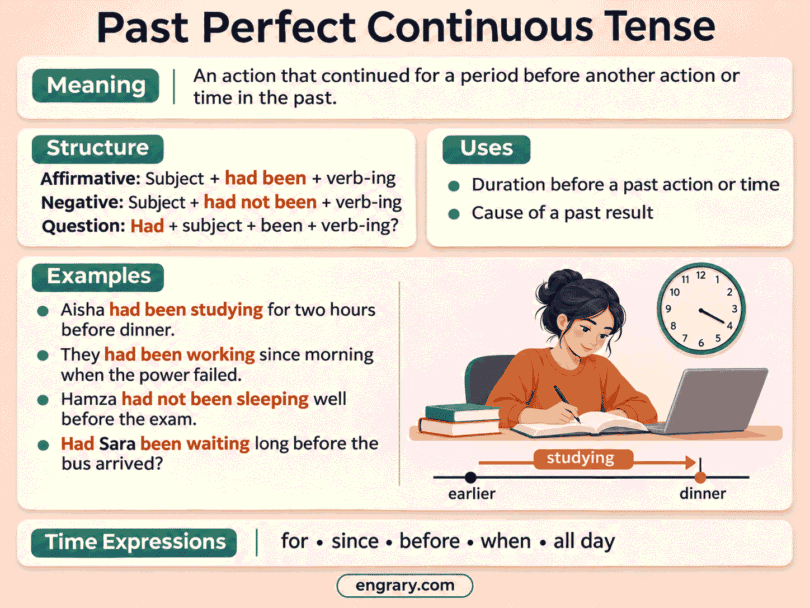
The past perfect continuous tense describes an activity that began before a particular point in the past and continued until or shortly before that point. It uses had been + verb-ing, as in She had been studying for two hours when her friend called. The tense often emphasizes an activity’s duration or process rather than its completion.
In addition, the past perfect continuous can explain a past result, describe repeated or temporary activities, and provide background in a story. This guide explains its structure, timeline, major uses, time expressions, contractions, and spelling rules. It also compares related tenses, covers advanced patterns, and corrects common mistakes.
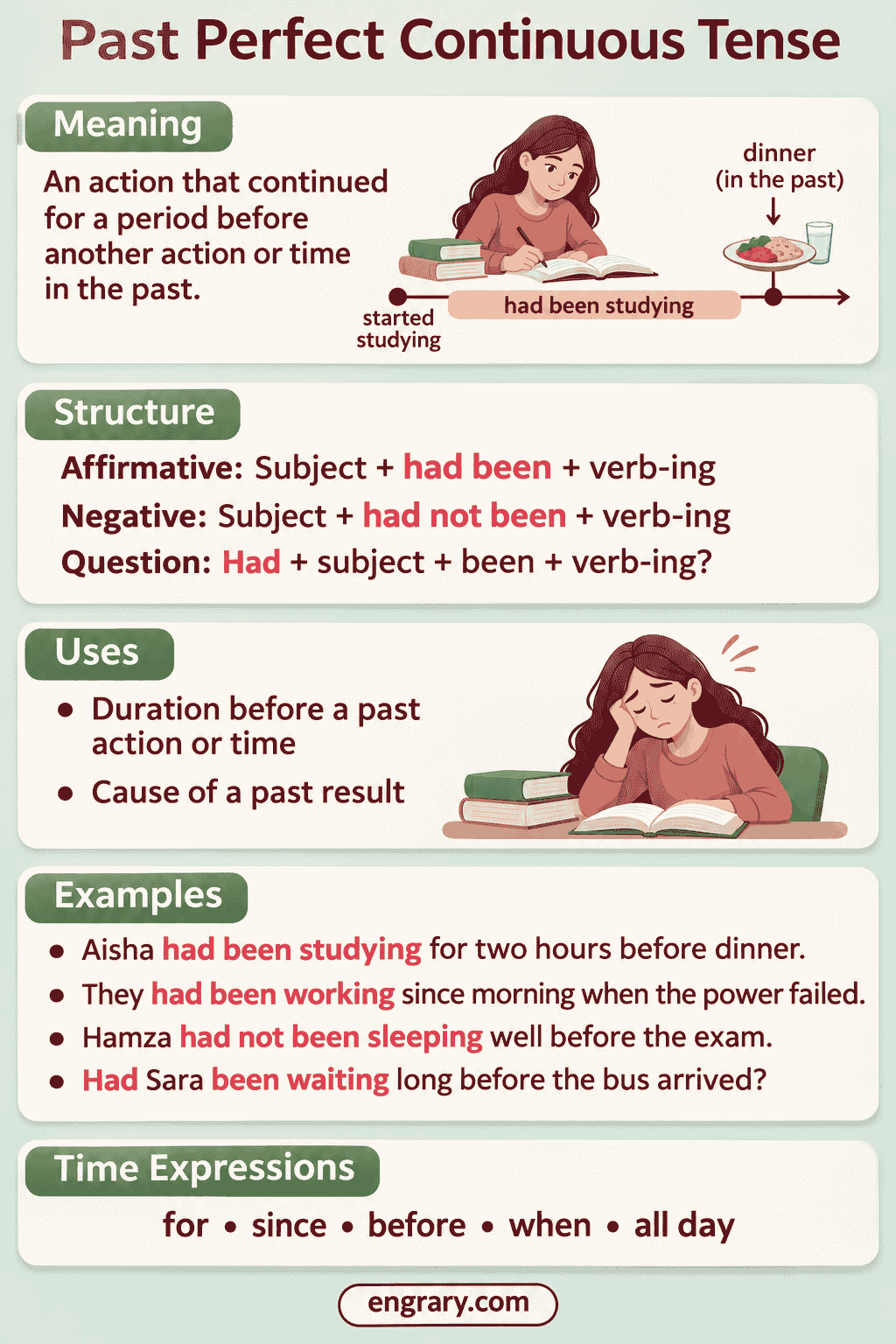
Past Perfect Continuous Tense at a Glance
The past perfect continuous looks backward from one point in the past to an earlier period of activity. Although the activity may have continued until the reference point, it may also have stopped shortly beforehand.
| Feature | Explanation | Example |
|---|---|---|
| Structure | had been + verb-ing | She had been studying. |
| Continuing activity | Continued until a later past point | She had been studying when I arrived. |
| Past duration | Shows how long an activity continued | She had been studying for three hours. |
| Recently stopped activity | Stopped shortly before a past situation | Her eyes were tired because she had been studying. |
| Negative | had not been + verb-ing | She had not been studying. |
| Question | Had + subject + been + verb-ing? | Had she been studying? |
The auxiliary had stays the same with every subject. Therefore, use had been with I, you, he, she, it, we, and they.
Meaning and Timeline of the Past Perfect Continuous
The basic timeline follows this pattern:
Earlier activity → period of activity → later past reference point
Consider this sentence:
They had been waiting for an hour when the bus arrived.
| Timeline element | Information |
|---|---|
| Earlier activity | They started waiting. |
| Duration | The waiting continued for an hour. |
| Later past event | The bus arrived. |
| Main focus | The waiting process and its duration |
The later reference point can appear in several ways:
| Reference type | Example |
|---|---|
| Another past action | She had been studying when I called. |
| A stated past time | By midnight, she had been studying for five hours. |
| A past result or situation | She was tired because she had been studying. |
| Previous context | We finally reached the village. We had been walking since sunrise. |
As a result, every sentence does not need when or before. However, the sentence or surrounding context should provide a meaningful later point in the past.
Structure of the Past Perfect Continuous Tense
Every past perfect continuous construction contains three verb elements:
- Had: the past-tense auxiliary
- Been: the past participle of be
- Verb-ing: the present participle of the main verb
| Subject | Auxiliary | Complete example |
|---|---|---|
| I | had | I had been working. |
| You | had | You had been working. |
| He, she, it | had | She had been working. |
| We | had | We had been working. |
| They | had | They had been working. |
Affirmative Sentences
Structure: Subject + had been + verb-ing + remaining information.
- I had been reading for an hour before dinner.
- Sara had been preparing for the interview all week.
- The children had been playing outside when it began to rain.
- We had been discussing the problem before the manager arrived.
In conversation, speakers commonly shorten had to ’d: I’d been reading and she’d been preparing.
Negative Sentences
Structure: Subject + had not been + verb-ing + remaining information.
- I had not been sleeping well before the examination.
- He had not been following the instructions.
- They had not been living there for long when they moved again.
- The machine had not been working properly before it stopped.
The usual contraction is hadn’t been: They hadn’t been waiting long.
Yes/No Questions
Structure: Had + subject + been + verb-ing + remaining information?
- Had you been waiting long before the doctor arrived?
- Had she been working there for several years?
- Had the children been making that noise?
- Had it been raining before you left home?
For questions, move had before the subject. However, keep been after the subject.
Wh-Questions
Structure: Wh-word + had + subject + been + verb-ing + remaining information?
- What had you been doing before I called?
- Where had they been staying during the repairs?
- Why had he been avoiding the meetings?
- How long had she been learning French?
- What had the technicians been working on?
Negative Questions
Negative questions can express surprise, concern, criticism, or an expectation.
- Hadn’t she been sleeping well?
- Had they not been following the correct route?
- Why hadn’t you been answering your phone?
- Hadn’t the team been practicing regularly?
Subject Questions
In a subject question, who or what performs the activity. Consequently, do not add another subject between had and been.
- Who had been using my computer?
- Who had been calling the office every morning?
- What had been causing the strange noise?
- Which department had been handling the complaints?
Short Answers
Short answers repeat had or hadn’t. They do not repeat been or the main verb.
| Question | Affirmative answer | Negative answer |
|---|---|---|
| Had you been waiting? | Yes, I had. | No, I hadn’t. |
| Had she been working? | Yes, she had. | No, she hadn’t. |
| Had they been studying? | Yes, they had. | No, they hadn’t. |
| Had it been raining? | Yes, it had. | No, it hadn’t. |
Do not use ’d alone at the end of a short answer. Say Yes, I had, not Yes, I’d.
Main Uses of the Past Perfect Continuous Tense
The tense can highlight duration, process, repetition, evidence, or a cause. In each use, the earlier activity connects to a later past point.
Activities Continuing Until a Past Moment
Use the tense when an activity started earlier and remained in progress until a later event or time.
- We had been driving for four hours when we reached the hotel.
- She had been teaching at the school for a decade when she became principal.
- By six o’clock, the workers had been repairing the road all day.
- I had been waiting outside when the receptionist finally opened the door.
Activities That Stopped Shortly Before a Past Moment
An activity may stop before the reference point while leaving evidence or a relevant result.
- The ground was wet because it had been raining.
- His clothes were covered in dust because he had been cleaning the attic.
- Her eyes were red; she had been crying.
- The kitchen smelled wonderful because my mother had been baking.
The activity had probably stopped, but its effect remained visible at that past moment.
Duration Before Another Past Event
The tense frequently answers how long an activity continued before something else happened.
- He had been studying for three hours before he took a break.
- They had been living in Karachi since 2018 when they decided to move.
- How long had you been working there before the company closed?
- We had been waiting all morning when the announcement finally came.
Causes and Results in the Past
The past perfect continuous often explains why a past condition existed.
- She was exhausted because she had been traveling all night.
- The players were thirsty because they had been training in the heat.
- His back hurt because he had been lifting heavy boxes.
- The roads were flooded after it had been raining for several hours.
A causal relationship can also appear without because:
- He was exhausted; he had been working since dawn.
- Her voice was weak. She had been speaking for hours.
- The room felt warm. Several people had been exercising there.
Repeated Activities Before a Past Point
The word continuous does not always mean uninterrupted. The tense can describe actions that occurred repeatedly over a period.
- She had been calling her parents every weekend.
- They had been meeting twice a month before the office closed.
- The alarm had been going off at random times.
- Customers had been reporting the same error for weeks.
Temporary Situations in the Past
The tense can emphasize that a situation lasted for a limited period.
- We had been staying with relatives while our apartment was renovated.
- He had been working the night shift before joining our department.
- I had been taking the bus while my car was at the workshop.
- The company had been operating from a temporary office.
Background Information in Narratives
Writers use the tense to establish what had been happening before a main past event.
- The wind had been blowing all night when the old tree finally fell.
- Villagers had been watching the river rise before the water reached their homes.
- We had been following the narrow path for hours when we saw the cabin.
- The detectives had been monitoring the building before the suspect appeared.
Activity Completion and Continuation
The tense does not always show whether an activity continued after the later past point.
I had been working for two hours when Ali arrived.
This sentence confirms that the work continued until Ali arrived. However, it does not say whether the speaker continued working afterward.
| Situation | Example | Meaning |
|---|---|---|
| Continued at the reference point | She had been reading when I entered. | She was probably still reading. |
| Ended at the reference point | He had been working until six, and then he left. | The work ended at six. |
| Stopped shortly beforehand | Her hands were dirty because she had been gardening. | The gardening had recently stopped. |
| Later continuation unknown | They had been negotiating for weeks when the report appeared. | The sentence does not reveal what happened next. |
Therefore, avoid assuming that every past perfect continuous activity was completed or that it continued afterward.
Activity, Duration, Repetition, and Past Evidence
| Main focus | Example |
|---|---|
| Activity | She had been painting. |
| Duration | She had been painting for three hours. |
| Repetition | She had been painting every weekend. |
| Past evidence | Her clothes were stained because she had been painting. |
These meanings overlap, but context usually reveals the speaker’s main focus.
Past Perfect Continuous in Reported Speech
The tense often appears when a speaker reports an earlier continuing activity.
| Direct speech | Reported speech |
|---|---|
| “I have been working all day,” she said. | She said that she had been working all day. |
| “We have been waiting outside,” they said. | They said that they had been waiting outside. |
| “I haven’t been sleeping well,” he said. | He said that he had not been sleeping well. |
However, the past continuous does not automatically change to the past perfect continuous. The choice depends on the intended time relationship.
| Direct statement | Possible report | Meaning |
|---|---|---|
| “I was waiting,” she said. | She said that she was waiting. | The report keeps the activity at the stated past time. |
| “I was waiting before the office opened,” she said. | She said that she had been waiting before the office opened. | The report emphasizes an activity earlier than another past point. |
Time Expressions with the Past Perfect Continuous
Time expressions identify the duration, starting point, endpoint, or later reference point of an activity.
For and Since
Use for with a duration and since with a starting point.
| Expression | Function | Example |
|---|---|---|
| for | Introduces a period | They had been waiting for two hours. |
| since | Introduces a point in time | They had been waiting since noon. |
| since + clause | Introduces a starting event | They had been waiting since the office opened. |
Do not confuse the two:
- Incorrect: We had been waiting since three hours.
- Correct: We had been waiting for three hours.
- Correct: We had been waiting since three o’clock.
Before and When
Before clearly places the activity earlier than another event. Meanwhile, when commonly introduces the later past event.
- She had been exercising before she injured her knee.
- They had been discussing the budget when the director arrived.
- When we reached the farm, the workers had been harvesting since sunrise.
By and By the Time
Use by before a noun phrase or time. Use by the time before a clause.
- By six o’clock, he had been working for ten hours.
- By Monday, they had been traveling for a week.
- By the time we arrived, he had been waiting for an hour.
- By the time the rain stopped, water had been entering the basement for several minutes.
Until and Until Then
Until identifies an endpoint. In contrast, until then refers to a past point already mentioned.
- She had been working until midnight.
- The children had been playing outside until it became dark.
- He accepted a permanent position in June. Until then, he had been working temporarily.
- The new system launched in August. Until then, we had been processing every order manually.
Other Useful Time Expressions
- all day
- all morning
- throughout the week
- ever since
- up until
- up to that point
- over the previous month
- for the preceding two years
Examples:
- The staff had been preparing all morning before the guests arrived.
- She had been living alone ever since her sister moved away.
- Up until the factory closed, he had been working there full-time.
- Up to that point, the experiment had been progressing smoothly.
How Long Questions
Use how long to ask about duration:
- How long had you been waiting before the train arrived?
- How long had she been teaching before she retired?
- How long had they been working on the project?
However, how long does not automatically require a continuous form. With stative verbs, use the past perfect simple: How long had you known her?—not How long had you been knowing her?
Adverb Placement in Past Perfect Continuous Sentences
| Adverb | Natural example |
|---|---|
| already | She had already been waiting for an hour. |
| just | It had just been raining. |
| recently | They had been working together recently. |
| constantly | He had been constantly interrupting her. |
| gradually | The weather had been gradually improving. |
| still | Had she still been living there at the time? |
Adverbs such as already, just, constantly, and gradually usually appear after had or been, depending on their focus. By contrast, recently commonly appears near the end of the sentence.
For a regular past habit, the past perfect simple may sound more natural:
- Established habit: He had always worked late.
- Repeated temporary activity: He had been working late every day that month.
Contractions in Natural English
The contraction ’d can mean had or would. The following verb form identifies its meaning.
| Form | Meaning | Example |
|---|---|---|
| I’d been working | I had been working | I’d been working since dawn. |
| I’d worked | I had worked | I’d worked there before. |
| I’d be working | I would be working | I knew I’d be working late. |
| I hadn’t been working | I had not been working | I hadn’t been working that week. |
Because been follows ’d in I’d been waiting, the contraction must mean I had.
Present Participle Spelling Rules
| Base verb | Present participle | Spelling rule |
|---|---|---|
| work | working | Add -ing. |
| write | writing | Remove the final silent e. |
| run | running | Double the final consonant. |
| lie | lying | Change ie to y. |
| panic | panicking | Add k before -ing. |
| travel | travelling/traveling | British English often doubles l; American English usually does not. |
Stative and Dynamic Verbs
Stative verbs describe possession, knowledge, belief, preference, perception, or another condition. Therefore, they do not normally take continuous forms.
| Incorrect or unnatural | Natural correction |
|---|---|
| I had been knowing her for years. | I had known her for years. |
| He had been owning the shop since 2010. | He had owned the shop since 2010. |
| We had been believing the story. | We had believed the story. |
| She had been understanding the instructions. | She had understood the instructions. |
Some verbs can express either a state or an activity. Their meaning determines the form.
| Stative or result-focused meaning | Dynamic activity |
|---|---|
| She had thought the plan was safe. | She had been thinking about the plan. |
| He had had the car for years. | He had been having trouble with the car. |
| The soup had tasted strange. | The chef had been tasting the soup. |
Past Perfect Continuous with Punctual Verbs
Punctual or achievement verbs describe an event that occurs at a single point. As a result, they do not normally appear in a continuous form when they describe one completed event.
| Unnatural construction | Natural construction |
|---|---|
| The race had been starting at noon. | The race had started at noon. |
| She had been recognizing him. | She had recognized him. |
| They had been arriving at six. | They had arrived at six. |
| The machine had been stopping at noon. | The machine had stopped at noon. |
Nevertheless, some of these verbs work in the continuous when they describe repetition or a developing pattern:
- Guests had been arriving throughout the evening.
- The engine had been starting without difficulty all week.
- The machine had been stopping unexpectedly.
Past Perfect Continuous in Conditional Sentences
The tense can appear in third conditional sentences when an unreal past activity would have changed a past result.
- If he had been paying attention, he would have understood the instructions.
- If they had been driving more carefully, they might have avoided the accident.
- She would not have felt exhausted if she had not been working all night.
- If we had been monitoring the system, we could have detected the fault earlier.
These situations did not happen as described. Instead, the speaker imagines a different past activity and result.
Wishes and Regrets About Past Activities
Use the past perfect continuous after wish to express regret about an ongoing or repeated past activity.
- I wish I had not been wasting so much time.
- She wished she had been listening more carefully.
- They wished they had not been arguing all evening.
- He wished he had been taking better care of his health.
Indirect Questions and Embedded Clauses
Indirect questions use statement word order rather than direct-question order.
| Direct question | Indirect question |
|---|---|
| How long had she been waiting? | I wondered how long she had been waiting. |
| Why had they been arguing? | He asked why they had been arguing. |
| Who had been using the equipment? | The manager wanted to know who had been using the equipment. |
The tense also appears naturally in relative and content clauses:
- The project that we had been developing was suddenly canceled.
- She explained that she had been experiencing technical problems.
- I discovered that someone had been accessing my account.
- The course they had been attending ended in June.
Past Perfect Continuous in Narrative Sequences
Different past tenses perform different roles within a story.
| Narrative function | Example |
|---|---|
| Earlier background duration | It had been raining for hours. |
| Activity in progress | People were sheltering inside shops. |
| Main completed event | The river overflowed its banks. |
Another sequence shows the same pattern:
- The hikers had been climbing since dawn.
- Snow was falling around them.
- One climber slipped near the summit.
The past perfect continuous establishes the earlier activity, the past continuous describes the scene in progress, and the simple past reports the main event.
Past Perfect and Past Perfect Continuous
| Past perfect | Past perfect continuous | Main contrast |
|---|---|---|
| She had written the report. | She had been writing the report. | Completed result versus process |
| He had repaired three bicycles. | He had been repairing bicycles. | Quantity versus activity |
| She had called five times. | She had been calling all morning. | Completed number versus repetition |
| They had lived there for years. | They had been living there for years. | Neutral fact versus continuing or temporary emphasis |
With verbs such as live, work, teach, and study, both forms may be correct.
| Past perfect simple | Past perfect continuous | Difference in focus |
|---|---|---|
| She had lived there for ten years. | She had been living there for ten years. | Settled fact versus continuing experience |
| He had worked at the bank since 2015. | He had been working at the bank since 2015. | Employment fact versus duration or activity |
| They had studied English for years. | They had been studying English for years. | General fact versus sustained effort |
Past Continuous and Past Perfect Continuous
| Past continuous | Past perfect continuous | Main contrast |
|---|---|---|
| She was cooking when I arrived. | She had been cooking for two hours when I arrived. | Activity at that moment versus preceding duration |
| It was raining at noon. | It had been raining since morning. | Past scene versus earlier process |
| They were waiting outside. | They had been waiting outside for an hour. | Activity in progress versus duration leading to that point |
The past continuous places an activity around a past moment. In contrast, the past perfect continuous looks backward from that moment to an earlier period.
Simple Past and Past Perfect Continuous
| Simple past | Past perfect continuous | Main contrast |
|---|---|---|
| He worked all night. | He had been working all night before he fell asleep. | Completed past activity versus activity leading to another event |
| We waited for an hour and left. | We had been waiting for an hour when the bus arrived. | Finished sequence versus preceding duration |
| It rained yesterday. | It had been raining before we went outside. | Finished event versus evidence at a later past point |
Present Perfect Continuous and Past Perfect Continuous
| Present perfect continuous | Past perfect continuous | Reference point |
|---|---|---|
| I have been studying for two hours. | I had been studying for two hours when she called. | Now versus a past moment |
| It has been raining all morning. | It had been raining all morning before the sky cleared. | Present result versus past result |
| They have been living here since June. | They had been living there since June when we met. | Duration until now versus duration until a past point |
Rare Passive Forms and Natural Alternatives
A passive past perfect continuous construction is technically possible. However, it usually sounds heavy and unnatural.
| Awkward passive construction | Natural alternative |
|---|---|
| The road had been being repaired. | Workers had been repairing the road. |
| The system had been being tested. | Engineers had been testing the system. |
| The building had been being renovated. | The building had been under renovation. |
Whenever possible, use an active subject or another natural passive construction.
Common Mistakes with the Past Perfect Continuous
| Mistake | Incorrect sentence | Correct sentence |
|---|---|---|
| Using has or have | She has been waiting before I arrived. | She had been waiting before I arrived. |
| Omitting been | They had working all day. | They had been working all day. |
| Confusing been and being | I had being studying. | I had been studying. |
| Using a past participle | He had been worked outside. | He had been working outside. |
| Incorrect negative order | She had been not sleeping well. | She had not been sleeping well. |
| Incorrect question order | You had been waiting long? | Had you been waiting long? |
| Confusing for and since | We had been waiting since two hours. | We had been waiting for two hours. |
| Using a stative verb | I had been knowing him for years. | I had known him for years. |
| Confusing related tenses | She was working for three hours when I arrived. | She had been working for three hours when I arrived. |
| Focusing on completed quantity | She had been writing five emails. | She had written five emails. |
| Missing a past reference point | I had been working for two hours. | I had been working for two hours when the lights went out. |
| Misspelling the participle | He had been runing. | He had been running. |
| Using ’d as a short answer | Yes, I’d. | Yes, I had. |
The sentence I had been working for two hours can be correct when previous context supplies the reference point. However, without context, adding the later past event makes the time relationship clearer.
Quick Reference for the Past Perfect Continuous
| Feature | Rule or example |
|---|---|
| Basic structure | Subject + had been + verb-ing |
| Negative structure | Subject + had not been + verb-ing |
| Question structure | Had + subject + been + verb-ing? |
| Main meaning | Activity continuing until or shortly before a past point |
| Other uses | Duration, repetition, past cause, temporary situations, and narrative background |
| Common expressions | for, since, before, when, by the time, until then, all day |
| Short answers | Yes, I had. No, she hadn’t. |
| Main restrictions | Avoid most stative verbs, single punctual events, and completed quantities. |
FAQs
The past perfect continuous tense describes an activity that began before a particular point in the past and continued until or shortly before that point. For example, We had been waiting for an hour when the bus arrived connects an earlier period of waiting with the later arrival.
The affirmative structure is subject + had been + verb-ing. Use had with every subject: I had been working, she had been working, and they had been working. For negatives, add not after had. For questions, place had before the subject.
Use it to emphasize an activity’s duration or process before a later past point. It can also describe a recently stopped activity, explain a past result, show repeated behavior, present a temporary situation, or provide background information in a narrative.
The past perfect usually emphasizes a completed result, fact, number, or quantity: She had written three reports. In contrast, the past perfect continuous emphasizes the activity, duration, or repetition: She had been writing reports all morning. In some contexts, both forms are possible, but the focus changes.
Most stative verbs do not normally appear in continuous forms. Therefore, say I had known her for years, not I had been knowing her for years. However, some verbs can take a continuous form when they express an activity, as in I had been thinking about the problem.
You May Also Like

Leave a Comment