
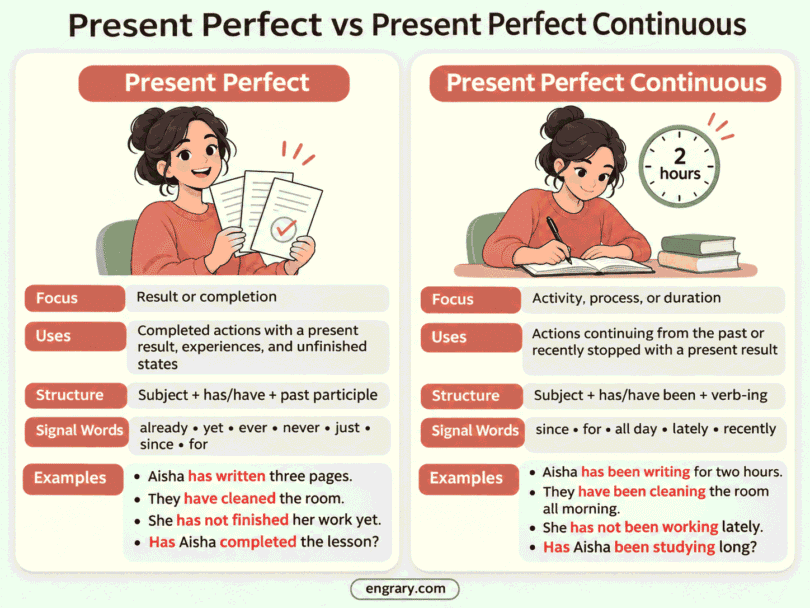
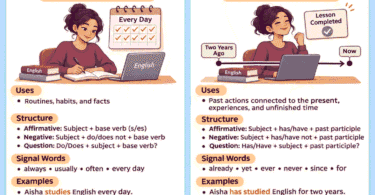
The present perfect and present perfect continuous both connect the past with the present. However, they present that connection differently. The present perfect commonly focuses on a result, completed amount, experience, or continuing state. In contrast, the present perfect continuous usually highlights an activity, its duration, repeated behavior, or evidence that it happened recently.
The difference is not simply “finished” versus “unfinished.” For example, the present perfect can describe a state that still continues, while the present perfect continuous can describe an activity that has just stopped. Therefore, you need to consider the verb, the context, and the idea you want to emphasize.
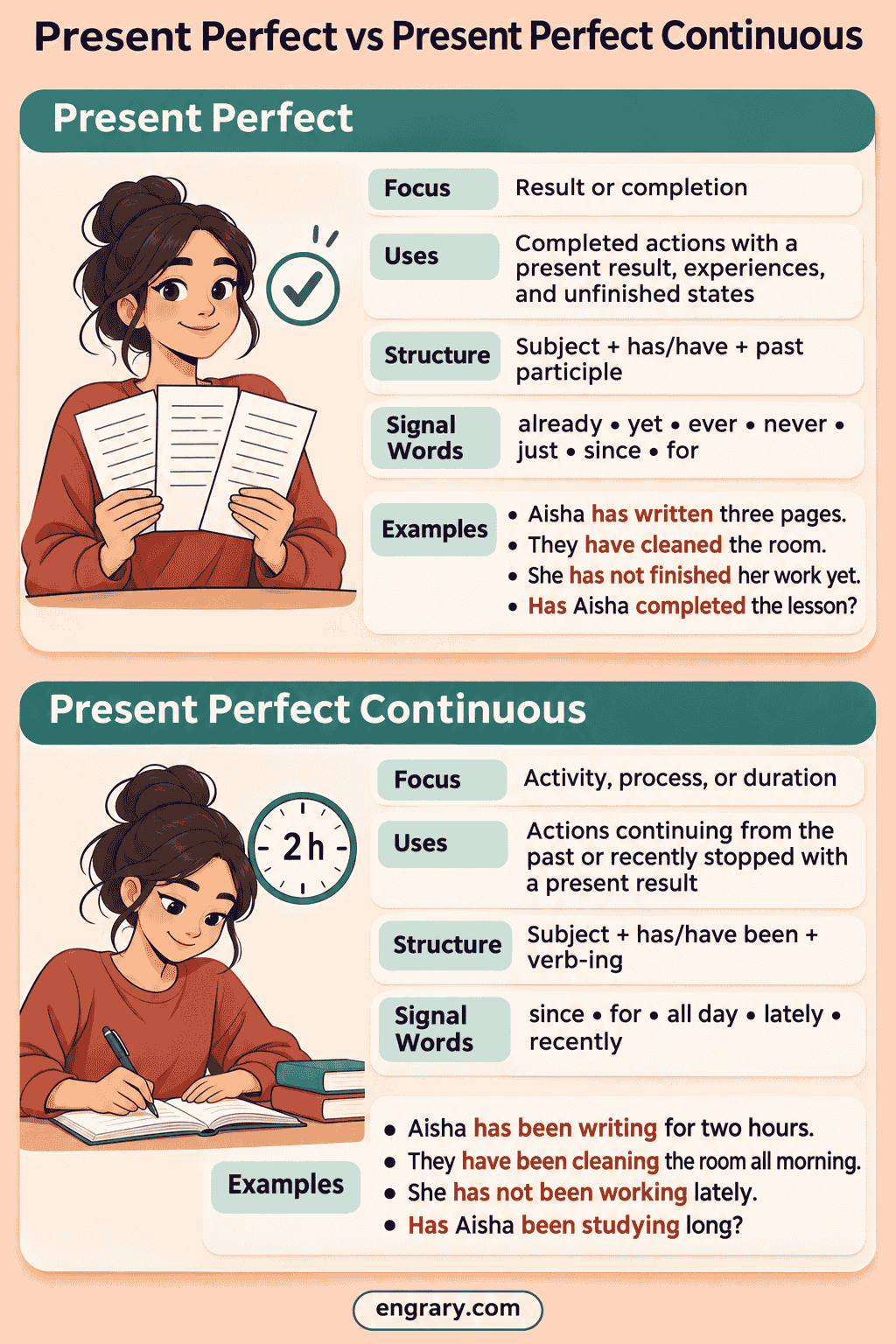
Present Perfect and Present Perfect Continuous at a Glance
The following table summarizes the central differences between these two forms.
| Feature | Present Perfect | Present Perfect Continuous |
|---|---|---|
| Structure | have/has + past participle | have/has + been + verb-ing |
| Main focus | Result, quantity, experience, or state | Activity, process, duration, or recent evidence |
| Common question | How many? | How long? |
| Typical example | I have painted three rooms. | I have been painting since morning. |
| Possible time meaning | Completed or continuing | Continuing or recently stopped |
As a quick guide, choose the present perfect when a result or completed amount matters. Choose the present perfect continuous when the activity or its duration matters. Nevertheless, this distinction is a tendency rather than an absolute rule.
Structures and Sentence Forms
Both tenses use have or has. However, the present perfect takes a past participle, whereas the present perfect continuous adds been before an -ing form.
Present Perfect Structure
| Sentence Type | Structure | Example |
|---|---|---|
| Affirmative | subject + have/has + past participle | She has completed the report. |
| Negative | subject + have/has not + past participle | She has not completed the report. |
| Question | Have/Has + subject + past participle? | Has she completed the report? |
| Short answer | Yes/No + subject + have/has | Yes, she has. |
Present Perfect Continuous Structure
| Sentence Type | Structure | Example |
|---|---|---|
| Affirmative | subject + have/has + been + verb-ing | She has been preparing the report. |
| Negative | subject + have/has not + been + verb-ing | She has not been preparing the report. |
| Question | Have/Has + subject + been + verb-ing? | Has she been preparing the report? |
| Short answer | Yes/No + subject + have/has | Yes, she has. |
In everyday English, speakers often use contractions such as I’ve, you’ve, she’s, haven’t, and hasn’t. In this context, she’s completed means she has completed. By contrast, she’s working means she is working.
Main Uses of the Present Perfect
The present perfect connects an earlier event or state with the present. It commonly expresses the following meanings:
- A present result: I have lost my keys, so I cannot open the door.
- A completed quantity: She has written six emails today.
- Life experience: We have visited Turkey twice.
- An achievement: The team has broken the school record.
- Recent news: The company has opened a new office.
- Repeated events up to now: He has called three times this morning.
- A continuing state: I have known Sara since childhood.
- A first experience: This is the first time I have driven at night.
The form often answers questions about results or completed amounts. For instance, How many chapters have you read? asks about the number completed rather than the time spent reading.
Main Uses of the Present Perfect Continuous
The present perfect continuous focuses on an activity connected to the present. It commonly describes:
- An activity continuing now: I have been studying for three hours.
- A recently stopped activity: It has been raining, so the roads are wet.
- The duration of an activity: She has been waiting since noon.
- A temporary situation: He has been working from home this month.
- Repeated recent behavior: They have been arriving late recently.
- Visible evidence: Your hands are dirty. Have you been gardening?
- A developing situation: The weather has been getting warmer.
Thus, this form often answers How long? or explains why a present condition exists.
Result and Activity
The most useful contrast is result versus activity. The present perfect presents what an action has achieved. Meanwhile, the present perfect continuous draws attention to the action itself.
| Present Perfect | Present Perfect Continuous | Main Difference |
|---|---|---|
| I have repaired the bicycle. | I have been repairing the bicycle. | Completed result vs activity |
| She has cleaned the kitchen. | She has been cleaning the kitchen. | Clean result vs cleaning process |
| They have built the wall. | They have been building the wall. | Finished structure vs ongoing work |
| He has read the book. | He has been reading the book. | Completed book vs reading activity |
The continuous examples do not confirm completion. For example, She has been cleaning the kitchen may mean that she is still cleaning or has stopped for the moment. Context supplies the final meaning.
Completion and Recent Evidence
The present perfect continuous can describe a finished activity when its evidence remains visible or relevant:
- Her clothes are wet because she has been walking in the rain.
- You look tired. Have you been running?
- The kitchen smells wonderful because Dad has been cooking.
Conversely, the present perfect does not always describe a finished situation. It often expresses a state that started earlier and continues now:
- I have owned this house for ten years.
- She has known him since 2015.
- We have believed that for a long time.
Therefore, “finished” and “unfinished” can help in some contexts, but they cannot explain every choice.
Present Consequences and Incomplete Results
The continuous form sometimes suggests that an activity remains incomplete or has produced an unintended effect:
- I have painted the room. — The result matters, and the room is probably finished.
- I have been painting the room. — The activity matters, and the work may remain unfinished.
- Who has eaten my cake? — The speaker may mean that all the cake has disappeared.
- Who has been eating my cake? — The speaker notices evidence, and some cake may remain.
Still, these meanings are implications rather than fixed rules. A speaker can add more context to confirm completion: I have been painting the room all day, and I have finally finished it.
Quantity and Duration
The present perfect commonly reports how much someone has completed. In contrast, the present perfect continuous commonly reports how long an activity has lasted.
| Intended Focus | Preferred Form | Example |
|---|---|---|
| Completed number | Present perfect | I have answered ten messages. |
| Amount produced | Present perfect | She has baked four cakes. |
| Length of activity | Present perfect continuous | I have been answering messages for an hour. |
| Ongoing process | Present perfect continuous | She has been baking since noon. |
Exact quantities usually favor the present perfect: He has made twelve calls. However, a quantity can appear with the continuous form when it describes a repeated rate or routine: He has been making twelve calls a day.
Continuing States and Activities
Stative verbs describe conditions, possession, knowledge, feelings, and relationships. Therefore, they usually take the present perfect rather than the continuous form:
- I have believed that for years.
- She has owned the shop since 2018.
- They have needed more space for months.
Dynamic verbs describe actions or processes, so they readily take the continuous form:
- I have been thinking about your suggestion all day.
- She has been managing the shop since January.
- They have been looking for a larger office.
Even so, neither form guarantees that a situation will continue in the future. The surrounding context reveals the speaker’s expectation.
Stative and Dynamic Meanings
Common stative verbs include believe, belong, know, need, own, prefer, understand, and want. These verbs rarely appear in the present perfect continuous. However, several verbs can express either a state or an activity, so their grammar changes with their meaning.
| Stative Meaning | Dynamic Meaning |
|---|---|
| I have had this laptop for years. | I have been having trouble with it. |
| I have thought that for a long time. | I have been thinking about moving. |
| I have seen that film before. | I have been seeing a specialist. |
In the first column, have, think, and see express possession, opinion, and experience. In the second column, they express ongoing experiences or repeated activities.
Punctual and Completion Verbs
Verbs such as arrive, achieve, finish, find, lose, recognize, reach, start, stop, and win often describe a single completed event. Consequently, they usually favor the present perfect:
- The train has arrived.
- She has achieved her goal.
- I have found my glasses.
- Our team has won the match.
Nevertheless, some of these verbs can take a continuous form when the meaning involves repetition or a developing process. For example, Teams have been reaching the final with lower scores this season describes a repeated pattern rather than one completed event.
Repeated Actions and Temporary Habits
Both forms can describe repetition, but they emphasize different aspects of it.
| Exact or Completed Number | Repeated Activity |
|---|---|
| She has called three times. | She has been calling all morning. |
| I have visited them twice. | I have been visiting them regularly. |
| He has knocked five times. | He has been knocking on the door. |
The continuous form also suits temporary habits and changing routines:
- I have been taking the bus this week.
- She has been eating at her desk lately.
- We have been meeting online recently.
In addition, it can highlight repeated behavior that concerns or annoys the speaker:
- You have been leaving the door open.
- He has been arriving late recently.
- Someone has been moving my files.
The tense itself does not express irritation. Instead, the context and the speaker’s tone create that meaning.
Long-Term and Temporary Situations
The present perfect often presents a situation as an established fact, while the continuous form may emphasize its ongoing or temporary nature:
- He has worked at the hospital for fifteen years.
- He has been working at a private clinic this month.
However, the continuous form can also describe a long activity: She has been teaching for twenty years. Therefore, length alone does not determine the tense.
Trends and Measurable Changes
The continuous form highlights development, whereas the simple form often reports a measurable outcome.
| Developing Trend | Measurable Result |
|---|---|
| Prices have been rising. | Prices have risen by 10 percent. |
| The company has been growing. | The company has opened six new branches. |
| Her English has been improving. | Her test score has improved by 20 points. |
As a result, reports often use the two forms together: Sales have been increasing, and the company has gained 2,000 new customers this year.
Negative Forms and Their Meanings
A negative present perfect sentence denies a result, event, experience, or state. In comparison, a negative present perfect continuous sentence denies that an activity has been taking place.
| Present Perfect | Present Perfect Continuous |
|---|---|
| I haven’t read the report. | I haven’t been reading the report. |
| She hasn’t completed the project. | She hasn’t been working on the project. |
| They haven’t repaired the road. | They haven’t been repairing the road. |
For example, I haven’t read the report means the reading remains incomplete or has not happened. However, I haven’t been reading the report focuses on the absence of the reading activity.
Questions and Short Answers
Questions in the present perfect often ask about completion, experience, or quantity. Meanwhile, questions in the continuous form commonly ask about an activity or its duration.
- Have you finished the assignment?
- How many pages have you written?
- Have you been working on the assignment?
- How long have you been writing?
Short answers repeat only the auxiliary verb:
| Question | Positive Answer | Negative Answer |
|---|---|---|
| Have you finished? | Yes, I have. | No, I haven’t. |
| Has she been studying? | Yes, she has. | No, she hasn’t. |
Thus, Yes, she has been is not the standard short answer to Has she been studying? The natural answer is Yes, she has.
For, Since, and Other Time Expressions
Time expressions can support a meaning, but they do not choose the tense by themselves.
| Function | Common Expressions |
|---|---|
| Duration | for two hours, all day, all week |
| Starting point | since Monday, since 2020, since I arrived |
| Recent activity | recently, lately |
| Result or completion | already, just, yet |
| Experience | ever, never, before |
| Progress up to now | so far, up to now, until now |
Both forms can appear with for and since:
- I have lived here for six years.
- I have been living here for six years.
Moreover, a clause after since commonly uses the simple past: I have been working here since I graduated. Finished past expressions such as yesterday, last week, and in 2020 normally require the simple past, not either present perfect form.
Adverb Placement
Adverbs such as already, just, and never commonly appear between have/has and the past participle:
- I have already finished.
- She has just arrived.
- They have never visited us.
With the continuous form, recently can appear within or after the verb phrase, while lately commonly comes at the end:
- He has recently been working from home.
- We have been working hard lately.
How Long with Both Forms
Although how long frequently introduces the present perfect continuous, it can also introduce the present perfect. The verb and the intended viewpoint determine the choice:
- How long have you known her? — Know expresses a state.
- How long have you lived here? — The question treats residence as an established fact.
- How long have you been living here? — The question emphasizes the ongoing experience.
Therefore, how long does not automatically require a continuous form.
Cases Where Both Forms Are Possible
Verbs such as live, work, study, teach, and wait may allow either form when the situation continues into the present.
| Present Perfect | Present Perfect Continuous | Possible Nuance |
|---|---|---|
| I have lived here for five years. | I have been living here for five years. | Established fact vs ongoing experience |
| She has taught here since 2020. | She has been teaching here since 2020. | Continuing position vs ongoing activity |
| We have waited for an hour. | We have been waiting for an hour. | Duration as a fact vs emphasis on the process |
Sometimes the difference is very small. Furthermore, the continuous form does not always make a situation temporary. It simply gives the activity greater prominence.
Experience and Recent Participation
The present perfect commonly asks whether an experience has occurred at any time up to now. In contrast, the continuous form asks about recent participation in an activity:
- Have you played tennis before? — experience
- Have you been playing tennis recently? — recent activity
- Has she worked with children before? — previous experience
- Has she been working with children lately? — recent ongoing work
This contrast also appears in statements: I have studied French before reports an experience, whereas I have been studying French lately describes a current pattern.
First-Time and Superlative Patterns
English normally uses the present perfect after expressions such as This is the first time and after superlatives that refer to experience up to now:
- This is the first time I have driven at night.
- It is the best restaurant we have visited.
- That is the funniest film she has ever seen.
Because these patterns emphasize a completed experience or counted occasion, the continuous form usually does not fit.
Been To and Gone To
Moreover, the present perfect distinguishes been to from gone to:
- Sara has been to Lahore. — She visited Lahore and returned.
- Sara has gone to Lahore. — She is probably in Lahore or travelling there.
The present perfect continuous does not normally replace either expression because these constructions describe a visit or a change of location rather than an extended activity.
News and Finished Details
Writers and speakers often use the present perfect to introduce news. Afterward, however, they use the simple past for details from a finished time:
- The company has opened a new office. It opened on Monday.
- Maya has won the competition. She received the prize yesterday.
- Scientists have discovered a new species. They announced the discovery last week.
This shift prevents the incorrect use of a present perfect form with on Monday, yesterday, or last week.
Mixed Results and Activities
One situation can require both forms. In such cases, the continuous form presents the process, while the present perfect reports its result:
- I have been writing the report, but I haven’t finished it.
- She has been applying for jobs, but she hasn’t received an offer.
- They have been renovating the house and have completed two rooms.
- We have been contacting customers, and twenty people have replied.
These combinations clearly show why the two forms complement each other rather than compete in every context.
Passive Forms and Natural Alternatives
The present perfect passive is common and natural:
- The road has been repaired.
- The documents have been signed.
The present perfect continuous passive is grammatically possible, but it usually sounds awkward:
- The road has been being repaired for weeks.
Natural English usually replaces that construction with an active sentence or another expression:
- Workers have been repairing the road for weeks.
- Repairs have been underway for weeks.
More Present Perfect and Present Perfect Continuous Examples
Affirmative Examples
- I have completed the application.
- She has visited three countries this year.
- We have known each other for a decade.
- He has been preparing for the interview all week.
- The children have been playing outside since lunch.
- My eyes hurt because I have been looking at the screen for hours.
Negative Examples
- I haven’t received your message.
- She hasn’t finished the final chapter.
- We haven’t seen that film before.
- He hasn’t been sleeping well lately.
- They haven’t been attending the weekly meetings.
- It hasn’t been raining for very long.
Question Examples
- Have you ever ridden a horse?
- How many orders has the shop received?
- Has the bus arrived yet?
- Have you been waiting long?
- Why has she been crying?
- What have they been discussing?
Correct and Incorrect Examples
| Incorrect | Correct | Explanation |
|---|---|---|
| She has been knowing him for years. | She has known him for years. | Know is normally stative. |
| I have written emails for two hours. | I have been writing emails for two hours. | The focus is duration. |
| He has been completed three tasks. | He has completed three tasks. | The continuous structure requires been + verb-ing. |
| We have visited them yesterday. | We visited them yesterday. | Yesterday is a finished past period. |
| She have been studying all day. | She has been studying all day. | A singular subject takes has. |
| I am working here since May. | I have been working here since May. | The activity began earlier and continues now. |
Common Mistakes
- Omitting been: Write She has been studying, not She has studying.
- Using the wrong auxiliary: Use has with he, she, and it, but use have with I, you, we, and they.
- Forcing stative verbs into continuous forms: Write I have understood the lesson, not I have been understanding the lesson.
- Choosing a tense only because of for or since: Both forms can use these expressions, so focus on meaning.
- Using the continuous form for a completed total: Write I have read five books, not I have been reading five books, when five books are complete.
- Adding a finished past expression: Write I saw her yesterday, not I have seen her yesterday.
- Assuming the present perfect always means finished: I have known him for years describes a continuing state.
- Assuming the continuous form always means unfinished: It has been raining can describe rain that has just stopped.
- Repeating the main verb in a short answer: Answer Yes, I have, not Yes, I have finished unless you want a full response.
Present Perfect or Present Perfect Continuous Selection Guide
| Intended Meaning | Recommended Form |
|---|---|
| Completed result | Present perfect |
| Exact number or amount | Present perfect |
| Life experience | Present perfect |
| Continuing state | Usually present perfect |
| Activity in progress | Present perfect continuous |
| Duration of an activity | Usually present perfect continuous |
| Recent visible evidence | Present perfect continuous |
| Repeated temporary behavior | Present perfect continuous |
| Flexible verb such as live or work | Either form, depending on focus |
When both forms seem possible, first identify what you want to emphasize. If the answer is the result, amount, experience, or state, choose the present perfect. If the answer is the process, duration, repetition, or visible evidence, choose the present perfect continuous.
FAQs
The present perfect generally emphasizes a result, completed quantity, experience, or state. In contrast, the present perfect continuous usually emphasizes an activity, its duration, repeated behavior, or recent evidence. For example, I have written five pages focuses on quantity, whereas I have been writing for two hours focuses on duration.
Yes. It can describe an activity that has recently stopped, especially when its present evidence or consequence remains visible. For instance, Her hands are dirty because she has been gardening can mean that she has stopped gardening for now.
Yes. It commonly describes continuing states, as in I have known her for ten years. It can also describe established situations with flexible verbs: She has worked here since 2020. Therefore, the present perfect does not always signal completion.
Both forms can appear with for and since. The present perfect often emphasizes a state or established fact, while the present perfect continuous emphasizes an ongoing activity or its duration. Compare I have lived here for six years with I have been living here for six years. Both sentences are correct, although their viewpoints differ slightly.
Stative verbs describe possession, knowledge, feelings, relationships, and other conditions rather than observable activities. Consequently, the present perfect usually sounds more natural with verbs such as know, own, believe, and want. However, some verbs allow a continuous form when their meaning becomes dynamic, as in I have been thinking about the problem.
You May Also Like

Leave a Comment