
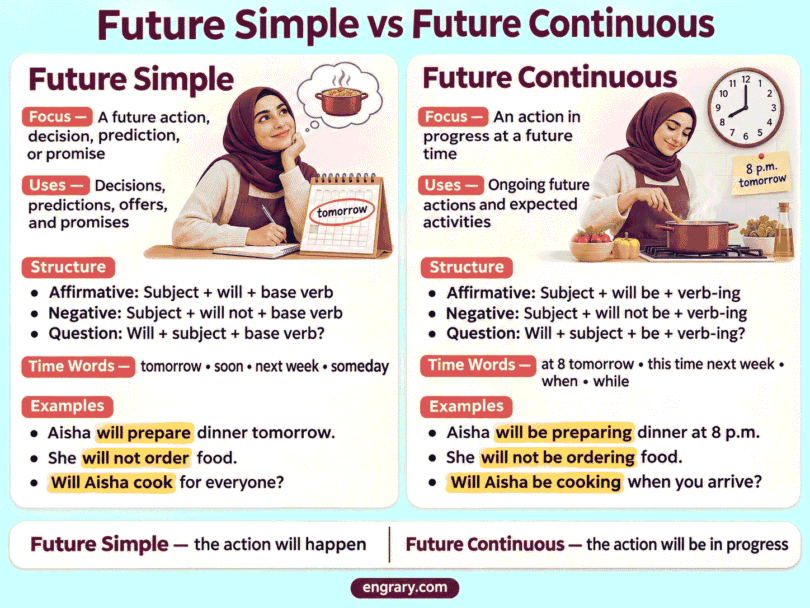
The future simple and future continuous both describe future situations, but they present them from different viewpoints. The future simple usually presents an event, decision, prediction, promise, offer, or request as a whole. In contrast, the future continuous shows an activity in progress around a future time or reports something expected to happen as part of an arrangement or normal course of events.
The difference does not depend on whether an action is short or long. Instead, it depends on the speaker’s focus and purpose. For example, I will call you at eight presents the call as a future event, whereas I will be talking to the manager at eight places the listener inside an activity already in progress.
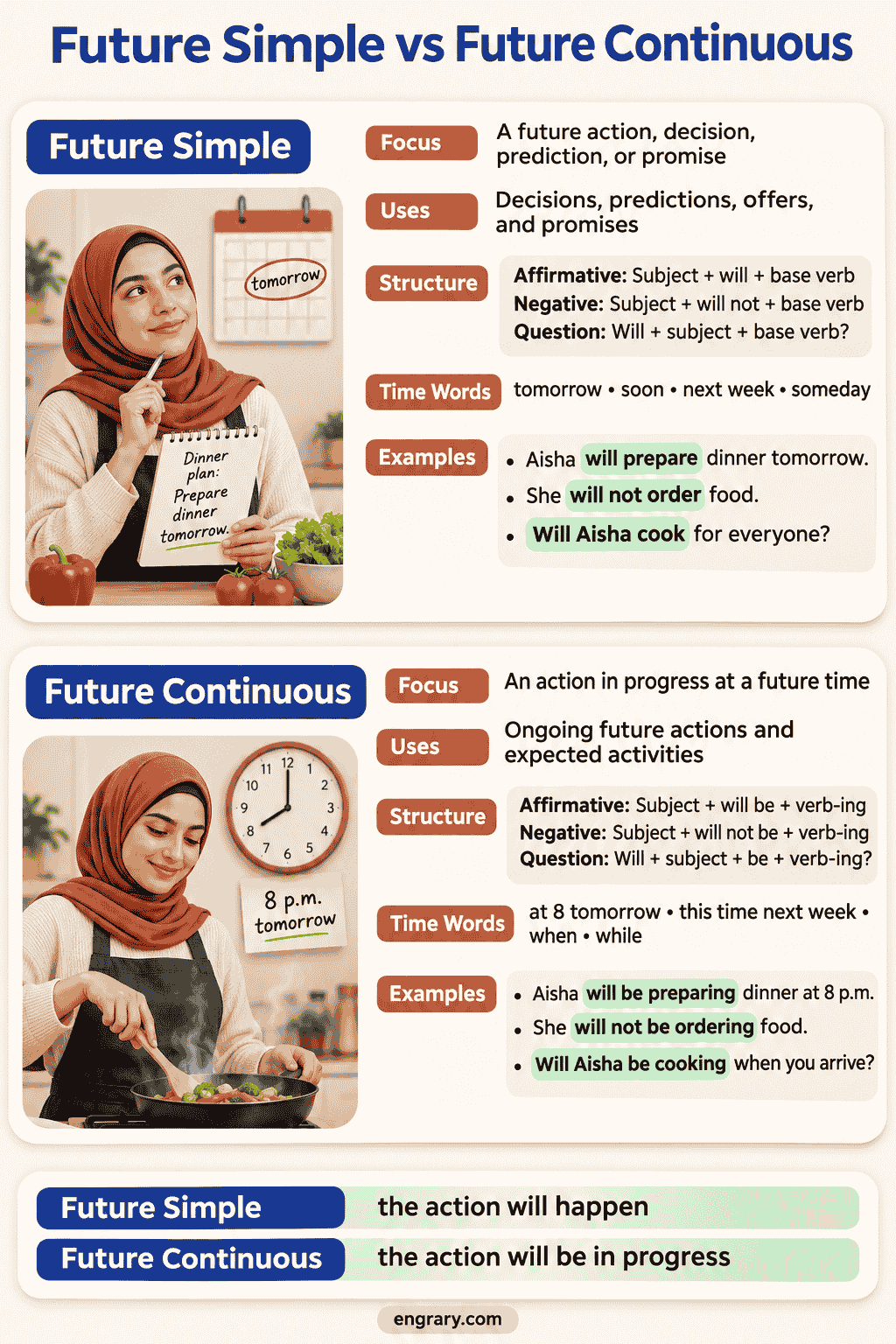
Future Simple and Future Continuous at a Glance
The following table summarizes the central differences between the two forms.
| Feature | Future Simple | Future Continuous |
|---|---|---|
| Structure | will + base verb | will be + verb-ing |
| Main focus | Future event as a whole | Future activity in progress |
| Example | I will work tomorrow. | I will be working at ten tomorrow. |
| Common uses | Predictions, decisions, promises, offers, requests, willingness | Ongoing activities, expected events, arrangements, neutral inquiries |
| Time perspective | What will happen | What will be happening |
| Typical question | Will you help me? | Will you be working tomorrow? |
Both forms use the modal auxiliary will. However, the continuous form adds be and the -ing form of the main verb.
Future Simple and Future Continuous Structures
The structures remain the same with every subject. Therefore, will does not change after I, you, he, she, it, we, or they.
Future Simple Structure
| Sentence Type | Structure | Example |
|---|---|---|
| Affirmative | Subject + will + base verb | She will call tonight. |
| Negative | Subject + will not + base verb | She will not call tonight. |
| Yes/no question | Will + subject + base verb? | Will she call tonight? |
| WH-question | WH-word + will + subject + base verb? | When will she call? |
| Positive short answer | Yes, subject + will. | Yes, she will. |
| Negative short answer | No, subject + will not. | No, she won’t. |
Use the base form directly after will. Consequently, write will go, will study, and will help rather than will goes, will studied, or will to help.
Future Continuous Structure
| Sentence Type | Structure | Example |
|---|---|---|
| Affirmative | Subject + will be + verb-ing | She will be working. |
| Negative | Subject + will not be + verb-ing | She will not be working. |
| Yes/no question | Will + subject + be + verb-ing? | Will she be working? |
| WH-question | WH-word + will + subject + be + verb-ing? | Where will she be working? |
| Positive short answer | Yes, subject + will. | Yes, she will. |
| Negative short answer | No, subject + will not. | No, she won’t. |
The future continuous always needs be before the -ing form. Therefore, She will working and She will be work are incorrect.
Contractions and Shall
In natural speech and informal writing, will commonly contracts to ’ll:
- I will → I’ll
- she will → she’ll
- we will → we’ll
- they will → they’ll
The negative form will not normally contracts to won’t:
- He won’t attend.
- They won’t be travelling.
In formal or traditional British English, shall can replace will with I and we. For example, We shall return sounds formal, while We will return is standard in most modern contexts. Questions such as Shall I help? and Shall we begin? remain common for offers and suggestions.
Main Uses of the Future Simple
The future simple presents a future situation as a complete event, fact, choice, or response.
Predictions and Beliefs
Use the future simple for predictions based on opinions, beliefs, or expectations.
- I think the team will win.
- It will probably rain tomorrow.
- She will enjoy the new course.
- I am sure they will understand.
Words and phrases such as I think, I believe, probably, perhaps, I am sure, and I expect frequently introduce this use.
Spontaneous Decisions
Use will for a decision made at the moment of speaking.
- The phone is ringing. I’ll answer it.
- I’m thirsty. I’ll make some tea.
- That bag looks heavy. I’ll carry it.
The speaker has not presented an earlier plan. Instead, the situation causes an immediate decision.
Promises
Use the future simple to make promises and commitments.
- I’ll call you tonight.
- We will finish the work on time.
- I won’t tell anyone your secret.
- I will always support you.
Because a promise expresses willingness and commitment, the future continuous would not normally replace will in these examples.
Offers and Suggestions
Use will to offer help or service:
- I’ll help you with the boxes.
- I’ll make dinner tonight.
- I’ll carry your bag.
For a question-form offer, Shall I …? often sounds more natural than Will I …?:
- Shall I open the window?
- Shall I call a taxi?
Requests
Questions with will can ask another person to do something.
- Will you help me?
- Will you close the door?
- Will you send me the file?
These sentences do not merely ask about the future. Instead, they request willingness or action.
Willingness and Refusal
Use will to express willingness. Conversely, won’t can express refusal or unwillingness.
- I’ll drive if you are tired.
- Sara will translate the letter for us.
- He won’t listen to my advice.
- The car won’t start.
In the last example, the car cannot literally choose to refuse. Nevertheless, English commonly uses won’t for something that fails to function as expected.
Future Facts
Use the future simple for events presented as future facts.
- The sun will rise at 6:12 tomorrow.
- She will be eighteen next month.
- The new school year will begin in August.
The speaker presents each event as a complete future fact rather than as an activity in progress.
Warnings and Threats
- Be careful, or you will fall.
- You’ll regret that decision.
- If you touch that wire, you will get a shock.
These statements predict a consequence, and tone determines whether they function as warnings or threats.
Main Uses of the Future Continuous
The future continuous places the listener inside an anticipated activity or situation.
Activities in Progress at a Future Time
Use the future continuous for an activity that will already be happening at a particular future point.
- At eight tomorrow, I will be studying.
- This time next week, we will be flying to Istanbul.
- When you arrive, they will be having dinner.
The activity usually begins before the reference time and continues after it.
Activities Around a Future Period
The continuous form can describe an activity that occupies a wider future period.
- I will be working in Lahore next month.
- She will be preparing for her exams this weekend.
- They will be travelling throughout July.
The activity does not need to happen during every moment of the period. Rather, the stated period provides the general future setting.
Expected and Normal-Course Events
Use the future continuous for something expected because of a routine, schedule, arrangement, or natural course of events.
- I’ll be passing the post office, so I can mail your letter.
- The manager will be meeting the new employees tomorrow.
- We’ll be travelling on Friday as usual.
- The bus will be stopping near the museum.
These events do not sound like decisions made at the moment of speaking. Instead, they form part of an expected future pattern.
Existing Plans and Arrangements
- I’ll be meeting Sara tomorrow.
- They’ll be staying at the hotel for three nights.
- The team will be playing in Karachi next week.
The future continuous can report an existing plan without strongly emphasizing intention. Therefore, it often sounds neutral and factual.
Temporary Future Situations
- She will be staying with her aunt for a few weeks.
- We will be working from home during the renovations.
- He will be using a rented car while his car is repaired.
The wider context creates the temporary meaning. The continuous structure supports that viewpoint, but it does not make every situation temporary by itself.
Neutral Questions About Plans
Use the future continuous to ask whether an activity already forms part of someone’s plans.
- Will you be using the printer this afternoon?
- Will you be staying for dinner?
- Will they be joining us later?
Because these questions ask about an anticipated activity, they often sound less forceful than direct requests with the future simple.
Future Background and Atmosphere
The future continuous can build the background of an imagined scene.
- Music will be playing, guests will be talking, and children will be running around.
- People will be celebrating in the streets throughout the evening.
As a result, this form works well when a speaker imagines several activities unfolding together.
Whole Future Events and Activities in Progress
The future simple views an event from the outside as a whole. In contrast, the future continuous views an activity from inside its progress.
| Future Simple | Future Continuous |
|---|---|
| I will call you at eight. | I will be talking to the manager at eight. |
| Presents the call as a complete event | Shows the conversation in progress |
| She will cook dinner. | She will be cooking dinner at six. |
| Focuses on what she will do | Focuses on what she will be doing at six |
| They will travel tomorrow. | They will be travelling this time tomorrow. |
| Presents the trip as a future event | Places them inside the journey |
An action’s length does not determine the form. For example, The light will flash for a second presents a brief event as a whole, while At noon, the light will be flashing presents that brief action in progress at the chosen reference point.
Actions Around a Specific Future Time
A specific future time can accompany either form. Therefore, the time expression alone does not select the tense.
- At ten, I will call the office.
- At ten, I will be speaking to the manager.
- This time tomorrow, we will be sitting on the beach.
- When you arrive, I will be waiting outside.
The first example presents the call as an event scheduled for ten. Meanwhile, the second says that the conversation will already be in progress at ten.
Spontaneous Decisions and Existing Arrangements
| Meaning | Example | Form |
|---|---|---|
| Decision made now | I’ll answer the phone. | Future simple |
| Existing arrangement | I’ll be meeting the director tomorrow. | Future continuous |
| Immediate offer | I’ll carry that bag. | Future simple |
| Expected activity | I’ll be travelling tomorrow. | Future continuous |
| Promise made now | I’ll send the report tonight. | Future simple |
| Planned activity | I’ll be working on the report tonight. | Future continuous |
The future simple can create a new decision, offer, or promise. However, the future continuous usually reports an activity that the speaker already expects.
Predictions with Both Forms
Both forms can make predictions, but their viewpoints differ.
| Future Simple | Future Continuous |
|---|---|
| It will rain tomorrow. | It will be raining when we leave. |
| Predicts a weather event | Predicts weather in progress |
| Sara will work late. | Sara will be working late. |
| Predicts a future fact or decision | Predicts or reports an expected activity |
| They will play well. | They will be playing at eight. |
| Predicts their performance | Locates their activity at a future time |
The future continuous does not automatically express greater certainty. For example, The sun will rise tomorrow expresses strong certainty even though it uses the future simple. Context and words such as probably, perhaps, and definitely communicate degrees of confidence more directly.
Expected and Normal-Course Events
The future continuous often removes the sense of a fresh decision or deliberate promise.
- I’ll be going past the pharmacy, so I can collect your medicine.
- You’ll be seeing Nadia at the meeting, so please give her this note.
- The bus will be stopping near the museum.
- Our teacher will be checking the assignments tomorrow.
In each case, the activity forms part of an expected route, routine, arrangement, or schedule. Consequently, the speaker treats it as something that will happen naturally.
Offers, Promises, Requests, and Willingness
| Purpose | Example | Form |
|---|---|---|
| Offer | I’ll help you. | Future simple |
| Promise | I’ll return the money tomorrow. | Future simple |
| Request | Will you open the window? | Future simple |
| Willingness | I’ll drive if you are tired. | Future simple |
| Refusal | He won’t cooperate. | Future simple |
| Existing plan inquiry | Will you be driving tomorrow? | Future continuous |
The future continuous normally reports or asks about an anticipated activity. Therefore, it does not usually create an immediate promise, offer, or request.
Direct Requests and Neutral Plan Questions
Questions with the two forms can have different social meanings.
| Future Simple | Future Continuous |
|---|---|
| Will you use the car tonight? | Will you be using the car tonight? |
| May request a decision or ask the person to use it | Asks whether using it is already part of the person’s plan |
| Will you stay for dinner? | Will you be staying for dinner? |
| Can function as an invitation | Neutrally asks about the expected plan |
| Will you help at the event? | Will you be helping at the event? |
| Requests help or willingness | Asks whether the help is already arranged |
Context and tone still matter. Nevertheless, the continuous form often sounds less pressuring because it asks about an expected activity rather than requesting a new decision.
Temporary Future Situations
| Future Simple | Future Continuous |
|---|---|
| He will live in Islamabad. | He will be living in Islamabad for six months. |
| General prediction or future fact | Temporary future situation |
| She will work at the new office. | She will be working at the new office during June. |
| Focuses on future employment | Focuses on a limited future arrangement |
However, temporariness is not an absolute continuous-tense rule. A speaker can use the continuous for a long-term activity when its ongoing nature matters.
Simultaneous Future Activities
Use the future continuous for activities expected to overlap.
- At eight, Sara will be studying, and Ali will be working.
- While I am cooking, the children will be doing their homework.
- We will be travelling while you are attending the conference.
Notice that the clause after while uses a present form even though it refers to future time. The main clause can then use the future continuous to describe the overlapping activity.
Future Activities and Reference Events
- I will be sleeping when you arrive.
- They will be having dinner when the match begins.
- She will be driving when you call her.
The shorter event provides a future reference point. It may interrupt the ongoing activity, but interruption is not necessary. In many cases, it simply identifies the time at which the activity will be in progress.
Future Time Clauses
English normally uses a present form—not will—after future time conjunctions such as when, while, before, after, until, as soon as, once, and by the time.
| Incorrect | Correct |
|---|---|
| When you will arrive, I will be working. | When you arrive, I will be working. |
| I will call after I will finish. | I will call after I finish. |
| While you will travel, I will care for the house. | While you are travelling, I will care for the house. |
| We will wait until she will return. | We will wait until she returns. |
| As soon as he will arrive, we will start. | As soon as he arrives, we will start. |
The main clause may use the future simple or future continuous:
- When you arrive, I will open the gate.
- When you arrive, I will be waiting at the gate.
In rare cases, will can appear in a subordinate clause when it expresses willingness rather than ordinary future time: If you will wait here, the manager will see you shortly.
Stative and Dynamic Verbs
Stative verbs describe conditions such as knowledge, possession, belief, preference, and need. Dynamic verbs describe actions or processes.
Stative Verbs
Stative verbs normally favor the future simple.
| Standard Form | Usually Unnatural |
|---|---|
| I will know the result tomorrow. | I will be knowing the result tomorrow. |
| She will need some help. | She will be needing some help. |
| They will own the property. | They will be owning the property. |
| We will understand the lesson. | We will be understanding the lesson. |
Common stative verbs include:
- believe
- belong
- know
- love
- need
- own
- understand
- want
Dynamic and Changed Meanings
Some verbs permit continuous forms when their meaning changes or when the speaker emphasizes temporary activity:
- We will be having dinner at eight.
- You will be seeing more changes soon.
- I will be needing the car tomorrow.
These forms occur naturally in suitable contexts. Therefore, it is more accurate to say that stative verbs normally avoid continuous forms than to claim that they can never appear in them.
Cases Where Both Forms Are Possible
Sometimes either form can describe a similar real-world situation. However, the choice changes the viewpoint, tone, or implication.
| Future Simple | Future Continuous | Difference in Focus |
|---|---|---|
| I will work tomorrow. | I will be working tomorrow. | Future fact or intention versus expected activity |
| She will meet the client. | She will be meeting the client. | Event as a whole versus arranged activity |
| We will travel next week. | We will be travelling next week. | Future action versus existing plan or ongoing activity |
| He will stay with us. | He will be staying with us. | Future fact versus temporary arrangement |
| They will study tonight. | They will be studying tonight. | Intention or prediction versus expected activity |
The future continuous can sound more neutral because it presents the activity as already anticipated. In contrast, the future simple may highlight willingness, intention, or a new decision.
Negative Forms and Meaning Differences
The negative forms can carry different implications.
| Future Simple | Future Continuous |
|---|---|
| She won’t attend the meeting. | She won’t be attending the meeting. |
| May express a decision, refusal, or prediction | Neutrally reports an expected absence |
| I won’t call at eight. | I won’t be calling at eight. |
| The call will not happen | The calling activity will not be in progress or planned |
| He won’t work tomorrow. | He won’t be working tomorrow. |
| May suggest refusal or a future fact | Often describes his expected schedule |
Context determines whether won’t communicates refusal, prediction, decision, or simple absence. Nevertheless, the continuous version often sounds less deliberate and more like a report about an arrangement.
Questions and Short Answers
| Purpose | Future Simple | Future Continuous |
|---|---|---|
| Prediction | Will it rain? | Will it be raining at noon? |
| Request | Will you help me? | — |
| Invitation | Will you have some tea? | — |
| Future action | What will you do? | What will you be doing at eight? |
| Neutral plan inquiry | — | Will you be working tomorrow? |
| Positive short answer | Yes, I will. | Yes, I will. |
| Negative short answer | No, I won’t. | No, I won’t. |
Short answers use only will or won’t. Therefore, answer Yes, I will rather than repeating be working or another main verb.
Time Expressions with Both Forms
Time expressions provide context, but they do not mechanically select a tense.
| Expression | Typical Function |
|---|---|
| tomorrow | General future time |
| soon | Near-future event |
| later | Later future event |
| at eight tomorrow | Specific future reference point |
| this time tomorrow | Activity in progress |
| all day tomorrow | Extended future activity |
| when you arrive | Future reference event |
| while | Overlapping future activity |
| next week | General future period |
| in two hours | Future point or period |
For example, I will finish the report tomorrow emphasizes completion of a future event, while I will be writing the report tomorrow emphasizes the activity.
Future Simple and Going To
Both forms refer to the future, but they commonly express different viewpoints.
| Future Simple | Be Going To |
|---|---|
| Immediate decision, promise, offer, belief, or neutral prediction | Prior intention or evidence-based prediction |
| I’ll call her now. | I’m going to call her tonight. |
| I think it will rain. | Look at those clouds. It’s going to rain. |
These distinctions are tendencies rather than rigid rules. Context often allows more than one natural form.
Future Continuous and Present Continuous
| Present Continuous | Future Continuous |
|---|---|
| Emphasizes a firm personal arrangement | Presents an expected activity or activity in progress |
| I’m meeting Sara tomorrow. | I’ll be meeting Sara tomorrow. |
| Often highlights an organized plan | Often sounds more neutral and less intentional |
In many arrangement contexts, either form works. Nevertheless, the present continuous often highlights a personal arrangement, whereas the future continuous presents the event as part of the expected future situation.
Future Continuous and Future Perfect
| Future Continuous | Future Perfect |
|---|---|
| Activity in progress at a future point | Action completed before a future point |
| At eight, I’ll be writing the report. | By eight, I’ll have written the report. |
| Focuses on process | Focuses on completion |
The words at and by help illustrate the contrast. At eight often locates an activity in progress, while by eight sets a deadline before which the action will be complete.
Correct and Incorrect Examples
| Incorrect | Correct | Explanation |
|---|---|---|
| She will working tomorrow. | She will be working tomorrow. | The continuous structure requires be. |
| He will be work at eight. | He will be working at eight. | Use the -ing form after will be. |
| I will to call you later. | I will call you later. | Use the base verb without to after will. |
| When you will arrive, I will be sleeping. | When you arrive, I will be sleeping. | Use a present form in a future time clause. |
| She will be knowing the result tomorrow. | She will know the result tomorrow. | Know normally avoids continuous forms. |
| Will you be help me? | Will you help me? | A direct request normally uses will + base verb. |
| At eight, I will finish dinner. | At eight, I will be having dinner. | Use the continuous if dinner will be in progress at eight. |
| I will be calling you five times. | I will call you five times. | A definite number of complete calls favors the simple form. |
Common Mistakes
- Treating the difference as short action versus long action: The speaker’s viewpoint, not the action’s length, determines the form.
- Omitting be from the future continuous: Write will be working, not will working.
- Adding to after will: Write will call, not will to call.
- Using the base verb after will be: Write will be studying, not will be study.
- Using will in an ordinary future time clause: Write when she arrives, not when she will arrive.
- Treating every specific future time as a continuous signal: I will call at eight is correct when the call is viewed as a whole event.
- Using continuous forms with stative verbs without a suitable meaning: Prefer will know and will own in ordinary contexts.
- Assuming the future continuous always shows greater certainty: Both forms can express strong or weak predictions.
- Confusing neutral plan inquiries with requests: Will you be driving? usually asks about a plan, whereas Will you drive? may request willingness.
- Using the future continuous for a spontaneous promise or offer: Prefer I’ll help you to make the offer directly.
- Confusing future continuous with future perfect: Use the future perfect for completion before a future deadline.
- Choosing a tense only from a time expression: Determine whether the sentence presents an event as a whole or an activity in progress.
Future Simple or Future Continuous Selection Guide
| Intended Meaning | Recommended Form |
|---|---|
| Spontaneous decision | Future simple |
| Promise | Future simple |
| Offer | Future simple |
| Direct request | Future simple |
| Willingness or refusal | Future simple |
| General prediction | Future simple |
| Future fact | Future simple |
| Activity in progress at a future time | Future continuous |
| Expected arrangement | Future continuous |
| Normal-course activity | Future continuous |
| Temporary future situation | Future continuous |
| Neutral question about plans | Future continuous |
| Imagined future background | Future continuous |
| Either form seems possible | Choose according to perspective |
Use the future simple when the event, decision, promise, offer, or prediction matters as a whole. However, use the future continuous when the activity, its progress, an existing arrangement, or an expected future situation matters most.
FAQs
The future simple presents a future event, decision, promise, offer, or prediction as a whole. In contrast, the future continuous presents an activity as being in progress around a future time or as part of an expected arrangement. For example, I will call at eight presents the call as an event, while I will be working at eight shows an activity in progress.
Yes. Both forms can sometimes describe a similar future situation, but they change the focus or tone. I will work tomorrow presents work as a future fact or intention, whereas I will be working tomorrow presents it as an expected activity or arrangement.
The future continuous often asks neutrally about an activity already included in someone’s plans. Therefore, Will you be using the car tonight? usually sounds less demanding than Will you use the car tonight?, which may request a decision or action.
Stative verbs such as know, believe, own, and understand normally avoid continuous forms. However, some verbs can use the future continuous when their meaning changes or when the speaker emphasizes temporary activity, as in We will be having dinner at eight or I will be needing the car tomorrow.
Future time clauses normally use the present simple or present continuous after when and while. Meanwhile, the main clause may use the future simple or future continuous. For example, write When you arrive, I will be waiting, not When you will arrive, I will be waiting.
You May Also Like



Leave a Comment