
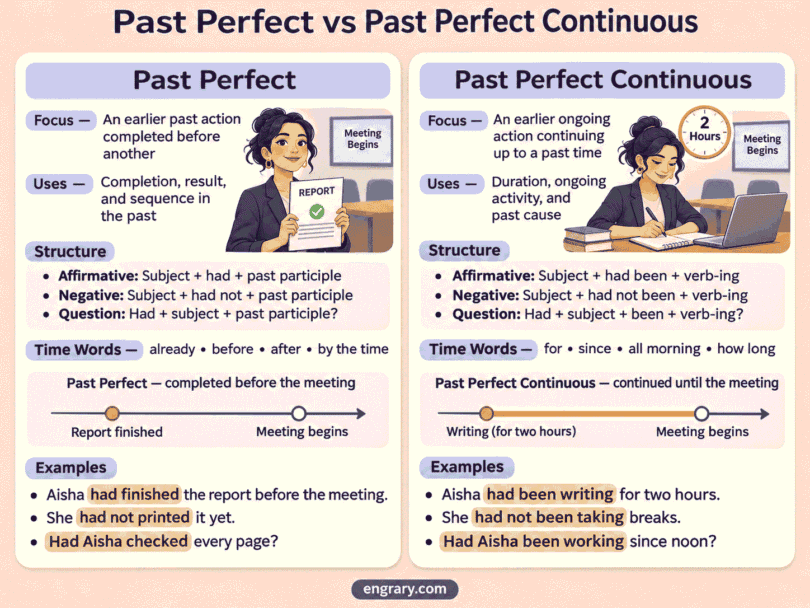
The past perfect and past perfect continuous both look back from a point in the past. However, they present the earlier situation differently. The past perfect usually emphasizes a completed result, experience, quantity, or state, whereas the past perfect continuous emphasizes an activity, its duration, its development, or its recent effect.
The distinction is not simply “finished” versus “unfinished.” A continuous activity may stop shortly before the later past event, and a past perfect situation may continue up to that event. Therefore, the best tense depends on what the speaker wants to highlight: the result or the process.
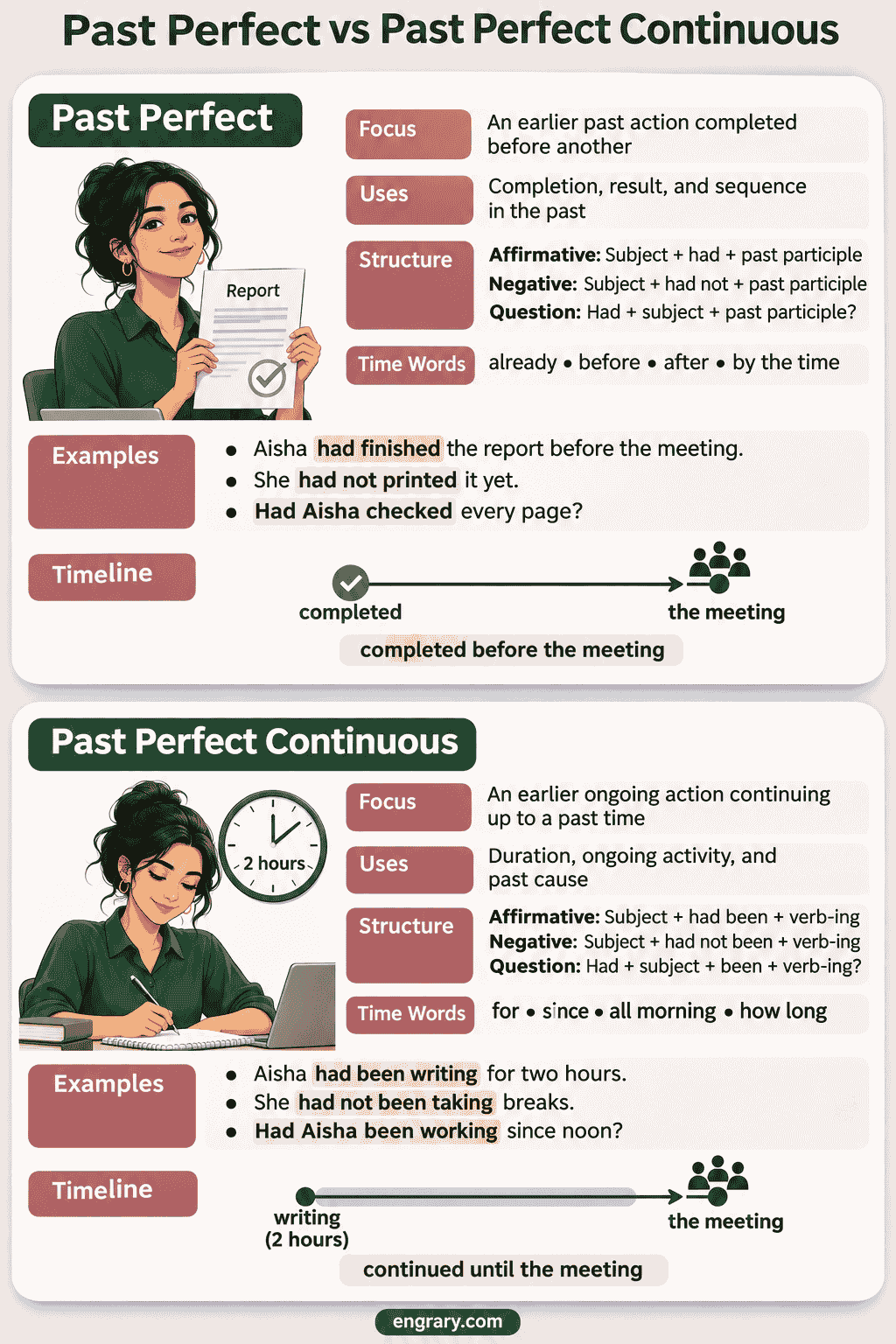
Past Perfect and Past Perfect Continuous at a Glance
Both tenses describe something earlier than a past reference point. Nevertheless, their focus differs.
| Feature | Past Perfect | Past Perfect Continuous |
|---|---|---|
| Structure | had + past participle | had been + verb-ing |
| Main focus | Completion, result, quantity, experience, or state | Activity, process, duration, development, or recent effect |
| Example | She had written the report. | She had been writing the report. |
| Main meaning | The completed report matters. | The writing activity matters. |
| Typical verbs | Dynamic and stative verbs | Mainly dynamic verbs |
| Reference point | A later point in the past | A later point in the past |
For example, Maya had painted the room before the guests arrived suggests that the room was complete. By contrast, Maya had been painting the room before the guests arrived focuses on the activity. She may have finished, stopped temporarily, or still had work to do.
Past Perfect and Past Perfect Continuous Structures
Both forms use the auxiliary verb had with every subject. As a result, their structures do not change for I, you, he, she, it, we, or they.
Past Perfect Structure
| Sentence Type | Structure | Example |
|---|---|---|
| Affirmative | Subject + had + past participle | She had completed the project. |
| Negative | Subject + had not + past participle | She had not completed the project. |
| Yes/no question | Had + subject + past participle? | Had she completed the project? |
| WH-question | WH-word + had + subject + past participle? | Why had she left? |
| Positive short answer | Yes, subject + had. | Yes, she had. |
| Negative short answer | No, subject + had not. | No, she hadn’t. |
Regular past participles usually end in -ed, as in worked, finished, and cleaned. However, irregular verbs have special forms, such as written, gone, seen, done, and taken.
Past Perfect Continuous Structure
| Sentence Type | Structure | Example |
|---|---|---|
| Affirmative | Subject + had been + verb-ing | She had been working. |
| Negative | Subject + had not been + verb-ing | She had not been working. |
| Yes/no question | Had + subject + been + verb-ing? | Had she been working? |
| WH-question | WH-word + had + subject + been + verb-ing? | How long had she been working? |
| Positive short answer | Yes, subject + had. | Yes, she had. |
| Negative short answer | No, subject + had not. | No, she hadn’t. |
The continuous form always contains been before the -ing verb. Therefore, She had working and She had been worked are incorrect when the intended meaning is an ongoing activity.
Contractions with Had
In affirmative sentences, had can contract to ’d:
- I had finished → I’d finished
- She had been waiting → She’d been waiting
- They had left → They’d left
In negative sentences, had not usually becomes hadn’t:
- He hadn’t arrived.
- We hadn’t been sleeping.
The contraction ’d can mean had or would. However, the following verb reveals its meaning. A past participle usually signals had, as in She’d gone, while a base verb signals would, as in She’d go.
Main Uses of the Past Perfect
The past perfect presents an earlier event or situation as a complete fact when viewed from a later past point.
Completed Actions Before a Past Point
Use the past perfect when an earlier action was complete before another past event or deadline.
- The train had left before we reached the station.
- By noon, Aisha had completed the report.
- When the doctor arrived, the patient had fallen asleep.
The later action usually appears in the past simple. Nevertheless, the reference point may also be a clock time, a date, or an understood moment in a story.
Completed Results
Use the past perfect when the achieved result matters more than the activity that produced it.
- Hamza had repaired the computer, so it worked again.
- They had cleaned the hall before the ceremony began.
- The chef had prepared dinner by seven.
In each example, the completed outcome affects the later past situation.
Completed Quantities
Exact totals and measurable achievements usually favor the past perfect.
- She had answered twenty emails by lunchtime.
- We had visited four cities before the tour ended.
- The team had scored three goals by halftime.
Here, the speaker counts completed results rather than describing the activity in progress.
Experiences Before a Past Event
The past perfect can summarize experiences accumulated before a later past point.
- He had never flown before he visited Dubai.
- I had seen the film twice before we discussed it.
- By the age of thirty, she had worked in five countries.
Words such as ever, never, and before often appear in this pattern.
States Up to a Past Point
Stative verbs commonly use the past perfect, even when the state continued for a long time.
- I had known her for ten years when she moved abroad.
- They had owned the house since 2005.
- He had believed the story until he saw the evidence.
Because verbs such as know, own, and believe normally avoid continuous forms, the simple form expresses their duration.
Unreal Past Conditions and Wishes
The past perfect also appears in third conditional sentences and wishes about an unreal or regretted past.
- If I had studied harder, I would have passed.
- She wished she had accepted the offer.
- If they had left earlier, they would not have missed the flight.
These patterns do not simply arrange two real events. Instead, they imagine a different past.
Main Uses of the Past Perfect Continuous
The past perfect continuous presents an earlier situation as an activity unfolding over time. Consequently, it often highlights duration, effort, repetition, or a recent cause.
Activities Continuing Up to a Past Point
Use the continuous form when an activity began earlier and remained in progress at the reference point.
- He had been studying for three hours when the lights went out.
- They had been travelling all day before they stopped.
- The children had been playing outside when it began to rain.
In these examples, the later event interrupts or follows an activity already in progress.
Recently Finished Activities
The activity may stop shortly before the reference point. However, its evidence or effect remains visible.
- The ground was wet because it had been raining.
- Her hands were covered in paint because she had been decorating.
- Bilal was out of breath because he had been running.
The rain, decorating, and running may have ended. Even so, the continuous form keeps attention on the recent activity.
Duration Before Another Past Event
Use the continuous form to emphasize how long an activity continued.
- She had been teaching for six years when she became principal.
- We had been waiting since noon when the bus finally arrived.
- How long had they been living there before they moved?
Expressions with for, since, and how long commonly support this use, although they do not automatically determine the tense.
Earlier Causes of Past Results
The continuous form often explains a later appearance, feeling, or condition.
- He was tired because he had been working all night.
- Her eyes hurt because she had been reading for hours.
- The streets were flooded because it had been raining heavily.
Therefore, this form works especially well when an extended activity produces a visible past result.
Temporary or Developing Situations
The continuous form can present a situation as temporary, changing, or developing.
- The company had been expanding rapidly before the recession began.
- They had been staying with relatives while their house was under repair.
- Prices had been rising steadily before the government acted.
Still, the form does not always mean temporary. Context determines whether the situation was temporary or simply viewed as an ongoing process.
Completion and Continuing Activity
The past perfect views an action as a complete whole. In contrast, the past perfect continuous views it from inside the activity.
| Past Perfect | Past Perfect Continuous |
|---|---|
| He had repaired the roof. | He had been repairing the roof. |
| The repair was complete. | The repair activity was in progress or had recently stopped. |
| She had read the book. | She had been reading the book. |
| She finished the book. | The reading activity matters; completion remains unclear. |
| They had built the bridge. | They had been building the bridge. |
| The bridge was complete. | The construction process matters. |
However, real situations do not always fit a strict finished-versus-unfinished division. A speaker can use the continuous form for a finished activity when its duration or recent effect matters more than its completion.
Result and Process
The following pairs show how the speaker’s focus changes.
| Intended Focus | Example | Tense |
|---|---|---|
| Completed result | She had painted the kitchen. | Past perfect |
| Painting process | She had been painting the kitchen. | Past perfect continuous |
| Completed report | He had written the report. | Past perfect |
| Time spent writing | He had been writing the report for hours. | Past perfect continuous |
| Finished meal | They had cooked dinner. | Past perfect |
| Cooking activity | They had been cooking since five. | Past perfect continuous |
For example, He had fixed the bicycle confirms that it was fixed. Meanwhile, He had been fixing the bicycle tells us what occupied his time, but it does not confirm completion.
Finished and Recently Finished Activities
A continuous activity can still be finished. Therefore, consider the relationship between the activity and the later past moment.
| Situation | Example | Meaning |
|---|---|---|
| Activity still continuing | She had been studying for two hours when I called. | She was probably still studying. |
| Activity recently finished | She was tired because she had been studying. | The studying had probably stopped recently. |
| Completed result | She had studied all five chapters. | All five chapters were complete. |
The surrounding context often shows whether the activity continued. Without that context, the continuous form leaves completion open.
Duration Before a Past Point
Both forms can appear with duration expressions. However, they frame the situation differently.
- They had worked there for ten years before the factory closed.
- They had been working there for ten years when the factory closed.
- He had known Sara since childhood.
- He had been studying since sunrise.
The past perfect can present a whole period as a fact, especially with stative verbs. By contrast, the continuous form emphasizes the flow or persistence of an activity. As a result, for and since are useful clues, but neither word forces the continuous form.
Completed Quantities and Repeated Actions
Use the past perfect for an exact number of completed items or occurrences. In contrast, use the continuous form for the general activity or repeated process.
| Completed Quantity | General Activity |
|---|---|
| She had written six pages. | She had been writing all morning. |
| He had repaired three bicycles. | He had been repairing bicycles. |
| They had visited the museum twice. | They had been visiting local museums. |
| I had read the article three times. | I had been reading the article. |
| The nurse had checked ten patients. | The nurse had been checking patients. |
The continuous form can describe repeated activity, as in Someone had been calling all morning. Nevertheless, an exact completed count normally favors the simple form: Someone had called six times.
Stative and Dynamic Verbs
The type of verb affects the tense choice. Stative verbs describe states such as knowledge, possession, belief, preference, and need. Dynamic verbs describe actions or processes.
Stative Verbs
Stative verbs normally use the past perfect rather than the past perfect continuous.
| Standard Form | Usually Incorrect |
|---|---|
| I had known her for years. | I had been knowing her for years. |
| They had owned the house since 2010. | They had been owning the house since 2010. |
| She had believed him until then. | She had been believing him until then. |
| We had wanted to leave earlier. | We had been wanting to leave earlier. |
Common stative verbs include:
- be
- believe
- belong
- know
- like
- love
- need
- own
- understand
- want
Some verbs can express either a state or an action. For example, have expresses possession in They had had the car for years, but it describes an activity in They had been having problems with the engine.
Dynamic Verbs
Dynamic verbs often allow either tense because the speaker can focus on the result or the process. Common examples include work, study, wait, write, build, travel, teach, and rain.
Cases Where Both Tenses Are Possible
Sometimes both forms describe the same real-world situation. Nevertheless, they guide the listener toward different details.
| Past Perfect | Past Perfect Continuous | Difference in Focus |
|---|---|---|
| She had lived there for ten years. | She had been living there for ten years. | Complete fact versus continuing situation |
| He had worked all day. | He had been working all day. | Accomplished work versus prolonged activity |
| We had waited for an hour. | We had been waiting for an hour. | Completed period versus experienced duration |
| It had rained all night. | It had been raining all night. | Weather event as a fact versus ongoing activity |
| She had taught there for years. | She had been teaching there for years. | Employment history versus continuing work |
In many contexts, the factual difference is small. However, the continuous form often sounds more vivid because it places the listener inside the activity.
Temporary and Established Situations
The simple form may present a situation as an established fact, whereas the continuous form may present it as ongoing or developing.
| Example | Likely Emphasis |
|---|---|
| They had lived in Lahore for ten years. | Their residence appears as an established fact. |
| They had been living in Lahore for ten years. | Their residence appears as an ongoing situation. |
| He had worked for the company since 2018. | His employment record matters. |
| He had been working for the company since 2018. | The continuing duration matters. |
Still, do not treat permanence as a fixed grammar rule. A long-term situation can use the continuous form, while a temporary situation can use the simple form when the speaker views it as a complete fact.
Earlier Causes and Past Results
Both tenses can explain a later past result. However, the simple form usually identifies a completed cause, while the continuous form emphasizes an extended cause.
| Earlier Situation | Later Past Result |
|---|---|
| She had forgotten the appointment. | She missed the meeting. |
| She had been working all night. | She looked exhausted. |
| The pipe had broken. | The basement was flooded. |
| The pipe had been leaking. | The floor was damp. |
| He had deleted the file. | Nobody could open it. |
| He had been downloading files. | The internet connection was slow. |
Consequently, visible evidence such as wet clothes, dirty hands, tired eyes, or muddy shoes often supports the continuous form.
Time Expressions with Both Tenses
Time expressions help establish the relationship between the earlier situation and the later past point. Nevertheless, meaning—not a signal word alone—determines the tense.
| Time Expression | Common Function | Example |
|---|---|---|
| for | Length of time | He had been waiting for an hour. |
| since | Starting point | She had known him since school. |
| by the time | Past deadline | By the time we arrived, they had left. |
| before | Earlier event | He had been working before I called. |
| already | Earlier completion or activity | She had already finished. |
| just | Recent completion or activity | He had just left. |
| all day | Extended duration | They had been travelling all day. |
| how long | Duration question | How long had you been waiting? |
| until then | Continuation to a past point | Everything had been going well until then. |
Adverb Placement
Place already, just, never, and always after had in the past perfect:
- She had already finished the report.
- He had just arrived when we called.
- They had never seen snow before.
In the continuous form, place the adverb between had and been:
- She had already been working for two hours.
- We had just been discussing the same problem.
- He had always been trying to improve.
Negative Forms and Meaning Differences
Negatives show why tense choice affects more than structure.
| Past Perfect | Past Perfect Continuous |
|---|---|
| She had not completed the assignment. | She had not been working on the assignment. |
| The completed result did not exist. | The activity had not been taking place. |
| He had not repaired the car. | He had not been repairing the car. |
| The car remained unrepaired. | He had not spent time on the repair activity. |
| They had not built the wall. | They had not been building the wall. |
| No completed wall existed. | The construction activity had not been happening. |
Use hadn’t in natural conversation and informal writing: She hadn’t finished and She hadn’t been sleeping.
Questions and Short Answers
Questions in both tenses begin with had. However, the continuous form adds been and an -ing verb.
| Question Type | Past Perfect | Past Perfect Continuous |
|---|---|---|
| Yes/no question | Had she finished? | Had she been working? |
| Positive short answer | Yes, she had. | Yes, she had. |
| Negative short answer | No, she hadn’t. | No, she hadn’t. |
| WH-question | What had she completed? | What had she been doing? |
| Duration question | How long had she lived there? | How long had she been living there? |
| Reason question | Why had he left? | Why had he been crying? |
Short answers use only had or hadn’t. Therefore, avoid answers such as Yes, she had been unless been carries a separate meaning required by the context.
Past Reference Points
Both tenses need a later past viewpoint. The reference point can appear in the same sentence, in an earlier sentence, or in the wider story.
- By eight o’clock, she had finished the report.
- When I arrived, they had been waiting for an hour.
- The roads were wet. It had been raining.
- In 2020, he had already worked there for five years.
In the third example, the roads were wet establishes the past viewpoint. As a result, the next sentence can look back without repeating the reference time.
Narrative Background and Storytelling
In narratives, the past simple usually advances the main events. Meanwhile, the past perfect establishes completed earlier events, and the past perfect continuous supplies earlier background activity.
Sara entered the office at nine. Her manager had already arrived, and he had been waiting for her since eight-thirty. She apologized because she had missed the earlier bus.
Here, entered advances the main story. Had arrived identifies a completed earlier event, had been waiting emphasizes duration, and had missed explains the completed cause of Sara’s delay.
After the earlier timeline becomes clear, writers often return to the past simple. Otherwise, repeated perfect forms can make a story heavy and difficult to follow.
Reported Speech and Backshift
Reported speech can shift earlier forms further into the past.
| Direct Speech | Reported Speech |
|---|---|
| “I finished the work.” | She said that she had finished the work. |
| “I have been working all day.” | She said that she had been working all day. |
| “I was waiting outside.” | He said that he had been waiting outside. |
However, backshift is not always necessary when the information remains true or the time relationship is already clear. Context and reporting style influence the choice.
Past Perfect Continuous Passive Forms
The pattern had been being + past participle is grammatically possible, as in The road had been being repaired for several weeks. However, the form sounds heavy and unnatural in most contexts. Therefore, writers usually choose a clearer alternative:
- Workers had been repairing the road for several weeks.
- The road had been under repair for several weeks.
The ordinary past perfect passive is much more natural when the completed result matters: The road had been repaired before winter began.
Past Perfect Continuous and Past Continuous
The past continuous describes an activity in progress at a past moment. In contrast, the past perfect continuous looks backward from that moment and emphasizes the activity’s earlier duration.
| Past Continuous | Past Perfect Continuous |
|---|---|
| She was working when I called. | She had been working for two hours when I called. |
| The activity was in progress at that moment. | The activity began before that moment. |
| They were waiting at six. | They had been waiting since five. |
| The focus is the activity at six. | The focus is the duration before six. |
Correct and Incorrect Examples
| Incorrect | Correct | Explanation |
|---|---|---|
| She had been knowing him for years. | She had known him for years. | Know is normally stative. |
| He had been wrote the report. | He had been writing the report. | Use the -ing form after had been. |
| They had went home. | They had gone home. | Use the past participle after had. |
| She had been completed three tasks. | She had completed three tasks. | A completed quantity favors the past perfect. |
| Had he been work all day? | Had he been working all day? | Use the -ing form. |
| I had been read the book twice. | I had read the book twice. | Use the simple form for a completed number. |
| He had working since morning. | He had been working since morning. | The continuous structure requires been. |
| She had been own the shop for years. | She had owned the shop for years. | Own normally avoids continuous forms. |
Common Mistakes
- Treating the difference as only finished versus unfinished: A continuous activity may have finished recently, while a simple-form state may have continued to the reference point.
- Forgetting the past reference point: Both tenses look backward from a later past time, whether that time appears explicitly or through context.
- Omitting been: Write had been working, not had working.
- Using the wrong participle: Write had gone, not had went.
- Using a past participle after had been for an active continuous meaning: Write had been writing, not had been written.
- Using stative verbs unnecessarily in the continuous form: Prefer had known, had owned, and had believed.
- Using the continuous form for exact completed quantities: Prefer had written five pages to express a finished total.
- Assuming for and since always require a continuous tense: Stative verbs and complete factual periods often use the past perfect.
- Choosing a tense from one signal word: Determine whether the sentence emphasizes a result, state, process, or duration.
- Confusing the past continuous with the past perfect continuous: The latter emphasizes activity before the past reference point.
- Overusing perfect forms in a story: Establish the earlier layer, then return to the past simple when the sequence becomes clear.
- Using a heavy passive continuous construction: Restructure had been being repaired when a clearer active or passive alternative exists.
Past Perfect or Past Perfect Continuous Selection Guide
| Intended Meaning | Recommended Form |
|---|---|
| Completed action before a past point | Past perfect |
| Achieved result | Past perfect |
| Exact completed quantity | Past perfect |
| Earlier experience | Past perfect |
| Stative situation | Past perfect |
| Unreal past condition or regret | Past perfect |
| Activity continuing to a past point | Past perfect continuous |
| Duration or process | Past perfect continuous |
| Recently finished activity | Past perfect continuous |
| Earlier activity causing visible evidence | Past perfect continuous |
| Either form seems possible | Choose according to focus |
Use the past perfect when the completed fact, result, quantity, experience, or state matters most. However, use the past perfect continuous when the activity, duration, development, or process matters most.
FAQs
The past perfect focuses on a completed result, quantity, experience, or state before a later past point. In contrast, the past perfect continuous focuses on an activity, its duration, its development, or its recent effect. For example, She had written the report emphasizes completion, whereas She had been writing the report emphasizes the activity.
Yes. The activity may have stopped shortly before the reference point, especially when its effect remained visible. For example, His clothes were wet because he had been walking in the rain suggests that the walk may have ended, but its result was still evident.
Yes. Sometimes both forms describe the same situation but change the emphasis. She had worked there for ten years presents the period as a complete employment fact, while She had been working there for ten years emphasizes the continuing activity and duration.
Stative verbs such as know, believe, own, understand, need, want, and belong normally use the past perfect. Therefore, write I had known him for years rather than I had been knowing him for years.
For introduces a length of time, while since introduces a starting point. Both can appear with either tense. Use the past perfect for a state or period viewed as a complete fact, but use the past perfect continuous when you want to emphasize an activity and its duration.
You May Also Like



Leave a Comment