

The past simple and present perfect both describe earlier events, but they connect those events to time differently. The past simple places an event, state, or sequence in a finished past period. In contrast, the present perfect connects an earlier event or state with the present or with a period that continues until now.
The difference is broader than “specific time versus no specific time.” For example, I saw that film contains no time expression, yet it can naturally refer to a finished past occasion. Meanwhile, I have seen that film presents the viewing as part of the speaker’s experience up to now. Therefore, the time frame, context, and intended viewpoint determine the correct form.

Past Simple and Present Perfect at a Glance
The following table summarizes the central differences between these two forms.
| Feature | Past Simple | Present Perfect |
|---|---|---|
| Structure | past form of the verb | have/has + past participle |
| Time frame | Finished past time | Time extending to the present |
| Main focus | Finished event, state, habit, or detail | Experience, continuation, result, or progress up to now |
| Typical question | When did it happen? | Has it happened yet? |
| Example | I visited Lahore last year. | I have visited Lahore twice. |
As a quick guide, use the past simple when you place an event inside a finished past period. However, use the present perfect when the relevant period includes now or when the event belongs to a present-centered situation. In addition, introduce an experience with the present perfect and switch to the past simple when you give its finished details.
Past Simple and Present Perfect Structures
The past simple uses a past verb in affirmative sentences and did with the base verb in negatives and questions. The present perfect uses have or has followed by a past participle.
Past Simple Structure
| Sentence Type | Structure | Example |
|---|---|---|
| Affirmative | subject + past verb | She finished the report. |
| Negative | subject + did not + base verb | She did not finish the report. |
| Question | Did + subject + base verb? | Did she finish the report? |
| Short answer | Yes/No + subject + did/didn’t | Yes, she did. |
After did or didn’t, always use the base verb. Therefore, write Did she go? rather than Did she went?
Present Perfect Structure
| Sentence Type | Structure | Example |
|---|---|---|
| Affirmative | subject + have/has + past participle | She has finished the report. |
| Negative | subject + have/has not + past participle | She has not finished the report. |
| Question | Have/Has + subject + past participle? | Has she finished the report? |
| Short answer | Yes/No + subject + have/has | Yes, she has. |
Use has with he, she, and it. In contrast, use have with I, you, we, and they. Common contractions include I’ve, you’ve, she’s, haven’t, and hasn’t. In She’s finished, the contraction she’s means she has.
Regular and Irregular Verb Forms
Regular verbs usually have the same past simple and past participle forms. However, irregular verbs may have two different forms.
| Base Verb | Past Simple | Past Participle |
|---|---|---|
| work | worked | worked |
| study | studied | studied |
| go | went | gone |
| see | saw | seen |
| write | wrote | written |
| take | took | taken |
| do | did | done |
Consequently, write She went home in the past simple but She has gone home in the present perfect.
Main Uses of the Past Simple
The past simple presents an event, state, or period as a finished past fact. Its main uses include:
- Completed events: We visited Lahore last year.
- Events at definite past times: She called at noon.
- Ended states: I knew him at school.
- Completed periods: He worked there for six years.
- Past habits: They played cricket every weekend.
- Event sequences: I opened the email, read the message, and replied.
- Past experience details: We stayed in Istanbul during our trip.
- Events from a finished life or career: Shakespeare wrote many plays.
The event can remain important now. Nevertheless, the speaker presents it within a closed past frame.
Main Uses of the Present Perfect
The present perfect connects earlier time with the present. Its main uses include:
- Life experience up to now: I have visited Lahore twice.
- A present result: He has lost his keys.
- A continuing state: She has worked here for six years.
- Repeated events in an open period: We have received ten orders today.
- Recent developments: The weather has changed recently.
- News announcements: The company has opened a new office.
- Achievements in an open career: This author has written twelve novels.
- First-time and superlative patterns: This is the best film I have seen.
Thus, the present perfect does not merely report the past. It frames an earlier event or state as part of a period or situation that reaches the present.
Finished Past Time and Time Up to Now
The most reliable distinction concerns the time frame.
| Finished Past Frame | Time Extending to Now |
|---|---|
| I saw her twice last week. | I have seen her twice this week. |
| We received ten orders yesterday. | We have received ten orders today. |
| He worked there from 2015 to 2020. | He has worked there since 2020. |
| She called me on Monday. | She has called me several times this week. |
In the first column, the speaker closes the relevant period. In the second column, the period includes the present or remains open for further events.
Specific Time and Present Connection
The familiar rule “specific time means past simple” can help, but its opposite is unreliable. An unstated time does not automatically require the present perfect.
- I saw that film. — The context places the viewing in a finished past occasion.
- I have seen that film. — The speaker reports experience up to now.
- Did you speak to Sara? — The question refers to a finished occasion or understood period.
- Have you spoken to Sara? — The question asks about the period up to the present.
Therefore, identify the time frame supplied by the conversation, even when no time expression appears.
Finished and Unfinished Time Periods
| Finished Period | Period That May Include Now |
|---|---|
| yesterday | today |
| last week | this week |
| last month | this month |
| last year | this year |
| in 2020 | so far |
| when I was at school | in my life |
Expressions in the second column often occur with the present perfect. However, the speaker can use the past simple when the relevant part of the period feels complete.
Flexible Periods with Today and This Morning
Words such as today, this morning, and this week can take either form because the speaker can view the period differently.
- I didn’t eat breakfast this morning. — The morning or breakfast period feels finished.
- I haven’t eaten breakfast this morning. — It is still morning or breakfast remains possible.
- I spoke to three clients today. — The relevant work period feels complete.
- I have spoken to three clients today. — Today remains open.
- We had two meetings this week. — The meeting schedule feels complete.
- We have had two meetings this week. — More meetings remain possible.
Consequently, these expressions provide clues rather than automatic rules.
Past Events with Present Results
The present perfect often implies that a result still exists. Nevertheless, the past simple can also describe an event with a current consequence.
| Past Simple | Present Perfect | Main Difference |
|---|---|---|
| I lost my keys this morning. | I have lost my keys. | Past event vs present unresolved situation |
| She broke her glasses last year. | She has broken her glasses. | Finished-time detail vs current damage |
| The bus left at nine. | The bus has left. | Specified departure vs current absence |
| Someone took my chair. | Someone has taken my chair. | Past report vs current problem |
Compare I have lost my keys, which suggests that the keys remain missing, with I lost my keys, but I found them later, which closes the story. Still, I lost my keys this morning, and I still cannot find them is also correct because the explicit finished time favors the past simple.
Present Perfect Without Recent Meaning
The present perfect does not reveal how recently an event happened:
- I have visited Egypt twice.
- She has read that novel before.
- He has never travelled by plane.
- We have known each other for twenty years.
These events or states may reach far into the past. What matters is their connection to experience or time up to now.
Life Experiences and Finished Details
English commonly uses the present perfect to introduce an experience and the past simple to give its finished details.
Have you ever visited Türkiye?
Yes, I have. I went there in 2024.
Where did you stay?
I stayed in Istanbul.
| Intended Meaning | Tense | Example |
|---|---|---|
| General experience up to now | Present perfect | Have you visited Türkiye? |
| Time of the experience | Past simple | When did you go? |
| Place or circumstances | Past simple | Where did you stay? |
| Number of experiences up to now | Present perfect | I have visited twice. |
Once the speaker asks when, where, or how a completed experience happened, the conversation usually shifts to the past simple.
Living and Finished Life Periods
| Finished Life or Career | Life or Career Still Open |
|---|---|
| Shakespeare wrote many plays. | This author has written twelve novels. |
| My grandfather worked in a bank for thirty years. | My uncle has worked in a bank for thirty years. |
| The retired player won four championships. | The active player has won four championships. |
However, a deceased person can still appear with the present perfect when the action or effect extends to now: Shakespeare has influenced generations of writers. His writing career ended, but his influence continues.
Continuing and Ended States
The past simple describes a state or situation that ended. In contrast, the present perfect describes one that began earlier and continues now.
| Ended State or Situation | Continuing State or Situation |
|---|---|
| She lived there for six years. | She has lived here for six years. |
| I knew him at school. | I have known him since school. |
| He worked there for a decade. | He has worked there for a decade. |
| They were married for twenty years. | They have been married for twenty years. |
The duration may be identical, but the endpoint differs. Therefore, She lived there for six years normally means she no longer lives there, whereas She has lived here for six years means she still does.
Have Had and Has Had
Forms such as have had can look unusual because have appears twice in different grammatical roles:
- I had this phone for three years. — The ownership ended.
- I have had this phone for three years. — I still own it.
- She had a headache yesterday. — The headache belonged to a finished time.
- She has had a headache since morning. — The headache continues now.
In the present perfect, have or has acts as the auxiliary, while had serves as the past participle of the main verb have.
For, Since, and Ago
| Expression | Function | Typical Form | Example |
|---|---|---|---|
| for | duration | Either, depending on continuation | I lived there for five years. / I have lived here for five years. |
| since | starting point extending to now | Present perfect | I have lived here since 2021. |
| ago | finished time before now | Past simple | I moved here five years ago. |
A clause following since commonly uses the past simple because it identifies the starting event:
- I have known her since we started school.
- She has worked here since she graduated.
Therefore, do not write I have moved here five years ago. Write I moved here five years ago or I have lived here for five years.
How Long with Both Forms
Questions with how long clearly show whether a state ended or continues:
- How long did you live there? — The residence ended.
- How long have you lived here? — The residence continues.
- How long did she work for that company? — The job ended.
- How long has she worked for this company? — The job continues.
Likewise, the answers reflect the same distinction: I lived there for five years versus I have lived here for five years.
Repeated Actions and Number of Times
Both forms can count repeated events. Therefore, the number of repetitions does not choose the tense; the time frame does.
| Finished Period | Unfinished Period |
|---|---|
| I called her three times yesterday. | I have called her three times today. |
| We visited them twice last year. | We have visited them twice this year. |
| She completed five tasks last week. | She has completed five tasks so far. |
| He missed two classes last month. | He has missed two classes this month. |
The same principle applies to once, twice, several times, and exact totals.
Questions with How Many Times
Compare open and finished periods:
- How many times did you visit them last year?
- How many times have you visited them this year?
- How many times did you call yesterday?
- How many times have you called today?
Again, last year and yesterday close the period, while this year and today may remain open.
Current Quantities and Finished Totals
The present perfect can report measurable progress up to now:
- The company has opened six branches.
- Researchers have identified three causes.
- She has completed eight chapters so far.
In contrast, the past simple places the total in a finished period:
- The company opened six branches last year.
- Researchers identified three causes during the study.
- She completed eight chapters during the course.
News and Follow-Up Details
Speakers often introduce news with the present perfect and then use the past simple for finished details:
- The company has opened a new office.
- It opened on Monday.
- The mayor attended the ceremony.
- More than 200 guests visited the building.
The first sentence announces a current development. Afterward, the past simple locates and expands the story.
First-Time and Superlative Patterns
Use the present perfect after a present reference point:
- This is the first time I have driven at night.
- This is the second time she has called today.
- It is the best meal I have ever eaten.
- That is the most interesting book she has read.
With a past reference point, standard formal English normally uses the past perfect:
- That was the first time I had driven alone.
- It was the worst journey we had ever experienced.
By contrast, a superlative tied to a clearly finished period can use the past simple: That was the best meal I ate during my holiday.
Been To, Gone To, Been In, and Went To
| Form | Meaning | Example |
|---|---|---|
| has been to | visited and returned | Sara has been to Lahore. |
| has gone to | went and has not returned | Sara has gone to Lahore. |
| has been in | has stayed or lived there for a period | Sara has been in Lahore for a week. |
| went to | completed past movement or visit | Sara went to Lahore last week. |
Thus, been to often describes experience, gone to explains someone’s current absence, and went to places the journey in finished time.
Ever and Never
The adverbs ever and never do not automatically require the present perfect:
- Have you ever met her? — experience up to now
- Did you ever meet her while you lived in Dubai? — finished period
- I have never visited Japan. — experience up to now
- I never visited Japan when I lived in Asia. — finished period
- He never called me again. — completed past narrative
Therefore, the surrounding period remains more important than the adverb itself.
Already, Just, Yet, and Still
These adverbs commonly appear with the present perfect:
- I have already finished.
- She has just arrived.
- Have they called yet?
- They still haven’t called.
However, the past simple can also occur, especially in American English or a clearly finished context:
- I already finished the report.
- She just arrived.
- Did they call yet?
Moreover, just now commonly takes the past simple: I finished it just now.
Adverb Placement
Already, just, and never commonly appear between have/has and the past participle. Meanwhile, yet usually appears at the end, and still comes before a negative auxiliary:
- We have already eaten.
- He has never travelled abroad.
- Have you sent the email yet?
- She still hasn’t replied.
Recently and Lately
Both forms can appear with recently:
- I have seen her recently.
- She has changed jobs lately.
- Did you see her recently?
- I recently spoke to the manager.
The present perfect connects the recent period to now. In contrast, the past simple presents the event as a past fact or places it in an understood finished context.
Before with Both Forms
The meaning of before influences the tense:
- I have seen that film before. — experience at an unspecified time up to now
- I saw that film before I moved to Lahore. — event before a finished past point
- She had seen it before we arrived. — event completed before another past event
The last example briefly uses the past perfect to show the complete time relationship.
In the Past and Over the Past
Compare a finished historical frame with a period extending to now:
- People travelled more slowly in the past.
- Technology has changed rapidly over the past twenty years.
- The company has grown significantly in the last decade.
The expression in the past often creates a finished contrast with the present. However, over the past and in the last commonly describe a period continuing until now.
Always with Both Forms
The adverb always can appear with either tense:
- I always wanted to become a teacher. — The desire belongs to a finished past context.
- I have always wanted to become a teacher. — The desire continues now.
- She always supported me when I was young. — The support belongs to a finished period.
- She has always supported me. — Her support extends to the present.
British and American English Differences
British English commonly favors the present perfect for recent events with just, already, and yet. American English often also uses the past simple.
| Common British Preference | Common American Alternative |
|---|---|
| I’ve just finished. | I just finished. |
| Have you eaten yet? | Did you eat yet? |
| She has already left. | She already left. |
Both varieties use the present perfect. Therefore, the difference affects some recent-event contexts rather than the entire tense system.
Questions About Experiences and Past Details
Compare the information requested by each question:
- Have you seen Ali? — asks about the period up to now
- Did you see Ali at the meeting? — asks about a finished occasion
- Have you visited Karachi? — asks about experience
- When did you visit Karachi? — asks for the finished time
- Has she completed the course? — asks about the current result
- When did she complete it? — asks for a past detail
Thus, a conversation naturally moves between the forms as its focus shifts.
Questions with When
Ordinary questions about one finished event normally use the past simple:
- When did you arrive?
- When did she finish the course?
- When did they meet?
However, when can occur with the present perfect in special open or repeated contexts:
- When have you felt most confident during this course?
- When have we discussed that issue before?
Therefore, avoid the absolute claim that when can never appear with the present perfect.
Last Time and It Has Been Since
These related structures express the same time relationship from different viewpoints:
- I last saw her in March.
- I haven’t seen her since March.
- It has been eight months since I saw her.
- The last time I saw her was eight months ago.
Similarly, speakers may ask How long has it been since you saw her? British English also uses How long is it since you last visited Lahore?
Past Simple Does Not Mean Distant Past
The past simple can describe an event from seconds ago:
- The phone rang a moment ago.
- I dropped my pen.
- Did you hear that?
- She left five minutes ago.
Likewise, the present perfect can describe experiences from many years ago. Consequently, recency or distance alone cannot determine the tense.
Present Perfect and Present Perfect Continuous Boundary
Some continuing activities allow either perfect form:
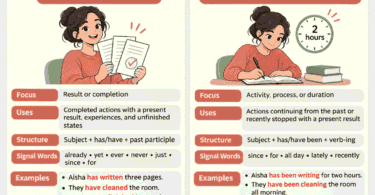
- I have worked here for ten years.
- I have been working here for ten years.
The present perfect simple presents the employment as an established fact. In contrast, the present perfect continuous emphasizes the activity or duration. Nevertheless, both can mean that the work continues now.
Negative Forms and Their Meanings
A past simple negative belongs to a finished occasion or period. Meanwhile, a present perfect negative remains relevant within the current period.
| Past Simple | Present Perfect |
|---|---|
| I didn’t finish the report. | I haven’t finished the report. |
| She didn’t call yesterday. | She hasn’t called today. |
| We didn’t visit them last year. | We haven’t visited them this year. |
| He didn’t submit the form on Monday. | He hasn’t submitted the form yet. |
For example, I didn’t finish the report refers to a finished opportunity or occasion. However, I haven’t finished the report means it remains unfinished now.
Questions and Short Answers
Past simple questions use did, whereas present perfect questions use have or has:
- Did you finish the report?
- Have you finished the report?
- When did she arrive?
- Has she arrived yet?
| Question | Positive Answer | Negative Answer |
|---|---|---|
| Did you finish? | Yes, I did. | No, I didn’t. |
| Have you finished? | Yes, I have. | No, I haven’t. |
| Has she arrived? | Yes, she has. | No, she hasn’t. |
Standard short answers repeat the auxiliary rather than the main verb.
Passive Forms
The same time distinction appears in passive sentences:
| Past Simple Passive | Present Perfect Passive |
|---|---|
| The bridge was built in 2010. | The bridge has been built. |
| The documents were signed yesterday. | The documents have already been signed. |
| The problem was solved last night. | The problem has been solved. |
| The order was delivered on Monday. | The order has been delivered. |
The past simple passive places the action in finished time. Meanwhile, the present perfect passive emphasizes completion or the current result.
Common Time Expressions
| Common with Past Simple | Common with Present Perfect |
|---|---|
| yesterday | ever |
| last week | never |
| two days ago | already |
| in 2020 | just |
| when I was young | yet |
| then | recently |
| from 2015 to 2020 | so far |
| on Monday | up to now |
| at six o’clock | until now |
These expressions provide useful clues. Still, context and the chosen time frame ultimately determine the form.
Cases Where Both Forms Are Possible
Both forms may describe the same events while framing the surrounding period differently:
| Past Simple | Present Perfect | Viewpoint Difference |
|---|---|---|
| I spoke to Sara today. | I have spoken to Sara today. | Relevant occasion complete vs today still open |
| We received ten orders this week. | We have received ten orders this week. | Work period complete vs continuing progress |
| She called twice this morning. | She has called twice this morning. | Morning treated as finished vs still open |
| I read three chapters today. | I have read three chapters today. | Reading period complete vs progress up to now |
Therefore, a difference in tense can reflect the speaker’s viewpoint rather than a difference in the events themselves.
Conversation Flow Across the Tenses
Natural conversations often move from the present perfect to the past simple:
Have you seen the new office?
Yes, I have.
When did you visit it?
I went there on Monday.
Did you meet the manager?
Yes, I spoke to her for a few minutes.
The first question asks about experience up to now. Afterward, the conversation uses the past simple because it focuses on a finished visit and its details.
More Past Simple and Present Perfect Examples
Affirmative Examples
- I completed the application yesterday.
- She moved to Karachi in 2022.
- We have completed five applications so far.
- He has lived here since childhood.
- The company has announced a new policy.
- They visited us twice last summer.
Negative Examples
- I didn’t attend the meeting yesterday.
- She didn’t recognize the caller.
- We haven’t received a reply yet.
- He hasn’t visited us this year.
- They didn’t complete the work on Monday.
- The bus hasn’t arrived yet.
Question Examples
- Did you enjoy the concert?
- When did she leave?
- Have you ever ridden a horse?
- Has the manager approved the request?
- How long have they lived here?
- How many times did you call yesterday?
Correct and Incorrect Examples
| Incorrect | Correct | Explanation |
|---|---|---|
| I have seen her yesterday. | I saw her yesterday. | Yesterday is a finished past period. |
| Did you went there? | Did you go there? | Use the base verb after did. |
| She has went home. | She has gone home. | Use the past participle after has. |
| We have moved here five years ago. | We moved here five years ago. | Ago requires the past simple. |
| I lived here since 2020. | I have lived here since 2020. | The situation continues now. |
| He has written five books before he died. | He wrote five books before he died. | His writing period is finished. |
| It was the first time I have driven alone. | It was the first time I had driven alone. | A past reference point normally takes the past perfect. |
Common Mistakes
- Using the present perfect with a finished time: Write I saw her yesterday, not I have seen her yesterday.
- Using a past verb after did: Write Did she go?, not Did she went?
- Using the wrong participle: Write She has gone, not She has went.
- Treating every unstated time as present perfect: Context may still create a finished past frame.
- Treating every current consequence as present perfect: An explicit finished time may require the past simple.
- Using the past simple for a continuing state: Write I have known her for years when the relationship continues.
- Confusing for, since, and ago: Use for for duration, since for a starting point, and ago with the past simple.
- Keeping the present perfect for finished details: After introducing an experience, use the past simple to state when and where it happened.
- Assuming ever and never always require the present perfect: Both can occur in finished past contexts.
- Ignoring English variety: American English often accepts the past simple where British English prefers the present perfect for recent events.
- Confusing been and gone: Been to means visited and returned; gone to means still away.
Past Simple or Present Perfect Selection Guide
| Intended Meaning | Recommended Form |
|---|---|
| Finished past event | Past simple |
| Definite finished time | Past simple |
| Ended state or duration | Past simple |
| Past habit or sequence | Past simple |
| Finished details about an experience | Past simple |
| Experience up to now | Present perfect |
| Continuing state | Present perfect |
| Event in an unfinished period | Present perfect |
| Current news or unresolved result | Often present perfect |
| Flexible period such as today | Either, depending on viewpoint |
When both forms seem possible, identify the relevant time frame. If the speaker closes the period and treats the event as a finished past fact, use the past simple. However, if the period reaches now or the event belongs to a present-centered situation, choose the present perfect.
FAQs
The past simple places an event, state, or sequence in a finished past time frame. In contrast, the present perfect connects an earlier event or state with the present or with a period that continues until now. Compare I visited Lahore last year with I have visited Lahore twice.
The present perfect normally does not appear with finished expressions such as yesterday, last week, or in 2020. However, it can appear with a specific starting point introduced by since, as in I have lived here since 2020, because the situation continues now. It can also occur with a period such as today when that period remains open.
Use did to form past simple questions and negatives about finished past events: Did you call her? Use have or has to form the present perfect when an experience, continuation, result, or time period connects to now: Have you called her yet?
For can appear with both forms because it expresses duration. For example, I lived there for five years describes an ended period, while I have lived here for five years describes a continuing one. However, since generally appears with the present perfect when a state started earlier and continues now.
Has been to means someone visited a place and returned. Has gone to means the person is there or travelling there. In contrast, went to places the movement or visit in a finished past period, as in Sara went to Lahore last week.
You May Also Like

Leave a Comment