
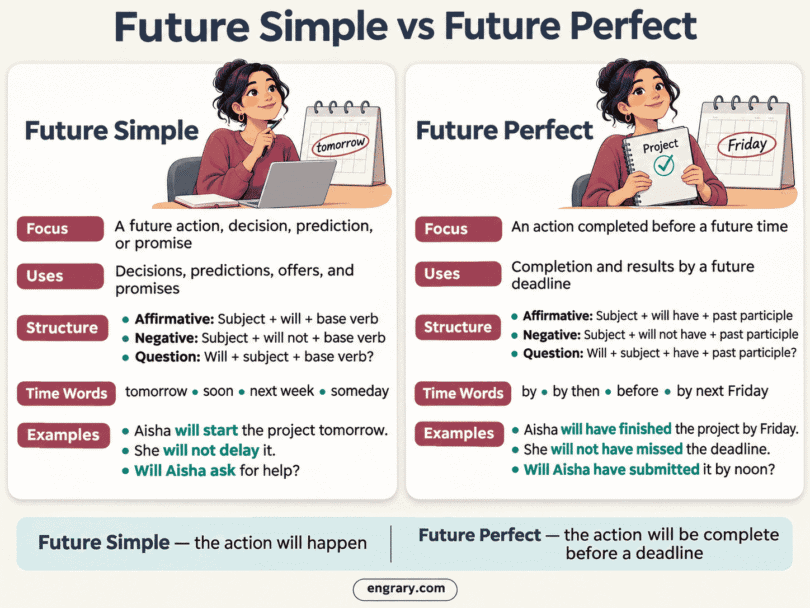
The future simple and future perfect both describe future situations, but they present them from different viewpoints. The future simple usually presents an event, prediction, decision, promise, offer, or result directly. In contrast, the future perfect imagines a later point in the future and looks back at something that will already be complete or true by then.
Their structures also reflect this difference. The future simple uses will + base verb, while the future perfect uses will have + past participle. Both forms can appear with future deadlines; however, the future perfect places greater emphasis on the completed result at the future reference point.
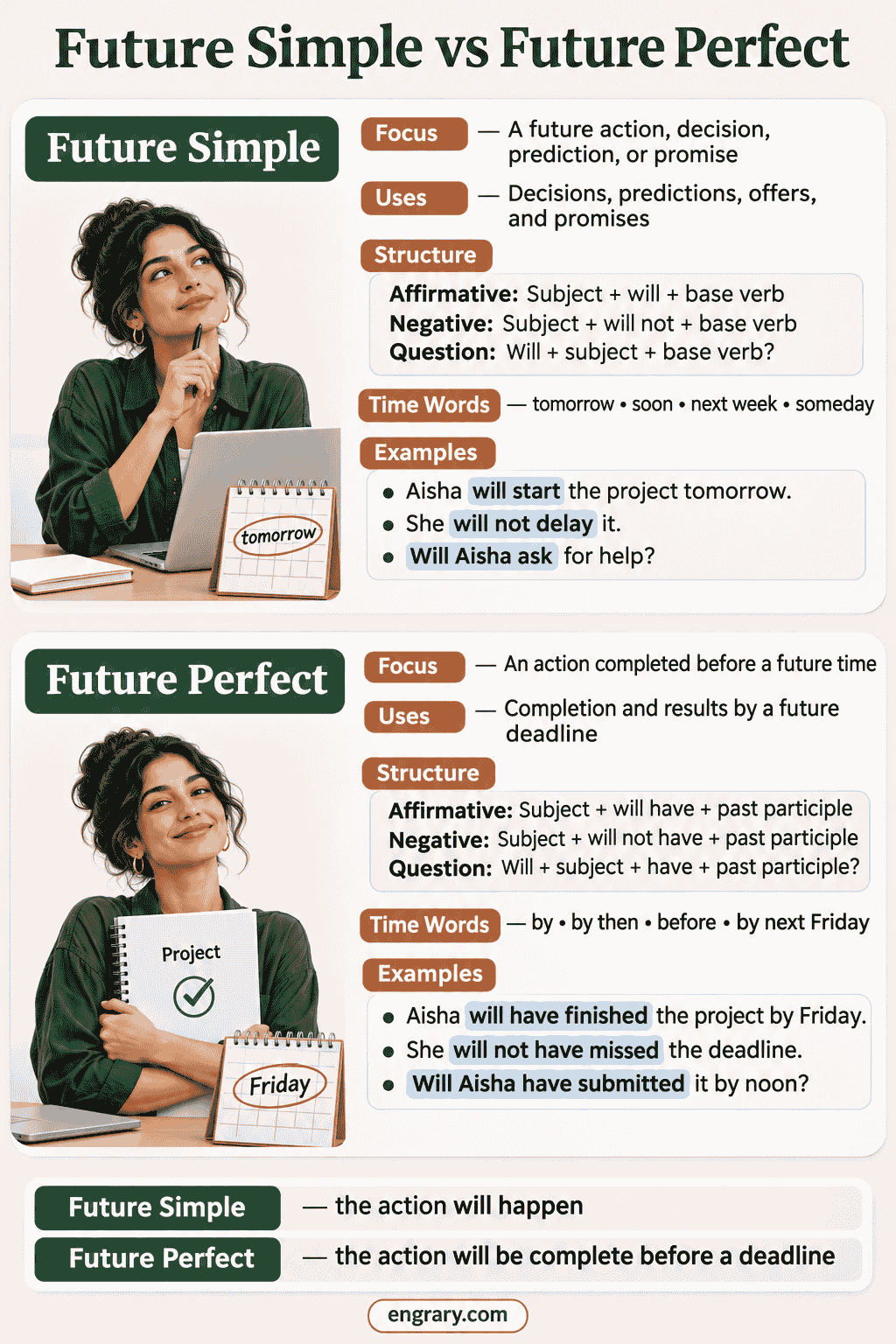
Future Simple and Future Perfect at a Glance
The following table summarizes the main differences between these two future forms.
| Feature | Future Simple | Future Perfect |
|---|---|---|
| Structure | will + base verb | will have + past participle |
| Main focus | Future event, decision, or prediction | Completion before a future point |
| Example | She will finish the report. | She will have finished the report by noon. |
| Viewpoint | Looks forward from now | Looks backward from a future point |
| Common uses | Predictions, decisions, promises, offers, future facts | Completed actions, achieved results, duration, assumptions |
| Typical time expressions | tomorrow, later, next week, at six | by six, by then, by the time, before |
The future perfect needs an explicit or understood reference point. For example, She will have finished can make sense in a conversation where everyone already understands the deadline. Without that context, adding by noon or another future point makes the meaning clearer.
Future Simple and Future Perfect Structures
Both forms use will with every subject. Therefore, the auxiliary does not change after I, you, he, she, it, we, or they.
Future Simple Structure
| Sentence Type | Structure | Example |
|---|---|---|
| Affirmative | Subject + will + base verb | She will finish the report. |
| Negative | Subject + will not + base verb | She will not finish the report. |
| Yes/no question | Will + subject + base verb? | Will she finish the report? |
| WH-question | WH-word + will + subject + base verb? | When will she finish? |
| Positive short answer | Yes, subject + will. | Yes, she will. |
| Negative short answer | No, subject + will not. | No, she won’t. |
Use the base form directly after will. Consequently, write will go, will finish, and will help rather than will goes, will finished, or will to help.
Future Perfect Structure
| Sentence Type | Structure | Example |
|---|---|---|
| Affirmative | Subject + will have + past participle | She will have finished the report. |
| Negative | Subject + will not have + past participle | She will not have finished the report. |
| Yes/no question | Will + subject + have + past participle? | Will she have finished the report? |
| WH-question | WH-word + will + subject + have + past participle? | What will she have finished? |
| Positive short answer | Yes, subject + will. | Yes, she will. |
| Negative short answer | No, subject + will not. | No, she won’t. |
The future perfect always uses have after will and a past participle after have. Therefore, will has finished, will have finish, and will have went are incorrect.
Contractions and Shall
In natural speech and informal writing, will commonly contracts to ’ll:
- I will finish → I’ll finish
- she will have arrived → she’ll have arrived
- they will complete → they’ll complete
The negative form will not contracts to won’t:
- He won’t leave.
- They won’t have arrived.
In formal or traditional English, shall can replace will with I and we. However, will is more common in modern usage. Questions such as Shall I help? and Shall we begin? remain natural for offers and suggestions.
Regular and Irregular Past Participles
The future perfect requires a past participle, not a simple past form.
| Base Verb | Simple Past | Past Participle |
|---|---|---|
| finish | finished | finished |
| write | wrote | written |
| go | went | gone |
| see | saw | seen |
| take | took | taken |
| do | did | done |
| leave | left | left |
| build | built | built |
Regular verbs usually add -ed. However, irregular verbs must be learned individually:
- will have went → will have gone
- will have wrote → will have written
- will have saw → will have seen
Main Uses of the Future Simple
The future simple presents a future action or situation directly rather than looking back from a later future point.
Predictions and Beliefs
Use the future simple for predictions based on opinions, beliefs, or expectations.
- I think the team will win.
- The weather will improve tomorrow.
- She will probably pass the exam.
- I am sure they will understand.
Expressions such as I think, I believe, probably, perhaps, and I am sure frequently introduce this use.
Spontaneous Decisions
Use will for decisions made at the moment of speaking.
- The phone is ringing. I’ll answer it.
- I’m hungry. I’ll make a sandwich.
- That box looks heavy. I’ll carry it.
In each example, the situation causes an immediate decision rather than activating an earlier plan.
Promises
- I’ll call you tonight.
- We will complete the work on time.
- I won’t tell anyone.
- I will always support you.
A promise communicates willingness and commitment. Therefore, the simple form is more appropriate than the future perfect when the speaker makes the promise.
Offers and Requests
- I’ll help you with the report.
- I’ll make some tea.
- Will you send me the document?
- Will you close the door?
For question-form offers, Shall I …? often sounds more natural: Shall I open the window?
Willingness and Refusal
- I’ll drive if you are tired.
- Sara will translate the letter.
- He won’t listen to my advice.
- The car won’t start.
Here, won’t can express refusal or failure to function, not merely a negative prediction.
Future Facts and Consequences
- She will be eighteen next month.
- The school year will begin in August.
- Be careful, or you will fall.
- If you touch that wire, you will get a shock.
These examples present future facts, warnings, or expected consequences directly.
Main Uses of the Future Perfect
The future perfect presents an action, result, state, or quantity as complete when viewed from a later future point.
Actions Completed Before a Future Point
- By noon, she will have completed the report.
- They will have arrived by six.
- By next week, we will have finished the project.
The action may occur at any time before the stated point. The exact completion time remains unknown or unimportant.
Results Achieved by a Deadline
- By Friday, the team will have reached its target.
- The builders will have completed the roof by winter.
- By the end of the month, I will have saved enough money.
In each example, the speaker imagines the deadline and considers the result that will exist then.
Completion Before Another Future Event
- When you arrive, I will have cooked dinner.
- By the time the meeting begins, everyone will have received the agenda.
- She will have left before the office closes.
The event in the future perfect happens first. The other future event provides the later reference point.
Experiences and Achievements by a Future Time
- By next year, she will have visited twenty countries.
- By graduation, he will have completed three internships.
- By the end of the course, students will have studied all twelve units.
These sentences summarize experiences or achievements accumulated before a future point.
Duration Up to a Future Point
- Next month, I will have known her for ten years.
- By December, they will have lived there for five years.
- At midnight, he will have been awake for twenty hours.
The situation may start before now or after now. However, it continues up to the chosen future reference point.
Assumptions About Completed Events
- They will have arrived by now.
- You will have heard the news.
- She will have received my message.
These examples express confident assumptions about events that have probably already happened. Thus, the form does not always describe literal future completion.
Future Events and Completed Future Results
The future simple presents what will happen, whereas the future perfect presents what will already be complete.
| Future Simple | Future Perfect |
|---|---|
| She will write the report tomorrow. | She will have written the report by tomorrow evening. |
| Focuses on the future activity | Focuses on the completed report |
| He will repair the car. | He will have repaired the car by Friday. |
| Presents the future event | Presents the completed result at the deadline |
| They will visit six cities. | They will have visited six cities by the end of the tour. |
| States what they will do | States the total achieved by the future point |
The Future Reference Point
The future perfect looks backward from a later point in the future. That reference point may be:
- A clock time
- A date
- A deadline
- Another future event
- A moment established in an earlier sentence
- An understood point expressed by by then
Examples include:
- By six, I will have finished.
- When you arrive, we will have eaten.
- The meeting starts at ten. The manager will have arrived by then.
- By 2030, the company will have opened ten new offices.
Without a clear or understood reference point, the future perfect may sound incomplete or unnecessary.
Events at a Future Time and Completion by That Time
| At a Future Time | By a Future Time |
|---|---|
| The event occurs at that time | The action is complete no later than that time |
| I will call at six. | I will have finished by six. |
| The train will leave at noon. | The train will have left by noon. |
| We will meet at eight. | We will have completed the meeting by eight. |
The preposition at identifies when an event happens. In contrast, by establishes a deadline and allows completion at any earlier time.
At, By, Before, and Until
| Expression | Main Meaning | Example |
|---|---|---|
| at six | The event occurs or the situation exists at six | I will call at six. |
| by six | The event occurs no later than six | I will have finished by six. |
| before six | The event occurs earlier than six | I will leave before six. |
| until six | A situation continues up to six | I will wait until six. |
Compare the following sentences:
- She will arrive at five.
- She will have arrived by five.
- She will leave before five.
- She will stay until five.
Each expression establishes a different relationship with five o’clock. Therefore, do not treat them as interchangeable signal words.
By and By the Time
Use by before a noun phrase:
- by Monday
- by noon
- by next year
- by the end of the month
- by then
Use by the time before a clause:
- By the time you arrive, I will have finished.
- By the time the class begins, the teacher will have prepared everything.
- By the time they return, we will have cleaned the house.
Both expressions establish a deadline. Nevertheless, neither tells us the exact moment of completion.
By and Until
Learners often confuse by and until, although they express different ideas.
| By | Until |
|---|---|
| Marks a completion deadline | Marks continuation to an endpoint |
| She will have submitted the form by Friday. | She will work on the form until Friday. |
| The action may finish earlier | The situation continues through the period |
| Common with completed results | Common with continuing actions or states |
For example, I will have saved enough money by June focuses on a completed result. By contrast, I will continue saving until June emphasizes an activity that continues through the period.
In and Within
The phrases in two hours and within two hours require careful interpretation.
| Expression | Meaning |
|---|---|
| I will finish in two hours. | The work takes two hours or ends two hours from now. |
| I will have finished in two hours. | At the point two hours from now, the work will already be complete. |
| I will finish within two hours. | The work finishes no later than the end of the period. |
Context determines whether in two hours describes duration or a future point. Meanwhile, within clearly establishes an outer limit.
Deadlines with Both Forms
The future simple and future perfect can both appear with a deadline.
| Future Simple | Future Perfect |
|---|---|
| I will finish the report by Friday. | I will have finished the report by Friday. |
| States the expected completion directly | Looks back from Friday at the completed result |
| Natural in everyday promises and plans | Adds stronger completed-by-then emphasis |
Therefore, the presence of by Friday does not automatically require the future perfect. Both sentences may describe the same factual outcome, but their viewpoints differ.
Will Finish and Will Have Finished
| Sentence | Main Meaning |
|---|---|
| I will finish the report tomorrow. | Finishing is a future event. |
| I will finish the report by noon. | The report will be complete no later than noon. |
| I will have finished the report by noon. | From the viewpoint of noon, the report will already be complete. |
| I will have finished the report when you arrive. | Completion occurs before the arrival. |
The difference often involves emphasis rather than a completely different real-world result. However, the future perfect makes the future viewpoint and prior completion explicit.
Actions Completed Before Another Future Event
| Future Simple | Future Perfect |
|---|---|
| When you arrive, I will cook dinner. | When you arrive, I will have cooked dinner. |
| Cooking begins at or after the arrival. | Dinner is already prepared before the arrival. |
| When the meeting begins, she will present the report. | When the meeting begins, she will have prepared the report. |
| Presentation happens during the meeting. | Preparation is complete before the meeting. |
The tense choice can therefore change the order of future events.
Duration Up to a Future Point
The future perfect can describe a state or situation extending to a future point.
- Next month, I will have known her for ten years.
- By December, they will have lived there for five years.
- At the end of this year, she will have worked here for a decade.
- By Monday, we will have been in Karachi for two weeks.
Expressions with for state the length of time, while expressions with since identify the starting point: By June, he will have lived here for five years and By June, he will have lived here since 2022.
Stative Verbs with the Future Perfect
Stative verbs normally use the future perfect rather than the future perfect continuous.
| Standard Form | Usually Unnatural |
|---|---|
| I will have known her for ten years. | I will have been knowing her for ten years. |
| They will have owned the house for a decade. | They will have been owning the house for a decade. |
| She will have understood the system for years. | She will have been understanding the system for years. |
| We will have believed that story for months. | We will have been believing that story for months. |
Common stative verbs include be, believe, belong, know, love, need, own, understand, and want.
Completed Quantities and Achievements
Exact numbers make the completed result especially clear.
| Future Perfect Example | Completed Result |
|---|---|
| She will have answered twenty emails by noon. | Twenty completed replies |
| We will have visited six cities by Friday. | Six completed visits |
| He will have written three chapters. | Three completed chapters |
| The team will have played thirty matches. | Thirty completed matches |
| The factory will have produced one million units. | A measurable production total |
Because these sentences emphasize measurable achievements, the future perfect fits naturally.
Predictions with Both Forms
| Future Simple | Future Perfect |
|---|---|
| She will arrive soon. | She will have arrived by noon. |
| Predicts a future event | Predicts completion by a future point |
| The team will win. | The team will have won the series by then. |
| Predicts the outcome | Views the outcome as complete |
| Sales will increase. | Sales will have increased by December. |
| Predicts a future change | Views the change from a later point |
The future perfect does not necessarily express greater certainty. Instead, it organizes the prediction around a future reference point.
Future Perfect for Assumptions About the Past
The future perfect can express a confident inference about a completed event.
- They will have arrived by now.
- You will have heard the news.
- She will have received my message.
- The manager will have seen the report.
Compare the following forms:
| Neutral Probability | Future Perfect Inference |
|---|---|
| They have probably arrived. | They will have arrived by now. |
| She has probably received the email. | She will have received the email. |
In this use, will communicates the speaker’s expectation or deduction rather than locating the event in the future.
Cases Where Both Forms Are Possible
Sometimes both forms describe a similar outcome. Nevertheless, the focus changes.
| Future Simple | Future Perfect | Difference in Focus |
|---|---|---|
| I will finish by Friday. | I will have finished by Friday. | Expected completion versus completed-by-then viewpoint |
| She will leave before noon. | She will have left by noon. | Future departure versus result at noon |
| They will complete the project this week. | They will have completed the project by Friday. | Future action versus completion before a reference point |
| He will arrive by six. | He will have arrived by six. | Direct prediction versus viewpoint from six |
The future perfect is not automatically more correct. Use it when the completed result at the future reference point deserves emphasis.
Negative Forms and Meaning Differences
| Future Simple | Future Perfect |
|---|---|
| She won’t finish the report. | She won’t have finished the report by noon. |
| Completion is not expected, or she may refuse. | The report will remain incomplete at noon. |
| He won’t leave. | He won’t have left by then. |
| He refuses or is not expected to leave. | His departure will not yet be complete. |
| They won’t complete the work. | They won’t have completed the work by Friday. |
| Predicts no completion. | Predicts incompletion at a particular point. |
The future perfect negative does not necessarily mean that completion will never happen. It may simply mean that the action will remain incomplete at the chosen reference time.
Questions and Short Answers
| Question Type | Future Simple | Future Perfect |
|---|---|---|
| Yes/no question | Will she finish? | Will she have finished by noon? |
| Positive short answer | Yes, she will. | Yes, she will. |
| Negative short answer | No, she won’t. | No, she won’t. |
| WH-question | When will she finish? | What will she have completed by Friday? |
| Deadline question | Will you finish by five? | Will you have finished by five? |
The first deadline question may ask for a prediction, promise, or commitment. In contrast, the second asks whether the completed result will already exist at five. Short answers use only will or won’t.
Future Time Clauses
English normally uses a present form—not will—after future time conjunctions such as when, before, after, until, as soon as, once, and by the time.
| Incorrect | Correct |
|---|---|
| By the time she will arrive, I will have finished. | By the time she arrives, I will have finished. |
| When he will return, we will have left. | When he returns, we will have left. |
| After they will finish, they will call us. | After they finish, they will call us. |
| Before she will leave, she will have completed the form. | Before she leaves, she will have completed the form. |
The time clause uses a present form, while the main clause can use the future simple or future perfect.
Time Clauses and Noun Clauses
The restriction on will applies to ordinary future time clauses, not every clause beginning with when.
| Time Clause | Noun Clause |
|---|---|
| When she arrives, we will begin. | I do not know when she will arrive. |
| By the time they finish, we will have left. | I wonder when they will have finished. |
| Uses a present form for future time | Can use will because the clause reports unknown information |
In the noun-clause examples, the clause functions as the object of know or wonder. Therefore, it does not follow the ordinary future time-clause pattern.
Passive Forms
Both forms can appear in passive sentences.
| Form | Active | Passive |
|---|---|---|
| Future simple | The company will announce the results. | The results will be announced. |
| Future perfect | The team will have completed the project. | The project will have been completed. |
The structures are:
- Future simple passive: will be + past participle
- Future perfect passive: will have been + past participle
Use the passive when the receiver of the action matters more than the doer.
Future Perfect and Future Perfect Continuous
| Future Perfect | Future Perfect Continuous |
|---|---|
| Focuses on completion, result, quantity, or state | Focuses on activity and duration |
| By noon, she will have written five pages. | By noon, she will have been writing for three hours. |
| Exact completed result | Length of the activity |
| I will have known her for ten years. | I will have been working here for ten years. |
Stative verbs normally favor the future perfect, while dynamic activities often permit the continuous form when duration matters.
Correct and Incorrect Examples
| Incorrect | Correct | Explanation |
|---|---|---|
| She will have finish by noon. | She will have finished by noon. | Use a past participle after will have. |
| He will have went home. | He will have gone home. | Gone is the past participle of go. |
| They will have wrote the report. | They will have written the report. | Written is the past participle of write. |
| By the time she will arrive, we will leave. | By the time she arrives, we will have left. | Use a present form in the time clause. |
| I will wait by six. | I will wait until six. | Until expresses continuation. |
| I will call by six exactly. | I will call at six exactly. | At identifies an exact event time. |
| Tomorrow, I will have visited the shop. | By tomorrow evening, I will have visited the shop. | Add a meaningful future reference point. |
| I will have be finished. | I will have finished. | Do not add be in the active form. |
Common Mistakes
- Omitting have: Write will have finished, not will finished.
- Using a base verb after will have: Write will have completed, not will have complete.
- Using a simple past form instead of a participle: Write will have gone, not will have went.
- Forgetting the reference point: The future perfect needs an explicit or understood later future viewpoint.
- Confusing at with by: At identifies an event time, while by sets a completion deadline.
- Confusing by with until: By focuses on completion; until focuses on continuation.
- Treating every deadline as requiring the future perfect: The future simple can also occur with by.
- Assuming the action must start in the future: A future perfect state may begin in the past and continue to a future point.
- Using will in an ordinary future time clause: Write by the time she arrives, not by the time she will arrive.
- Confusing time clauses with noun clauses: I wonder when she will arrive correctly uses will.
- Confusing future perfect with future perfect continuous: Use the simple form for completed quantities and the continuous form for activity duration.
- Overusing the future perfect: Choose the future simple when a direct future statement communicates the meaning more naturally.
Future Simple or Future Perfect Selection Guide
| Intended Meaning | Recommended Form |
|---|---|
| Spontaneous decision | Future simple |
| Promise or offer | Future simple |
| General prediction | Future simple |
| Future fact | Future simple |
| Event presented directly | Future simple |
| Completion before a future point | Future perfect |
| Result achieved by a deadline | Future perfect |
| Experience accumulated by a future time | Future perfect |
| Completed quantity | Future perfect |
| Duration with a stative verb | Future perfect |
| Assumption about an already completed event | Future perfect |
| Either form seems possible | Choose according to viewpoint |
Use the future simple when the event, decision, promise, prediction, or future fact matters directly. However, use the future perfect when you want to imagine a future point and look back at what will already be complete or true.
FAQs
The future simple presents a future event, decision, prediction, or fact directly. In contrast, the future perfect imagines a later future point and presents something as already complete or true by then. For example, She will finish the report states a future event, whereas She will have finished the report by noon emphasizes the completed result at noon.
Yes. I will finish by Friday and I will have finished by Friday can both be correct. The future simple states the expected completion directly, while the future perfect places stronger emphasis on looking back from Friday at the completed result.
Will finish presents completion as a future event. However, will have finished shows that the completed result will already exist at a later future point. Therefore, I will finish tomorrow focuses on the event, while I will have finished by noon tomorrow focuses on the result at noon.
Future time clauses normally use a present form even though their meaning refers to the future. Therefore, write By the time she arrives, I will have finished, not By the time she will arrive. The main clause carries the future form.
Yes. The future perfect can describe a state or situation that began in the past and continues up to a future point. For example, Next month, I will have known her for ten years means the relationship began before now and will reach a ten-year duration next month.
You May Also Like



Leave a Comment