
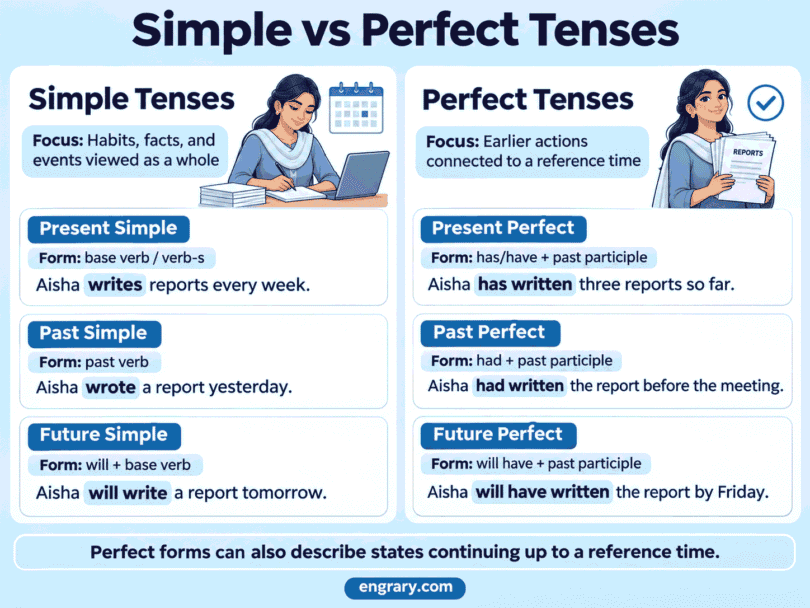
Simple and perfect tenses express different relationships in time. Simple forms describe facts, habits, states, and events without adding a perfect relationship. Perfect forms, however, connect an earlier situation to a later reference point. Compare She lives here with She has lived here since 2020. Both describe her current home, but the second sentence also tells us how her situation connects to the past.
This distinction applies to present, past, and future forms. Moreover, perfect tenses do not always describe finished actions. They can express experiences, repeated events, and states that continue up to a particular point.
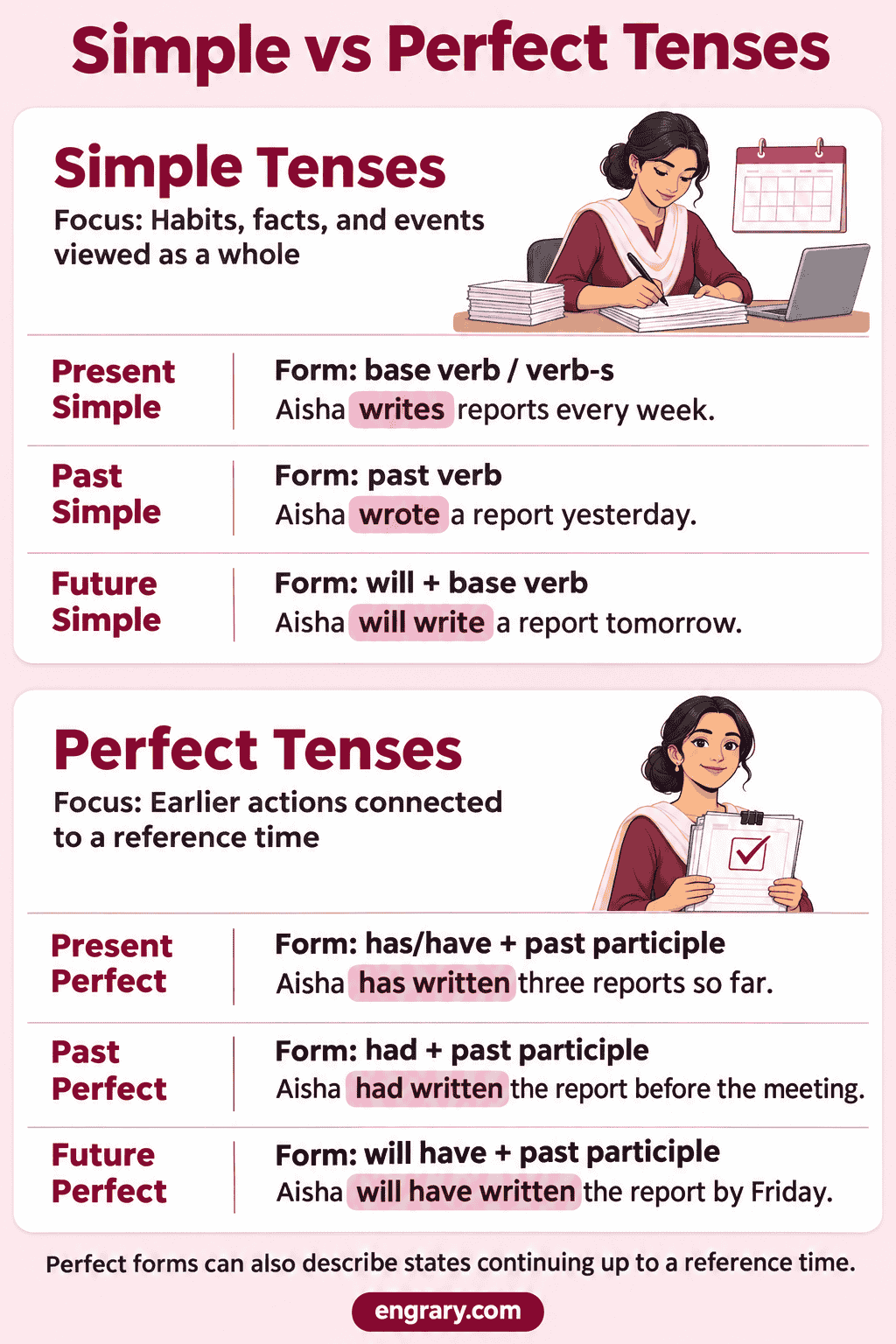
Simple and Perfect Tenses at a Glance
Simple forms present a situation directly within its time context. Perfect forms look back from a reference point to something earlier or to a situation continuing up to that point.
| Feature | Simple Forms | Perfect Forms |
|---|---|---|
| Main viewpoint | Presents a fact, state, habit, or event | Connects an earlier situation to a reference point |
| Present example | She works here. | She has worked here since June. |
| Past example | She finished the report. | She had finished before the meeting. |
| Future example | She will finish tomorrow. | She will have finished by tomorrow evening. |
| Formation | Depends on tense and subject | A form of have + past participle |
| Common meanings | Facts, habits, states, events | Experience, results, repetition, completion, duration |
For example, I know her states a present fact. By contrast, I have known her for years connects that fact to an earlier starting point.
Neither sentence describes a completed action. Therefore, “simple means unfinished” and “perfect means finished” are not reliable general rules.
Time References and Perfect Aspect
A reference point is the time from which the speaker views a situation. Perfect forms look back from that point.
| Perfect Form | Reference Point | Example |
|---|---|---|
| Present perfect | Now | I have finished the report. |
| Past perfect | A later past point | I had finished before the meeting began. |
| Future perfect | A future point | I will have finished by Friday. |
In the present perfect example, the speaker looks back from now. In the past perfect example, the meeting provides the later past reference point. Meanwhile, Friday supplies the future reference point in the final example.
The reference point does not always appear in the same sentence:
- I reached the station at nine. The train had already left.
Here, the first sentence establishes the past viewpoint for the second.
Simple Tenses and Perfect Simple Forms
The word simple appears in more than one tense label, which can cause confusion.
| Term | Example | Meaning |
|---|---|---|
| Present simple | She works. | Neither perfect nor continuous |
| Present perfect simple | She has worked. | Perfect without continuous aspect |
| Present perfect continuous | She has been working. | Perfect combined with continuous aspect |
Therefore, present perfect simple is not another name for present simple. The complete label matters.
Simple and Perfect Tense Structures
Perfect constructions share one essential pattern: a form of have followed by a past participle.
| Time Reference | Simple Structure | Perfect Structure |
|---|---|---|
| Present | Subject + base verb or -s/-es | Subject + has/have + past participle |
| Past | Subject + past form | Subject + had + past participle |
| Future | Subject + will + base verb | Subject + will have + past participle |
Compare the forms of write:
| Simple Form | Perfect Form |
|---|---|
| I write. | I have written. |
| She writes. | She has written. |
| They wrote. | They had written. |
| We will write. | We will have written. |
Use has with he, she, and it. Use have with I, you, we, and they. However, had and will have remain the same with every subject.
- He has finished.
- They have finished.
- He had finished.
- They had finished.
- He will have finished.
- They will have finished.
The verb be has special simple forms: am, is, are, was, and were. Its past participle is been, as in has been and had been.
Traditional grammar calls will write and will have written future tenses. More precisely, English expresses these future meanings through auxiliary constructions rather than a special future verb ending.
Present Simple vs Present Perfect
Current States and Duration up to Now
The present simple states what is true now. The present perfect can show that the situation began earlier and continues into the present.
| Present Simple | Present Perfect |
|---|---|
| She lives here. | She has lived here since 2020. |
| I know Daniel. | I have known Daniel for ten years. |
| He owns a shop. | He has owned the shop since June. |
| They are married. | They have been married for fifteen years. |
For instance, She lives here identifies her current home. In contrast, She has lived here since 2020 adds information about when that situation began.
Use the present perfect when the sentence measures a continuing state from the past to now:
- Incorrect: I know her since 2020.
- Correct: I have known her since 2020.
Habits and Accumulated Experience
The present simple commonly describes a general pattern. The present perfect describes experience or repetition accumulated up to now.
| Present Simple | Present Perfect |
|---|---|
| She visits the museum regularly. | She has visited the museum several times. |
| He writes articles. | He has written twenty articles this year. |
| We travel abroad every summer. | We have traveled abroad many times. |
| I read historical novels. | I have read three historical novels this month. |
The simple sentences describe habits or interests. Meanwhile, the perfect sentences look back over a period and describe what has happened within it.
Past Simple vs Past Perfect
Past Events and Earlier Past Situations
The past simple places an event in the past. The past perfect shows that a situation occurred before another past reference point.
| Past Simple | Past Perfect |
|---|---|
| She left when I arrived. | She had left when I arrived. |
| He read the instructions and started. | He had read the instructions before he started. |
| I recognized the building. | I recognized the building because I had visited it before. |
The first pair shows a clear difference. She left when I arrived suggests that her departure happened at or around my arrival. However, She had left when I arrived places her departure earlier.
Similarly, the past perfect can explain the cause of a later past situation:
- I could not enter because I had forgotten my key.
- She understood the instructions because she had used the machine before.
- They felt relieved because they had completed the work.
Past Perfect with Clear Context
A past perfect sentence can rely on an earlier sentence for its reference point:
- We arrived at the restaurant at eight. The kitchen had already closed.
- I opened my bag. Someone had taken my wallet.
In each example, the past simple establishes the narrative time. The past perfect then looks further back.
Past Perfect as an Optional Choice
Past perfect is not necessary every time two past actions appear together.
| Past Simple | Past Perfect |
|---|---|
| After she finished dinner, she washed the dishes. | After she had finished dinner, she washed the dishes. |
| He checked the address before he left. | He had checked the address before he left. |
Both versions can communicate the same sequence because after and before clarify the order. Nevertheless, the perfect form explicitly presents one situation as earlier than the other.
Future Simple vs Future Perfect
Future Events and Completion by a Future Point
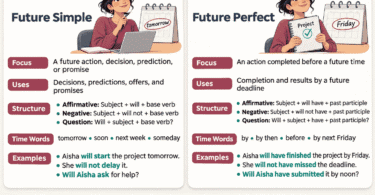
The future simple announces, predicts, or promises a future event. The future perfect views an action as complete from a later future point.
| Future Simple | Future Perfect |
|---|---|
| She will finish the report on Friday. | She will have finished the report by Friday. |
| They will repair the bridge next month. | They will have repaired the bridge by the end of next month. |
| I will read the book this weekend. | I will have read the book by Monday. |
For example, I will read the book this weekend describes a future activity. By comparison, I will have read the book by Monday presents Monday as the point at which the reading will already be complete.
Duration up to a Future Point
Future perfect also measures how long a state will have lasted:
- By June, she will have owned the shop for five years.
- Next month, we will have known each other for a decade.
- By December, they will have been married for twenty years.
These sentences do not say that ownership, friendship, or marriage will end at the stated point. Instead, they measure duration up to that point.
Deadlines with Both Forms
A deadline does not automatically require future perfect.
| Sentence | Emphasis |
|---|---|
| I will finish by Friday. | Predicts or promises completion no later than Friday |
| I will have finished by Friday. | Views the task as complete from the Friday reference point |
Both sentences can be correct in the same situation. However, the perfect version makes the backward-looking future perspective more explicit.
Past Simple vs Present Perfect
Past simple and present perfect can both describe earlier events. Their difference lies in how those events relate to the speaker’s current viewpoint.
Finished Past Time and Experience up to Now
| Past Simple | Present Perfect |
|---|---|
| I visited London in 2023. | I have visited London twice. |
| She called yesterday. | She has called three times today. |
| Did you see that film last night? | Have you ever seen that film? |
| We met at a conference last year. | We have met before. |
The past simple places an event in a finished past context. In contrast, the present perfect looks back from now over experience or an unfinished period.
The exact finished time may be explicit or understood:
- I bought this jacket yesterday.
- Where did you buy it?
The second sentence does not state a date, but it still asks about a particular past purchase.
Finished and Continuing Duration
| Past Simple | Present Perfect |
|---|---|
| She lived there for five years before moving. | She has lived there for five years. |
| I worked there from 2018 to 2022. | I have worked here since 2022. |
| He owned the shop for a decade before selling it. | He has owned the shop for a decade. |
In these examples, the past simple describes a period that ended. The present perfect describes a situation continuing into the present.
Current Results
| Past Simple | Present Perfect |
|---|---|
| I lost my keys yesterday. | I have lost my keys, so I cannot open the door. |
| She broke her glasses last night. | She has broken her glasses and needs another pair. |
Present perfect commonly draws attention to a current result. However, past simple events can also have present consequences. Someone who says I lost my keys yesterday may still be unable to find them.
Therefore, the difference concerns the way the speaker presents the event, not whether it matters now.
British and American Usage
American English often uses past simple in some contexts where British English favors present perfect.
| Common British Pattern | Also Common in American English |
|---|---|
| Have you eaten yet? | Did you eat yet? |
| I have just finished. | I just finished. |
| She has already left. | She already left. |
These are tendencies rather than absolute rules. Both varieties use present perfect, and context influences the choice.
Completed Actions, Experiences, and Continuing States
Perfect constructions express several meanings. Learning this range prevents the mistaken assumption that perfect always means finished.
| Meaning | Example |
|---|---|
| Completed action with a present result | I have lost my keys, so I cannot open the door. |
| Experience up to now | She has traveled abroad several times. |
| Continuing state | We have known each other since school. |
| Repeated events in an unfinished period | He has called three times today. |
| Earlier past experience | I had never flown before that trip. |
| Completion before a past point | They had finished before we arrived. |
| Completion before a future point | We will have completed the work by Monday. |
| Duration up to a future point | By June, she will have owned the shop for five years. |
The shared feature is the relationship to a reference point. Completion is one possible meaning within that broader relationship.
Past Forms and Past Participles
The past simple uses the past form of the main verb. Perfect constructions, however, require a past participle after the auxiliary.
Regular verbs often use the same spelling for both forms. Irregular verbs make the difference easier to see.
| Base Form | Past Simple | Past Participle |
|---|---|---|
| work | worked | worked |
| live | lived | lived |
| go | went | gone |
| write | wrote | written |
| see | saw | seen |
| take | took | taken |
| eat | ate | eaten |
| speak | spoke | spoken |
| be | was/were | been |
| have | had | had |
Compare:
- She wrote the letter yesterday.
- She has written the letter.
- She had written the letter before lunch.
- She will have written the letter by noon.
Only the past simple uses wrote. The perfect constructions use written.
Similarly:
- Incorrect: They have went home.
- Correct: They have gone home.
Main-Verb Have and Perfect Auxiliary Have
The words have, has, and had do not always function as auxiliaries. They can also act as main verbs.
| Sentence | Form and Function |
|---|---|
| She has a bicycle. | Present simple; has expresses possession |
| She has bought a bicycle. | Present perfect; has is an auxiliary |
| She had a bicycle. | Past simple; had expresses possession |
| She had bought a bicycle before moving. | Past perfect |
| She had had breakfast before leaving. | First had is the auxiliary; second is the past participle |
In She had had breakfast, the repetition is grammatical. The first had establishes the past perfect, while the second belongs to the expression have breakfast.
Contractions in Context
Contractions can represent different verbs. Therefore, examine the words that follow them.
| Contraction | Expanded Form |
|---|---|
| She’s finished the report. | She has finished the report. |
| She’s tired. | She is tired. |
| I’d finished before noon. | I had finished before noon. |
| I’d help if I could. | I would help if I could. |
For example, I’d finished contains a past participle, so ’d means had. In I’d help, the base verb follows, so ’d means would.
Affirmative, Negative, and Question Forms
Most present simple and past simple negatives and questions use do, does, or did. Perfect forms already contain an auxiliary, so they use has, have, or had directly.
Present Forms
| Sentence Type | Present Simple | Present Perfect |
|---|---|---|
| Affirmative | She works here. | She has worked here. |
| Negative | She does not work here. | She has not worked here. |
| Question | Does she work here? | Has she worked here? |
| Positive short answer | Yes, she does. | Yes, she has. |
| Negative short answer | No, she doesn’t. | No, she hasn’t. |
Use the base verb after does. By contrast, use the past participle after perfect has.
Past Forms
| Sentence Type | Past Simple | Past Perfect |
|---|---|---|
| Affirmative | They finished. | They had finished. |
| Negative | They did not finish. | They had not finished. |
| Question | Did they finish? | Had they finished? |
| Positive short answer | Yes, they did. | Yes, they had. |
| Negative short answer | No, they didn’t. | No, they hadn’t. |
Similarly, did takes the base verb, while perfect had takes the past participle.
Future Forms
| Sentence Type | Future Simple | Future Perfect |
|---|---|---|
| Affirmative | He will finish. | He will have finished. |
| Negative | He will not finish. | He will not have finished. |
| Question | Will he finish? | Will he have finished? |
| Positive short answer | Yes, he will. | Yes, he will. |
| Negative short answer | No, he won’t. | No, he won’t. |
In future perfect questions, only will moves before the subject. The remaining verb phrase stays after it:
- Will she have finished by noon?
Simple Forms of Be
Simple be does not normally use do or did in these patterns.
| Present Simple | Past Simple |
|---|---|
| Is she ready? | Was she ready? |
| She is not ready. | She was not ready. |
| Yes, she is. | Yes, she was. |
Time Expressions with Simple and Perfect Forms
Time expressions help establish meaning, but they do not replace an understanding of the sentence.
For and Since
| Expression | Function | Example |
|---|---|---|
| for | Introduces a duration | I have lived here for five years. |
| since | Introduces a starting point | I have lived here since 2021. |
The word for works with several tenses:
- I lived there for five years before moving.
- I have lived here for five years.
- By June, I will have lived here for five years.
Meanwhile, the reference point determines how the duration relates to time.
Finished Past Expressions
Expressions such as yesterday, last week, two years ago, and in 2019 commonly place an event in finished past time.
- Correct: We met yesterday.
- Incorrect: We have met yesterday.
However, a past date can appear in a present perfect sentence when it identifies a starting point:
- We have known each other since 2019.
The date does not locate a single completed event here. Instead, it marks the beginning of a continuing state.
Already, Yet, Just, Ever, and Never
These words commonly accompany perfect forms:
- She has already finished.
- Have they arrived yet?
- I have just eaten.
- Have you ever traveled abroad?
- He has never flown.
Nevertheless, they are not exclusive to present perfect:
- She had already finished when I called.
- He never visited us when we lived there.
- By noon, they will already have left.
By and Until
| Expression | Main Function | Example |
|---|---|---|
| by | Establishes a deadline | I will have finished by six. |
| until | Marks continuation to an endpoint | I will work until six. |
By six means no later than six. In contrast, until six describes how long the activity continues.
Also, remember that by can accompany simple forms:
- I will finish by six.
Perfect Forms in Time Clauses
Present perfect can refer to completion before a future action in the main clause.
- I will send the report when I have checked the figures.
- She will leave after she has finished.
- We can begin once everyone has arrived.
Compare the following versions:
| Present Simple Time Clause | Present Perfect Time Clause |
|---|---|
| I will call when I finish. | I will call when I have finished. |
| She will leave after she checks the room. | She will leave after she has checked the room. |
Both versions can refer to the future. However, the perfect version explicitly emphasizes completion before the next action.
These future time clauses normally use a present form rather than will:
- Incorrect: I will call when I will have finished.
- Correct: I will call when I have finished.
This pattern applies to time clauses. It does not prohibit will in indirect questions such as Do you know when she will have finished?
Perfect Simple and Perfect Continuous
Perfect simple and perfect continuous belong to the same broader family. Both connect an earlier situation to a reference point, but they often emphasize different features.
| Perfect Simple | Perfect Continuous |
|---|---|
| She has written three pages. | She has been writing for an hour. |
| He had repaired the bicycle. | He had been repairing the bicycle all morning. |
| By noon, they will have painted two rooms. | By noon, they will have been painting for four hours. |
Perfect simple often highlights a result or completed quantity. Perfect continuous, meanwhile, often highlights the activity or its duration.
However, these are tendencies rather than absolute rules:
- Perfect simple can describe a continuing state: I have known her for years.
- Perfect continuous can describe recently stopped activity: I am tired because I have been running.
- Both can sometimes work: I have lived here for years and I have been living here for years.
Common Mistakes with Simple and Perfect Tenses
| Incorrect | Correct | Reason |
|---|---|---|
| She has went home. | She has gone home. | Use the past participle |
| Did you finished? | Did you finish? | Use the base form after did |
| Have you finish? | Have you finished? | Perfect have requires a past participle |
| I know her since 2020. | I have known her since 2020. | Express duration continuing to now |
| We have met yesterday. | We met yesterday. | The main event belongs to finished past time |
| They will have finish by noon. | They will have finished by noon. | Use the past participle |
| He had wrote the letter. | He had written the letter. | Written is the past participle |
| She will has completed it. | She will have completed it. | Use base-form have after will |
Another common mistake is using past perfect throughout a story even when the events follow a clear chronological sequence.
Usually, past simple handles the main sequence:
- She opened the door, entered the room, and sat down.
Use past perfect when you need to look back from that sequence:
- She opened the door and noticed that someone had moved the furniture.
Choosing the Correct Form
First, identify the reference point. Next, decide whether the sentence needs to connect that point to an earlier situation. Finally, choose the correct auxiliary and main verb form.
| Intended Meaning | Usual Choice | Example |
|---|---|---|
| Current fact or habit | Present simple | She works here. |
| State continuing from earlier to now | Present perfect | She has worked here since June. |
| Finished event in a past period | Past simple | She left yesterday. |
| Experience up to now | Present perfect | She has visited Rome twice. |
| Situation earlier than another past point | Past perfect | She had left before I arrived. |
| Future event or prediction | Future simple | She will finish tomorrow. |
| Completion viewed from a future point | Future perfect | She will have finished by noon. |
| Duration accumulated by a future point | Future perfect | By June, she will have owned it for five years. |
Check meaning before relying on signal words. For example, for five years can describe a finished past period, a continuing present situation, or duration measured at a future point.
Frequently Asked Questions
Simple forms present facts, states, habits, or events without adding a perfect relationship. Perfect forms connect an earlier action or state to a later reference point, which may be now, a past moment, or a future moment.
Every perfect construction contains a form of have followed by a past participle. Examples include has written, had arrived, and will have finished. Perfect continuous forms also follow this pattern, with been as the past participle of be, followed by an -ing verb.
No. They can also describe experiences, repeated events, and continuing states. For example, I have known her for ten years describes a state that continues into the present.
Past simple places an event in a finished past context. Present perfect connects an earlier situation to now through experience, duration, repetition, or a current result. The distinction concerns the speaker’s viewpoint, not whether a past event has consequences today.
Use past perfect when you need to show that one situation came before another past reference point. However, past simple can be sufficient when the sequence is already clear from context or words such as before and after.
You May Also Like

Leave a Comment