

Simple and continuous tenses show different ways of viewing an action or situation. Simple forms describe facts, states, habits, and events without emphasizing their progress. In contrast, continuous forms focus on an activity unfolding around a particular time. For example, She reads every evening describes a habit, while She is reading now describes an activity in progress.
This distinction applies to present, past, and future forms. However, choosing the correct form involves more than deciding whether an action is finished or unfinished. The verb’s meaning, the time reference, and the speaker’s intended emphasis also matter.

Simple and Continuous Tenses at a Glance
Simple forms present a situation as a fact, a state, a repeated pattern, or an event viewed as a whole. Continuous forms, meanwhile, draw attention to an activity as it develops.
| Feature | Simple Forms | Continuous Forms |
|---|---|---|
| Main focus | Fact, state, habit, or whole event | Activity in progress around a reference point |
| Present example | She works in a bank. | She is working late today. |
| Past example | She worked yesterday. | She was working when I called. |
| Future example | She will work tomorrow. | She will be working at noon tomorrow. |
| Common uses | Routines, truths, states, whole events | Ongoing activities, temporary patterns, developments |
| Completion | Depends on the form and context | Does not establish whether the activity eventually finishes |
Although “permanent versus temporary” can help explain some examples, it is not a universal rule. For instance, I need help today describes a temporary situation but uses the present simple because need expresses a state.
Similarly, a simple form does not always describe a finished action. She owns a bicycle describes a current state rather than a completed event.
Time and Aspect in English
Time reference identifies when a situation occurs. Aspect, on the other hand, shows how the speaker presents that situation.
Compare these sentences:
| Sentence | Time Reference | Viewpoint |
|---|---|---|
| She worked yesterday. | Past | Presents the activity as a whole |
| She was working at eight. | Past | Focuses on the activity underway at that moment |
| She will work tomorrow. | Future | Presents an expected future activity |
| She will be working at eight tomorrow. | Future | Focuses on activity underway at a future moment |
Both worked and was working refer to the past. Nevertheless, they direct attention to different aspects of the event.
The terms continuous and progressive generally mean the same thing in English teaching. Therefore, present continuous and present progressive both describe forms such as is working.
Traditional grammar also uses the labels future simple and future continuous. English expresses these meanings through constructions such as will work and will be working, rather than through a special future verb ending.
Simple and Continuous Tense Structures
Continuous forms combine a form of be with the -ing form of the main verb. Simple forms follow different patterns according to the time reference.
| Time Reference | Simple Structure | Continuous Structure |
|---|---|---|
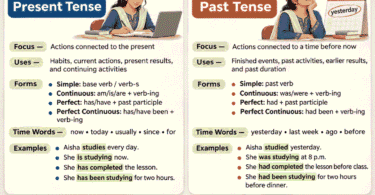
| Present | Subject + base verb or -s/-es | Subject + am/is/are + verb-ing |
| Past | Subject + past form | Subject + was/were + verb-ing |
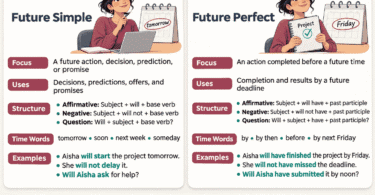
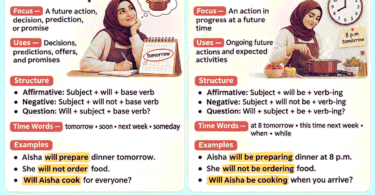
| Future | Subject + will + base verb | Subject + will be + verb-ing |
For example:
| Simple | Continuous |
|---|---|
| I write. | I am writing. |
| She writes. | She is writing. |
| They wrote. | They were writing. |
| We will write. | We will be writing. |
However, the verb be has special simple forms: am, is, are, was, and were.
Also, an -ing word alone does not create a continuous tense. Look at the complete verb phrase.
| Sentence | Classification | Explanation |
|---|---|---|
| She is tired. | Present simple | Is connects the subject to an adjective |
| She is working. | Present continuous | Is working forms the continuous verb phrase |
| Swimming helps me relax. | Present simple main clause | Helps is the finite verb; swimming names the activity |
Present Simple vs Present Continuous
Habits and Activities Around Now
Use the present simple for routines and repeated actions. In contrast, use the present continuous for an activity happening now or around the present period.
| Present Simple | Present Continuous |
|---|---|
| She reads every evening. | She is reading now. |
| We usually eat at home. | We are eating at a restaurant tonight. |
| He takes the bus to work. | He is taking the bus this week. |
| I study English after dinner. | I am studying English at the moment. |
An activity does not need to occur at the exact moment of speaking to take the present continuous.
For example, I am reading a long novel this month describes an ongoing project. The speaker might be having lunch rather than reading when they say it.
General Situations and Temporary Patterns
The present simple often presents a situation as normal or established. Meanwhile, the present continuous can emphasize a temporary arrangement.
| Present Simple | Present Continuous |
|---|---|
| I work from home. | I am working from home this week. |
| They live in Lahore. | They are living with relatives during the renovations. |
| She teaches mathematics. | She is teaching an extra class this term. |
These forms express the speaker’s viewpoint. They do not guarantee that one situation will last forever or that the other will end soon.
Facts and Developing Changes
Use the present simple for general facts. By comparison, the present continuous commonly describes a developing change.
| Present Simple | Present Continuous |
|---|---|
| The Earth orbits the Sun. | The population is increasing. |
| This shop sells books. | The shop is expanding its children’s section. |
| He speaks English. | His English is improving. |
Past Simple vs Past Continuous
Whole Events and Activities in Progress
The past simple presents an event as a whole within a past period. The past continuous, however, focuses on an activity underway at a past moment.
| Past Simple | Past Continuous |
|---|---|
| I read the report yesterday. | I was reading the report at eight. |
| She cooked dinner last night. | She was cooking dinner when I arrived. |
| They repaired the roof yesterday. | They were repairing the roof when it started raining. |
I was reading the report does not tell us whether the speaker eventually finished it. It simply describes the activity from a point during its progress.
Background Activities and Shorter Events
Writers often combine the past continuous with the past simple. The continuous form supplies the background, while the simple form identifies an event within that background.
- I was walking home when I saw an old friend.
- They were watching television when the lights went out.
- She was studying when her brother called.
However, the shorter event does not always stop the longer activity. Seeing a friend during a walk, for example, does not necessarily end the walk.
Two past continuous clauses can also describe simultaneous activities:
- She was studying while her brother was cooking.
- I was taking notes while the teacher was explaining the answer.
Changes in Event Order
Changing aspect can change the understood sequence.
| Sentence | Likely Meaning |
|---|---|
| When I arrived, she cooked dinner. | She began cooking after my arrival |
| When I arrived, she was cooking dinner. | Cooking was already underway at my arrival |
Therefore, the choice affects more than style. It helps readers understand when one event occurred in relation to another.
Future Simple vs Future Continuous
Future Events and Activities Underway Later
The future simple presents a future event, prediction, promise, or decision. In contrast, the future continuous describes an activity expected to be in progress at a future point.
| Future Simple | Future Continuous |
|---|---|
| She will work tomorrow. | She will be working at noon tomorrow. |
| We will travel next week. | We will be traveling this time next week. |
| I will read the report tonight. | I will be reading the report at eight tonight. |
The future continuous can also describe an expected course of events:
- I will be seeing Nadia at work tomorrow.
- We will be staying with relatives during the trip.
Questions About Future Plans
| Question | Common Interpretation |
|---|---|
| Will you use the car tonight? | Asks about a future action or decision |
| Will you be using the car tonight? | Asks about an expected plan |
| Will you stay with us? | May function as an invitation |
| Will you be staying with us? | Commonly asks about an arrangement |
Future continuous questions can sound less direct because they ask about existing plans. However, tone and context also influence politeness.
Simple and Continuous Forms in Perfect Constructions
The same contrast extends to perfect constructions. However, present perfect simple is different from present simple: has worked and works belong to different patterns.
Perfect-Form Structures
| Time Reference | Perfect Simple | Perfect Continuous |
|---|---|---|
| Present | Has/have + past participle | Has/have been + verb-ing |
| Past | Had + past participle | Had been + verb-ing |
| Future | Will have + past participle | Will have been + verb-ing |
Results, Quantities, and Activities
Perfect simple often emphasizes an achievement, result, or completed amount. Perfect continuous, meanwhile, often emphasizes the activity or its duration.
| Perfect Simple | Perfect Continuous |
|---|---|
| She has written three pages. | She has been writing for an hour. |
| He had repaired the bicycle before lunch. | He had been repairing the bicycle all morning. |
| By noon, they will have painted two rooms. | By noon, they will have been painting for four hours. |
In the first pair, three pages identifies a completed quantity. By contrast, for an hour emphasizes time spent on the activity.
Continuing States and Recently Stopped Activities
Perfect simple does not always indicate that a situation has ended:
- I have known her for years.
- He has owned that house since 2018.
Similarly, perfect continuous does not always mean that the activity is still happening:
- I am tired because I have been running.
- Her hands are dirty because she has been gardening.
Both activities may have stopped shortly before the speaker’s observation.
Moreover, continuous forms can describe repeated sessions with breaks. I have been studying all week does not mean that the speaker studied without sleeping or eating.
Cases Where Both Forms Work
| Perfect Simple | Perfect Continuous |
|---|---|
| I have lived here for years. | I have been living here for years. |
| She has worked here since June. | She has been working here since June. |
Both versions can describe the same situation. Nevertheless, the continuous form can draw more attention to its ongoing nature or duration.
Habits, Temporary Situations, and Repeated Actions
Neutral Habits and Emphasized Repetition
Simple forms commonly describe habits neutrally. Continuous forms with always can add an attitude toward repeated behavior.
| Simple | Continuous |
|---|---|
| He always loses his keys. | He is always losing his keys. |
| She always helps us. | She is always helping us. |
The continuous form may express irritation, admiration, surprise, or another attitude. Therefore, always + continuous does not automatically signal annoyance.
Temporary Repeated Activities
Continuous forms can describe a repeated pattern during a limited period:
- I am taking the bus this week.
- She is attending evening classes this month.
- They are practicing every day before the competition.
Here, the activities repeat, but the speaker presents the pattern as part of the current situation.
Duration Without Continuous Aspect
A long duration does not require a continuous form:
- We lived there for ten years.
- She worked all afternoon.
- I have known him since childhood.
Instead, choose the form according to the intended viewpoint and the verb’s meaning.
Stative Verbs and Changes in Meaning
Common State Meanings
Stative verbs describe conditions, knowledge, possession, preferences, and similar states. They usually take simple forms in these meanings.
Common examples include:
- know
- believe
- understand
- own
- belong
- need
- prefer
- mean
For example:
- I know the answer.
- She owns a bicycle.
- We need help today.
- I understand now.
Notice that today and now do not force a continuous form. The state meaning still determines the usual choice.
Verbs with State and Activity Meanings
Some verbs allow both forms because their meanings change.
| State Meaning | Activity or Temporary Behavior |
|---|---|
| I think she is right. | I am thinking about her suggestion. |
| He has a car. | He is having lunch. |
| The soup tastes salty. | The chef is tasting the soup. |
| She is helpful. | She is being especially helpful today. |
In I think she is right, think expresses an opinion. In contrast, I am thinking about her suggestion describes an active mental process.
Similarly, has a car expresses possession, whereas is having lunch describes an activity.
Affirmative, Negative, and Question Forms
Most present simple and past simple negatives and questions use do, does, or did. Continuous forms already contain an auxiliary, so they use that auxiliary directly.
Present Forms
| Sentence Type | Present Simple | Present Continuous |
|---|---|---|
| Affirmative | She works here. | She is working here. |
| Negative | She does not work here. | She is not working here. |
| Question | Does she work here? | Is she working here? |
| Positive short answer | Yes, she does. | Yes, she is. |
| Negative short answer | No, she doesn’t. | No, she isn’t. |
After does, use the base verb: Does she work?, not Does she works?
Past Forms
| Sentence Type | Past Simple | Past Continuous |
|---|---|---|
| Affirmative | They worked. | They were working. |
| Negative | They did not work. | They were not working. |
| Question | Did they work? | Were they working? |
| Positive short answer | Yes, they did. | Yes, they were. |
| Negative short answer | No, they didn’t. | No, they weren’t. |
Similarly, the main verb stays in its base form after did: Did they work?, not Did they worked?
Future Forms
| Sentence Type | Future Simple | Future Continuous |
|---|---|---|
| Affirmative | He will work. | He will be working. |
| Negative | He will not work. | He will not be working. |
| Question | Will he work? | Will he be working? |
| Positive short answer | Yes, he will. | Yes, he will. |
| Negative short answer | No, he won’t. | No, he won’t. |
Simple Forms of Be
The verb be does not normally use do or did for these patterns.
| Sentence Type | Present Simple | Past Simple |
|---|---|---|
| Affirmative | She is ready. | She was ready. |
| Negative | She is not ready. | She was not ready. |
| Question | Is she ready? | Was she ready? |
| Short answer | Yes, she is. | Yes, she was. |
Verb Endings and Spelling Rules
Present Simple and Past Simple Endings
| Pattern | Example |
|---|---|
| Add -s for most third-person singular present verbs | work → works |
| Add -es after endings such as -sh and -ch | wash → washes; watch → watches |
| Change consonant + y to -ies | study → studies |
| Add -ed for most regular past forms | work → worked |
| Add -d after final e | live → lived |
| Change consonant + y to -ied | study → studied |
| Learn irregular past forms separately | go → went; write → wrote |
However, keep y after a vowel: play → plays → played.
Continuous Verb Endings
| Pattern | Example |
|---|---|
| Usually add -ing | work → working |
| Usually remove final silent e | write → writing |
| Change final -ie to -y | lie → lying |
| Double the final consonant in suitable stressed patterns | run → running; begin → beginning |
| Keep y before -ing | study → studying |
| Keep final -ee | see → seeing |
Consonant doubling does not apply to every verb. For example, open becomes opening because its final syllable is unstressed. Also, final w, x, and y do not normally double: snowing, fixing, and playing.
Time Expressions and Context
Time expressions provide useful clues, but they do not mechanically select a tense.
| Expression | Simple Example | Continuous Example |
|---|---|---|
| always | She always helps. | She is always helping others. |
| now | I understand now. | I am studying now. |
| every day | I walk every day. | I am walking every day this week. |
| for two hours | We talked for two hours. | We were talking for two hours. |
| when | When I arrived, she left. | When I arrived, she was leaving. |
For example, both We talked for two hours and We were talking for two hours can be grammatical. The simple form presents the conversation as a whole, while the continuous form gives more attention to the activity during that period.
Similarly, when and while describe relationships between situations. They do not automatically require a particular verb form.
Simple and Continuous Forms for Future Meaning
Present forms can refer to future time when the context makes that meaning clear.
| Present Simple | Present Continuous |
|---|---|
| The train leaves at six tomorrow. | We are leaving at six tomorrow. |
| The course starts on Monday. | I am meeting my tutor on Monday. |
| The concert begins at eight. | We are attending the concert tonight. |
The present simple commonly describes schedules and timetables. In contrast, the present continuous commonly describes organized personal arrangements.
Present forms also appear in future time clauses:
- I will call you when I arrive.
- I will keep quiet while you are studying.
The first time clause identifies an arrival event. The second focuses on an ongoing activity during which the speaker will remain quiet.
Common Mistakes with Simple and Continuous Tenses
| Incorrect | Correct | Explanation |
|---|---|---|
| She working now. | She is working now. | Add the auxiliary |
| Does he working here? | Does he work here? | Use the base verb after does |
| I am knowing the answer. | I know the answer. | Use the simple form for this state |
| They were play outside. | They were playing outside. | Use verb-ing |
| Did she worked yesterday? | Did she work yesterday? | Use the base verb after did |
| He will working at noon. | He will be working at noon. | Add be |
| I have been knowing her for years. | I have known her for years. | Use perfect simple for this state |
| She is writeing a letter. | She is writing a letter. | Remove final silent e |
However, a different tense does not always create an error. Sometimes it simply changes the meaning.
| Sentence | Meaning |
|---|---|
| She works late. | Late working is her usual pattern |
| She is working late. | Late working is part of the current situation |
| She worked late. | The speaker reports a past event or pattern |
| She was working late. | The speaker focuses on an activity underway in the past |
Choosing the Correct Form
Start by identifying the time reference. Next, decide whether you want to present a fact or whole event, or focus on an activity in progress. Finally, check the verb’s meaning and build the appropriate auxiliary pattern.
| Intended Meaning | Usual Choice | Example |
|---|---|---|
| General fact | Present simple | This machine uses electricity. |
| Regular habit | Present simple | She walks to work. |
| Activity around now | Present continuous | She is preparing a report. |
| Temporary repeated activity | Present continuous | She is working late this week. |
| Whole past event | Past simple | They repaired the roof yesterday. |
| Background past activity | Past continuous | They were repairing the roof when I arrived. |
| Future prediction or decision | Future simple | I will call tomorrow. |
| Activity underway at a future point | Future continuous | I will be working at noon. |
| Completed quantity connected to a reference point | Perfect simple | She has written three pages. |
| Activity or duration leading to a reference point | Perfect continuous | She has been writing for an hour. |
| State meaning | Usually a simple form | I have known him for years. |
FAQs
Simple forms present facts, states, habits, or events without focusing on their internal progress. Continuous forms emphasize an activity unfolding around a reference point. For example, She reads every evening describes a habit, while She is reading now describes an activity in progress.
In most English grammar teaching, continuous and progressive name the same forms. Therefore, present continuous and present progressive both refer to constructions such as is working.
No. Simple forms also describe habits, general truths, and continuing states. For example, I know the answer describes a present state, while She works here describes her current employment.
Verbs such as know, believe, understand, own, and belong usually avoid continuous forms when they describe states. However, some verbs allow continuous forms with a different meaning, as in I think she is right and I am thinking about the problem.
Yes. Sometimes both forms are grammatical but emphasize different aspects of a situation. For example, I have lived here for years and I have been living here for years can describe the same situation, with the continuous form giving more attention to its ongoing duration.
You May Also Like

Leave a Comment