

Past tense and future tense place actions, events, and states on opposite sides of the present moment. Past forms look back at situations before now, whereas future constructions look forward to situations expected after now. Compare She worked yesterday with She will work tomorrow. The first sentence reports a completed past action, while the second predicts or states a later action.
However, this difference involves more than changing one verb. English uses simple, continuous, perfect, and perfect continuous forms to show whether an action is viewed as a whole, in progress, completed before a reference point, or continuing over a period. In addition, English can express future time with will, be going to, the present continuous, the present simple, and several other constructions. This guide compares the four main past forms with their conventional future counterparts and explains their structures, uses, time expressions, and common errors.

Past Tense and Future Tense at a Glance
Past forms usually locate a situation before the present. Therefore, they describe completed events, former habits, activities underway at past moments, and actions that happened before other past events. Future forms, on the other hand, locate a situation after the present or after another stated reference point. They describe predictions, plans, expected activities, future completion, and duration leading to a future moment.
Traditional ESL grammar commonly calls forms such as will work, will be working, and will have worked future tenses. More precisely, English has no special future verb ending. Instead, it expresses future time through auxiliary verbs and other constructions. The familiar term future tense remains useful for learning, but readers should remember that will is not the only way to discuss the future.
| Feature | Past Tense | Future Forms |
|---|---|---|
| Main time reference | Before now | After now or another reference point |
| Basic form | Past verb form | Usually will + base verb |
| Regular verb example | worked | will work |
| Irregular verb example | went | will go |
| Continuing activity | was working | will be working |
| Completion before a point | had worked | will have worked |
| Duration before a point | had been working | will have been working |
The four corresponding pairs are:
| Past Form | Future Form | Main Contrast |
|---|---|---|
| Past simple | Future simple | Completed past action vs expected future action |
| Past continuous | Future continuous | Activity underway at a past point vs activity underway at a future point |
| Past perfect | Future perfect | Completion before a past point vs completion before a future point |
| Past perfect continuous | Future perfect continuous | Duration leading to a past point vs duration leading to a future point |
Tense, Time, and Aspect
Tense, time, and aspect work together, but they do not mean exactly the same thing.
- Tense establishes the grammatical viewpoint of a verb phrase.
- Time identifies when the situation actually happens.
- Aspect shows how the speaker views the situation: as a whole, in progress, completed, or continuing over time.
For example, She worked uses the past simple and presents the action as a complete past event. By contrast, She was working uses the past continuous and places the listener inside an activity at a past moment. Similarly, She will work presents a future action as a whole, while She will be working presents it as an activity in progress at a later time.
| Aspect | Past Viewpoint | Future Viewpoint |
|---|---|---|
| Simple | Past event viewed as a whole | Event expected to happen later |
| Continuous | Activity in progress at a past point | Activity expected to be in progress at a future point |
| Perfect | Completion before a past point | Completion before a future point |
| Perfect continuous | Duration leading to a past point | Duration leading to a future point |
Moreover, grammatical tense does not always match literal time. A past form can express an unreal present wish, as in I wish I knew. Meanwhile, a present form can describe a future schedule, as in The train leaves tomorrow. Meaning and context must therefore guide tense selection.
Four Past Tense Forms
English has four main past forms. Each uses a past reference point, but each presents the situation differently.
Past Simple
Structure: Subject + past form
The past simple describes completed events in finished periods. It also describes former habits, past states, and sequences of completed actions.
- She worked yesterday.
- We visited Lahore last summer.
- He lived abroad for five years.
- They played outside every evening.
- I opened the door, entered the room, and switched on the light.
Regular verbs usually add -ed, although spelling may change. Irregular verbs have special forms, such as go–went, see–saw, and write–wrote.
Past Continuous
Structure: Subject + was/were + verb-ing
The past continuous focuses on an activity that was in progress at a particular past moment. It also provides background information, describes simultaneous activities, and shows an action interrupted by a shorter event.
- She was working at eight last night.
- They were eating when we arrived.
- I was reading while my brother was studying.
- The wind was blowing, and the rain was falling.
- We were driving home when the car stopped.
In an interrupted-action sentence, the longer background activity usually takes the past continuous, whereas the shorter event usually takes the past simple.
Past Perfect
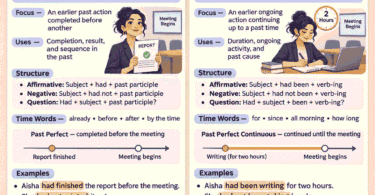
Structure: Subject + had + past participle
The past perfect identifies an action or state that came before another past event or reference point. Consequently, it helps clarify the order of two past situations.
- She had finished before the meeting began.
- They had left when I arrived.
- I had never seen snow before that trip.
- By noon, we had completed the inspection.
- He felt relieved because he had passed the test.
When words such as before or after already make the order obvious, speakers sometimes use the past simple for both actions. Nevertheless, the past perfect remains useful when the earlier event needs emphasis.
Past Perfect Continuous
Structure: Subject + had been + verb-ing
The past perfect continuous emphasizes an activity or its duration before a later past point. It can also explain the cause of a past condition or visible result.
- She had been working for three hours when I arrived.
- They had been waiting since morning.
- It had been raining, so the road was wet.
- He felt tired because he had been running.
- We had been traveling for days before we reached the village.
This form focuses on the activity or length of time. In contrast, the past perfect often emphasizes a completed result.
Four Future Tense Forms
Traditional grammar groups four principal constructions under the label future tense. All four use will, but each expresses a different aspect.
Future Simple
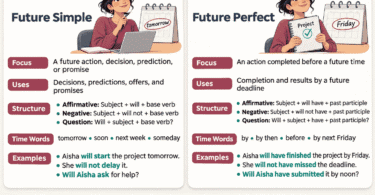
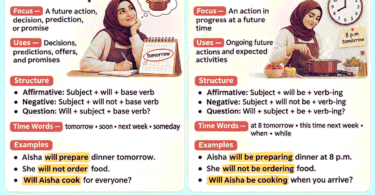
Structure: Subject + will + base verb
The future simple expresses predictions, spontaneous decisions, promises, offers, willingness, and future facts.
- She will work tomorrow.
- I think it will rain.
- The phone is ringing; I will answer it.
- We will help you with the project.
- The results will appear next week.
The main verb remains in its base form after will. Therefore, will goes, will worked, and will arrived are incorrect.
Future Continuous
Structure: Subject + will be + verb-ing
The future continuous describes an activity that will be in progress at a particular future moment. It can also describe an expected routine or ask politely about another person’s plans.
- She will be working at eight tomorrow.
- This time next week, we will be traveling.
- He will be staying at the same hotel.
- They will be having lunch when you call.
- Will you be using the car tonight?
Compared with Will you use the car?, the question Will you be using the car? often sounds less direct because it asks about an expected plan rather than requesting a decision.
Future Perfect
Structure: Subject + will have + past participle
The future perfect describes an action that will be complete before a stated future time, deadline, or event.
- She will have finished by noon.
- They will have left before we arrive.
- By Friday, we will have completed the project.
- He will have saved enough money by December.
- The team will have played ten matches by the end of the month.
Expressions such as by, by then, by the time, and before frequently accompany this form because they establish the future deadline.
Future Perfect Continuous
Structure: Subject + will have been + verb-ing
The future perfect continuous emphasizes how long an activity will have continued before a future reference point.
- By noon, she will have been working for four hours.
- Next May, they will have been living here for ten years.
- When the bus arrives, we will have been waiting for an hour.
- By sunset, he will have been driving all day.
- In June, I will have been teaching at this school for five years.
Although this form is less common in everyday conversation, it is useful when duration before a future point matters.
Past and Future Tense Structure Comparison
The auxiliary verbs reveal both time viewpoint and aspect. Learning the complete verb phrase therefore makes sentence formation easier.
| Form Pair | Past Structure | Future Structure |
|---|---|---|
| Simple | subject + past form | subject + will + base verb |
| Continuous | subject + was/were + verb-ing | subject + will be + verb-ing |
| Perfect | subject + had + past participle | subject + will have + past participle |
| Perfect continuous | subject + had been + verb-ing | subject + will have been + verb-ing |
Here are all eight forms with the verb work:
| Form | Example |
|---|---|
| Past simple | She worked. |
| Future simple | She will work. |
| Past continuous | She was working. |
| Future continuous | She will be working. |
| Past perfect | She had worked. |
| Future perfect | She will have worked. |
| Past perfect continuous | She had been working. |
| Future perfect continuous | She will have been working. |
Past Simple vs Future Simple
The past simple reports an action, state, or habit located in a finished past period. In contrast, the future simple presents a prediction, decision, promise, or expected event after now.
| Past Simple | Future Simple |
|---|---|
| She worked yesterday. | She will work tomorrow. |
| They traveled last year. | They will travel next year. |
| He called me last night. | He will call me tonight. |
| We did not attend the meeting. | We will not attend the meeting. |
| Did she arrive early? | Will she arrive early? |
The past simple often changes the main verb:
- work → worked
- take → took
- go → went
The future simple, however, always uses the base verb after will:
- will work
- will take
- will go
Past habits can also use used to:
- We used to play outside every evening.
Future habits or routines may use will when the speaker predicts or expects them:
- During the holidays, we will play outside every evening.
Past Continuous vs Future Continuous
Both continuous forms present an unfolding activity. The difference lies in the reference point.
| Past Continuous | Future Continuous |
|---|---|
| I was studying at eight last night. | I will be studying at eight tomorrow night. |
| She was traveling at this time yesterday. | She will be traveling at this time tomorrow. |
| They were having lunch when I called. | They will be having lunch when I call. |
| Were you using the computer? | Will you be using the computer? |
| We were staying with relatives. | We will be staying with relatives. |
The past continuous often interacts with the past simple:
- I was walking home when it began to rain.
The future continuous often interacts with the present simple in a future time clause:
- I will be walking home when the class ends.
In both cases, the continuous form establishes the ongoing activity, while the other clause identifies the reference event.
Past Perfect vs Future Perfect
Both perfect forms describe completion before a reference point. However, the past perfect looks backward from a past point, whereas the future perfect looks ahead to completion before a future point.
| Past Perfect | Future Perfect |
|---|---|
| She had finished before the meeting began. | She will have finished before the meeting begins. |
| They had left by noon. | They will have left by noon. |
| I had completed the course before I applied. | I will have completed the course before I apply. |
| Had he arrived by then? | Will he have arrived by then? |
| We had saved enough by June. | We will have saved enough by June. |
Notice the verb in the time clause:
- She had finished before the meeting began.
- She will have finished before the meeting begins.
The first sentence uses two past viewpoints. The second refers to the future, but the clause after before uses the present simple rather than will.
Past Perfect Continuous vs Future Perfect Continuous
These forms emphasize activity and duration before different endpoints.
| Past Perfect Continuous | Future Perfect Continuous |
|---|---|
| She had been working for three hours when I arrived. | She will have been working for three hours when I arrive. |
| They had been living there for a decade. | They will have been living there for a decade. |
| We had been waiting since noon. | We will have been waiting since noon. |
| Had he been studying for long? | Will he have been studying for long? |
| It had been raining for hours. | It will have been raining for hours. |
The past form views the duration from a later past moment. By comparison, the future form imagines the accumulated duration at a future moment.
Affirmative, Negative, and Question Forms
In negative sentences, not follows the first auxiliary. In questions, the first auxiliary moves before the subject. The following tables show the complete patterns.
Simple Forms
| Sentence Type | Past Simple | Future Simple |
|---|---|---|
| Affirmative | She worked. | She will work. |
| Negative | She did not work. | She will not work. |
| Question | Did she work? | Will she work? |
| Short answer | Yes, she did. | Yes, she will. |
After did or did not, use the base verb. Therefore, say Did she work?, not Did she worked?
Continuous Forms
| Sentence Type | Past Continuous | Future Continuous |
|---|---|---|
| Affirmative | They were studying. | They will be studying. |
| Negative | They were not studying. | They will not be studying. |
| Question | Were they studying? | Will they be studying? |
| Short answer | Yes, they were. | Yes, they will. |
Perfect Forms
| Sentence Type | Past Perfect | Future Perfect |
|---|---|---|
| Affirmative | He had finished. | He will have finished. |
| Negative | He had not finished. | He will not have finished. |
| Question | Had he finished? | Will he have finished? |
| Short answer | Yes, he had. | Yes, he will. |
Perfect Continuous Forms
| Sentence Type | Past Perfect Continuous | Future Perfect Continuous |
|---|---|---|
| Affirmative | She had been working. | She will have been working. |
| Negative | She had not been working. | She will not have been working. |
| Question | Had she been working? | Will she have been working? |
| Short answer | Yes, she had. | Yes, she will. |
Contractions are common in natural English:
- did not → didn’t
- had not → hadn’t
- will not → won’t
- will → ’ll
Regular and Irregular Past Verb Forms
The past simple and past participle of regular verbs normally end in -ed. Nevertheless, spelling changes may occur.
Regular Past Forms
| Base Verb | Past Form | Spelling Rule |
|---|---|---|
| work | worked | Add -ed |
| live | lived | Add -d after final e |
| study | studied | Change consonant + y to -ied |
| stop | stopped | Double the final consonant and add -ed |
Irregular verbs do not follow one standard pattern. Learners should therefore study the base form, past form, and past participle together.
Irregular Past Forms
| Base Verb | Past Form | Past Participle | Future Form |
|---|---|---|---|
| go | went | gone | will go |
| see | saw | seen | will see |
| write | wrote | written | will write |
| eat | ate | eaten | will eat |
| take | took | taken | will take |
| begin | began | begun | will begin |
| speak | spoke | spoken | will speak |
| choose | chose | chosen | will choose |
| come | came | come | will come |
| know | knew | known | will know |
Irregularity affects the past form and past participle. However, the verb after will always remains in its base form. Thus, will go is correct, while will went is not.
Main Uses of Will
Although will commonly refers to future time, its meaning depends on context.
Predictions
Use will for predictions based on opinions, beliefs, or expectations:
- I think it will rain.
- The team will probably win.
- Prices will increase next year.
Spontaneous Decisions
Use will for a decision made at the moment of speaking:
- The phone is ringing. I will answer it.
- I am thirsty. I will get some water.
- We need more chairs. I will bring them.
Promises
- I will call you tonight.
- We will not tell anyone.
- I will return the book tomorrow.
Offers
- I will carry that bag for you.
- We will help you with the project.
- I will make some tea.
Requests
- Will you close the window?
- Will you send me the document?
- Will you wait here for a moment?
Willingness and Refusal
- She will gladly assist you.
- I will do whatever I can.
- The car will not start.
- He will not listen to advice.
In the last two examples, will not can express refusal or failure to function rather than a neutral future prediction.
Will vs Going To
Both will and be going to can refer to future time. However, they often present the situation differently.
| Will | Be Going To |
|---|---|
| Spontaneous decision | Prior intention |
| Opinion-based prediction | Evidence-based prediction |
| Promise or offer | Existing plan |
| I’ll call her now. | I’m going to call her tonight. |
| I think it will rain. | Look at those clouds. It’s going to rain. |
| I’ll help you. | We’re going to renovate the kitchen. |
Compare these decisions:
- The bags look heavy. I’ll help you.
The speaker decides at that moment. - I’m going to help my brother move on Saturday.
The speaker already has a plan.
For predictions, going to often highlights present evidence:
- Look at that child near the puddle. He is going to fall.
By contrast, will commonly introduces an opinion:
- I think he will become a great athlete.
Sometimes both forms are possible, and the difference is small. Therefore, context matters more than a rigid signal-word rule.
Other Ways to Express Future Time
English uses several structures besides will.
Present Continuous for Arrangements
Use the present continuous for an organized personal arrangement:
- We are meeting the client tomorrow.
- She is flying to Islamabad next week.
- I am having lunch with Ali on Friday.
The arrangement often involves another person, a confirmed time, or a specific place.
Present Simple for Schedules
Use the present simple for timetables, programs, and fixed schedules:
- The train leaves at six.
- The course begins next Monday.
- The film starts at eight tonight.
Be About To for the Immediate Future
Use be about to when something will happen very soon:
- The film is about to start.
- The baby is about to fall asleep.
- We are about to leave.
Be Due To for Expected Events
Use be due to for a scheduled or expected event:
- The flight is due to arrive at nine.
- The report is due to be published tomorrow.
- The guests are due to leave after lunch.
These constructions show why future time cannot be reduced to will alone.
Future Time Clauses
After conjunctions such as when, before, after, until, as soon as, once, and if, English normally uses a present form to refer to the future. The main clause can still contain will.
- I will call you when I arrive.
- She will leave after she finishes.
- We will wait until the rain stops.
- They will begin as soon as everyone is ready.
- I will tell him if I see him.
- Once she has completed the form, she will submit it.
Common corrections include:
- Incorrect: I will call you when I will arrive.
Correct: I will call you when I arrive. - Incorrect: We will leave after she will finish.
Correct: We will leave after she finishes. - Incorrect: I will wait until he will return.
Correct: I will wait until he returns.
This rule applies when the subordinate clause functions as a time or condition clause. However, will can appear after when in a direct or indirect question:
- When will she arrive?
- Do you know when she will arrive?
Past Forms with Non-Past Meanings
Past forms do not always locate a situation in past time. They can create psychological or social distance.
Hypothetical Situations
- If I had more money, I would travel.
- If she knew the answer, she would tell us.
- Suppose the plan failed. What would we do?
Here, the past forms describe unreal or unlikely present and future situations.
Wishes
- I wish I knew the answer.
- He wishes he lived closer.
- We wish the weather were warmer.
The past form shows that present reality differs from the wish.
Polite Language
- I wanted to ask about the course.
- Did you need any assistance?
- I wondered if you could help me.
The speaker may still be asking now. Nevertheless, the past form makes the request less direct and often more polite.
Future in the Past
Future-in-the-past constructions describe events that were still in the future from an earlier past viewpoint.
Would and Would Not
Use would + base verb when reporting a future event from a past perspective:
- She said she would call.
- He promised that he would help.
- They knew the journey would take several hours.
- I thought the weather would improve.
Was and Were Going To
Use was/were going to for a past plan or prediction:
- I was going to leave, but the meeting continued.
- They were going to travel, but they changed their plans.
- We knew the road was going to close.
This form often describes an intention that did not happen, although context determines the final meaning.
Was and Were About To
- We were about to start when the power failed.
- She was about to speak when the phone rang.
- I was about to call you.
Past Continuous for Arrangements
- He said he was meeting the director the next day.
- They told us they were leaving on Friday.
- I knew she was flying home that weekend.
These examples show how future meaning can be viewed from a past reference point.
Past and Future Time Expressions
Time expressions often provide useful clues, but they do not determine tense by themselves.
| Past-Time Expressions | Future-Time Expressions |
|---|---|
| yesterday | tomorrow |
| last week | next week |
| ago | soon |
| in 2020 | in two days |
| then | later |
| at that time | this time tomorrow |
| before | by Friday |
| by the time | by then |
Examples:
- She left yesterday.
- They were living abroad at that time.
- We had finished by noon.
- She will return tomorrow.
- This time tomorrow, we will be flying.
- They will have completed the work by Friday.
Words such as before, by, and when can occur with both past and future forms. Therefore, the reference point and context remain essential.
Past and Future Forms in Passive Voice
The passive voice focuses on the action or receiver rather than the performer. Form it with the appropriate form of be followed by a past participle.
| Active Form | Passive Form |
|---|---|
| They cleaned the room. | The room was cleaned. |
| They will clean the room. | The room will be cleaned. |
| They were repairing the road. | The road was being repaired. |
| They had completed the project. | The project had been completed. |
| They will have completed the project. | The project will have been completed. |
Future continuous passive forms such as will be being repaired are grammatically possible. However, they often sound heavy. A natural active sentence usually communicates the idea more clearly:
- Heavy: The road will be being repaired tomorrow.
- Natural: Workers will be repairing the road tomorrow.
Tense Consistency and Meaningful Shifts
Clear writing maintains a logical time viewpoint. Nevertheless, a shift from past to future is correct when the time genuinely changes.
Correct shifts:
- She finished the design yesterday and will present it tomorrow.
- They signed the agreement last week, and construction will begin next month.
- I missed the first session, but I will attend the next one.
Unclear or incorrect shift:
- Incorrect: She finished the design yesterday and presents it tomorrow.
- Correct: She finished the design yesterday and will present it tomorrow.
A tense shift should reflect a meaningful change in time, reference point, or perspective rather than an accidental change in verb form.
Common Past and Future Tense Mistakes
The most frequent errors involve incorrect main verbs, unnecessary will in time clauses, and confusion between perfect forms.
- Incorrect: She didn’t went home.
Correct: She didn’t go home. - Incorrect: They will arrived tomorrow.
Correct: They will arrive tomorrow. - Incorrect: I will call you when I will arrive.
Correct: I will call you when I arrive. - Incorrect: He had completed it tomorrow.
Correct: He will have completed it by tomorrow. - Incorrect: She will can attend.
Correct: She will be able to attend. - Incorrect: They will be work at eight.
Correct: They will be working at eight. - Incorrect: We had been waited for an hour.
Correct: We had been waiting for an hour. - Incorrect: He will has finished by noon.
Correct: He will have finished by noon. - Incorrect: Did she went to work?
Correct: Did she go to work? - Incorrect: They will have went home.
Correct: They will have gone home.
To prevent these errors, first identify the reference point. Next, decide whether the focus falls on a complete event, an ongoing activity, prior completion, or duration. Finally, select the appropriate auxiliary and main verb form.
Past and Future Form Selection Guide
Use the following table to match meaning with form:
| Intended Meaning | Recommended Form | Example |
|---|---|---|
| Completed past action | Past simple | She called yesterday. |
| Former habit or state | Past simple | We lived near the station. |
| Activity in progress at a past point | Past continuous | I was sleeping at midnight. |
| Action completed before another past event | Past perfect | They had left before I arrived. |
| Duration before a past point | Past perfect continuous | She had been waiting for an hour. |
| Prediction, promise, or immediate decision | Future simple | I will help you. |
| Activity in progress at a future point | Future continuous | I will be working at noon. |
| Completion before a future deadline | Future perfect | I will have finished by Friday. |
| Duration until a future point | Future perfect continuous | I will have been working for six hours. |
| Prior intention | Be going to | We are going to renovate the kitchen. |
| Fixed personal arrangement | Present continuous | I am meeting Sara tomorrow. |
| Timetabled future event | Present simple | The train leaves at six. |
| Future event viewed from the past | Would or was/were going to | She said she would call. |
Follow this sequence when choosing a form:
- Identify whether the reference point lies in the past or future.
- Decide whether the situation is complete, ongoing, earlier than another event, or duration-focused.
- Check whether a future plan already exists or arises at the moment of speaking.
- Select the correct auxiliary verb.
- Check the main verb: base form, verb-ing form, or past participle.
- Review any time clause to ensure that it uses an appropriate present form.
Key Points to Remember
- Past forms generally describe situations before now.
- Future constructions generally describe situations expected after now.
- The simple aspect presents an event as a whole.
- The continuous aspect emphasizes an activity in progress.
- The perfect aspect shows completion before a reference point.
- The perfect continuous aspect emphasizes duration before a reference point.
- Use the base verb after did and will.
- Use a past participle after had and will have.
- Use will for predictions, spontaneous decisions, promises, and offers.
- Use be going to for prior intentions and evidence-based predictions.
- Do not normally use will in future time clauses after when, before, after, and until.
- Use would or was/were going to for future situations viewed from the past.
- Change tense only when the time or reference point genuinely changes.
FAQs
Past tense generally describes actions, events, and states located before now. In contrast, future constructions describe situations expected to happen after now or after another stated reference point. Aspect adds further meaning by showing whether the situation is simple, continuing, completed, or duration-focused.
The four past forms are past simple, past continuous, past perfect, and past perfect continuous. The four conventional future forms are future simple, future continuous, future perfect, and future perfect continuous. Each future form corresponds to a past form with the same aspect but a different reference point.
Traditional grammar uses the term future tense, but English has no special future verb ending. Instead, it expresses future time with constructions such as will, be going to, present continuous, and present simple. The conventional four-form model remains helpful for learners as long as they understand that will is not the only future construction.
Will commonly expresses spontaneous decisions, promises, offers, and opinion-based predictions. In contrast, be going to commonly expresses prior intentions and predictions based on present evidence. Nevertheless, some contexts allow either form with only a small difference in emphasis.
Yes. Past forms can express unreal present or future situations, wishes, hypothetical conditions, and polite distance. For example, If I had more time, I would travel uses a past form to describe an unreal present condition and its imagined future result.
You May Also Like

Leave a Comment