
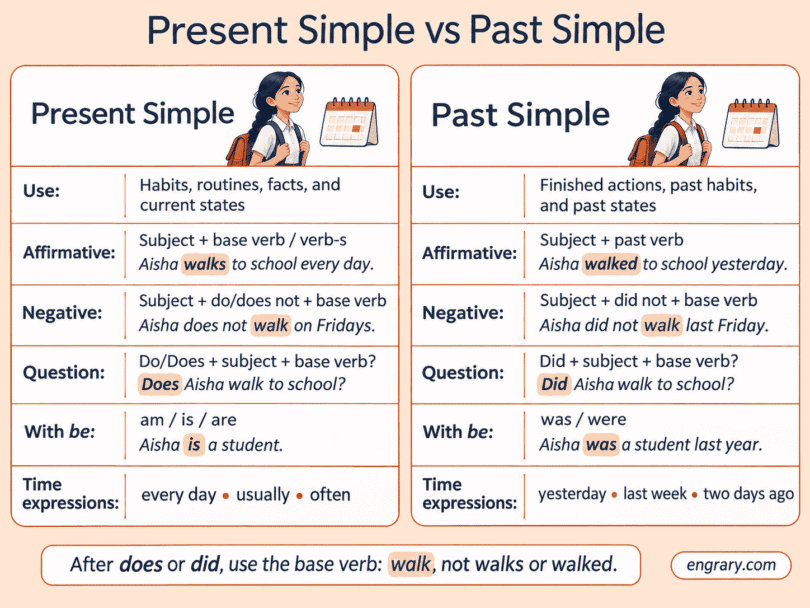
Present simple describes current habits, general truths, and present situations. Past simple describes events, habits, and states in a past context. For example, “She works here” describes her current situation, while “She worked here last year” places the work in the past.
The two tenses also use different verb forms and auxiliaries. This guide compares their uses, regular and irregular forms, negatives, questions, and short answers.
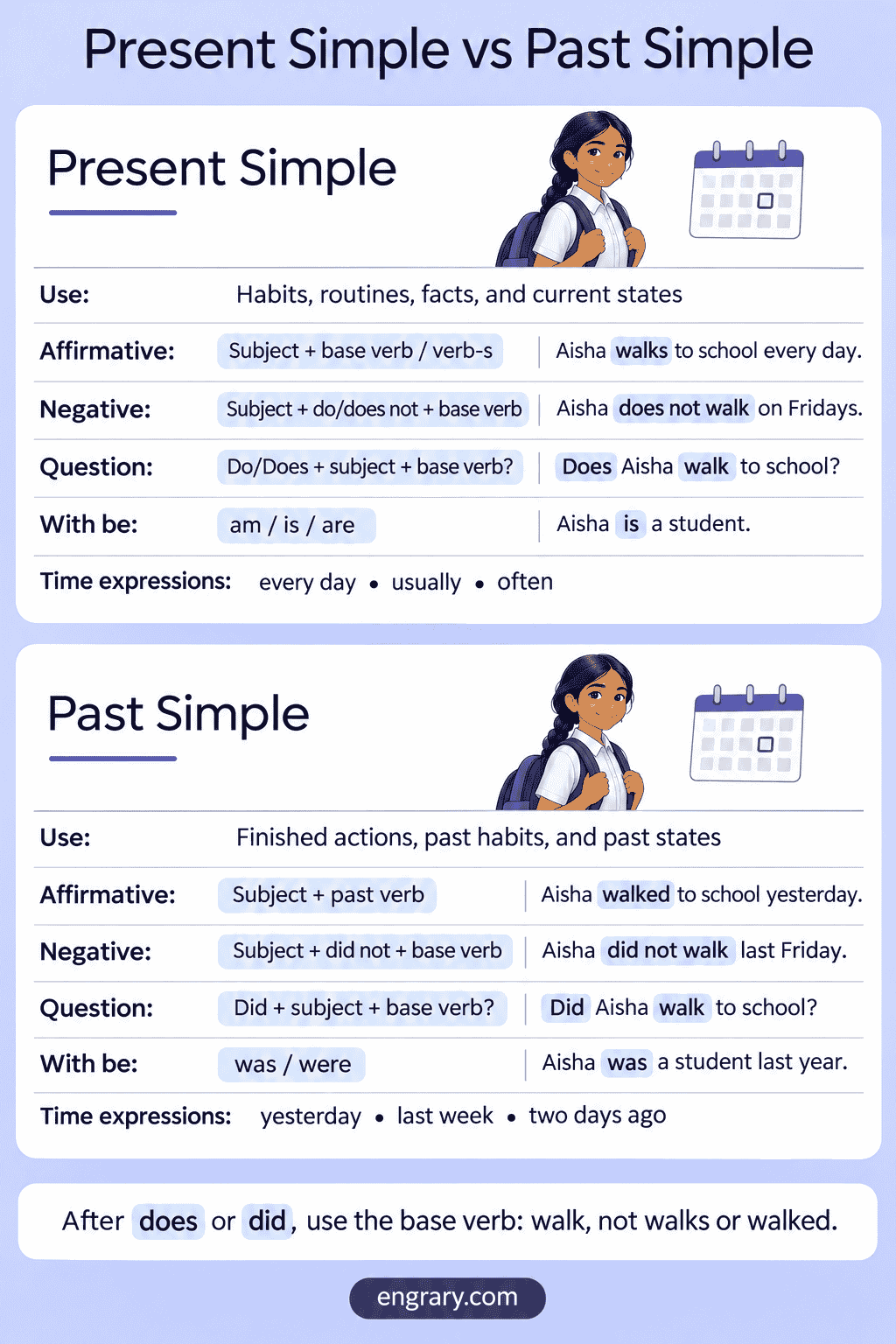
Present Simple and Past Simple at a Glance
You may also see the names simple present and simple past. These refer to the same two tenses.
| Feature | Present simple | Past simple |
|---|---|---|
| Main uses | Current habits, facts, and states | Past events, habits, and states |
| Habit | I walk to school every day. | I walked to school every day last year. |
| Situation | She works at a hospital. | She worked at a hospital in 2020. |
| Affirmative form | He plays tennis. | He played tennis. |
| Negative form | He doesn’t play tennis. | He didn’t play tennis. |
| Question form | Does he play tennis? | Did he play tennis? |
| Forms of be | am, is, are | was, were |
Both tenses can describe repeated actions. Therefore, the main difference is usually the time context, rather than whether something happens once or regularly.
Main Uses of Present Simple and Past Simple
Current Habits and Routines
Use present simple for actions that happen regularly in your current life.
- I drink tea every morning.
- Sara takes the bus to work.
- We visit our grandparents on Sundays.
- My brother plays cricket after school.
These sentences describe routines. However, they do not necessarily describe what someone is doing at the moment of speaking.
General Truths and Present States
Present simple also expresses general truths, opinions, possession, and current situations.
- The Earth orbits the Sun.
- I like this song.
- He has two sisters.
- They live near the station.
- She knows the answer.
A present situation does not need to be permanent. For example, “They live near the station” describes their current home, even if they plan to move later.
Past Events and Sequences
Use past simple for events that happened before now.
- I met Sara yesterday.
- They arrived late last night.
- We bought a new table last week.
- He called me earlier today.
Past simple can also present a sequence of events:
She opened the door, entered the room, and sat down.
Here, the verbs move the story from one event to the next.
You do not need to state the past time in every sentence. Instead, the surrounding conversation can establish it:
How was your trip?
We enjoyed it. We visited several museums and tried some local food.
Past Habits and States
Past simple also describes repeated actions and states within a past period.
- We played cricket every Friday last summer.
- She worked at the library for two years.
- I knew the answer during the test.
- They owned a small shop when I was a child.
Therefore, past simple is not limited to short actions or single events.
Present Simple and Past Simple Structures
The base form is the verb without endings, such as work, go, or study.
With most verbs, present simple uses the base form for I, you, we, and they. However, it adds -s or -es for he, she, and it.
Past simple uses a regular -ed form or an irregular past form.
| Sentence type | Present simple structure | Past simple structure |
|---|---|---|
| Affirmative | Subject + base verb or verb-s/-es | Subject + past form |
| Negative | Subject + do/does not + base verb | Subject + did not + base verb |
| Question | Do/Does + subject + base verb? | Did + subject + base verb? |
Compare the structures in complete sentences:
| Present simple | Past simple |
|---|---|
| I work here. | I worked here. |
| She works here. | She worked here. |
| I don’t work here. | I didn’t work here. |
| She doesn’t work here. | She didn’t work here. |
| Do you work here? | Did you work here? |
| Does she work here? | Did she work here? |
Unlike present-simple agreement, the ordinary past form stays the same across subjects: I worked, she worked, we worked, and they worked.
Am, Is, and Are vs Was and Were
The verb be follows a different pattern. It forms ordinary questions and negatives without do, does, or did.
| Subject | Present simple | Past simple |
|---|---|---|
| I | am | was |
| He, she, it | is | was |
| You, we, they | are | were |
Affirmative Sentences with Be
| Present simple | Past simple |
|---|---|
| I am tired. | I was tired yesterday. |
| She is at home. | She was at home last night. |
| They are ready. | They were ready before lunch. |
Negative Sentences with Be
Place not directly after the form of be.
| Present simple | Past simple |
|---|---|
| I am not busy. | I was not busy. |
| He is not late. | He was not late. |
| We are not tired. | We were not tired. |
Common contractions include I’m not, isn’t, aren’t, wasn’t, and weren’t.
Questions with Be
Move the form of be before the subject.
| Present simple | Past simple |
|---|---|
| Am I early? | Was I early? |
| Is she ready? | Was she ready? |
| Are they outside? | Were they outside? |
Say “Were you tired?”, rather than “Did you were tired?”
Regular and Irregular Verb Changes
Present-Simple Endings
For he, she, and it, follow these common spelling patterns.
| Pattern | Base form | Third-person present |
|---|---|---|
| Usually add -s | work | works |
| Add -es after endings such as -sh and -ch | wash; watch | washes; watches |
| Change consonant + y to -ies | study | studies |
| Keep y after a vowel and add -s | play | plays |
| Learn common exceptional forms | have; do; go | has; does; goes |
For example, write “She studies English”, but “They study English.”
Regular Past-Simple Endings
Regular verbs usually take -ed, although spelling sometimes changes.
| Pattern | Base form | Past simple |
|---|---|---|
| Usually add -ed | work | worked |
| Add -d after final -e | live | lived |
| Change consonant + y to -ied | study | studied |
| Keep y after a vowel and add -ed | play | played |
| Double the final consonant in short verbs such as stop | stop | stopped |
Regular -ed has three common pronunciations:
- /t/ after a voiceless sound other than /t/: worked, washed.
- /d/ after a voiced sound other than /d/: played, cleaned.
- /ɪd/ after /t/ or /d/: wanted, needed.
Only the last group adds an extra syllable.
Common Irregular Verbs
Irregular verbs do not follow the usual -ed pattern.
| Base form | Third-person present | Past simple |
|---|---|---|
| go | goes | went |
| have | has | had |
| do | does | did |
| eat | eats | ate |
| see | sees | saw |
| take | takes | took |
| write | writes | wrote |
| buy | buys | bought |
| know | knows | knew |
| read | reads | read |
Present read sounds like reed. In contrast, past read sounds like red, although the spelling remains the same.
Verbs with Identical Present and Past Forms
Some verbs keep both their spelling and pronunciation in the past. Consequently, context helps identify the tense.
| Verb | Present simple | Past simple |
|---|---|---|
| put | I put my keys here every evening. | I put my keys here yesterday. |
| cut | They cut the grass every Friday. | They cut the grass last Friday. |
| hit | They hit the ball hard during practice. | They hit the ball hard yesterday. |
The third-person present still changes: she puts, she cuts, and she hits.
Current Habits and Past Habits
Both tenses can describe routines. Present simple places the routine in your current life, while past simple places it within a past context.
| Current habit | Past habit |
|---|---|
| I walk to work every day. | I walked to work every day last summer. |
| She usually brings lunch. | She usually brought lunch when she worked here. |
| We visit our cousins on Fridays. | We visited our cousins on Fridays during the holidays. |
| He often reads before bed. | He often read before bed when he was younger. |
Expressions such as every day, usually, and often can accompany either tense. Therefore, look at the whole sentence before choosing the verb form.
Frequency Adverb Position
Words such as usually, often, always, and never normally appear before an ordinary main verb. However, they usually follow be.
| Pattern | Present simple | Past simple |
|---|---|---|
| Before an ordinary verb | She usually walks home. | She usually walked home. |
| After be | She is usually early. | She was usually early. |
| With never | He never calls me. | He never called me. |
Because never already carries a negative meaning, standard English uses “He never called”, rather than “He didn’t never call.”
Past Simple and Used To
Both past simple and used to can describe past habits, but their emphasis differs.
| Form | Example | Emphasis |
|---|---|---|
| Past simple | I walked to school every day that summer. | A habit during a past period |
| Used to | I used to walk to school. | A former habit, normally understood as no longer current |
Use used to when the contrast with the present matters. However, ordinary past simple is enough to describe a routine within an established past period.
Negative Sentences with Both Tenses
With ordinary verbs, use don’t or doesn’t in present simple and didn’t in past simple.
| Subject | Present simple negative | Past simple negative |
|---|---|---|
| I, you, we, they | don’t work | didn’t work |
| He, she, it | doesn’t work | didn’t work |
After does, doesn’t, did, and didn’t, use the base form of the main verb.
- She doesn’t like coffee.
- She didn’t like the coffee yesterday.
- He doesn’t have a car.
- He didn’t have a car last year.
- They don’t go there often.
- They didn’t go there last week.
The auxiliary carries the grammatical information. Therefore, do not add a third-person ending or past ending to the main verb.
Do and Have as Main Verbs
The verbs do and have can carry the main meaning of a sentence. In that case, they can appear after an auxiliary.
| Present simple | Past simple |
|---|---|
| She does her homework after dinner. | She did her homework after dinner. |
| She doesn’t do the shopping. | She didn’t do the shopping. |
| Does he have a car? | Did he have a car? |
| Does she do her homework? | Did she do her homework? |
In “Did she do her homework?”, did forms the question, while do describes the activity.
Questions and Short Answers
Yes-or-No Questions
Use do with I, you, we, and they. Use does with he, she, and it. For past simple, use did with every subject.
| Present simple | Past simple |
|---|---|
| Do you play tennis? | Did you play tennis yesterday? |
| Does she drive to work? | Did she drive to work yesterday? |
| Do they know the answer? | Did they know the answer? |
Remember that be forms questions directly: “Is he ready?” and “Was he ready?”
Positive and Negative Short Answers
Match the auxiliary or form of be in the question.
| Question | Positive answer | Negative answer |
|---|---|---|
| Do you work here? | Yes, I do. | No, I don’t. |
| Does she work here? | Yes, she does. | No, she doesn’t. |
| Did they work here? | Yes, they did. | No, they didn’t. |
| Are you ready? | Yes, I am. | No, I’m not. |
| Is he ready? | Yes, he is. | No, he isn’t. |
| Was she ready? | Yes, she was. | No, she wasn’t. |
| Were they ready? | Yes, they were. | No, they weren’t. |
Information Questions
Place words such as where, when, why, and how before the auxiliary.
- Where do you live?
- Where did you live last year?
- When does the shop open?
- When did the shop open yesterday?
- Why does she walk to work?
- Why did she walk to work yesterday?
Subject and Object Questions
Ordinary affirmative subject questions do not need do, does, or did.
| Question type | Present simple | Past simple |
|---|---|---|
| Subject question | Who calls Sara? | Who called Sara? |
| Object question | Who does Sara call? | Who did Sara call? |
In “Who called Sara?”, the question asks who performed the action. By contrast, “Who did Sara call?” asks about the person receiving the call.
Time Expressions with Present and Past Simple
Time expressions help establish context, but they do not always determine the tense by themselves.
| Expression | Present-simple example | Past-simple example |
|---|---|---|
| every day | I exercise every day. | I exercised every day last summer. |
| usually | She usually walks home. | She usually walked home when she lived nearby. |
| on Sundays | We visit them on Sundays. | We visited them on Sundays during our holiday. |
| now / yesterday | I understand now. | I understood the explanation yesterday. |
| these days / years ago | He works locally these days. | He worked abroad years ago. |
Common past-time expressions include:
- Yesterday
- Last night
- Last week
- Two days ago
- In 2020
- When I was younger
However, a period does not need to be over for you to describe an earlier completed event within it:
I called her earlier today.
The call happened before now, even though today continues.
Similarly, now does not always require present continuous. States such as “I understand now” and “I need help now” naturally use present simple.
Present Simple and Actions Happening Now
Present simple often describes routines, whereas present continuous commonly describes activities in progress at the moment.
| Meaning | Form | Example |
|---|---|---|
| Current habit | Present simple | I cook dinner every evening. |
| Activity in progress now | Present continuous | I am cooking dinner now. |
| Past event | Past simple | I cooked dinner yesterday. |
However, state verbs such as know, need, like, and understand commonly use simple forms even when the state applies right now.
For example, say “I need help”, rather than “I am needing help” in ordinary usage.
Using Both Tenses in the Same Sentence
A sentence can correctly combine present simple and past simple when it refers to different times.
- I work from home now, but I worked in an office last year.
- She lives in Karachi, but she grew up in Lahore.
- I know the answer now because the teacher explained it yesterday.
- He owns the shop that his father opened in 1995.
Each tense contributes a different time perspective. Therefore, keeping every verb in the same tense would sometimes change the intended meaning.
Past Statements and Present Truth
A past statement does not always mean that its content is no longer true.
She liked the course when we spoke yesterday. She may still like it now.
The first sentence reports her attitude at a past moment. It does not tell us whether that attitude has changed.
Compare these examples:
| Sentence | What it establishes |
|---|---|
| She likes the course. | Her current attitude |
| She liked the course when we spoke yesterday. | Her attitude at that past moment |
| She used to like the course. | A former attitude, normally suggesting a change |
Special Uses Beyond Present and Past Time
The main uses are straightforward, but tense names do not describe every possible meaning.
| Special use | Example | Meaning |
|---|---|---|
| Present simple for schedules | The train leaves at six tomorrow. | A scheduled future event |
| Present simple in storytelling | Suddenly, he opens the door and walks in. | A narrative presented vividly |
| Past simple for a hypothetical situation | If I had more time, I would learn Spanish. | An imagined present situation |
These uses do not change the basic verb forms. However, they show why context matters more than a simple rule that “present always means now” or “past always means before now.”
Emphatic Do, Does, and Did
You can also use do, does, and did in affirmative sentences for emphasis or correction.
| Present simple | Past simple |
|---|---|
| I do agree with you. | I did agree with you. |
| She does work here. | She did work here. |
| He does know the answer. | He did know the answer. |
Even with emphasis, the main verb stays in its base form. Say “She did go”, rather than “She did went.”
Common Mistakes with Present Simple and Past Simple
| Incorrect | Correct | Explanation |
|---|---|---|
| She work here. | She works here. | Add the third-person present ending |
| Does he works here? | Does he work here? | Use the base verb after does |
| Did she went home? | Did she go home? | Use the base verb after did |
| They didn’t played. | They didn’t play. | Use the base verb after didn’t |
| Did you were tired? | Were you tired? | Form the question directly with were |
| He studyed yesterday. | He studied yesterday. | Change consonant + y to -ied |
| She goed home. | She went home. | Use the irregular past form |
| He doesn’t has a car. | He doesn’t have a car. | Use have after doesn’t |
| She don’t like tea. | She doesn’t like tea. | Use doesn’t with she |
| They was late. | They were late. | Use were with they |
Also, avoid choosing a tense only because you see always, usually, or every day. These expressions work with both present and past habits.
Choosing the Correct Tense
First, identify the time perspective. Then check the verb and sentence structure.
- Choose the meaning. Use present simple for current habits, facts, and states. Use past simple for events, habits, and states in a past context.
- Identify the verb type. The verb be follows a different pattern from ordinary verbs.
- Check the subject. Present simple normally adds -s or -es with he, she, and it.
- Check the sentence form. Ordinary questions and negatives use do/does/did with the base verb.
- Read the full context. Time expressions provide clues, but the intended meaning determines the choice.
Frequently Asked Questions
Present simple describes current habits, general truths, and present states or situations. Past simple describes events, habits, and states in a past context. For example, “She works here” describes her current situation, while “She worked here last year” places the work in the past.
Use do with I, you, we, and they, and does with he, she, and it in ordinary present-simple questions and negatives. Use did with every subject in past-simple questions and negatives. The main verb takes its base form, as in “Does she work?” and “Did she work?” However, be forms questions and negatives without these auxiliaries.
Yes. Present simple describes current habits, while past simple describes habits within a past context. Compare “I walk to school every day” with “I walked to school every day when I was younger.” Therefore, expressions such as usually and every day can accompany either tense.
Present simple uses am, is, and are, while past simple uses was and were. In ordinary past statements, use was with I, he, she, and it, and were with you, we, and they. Form questions by placing the verb before the subject: “Is she ready?” becomes “Was she ready?”
Yes. Use both when the sentence refers to different times. For example, “I live in Lahore now, but I lived in Islamabad last year” correctly combines a present situation with a past one. The change in tense makes the time difference clear.
You May Also Like

Leave a Comment