
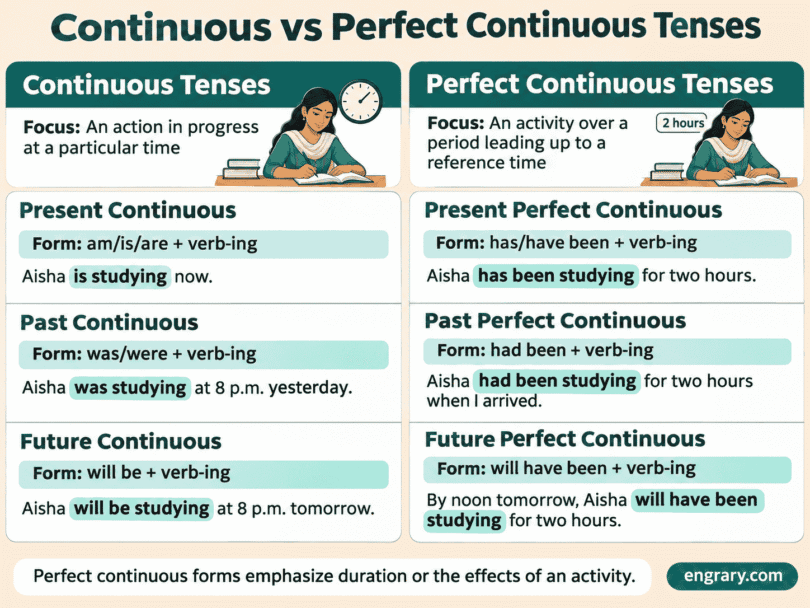
Continuous and perfect continuous tenses describe activities in relation to a present, past, or future reference point. Continuous forms focus on an activity in progress around that point. Perfect continuous forms look back at activity leading up to it, often emphasizing duration or explaining a result.
For example, “I am studying” describes current activity, while “I have been studying for two hours” connects earlier activity to now. This guide explains all three tense pairs, with structures, comparison tables, examples, and common mistakes.
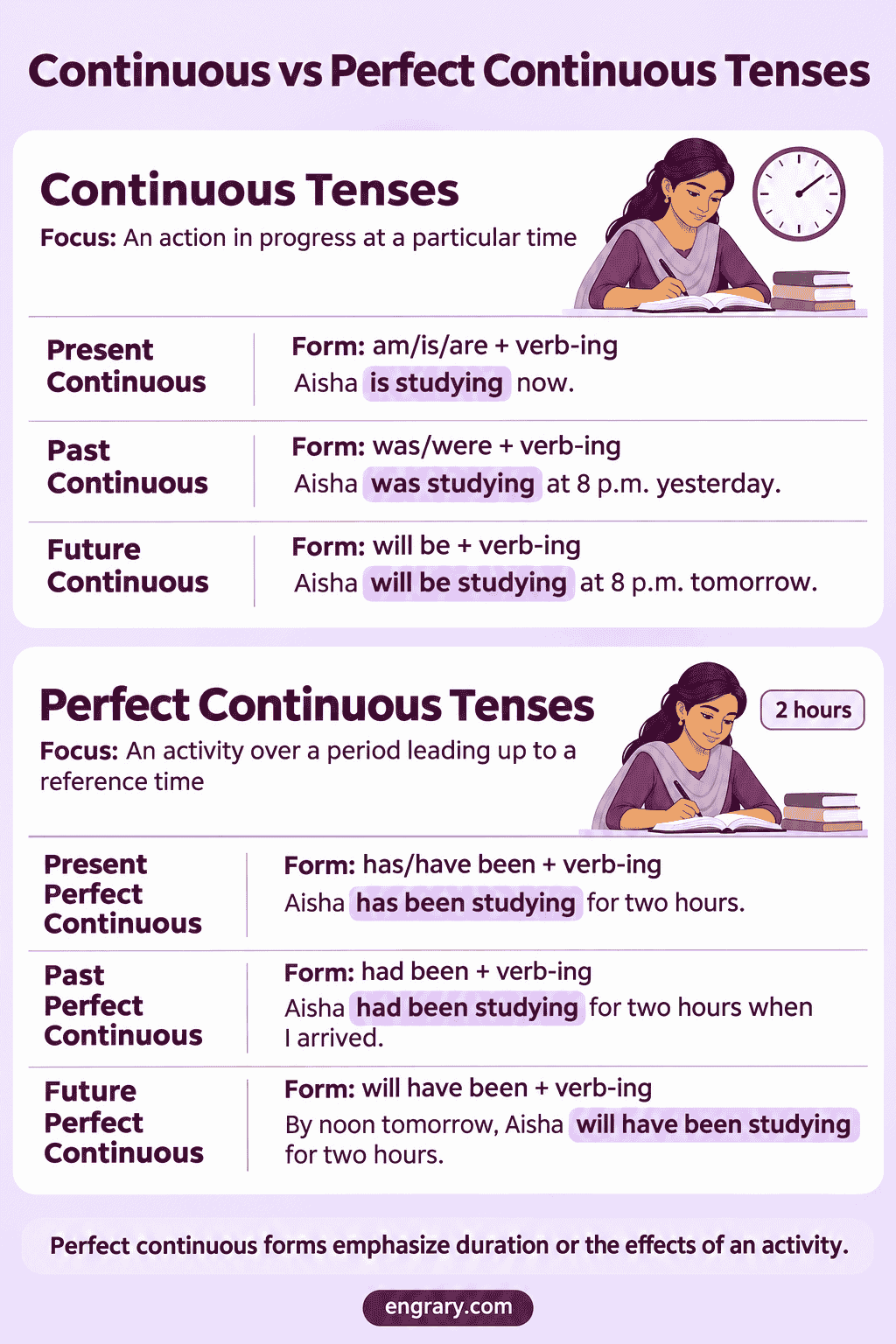
Continuous and Perfect Continuous Tenses at a Glance
Both continuous and perfect continuous forms can describe ongoing activities. However, they present those activities from different perspectives. You may also see the terms progressive and perfect progressive, which mean the same as continuous and perfect continuous.
| Feature | Continuous | Perfect continuous |
|---|---|---|
| Main focus | Activity in progress around a reference point | Earlier activity viewed from a later reference point |
| Common emphasis | What is happening, was happening, or will be happening | How long an activity has continued or how it explains a situation |
| Present example | I am studying now. | I have been studying for two hours. |
| Past example | I was studying when she called. | I had been studying for two hours when she called. |
| Future example | I will be studying at eight. | By eight, I will have been studying for two hours. |
The difference is not simply “unfinished versus finished.” For instance, someone who says “I have been studying for two hours” may still be studying.
Reference Points and Duration
A reference point is the time from which we view an activity. It can be now, a past moment, or a future moment.
| Time frame | Reference point | Example | Meaning |
|---|---|---|---|
| Present | Now | I have been working for three hours. | The work began earlier and leads up to now. |
| Past | A past moment | I had been working for three hours when she arrived. | The work began before her arrival. |
| Future | A future moment | By noon, I will have been working for three hours. | At noon, three hours of work will have accumulated. |
Consider this situation:
I started studying at six. It is eight now. I have been studying for two hours.
Here, now is the reference point, and two hours expresses the duration.
However, perfect continuous does not always need an explicit duration:
You look tired. Have you been running?
Similarly, continuous forms can include duration:
I was studying all afternoon.
Therefore, choose the tense according to the relationship between the activity and the reference point, rather than the presence of a duration phrase alone.
Continuous and Perfect Continuous Structures
Continuous constructions use a form of be + verb-ing. Perfect continuous constructions combine a form of have with been + verb-ing.
| Form | Affirmative structure | Example |
|---|---|---|
| Present continuous | Subject + am/is/are + verb-ing | She is working. |
| Present perfect continuous | Subject + have/has been + verb-ing | She has been working. |
| Past continuous | Subject + was/were + verb-ing | She was working. |
| Past perfect continuous | Subject + had been + verb-ing | She had been working. |
| Future continuous | Subject + will be + verb-ing | She will be working. |
| Future perfect continuous | Subject + will have been + verb-ing | She will have been working. |
Been is the past participle of be. Keep it before the -ing form in every perfect continuous construction.
Subject Agreement
The subject determines the auxiliary in the present and past continuous, as well as the present perfect continuous.
| Subject | Present continuous | Past continuous | Present perfect continuous |
|---|---|---|---|
| I | am working | was working | have been working |
| You, we, they | are working | were working | have been working |
| He, she, it | is working | was working | has been working |
By contrast, had been, will be, and will have been remain the same for every subject.
Common Verb-ing Spellings
| Pattern | Base verb | Verb-ing form |
|---|---|---|
| Usually add -ing | work | working |
| Usually drop a final silent -e | write | writing |
| Double the final consonant in words such as run | run | running |
| Change final -ie to -y | lie | lying |
Present Continuous vs Present Perfect Continuous
Current Activity and Activity Leading Up to Now
The present continuous describes activity happening now or around the present period. In contrast, the present perfect continuous connects earlier activity with the present.
| Present continuous | Present perfect continuous |
|---|---|
| She is painting the kitchen. | She has been painting the kitchen all morning. |
| They are waiting outside. | They have been waiting outside since nine. |
| I am reading your report. | I have been reading your report for an hour. |
| He is learning Spanish. | He has been learning Spanish for six months. |
“She is painting the kitchen” tells us about her current activity. Meanwhile, “She has been painting the kitchen all morning” emphasizes the activity over the period leading up to now.
Neither sentence tells us that she has finished painting the kitchen.
Temporary Situations and Repeated Activities
Both forms can describe temporary situations and repeated activities.
| Present continuous | Present perfect continuous |
|---|---|
| I am staying with my sister this week. | I have been staying with my sister since Monday. |
| He is taking evening classes this term. | He has been taking evening classes since September. |
| We are practicing every evening this month. | We have been practicing every evening for a month. |
The continuous examples focus on current patterns. By comparison, the perfect continuous examples connect those patterns with an earlier starting point or period.
These activities do not need to happen without interruption. For example, evening classes include breaks between lessons.
Recently Stopped Activities and Present Results
Present perfect continuous can also describe an activity that has recently stopped but still explains the present situation.
- Your hands are dirty. Have you been gardening?
- I have been running, so I need some water.
- Her eyes are red because she has been crying.
- We have been moving furniture, so the room looks different.
In these examples, the speaker focuses on evidence or results. The activity itself may already have stopped.
Past Continuous vs Past Perfect Continuous
Activity in Progress at a Past Moment
The past continuous describes an activity in progress around a particular past time.
They were waiting outside when the doors opened.
Here, the waiting was in progress at the moment the doors opened. However, the sentence does not say how long they had already waited.
Activity Leading Up to a Past Moment
The past perfect continuous looks back from a past moment at earlier activity.
They had been waiting outside for an hour when the doors opened.
This sentence emphasizes the hour of waiting before the doors opened.
| Past continuous | Past perfect continuous |
|---|---|
| I was cooking when Maya arrived. | I had been cooking for an hour when Maya arrived. |
| It was raining when we left. | It had been raining for hours when we left. |
| She was practicing at six. | By six, she had been practicing for two hours. |
| He was driving when I called. | He had been driving for three hours when I called. |
The continuous forms show what was happening around the past reference point. In contrast, the perfect continuous forms highlight activity leading up to that point.
Earlier Activities That Explain Past Results
Past perfect continuous also helps explain a later past situation.
- Leo was tired because he had been running.
- The ground was wet because it had been raining.
- My hands hurt because I had been carrying heavy bags.
- She understood the instructions because she had been listening carefully.
The earlier activity may have stopped before the later situation. For instance, Leo may have finished running before someone noticed that he was tired.
Also, a past reference point can come from the surrounding conversation. You do not need to repeat it in every sentence.
Future Continuous vs Future Perfect Continuous
Activity in Progress at a Future Moment
The future continuous describes an activity that will be in progress around a future time.
At noon tomorrow, I will be working.
This sentence tells us what will be happening at noon. It does not specify how long the work will have continued by then.
Duration Accumulated by a Future Moment
The future perfect continuous looks back from a future point at activity leading up to it.
By noon tomorrow, I will have been working for three hours.
Here, noon is the reference point. At that time, the work will have lasted three hours.
| Future continuous | Future perfect continuous |
|---|---|
| At eight, she will be studying. | By eight, she will have been studying for two hours. |
| At noon, we will be driving. | By noon, we will have been driving for four hours. |
| This time next year, he will be teaching here. | By this time next year, he will have been teaching here for ten years. |
| At six, they will be rehearsing. | By six, they will have been rehearsing for an hour. |
The future reference point does not necessarily mark the end of the activity. For example, they may continue rehearsing after six.
Activities That Start in the Future
Future perfect continuous does not require an activity to have started already.
I start work at nine tomorrow. By noon, I will have been working for three hours.
The work starts tomorrow, but it begins before the future reference point of noon.
Alternatively, the activity may already be underway:
By next June, I will have been teaching here for ten years.
In both cases, the tense measures activity leading up to a future point.
Negative Sentences, Questions, and Short Answers
To form a negative, place not after the first auxiliary. To form a yes-or-no question, move the first auxiliary before the subject.
| Form | Negative sentence | Question |
|---|---|---|
| Present continuous | She is not working. | Is she working? |
| Present perfect continuous | She has not been working. | Has she been working? |
| Past continuous | She was not working. | Was she working? |
| Past perfect continuous | She had not been working. | Had she been working? |
| Future continuous | She will not be working. | Will she be working? |
| Future perfect continuous | She will not have been working for long by noon. | Will she have been working for long by noon? |
Common contractions include isn’t, aren’t, wasn’t, weren’t, hasn’t, haven’t, hadn’t, and won’t.
Notice that “She won’t have been working for long by noon” does not necessarily mean she will do no work. Instead, it means that the duration will not be long at that point.
Positive and Negative Short Answers
Use the first auxiliary in the short answer. You do not need to repeat the whole verb phrase.
| Question | Positive answer | Negative answer |
|---|---|---|
| Are you studying? | Yes, I am. | No, I’m not. |
| Have you been studying? | Yes, I have. | No, I haven’t. |
| Was he studying? | Yes, he was. | No, he wasn’t. |
| Had he been studying? | Yes, he had. | No, he hadn’t. |
| Will they be studying? | Yes, they will. | No, they won’t. |
| Will they have been studying for an hour by noon? | Yes, they will. | No, they won’t. |
Information Questions
For most information questions, place the question word or phrase before the auxiliary.
- What are you reading?
- How long have you been reading?
- What were they doing?
- How long had they been waiting when you arrived?
- Where will you be staying?
- How long will you have been living here by June?
However, when who is the subject, keep the usual subject position:
Who has been using my computer?
Time Expressions with Both Forms
Time expressions help establish a reference point, a starting point, or a duration. However, they do not automatically determine the tense.
| Expression | Function | Example |
|---|---|---|
| now | Present reference point | I am working now. |
| at that moment | Past reference point | I was working at that moment. |
| this time tomorrow | Future reference point | I will be working this time tomorrow. |
| for three hours | Duration | I have been working for three hours. |
| since nine | Starting point | I have been working since nine. |
| all morning | Period of activity | I was working all morning. |
| by noon | Point for looking back | By noon, I will have been working for three hours. |
| by the time | Connects a reference point to an event | I had been working for three hours by the time she arrived. |
For and Since
Use for with a length of time and since with a starting point.
| For + duration | Since + starting point |
|---|---|
| for twenty minutes | since ten o’clock |
| for three days | since Monday |
| for six months | since January |
| for several years | since 2020 |
For example:
- We have been waiting for twenty minutes.
- We have been waiting since ten o’clock.
Nevertheless, for does not belong exclusively to perfect continuous:
I will be working for three hours tomorrow.
That sentence describes the planned period of activity. By contrast, “By noon, I will have been working for three hours” measures the duration from a future reference point.
Stative Verbs and Changes in Meaning
Stative verbs express states such as knowledge, possession, and belief. They normally avoid continuous forms when they carry these meanings.
| Unsuitable form for the intended state | Natural form |
|---|---|
| I am knowing the answer. | I know the answer. |
| I have been knowing her for years. | I have known her for years. |
| They had been owning the house for a decade. | They had owned the house for a decade. |
A long duration does not make a stative verb suitable for perfect continuous. Therefore, use “I have known her for years,” even though the relationship continues.
However, some verbs express either a state or an activity, depending on their meaning.
| Example | Meaning |
|---|---|
| I think the answer is correct. | An opinion |
| I am thinking about the answer. | Current mental activity |
| I have been thinking about the answer all morning. | Mental activity leading up to now |
| She has a car. | Possession |
| She is having lunch. | An activity |
| She has been having lunch with her colleagues lately. | A repeated activity |
Choose the form according to the verb’s meaning in the sentence, rather than treating every use of the verb alike.
Future Arrangements and Time Clauses
Present Continuous for Future Arrangements
Present continuous can describe an arrangement for the future.
I am meeting Sara tomorrow.
Here, “tomorrow” makes the future meaning clear. Present perfect continuous cannot replace this form without changing the meaning.
| Sentence | Meaning |
|---|---|
| I am meeting Sara tomorrow. | A future arrangement |
| I have been meeting Sara every Friday. | Repeated meetings leading up to now |
Present Forms in Future Time Clauses
In ordinary future time clauses after when, before, after, and by the time, use a present form rather than will.
- When Sara arrives, I will be waiting outside.
- By the time Sara arrives, I will have been waiting for an hour.
The main clause carries the future construction. Meanwhile, the time clause establishes when the activity or duration applies.
Common Mistakes with Continuous and Perfect Continuous Tenses
| Mistake | Correction | Explanation |
|---|---|---|
| She working now. | She is working now. | Present continuous needs am, is, or are. |
| I am studying since nine. | I have been studying since nine. | The activity began earlier and continues up to now. |
| He has working all morning. | He has been working all morning. | Perfect continuous needs been. |
| They had been waited for an hour. | They had been waiting for an hour. | Use verb-ing after been. |
| She will have being working for two hours. | She will have been working for two hours. | Use been, not being. |
| I have been knowing him for years. | I have known him for years. | Know expresses a state here. |
| By the time she will arrive, we will have been waiting for an hour. | By the time she arrives, we will have been waiting for an hour. | Use a present form in this future time clause. |
Assuming Perfect Continuous Always Means an Activity Continues
“I have been running” may describe someone who is still running. However, it can also describe someone who has just stopped and remains out of breath.
The surrounding context tells us which meaning applies.
Assuming Duration Requires Perfect Continuous
Both of these sentences are correct:
| Sentence | Focus |
|---|---|
| I was working all afternoon. | Activity throughout a past period |
| I had been working all afternoon when you called. | Earlier activity viewed from the moment of the call |
Therefore, a duration phrase alone does not decide the tense.
Assuming the Activity Has No Breaks
Perfect continuous can describe repeated sessions over a longer period.
She has been practicing the piano every evening for six months.
This sentence includes ordinary breaks between practice sessions. It does not mean she has played continuously for six months.
Assuming Perfect Continuous Guarantees Completion
I have been writing the report.
This sentence emphasizes the writing activity. It does not tell us that the report is complete.
By comparison, “I have written the report” normally presents the report as finished. The perfect continuous form keeps the focus on the process.
Choosing the Correct Form
First, identify the reference point: now, a past moment, or a future moment. Next, decide whether you want to describe activity around that point or look back at earlier activity leading up to it.
Then check whether the verb expresses an activity or a state. Finally, build the appropriate auxiliary structure.
| Intended meaning | Suitable example |
|---|---|
| Activity happening now | I am practicing. |
| Earlier activity connected to now | I have been practicing for an hour. |
| Activity happening around a past moment | I was practicing when you called. |
| Earlier activity connected to a past moment | I had been practicing for an hour when you called. |
| Activity happening around a future moment | I will be practicing at six. |
| Activity leading up to a future moment | By six, I will have been practicing for an hour. |
Frequently Asked Questions
Continuous forms focus on an activity in progress around a reference point. In contrast, perfect continuous forms look back from that point at earlier activity, often emphasizing duration or explaining a result. For example, “I am studying” describes current activity, while “I have been studying for two hours” connects earlier activity to now.
Perfect continuous forms use have/has been + verb-ing, had been + verb-ing, or will have been + verb-ing. For example, you can say “She has been working,” “She had been working,” or “She will have been working.”
No. The activity may still be happening, or it may have stopped shortly before the reference point. For instance, “I have been running, so I’m tired” can describe someone who has already stopped running.
Yes. Sentences such as “I was working all afternoon” and “I will be working for three hours tomorrow” use continuous forms with duration expressions. Perfect continuous adds a perspective that looks back from a reference point at earlier activity.
Verbs such as know, own, and believe normally avoid these forms when they express states. For example, say “I have known her for years,” rather than “I have been knowing her for years.” However, some verbs allow continuous forms when they describe activities, as in “I am thinking about the problem.”
You May Also Like

Leave a Comment