

Verbs are some of the most important words children learn because they tell us what someone or something does, feels, is, or becomes. Words such as run, read, think, is, seem, and can all work as verbs, even though they do not all show the same kind of action.
This article gives clear verb examples for kids through simple words, short sentences, common verb types, and everyday situations. It also shows how to spot verbs in sentences and avoid common mistakes.
What Is a Verb?
A verb is a word that shows an action, a state, or what someone or something does, is, feels, or becomes.
For example:
- run
- jump
- read
- write
- think
- know
- is
- seem
- have
- can
Some verbs show visible actions, while others describe states or help another verb.
For example:
The boy runs.
She is happy.
Mia is reading.
In these sentences, runs, is, and is reading all contain verbs.
Common Verb Examples for Kids
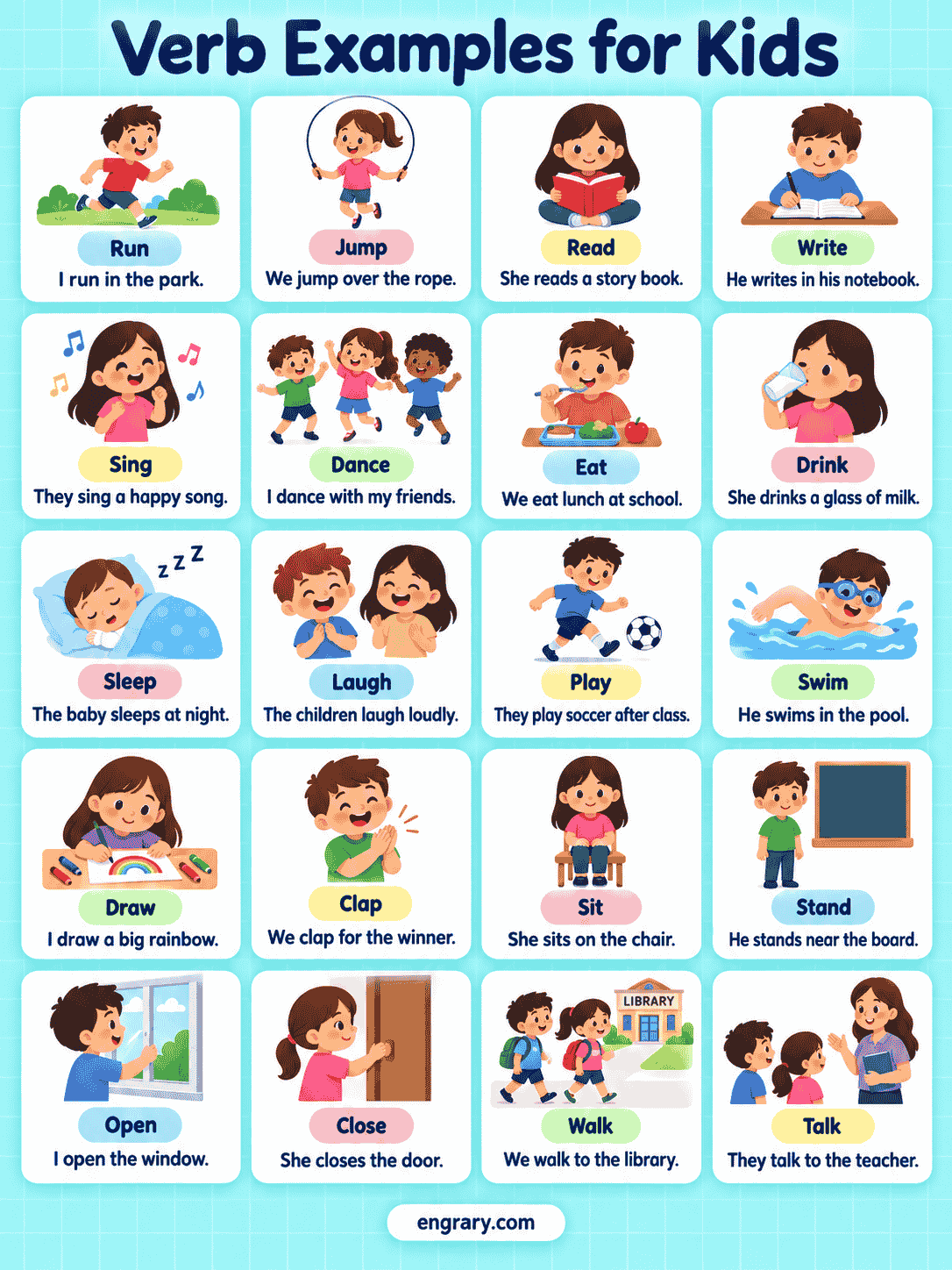
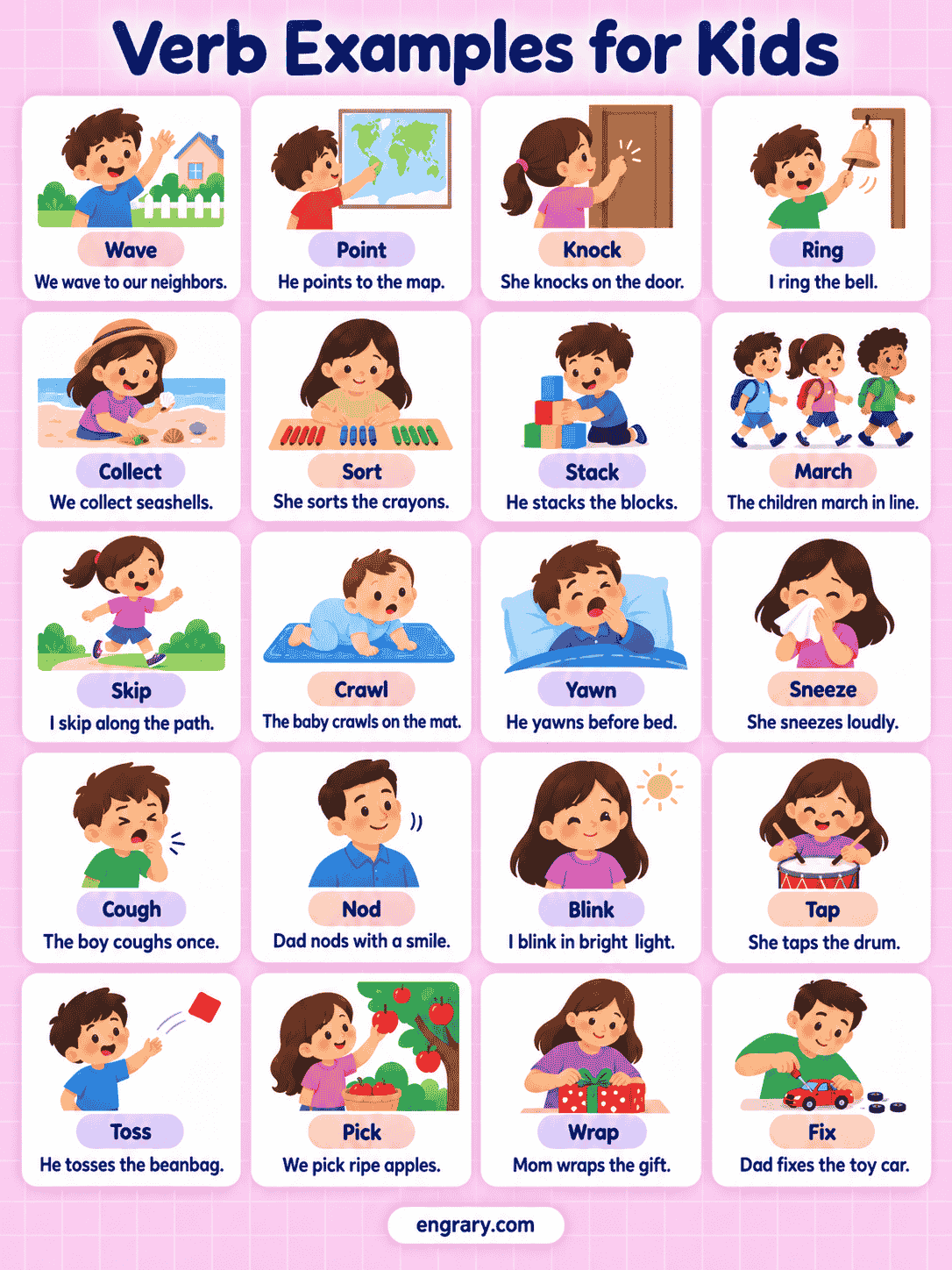
Here are some common verbs children hear and use every day.
Run
The boy runs fast.
Jump
The girl jumps over the rope.
Walk
We walk to school.
Eat
I eat breakfast in the morning.
Drink
She drinks water.
Sleep
The baby sleeps peacefully.
Read
Mia reads a story.
Write
Noah writes his name.
Draw
The children draw pictures.
Sing
We sing a song.
Dance
Ava dances happily.
Play
They play outside.
Laugh
The children laugh together.
Smile
She smiles at her friend.
Think
I think about the answer.
Know
He knows the answer.
Feel
I feel tired.
Make
We make a paper boat.
Open
Please open the door.
Close
She closes the window.
Verb Examples in Sentences
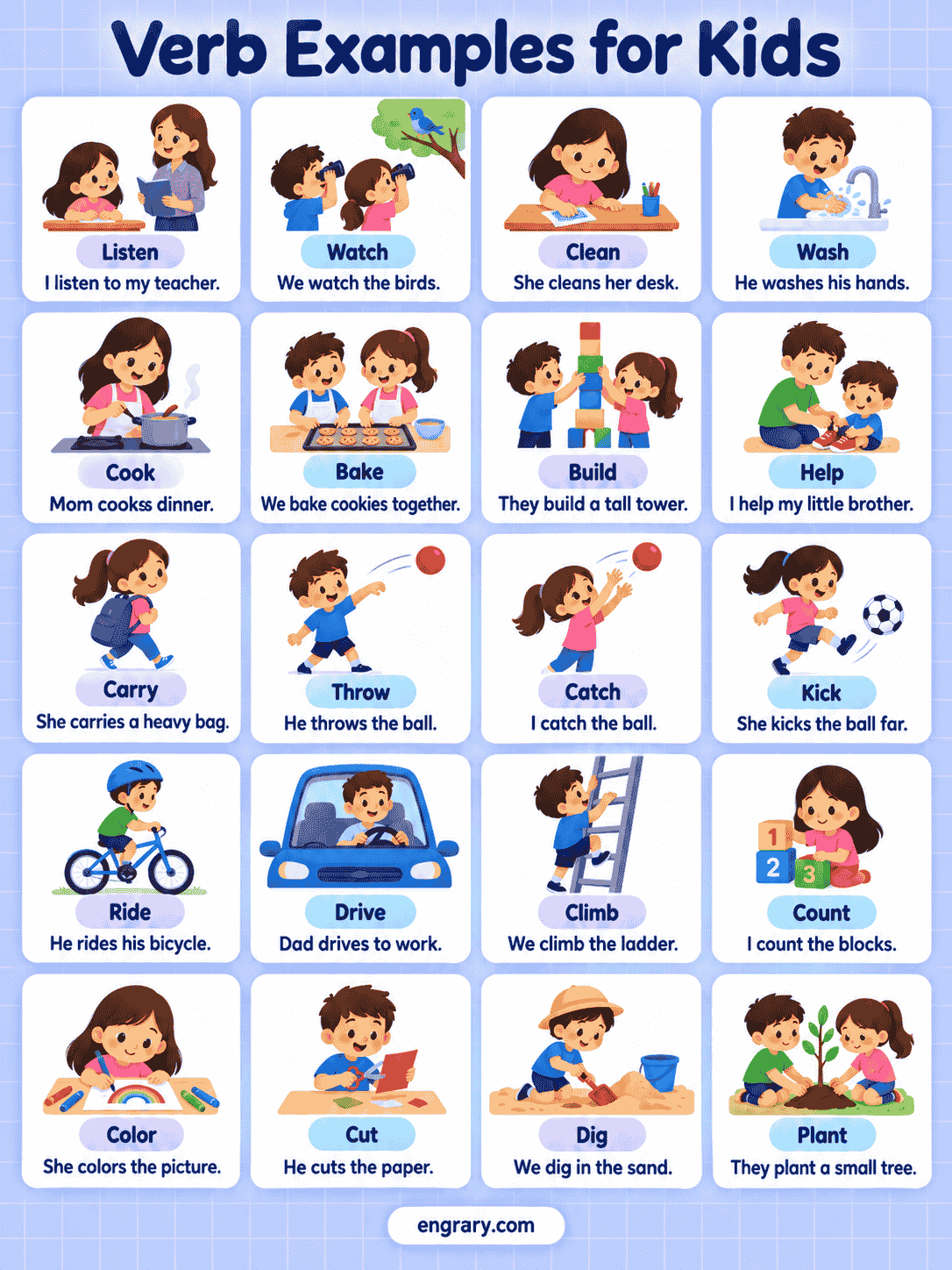
Seeing verbs inside sentences makes their job much clearer.
- The dog runs across the yard.
- Mia reads every evening.
- The baby sleeps in the crib.
- We play after school.
- Dad cooks dinner.
- The bird flies over the trees.
- She writes neatly.
- Noah draws a house.
- I know the answer.
- They laugh at the joke.
- The soup smells good.
- The sky looks bright.
- The children are playing football.
- Mia has finished her homework.
- He can swim well.
- We will visit Grandma tomorrow.
- The flowers smell fresh.
- She seems happy.
- They need more water.
- I remember your name.
These examples show that verbs can express actions, states, feelings, and helping functions.
Action Verb Examples for Kids
Action verbs show what someone or something does. The action can be physical or mental.
Common action verbs include:
- run
- jump
- swim
- climb
- throw
- catch
- kick
- read
- write
- draw
- build
- think
- imagine
- remember
- decide
Examples in sentences:
Noah runs quickly.
Ava jumps over the puddle.
The children swim in the pool.
Mia draws a flower.
We build a tower.
I think about the question.
She remembers the answer.
He decides what to choose.
Mental actions may not be visible, but words such as think, imagine, remember, and decide still work as verbs.
Linking Verb Examples for Kids
A linking verb connects the subject to a word or phrase that describes or identifies it. It does not usually show an action.
Common linking verbs include:
- am
- is
- are
- was
- were
- seem
- become
- feel
- look
- sound
- smell
- taste
- remain
- stay
- appear
Examples:
The sky is blue.
Mia seems tired.
The soup tastes salty.
The flowers smell fresh.
The music sounds beautiful.
He became captain.
The room stays quiet.
She appears calm.
In these sentences, the linking verb connects the subject with a description or identity.
Helping Verb Examples for Kids
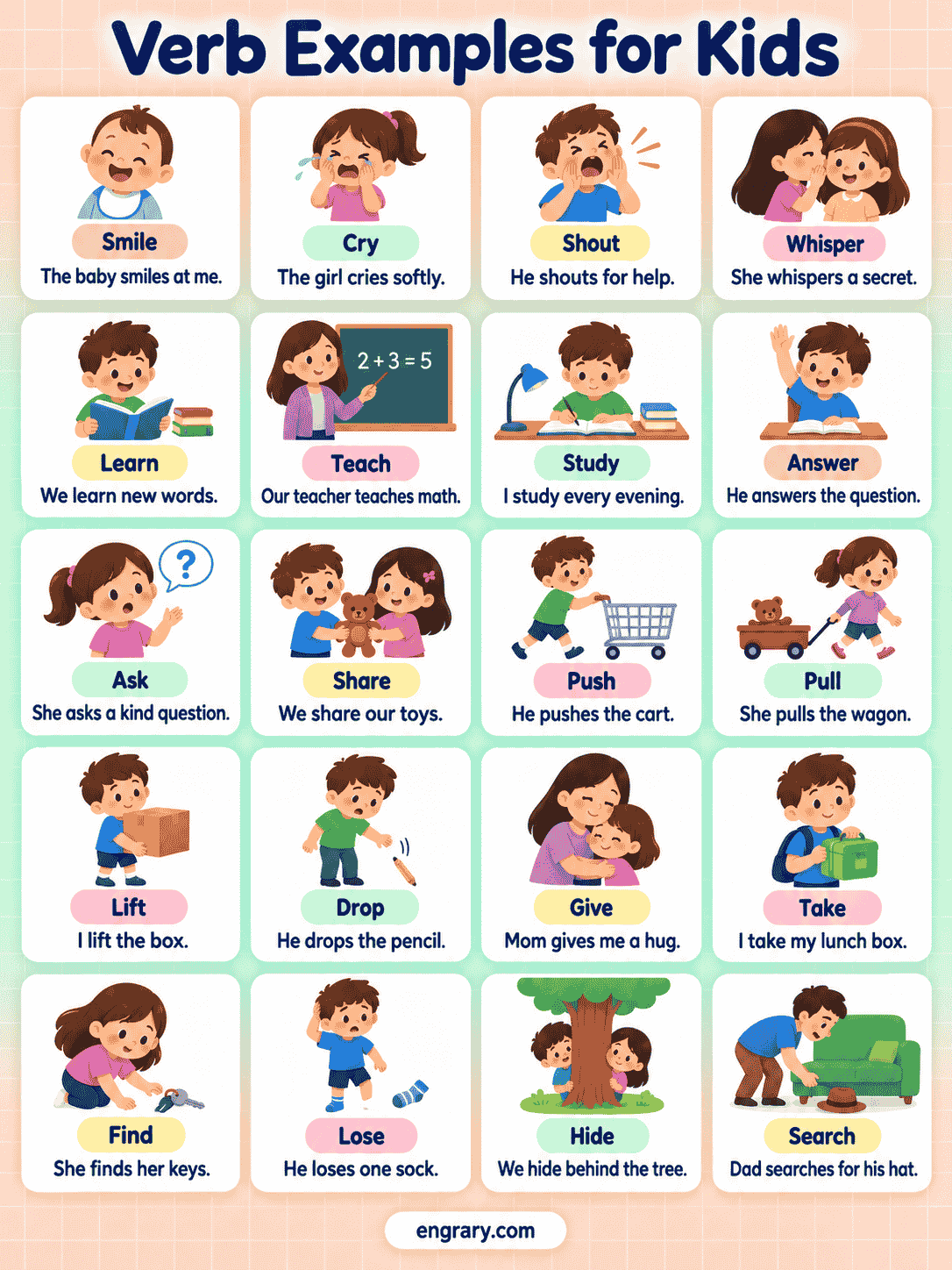
Helping verbs work with a main verb to form a verb phrase.
Common helping verbs include:
- am
- is
- are
- was
- were
- has
- have
- had
- can
- could
- will
- would
- shall
- should
- may
- might
- must
Examples:
She is reading.
They have finished.
He can swim.
We will play later.
Mia might come today.
You should listen carefully.
They were running outside.
I have seen that movie.
In each example, the helping verb works with the main verb.
Main Verb and Helping Verb Examples
A sentence can contain a helping verb and a main verb together.
| Sentence | Helping Verb | Main Verb |
|---|---|---|
| She is reading. | is | reading |
| They have finished. | have | finished |
| He can swim. | can | swim |
| We will play. | will | play |
| Mia might come. | might | come |
| They were running. | were | running |
| I have seen it. | have | seen |
The main verb carries the main meaning, while the helping verb supports it.
Being and State Verb Examples
Not every verb shows movement or action. Some verbs describe a state, feeling, need, thought, or condition.
Common state verbs include:
- be
- know
- like
- love
- want
- need
- believe
- understand
- prefer
- remember
Examples:
I know the answer.
She likes apples.
We need water.
They believe the story.
I understand the question.
He prefers juice.
She remembers my name.
These examples show why a verb should not be defined only as an action word.
Regular and Irregular Verb Examples
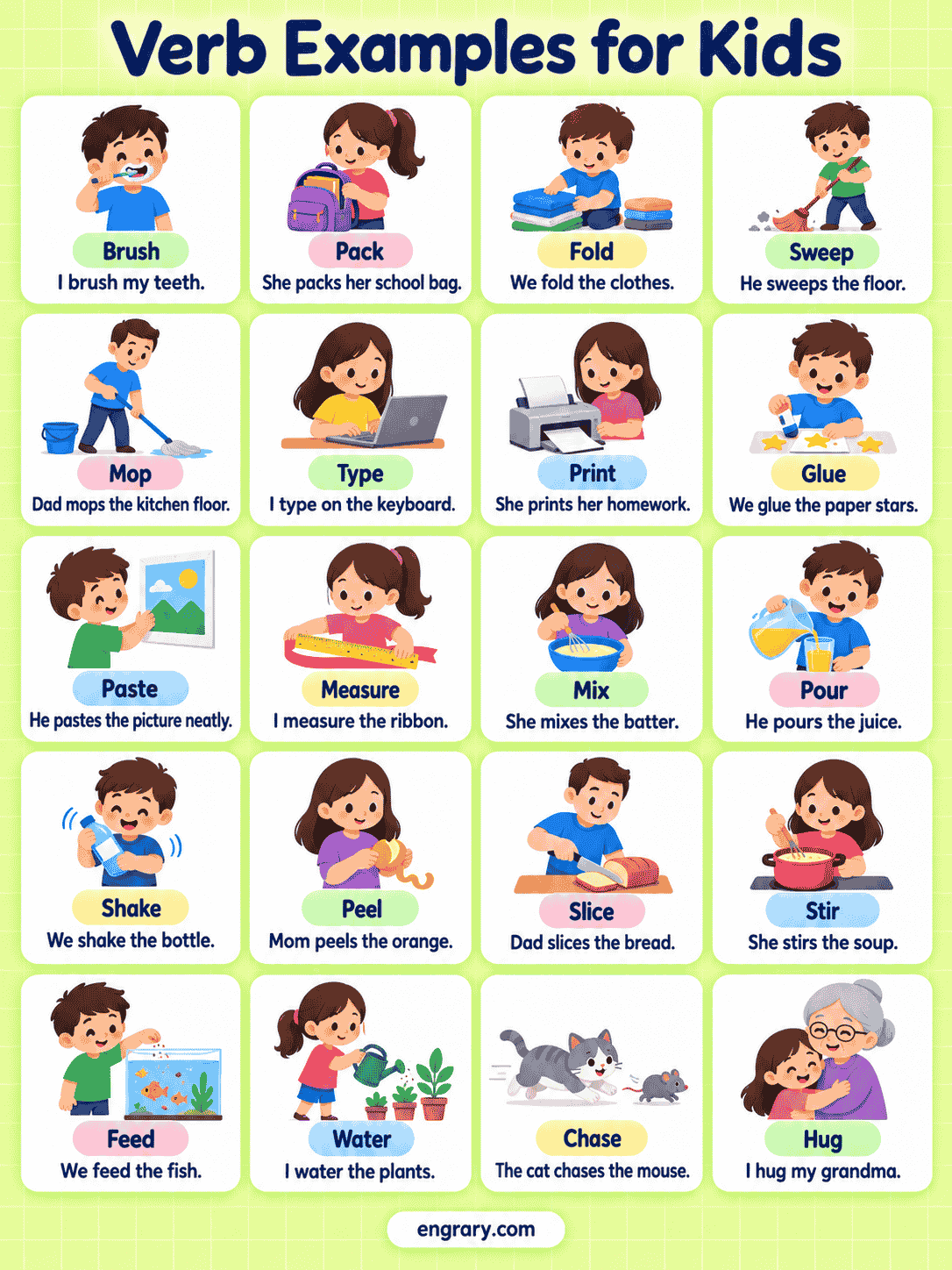
Some verbs form the past in a regular way, while others change differently.
| Regular Verb | Irregular Verb |
|---|---|
| play → played | go → went |
| walk → walked | eat → ate |
| jump → jumped | write → wrote |
| help → helped | see → saw |
| open → opened | take → took |
Regular verbs usually add -ed in the past.
Irregular verbs do not follow one fixed pattern, so their past forms need to be learned individually.
Verb Examples From Everyday Life
Children use verbs all day without always noticing them. Grouping verbs by familiar situations makes them easier to understand and remember.
At Home
Common home verbs include:
- eat
- drink
- cook
- wash
- clean
- sleep
- open
- close
- carry
- help
Examples:
Mom cooks dinner.
I wash my hands.
The baby sleeps.
Dad opens the window.
We clean the room.
At School
Common school verbs include:
- read
- write
- listen
- answer
- learn
- draw
- count
- ask
- study
- explain
Examples:
We read a story.
Mia writes neatly.
The students listen carefully.
Noah answers the question.
I study English.
On the Playground
Common playground verbs include:
- run
- jump
- climb
- swing
- throw
- catch
- kick
- chase
- slide
- play
Examples:
The children run outside.
Ava jumps over the rope.
Noah throws the ball.
Mia climbs the ladder.
They play together.
Thinking and Feeling
Some verbs describe thoughts, feelings, wants, or needs.
Examples include:
- think
- know
- remember
- believe
- like
- love
- want
- need
- feel
- hope
Examples:
I remember your name.
She likes music.
We hope for good weather.
He knows the answer.
They want some water.
How to Find the Verb in a Sentence
To find the verb, first look at the subject and ask what the sentence says about it.
If the subject is doing something, the action word is usually the verb.
The dog runs.
Here, runs tells what the dog does.
Some sentences use a linking verb instead.
The girl is happy.
Here, is connects girl with happy.
A sentence may also contain a helping verb and a main verb.
Mia is reading.
Here, is is the helping verb and reading is the main verb.
It helps to ask:
What is the subject doing?
or:
What does the sentence say the subject is, feels, seems, or becomes?
Common Verb Mistakes Kids Make
Some verb mistakes happen because children expect every verb to work in the same way.
| Mistake | Better Understanding |
|---|---|
| Every verb is an action word. | Some verbs show states, feelings, or relationships. |
| Is is always a helping verb. | It can also be a linking verb. |
| A sentence can have only one verb. | A helping verb and main verb can appear together. |
| Thinking words are not verbs. | Think, know, remember, and believe are verbs. |
| Every -ing word is a complete verb. | An -ing form often works with a helping verb. |
| Sense verbs are always linking verbs. | Their job depends on the sentence. |
Compare:
She smells the flower.
Here, smells shows an action.
The flower smells sweet.
Here, smells is a linking verb.
The same verb can therefore perform different jobs in different sentences.
FAQs
Ten easy examples are run, jump, read, write, eat, drink, sleep, play, sing, and draw.
Examples include The dog runs, Mia reads, The baby sleeps, We play outside, and She is happy.
No. Some verbs show states, feelings, thoughts, or relationships. Examples include know, like, need, seem, and is.
The main verb carries the main meaning, while a helping verb works with it. In She is reading, is is the helping verb and reading is the main verb.
Look for the word or verb phrase that tells what the subject does, is, feels, seems, or becomes.
You May Also Like



Leave a Comment