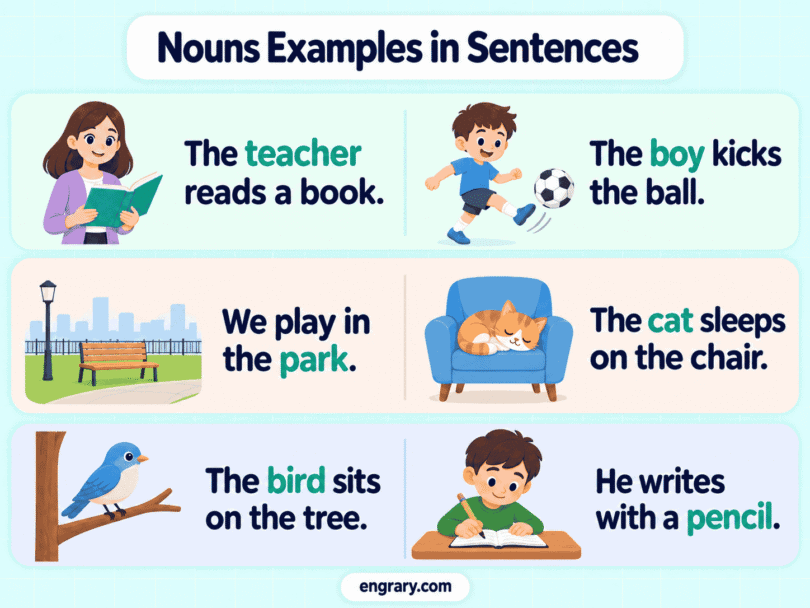
Nouns appear in almost every kind of English sentence because they name people, places, animals, things, ideas, feelings, and qualities. Learning to identify nouns in context helps children understand sentence meaning and recognize how different noun types work in real English.
You’ll see many noun examples in sentences, including common, proper, concrete, abstract, singular, plural, collective, possessive, countable, and uncountable nouns. In addition, the article shows nouns in different sentence roles, sentences with several nouns, and common mistakes learners should avoid.

What Is a Noun in a Sentence?
A noun is a word that names a person, place, animal, thing, idea, feeling, quality, or state.
For example:
The teacher opened the door.
We visited the library.
A dog barked outside.
Her kindness helped everyone.
In each sentence, the bold word functions as a noun because it names someone, somewhere, something, or an idea or quality.
Easy Noun Examples in Sentences
The following table shows easy noun examples in natural sentences.
| Sentence | Noun | Type |
|---|---|---|
| The teacher opened the book. | teacher | common, concrete |
| We visited the park. | park | common, concrete |
| A dog barked outside. | dog | common, concrete |
| Mia dropped her pencil. | pencil | common, concrete |
| Kindness matters. | kindness | abstract |
| The children laughed. | children | plural |
| Emma lives nearby. | Emma | proper |
| Our team won the game. | team | collective |
| The girl’s bag is blue. | girl’s | possessive |
| We need some rice. | rice | uncountable |
| Three books are on the desk. | books | plural, countable |
| The doctor entered the room. | doctor | common, concrete |
| London is a large city. | London | proper |
| His courage impressed the class. | courage | abstract |
| A rabbit crossed the road. | rabbit | common, concrete |
| The family ate dinner together. | family | collective |
| Sara bought an apple. | apple | countable |
| The room has new furniture. | furniture | uncountable |
| The teacher’s desk is near the window. | teacher’s | possessive |
| Two mice ran behind the cupboard. | mice | plural |
These examples show that nouns can appear in many forms and positions. Therefore, identifying a noun depends on what the word names and how it functions in the sentence.
Noun Examples in Sentences by What They Name
Nouns can be grouped according to what they name. For beginners, five useful groups are people, places, animals, things, and ideas or feelings.
People
Nouns for people can name occupations, relationships, roles, or individuals.
The teacher explained the lesson.
After lunch, a doctor checked the patient.
Three students entered the classroom.
My friend called after school.
Nearby, the farmer worked in the field.
A nurse opened the door.
The driver stopped the bus safely.
Several artists displayed their paintings.
Places
Place nouns name locations where people live, work, study, visit, or travel.
The children played in the park.
We visited the museum on Saturday.
Mia walked to the library after school.
At noon, the train stopped at the station.
Her family stayed at a hotel.
Tourists explored the city.
The children returned to the classroom.
Later, we walked along the beach.
Animals
Animal names function as nouns because they name living creatures.
A rabbit crossed the road.
The parrot sat on a branch.
Two horses stood near the fence.
An elephant drank water.
Near the door, the dog slept quietly.
Several birds flew over the lake.
The turtle moved slowly across the sand.
A butterfly landed on the flower.
Things
Thing nouns name objects that people can usually see, touch, carry, own, or use.
The book is on the desk.
Mia opened her bag.
Suddenly, the clock stopped.
He rode his bicycle home.
A camera was inside the box.
She placed the cup on the table.
The lamp is beside the bed.
A red ball rolled across the floor.
Ideas and Feelings
Nouns can also name ideas, emotions, qualities, and states.
Her kindness helped everyone.
Courage helped him speak.
Their friendship lasted for years.
Happiness filled the room.
His patience impressed the teacher.
The child felt great joy.
Her honesty earned everyone’s trust.
Despite the difficulty, they kept their hope.
These examples show that nouns do not only name physical objects. In addition, abstract nouns can name thoughts, emotions, qualities, and states.
Common Noun Examples in Sentences
A common noun gives a general name rather than a specific name.
The girl carried a bag.
A city can be crowded.
The teacher wrote on the board.
A river flowed beside the village.
The dog ran across the field.
The book fell from the table.
Several children waited outside.
The doctor spoke to the family.
Common nouns normally use lowercase letters unless they begin a sentence.
Proper Noun Examples in Sentences
A proper noun gives the specific name of a person, place, organization, day, month, or other unique subject.
Emma opened the door.
We visited London during the summer.
January is the first month of the year.
The Nile is a famous river.
My cousin lives in Canada.
They sailed across the Pacific Ocean.
Noah brought his notebook.
Our class visited Greenfield School.
Proper nouns normally begin with capital letters.
Concrete and Abstract Nouns in Sentences
Concrete nouns name things we can experience through the senses, while abstract nouns name ideas, feelings, qualities, or states.
| Concrete Noun Sentence | Abstract Noun Sentence |
|---|---|
| The apple fell from the table. | Her honesty impressed the teacher. |
| The dog barked loudly. | His courage surprised everyone. |
| A bell rang outside. | Their friendship remained strong. |
| The flower opened in the sun. | Hope helped the family continue. |
| The book is on the shelf. | Knowledge takes time to develop. |
| A child opened the gate. | Her patience helped the group. |
For example, apple is concrete because we can see and touch it. By contrast, honesty is abstract because it names a quality.
Singular and Plural Nouns in Sentences
A singular noun names one person, place, animal, thing, or idea. A plural noun usually names more than one.
| Singular Sentence | Plural Sentence |
|---|---|
| The cat is sleeping. | The cats are sleeping. |
| The child is reading. | The children are reading. |
| A box is on the floor. | The boxes are on the floor. |
| The city is busy. | The cities are busy. |
| One mouse ran away. | Two mice ran away. |
| The leaf is green. | The leaves are green. |
These pairs show how nouns change when the number changes. However, not every plural noun forms in the same way.
Collective Noun Examples in Sentences
A collective noun names a group of people, animals, or things as one unit.
The team won the match.
Our family ate dinner together.
A flock crossed the sky.
The audience applauded loudly.
A herd moved across the field.
The class listened quietly.
A large crowd gathered outside.
The group completed the project.
Collective nouns let one noun refer to an entire group.
Possessive Noun Examples in Sentences
A possessive noun shows ownership, relationship, or another connection.
The girl’s bag is blue.
The teacher’s desk is near the window.
The dog’s collar is red.
The parents’ car is outside.
The children’s toys are on the floor.
Mia borrowed her friend’s pencil.
The school’s library closes at four.
The bird’s wings were wet.
Apostrophe placement depends on the noun form, but detailed possessive rules belong to a separate grammar lesson.
Countable and Uncountable Nouns in Sentences
Countable nouns refer to separate units that can normally be counted directly. Uncountable nouns usually refer to masses, amounts, substances, concepts, or collections.
| Countable Sentence | Uncountable Sentence |
|---|---|
| I bought three apples. | We need some rice. |
| There are four chairs. | The room has new furniture. |
| She read two books. | She found useful information. |
| He has several coins. | He saved some money. |
| She asked three questions. | She gave useful advice. |
| We packed two suitcases. | We carried heavy luggage. |
Because countable nouns can take numbers directly, forms such as three apples are natural. By contrast, uncountable nouns usually use quantity expressions such as some rice or a piece of information.
Nouns in Different Sentence Roles
Nouns can perform several roles in a sentence. Therefore, a noun does not have to appear only as the subject.
| Sentence Role | Example |
|---|---|
| Subject | The dog barked. |
| Direct object | Mia opened the door. |
| Indirect object | Ava gave Noah a book. |
| Subject complement | Ava is a student. |
| Object of preposition | We walked through the park. |
In the first sentence, dog performs the subject role. Meanwhile, door functions as the direct object in the second sentence.
Sentences With More Than One Noun
A single sentence can contain several nouns.
The teacher gave the student a book.
Nouns: teacher, student, book
Emma visited the library with her friend.
Nouns: Emma, library, friend
The dog chased the ball across the garden.
Nouns: dog, ball, garden
A doctor spoke to the parent in the hospital.
Nouns: doctor, parent, hospital
The children carried their bags into the classroom.
Nouns: children, bags, classroom
These examples show that one sentence can include nouns with different meanings and functions.
Can a Noun Belong to More Than One Type?
Yes. Noun categories describe different grammatical features, so one noun can belong to several types at the same time.
For example, in:
The teacher opened the door.
teacher is:
- a common noun;
- a concrete noun;
- a countable noun;
- a singular noun;
- the subject of the sentence.
Similarly, London can be:
- a proper noun;
- a concrete noun;
- a singular noun.
In another example, happiness can be:
- a common noun;
- an abstract noun;
- usually an uncountable noun.
Therefore, noun categories are not separate boxes. Instead, different labels can describe different features of the same noun.
Common Mistakes With Nouns in Sentences
Learners sometimes misunderstand nouns because they apply one simple rule to every sentence.
| Mistake | Correct Understanding |
|---|---|
| Every sentence contains only one noun. | A sentence can contain several nouns. |
| A noun must always be the subject. | Nouns can perform several sentence roles. |
| Every noun is physical. | Abstract nouns name ideas, feelings, qualities, and states. |
| Proper nouns use lowercase letters. | Proper nouns normally begin with capital letters. |
| Every plural noun adds -s. | Some plural nouns form differently. |
| Advice can be written as “an advice.” | Advice is normally uncountable. |
For example, the sentence Emma visited the library with her friend contains three nouns: Emma, library, and friend.
Similarly, kindness is still a noun even though it names a quality rather than a physical object.
Another common mistake is assuming that a noun must be the subject. However, nouns can also function as objects, complements, or objects of prepositions.
FAQs
Examples include teacher in “The teacher opened the book,” park in “We visited the park,” Emma in “Emma lives nearby,” and kindness in “Kindness matters.”
Look for words that name people, places, animals, things, ideas, feelings, qualities, or states. For example, in “The dog chased the ball,” both dog and ball are nouns.
Yes. A sentence can contain several nouns. For instance, “The teacher gave the student a book” contains the nouns teacher, student, and book.
Yes. Nouns can function as subjects, direct objects, indirect objects, complements, or objects of prepositions. Therefore, their position and role can vary.
Sentences can contain common, proper, concrete, abstract, singular, plural, collective, possessive, countable, and uncountable nouns. One noun can also belong to several categories at the same time.
You May Also Like