Nouns and pronouns help us identify people, places, animals, things, and ideas without making sentences repetitive or unclear. Understanding the difference between them helps children choose the right words, build smoother sentences, and use subject and object forms correctly.
You’ll learn what nouns and pronouns are, how they differ, and how pronouns can refer to nouns or noun phrases. In addition, you’ll see noun-to-pronoun examples, sentence comparisons, subject and object forms, singular and plural matching, common pronoun types, and mistakes to avoid.

What Is a Noun?
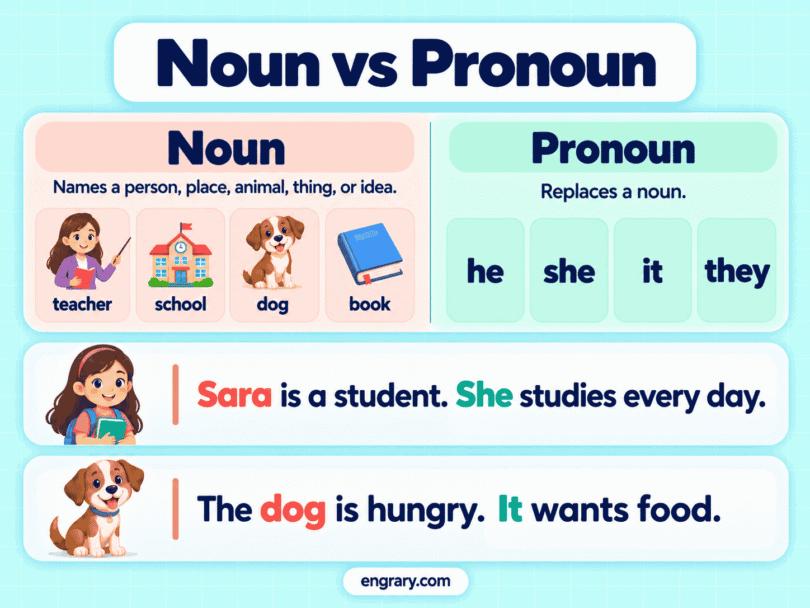
A noun is a word that names a person, place, animal, thing, idea, feeling, quality, or state.
Examples include:
- teacher
- Emma
- school
- dog
- book
- happiness
For example:
Emma opened the door.
The dog barked outside.
Her kindness helped everyone.
In these sentences, Emma, dog, and kindness are nouns because they name a person, an animal, and a quality.
What Is a Pronoun?
A pronoun commonly refers to or replaces a noun or noun phrase. As a result, writers do not need to repeat the same noun unnecessarily.
Common pronouns include:
- I
- you
- he
- she
- it
- we
- they
- me
- him
- her
- us
- them
For example:
Emma is reading. She likes the book.
Here, she refers to Emma.
Similarly:
The children are outside. They are playing.
In this example, they refers to the children.
Difference Between a Noun and a Pronoun
The main difference is simple:
A noun names.
A pronoun refers to or replaces.
| Feature | Noun | Pronoun |
|---|---|---|
| Main role | names a person, place, animal, thing, or idea | refers to or replaces a noun or noun phrase |
| Examples | Emma, teacher, dog, book | she, he, it, they |
| Can give a specific name? | yes | usually refers to an understood person or thing |
| Helps reduce repetition? | not by itself | often yes |
| Example | Emma opened the door. | She opened the door. |
For example, Emma directly names a person. By contrast, she refers to Emma after the reader already knows who Emma is.
Therefore, nouns usually establish the reference, while pronouns often continue that reference.
Easy Noun to Pronoun Examples
The following table shows common nouns or noun phrases and pronouns that can refer to them in suitable contexts.
| Noun or Noun Phrase | Pronoun |
|---|---|
| Emma | she |
| Noah | he |
| the dog | it |
| the children | they |
| my parents | they |
| Emma and Noah | they |
| Emma and I | we |
| the books | they |
| the bicycle | it |
| Mia and you | you |
| the students | they |
| the baby | he / she / they, depending on context |
| the teacher | he / she / they, depending on context |
Pronoun choice depends on meaning and context.
For example, the teacher does not always match one fixed pronoun. Depending on the person being discussed, the correct pronoun might be he, she, or they.
Noun and Pronoun Examples in Sentences
Pronouns often make sentences smoother by preventing repeated nouns.
Compare:
Emma is reading. Emma likes the book.
Better:
Emma is reading. She likes the book.
Another example:
The dog is hungry. The dog is barking.
Better:
The dog is hungry. It is barking.
Similarly:
The children are outside. The children are playing.
Better:
The children are outside. They are playing.
A longer example also shows the difference clearly:
Mia and I went to the library. Mia and I borrowed two books.
Better:
Mia and I went to the library. We borrowed two books.
In each case, the pronoun keeps the meaning while reducing unnecessary repetition.
Nouns and Pronouns as Subjects
A noun can act as the subject of a sentence. Likewise, a subject pronoun can fill the subject position when the reference is clear.
Common subject pronouns are:
I, you, he, she, it, we, they
| Noun as Subject | Subject Pronoun |
|---|---|
| Emma | she |
| Noah | he |
| the dog | it |
| the children | they |
| Mia and I | we |
| Noah and Emma | they |
Compare:
Emma runs quickly.
She runs quickly.
Another example:
The children are reading.
They are reading.
Similarly:
The dog slept outside.
It slept outside.
Because the noun and pronoun occupy the subject position, the pronoun must use a subject form.
Nouns and Pronouns as Objects
Nouns can also appear as objects. When a pronoun fills the same position, English usually requires an object pronoun.
Common object pronouns are:
me, you, him, her, it, us, them
| Noun as Object | Object Pronoun |
|---|---|
| Emma | her |
| Noah | him |
| the dog | it |
| the children | them |
| Noah and me | us |
Compare:
I called Emma.
I called her.
Another example:
The teacher helped the children.
The teacher helped them.
Likewise:
Mia invited Noah and me.
Mia invited us.
This distinction explains why subject and object forms cannot always be used interchangeably.
Correct:
She called me.
Correct:
I called her.
Incorrect:
Her called me.
Incorrect:
I called she.
Singular and Plural Noun-Pronoun Matching
Pronouns usually match the noun or noun phrase they refer to in number.
| Noun or Noun Phrase | Matching Pronoun |
|---|---|
| the boy | he |
| the girl | she |
| the bicycle | it |
| the students | they |
| Emma and Noah | they |
| Emma and I | we |
| Mia and you | you |
| the books | they |
For example:
The boy is running. He is late.
The girl opened the box. She smiled.
Several students arrived. They sat down.
Emma and Noah studied together. They finished early.
Meanwhile, Emma and I studied in the library. We finished our work.
The pronoun should match the intended reference clearly.
Why Do We Use Pronouns Instead of Repeating Nouns?
Pronouns help reduce unnecessary repetition and make sentences sound more natural.
Compare:
Mia opened Mia’s bag because Mia needed Mia’s pencil.
This sentence is understandable, but it sounds repetitive.
A smoother version is:
Mia opened her bag because she needed her pencil.
Another example:
Noah found Noah’s book and Noah put Noah’s book on the desk.
Better:
Noah found his book and put it on the desk.
Therefore, pronouns can make writing:
- smoother;
- less repetitive;
- more natural;
- easier to follow.
However, pronouns should only replace nouns when their reference remains clear.
When Is a Noun Clearer Than a Pronoun?
Pronouns do not always improve a sentence. Sometimes repeating a noun makes the meaning clearer.
Consider:
Emma spoke to Mia because she was upset.
Who was upset?
The pronoun she could refer to Emma or Mia.
If Mia was upset, write:
Emma spoke to Mia because Mia was upset.
If Emma was upset, write:
Emma spoke to Mia because Emma was upset.
Another example:
The teacher spoke to the parent after she arrived.
The pronoun she may be unclear because both people could fit the reference.
Therefore, the best rule is:
Use a pronoun when the reference is clear. Use or repeat a noun when the pronoun could cause confusion.
Common Types of Pronouns
Pronouns belong to several groups. However, this comparison only needs a brief overview.
| Pronoun Type | Examples |
|---|---|
| subject personal | I, you, he, she, it, we, they |
| object personal | me, you, him, her, it, us, them |
| possessive | mine, yours, his, hers, ours, theirs |
| reflexive | myself, yourself, himself, herself, ourselves, themselves |
| demonstrative | this, that, these, those |
| interrogative | who, what, which |
| indefinite | someone, anyone, everyone, something |
For example:
She called me.
Subject personal pronoun
The book is hers.
Possessive pronoun
He fixed the bike himself.
Reflexive pronoun
Who called you?
Interrogative pronoun
In addition, some words can belong to different grammatical categories depending on how they function in a sentence.
Nouns and Pronouns in the Same Sentence
Nouns and pronouns often work together in the same sentence.
Emma said she was tired.
The dog wagged its tail.
My parents said they would come.
The teacher helped us.
Noah said he had finished his homework.
The children brought their books, and they sat down.
Usually, the noun first establishes who or what the sentence refers to. Afterward, the pronoun can continue that reference without repeating the noun.
This pattern is common in both speaking and writing.
Common Noun vs. Pronoun Mistakes
Noun-pronoun mistakes often involve unnecessary repetition, incorrect subject or object forms, unclear references, or agreement problems.
| Incorrect or Weak | Better Form | Reason |
|---|---|---|
| Emma said Emma was tired. | Emma said she was tired. | pronoun reduces repetition |
| Me went to school. | I went to school. | subject requires I |
| The teacher helped I. | The teacher helped me. | object requires me |
| The boys finished his work. | The boys finished their work. | plural reference needs matching form |
| The dog wagged their tail. | The dog wagged its tail. | intended reference is singular |
| Emma spoke to Mia because she was upset. | Clarify who was upset. | pronoun reference is unclear |
For example:
Incorrect:
Me went to school.
Correct:
I went to school.
By contrast:
Incorrect:
The teacher helped I.
Correct:
The teacher helped me.
Another mistake occurs when a pronoun creates ambiguity.
Unclear:
Noah spoke to Liam because he was worried.
Since he could refer to Noah or Liam, repeating the correct noun may make the sentence clearer.
FAQs
A noun names a person, place, animal, thing, or idea, while a pronoun commonly refers to or replaces a noun or noun phrase. For example, Emma is a noun, while she can refer to Emma.
Noun examples include teacher, Emma, dog, school, book, and happiness. Pronoun examples include I, you, he, she, it, we, they, me, him, her, us, and them.
A pronoun can refer to a noun after the reader understands the reference. For example, Emma is reading. Emma likes the book can become Emma is reading. She likes the book.
Subject pronouns perform the subject role, as in She called me. Object pronouns perform an object role, as in I called her. Common subject forms include I, he, she, we, they, while common object forms include me, him, her, us, them.
Use a noun when a pronoun would make the meaning unclear. For example, Emma spoke to Mia because she was upset is ambiguous, so repeating Emma or Mia can clarify who was upset.
You May Also Like